

Sāṃkhya: Prakṛti; Puruṣa; Causation; Liberation.
Official Syllabus: Paper I, Section B, Unit 16
The whole of Sāṃkhya — its causation, its Prakṛti, its evolution and its Puruṣa — exists for one practical end: to free us from suffering. Sāṃkhya’s diagnosis is striking. Suffering comes from a mistake of identity: the pure, ever-free witness (Puruṣa) confuses itself with the body, mind, ego and intellect, which belong to Prakṛti (aviveka, non-discrimination). The cure is not action, ritual or devotion but discriminating knowledge (vivekakhyāti) — the direct realisation “I am not this; nothing is mine”. Liberation is kaivalya, “isolation”: the self resting alone in its own nature, beyond all pain — and also beyond all pleasure and bliss. Most strikingly, Īśvarakṛṣṇa says that Puruṣa was never really bound at all: “no one is bound, no one is released, no one transmigrates; it is Prakṛti that is bound and released.” This article explains the threefold suffering, bondage, the path and the state of liberation, embodied and disembodied freedom, Sāṃkhya’s liberation without God, and the criticisms of this austere ideal.
In simple words
A man dreams that he is lost in a burning forest. He runs, sweats and screams. Then he wakes up — and realises he was in his bed all along. Nothing had to be done to the forest; nothing new was added to him; he simply saw that he was never there. Sāṃkhya’s liberation is like this waking: the self does not escape from Prakṛti; it recognises that it was never caught.
Context & Problem
The Starting Point: Suffering
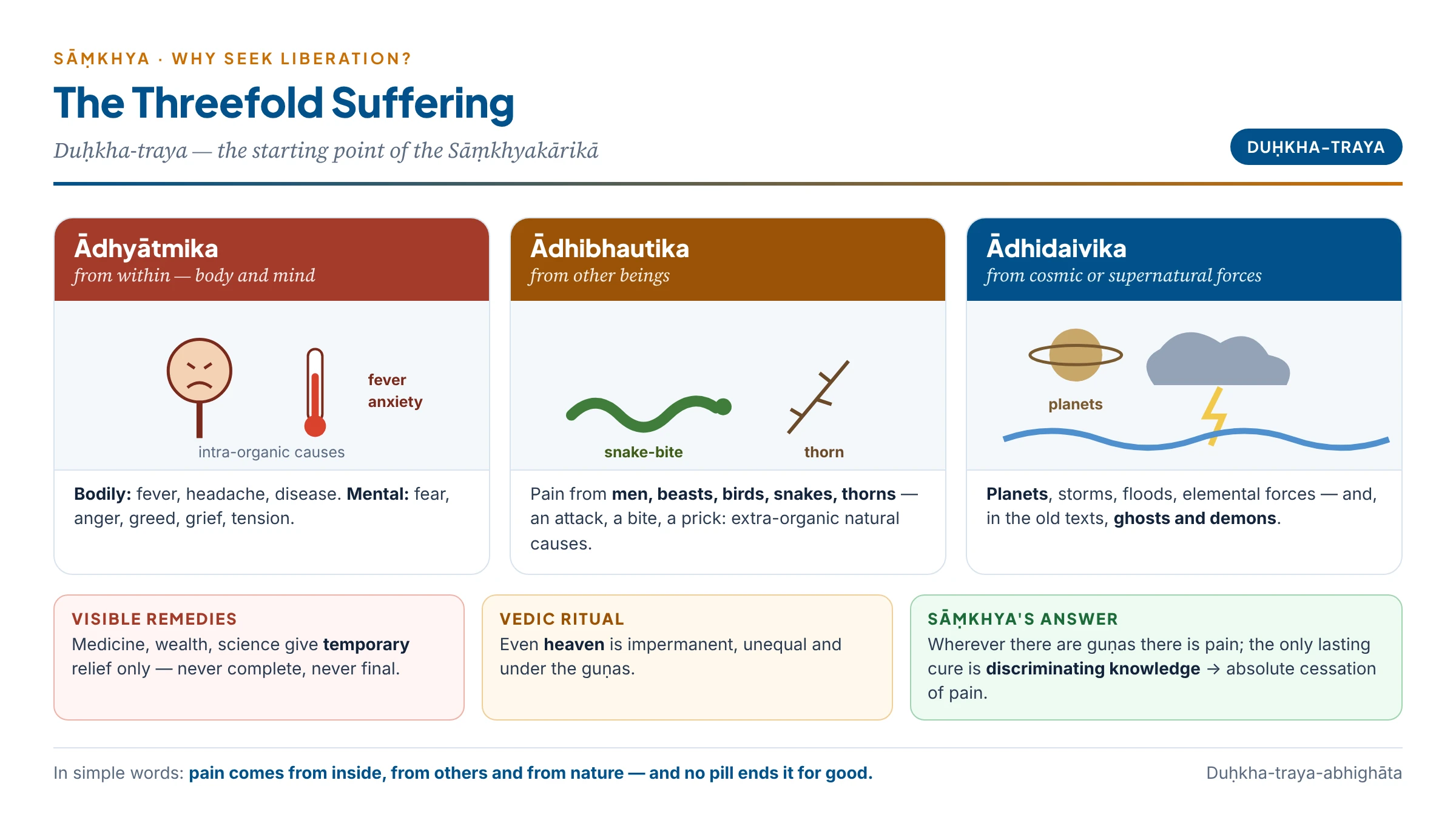
- Why philosophy at all? The Kārikā opens by saying that inquiry begins because human beings are struck by threefold suffering (duḥkha-traya) and want to be rid of it.
- The three kinds of suffering.
- Ādhyātmika — from within (intra-organic, psycho-physical causes). Bodily pain such as fever and headache, and mental pain such as fear, anger, greed, tension and grief.
- Ādhibhautika — from other beings (extra-organic natural causes). Pain inflicted by men, beasts, birds, snakes and thorns — murder, snake-bite, the prick of a thorn.
- Ādhidaivika — from supernatural or cosmic causes. Pain caused by planets, natural calamities and elemental forces, and (as tradition says) by ghosts and demons.
- The ordinary remedies fail.
- Visible means — medicine, wealth, comfort, and today all the arts and blessings of modern science — give only temporary relief or short-lived pleasures; they do not end suffering completely or finally.
- Vedic ritual is no better: its rewards, even heaven, are impermanent, unequal and mixed with impurity.
- Why suffering is everywhere. Wherever there are guṇas, there is pain. Even pleasures lead to pain, because they are mixed with it, are temporary and create craving. Even life in heaven is subject to the guṇas. While we live in this frail body, decay and death cannot be evaded.
- So the realistic goal. Since we cannot have pleasure without pain, the rational ideal is not more pleasure but freedom from pain — the absolute and complete cessation of suffering without return. This is liberation (mukti, apavarga), the highest end of life (puruṣārtha, summum bonum).
Core Doctrine
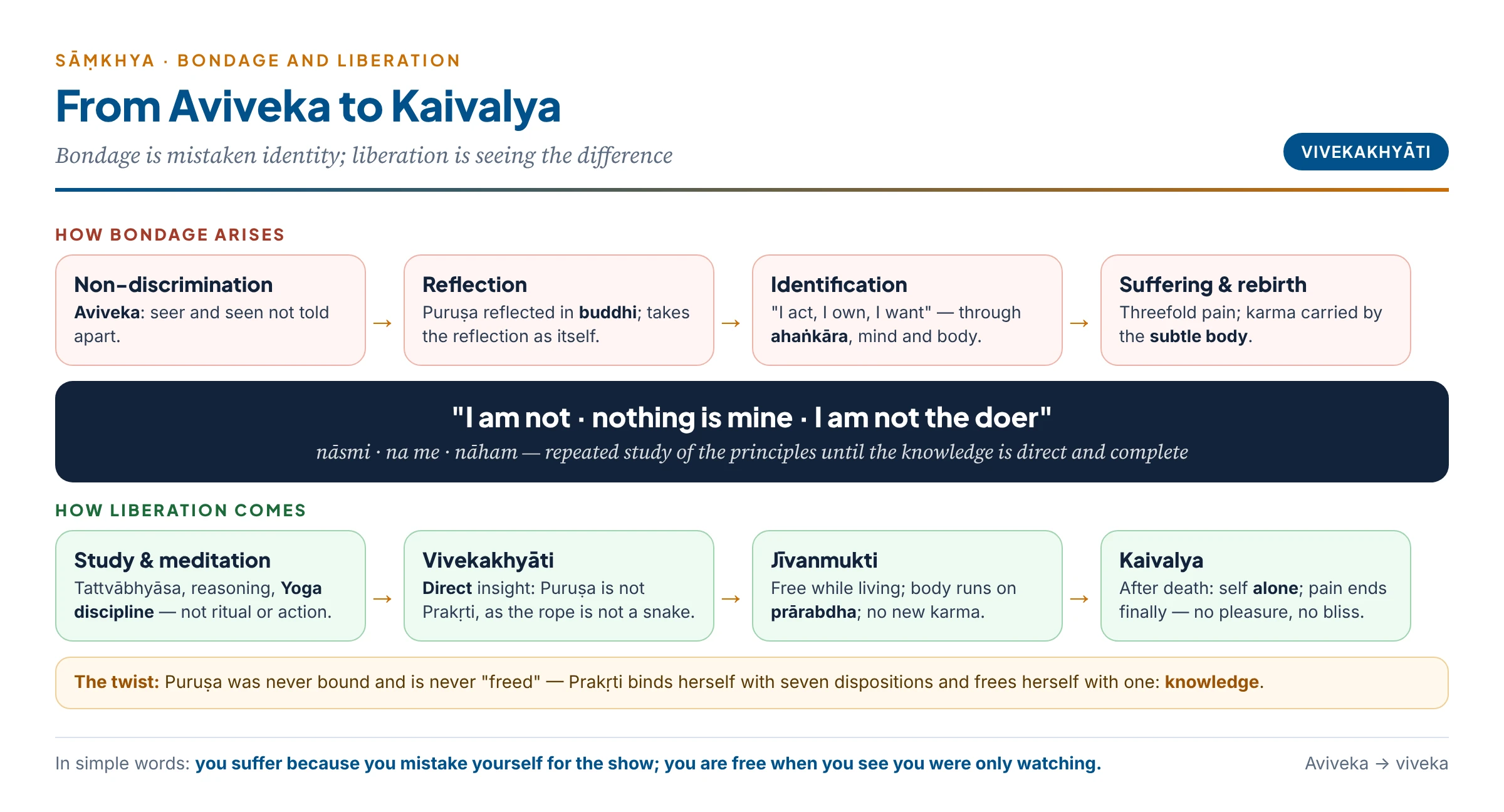
1. What Is Bondage?
- Puruṣa is free by nature. Puruṣa is pure, eternal consciousness, beyond space and time, beyond merit and demerit, untouched by the guṇas — “unattached” by its very nature. Really it is above both bondage and liberation.
- The mistake (aviveka). Through ignorance — the failure to discriminate (aviveka) between self and not-self — Puruṣa identifies itself with what belongs to Prakṛti:
- With buddhi. Puruṣa is reflected in buddhi and mistakes this reflection for itself.
- With ahaṅkāra. Through the ego it takes itself to be an agent of action, the owner of possessions and the slave of desires.
- With manas, the senses and the body. It becomes, as it were, somebody — with a name and a particular “combination of talent, temperament and character” — a material self, a social self, a desiring self, a thinking self. All these are not-self.
- How the borrowed feelings arise. Pleasure and pain really belong to buddhi and manas. But the self, identifying with them, feels happy or unhappy when they are so —
- as a father feels fortunate or unfortunate because of his beloved son’s good or bad luck;
- as a master feels insulted by an insult to his servant.
- The core formula. The seer (draṣṭā) wrongly identifies itself with the seen (dṛśya). This non-discrimination is the cause of all our troubles.
- Who is really bound? Strictly, it is the ego, not Puruṣa, that is bound. Īśvarakṛṣṇa says that Prakṛti binds herself by her own seven dispositions — virtue, vice, ignorance, detachment, attachment, power and weakness — and frees herself by one — knowledge.
In simple words
Watch someone engrossed in a cricket match on television. When his team loses, he is miserable; when it wins, he is overjoyed — though nothing has happened to him. He has “become” the team. Sāṃkhya says Puruṣa is like this fan: it borrows the joys and sorrows of the body and mind it watches. Bondage is this over-identification; liberation is remembering, “That is the match; I am the one watching.”
2. “The Self Is Neither Bound nor Liberated, nor Does It Transmigrate”
“Therefore no one is bound, no one is released, and no one transmigrates. It is Prakṛti, resting in its many forms, that transmigrates, is bound and is released.” — Īśvarakṛṣṇa, Sāṃkhyakārikā
- What the statement means.
- Puruṣa is never bound. Bondage is not a real condition of the self but an appearance due to non-discrimination.
- So Puruṣa is never “liberated”. Liberation is not something that happens to the self — it only realises that it was never bound.
- Transmigration belongs to the subtle body. It is the subtle body — buddhi, ahaṅkāra, the organs and the tanmātras — that carries karma and passes from birth to birth.
- Bondage and liberation belong to Prakṛti in its manifold forms — that is, to the ego and the subtle body.
- Why Sāṃkhya must say this.
- If bondage were real, it could never end. What is real cannot be destroyed (satkāryavāda): “if Puruṣa were really bound, it could not be liberated even after a hundred births”. Real bondage is indestructible; only an apparent bondage can be removed by knowledge.
- Puruṣa is changeless. To be bound and then freed would be to change; but Puruṣa does not change.
- Liberation is not a new production. If liberation were a new state produced in time, it would — like every product — be impermanent. So it must be the recognition of what always was. In this sense the doctrine fits Sāṃkhya’s satkāryavāda: nothing new comes into being in liberation.
- Evaluation of the statement.
- Strength — consistency. It follows strictly from Puruṣa’s nature as unchanging, inactive and untouched by the guṇas.
- Strength — a deep insight. Freedom is not won by adding anything to the self; it is the self’s own nature, uncovered.
- Difficulty — who seeks freedom? If Puruṣa is not bound, and Prakṛti is unconscious, who suffers, who strives and who is freed? An unconscious ego “suffering” pain is hard to make sense of; the Jainas, Nyāya and Mīmāṃsā all make the conscious self the subject of pleasure and pain.
- Difficulty — bondage becomes unreal. If bondage and liberation are only “phenomenal”, Sāṃkhya moves close to Advaita. Gauḍapāda, Śaṅkara’s teacher’s teacher, says in almost the same words that “there is no bondage, no one striving, no seeker of liberation, no one liberated — this is the highest truth”.
- Difficulty — Prakṛti becomes relative. Prakṛti “vanishes” for the Puruṣa who has seen her but continues for others. Then Prakṛti looks less like an absolute, independent reality and more like avidyā (Article 6).
3. The Path: Liberation by Knowledge Alone
- Not by action (karma-mārga). Actions — good, bad or indifferent — are functions of the guṇas and lead to bondage, not freedom. Good actions may lead to heaven, bad ones to hell; but heaven and hell, like this world, are subject to pain.
- Knowledge is the cure because ignorance is the disease. Since bondage is due to ignorance (non-discrimination), only knowledge (discrimination) can remove it. Knowledge leads to liberation; its opposite to bondage.
- What must be known — vivekakhyāti. The discriminating knowledge (viveka-jñāna, vivekakhyāti) that Puruṣa is distinct from Prakṛti and all its products — that actions and their fruits, merit and demerit, desires, pleasure and pain all belong to the not-self.
- The realisation in three phrases. By repeated study of the principles (tattvābhyāsa) arises the pure, complete knowledge: “I am not (the not-self); nothing is mine; I am not the doer” (nāsmi, na me, nāham). When constantly meditated upon, it becomes pure, free from error, absolute.
- It must be direct, not merely intellectual. I now have a direct, undoubted perception that I am this body and mind. Only an equally direct knowledge can cancel it — as the illusion of a snake in a rope is removed not by an argument but by seeing the rope. So a long course of spiritual training — study, reasoning and constant contemplation — is needed.
- Yoga supplies the method. Sāṃkhya stresses knowledge; Yoga supplies the practical discipline — the eightfold path and the cessation of the mind’s modifications — by which this knowledge becomes a lived realisation.
- Prakṛti helps. Buddhi, the subtlest product of Prakṛti, is what finally presents the subtle difference between Puruṣa and Prakṛti. Prakṛti, which bound the self through its many forms, also serves its liberation.
4. The Dancer Who Leaves the Stage
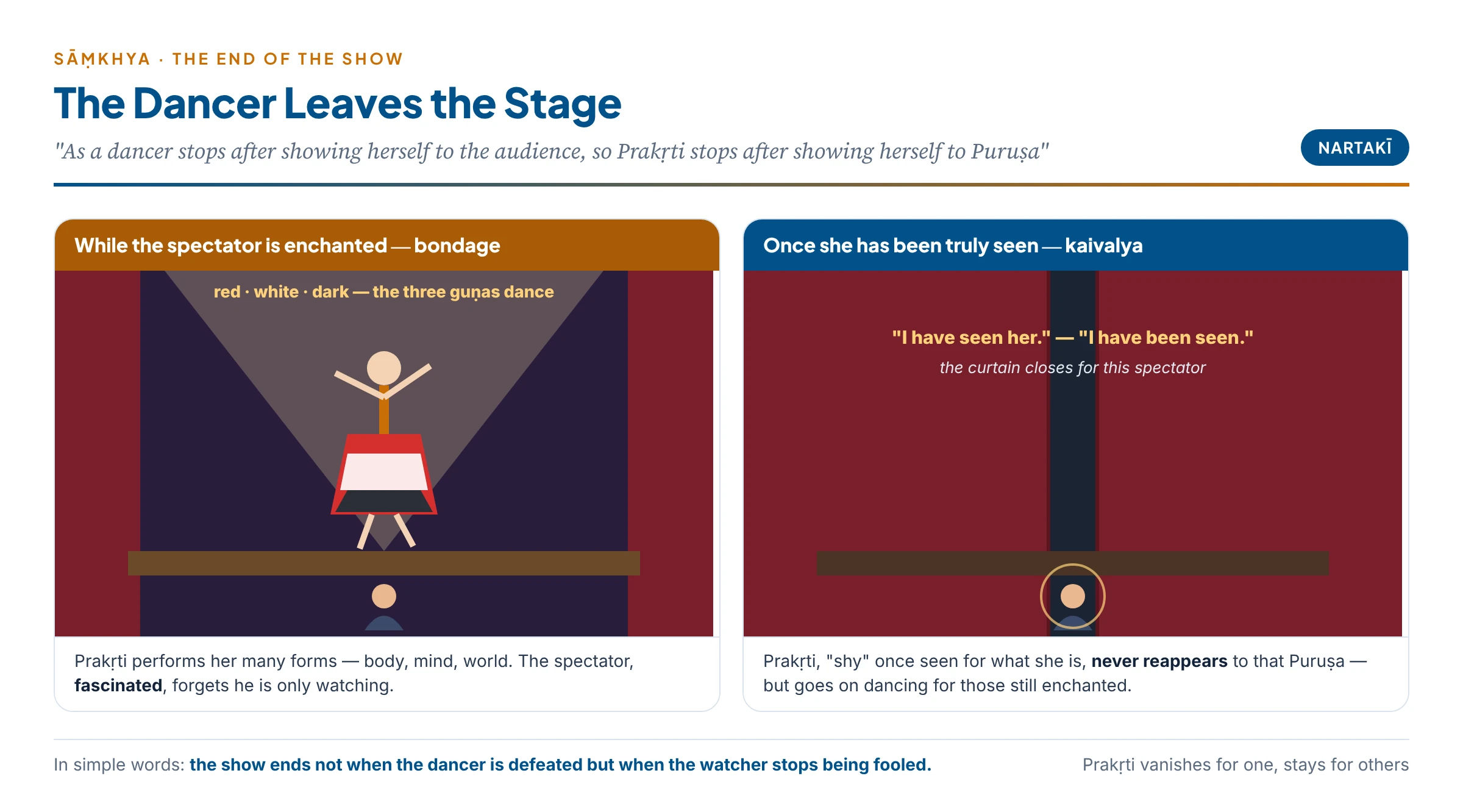
- The image. “As a dancer stops dancing after she has shown herself to the audience, so Prakṛti stops after she has shown herself to Puruṣa.“
- The shy Prakṛti. “Nothing is more modest than Prakṛti”: once she knows she has been seen for what she is, she never again appears before that Puruṣa.
- Two sides of the end. One says, “I have seen her“, and becomes indifferent; the other says, “I have been seen“, and ceases. Though they are still near each other, there is no longer any motive for creation.
- The selfless servant. Generous Prakṛti, full of qualities, serves the indifferent Puruṣa in every way, seeking nothing for herself — like a devoted helper whose help is not even acknowledged.
- For others she goes on. Prakṛti withdraws only for the Puruṣa that has seen her; for other Puruṣas, still undiscriminating, she continues her dance.
In simple words
A good magician performs a trick again and again. The audience gasps every time — until one spectator sees how it is done. For that spectator the magic is over: the same movements no longer enchant him, though the rest of the hall still gasps. Sāṃkhya’s liberated Puruṣa is this spectator; Prakṛti’s “dance” no longer has any hold on it.
5. Liberation in Life and after Death
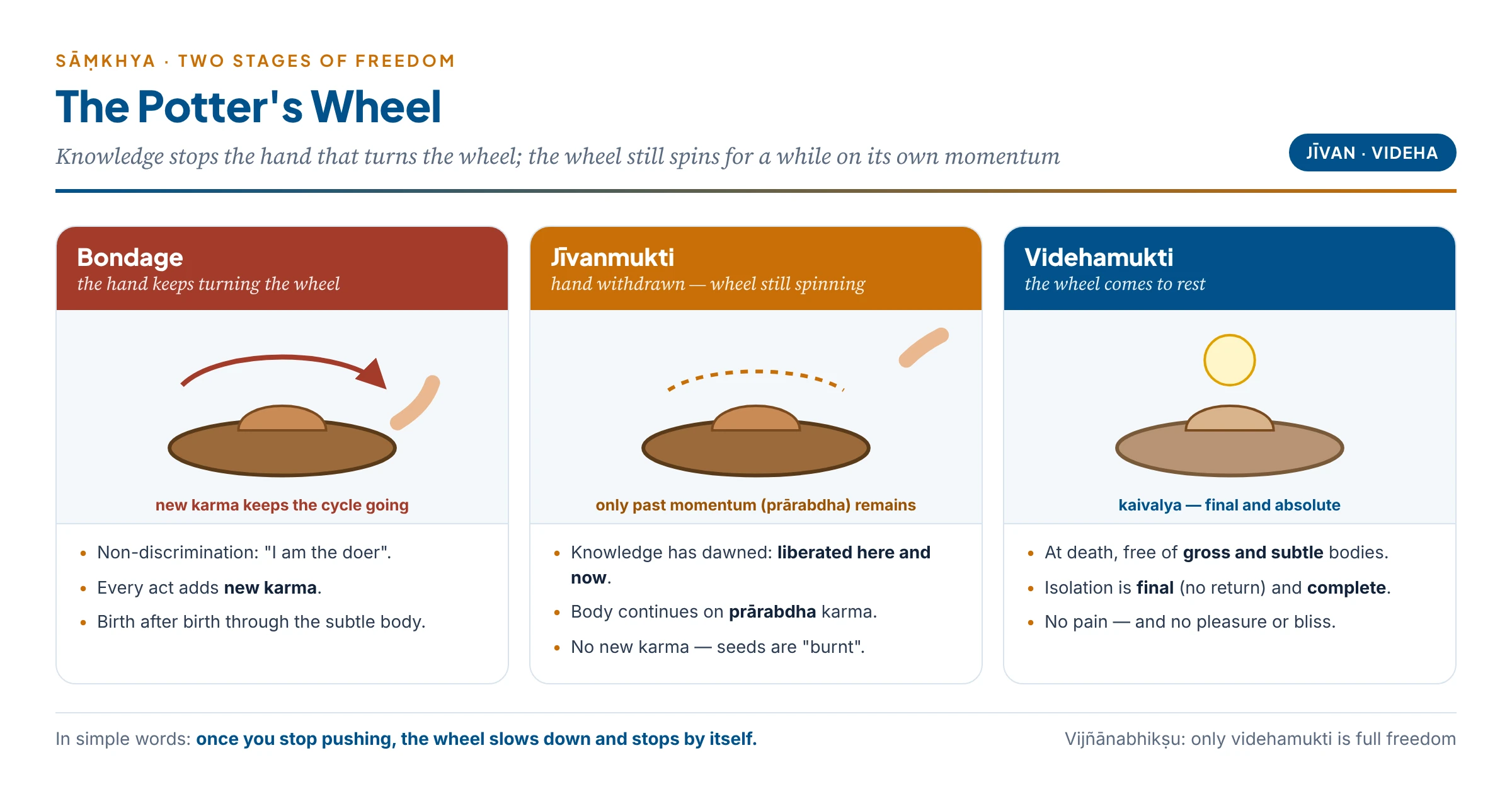
- Jīvanmukti — liberation while living. The moment discriminating knowledge dawns, the person is liberated here and now, though still embodied.
- Why the body continues. The body goes on because of the momentum of past karma that has already begun to bear fruit (prārabdha).
- The potter’s wheel. As a potter’s wheel goes on spinning for a while after the potter has taken his hand away, so the body continues for a time after knowledge.
- No new karma. The liberated sage feels no association with the body; virtue and vice lose their causal power, like burnt seeds that cannot sprout. No new karma accumulates.
- Videhamukti — liberation after death. When the body falls, the separation becomes complete: Puruṣa is freed from both the gross and the subtle body. Its isolation is now final (it does not return) and absolute (it is complete).
- Disagreements. Vijñānabhikṣu holds that only videhamukti is real liberation, since the self cannot be wholly free of bodily and mental influences while embodied; Rāmānuja and some later writers also deny jīvanmukti. But all Sāṃkhyas agree that liberation is the complete destruction of the threefold suffering.
6. The State of Liberation: Kaivalya
- Kaivalya means “aloneness”. From kevala, “alone”: Puruṣa rests in itself, as pure consciousness, isolated from Prakṛti and all its products.
- A return to its own nature. Nothing new is added; no change occurs in Puruṣa; it does not become more perfect. Liberation is not a future event in time — if it were, it would be governed by time, space and causality and could be lost. It is the clear recognition of the self as eternally free.
- No pain — and no pleasure, no bliss.
- Pleasure is relative to pain; where there is no pain there can be no pleasure.
- Pleasure and bliss are products of sattva, a guṇa of Prakṛti; liberation is beyond all guṇas.
- So Sāṃkhya’s liberation is the negative state of the absolute cessation of pain — unlike Advaita’s bliss (ānanda).
- The witness at rest. In kaivalya the self ceases to be affected by the changes of body and mind and rests in itself as the disinterested witness.
| Point | Bondage | Jīvanmukti | Videhamukti (kaivalya) |
|---|---|---|---|
| Cause | Non-discrimination (aviveka) | Discriminating knowledge (vivekakhyāti) | Fall of the body after knowledge |
| Relation to body | Identifies with body, mind, ego | Embodied but unattached | Free of gross and subtle bodies |
| Karma | New karma accumulates | Only prārabdha works itself out; no new karma | No karma at all |
| Suffering | Threefold suffering | Not touched by it | Absolute, final cessation |
| Image | The cricket fan who “is” the team | The potter’s wheel spinning down | The dancer gone from the stage |
In simple words
When a long, throbbing headache finally stops, you do not feel a new pleasure added to you — you simply return to your normal, clear state. Sāṃkhya’s kaivalya is like that, made permanent: not an extra joy but the end of all disturbance, the self back in its own natural clarity. Advaita objects that this clarity is itself bliss; Sāṃkhya refuses to call it so, because “pleasure” belongs to Prakṛti.
7. Liberation without God
- Sāṃkhya’s position. Classical Sāṃkhya is nirīśvara — it does not admit God. It does not so much prove that God does not exist as show that Prakṛti and the Puruṣas are enough to explain the world, so that there is no reason to postulate God. Some commentators go further and argue against God.
- The arguments against God.
- No proof. God is neither perceived nor validly inferred.
- An unchanging God cannot act. God is said to be eternal and immutable; what is unchanging cannot be the active cause of anything. The world needs an ever-changing cause — Prakṛti.
- God cannot be the material cause. By satkāryavāda the effect shares the nature of its cause; a material, changing world cannot come from a spiritual, unchanging God.
- What would be God’s motive? Not his own good — a perfect being has no unfulfilled desires. Not the good of others — no prudent being labours for others with no gain to himself; and a world so full of sin and suffering could hardly be made by one who had his creatures’ good in view.
- The problem of evil and karma. If God is affected by selfish motives, he is not free; if he is free, he would not create a world of pain. If God is bound by the law of karma, he is not free; if he is not, he is a tyrant and the law of karma is pointless. Karma is a self-operating law and needs no controller.
- The status of selves. Belief in God conflicts with the eternal, independent reality of the Puruṣas: if they are parts of God, they should share divine powers; if they are created by God, they can be destroyed.
- The Vedic passages. Sāṃkhya, being orthodox, must deal with Vedic texts that seem to speak of God; it reads them as praise of liberated or perfected selves with special powers.
- Prakṛti is enough. Prakṛti works unconsciously for the good of the selves, as the cow’s milk flows for the calf; there is no need for a guiding God.
- Later theistic readings. Vijñānabhikṣu and some modern writers argue that Sāṃkhya is not atheistic: they admit God not as an active creator but as the eternally perfect spirit whose mere presence moves Prakṛti, as a magnet moves iron.
- Yoga’s Īśvara. Yoga (seśvara-sāṃkhya) admits Īśvara — a special Puruṣa untouched by afflictions, karma and its fruits — but mainly as an object of devotion that helps the mind become one-pointed, not as the creator.
Common confusion
Is Sāṃkhya atheistic because it denies the authority of the Veda? No. Sāṃkhya is āstika (orthodox) because it accepts the Veda as a source of knowledge; it is nirīśvara (without God) because it finds no need for, or no valid proof of, a creator. In classical Indian usage “āstika” and “nāstika” refer to acceptance of the Veda, not belief in God — so Sāṃkhya is both orthodox and atheistic, and Jainism and Buddhism are heterodox even though they too reject a creator.
8. Is Liberation Different in Theological and Non-theological Approaches?
- Two families.
- Theological approaches — liberation involves God: by his grace, through devotion and surrender, and often as communion with or nearness to him (Rāmānuja, Madhva, Nyāya’s God-assisted apavarga, the Christian idea of salvation).
- Non-theological approaches — liberation is won by the self’s own knowledge and discipline, with no God required (Sāṃkhya, Jainism, Buddhism, Mīmāṃsā).
- What they share. The goal: freedom from suffering and from the cycle of rebirth, and the transformation of the person through moral and spiritual discipline. Both regard liberation as the highest end of life.
- Where they differ.
| Point | Theological (e.g. Rāmānuja) | Non-theological (Sāṃkhya) |
|---|---|---|
| Means | Devotion, surrender, grace of God (along with knowledge and action) | Discriminating knowledge and self-discipline alone |
| Who frees? | God, in response to devotion | The self, by recognising its own nature |
| Nature of liberation | Positive — bliss in communion with God; individuality kept in relation to God | Negative — absolute cessation of pain; isolation (kaivalya) |
| Relation in liberation | Loving relation to the Lord | No relation — the self alone |
| Moral psychology | Humility, dependence, love | Self-reliance, detachment, insight |
- A balanced answer. There is an essential difference in the means (grace vs self-effort) and in the picture of the liberated state (communion vs isolation), though not in the aim of ending suffering. Sāṃkhya shows that a coherent, serious idea of liberation is possible without God — as do Jainism and Buddhism.
Critical Evaluation
Objections
- A negative, uninspiring ideal.
- Liberation as mere cessation of pain, without bliss, is cold and unattractive; it may discourage aspirants.
- Will the liberated Puruṣas, eternally isolated, not form “a vast array of sad personalities“?
- If liberation is the annihilation of personality (“I am not”, “nothing is mine”) rather than its perfection, the ideal is uninspiring.
- Confusing empirical pleasure with transcendental bliss. Sāṃkhya denies bliss because pleasure is a product of sattva. But the bliss of liberation (as Advaita holds) is not empirical happiness opposed to pain; it is beyond pleasure and pain.
- Influence of early Buddhism. The purely negative kaivalya looks like the early Buddhist nirvāṇa understood as the extinction of suffering.
- Who is bound and who is freed?
- If Puruṣa is never bound, why strive?
- If it is the unconscious ego that suffers, the idea that something unconscious feels pain is self-contradictory.
- If Puruṣa is bound, then, being inert, it will never make any effort to be free and will remain bound for ever.
- Embodied liberation is doubtful. While the body lives, it is subject to bodily and mental change; hence Vijñānabhikṣu and Rāmānuja reject jīvanmukti.
- The relation problem returns. Liberation is the end of Puruṣa’s “contact” with Prakṛti; but Sāṃkhya never explained that contact (Article 3). If the relation was only apparent, Sāṃkhya has become Advaita.
- Plurality and liberation. Prakṛti vanishes for one Puruṣa while continuing for others — so Prakṛti is relative to each Puruṣa, not an absolute reality.
Sāṃkhya’s Replies
- Honesty about pleasure. Promising bliss smuggles in a guṇa-product; Sāṃkhya refuses to describe liberation in terms of anything that belongs to Prakṛti. The end of all suffering, permanently, is the most rational and realistic goal.
- Not annihilation. “I am not”, “nothing is mine” deny only the false self; the true self — pure consciousness — remains, eternal and unharmed.
- Why strive, if never bound? Because non-discrimination is real as an experience and causes real suffering; knowledge removes it, as waking ends a nightmare that was “real” while it lasted.
- Jīvanmukti. The body continues only on past momentum; the sage no longer identifies with it, so it does not bind.
- Self-reliance. Liberation without God makes freedom the result of one’s own insight and effort, not of external favour.
Critics and Defenders
Criticism — Critics
- Advaita: liberation is blissful, not merely painless; Sāṃkhya confuses empirical pleasure with transcendental bliss.
- Theists: without God’s grace and love, liberation is lonely isolation — “a vast array of sad personalities”.
- Logical critics: an unconscious ego cannot suffer; an inert Puruṣa cannot strive; if never bound, why seek release?
- Vijñānabhikṣu, Rāmānuja: true freedom is impossible while embodied.
- Historians of ideas: negative kaivalya shows the influence of early Buddhist nirvāṇa.
Defence — Defenders and strengths
- Bondage as mistaken identity is a profound diagnosis — suffering comes from identifying with body and mind.
- Liberation by knowledge removes the root, not the symptoms; ritual and action cannot.
- “Neither bound nor liberated” keeps the self’s freedom eternal and unproduced, hence unlosable.
- Jīvanmukti makes liberation a present possibility, not only an after-death hope.
- Liberation without God shows that a serious spiritual life is possible on rational, self-reliant grounds.
Cross-Tradition Comparison
Liberation across the Indian Schools
| School | Cause of bondage | Means of liberation | State of liberation | Bliss? |
|---|---|---|---|---|
| Sāṃkhya | Non-discrimination of Puruṣa and Prakṛti | Discriminating knowledge | Isolation (kaivalya) of pure consciousness | No |
| Yoga | Non-discrimination; afflictions (kleśas) | Eightfold discipline, cessation of mental modifications, devotion to Īśvara as aid | Kaivalya | No |
| Nyāya–Vaiśeṣika | False knowledge | True knowledge of the categories | Self without consciousness, free of all qualities (apavarga) | No |
| Jainism | Karmic matter clinging to the soul | Right faith, knowledge and conduct | Soul’s infinite knowledge, faith, power, bliss | Yes |
| Buddhism | Ignorance and craving | Eightfold path | Nirvāṇa — extinction of suffering | Peace |
| Advaita | Avidyā — taking the self as other than Brahman | Knowledge of identity with Brahman | Being Brahman — existence, consciousness, bliss | Yes |
| Rāmānuja | Ignorance and karma | Devotion and surrender, with God’s grace | Communion with God, keeping individuality | Yes |
Western Parallels
| Point | Sāṃkhya | Western parallel |
|---|---|---|
| Freedom from pain as highest good | Absolute cessation of the threefold suffering | Epicurus: tranquillity (ataraxia) and absence of bodily pain; the Stoics‘ freedom from passion (apatheia) |
| Freedom through knowledge | Discrimination frees the self | Spinoza: human bondage to the passions is overcome by adequate knowledge |
| Soul released from the body | Kaivalya — the self alone, free of body | Plato’s Phaedo: philosophy as preparation for the soul’s release from the body |
| Life as suffering; release by detachment | Wherever there are guṇas, there is pain | Schopenhauer: life is suffering; release through the denial of the will |
| The witness that does not act | Puruṣa as pure spectator | Stoic advice to observe one’s impressions without assent |
Indian Connect — Key takeaways
- Sāṃkhya’s diagnosis (mistaken identity) and cure (discriminating knowledge) became the common framework of Yoga and Vedānta.
- Its negative kaivalya contrasts with the positive bliss of Advaita, Jainism and the theistic schools — this is the main point of attack.
- The statement that no one is bound or freed links Sāṃkhya directly to Advaita’s view that bondage is only apparent.
Synthesis (Siddhānta)
- Human life is subject to threefold suffering — from within, from other beings and from cosmic forces; ordinary and ritual remedies give only temporary relief.
- Bondage is Puruṣa’s non-discrimination from Prakṛti: identifying with buddhi, ego, mind and body, it borrows their pleasures and pains. Strictly, it is the ego — Prakṛti — that is bound by its seven dispositions and freed by one, knowledge.
- Hence the famous thesis: no one is bound, freed or reborn; bondage, liberation and transmigration belong to Prakṛti. Real bondage could never end.
- Liberation comes only from discriminating knowledge — “I am not, nothing is mine, I am not the doer” — made direct by long practice (supplied by Yoga); not from action or ritual.
- Then Prakṛti, like a dancer who has been seen, withdraws; the sage is liberated in life, the body running on like a potter’s wheel, and at death attains final kaivalya — the self alone, free from pain, but also beyond pleasure and bliss.
- Sāṃkhya reaches liberation without God, arguing that an unchanging God cannot act, has no motive and would conflict with karma and the eternity of selves.
- A balanced view. The diagnosis of suffering as mistaken identification is powerful and has stood the test of time; the negative, isolated picture of the goal and the puzzle of who is bound are its weak points — which Advaita answers by making liberation blissful and bondage wholly apparent.
- Contemporary relevance.
- Psychology. Many forms of suffering involve over-identification with thoughts, roles and possessions; therapies that teach observing the mind without identifying with it echo vivekakhyāti.
- Mindfulness. “Witnessing” practices in meditation mirror the stance of the uninvolved seer.
- Secular spirituality. Sāṃkhya shows that serious ethical and spiritual life is possible without belief in God — relevant to today’s debates on religion without God.
- Consumer culture. The insight that pleasures are mixed with pain and breed craving offers a critique of endless consumption.
“As a dancer, having shown herself to the audience, ceases to dance, so Prakṛti ceases, having shown herself to Puruṣa.” — Īśvarakṛṣṇa, Sāṃkhyakārikā
Previous Year Questions
- 2017Is there an essential difference between the concept of liberation in theological and non-theological approaches of life? Discuss.
- 2014Examine the Sāṃkhya view about liberation that “self is neither bound nor liberated, nor transmigrates.”
- 2005What do you understand by liberation? Is it possible for one to be liberated in this very life? If it is, what are the characteristics of a liberated person? Discuss.
- 2003The Sāṃkhya doctrine of liberation. Short notes.
- 1994The idea of Liberation (Mokṣa) in the Sāṃkhya Philosophy. Notes.
- 1992“There is no need for God in Sāṃkhya and Yoga systems, as these are fully consistent even without the idea of God.” Notes.