

Sāṃkhya: Prakṛti; Puruṣa; Causation; Liberation.
Official Syllabus: Paper I, Section B, Unit 16
Beside Prakṛti, the one unconscious root of everything material and mental, Sāṃkhya places a second, utterly different reality: Puruṣa, the self as pure consciousness. Puruṣa is not the body, not the brain, not the mind, the ego or even the intellect — all those belong to Prakṛti. It is the silent witness (sākṣī) that never acts, never changes and is never an object, yet without which nothing would be known or experienced. Sāṃkhya gives five proofs that such a self exists, and — unlike Advaita Vedānta — insists that there are many Puruṣas, one for each living being. This article explains the nature of Puruṣa, its five proofs, the arguments for plurality (bahupuruṣavāda) and their critics, the difference between Puruṣa and jīva (the empirical self), and the difficult question of how Puruṣa is related to Prakṛti at all.
In simple words
Picture a cinema hall. On the screen there is a film full of action, joy, tragedy and noise. In the dark sits a viewer who does nothing at all — only watches. The viewer is not part of the film, cannot be hurt by the villain and is not made rich by the hero’s treasure; yet without a viewer the whole show would be pointless. Sāṃkhya’s Puruṣa is this viewer; the film — body, mind, feelings, the world — is Prakṛti.
Context & Problem
The Self Cannot Be Denied
- Everyone feels “I exist”. The feeling of one’s own existence is the most natural and indubitable experience. No one can consistently deny their self, because the very act of denying presupposes a self that denies; even doubt implies a doubter.
- So Sāṃkhya says the self exists because it is self-manifest (svayaṃ-prakāśa), and its non-existence cannot be proved in any way.
- The real dispute is about its nature. Indian schools agree that there is something we call “self”, but disagree sharply on what it is.
| School | What the self is |
|---|---|
| Cārvāka | The body (or, for some, the senses, the life-breath or the mind) — consciousness is a product of matter |
| Buddhists | A changing stream of momentary states; no permanent self |
| Nyāya–Vaiśeṣika, Prābhākara Mīmāṃsā | An unconscious substance that acquires consciousness as a quality when joined with mind and body |
| Bhāṭṭa Mīmāṃsā | A conscious entity partly hidden by ignorance |
| Advaita Vedānta | Pure consciousness that is also bliss; one in all bodies, identical with Brahman |
| Sāṃkhya | Pure consciousness, not bliss; inactive witness; many |
Core Doctrine
1. The Nature of Puruṣa
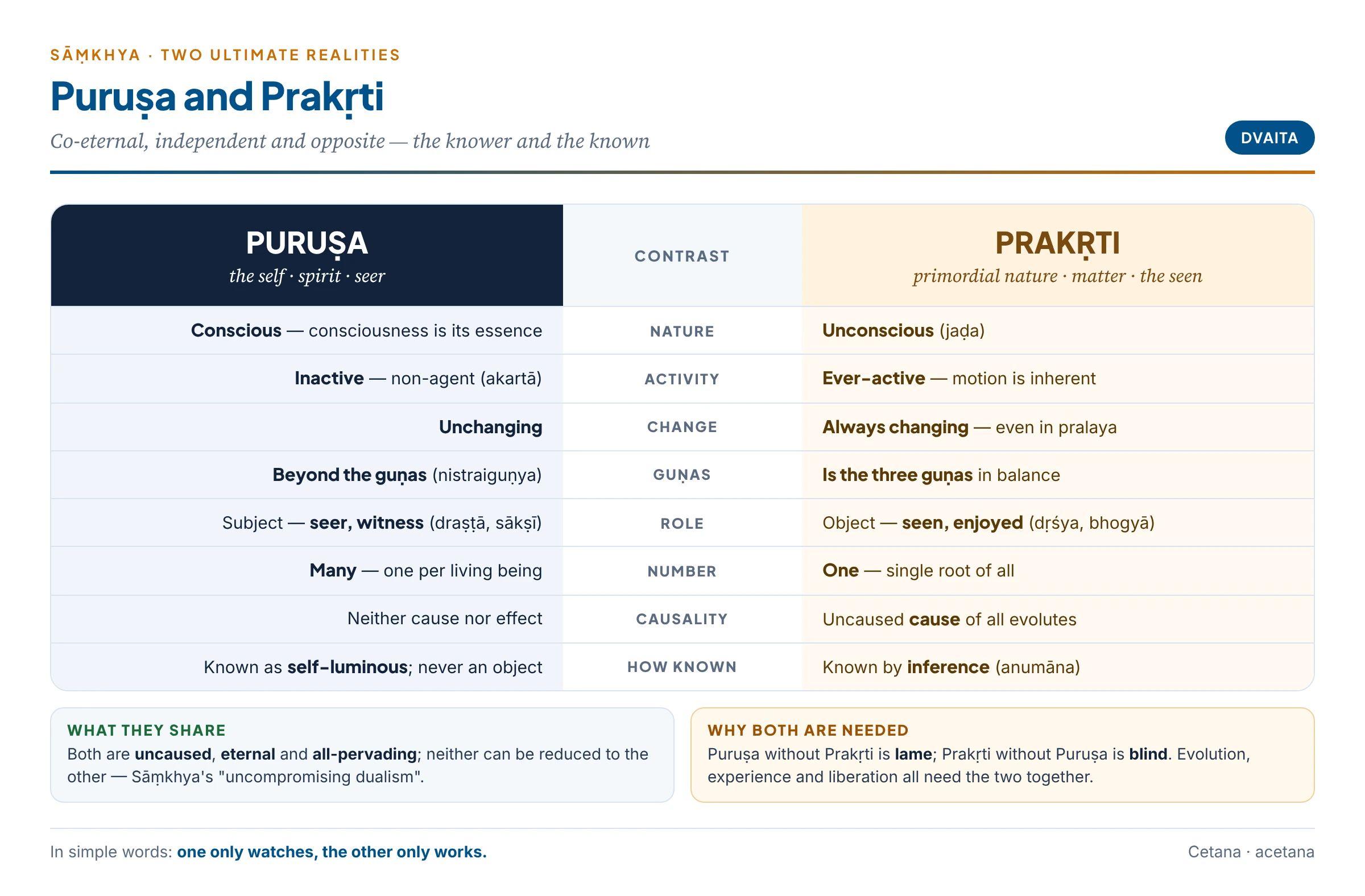
- Not anything material. Puruṣa is not the body, the senses, the brain or the nervous system, not manas, ahaṅkāra or buddhi, and not the aggregate of conscious states. All of these are products of Prakṛti.
- Consciousness is its essence. Puruṣa is not a substance that has consciousness as a quality (as Nyāya holds); it is pure consciousness (śuddha caitanya). Consciousness is its very nature.
- Not bliss. Unlike the Advaitin’s self, Puruṣa is not “blissful consciousness”. Bliss and consciousness are different things and cannot both be the essence of one reality; bliss (pleasure) is a product of sattva and belongs to Prakṛti.
- Always subject, never object. Puruṣa is the knower that can never become an object of knowledge. It is the foundation of all knowledge — “the postulate of knowledge”.
- Unchanging and inactive. The light of its consciousness stays the same while objects come and go. It is beyond change and activity, beyond time and space, uncaused, eternal and all-pervading.
- Unaffected. It is free from all attachment and unaffected by objects; all change and activity, all pleasure and pain belong to matter and its products — body, mind and intellect. To think that the self is any of these is ignorance, and through such ignorance the self seems caught in change and sorrow (Article 5).
- Its classic descriptions. Because Puruṣa is the opposite of the guṇas, the Kārikā derives its character from that contrast:
| Epithet | Meaning |
|---|---|
| Sākṣī | The witness — sees everything, takes part in nothing |
| Draṣṭā | The seer — the one for whom all is seen |
| Kevala | Alone, isolated — the “emancipated alone” |
| Madhyastha / Udāsīna | Neutral, indifferent — neither attracted nor repelled |
| Akartā | Non-agent — does nothing |
| Abhoktā (in itself) | Not truly an enjoyer of pleasure and pain |
| Nistraiguṇya | Beyond the three guṇas |
| Sadā-prakāśa-svarūpa | Ever self-luminous — shines by its own light, self-proved |
| Jñātā | The ultimate knower |
| Śuddha, nirañjana | Pure, stainless |
In simple words
A mirror reflects a sunset, a fight, a wedding, a flood — and remains exactly as it was. Nothing it shows sticks to it. Sāṃkhya’s Puruṣa is like the clear light that lets the mirror show anything at all, while it itself is never coloured by what is shown. Pleasure, pain, success, failure all appear “in its light”, but none of them belongs to it.
2. The Five Proofs for the Existence of Puruṣa
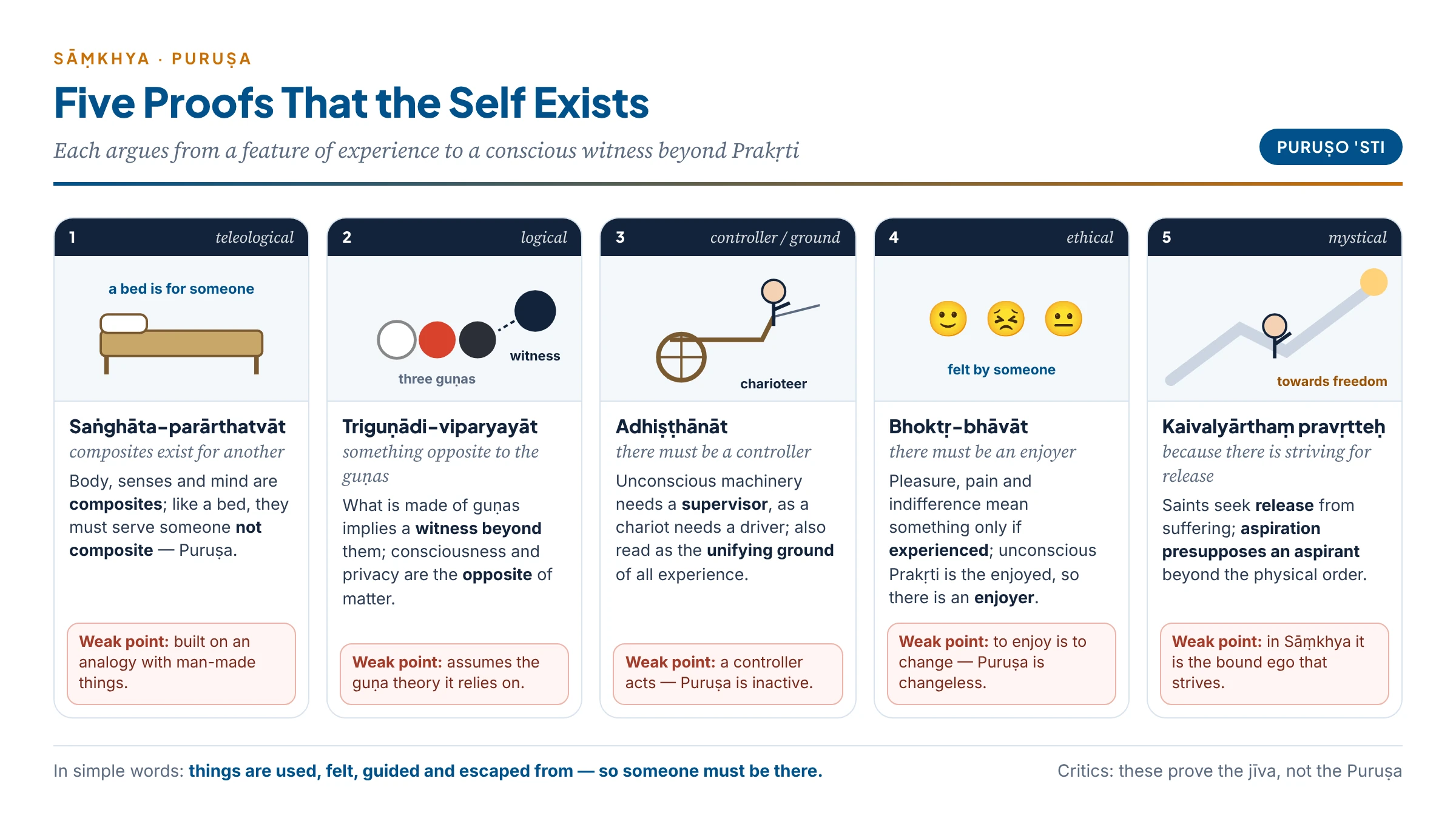
Īśvarakṛṣṇa gives five proofs in one verse: saṅghāta-parārthatvāt, triguṇādi-viparyayāt, adhiṣṭhānāt, puruṣo ‘sti bhoktṛ-bhāvāt, kaivalyārthaṃ pravṛtteś ca — “Puruṣa exists because composite things are for another, because there must be something opposite to the three guṇas, because there must be a controller, because there must be an enjoyer, and because there is striving for liberation.”
- (1) Saṅghāta-parārthatvāt — “because composite things exist for another” (the teleological proof).
- The argument. Every composite thing — a bed, a chair, a house — exists for the use of something other than itself: a bed is for someone to lie on.
- Applied. The body, the senses, the mind and the intellect are complex composites; so they too must exist for the sake of something different from them. If that “something” were itself composite, it would in turn be for another — so it must be non-composite and conscious: Puruṣa.
- Wider. The three guṇas, Prakṛti, evolution and the subtle body all serve the purpose of the self. Evolution is teleological.
- (2) Triguṇādi-viparyayāt — “because there must be something opposite to the three guṇas” (the logical proof).
- The argument. All objects are composed of the three guṇas. The very idea of things made of guṇas logically presupposes something beyond them — the witness of the guṇas who is himself free of them (nistraiguṇya).
- Another way of putting it. The guṇas explain all material phenomena, but in sentient beings we find features opposite to everything material — consciousness, privacy of experience, being a subject. These need a non-material source: Puruṣa.
- (3) Adhiṣṭhānāt — “because there must be a controller or ground”.
- As a controller. Unconscious things achieve nothing unless directed by an intelligent principle — a chariot moves well only with a charioteer, a car or machine only under a driver. The coordinated working of body, senses and mind shows a supervisor; when it departs, as in a dead body, the system falls apart.
- As the ground of knowledge. All experience needs a unifying consciousness — a “transcendental synthetic unity” that holds experiences together as mine. All affirmations and denials presuppose it; even to doubt it is to affirm the doubting self. On this reading the proof is called ontological.
- (4) Bhoktṛ-bhāvāt — “because there must be an enjoyer” (the ethical proof).
- The argument. All objects of the world produce pleasure, pain and indifference. But pleasure and pain have meaning only if someone experiences them. Prakṛti is unconscious and cannot experience its own products.
- Conclusion. Prakṛti is the enjoyed (bhogyā); there must be an enjoyer (bhoktā). That is Puruṣa.
- (5) Kaivalyārthaṃ pravṛtteḥ — “because there is striving for liberation” (the mystical or religious proof).
- The argument. Some persons — saints and seekers — make a sincere effort to gain release from suffering. The physical world causes suffering rather than ending it, so the one who seeks release must be beyond the physical order.
- Conclusion. Aspiration presupposes an aspirant. Without a self distinct from Prakṛti, the very idea of liberation — and the will of saints and saviours to be free — would be meaningless.
Common confusion
Does “adhiṣṭhānāt” mean “the self is the substratum of all knowledge” or “the self controls the body”? Both readings circulate and both are useful, but they are different arguments. In the Kārikā tradition the word means superintendence or control: as a chariot needs a charioteer, the unconscious body–mind system needs a conscious supervisor. Many notes instead present it as the ground of knowledge (“doubt implies a doubter”), echoing Descartes and Kant, and call it “ontological”. Know both; but note that the “controller” reading sits awkwardly with Puruṣa’s inactivity — a point critics press (section 3).
3. Evaluating the Proofs
- What they achieve.
- They show that consciousness cannot be reduced to the material mind-body system — a point many philosophers still find compelling.
- The teleological and enjoyer proofs show that experience requires a subject for whom things exist.
- The logical proof neatly links the doctrine of the guṇas with the doctrine of the self.
- Where they are weak.
- The teleological proof rests on an analogy with artefacts (beds, houses), which are made by and for conscious beings. Natural composites may simply exist without being “for” anyone; the argument assumes the purposiveness it needs.
- The controller proof conflicts with Puruṣa’s inactivity: a charioteer acts; Puruṣa does not.
- The enjoyer proof conflicts with Puruṣa’s changelessness: to enjoy and suffer is to be modified. If Puruṣa is untouched by pleasure and pain, it is not really an enjoyer.
- The liberation proof shows only that there is someone who seeks release — and in Sāṃkhya, it is the bound ego, a product of Prakṛti, that seeks.
- All five prove, at most, a conscious empirical subject — something every school except the Cārvāka accepts — rather than the transcendental, inactive, many Puruṣas of Sāṃkhya. Critics say they prove the jīva, not the Puruṣa.
4. The Plurality of Puruṣas (Bahupuruṣavāda)
- The thesis. Unlike Advaita (one self for all), and like Jainism, Nyāya, Mīmāṃsā and Rāmānuja, Sāṃkhya holds that there are many Puruṣas — one connected with each body.
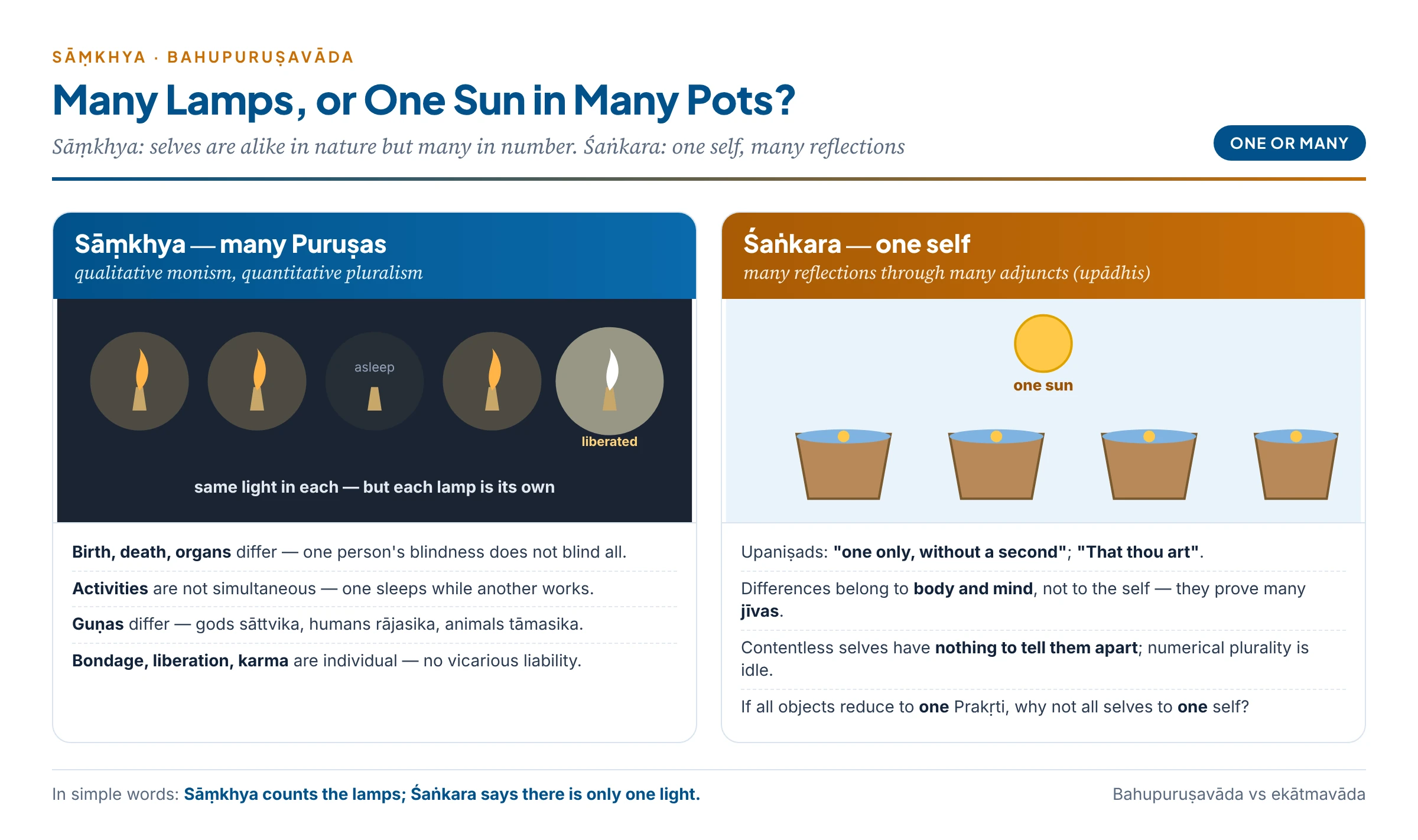
- Qualitative monism, quantitative pluralism. All Puruṣas are alike in nature — pure consciousness — but numerically many. They are like many lamps giving the same light while remaining distinct lamps; or like the jīvas of the Jainas, the souls of Rāmānuja and the monads of Leibniz.
- The three arguments of the Kārikā.
- Separate allotment of birth, death and organs (janana-maraṇa-karaṇānāṃ pratiniyamāt). Different individuals are born and die at different times and have different sense and motor organs. If there were one self, the birth or death of one would be the birth or death of all, and the blindness or deafness of one would make all blind or deaf.
- Activities are not simultaneous (ayugapat pravṛtteḥ). If there were one self, the activity of one would make everyone active at once. But when one sleeps, another works; when one studies, another runs.
- Different proportions of the guṇas (traiguṇya-viparyayāt). Beings differ in their dominant guṇa — gods are mostly sāttvika, humans rājasika, animals tāmasika; one person is saintly, another passionate, a third dull. Such differences would be impossible if all had the same single self.
- Further arguments added in many expositions.
- Different experiences. Pleasure, pain and indifference are felt differently by different people; if the self were one, every experience would be shared by all, and the sleep of one would lull all into sleep.
- Bondage and liberation. Some are bound, others liberated. If there were one self, the bondage of one would be the bondage of all and the liberation of one the liberation of all; and why should anyone strive for freedom if his bondage could be due to another’s actions? (Prakṛti “vanishes” for the Puruṣa who has seen her but continues for others.)
- The law of karma. If there were one self, the actions of one would bear fruit for all — vicarious liability, which overthrows the moral law.
- Scripture. Some Upaniṣadic passages are read by Sāṃkhya as speaking of many selves.
In simple words
Ten bulbs in ten rooms give the same kind of light, yet switching off the bulb in your room does not darken mine. Sāṃkhya says Puruṣas are like that: identical in nature (all pure light of consciousness), yet many — because when you are born, sleep, suffer or are liberated, I am not.
5. Is Puruṣa One or Many? The Debate
- Śaṅkara’s objections.
- Against scripture. The Upaniṣads proclaim the unity of the self: “One only, without a second” (ekam eva advitīyam), “That thou art” (tat tvam asi). Plurality of Puruṣas contradicts the Veda that Sāṃkhya itself accepts.
- Differences belong to the adjuncts. Diversity of experience arises not in the self but in its limiting adjuncts (upādhis) — mind, body, intellect. As one sun appears as many suns reflected in many pots of water, the one self appears as many through many bodies.
- Liberation. Liberation is not the release of “many” but the one self’s realisation of its own nature; ignorance makes it appear that many are bound.
- Plurality is redundant. If all Puruṣas are exactly alike — eternal, inactive, pure consciousness — what is the point of their numerical difference? It becomes meaningless.
- The confusion of jīva and Puruṣa. Sāṃkhya rightly teaches that Puruṣa is beyond birth, death, action, bondage and liberation — then proves plurality from birth, death, activity, bondage and differences of guṇas. These belong to the body and the ego, products of Prakṛti; they prove the plurality of jīvas (empirical selves), which no one denies, not of transcendental Puruṣas. Sāṃkhya even says the self is “neither bound nor liberated” (Article 5) — so differences of bondage cannot distinguish Puruṣas.
- Nothing to tell them apart. Sāṃkhya has no principle of individuation such as the Vaiśeṣika viśeṣa (ultimate particularity). If all Puruṣas are contentless consciousness, all-pervading and formless, what makes one Puruṣa different from another? “Differences and distinctions constitute individuality”; without them, “numerical pluralism is sheer nonsense.”
- The inconsistency of logic. If Sāṃkhya can reduce all objects to one Prakṛti by the argument from unity, why not reduce all selves to one Puruṣa by the same logic — and Prakṛti and the selves to one Absolute?
- Sāṃkhya’s replies.
- Liberation is individual. When one person is liberated the world does not end for everyone; the continuing bondage of others is a fact. Only many Puruṣas explain it.
- Individuation by relation. Each Puruṣa is individuated by its unique connection with its own subtle body; this does not make the Puruṣa itself bodily.
- The “one self” texts. Later Sāṃkhya answers that Upaniṣadic statements of oneness speak of sameness of kind — all selves are of one nature — not of numerical identity.
- The Advaitin’s adjuncts. If the one self is “limited” by many adjuncts, the adjuncts themselves need explaining; Advaita merely moves the plurality from selves to ignorance and its adjuncts.
Common confusion
Did later Sāṃkhya commentators like Vācaspati and Vijñānabhikṣu accept only one Puruṣa? Many notes say so, but it is not accurate. The classical commentators, including Gauḍapāda and Vācaspati Miśra, defend the Kārikā‘s arguments for plurality. The later Sāṃkhya tradition answers the Upaniṣadic “one self” texts by saying they mean sameness of kind, not number. Vijñānabhikṣu, who tried to reconcile Sāṃkhya with Vedānta, brought back a supreme Lord and spoke of selves as not separate from the Absolute — but he still kept many selves. What is true is that critics such as Śaṅkara argued that Sāṃkhya’s own logic should have led it to one self.
6. Jīva and Puruṣa
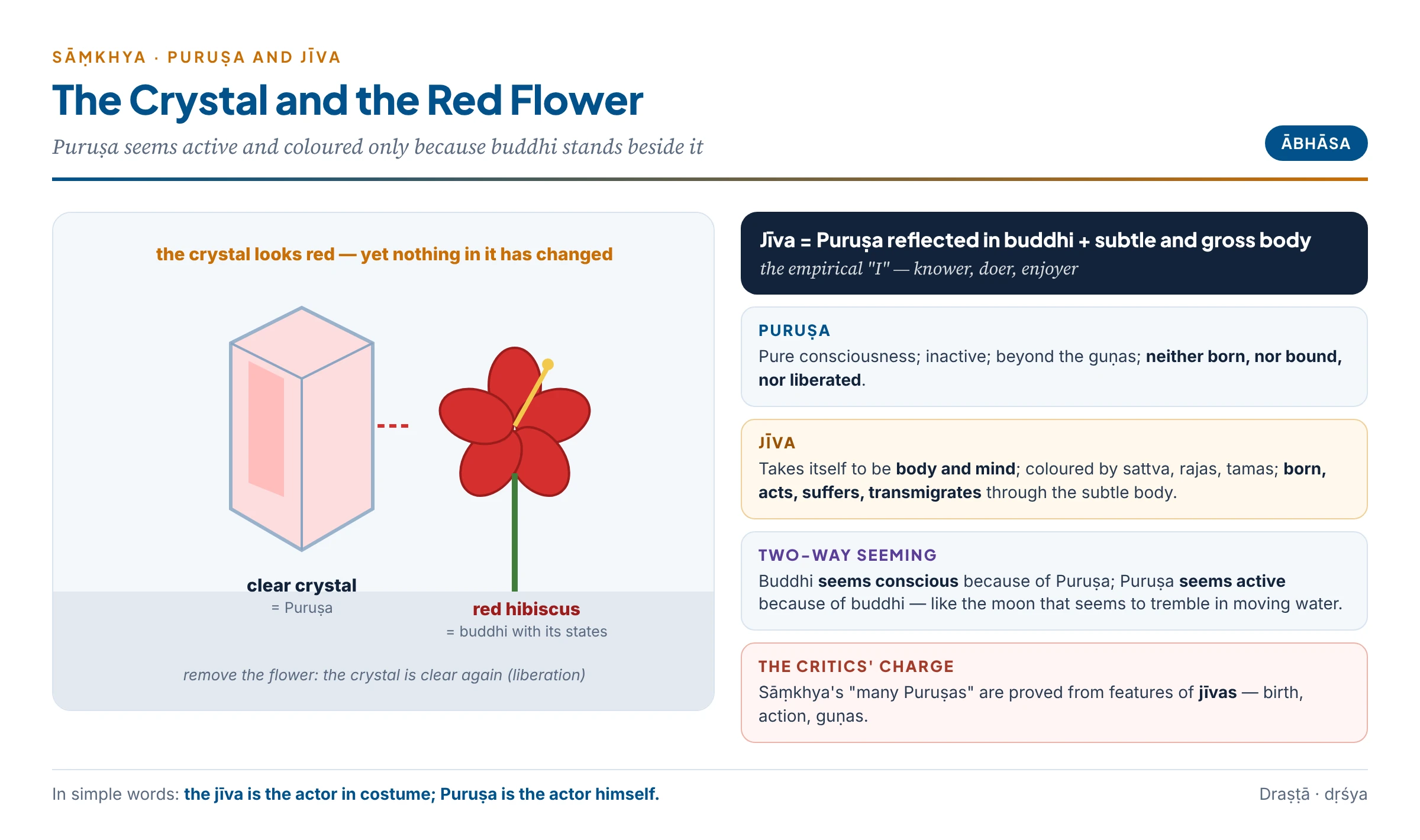
- The distinction. Puruṣa is the transcendental self — pure consciousness, inactive, beyond the guṇas, untouched by birth, death, bondage and liberation. The jīva is the empirical self — the person we ordinarily are: Puruṣa as reflected in buddhi and associated with the subtle and gross body, taking itself to be a knower, doer and enjoyer.
- How the jīva arises. Buddhi, being sāttvika and transparent, reflects Puruṣa’s consciousness and so seems conscious; Puruṣa, through its proximity to the active buddhi, seems to act and suffer.
- The crystal and the flower. A clear crystal placed beside a red hibiscus looks red; nothing has happened to the crystal. Puruṣa “looks” active and pained beside the active, pained buddhi.
- The moon in the waves. The moon reflected in moving water seems to tremble, though it is perfectly still; the self reflected in the changing mind seems to change.
- Metaphysical status compared.
| Point | Puruṣa (transcendental self) | Jīva (empirical self) |
|---|---|---|
| What it is | Pure consciousness as such | Puruṣa reflected in buddhi, joined to a subtle and gross body |
| Reality | Ultimately real, eternal | A real combination, but its sense of selfhood rests on non-discrimination |
| Activity | Inactive, non-agent | Feels itself to be agent, knower and enjoyer |
| Guṇas | Beyond them | Coloured by them — sāttvika, rājasika, tāmasika |
| Birth and death | Neither | Born, dies, transmigrates through the subtle body |
| Bondage and liberation | Neither bound nor liberated | It is the jīva (really the ego) that is bound and “liberated” |
| Number | Many (Sāṃkhya) | Many — one with each body |
| Known by | Discriminative knowledge | Ordinary self-awareness — “I am happy”, “I am fat” |
- Critics’ point. The real difficulty is that Sāṃkhya’s descriptions keep sliding between the two: Puruṣa is called “enjoyer” (a jīva-property) and the jīvas’ differences are used to prove the plurality of Puruṣas. If Puruṣa is the transcendental subject, how can it be an enjoyer? If it is passive and indifferent, how can it enjoy? Critics conclude that Sāṃkhya’s “many Puruṣas” are really many jīvas.
In simple words
Think of an actor playing King Lear. On stage he rages, weeps and dies — that is the character. Off stage he is the calm person who was playing the part all along — that is the actor. Sāṃkhya’s jīva is the character; Puruṣa is the actor. The tragedy is that the actor has forgotten he is acting.
7. The Relation, If Any, between Puruṣa and Prakṛti
- Why the question is hard. Sāṃkhya makes Puruṣa and Prakṛti absolutely different and independent: conscious and unconscious, inactive and active, beyond the guṇas and made of them. Yet the whole system — evolution, experience, bondage and liberation — depends on their coming together.
- The relation Sāṃkhya claims.
- Complementary ends. Prakṛti needs Puruṣa to be seen; Puruṣa needs Prakṛti for experience and liberation (Article 3).
- Seer and seen. The relation is that of subject and object, enjoyer and enjoyed, witness and witnessed (draṣṭṛ–dṛśya).
- Proximity and reflection. Not physical contact but nearness (like magnet and iron) and reflection of Puruṣa in buddhi.
- Similes offered. The lame and the blind; the magnet and the iron; the cow’s milk flowing for the calf; the dancer and the spectator (Article 5).
- Why critics say no real relation is possible.
- Two wholly opposite and independent entities cannot be related without a third principle (tertium quid) — and Sāṃkhya has none.
- Real contact would make liberation impossible; proximity would make evolution endless; a semblance of contact would make evolution a mere appearance (Article 3).
- The similes fail: the lame and the blind, and the cow and the calf, are all conscious beings with a shared purpose.
- Descartes faced the same problem with mind and body; his pineal gland answer was no more successful.
- A balanced judgement. Sāṃkhya is most consistent when it says the relation is not real but only apparent, due to non-discrimination — but that concession pulls it towards Advaita, where the world itself is an appearance (Article 6).
Critical Evaluation
Further Objections to the Sāṃkhya Self
- Nyāya–Vaiśeṣika.
- Nyāya accepts a self but rejects an inactive one: the self must be capable of desire, effort and volition to be a moral agent.
- An utterly inactive Puruṣa cannot be the enjoyer, because experience means change.
- Mere proximity to Prakṛti is a contact theory without a causal mechanism.
- Buddhists.
- There is no permanent self (anātmavāda); consciousness is a series of momentary states arising and ceasing with conditions; an eternal observer is an unnecessary postulate.
- Reflections — same or different? If Puruṣa only enjoys what is reflected in buddhi, are the reflections identical with Puruṣa or different? If identical, Puruṣa changes with them and is not eternal; if different, Puruṣa does not really enjoy them.
- Vicarious suffering. If actions belong to buddhi and their fruits to Puruṣa, then Puruṣa suffers for what it never did.
- The cook who cannot eat. It is absurd that Prakṛti “knows how to prepare delicious dishes but not how to eat them”.
- Unfulfilled desires. If Prakṛti gives fruits to Puruṣa according to its desires, why do we so often intensely desire something and not get it?
- Unconscious yet obedient. If Prakṛti creates according to the self’s “desire to see”, how can Prakṛti be called unconscious?
- Cārvāka. Consciousness is a product of the body; an immaterial Puruṣa is never perceived and does not exist. Today, the materialist would add that the sense of individuality and awareness can be explained neurologically.
- Advaita. Puruṣa as a mere passive spectator conflicts with Upaniṣadic texts that speak of the self as the source of the world; Sāṃkhya’s Puruṣa becomes an abstraction rather than the Absolute.
- Yoga’s inconsistency. Yoga adds Īśvara as a “special Puruṣa” untouched by afflictions and karma. If all Puruṣas are alike in nature, how can one be special?
Sāṃkhya’s Replies
- Inactivity is the point. If the self acted, it would change, and what changes can be bound for ever; only an unchanging witness can be freed. Agency belongs to the ego.
- Enjoyment is apparent. Puruṣa “enjoys” only in the sense that experiences are illumined by it, as a lamp “sees” nothing yet makes everything visible.
- Vicarious liability answered. Strictly, it is Prakṛti (the ego) that acts and also Prakṛti that is bound and released; Puruṣa neither acts nor suffers. Bondage, liberation and transmigration belong to Prakṛti (Article 5).
- Against the Buddhists. A series of momentary states cannot remember, compare or seek liberation; continuity of experience needs an abiding witness.
- Against the Cārvāka. Consciousness cannot be a product of matter, because effects share the nature of their causes; unconscious elements cannot produce awareness.
Critics and Defenders
Criticism — Critics
- Śaṅkara: many Puruṣas contradict the Upaniṣads; differences belong to adjuncts; plurality is redundant; jīva and Puruṣa are confused.
- Nyāya: an inactive self cannot enjoy, desire or be a moral agent.
- Buddhists: no permanent self; reflections are either identical (Puruṣa changes) or different (Puruṣa does not enjoy); vicarious suffering.
- Logicians: contentless selves cannot be told apart; the proofs establish only the empirical subject.
- Cārvāka: consciousness is a property of the body.
Defence — Defenders and strengths
- Consciousness is not reducible to body, brain or mind — a lasting insight.
- The self as witness explains why awareness stays constant while its contents change.
- Many selves fit the obvious facts that birth, experience, karma and liberation are individual.
- The jīva–Puruṣa distinction separates the empirical person from pure awareness — later central to Yoga and Vedānta.
- Making the self inactive keeps liberation possible: what never really acted was never really bound.
Cross-Tradition Comparison
Puruṣa and Western Theories of the Self
| Point | Sāṃkhya’s Puruṣa | Western parallel |
|---|---|---|
| Self beyond doubt | Doubt implies a doubter; the self is self-proved | Descartes: “I think, therefore I am” — but Descartes’ self is a thinking substance, while for Sāṃkhya thinking belongs to buddhi |
| Unity of experience | Adhiṣṭhāna — a unifying consciousness behind all experience | Kant: the transcendental unity of apperception, the “I think” that accompanies all representations |
| Pure witness | Sākṣī — consciousness without content | Husserl’s transcendental ego; Sartre: consciousness is transparent, “nothingness”, never an object |
| Self as bundle | Rejected — states belong to buddhi; the witness stands apart | Hume: “I never can catch myself… without a perception” — the self is a bundle |
| Many simple selves | Qualitatively one, numerically many Puruṣas | Leibniz’s monads — but monads are active, mirroring the world from within |
| Mind as material | Intellect, ego, mind are products of Prakṛti | Unlike Descartes, for whom mind is spirit; closer to modern physicalism about mental contents |
| The ego as a construction | Ahaṅkāra is a product, not the true self | Freud’s ego; contemporary “self-model” theories |
| Interaction problem | How do Puruṣa and Prakṛti relate? | Descartes’ mind–body problem; the pineal gland |
Puruṣa and Other Indian Selves
| Point | Sāṃkhya | Nyāya–Vaiśeṣika | Jainism | Advaita Vedānta |
|---|---|---|---|---|
| Consciousness | Essence of the self | An adventitious quality | Essence of the jīva | Essence of the self |
| Activity | Inactive | Active — knows, desires, wills | Active; agent and enjoyer | Inactive witness |
| Bliss | No — bliss is sattva | No | Infinite bliss in liberation | Yes — sat-cit-ānanda |
| Number | Many | Many | Many | One |
| Size | All-pervading | All-pervading | Body-sized | All-pervading |
Indian Connect — Key takeaways
- Sāṃkhya’s witness-self (sākṣī) passed into Yoga and Advaita, where it became the central idea of the self as pure awareness.
- The jīva–Puruṣa distinction is Sāṃkhya’s version of the empirical vs transcendental self, later developed by Kant and Husserl in the West.
- The debate on one or many selves is the dividing line between pluralist schools (Sāṃkhya, Nyāya, Jainism, Rāmānuja) and Advaita.
Synthesis (Siddhānta)
- Puruṣa is pure consciousness — not a substance with consciousness, not bliss — the eternal, inactive, all-pervading witness, beyond the guṇas, self-luminous and never an object.
- Its existence is shown by five proofs: composite things exist for another; the guṇas imply something beyond them; there must be a controller and ground of experience; there must be an enjoyer; there is striving for liberation.
- Sāṃkhya holds that Puruṣas are many — alike in nature, many in number — because birth, death, activity, experience, bondage and the guṇas differ from person to person.
- Critics, led by Śaṅkara, reply that these differences belong to jīvas and their adjuncts, not to Puruṣa; that contentless selves cannot be told apart; and that the logic of unity should lead to one self.
- The jīva is Puruṣa as reflected in buddhi and embodied — the empirical knower, doer and enjoyer; it is this, not Puruṣa, that is born, acts and is bound.
- The relation of Puruṣa and Prakṛti — seer and seen, by proximity and reflection — is the weakest point of the system: a real relation threatens liberation, an apparent one points to Advaita.
- Contemporary relevance.
- Philosophy of mind. The distinction between awareness and its contents is central to today’s debates on the “hard problem” of consciousness.
- Meditation research. Mindfulness practices train the “witnessing” stance — observing thoughts and feelings without identifying with them — very close to Sāṃkhya’s sākṣī.
- Psychology. Therapies that teach clients to “defuse” from thoughts (“I am having the thought that I am a failure”) echo the discrimination of Puruṣa from buddhi.
- Ethics. The plurality of selves grounds individual responsibility and the dignity of each person — a theme central to modern rights-based thinking.
“From this contrast it follows that Puruṣa is witness, isolated, neutral, seer and non-agent.” — Īśvarakṛṣṇa, Sāṃkhyakārikā
Previous Year Questions
- 2026Is Puruṣa one or many? Explain and examine the Sāṃkhya position in this context.
- 2022Examine and evaluate the proofs given by Sāṃkhya philosophy to prove the existence of Puruṣa.
- 2019Critically discuss the metaphysical status of a Jīva and a Puruṣa according to Sāṃkhya philosophy.
- 2018Is Puruṣa one or many? Explain the Sāṃkhya position in this regard and give arguments in support of your answer.
- 2015State and examine Sāṃkhya proofs for the existence of Puruṣa.
- 2013Evaluate the relation, if any, between Prakṛti and Puruṣa.
- 2011Examine Sāṃkhya’s arguments for Bahupuruṣavāda (Plurality of Puruṣa).
- 2005Sāṃkhya conception of Puruṣa. Short notes.
- 2001Evaluate the Sāṃkhya justification for their theory of Puruṣa.
- 1998Doctrine of plurality of Puruṣas. Notes.
- 1993Explain and examine the Sāṃkhya arguments for the existence of Prakṛti and Puruṣa.