

Sāṃkhya: Prakṛti; Puruṣa; Causation; Liberation.
Official Syllabus: Paper I, Section B, Unit 16
How does one quiet, balanced Prakṛti become a world of stars and stones, bodies and brains, thoughts and feelings? Sāṃkhya answers with the first great theory of evolution in Indian thought (sarga): in the presence of Puruṣa the balance of the guṇas is disturbed, and Prakṛti unfolds, step by step, into twenty-three products — the cosmic intellect (mahat or buddhi), the ego (ahaṅkāra), the mind (manas), ten organs, five subtle elements (tanmātras) and five gross elements (mahābhūtas). With Prakṛti and Puruṣa these make the famous twenty-five tattvas. This evolution is a manifestation, not a new creation; it is cyclic; and it is purposive — everything unconsciously works for the experience and liberation of Puruṣa. This article explains the order of evolution, the difference between buddhi, mahat and ahaṅkāra, the subtle body, the purpose of evolution, Sāṃkhya’s three attempts to explain how it starts, and whether the system can explain the presence of consciousness in the world.
In simple words
Think of a seed packet of a whole garden. In the packet everything is folded up — roots, stems, leaves, flowers, fruits. Plant it and the garden unfolds in a fixed order: first the root, then the stem, then branches, then leaves and flowers. Sāṃkhya sees the universe the same way: everything is folded up in Prakṛti, and it unfolds in a definite order — first the subtlest (intellect), then the ego, then the senses and the subtle elements, and last the solid earth.
Context & Problem
Why Evolution Needs Both Puruṣa and Prakṛti
- Not Puruṣa alone. Puruṣa is conscious but inactive; an intelligent principle cannot transform itself into unintelligent things.
- Not Prakṛti alone. Prakṛti is active but non-intelligent (blind); left to itself it stays in balance and evolves nothing.
- So the two must come together. Evolution starts with the contact (saṃyoga) of Puruṣa and Prakṛti, in spite of their opposite natures.
- Each needs the other.
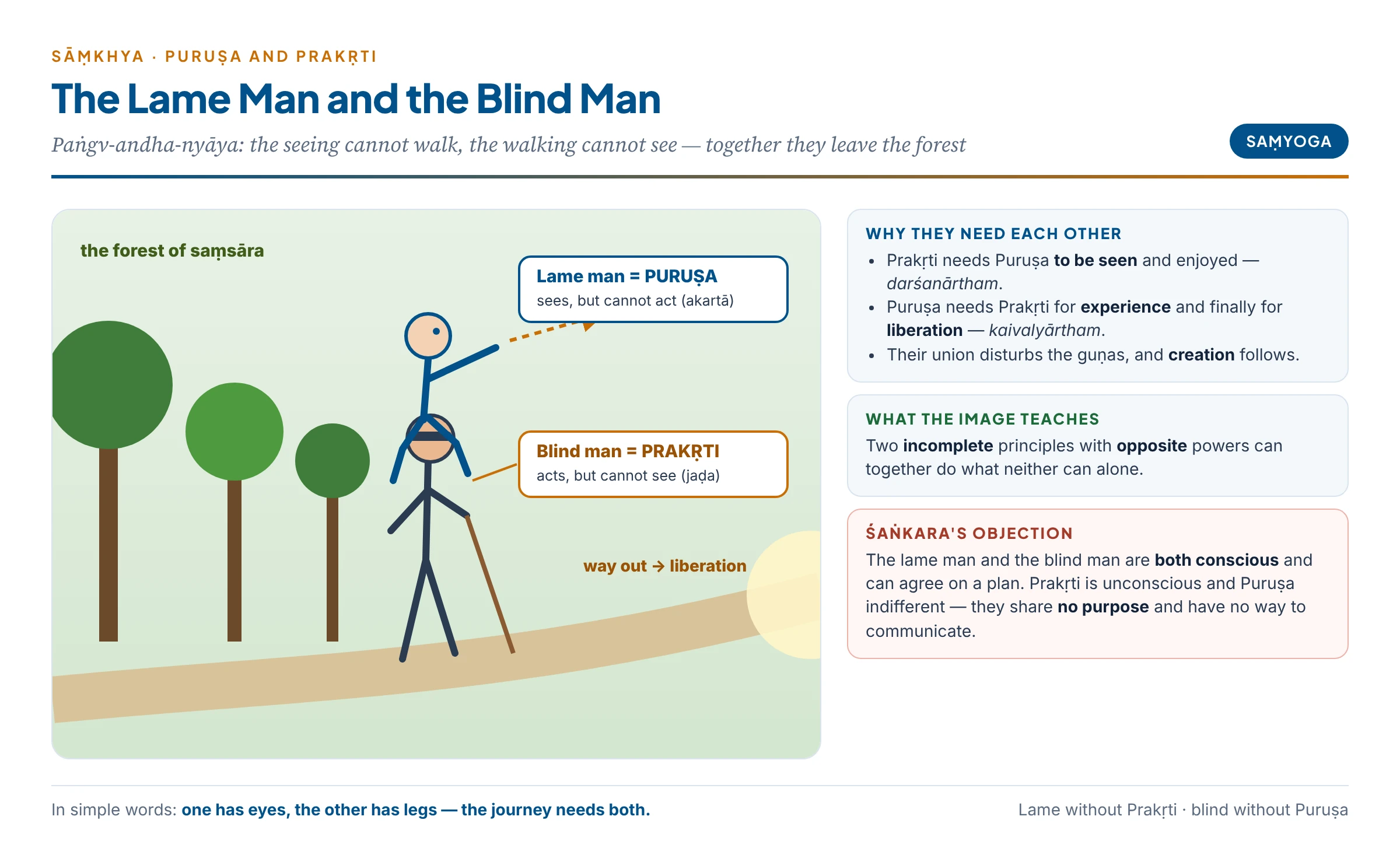
- Prakṛti needs Puruṣa in order to be seen, known and enjoyed — “for the sake of being seen” (darśanārtham).
- Puruṣa needs Prakṛti in order to enjoy (bhoga) and, finally, to discriminate itself from Prakṛti and attain liberation — “for the sake of isolation” (kaivalyārtham). Puruṣa needs Prakṛti for saṃsāra as well as for kaivalya.
- The lame man and the blind man (paṅgv-andha-nyāya). A lame man who can see and a blind man who can walk are lost in a forest. Neither can get out alone. The lame man climbs onto the blind man’s shoulders and points the way; the blind man walks. Together they reach the destination. In the same way, the inactive but conscious Puruṣa and the active but unconscious Prakṛti cooperate, and from their union comes creation.
- A Western echo. Kant wrote that “thoughts without content are empty, intuitions without concepts are blind”; people also say “theory without practice is empty, practice without theory is blind”. Sāṃkhya’s point is similar: Puruṣa without Prakṛti is lame, Prakṛti without Puruṣa is blind.
What Kind of Contact?
- Not an ordinary conjunction. The contact of Puruṣa and Prakṛti is not like two material things touching. It is a special, effective relation through which Prakṛti is influenced by the mere presence of Puruṣa — in the way our body is sometimes moved by the presence of a thought, or iron filings by a magnet.
- The disturbance. With this contact the equilibrium of the guṇas is disturbed. Rajas, naturally active, is stirred first; through rajas, sattva and tamas begin to vibrate. A tremendous commotion arises in the infinite “bosom” of Prakṛti; each guṇa tries to prevail; through their differentiation and combination in different proportions, the objects of the world arise.
Core Doctrine
1. The First Evolute: Mahat or Buddhi
- Two aspects of one principle.
- Cosmic aspect — mahat, “the Great”. The first product of Prakṛti is the great germ of this vast world of objects, including intellect, ego and mind.
- Psychological aspect — buddhi, “intellect”. The same principle as present in each individual being.
- Sattva predominates. Buddhi arises from the preponderance of sattva; its nature is to manifest itself and other things.
- Its functions: ascertainment and decision (adhyavasāya). By buddhi we understand the distinction between the subject and other objects, and we decide what to do.
- Apparently conscious, not conscious. Buddhi is material, a product of Prakṛti, made of the finest matter. Because it is so close to Puruṣa and so clear (sāttvika), it reflects Puruṣa’s consciousness, like a clean mirror reflecting a lamp — or, in a modern image, like a radio set picking up waves that it does not itself produce. So it appears conscious and intelligent.
- Its eight dispositions (bhāvas). In its pure, sāttvika state buddhi has virtue (dharma), knowledge (jñāna), detachment (vairāgya) and power or excellence (aiśvarya). When vitiated by tamas, these are replaced by their opposites: vice, ignorance, attachment and weakness.
- Its special place. The senses and the mind work for buddhi; buddhi works directly for Puruṣa. It presents all experience to Puruṣa and, at the end, makes possible the discrimination between Puruṣa and Prakṛti. Memories and past impressions are stored in buddhi.
2. The Second Evolute: Ahaṅkāra, the Ego
- Origin and function. Mahat produces ahaṅkāra, the principle of individuation. Its function is self-sense (abhimāna) — the feeling of “I” (aham) and “mine” (mama).
- How it works in experience.
- We first perceive objects through the senses.
- The mind reflects on them and determines them as of this or that kind.
- Ahaṅkāra then appropriates them: “this is mine, this is for me“, and feels the self to be concerned in them.
- Then we act. The potter makes a pot only after he takes it as his own end and resolves within himself: “Let me make a pot.“
- Its role in bondage. Because of ahaṅkāra, Puruṣa (wrongly) regards itself as the agent of actions, the desirer of desires, the striver for ends and the owner of possessions (Article 5).
- Three kinds of ahaṅkāra, according to the predominant guṇa:
- Vaikārika or sāttvika (sattva predominant) — in its cosmic aspect it produces the eleven organs: manas, the five organs of knowledge and the five organs of action. In its psychological aspect it is the source of good deeds.
- Bhūtādi or tāmasa (tamas predominant) — in its cosmic aspect it produces the five subtle elements (tanmātras). Psychologically it leads to idleness and indifferent acts.
- Taijasa or rājasa (rajas predominant) — it produces nothing of its own but supplies the energy by which the sāttvika and tāmasa ahaṅkāra produce their evolutes. Psychologically it is the source of evil or restless deeds.
- A different order. This order is the one laid down in the Kārikā and followed by Vācaspati Miśra. Vijñānabhikṣu gives another: only manas, the pre-eminently sāttvika sense, comes from sāttvika ahaṅkāra; the ten outer organs come from rājasa ahaṅkāra; the tanmātras from tāmasa.
3. Buddhi, Mahat and Ahaṅkāra Compared
| Point | Mahat | Buddhi | Ahaṅkāra |
|---|---|---|---|
| What it is | The first evolute in its cosmic aspect — the great germ of the world | The same first evolute in its individual, psychological aspect | The second evolute, produced from mahat |
| Main function | Starting point of all further evolution | Ascertainment and decision (adhyavasāya) | Self-sense (abhimāna) — “I” and “mine” |
| Dominant guṇa | Sattva | Sattva | All three; divided into sāttvika, rājasa, tāmasa |
| Relation to Puruṣa | — | Nearest to Puruṣa; reflects its consciousness | Puruṣa wrongly identifies with it as agent and owner |
| What it produces | Ahaṅkāra | Ahaṅkāra (same principle) | The eleven organs and the five tanmātras |
| Psychological role | — | Cognition: knowing and deciding | The sense of ownership that drives desire and action |
| In bondage and release | — | Its discrimination brings liberation | Its “I am the doer” is the core of bondage |
| Example | The cosmic intellect behind all things | “This is a snake — I must step back” | “I am in danger; my life must be saved” |
In simple words
You see a dark shape on the path. Your eyes take in the shape; your mind sorts it out — “long, curved, moving”; your ego makes it personal — “it is near me, I could be bitten”; your intellect decides — “it is a snake; step back.” In Sāṃkhya these are four different organs at work — senses, manas, ahaṅkāra and buddhi — and none of them is conscious by itself. They are all lit up by the consciousness of Puruṣa.
4. Manas, the Mind
- Origin. Manas arises from sāttvika ahaṅkāra.
- Nature. It is a subtle, central sense-organ that shares the nature of both the organs of knowledge and the organs of action; without its guidance neither can work.
- Not atomic, not eternal. Unlike Nyāya–Vaiśeṣika, which holds that manas is eternal and atomic and so can contact only one sense at a time, Sāṃkhya holds that manas is a composite, made of parts, produced and destroyed with the world. So it can contact several senses at once — we may have several experiences together, though ordinarily they come one after another.
- Function. Manas synthesises the indeterminate sense-data into determinate perceptions (“this is a cow”), passes them on to the ego, and carries out the orders of the ego through the motor organs. It is the organ of deliberation (saṅkalpa).
5. The Ten Outer Organs
- Five organs of knowledge (jñānendriya or buddhīndriya). The senses of sight, hearing, smell, taste and touch, which perceive colour, sound, smell, taste and touch respectively.
- Five organs of action (karmendriya). Located in the mouth, hands, feet, anus and sex organ; their functions are speech, grasping (prehension), movement, excretion and reproduction.
- The real organs are powers. The true organ is not the visible eyeball, ear-hole, skin, hand or foot, but an imperceptible power (śakti) in these end-organs which apprehends objects and acts on them. An organ is therefore inferred, not perceived — we infer that we have senses because perceiving is an action and every action needs an instrument.
- Why they evolve. It is the self’s desire to enjoy objects that brings forth both the objects of enjoyment and the organs for enjoying them.
- Against Nyāya–Vaiśeṣika. For Nyāya–Vaiśeṣika the senses are made of the physical elements (the eye of light, the ear of ether). For Sāṃkhya they are functions of the mind derived from ahaṅkāra, which the other schools do not even recognise as a separate principle.
Common confusion
Do the organs of action include “hearing”, and are buddhi, ahaṅkāra and manas “eternal organs”? Many notes list the functions of the five organs of action as “speech, hearing, movement, excretion and reproduction”, and call buddhi, ahaṅkāra and manas the “eternal organs”. Both are slips. Hearing belongs to the ear, an organ of knowledge; the organ of action in the hands is for grasping (prehension). And buddhi, ahaṅkāra and manas are the internal organs (antaḥkaraṇa) — they are products of Prakṛti and dissolve back into it, so they are not eternal at all.
6. The Thirteen Instruments (Karaṇas)
- Internal organs (antaḥkaraṇa) — three. Buddhi, ahaṅkāra and manas. They represent the three psychological aspects of knowing, willing and feeling (cognition, conation and affection). The vital breaths (prāṇa) are not separate principles (as Vedānta holds) but functions of the internal organs.
- External organs (bāhyakaraṇa) — ten. The five organs of knowledge and the five organs of action.
- Together: the thirteen karaṇas. The external organs supply the present; the internal organs deal with the past, present and future.
- How they cooperate. The outer senses present raw data; manas turns them into determinate perceptions; ahaṅkāra owns the objects as desirable or hateful; buddhi decides to attain or avoid them.
7. Tanmātras and Mahābhūtas
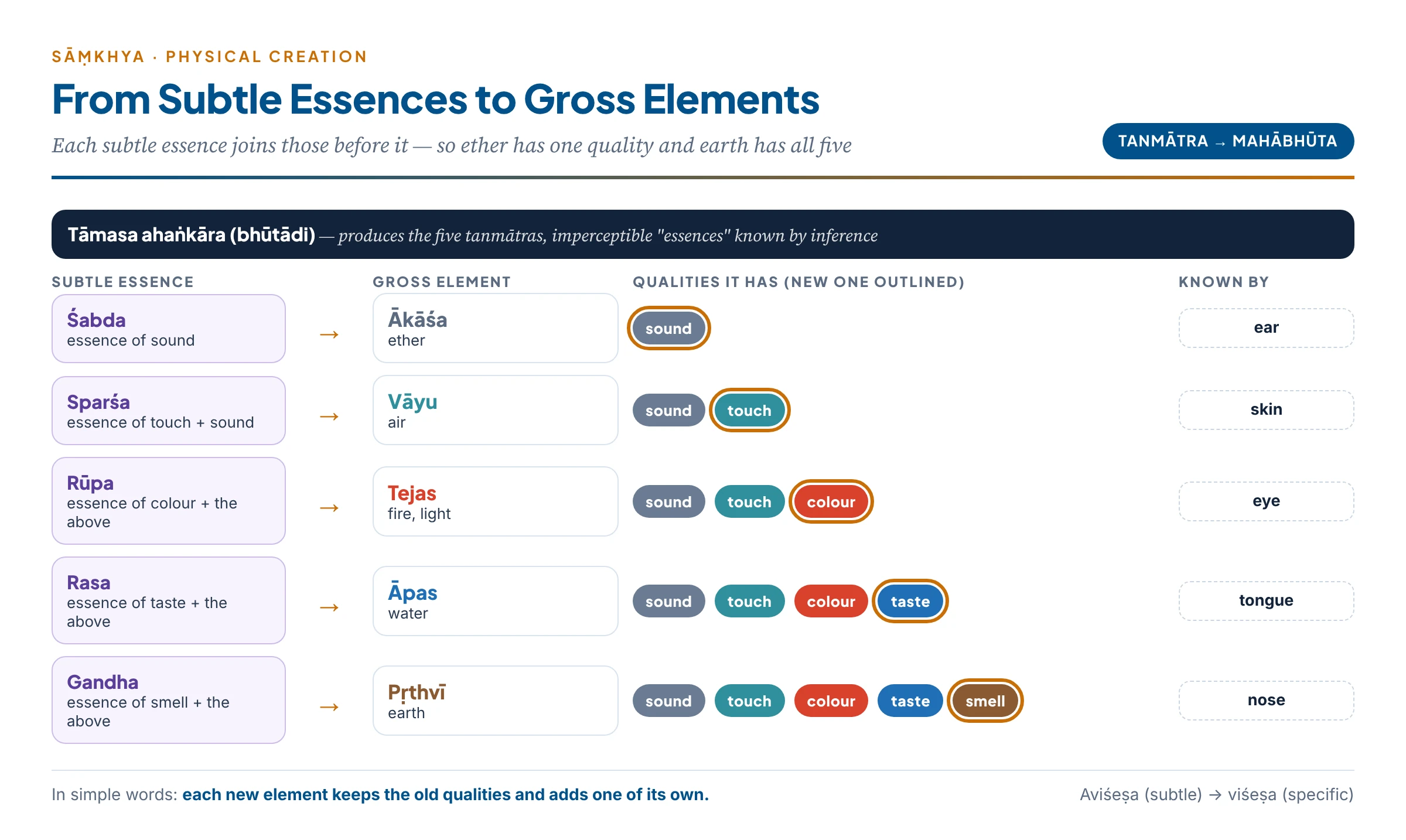
- The five tanmātras (“that only”). From tāmasa ahaṅkāra arise the five subtle elements — the generic essences of sound (śabda), touch (sparśa), colour/form (rūpa), taste (rasa) and smell (gandha).
- Not qualities, not senses. They are neither qualities of the gross elements nor the sense-functions; they are subtle essences which produce the gross elements and their qualities. Some expositions call them “things-in-themselves“.
- Imperceptible. Ordinary people cannot perceive them; they are known by inference, though yogins are said to perceive them.
- Not derived from the gross elements (as Nyāya–Vaiśeṣika would have it) — the gross elements are derived from them.
- The five mahābhūtas — cumulative growth.
- From the essence of sound comes ether (ākāśa), with the quality of sound.
- From the essence of touch together with sound comes air (vāyu), with sound and touch.
- From the essence of colour together with sound and touch comes fire or light (tejas), with sound, touch and colour.
- From the essence of taste together with the first three comes water (āpas), with sound, touch, colour and taste.
- From the essence of smell together with the other four comes earth (pṛthvī), with all five qualities.
- Specific qualities. Each element has one special quality of its own — ether sound, air touch, fire colour, water taste, earth smell — and the qualities of the earlier ones are added to it as the essences go on combining.
| Tanmātra (subtle essence) | Mahābhūta (gross element) | Special quality | All qualities it has | Sense that knows it |
|---|---|---|---|---|
| Śabda (sound) | Ākāśa (ether) | Sound | Sound | Ear |
| Sparśa (touch) | Vāyu (air) | Touch | Sound, touch | Skin |
| Rūpa (colour) | Tejas (fire, light) | Colour | Sound, touch, colour | Eye |
| Rasa (taste) | Āpas (water) | Taste | Sound, touch, colour, taste | Tongue |
| Gandha (smell) | Pṛthvī (earth) | Smell | All five | Nose |
8. Two Stages of Evolution, Specific and Non-specific, and the Bodies
- Two stages.
- Psychical creation (pratyaya-sarga or buddhi-sarga) — buddhi, ahaṅkāra and the eleven organs.
- Physical creation (tanmātra-sarga or bhautika-sarga) — the five tanmātras, the five gross elements and their products.
- Non-specific and specific.
- The tanmātras, being supersensible and not enjoyable by ordinary beings, are aviśeṣa — without specific perceptible characters.
- The gross elements and their products, which are pleasant, painful or stupefying (śānta, ghora, mūḍha), are viśeṣa — specific.
- Three kinds of specific things. The gross elements; the gross body born of parents (sthūla-śarīra); and the subtle body (sūkṣma or liṅga-śarīra).
- The subtle body (liṅga-śarīra).
- Composition. Buddhi, ahaṅkāra, the eleven organs and the five tanmātras — eighteen principles.
- Function. It is the carrier of karma and impressions; it passes from one gross body to another in rebirth, until liberation.
- Needs a support. The subtle body cannot function without a physical basis, just as a painting cannot stand without a wall or a shadow without a post. The gross body is its support.
- A third body? Vācaspati admits only the gross and the subtle bodies; Vijñānabhikṣu adds a third, the adhiṣṭhāna body, which supports the subtle body as it passes from one gross body to another.
- The “intellectual creation” — for the topper. The Kārikā also speaks of a creation of dispositions of buddhi, divided into fifty forms: error (five kinds), incapacity (twenty-eight), contentment (nine) and accomplishment (eight). And it divides embodied beings into fourteen kinds — eight divine, one human, five animal and plant. The point is that the manifest world includes not only things but also states of mind and grades of beings.
In simple words
Think of the SIM card in a mobile phone. The phone (the gross body) can break or be replaced, but your SIM — carrying your number, contacts and history — is taken out and put into a new phone, which then works as “you”. Sāṃkhya’s subtle body is like that SIM: it carries the intellect, ego, mind, senses and the stored traces of karma from one body to the next, until liberation.
9. The Twenty-five Tattvas and Their Fourfold Division
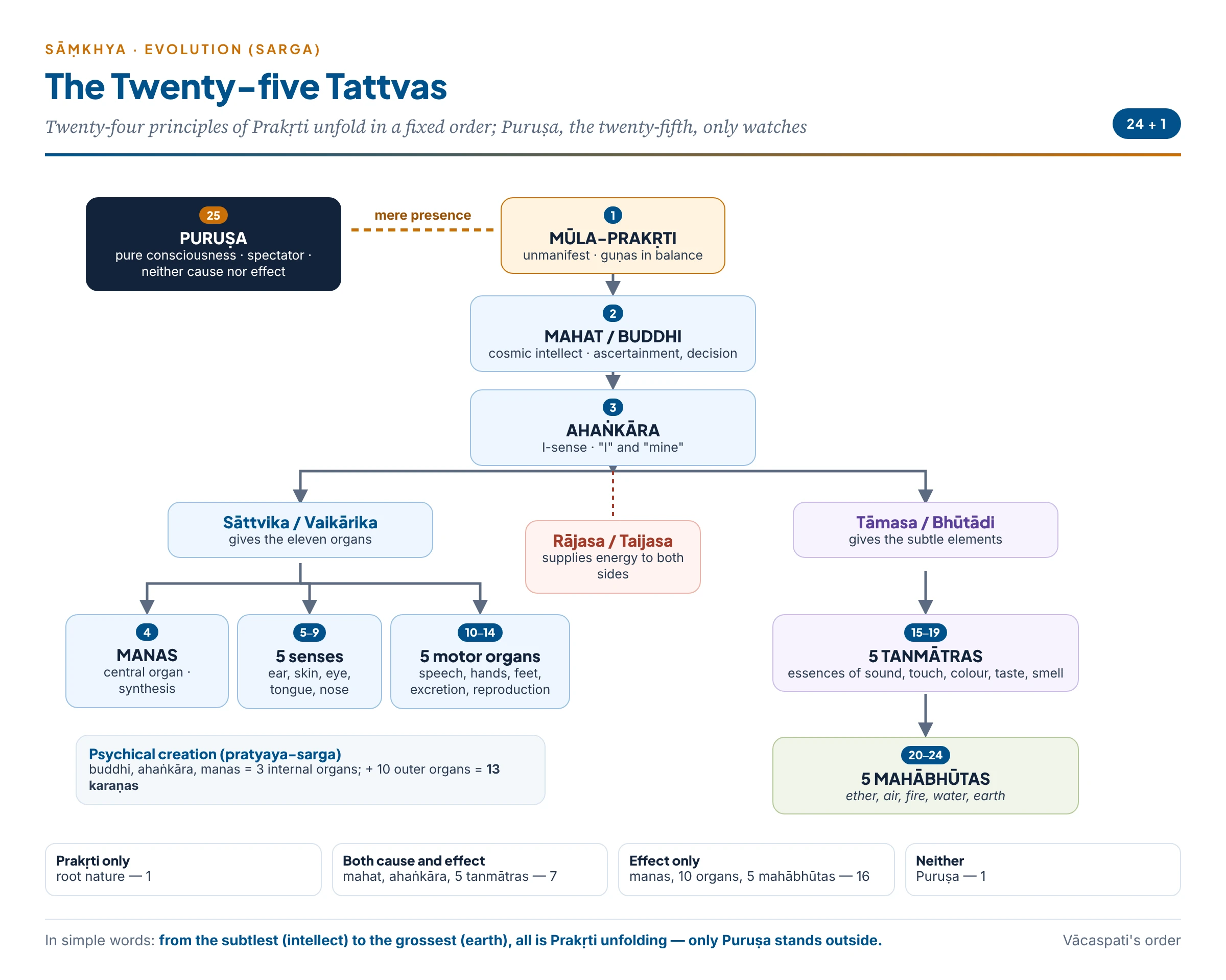
- The list. (1) Puruṣa, (2) Prakṛti, (3) Mahat or buddhi, (4) Ahaṅkāra, (5) Manas, (6–10) five organs of knowledge, (11–15) five organs of action, (16–20) five tanmātras, (21–25) five mahābhūtas. Evolution is the play of the twenty-four principles of Prakṛti; Puruṣa, the twenty-fifth, is a mere spectator, outside the play.
| Class | Meaning | Tattvas | Number |
|---|---|---|---|
| Prakṛti only (avikṛti) | Cause, never an effect | Mūla-prakṛti | 1 |
| Prakṛti–vikṛti | Both an effect (of what precedes) and a cause (of what follows) | Mahat, ahaṅkāra, five tanmātras | 7 |
| Vikṛti only | Only effects; produce no new tattva | Manas, ten organs, five mahābhūtas | 16 |
| Neither prakṛti nor vikṛti | Neither cause nor effect | Puruṣa | 1 |
- Why the gross elements are “effects only”. Trees, pots and bodies come from the elements, but they are not new principles (tattvas); they are combinations of the same elements.
10. The Character of Evolution
- Manifestation, not creation. Creation is not the new creation of things but only their manifestation — making explicit what was implicit (satkāryavāda, Article 1).
- Cyclic, not linear. There is no continuous progress in one direction, but alternating periods of evolution (sarga) and dissolution (pralaya) without beginning.
- Teleological, not mechanical. Evolution is not the dance of blind atoms or the push and pull of forces producing a world to no purpose; it is for the sake of Puruṣa — for experience (bhoga) and finally liberation (apavarga).
- For experience. Evolution makes it possible for selves to enjoy or suffer according to their merit and demerit; the moral order is adjusted to the joys and sorrows of life.
- For liberation. Through a life of moral and spiritual training in the evolved world, the self comes to discriminate itself from Prakṛti.
- Unconscious teleology. Prakṛti is unconscious, yet it works for a purpose — in the way that:
- Unintelligent trees bear fruit for others;
- Water flows downhill because of the slope of the ground;
- Iron filings move towards a magnet;
- Milk flows unconsciously from the cow’s udder to nourish the calf;
- People act to satisfy their desires and stop when they are satisfied.
- Prakṛti the benefactress. Though Puruṣa is inactive and indifferent, the generous Prakṛti, full of qualities, works ceaselessly and selflessly for Puruṣa’s good, seeking no benefit for herself. The guṇas, though differing, cooperate like the oil, wick and flame of a lamp to illuminate Puruṣa’s purpose and present it to buddhi. All the organs and the subtle body work for Puruṣa’s end.
- Until all are free. Creation continues until all Puruṣas are liberated; the whole evolution, from mahat to the gross elements, is for the liberation of each individual Puruṣa.
- Puruṣa as efficient and final cause. Officially Puruṣa is neither cause nor effect, and Prakṛti is both the material and the efficient cause. But relatively, Puruṣa should be regarded as the efficient cause (its proximity disturbs the guṇas) and the final cause (everything works for its ends). Like Aristotle’s God, the unmoved mover, Puruṣa moves the world by mere presence and is the end towards which it moves.
In simple words
A tree does not “know” that its mangoes will feed a hungry traveller, and a cow’s milk does not “decide” to feed the calf — yet both work perfectly for someone else’s good. Sāṃkhya says the whole of Prakṛti is like this: an enormous system, without a mind of its own, which nonetheless keeps working for the good of the conscious selves — first giving them experience, then helping them see that they were never part of it.
11. How Is the Balance First Disturbed? Three Attempts
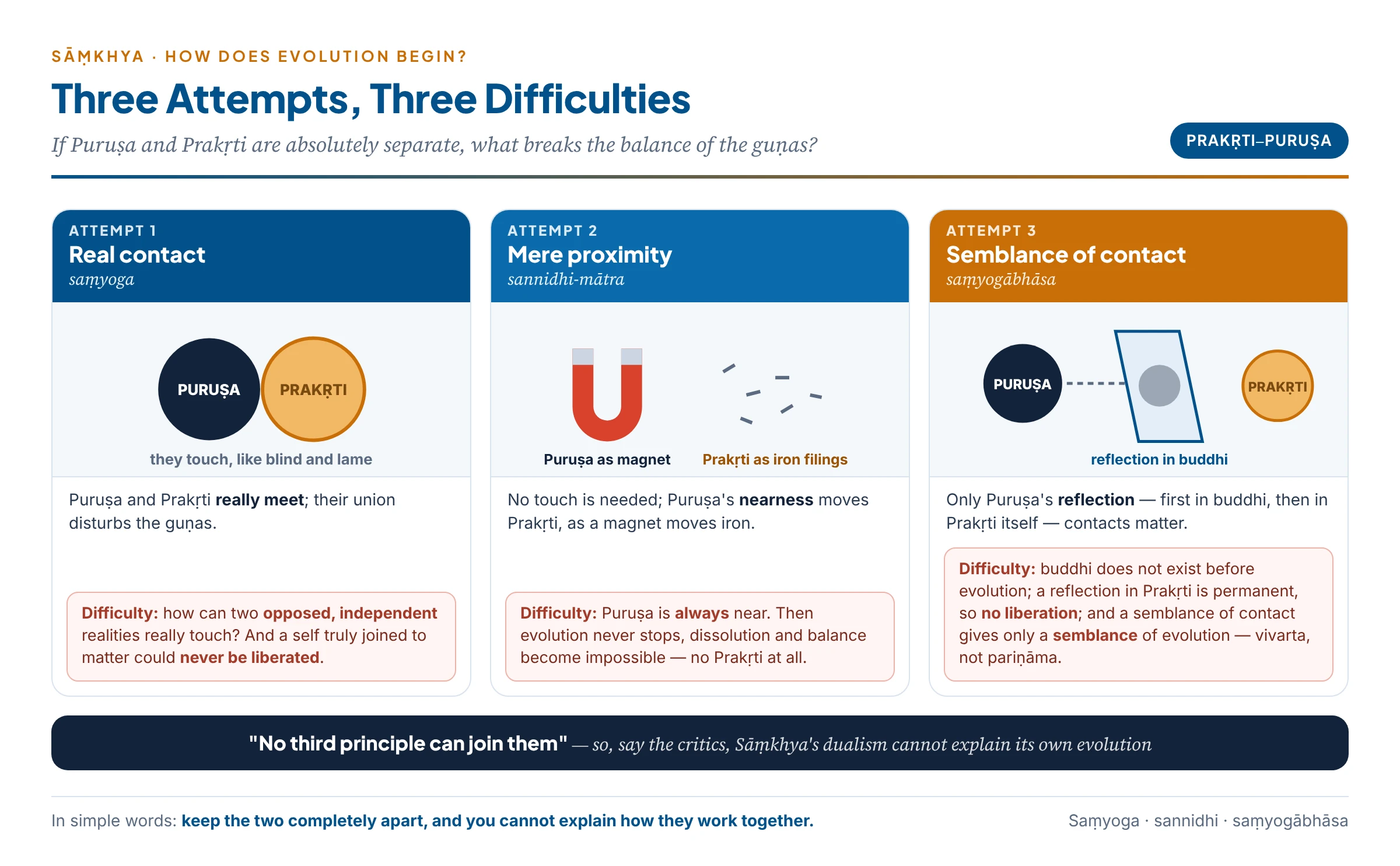
The hardest question for Sāṃkhya is: how does the presence of Puruṣa disturb the equilibrium of the guṇas, if the two are absolutely separate and independent? The system offers three answers, each meeting a difficulty.
- First attempt — real contact (saṃyoga).
- The view. The equilibrium is disturbed by a real contact of Puruṣa and Prakṛti, as in the lame-and-blind parable.
- The difficulty. How can two opposed, independent realities — one inactive, the other unconscious — really come into contact? And if Puruṣa were really joined to Prakṛti, it could never be liberated.
- Second attempt — mere proximity (puruṣa-sannidhi-mātra).
- The view. There is no real contact; the mere nearness of Puruṣa is enough, as a magnet moves iron filings without touching them.
- The difficulty. Puruṣa, being inactive and all-pervading, can never move away; it is always near Prakṛti. Then evolution should never stop, dissolution would be impossible, evolution would be beginningless, and Prakṛti as a state of balance could never exist. Sāṃkhya is caught in a dilemma: either no contact and no evolution, or constant contact and no equilibrium, no Prakṛti, no dissolution.
- Third attempt — a semblance of contact (saṃyogābhāsa).
- The view. There is only an appearance of contact: Puruṣa is reflected in buddhi and wrongly identifies itself with this reflection; it is the reflection, not Puruṣa, that contacts Prakṛti.
- First difficulty. Buddhi is the first product of evolution; how can it exist before evolution to receive the reflection?
- Revised view. Puruṣa is reflected in Prakṛti itself.
- Further difficulties. Prakṛti is always there, and it is Puruṣa’s nature to identify with its reflection — so Puruṣa would never be liberated, and the very purpose of evolution would be defeated. The reflection being always there, there would be no dissolution, no equilibrium and no Prakṛti. And if a semblance of contact is enough to start evolution, evolution itself becomes a semblance — an appearance (vivarta) — and not a real transformation (pariṇāma).
- The verdict of critics. To keep Puruṣa and Prakṛti absolute and independent, Sāṃkhya “commits blunder after blunder”. As Śaṅkara puts it, Prakṛti being unintelligent and Puruṣa indifferent, with no third principle to connect them, no connection between the two is possible.
12. Can Sāṃkhya Explain the Presence of Consciousness in the World?
- The question. Our world is full of conscious beings who perceive, think and feel. Sāṃkhya’s evolutes — buddhi, ahaṅkāra, manas — are all material and unconscious. Can the system account for consciousness?
- What satkāryavāda rules out. Since the effect has the same nature as its material cause, an unconscious Prakṛti can never produce consciousness. So Sāṃkhya never says consciousness evolves from matter. On this point it is firmer than many materialisms: consciousness is not a product of the brain or of the organs.
- What Sāṃkhya says instead.
- Consciousness belongs to Puruṣa alone. It is not one of the twenty-four evolutes.
- The mind-body system borrows it. Buddhi, being sāttvika and transparent, reflects Puruṣa’s consciousness and so becomes apparently conscious. The unconscious subtle body seems conscious because of its link with Puruṣa, and the inactive Puruṣa seems to be an agent because of its link with the active guṇas — as a clear crystal seems red when a red hibiscus is placed beside it.
- So conscious life = Puruṣa’s light + Prakṛti’s machinery. Every conscious state is a material modification of buddhi lit up by Puruṣa.
- Strengths of the answer.
- It respects the difference in kind between consciousness and matter — the point modern philosophers call the “hard problem“: no amount of physical process seems to add up to experience.
- It explains why our mental contents change while the awareness of them seems constant.
- Weaknesses.
- Reflection is a metaphor. How can immaterial consciousness be “reflected” in a material intellect? A mirror reflects light because both are physical.
- The relation problem again. If Puruṣa and Prakṛti can never truly meet (section 11), the reflection itself is unexplained.
- Many consciousnesses, one world. If each Puruṣa is separate and contentless, what makes my consciousness mine? The answer — “its own buddhi” — makes individuality a feature of matter.
- Materialist reply. The Cārvākas (and modern neuroscience) treat consciousness as arising from matter organised in a certain way, like the intoxicating power that arises when certain ingredients are fermented.
- Conclusion. Sāṃkhya can explain the presence of consciousness only by importing it from outside Prakṛti — from Puruṣa. Within its own theory of causation, it cannot let consciousness evolve; this makes its account consistent but leaves the link between consciousness and matter unexplained.
Indian Connect — Evolution, Indian and Western
- Herbert Spencer defined evolution as a change from an indefinite, incoherent homogeneity to a definite, coherent heterogeneity — almost word for word Sāṃkhya’s passage from the homogeneous change of the balanced guṇas to the heterogeneous change that produces the world.
- Darwin’s evolution is biological and blind; Sāṃkhya’s is cosmic and purposive, and it moves from the subtle (intellect) to the gross (earth) — the reverse of modern science, which moves from matter to mind.
- Sri Aurobindo keeps the idea of evolution but adds involution: Spirit first descends into matter, which is why matter can evolve towards life, mind and Spirit — answering the Sāṃkhya puzzle of how unconscious matter can be purposive.
Critical Evaluation
Objections
- Unconscious teleology is a contradiction.
- If Prakṛti is unconscious, evolution must be mechanical and blind; if evolution serves Puruṣa’s purposes, Prakṛti is neither unconscious nor independent.
- Stones, bricks and mortar cannot account for the design of a building; clay cannot fashion itself into a pot.
- The analogies mislead.
- Milk and calf. Milk flows because there is a living cow with motherly love for the calf.
- Grass into milk. Grass becomes milk only when eaten by a cow, not when it lies uneaten or is eaten by a bull.
- Blind and lame. Both are conscious, active people who can agree on a common plan; Prakṛti is unconscious, Puruṣa indifferent, and they have no common purpose.
- Magnet and iron. The magnet’s nearness is permanent; so evolution would never cease and dissolution would be impossible.
- The first push. Sāṃkhya cannot explain the original impetus — the first disturbance — that breaks the balance of the guṇas.
- The three attempts fail (section 11): real contact makes liberation impossible; proximity makes evolution endless; semblance makes evolution unreal.
- Order of evolution. Why should the subtle (intellect, ego) come before the gross (earth, water)? Experience and science show mind appearing after matter.
- The ego and the elements. Deriving the senses and the physical elements from ahaṅkāra, a psychological principle, mixes the psychological and the physical.
Sāṃkhya’s Replies
- On unconscious teleology. Nature everywhere shows purpose without consciousness — seeds grow into trees, bodies heal themselves, organs work for the whole. Purposiveness need not mean conscious design.
- On the analogies. They are illustrations, not proofs; each shows one point — cooperation of opposites, action without awareness, influence without touch.
- On the first push. The cycle of creation and dissolution is beginningless; there is no absolute “first” disturbance to explain, only the regular alternation of balance and imbalance in the presence of Puruṣa.
- On the order of evolution. The order is logical and causal, not a matter of time: the subtler principle is the cause of the grosser, since the cause is always subtler than its effect.
- On ahaṅkāra. Mahat and ahaṅkāra have cosmic as well as psychological aspects; the physical world is the objective side of the same process whose subjective side is the individual ego.
Critics and Defenders
Criticism — Critics
- Śaṅkara: blind Prakṛti cannot produce an ordered world; the milk–calf and blind–lame similes fail; there is no third principle to join Puruṣa and Prakṛti.
- Nyāya: order requires an intelligent agent, God.
- Logical critics: real contact, proximity and semblance all fail; unconscious purpose is a contradiction.
- Scientific critics: mind appears after matter, not before; the senses are not products of the ego.
Defence — Defenders and strengths
- The first systematic evolutionary cosmology in India — from the subtle to the gross, by stages.
- Satkāryavāda keeps the account non-theistic and rational.
- Purpose without consciousness has real parallels in nature.
- The cyclic view removes the need for a first moment of creation.
- Its analysis of buddhi, ahaṅkāra and manas is a rich psychology later used by Yoga, Vedānta and Āyurveda.
Cross-Tradition Comparison
Sāṃkhya Evolution and Western Ideas
| Point | Sāṃkhya | Western parallel |
|---|---|---|
| Homogeneous to heterogeneous | Balanced guṇas → differentiated world | Spencer’s formula of evolution |
| Purpose without a designer | Unconscious teleology of Prakṛti | Aristotle’s natural teleology; Kant’s “purposiveness without purpose” in nature |
| Unmoved mover | Puruṣa moves Prakṛti by mere presence | Aristotle’s God moves the world as an object of desire |
| Intellect before matter | Mahat, the cosmic intellect, is the first evolute | Plotinus: from the One comes Intellect (Nous), then Soul, then matter |
| Mind as material | Buddhi, ahaṅkāra, manas are products of matter | Hobbes and modern materialists — but Sāṃkhya keeps a separate witness-consciousness |
| Faculties of mind | Buddhi, ahaṅkāra, manas — knowing, willing, feeling | Plato’s three parts of the soul; the classical triad of cognition, conation, affection |
| Ego as a construction | Ahaṅkāra is a product, not the true self | Hume: the self is a bundle; Freud: the ego as a part of the psyche |
| Life force | Rajas, the inherent motion of Prakṛti | Bergson’s élan vital |
| Cycles | Endless sarga and pralaya | Stoic world-cycles; Nietzsche’s eternal recurrence |
Indian Connect — Key takeaways
- The twenty-five tattvas are Sāṃkhya’s map of reality; Yoga, the Purāṇas, the Gītā, Tantra and Āyurveda all build on it.
- Sāṃkhya puts mind inside nature: intellect, ego and mind are as material as earth — only consciousness stands outside. This is the reverse of Descartes, for whom mind is the spiritual substance.
- Its unsolved question — how unconscious matter is moved by an inactive self — is exactly where Advaita and Aurobindo take over.
Synthesis (Siddhānta)
- Evolution (sarga) begins when the presence of Puruṣa disturbs the balance of Prakṛti’s guṇas; rajas is stirred first, and the guṇas combine in different proportions.
- The order is: mahat/buddhi (cosmic germ and individual intellect: ascertainment and decision) → ahaṅkāra (I-sense: “I” and “mine”), threefold → from sāttvika ahaṅkāra manas and the ten organs; from tāmasa ahaṅkāra the five tanmātras → the five mahābhūtas, each with cumulative qualities. With Prakṛti and Puruṣa these make twenty-five tattvas.
- The three internal and ten external organs make the thirteen karaṇas; the subtle body of eighteen principles carries karma from birth to birth.
- Evolution is a manifestation, cyclic and teleological — an unconscious purposiveness for Puruṣa’s experience and liberation, continuing until all Puruṣas are free.
- Its weak points are the first disturbance and the relation of Puruṣa and Prakṛti (real contact, proximity and semblance of contact all fail) and the claim that blind matter can work for a purpose.
- On consciousness, Sāṃkhya is consistent — consciousness never evolves from matter, it belongs to Puruṣa and is only reflected in buddhi — but the reflection remains a metaphor.
- Contemporary relevance.
- Cosmology. The picture of a balanced primordial state that breaks into increasing complexity, in cycles, resonates with modern cosmological narratives of symmetry-breaking and structure formation.
- Philosophy of mind. Sāṃkhya’s line between mental contents (material) and awareness (not material) is close to today’s debates on the hard problem of consciousness and on “witness consciousness” in meditation research.
- Psychology. The distinction of intellect, ego and mind anticipates the separation of decision-making, self-identification and perceptual processing in cognitive science.
- Āyurveda and Yoga. The tattva scheme remains the theoretical basis of Āyurvedic physiology and of Yoga’s account of the mind.
“As the unconscious milk flows for the nourishment of the calf, so Prakṛti acts for the liberation of Puruṣa.” — Īśvarakṛṣṇa, Sāṃkhyakārikā
Previous Year Questions
- 2024Present an account of evolution of Prakṛti as propounded in Sāṃkhya-kārikā. In this context, also explain the difference between buddhi, mahat and ahaṃkāra.
- 2017Given the theory of causation, is it possible for Sāṃkhya to explain the presence of consciousness in the world? Discuss.
- 2016Critically examine the role of ‘Prakṛti’ in the process of evolution.
- 2013Evaluate the relation, if any, between Prakṛti and Puruṣa.
- 2002Sāṃkhya theory of Evolution of Prakṛti. Short notes.
- 1997Explain the nature of Prakṛti and its evolution according to the Sāṃkhya system.