

Schools of Buddhism: Pratītyasamutpāda; Kṣaṇikavāda, Nairātmyavāda
Official Syllabus: Paper I, Section B, Unit 14
Pratītyasamutpāda — “dependent origination” or “conditioned arising” — is the Buddha’s theory of causation and the root from which every other Buddhist doctrine grows. It says that nothing exists on its own: everything arises in dependence on conditions and ceases when those conditions cease. Applied to human life, it becomes the twelve-linked chain (dvādaśa-nidāna) that explains how ignorance leads, step by step, to birth, old age and death — and how breaking the chain leads to nirvāṇa. Applied to the world, it rules out an eternal self, a creator God and pure chance, and yields momentariness (Kṣaṇikavāda) and no-self (Nairātmyavāda). The Buddha himself said: “He who sees dependent origination sees the Dhamma; he who sees the Dhamma sees dependent origination.“
In simple words
A lamp’s flame needs a wick, oil, air and a spark. Take away any one and the flame goes out. The flame was never sitting hidden inside the oil, and it did not come from nowhere either; it arises because these conditions come together, and ceases when they fall apart. Buddhism says the same of everything — a sprout, a feeling, a person, and our suffering.
Context & Problem
The Question of Causation in Indian Philosophy
- The central question. Indian schools classify theories of causation by one question: does the effect pre-exist in its material cause?
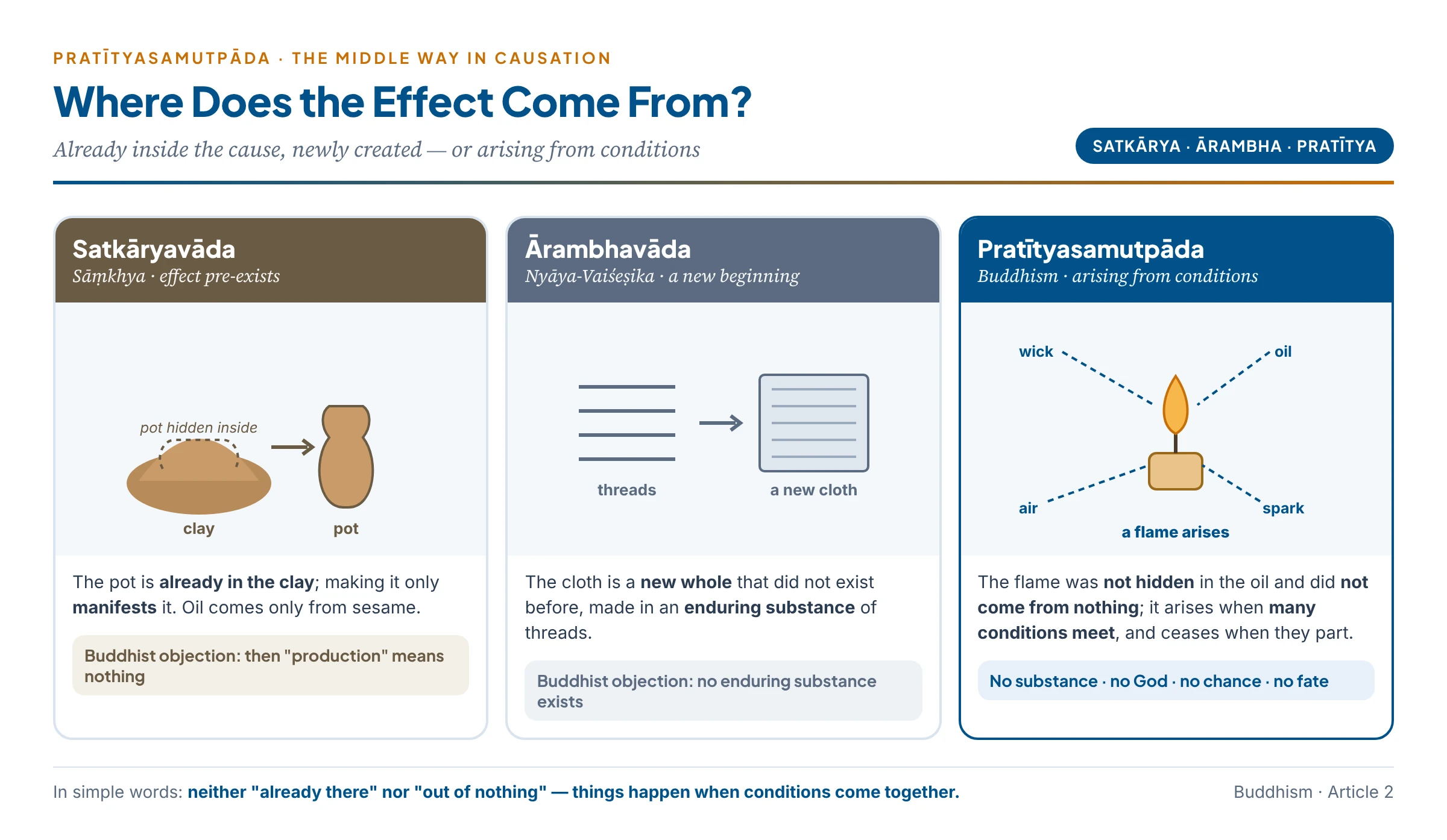
- Satkāryavāda (yes) — the effect already exists in the cause in a hidden form; causation is manifestation (Sāṃkhya, Yoga, Advaita). Clay already contains the pot.
- Asatkāryavāda (no) — the effect is a new beginning (ārambha), not present before production (Nyāya, Vaiśeṣika). Threads produce a cloth that did not exist before.
- Other views the Buddha rejected: svabhāvavāda (things happen by their own nature — Cārvāka), yadṛcchāvāda (pure chance), niyativāda (fate — the Ājīvikas), and Īśvara-nirmāṇa (creation by God).
- Where Buddhism stands. Buddhists deny that the effect pre-exists (so they are counted among asatkāryavādins, beside the Nyāya-Vaiśeṣika ārambhavāda), yet they also deny that the effect is a new creation out of nothing. Their theory is a third way: the effect arises in dependence on a collection of conditions.
Why the Buddha Needed a Theory of Causation
- The second noble truth asks: what is the cause of suffering? To answer it, the Buddha had to explain how suffering arises — and therefore how it can cease.
- The problem of the self. If there is no permanent soul, what links one moment of life to the next, and one life to the next? Causation, not a soul, does the linking.
- The problem of God and fate. If the world is made by God or fixed by fate, human effort is useless. If things happen by chance, nothing can be predicted or changed. Only a lawful, conditioned world leaves room for the path.
Core Doctrine
1. Meaning of the Term
- Pratītya — “having depended on“, “having reached” (from prati + i, to go towards).
- Samutpāda — “arising together“, “co-origination” (sam = together, ut-pāda = arising). The “together” matters: an effect arises from several conditions jointly, never from a single cause.
- Pāli: paṭicca-samuppāda. Another early name is idappaccayatā — “this-conditionality“.
- Other names: the theory of conditional existence of things; relativity (of everything to its conditions).
2. The General Formula
“When this is, that is; from the arising of this, that arises. When this is not, that is not; from the ceasing of this, that ceases.” — The Buddha (asmin sati idaṃ bhavati, asyotpādād idam utpadyate)
- Two halves. The formula states a law of arising (“this being, that arises”) and a law of ceasing (“this not being, that does not arise”). The first explains bondage; the second makes liberation possible.
- Universal law. “There is a spontaneous and universal law of causation which conditions the appearance of all events, mental and physical. This law (dharma) works automatically, without the help of any conscious guide.” Whenever the cause appears, the effect follows; “nothing happens fortuitously or by chance“.
- Its importance to the Buddha.
- He calls it the Dhamma itself: “Let us put aside questions of the beginning and the end. I will teach you the Dhamma: that being thus, this comes to be.”
- He identifies it with his enlightenment (bodhi): it was this that he “saw” under the Bodhi tree.
- He compares it to a staircase, mounting which one sees the world “with the eye of a Buddha”.
- Failure to grasp it is “the cause of all our troubles“. It is “very profound“.
- The foundation of all teaching. It is contained in the second noble truth (how suffering arises) and the third (how it ceases), and all other doctrines can be deduced from it.
In simple words
Ask “Why did the mango fall?” One person says “the wind“, another “its own weight“, a third “its stem had dried“, a fourth “the tree let it go in its season“. Each names one condition; none names “the” cause. The mango fell because all these conditions met. Pratītyasamutpāda trains us to stop looking for one cause — a God, a soul, a fate — and to see a web of conditions.
3. The Twelve Links (Dvādaśa Nidāna)
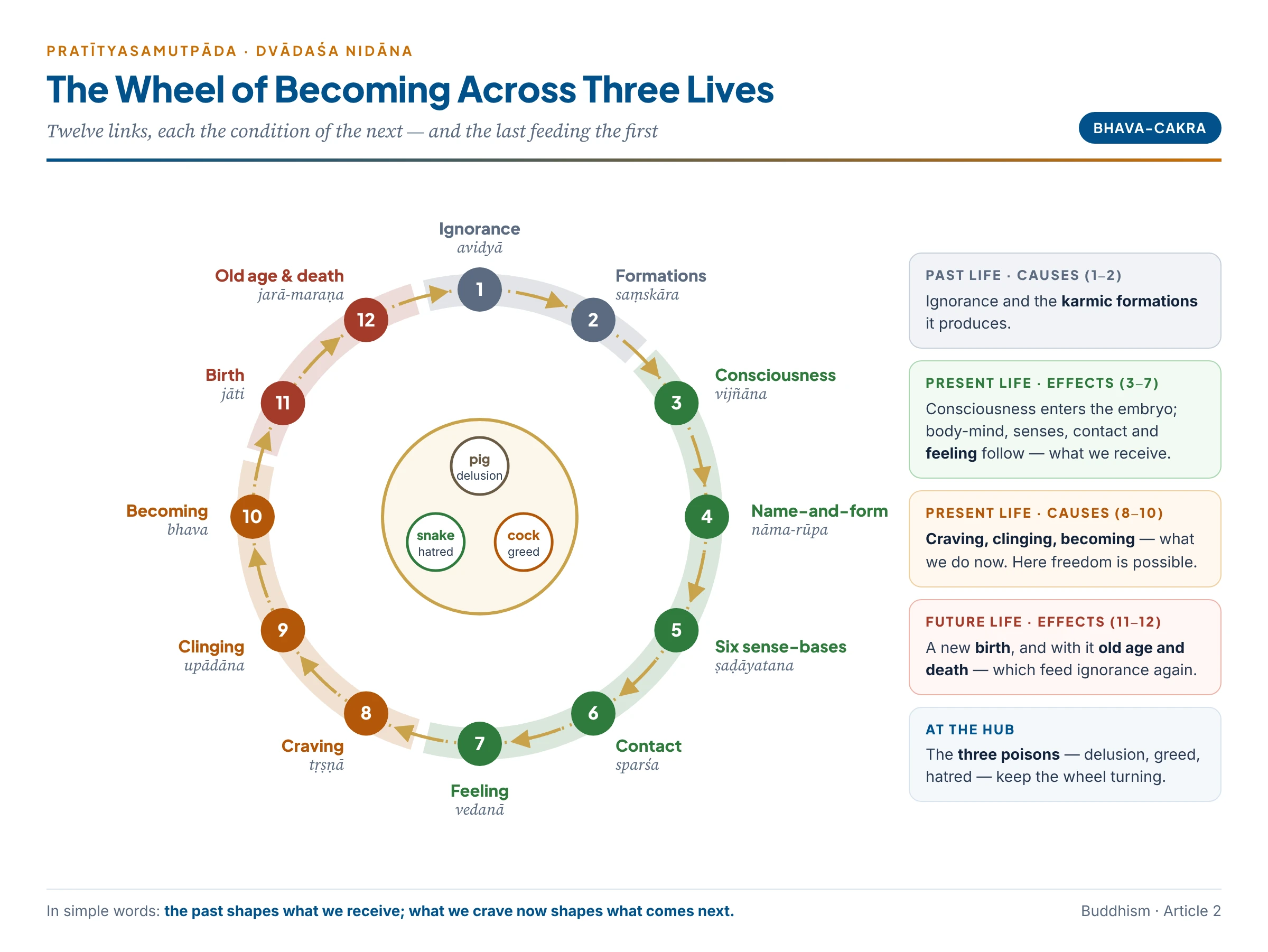
Applied to the human predicament, dependent origination answers the question: why are we born, and why do we grow old and die? The Buddha traced the causes backwards from suffering:
| # | Link | Sanskrit / Pāli | What it means | Arises because of… |
|---|---|---|---|---|
| 12 | Old age and death (with sorrow, grief, despair) | jarā-maraṇa | Life’s suffering | birth — had we not been born, we would not decay and die |
| 11 | Birth | jāti | Coming into a new existence | the will to become |
| 10 | Becoming | bhava | The disposition or tendency to be born — the karmic force that projects a new life | clinging |
| 9 | Clinging | upādāna | Grasping at objects, views, rituals and the idea of a self | craving |
| 8 | Craving | tṛṣṇā / taṇhā | Thirst to enjoy sights, sounds and other objects | feeling — we desire only what we have tasted as pleasant |
| 7 | Feeling | vedanā | Pleasant, unpleasant or neutral tone of experience | contact |
| 6 | Contact | sparśa / phassa | Meeting of sense-organ, object and consciousness | the six sense-bases |
| 5 | Six sense-bases | ṣaḍāyatana | The five senses and mind (manas) | the mind–body organism |
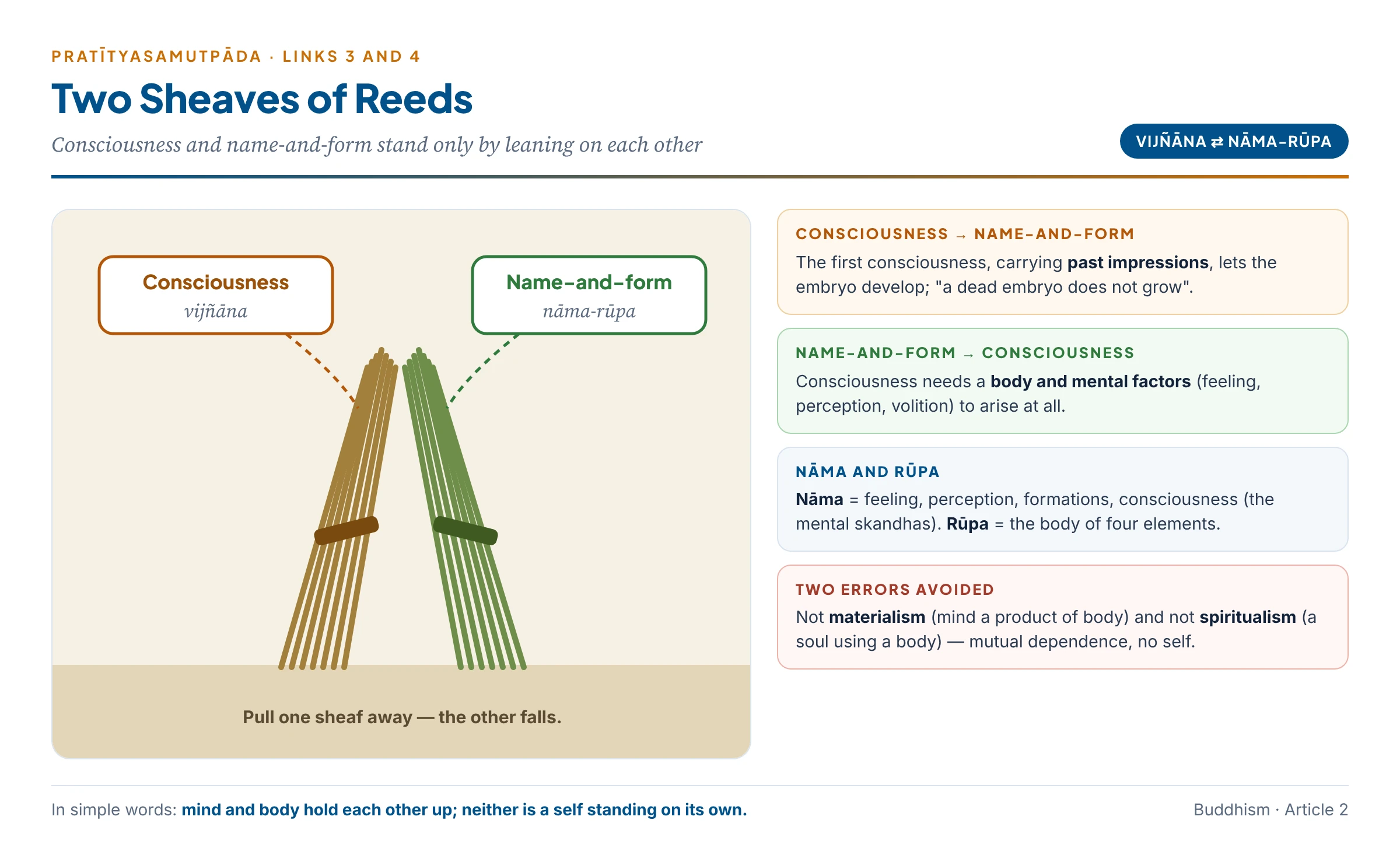
| 4 | Name-and-form | nāma-rūpa | The psycho-physical organism developing in the womb | consciousness — a dead embryo would not develop |
| 3 | Consciousness | vijñāna | The initial consciousness that “descends” into the embryo | karmic formations of the past life |
| 2 | Formations | saṃskāra | Impressions and volitional tendencies left by past deeds | ignorance |
| 1 | Ignorance | avidyā | Not knowing the Four Truths, impermanence and no-self | — (the root) |
- Read forwards: ignorance → formations → consciousness → name-and-form → six sense-bases → contact → feeling → craving → clinging → becoming → birth → old age and death.
- Not fixed in every sermon. “The order and number of the links are not always the same in all the sermons”, but this twelvefold list became the standard account.
- Its names. The wheel of becoming (bhava-cakra), the wheel of birth and death (janma-maraṇa-cakra), the wheel of the Dhamma (dharma-cakra), the twelve sources (dvādaśa nidāna). Devout Buddhists still turn prayer wheels to remind themselves of it.
- A vicious circle. The wheel does not stop at death: “death is only the beginning of a new life”. Old age and death, by renewing ignorance, feed the next turn.
4. The Three-Life Interpretation
The twelve links are often spread over three lives connected as cause and effect:
| Period | Links | Role |
|---|---|---|
| Past life | 1. Ignorance, 2. Formations | Past causes — the karma that produces this life |
| Present life | 3. Consciousness, 4. Name-and-form, 5. Six sense-bases, 6. Contact, 7. Feeling | Present effects — what we receive |
| Present life | 8. Craving, 9. Clinging, 10. Becoming | Present causes — what we do now |
| Future life | 11. Birth, 12. Old age and death | Future effects — what we will receive |
- The lesson. The present is the result of the past and the cause of the future. We cannot change links 3–7 (they are already given), but we can act on links 8–10 — craving, clinging and becoming. That is where freedom lies.
- Rebirth without a soul. The chain explains how a new life arises from the old without anything permanent passing over: the last state of the past life, “containing in a concentrated manner the impressions of all our past deeds”, conditions the first consciousness of the new life.
5. The Wheel in Picture (Bhavacakra Painting)
In the traditional painting of the wheel, held in the jaws of Yama (Death), the twelve links are shown as images on the rim — a memory aid for beginners:
| Link | Image | Why |
|---|---|---|
| Ignorance | A blind person with a stick | We walk without seeing |
| Formations | A potter shaping pots | Our deeds shape the next life |
| Consciousness | A monkey jumping from branch to branch | Restless mind passes from one object to another |
| Name-and-form | Two people in a boat | Mind and body travel together |
| Six sense-bases | A house with six windows | The six doors of experience |
| Contact | A couple embracing | Sense and object meet |
| Feeling | An arrow in the eye | Feeling strikes us |
| Craving | A man drinking | Thirst that is never quenched |
| Clinging | A monkey or man plucking fruit | Grasping at objects |
| Becoming | A pregnant woman | A new life is conceived |
| Birth | A woman giving birth | Rebirth |
| Old age and death | A corpse carried away | The end — and a new beginning |
- At the hub: a pig (delusion), a cock (greed) and a snake (hatred) chase each other — the three poisons that keep the wheel turning.
6. The Importance of Name-and-Form (Nāma-rūpa)
- What it is. Nāma (“name”) is the mental side — feeling, perception, volition, contact, attention (the four mental skandhas of vedanā, saṃjñā, saṃskāra and vijñāna are counted as nāma); rūpa (“form”) is the material side — the body made of the four elements. Together they are the psycho-physical person.
- Why it matters in the chain.
- It replaces the soul. What later appears as “I” is shown to be a compound of mental and bodily processes, conditioned by consciousness — not a self.
- It links the past to the present life. Consciousness, carrying past impressions, conditions the development of the embryo (nāma-rūpa); without consciousness, the embryo would be “dead” and would not grow.
- Mutual dependence. The Buddha also says that consciousness depends on name-and-form and name-and-form on consciousness — “like two sheaves of reeds standing leaning against each other: if one is pulled away, the other falls”. Neither mind nor body is the independent ground of the other.
- The base of experience. From nāma-rūpa arise the six sense-bases, and from them all experience, craving and clinging.
- Against two extremes. By making mind and body interdependent, nāma-rūpa avoids both materialism (consciousness is a by-product of the body, as the Cārvāka says) and spiritualism (an immaterial soul uses the body).
7. Forward and Reverse Order: Bondage and Liberation
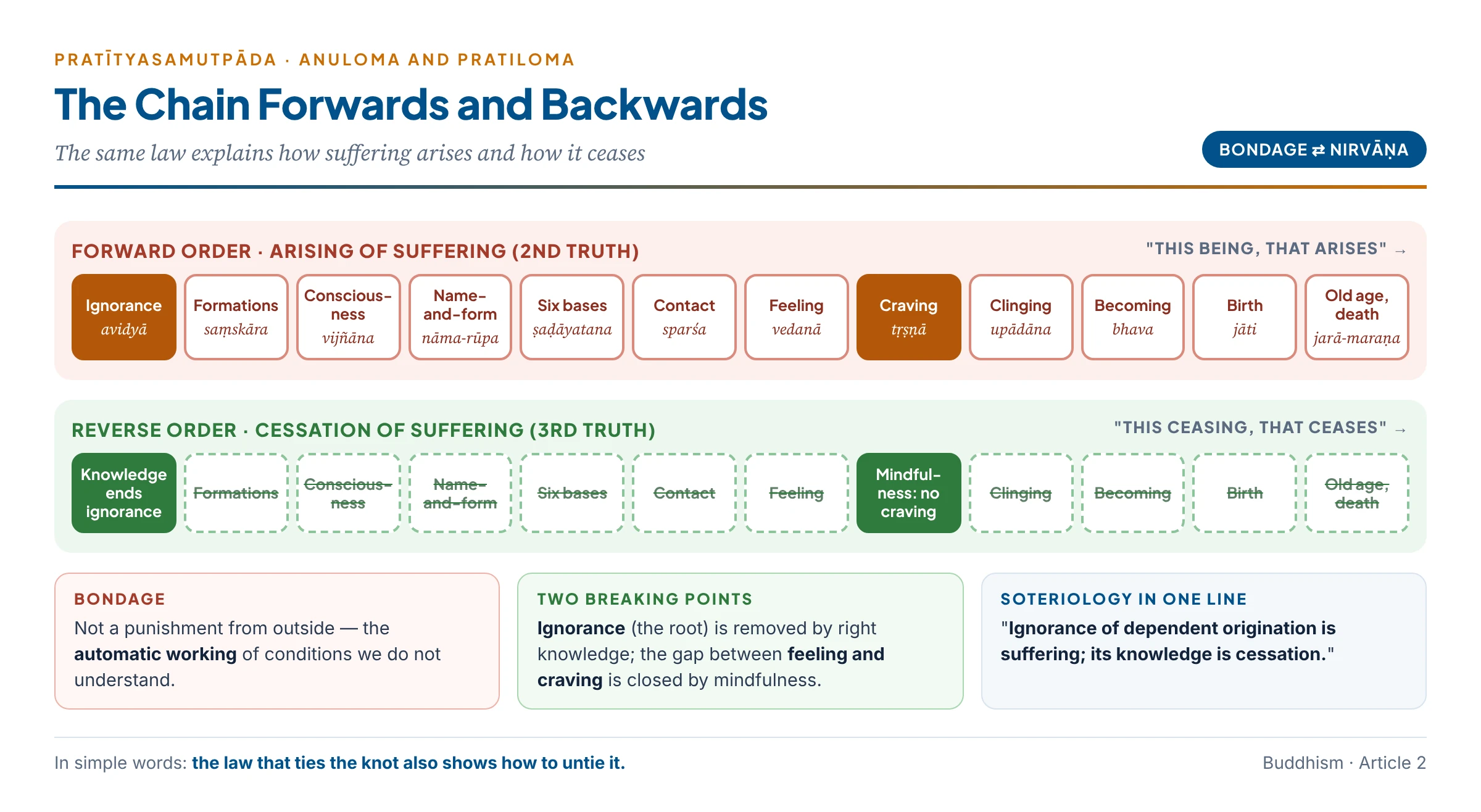
- Forward order (anuloma) — “From ignorance as condition, formations arise… thus arises this whole mass of suffering.” This is dukkha-samudaya, the second noble truth.
- Reverse order (pratiloma) — “From the complete cessation of ignorance, formations cease; from the cessation of formations, consciousness ceases… thus ceases this whole mass of suffering.” This is dukkha-nirodha, the third noble truth.
- Where the chain is broken.
- At the root: ignorance. “Ignorance can be removed only by right knowledge — specifically, knowledge of the Dhamma, that is, of dependent origination itself.” “Ignorance is bondage and knowledge is nirvāṇa.“
- At the hinge: between feeling and craving. Feeling (7) is a result, but craving (8) is a response. Through mindfulness, a pleasant or painful feeling can be seen as arising and passing without turning into thirst. Here the Eightfold Path does its daily work.
- “Ignorance of dependent origination is suffering; knowledge of it is the cessation of suffering.” This is Buddhist soteriology (the doctrine of salvation) in one line:
- Bondage is not a punishment imposed from outside; it is the automatic working of conditions that we do not understand.
- Liberation is not a gift of grace; it is the ending of those conditions by seeing them for what they are.
- The same law that binds also frees — because what arises from conditions ceases with them.
In simple words
A row of dominoes falls because the first one was pushed. To stop the fall, you need not fight every domino; remove the first one, or pull out one in the middle, and the rest stay standing. Ignorance is the first domino; the gap between feeling and craving is the one we can reach every day.
8. Pratītyasamutpāda as the Middle Way
The Buddha himself called dependent origination the middle. It avoids several pairs of extremes:
(a) Between Eternalism and Annihilationism
- Eternalism (śāśvatavāda) — some reality (a soul, a substance) exists eternally, independent of conditions.
- Annihilationism (ucchedavāda) — what exists can be utterly destroyed, leaving nothing.
- The middle. “Everything that we perceive possesses an existence but is dependent on something else, and that thing in turn does not perish without leaving some effect.” Things are neither absolutely real nor absolutely unreal; they “hang between reality and nothingness“.
(b) Between Satkāryavāda and Asatkāryavāda
- Against satkāryavāda. If the effect already existed in the cause, its “production” would be meaningless; and a thing “can never change into another thing, because a thing is what it is“. The sprout is not hidden inside the seed.
- Against strict asatkāryavāda. If the effect were wholly new and unconnected, anything could come from anything; and a substance that persists through the change (as the Nyāya believe) is not admitted by Buddhism.
- The Buddhist view. Causation is the succession of two events, the former the cause and the latter the effect, where the effect is conditioned by many factors together. The flame is conditioned by wick, oil and air; the sprout by seed, soil, water, warmth and season.
- Does it reconcile the two? In one sense yes: with satkāryavāda it holds that the effect is not unrelated to its cause (there is continuity of the series); with asatkāryavāda it holds that the effect is new (it did not exist before). In another sense it is neither: both theories assume a substance (clay, threads) in which the effect does or does not pre-exist; Buddhism denies the substance and speaks only of conditions and events. It is better called a rejection of the shared assumption than a compromise.
Common confusion
Is ignorance the “first cause” of the world, as God is in theism? No. Many notes call avidyā the “first link” and then treat it like a beginning in time. The Buddha refused to speak of a first beginning at all (“let us put aside questions of the beginning and the end”). Ignorance comes first in the list because it is the root condition whose removal stops the cycle — not because the world started from it. The wheel is beginningless but endable.
In simple words
A seed in a granary stays a seed for months; the same kind of seed in a wet field sprouts in days. The sprout was not hiding in the seed (against satkāryavāda), nor did it come from nothing (against pure asatkāryavāda). It arose when seed, soil, water and warmth came together. Change the conditions and you change the result — that is why effort on the path is not wasted.
(c) Between Self-Caused and Other-Caused
- Asked whether suffering is made by oneself, made by another, by both, or by neither (by chance), the Buddha rejected all four:
- “Made by oneself” implies a permanent self that acts and suffers — eternalism.
- “Made by another” implies that the sufferer is unrelated to the doer — annihilationism.
- “Both” combines both errors.
- “Neither” means chance, which denies causation altogether.
- The middle: suffering arises dependently — “from ignorance, formations…”. This four-cornered rejection anticipates Nāgārjuna’s critique of causation.
(d) Between Theism, Fatalism and Chance
- No God. “The wheel of the cosmic order goes on without maker, without beginning.” The world needs no creator to explain it.
- No fate. Conditions can be changed; therefore effort on the path is meaningful.
- No chance. “Nothing comes out of nothing”; every event has conditions.
9. Conditions in the Later Schools
- Hetu and pratyaya. Later Abhidharma distinguishes the main cause (hetu) from the supporting conditions (pratyaya). The seed is the hetu of the sprout; soil, water and sunlight are its pratyayas.
- The four conditions (accepted by the Sarvāstivāda and examined by Nāgārjuna):
- Causal condition (hetu-pratyaya) — the seed-like cause.
- Immediately preceding condition (samanantara-pratyaya) — the previous moment of the same series (the last thought conditions the next).
- Object condition (ālambana-pratyaya) — the object that a cognition is about.
- Dominant condition (adhipati-pratyaya) — the decisive factor, such as the sense organ that makes a cognition visual rather than auditory.
- The Theravāda Abhidhamma lists twenty-four kinds of condition (paccaya) — a sign of how seriously the tradition analysed causation.
10. The Doctrines That Follow (Logical Corollaries)
Dependent origination is the “mother doctrine” from which the rest is logically derived:
- Universal change (anityavāda) and momentariness (kṣaṇikavāda) — what arises from conditions perishes when they cease; whatever is born must die (Article 3).
- No-self (nairātmyavāda) — nothing conditioned can be an independent, permanent self (Article 5).
- The theory of aggregates (saṅghātavāda) — a person or a thing is only a collection of conditioned parts (Article 5).
- The law of karma (karmavāda) — “only a special form of the more general law of causation”: the present is the effect of the past, the future of the present (Article 6).
- Causal efficiency as the mark of the real (arthakriyākāritva) — each link is real because it produces the next (Article 3).
- The three marks (tilakkhaṇa) — impermanence, unsatisfactoriness and no-self (Article 1).
- Emptiness (śūnyatā) — Nāgārjuna: “Whatever is dependent origination, that we call emptiness” (Article 9).
11. One Doctrine, Two Opposite Conclusions
How can the same doctrine lead one school to say “everything is real” and another to say “everything is void“?
- The Sarvāstivāda / Vaibhāṣika route — “everything is real”.
- Dependent origination is a relation between real elements (dharmas). A cause must be real to produce an effect; an unreal hare’s horn produces nothing.
- Each dharma has its own nature (svabhāva) — heat for fire, solidity for earth — which is what lets it act as a condition.
- For a past cause to produce a present effect, and a past deed to bear future fruit, dharmas must exist in all three times — hence the name sarvāsti-vāda, “the doctrine that all exists“.
- Only the composite (a person, a chariot) is a mere name; the elements are real.
- The Mādhyamika route — “everything is void”.
- If a thing depends on conditions, it has no nature of its own (niḥsvabhāva); what has an own-nature would be independent and could not depend on anything.
- Since everything depends, everything is empty of own-nature — śūnya.
- Even the dharmas are dependent, so the Abhidharmic “real elements” are empty too (dharma-nairātmya).
- “Void” does not mean non-existent; it means dependently existing. Emptiness is dependent origination.
- Why they diverge. The two schools read dependence in opposite ways: the realist sees it as a relation that needs real relata; the Mādhyamika sees it as proof that the relata are not independently real. Between them stand the Sautrāntika (only present dharmas are real) and the Yogācāra (only consciousness is real). (Compared fully in Article 10.)
Critical Evaluation
A. Was Dependent Origination Given Only to Explain Sorrow?
- For the view.
- The twelve links begin and end with suffering; their purpose is soteriological — to show where the chain can be cut.
- The Buddha avoided metaphysics (the ten unanswered questions) and called himself a physician, not a cosmologist.
- The “three-life” reading treats it as a theory of rebirth, not of the physical world.
- Against the view.
- The general formula (“this being, that arises”) is stated as a law of all events, mental and physical — the twelve links are only its application to human life.
- It answers metaphysical questions about causation (satkārya vs asatkārya), the self (no soul needed), God (no creator) and chance — and the later schools built entire metaphysics on it.
- The Buddha calls it the Dhamma and identifies it with his enlightenment: more than a medical chart.
- Balanced view. Its motive was practical (to end sorrow), but its content is metaphysical. The Buddha offered a minimal metaphysics for the sake of salvation; it later became a maximal metaphysics in the schools.
B. Rival Indian Critiques (Khaṇḍana)
- Śaṅkara: the links cannot be causes if they are momentary. The antecedent link ceases to exist when the next arises; how can a vanished thing produce anything? If it lasts until the effect appears, cause and effect are simultaneous and momentariness is given up. (Developed in Article 4.)
- Śaṅkara: the aggregates cannot form. Without an intelligent uniting principle (a self or God), momentary atoms and momentary skandhas cannot come together into bodies and persons. Each link causes only the next link, not the whole series.
- Śaṅkara: “existence from non-existence”. Buddhists say the seed must perish before the sprout appears; then the sprout comes from nothing — “had it been so, anything would arise from anything“.
- Whose ignorance? Ignorance is the first link, but ignorance must belong to someone. Without a self, who is ignorant? (The Buddhist reply: ignorance belongs to the series itself, as its present state; no owner beyond the series is required.)
- The beginningless circle. If the wheel has no beginning, calling ignorance the “first” link is arbitrary; and a beginningless chain explains nothing — “a series of the blind leading the blind”.
- Nyāya and Jaina: change needs a substance. Change is change of something; without an enduring substance (dravya), there is only replacement, not causation. The Jainas add that things are permanent as substance and changing only as modes (paryāya).
- Sāṃkhya: the effect must pre-exist. Oil comes only from sesame, not from sand; a definite cause yields a definite effect only if the effect is already there potentially.
C. Buddhist Replies
- The series does the work. Causation is between successive moments of a series (santāna): the preceding moment conditions the next as it passes; no persisting substance is needed, just as a flame needs no unchanging “flame-substance” to burn all night.
- Definite effects without pre-existence. Sesame yields oil because of the specific causal capacity of sesame-moments, not because oil hides inside them; regular conditions give regular effects.
- Ignorance as condition, not first cause. Ignorance is the most important condition, not a first cause in time. “Let us put aside questions of the beginning and the end.” The chain is explained as a cycle, and the cycle can be ended, even if it had no beginning.
- No uniting agent needed. Wholes are conventional names for aggregates; what is never really united needs no uniter.
D. Western Angles
- Hume also reduced causation to regular succession without hidden power — a striking parallel; but Hume kept a sceptical attitude to necessity, while the Buddha treated the causal law as certain and liberating.
- Kant made causation a category of the understanding; Buddhism makes it a feature of reality (at least of conventional reality).
- Process thinkers (Heraclitus, Bergson, Whitehead) agree that events and relations, not substances, are basic.
Critics and Defenders
Criticism — Critics
- Śaṅkara: a vanished cause cannot produce; momentary links cannot form aggregates; “existence from non-existence”.
- Nyāya and Jaina: change needs an enduring substance; without it causation becomes mere replacement.
- Sāṃkhya: a definite effect needs a pre-existing potential in the cause.
- The circle objection: a beginningless wheel with ignorance as “first” link explains nothing; whose ignorance?
- Interpreters: a chart of rebirth, not a metaphysics — given “only to explain sorrow”.
Defence — Defenders and strengths
- The series (santāna) carries causation, as the flame burns all night without a flame-substance.
- Avoids four errors at once: God, fate, chance and an eternal self.
- A middle way between eternalism and annihilation, between satkārya and asatkārya.
- Practically powerful: the same law that binds also frees; the chain can be broken at ignorance and at craving.
- Supports a whole metaphysics (momentariness, no-self, emptiness) from one principle.
Cross-Tradition Comparison
| Issue | Pratītyasamutpāda | Western parallel | Difference |
|---|---|---|---|
| What causation is | Conditioned arising of events from many conditions | Hume: constant conjunction, no observed “power” | Hume is sceptical about necessity; the Buddha treats the law as certain |
| Substance | No substance; only events and series | Heraclitus: everything flows; Whitehead: reality as process and relation | Buddhism uses process to end suffering, not only to describe nature |
| Life-force | Bhava — the will to become, causing birth | Bergson: the élan vital expresses an inner urge to live | Buddhism wants this urge extinguished; Bergson celebrates it |
| Interdependence | Everything relative to conditions | Modern ecology and systems theory | Both reject isolated, self-sufficient units |
| Causation and ethics | The causal law is the moral law (karma) | Kant separates the causal realm (nature) from the moral realm (freedom) | Buddhism unites them in one dharma |
| Indian theory | Effect before production? | Substance? | Example |
|---|---|---|---|
| Satkāryavāda (Sāṃkhya) | Exists potentially | Yes (Prakṛti) | Oil in sesame, pot in clay |
| Vivartavāda (Advaita) | Effect is an appearance of the cause | Yes (Brahman) | Snake on the rope |
| Ārambhavāda (Nyāya-Vaiśeṣika) | Does not exist; new beginning | Yes (atoms, parts) | Cloth from threads |
| Pratītyasamutpāda (Buddhism) | Does not exist, yet not from nothing | No | Flame from wick, oil, air |
Indian Connect — Key takeaways
- Indian thought asks about the material cause; the Buddha shifts attention to conditions and relations.
- Nāgārjuna turned dependent origination into emptiness; Śaṅkara, though a fierce critic, also made causation less than ultimately real (vivarta). Both deny that causation reveals an independent essence.
- The Yoga formula of “what is to be avoided, its cause, its removal and the means” mirrors the Buddha’s forward-and-reverse reading of the chain.
Synthesis (Siddhānta)
- The doctrine. Everything, mental and physical, arises in dependence on conditions and ceases when they cease. Applied to life, the twelve links show how ignorance leads to craving, clinging, rebirth and death; read in reverse, they show how knowledge ends the whole chain.
- Its place in Buddhism. It is the Dhamma, the content of the Buddha’s enlightenment, the basis of the second and third noble truths, and the root of momentariness, no-self, karma, and later emptiness.
- Its middle position. Neither eternalism nor annihilationism; neither pre-existence of the effect nor creation from nothing; neither God, fate nor chance.
- Its weak point. Without any enduring substance, the passage from one moment to the next — and the unity of a person — becomes hard to explain; this is the battleground of Articles 3–6.
- Contemporary relevance.
- Ecology and the interdependent world. Climate change, pandemics and supply chains show that nothing exists in isolation — a practical lesson in dependent arising.
- Psychology of addiction. The links feeling → craving → clinging describe the cycle of habit and addiction; mindfulness-based relapse prevention works precisely at the gap between feeling and craving.
- Systems thinking in policy. Public problems (poverty, health, crime) have many conditions rather than a single cause; effective policy addresses the web of conditions.
- Ethics of responsibility. If the present is conditioned by the past and conditions the future, every action matters — the moral core of karma without a creator.
“Whatever is subject to arising is subject to ceasing.” — The Buddha
Previous Year Questions
- 2024How do the two schools of Buddhism arrive at two opposed conclusions, namely “everything is void” and “everything is real” from the same doctrine of Pratityasamutpāda? Answer with arguments.
- 2023“Ignorance of dependent origination is suffering, while its knowledge is cessation of suffering.” Present an account of Buddhist soteriology in the light of above statement.
- 2020How is Kshanikavada a logical derivative of Pratityasamutpada in Buddhism? Explain.
- 2019What is Pratityasamutpāda? How do the Buddhists apply this concept to prove that everything is momentary?
- 2016Does the ‘Doctrine of Dependent Origination’ reconcile the two extreme views on the law of causation, namely Satkaryavada and Asatkaryavada? Give reasons for your answer.
- 2015What is the role of Pratityasamutpada in explaining dukkha? Elucidate means to overcome it.
- 2012Examine critically the statement that the doctrine of ‘paticcasamuppada‘ was given only to explain the problem of sorrow and not to solve the problems of metaphysics.
- 2011What is the importance of the Buddhist concept of ‘Nama-Rupa’ in the exposition of the Doctrine of Dependent Origination?
- 2010Bring out the metaphysical implication of the second noble truth of the Buddhism.
- 2006Discuss Pratityasamutpada in Buddhism. Short Notes.
- 2002Buddhistic doctrine of Pratitya-samutpada. Short Notes.