

Cārvāka: Theory of Knowledge; Rejection of Transcendent Entities.
Official Syllabus: Paper I, Section B, Unit 12
The Cārvāka or Lokāyata school is India’s only full-blooded materialist philosophy, and its whole system rests on one epistemological claim: perception (pratyakṣa) is the only valid means of knowledge (pramāṇa). Everything else follows from it. If only what the senses reveal can be known, then God, an immortal soul, karma, rebirth, heaven and liberation — all of which lie beyond the senses — cannot be known, and so cannot be accepted as real. To guard this conclusion, the Cārvāka does not so much prove that perception is valid as demolish every rival source of knowledge: inference (anumāna), comparison (upamāna) and testimony (śabda). Its attack on inference — the claim that the universal rule behind every inference (vyāpti) can never be established — is the most famous and most debated argument in the school.
In simple words
You come home and see your mother’s slippers at the door, so you say “Maa is home.” You did not see her — you inferred her from the slippers, trusting the rule “whenever her slippers are at the door, she is home.” The Cārvāka asks: how do you know that rule is true every time? Perhaps today she went to the neighbour’s in another pair. You saw the slippers (that is perception, and it is certain); the step from slippers to mother is a leap. The Cārvāka accepts only what you actually see, and calls every such leap uncertain.
Context & Problem
Who Were the Cārvākas?
- Two names. The school is called Cārvāka and Lokāyata.
- Lokāyata (loka = this world; āyata = spread, prevalent) means “that which is prevalent among the people” or “confined to this world (loka) alone” — the view of common people who believe only in what they see. A materialist is accordingly called a lokāyatika. Hostile writers twisted the word to mean “a commoner”, that is, a man of low and unrefined taste.
- Cārvāka has three popular explanations: from cāru-vāk, “sweet-tongued” — a doctrine pleasant to hear and superficially attractive; from the root carv, “to chew, to eat” — one who preaches “eat, drink and be merry“, or one who “chews up” all talk of merit and demerit (puṇya-pāpa), or even one who eats up his own words; or simply the proper name of a sage, Cārvāka, whose followers took his name.
- Other names. Bārhaspatya (followers of Bṛhaspati) and nāstika-śiromaṇi — “the crest-jewel of heretics” — a title of abuse given by opponents. The Rāmāyaṇa calls the materialists “fools who think themselves wise and are experts in leading people to ruin“; the Mahābhārata and the Manusmṛti also mention and condemn them.
- The founder. Tradition names Bṛhaspati as the founder, and Cārvāka as his chief disciple.
- Some Ṛgvedic hymns ascribed to a Bṛhaspati (called Laukya Bṛhaspati, son of Loka) show a spirit of revolt and free thinking.
- In the Mahābhārata materialist views are put into Bṛhaspati’s mouth.
- About a dozen aphorisms — the Bārhaspatya-sūtras — are quoted by other schools as his teaching.
- A hostile legend makes Bṛhaspati the teacher of the gods, who taught materialism to the asuras (demons) so that they would follow it and be ruined.
- An early materialist. The Buddhist scriptures describe Ajita Kesakambalī (“Ajita of the hair-blanket”), a contemporary of the Buddha, who taught that a person is made of the four elements, that nothing survives death, and that gifts and sacrifices bear no fruit. Later Buddhist logicians mention another materialist, Kambalāśvatara (“the man with a blanket and a mule”), who held that consciousness arises from the body together with the vital breath.
- The lost books. The Bārhaspatya-sūtras are lost. The only complete work by a thinker of the school is the Tattvopaplavasiṃha (“The Lion that Devours All Categories”) of Jayarāśi Bhaṭṭa (8th century CE), and it is not a textbook of materialism at all but a work of radical scepticism that attacks even perception.
- How we know them. Almost everything we know comes from opponents who stated the Cārvāka view only to refute it (the pūrvapakṣa, “the opponent’s side”):
- Mādhava’s Sarvadarśana-saṃgraha (14th century), whose first chapter summarises the Cārvāka system;
- Śaṅkara’s commentary on the Brahma-sūtra;
- Jayanta Bhaṭṭa’s Nyāyamañjarī (Nyāya);
- Buddhist and Jaina logicians such as Śāntarakṣita, Kamalaśīla and Guṇaratna;
- Kṛṣṇa Miśra’s allegorical play Prabodhacandrodaya, where the character Materialism declares: “Lokāyata is the only śāstra; perception is the only authority; earth, water, fire and air are the only elements; enjoyment is the only end of life; mind is only a product of matter; there is no other world; death is liberation.“
- A caricature? Because our sources are hostile, weak points are exaggerated and strong points omitted. It is hard to believe that a school given the status of an independent darśana was really as crude as it is painted. Read every “Cārvāka argument” as the strongest form of a view that its enemies took seriously enough to refute in every book.
Common confusion
Is the Mādhava who wrote the Sarvadarśana-saṃgraha the same as Madhvācārya, the founder of Dvaita Vedānta? No. The Sarvadarśana-saṃgraha (“Compendium of All Systems”) is by Mādhava (Mādhavācārya, of the Vidyāraṇya tradition), a 14th-century Advaita writer of Vijayanagara. Madhvācārya (13th century) is the dualist (Dvaita) Vedāntin. Some notes mix up the two names. Mādhava arranges sixteen systems from the “lowest” to the “highest”, so the Cārvāka comes first — as the view furthest from Advaita.
Why the Cārvāka Rose
- A protest movement. Materialism grew in the post-Upaniṣadic, pre-Buddhist period as a reaction against:
- ritualism that “ignored the substance and emphasised the shadow”;
- the excessive power of priests and the exploitation of ordinary people by priests, petty rulers and the wealthy;
- the idealism of the Upaniṣads, too abstract for common people;
- political and social crisis, greed and dissension in an unstable society.
- Short-lived as metaphysics. Materialism as a way of life — enjoying the pleasures of the senses — is as old as humanity. But as a metaphysics it never found favour in India: “born in discontent, it soon died in serious thought“. Jainism and Buddhism arose at once and supplied the ethical and spiritual background that pushed materialism aside.
- A philosophy of this world. The Cārvāka cares little for the “ultimate reality” behind the cosmos. It is more a philosophy of life than a theory of ultimate reality: its question is how to live well here and now.
Why Epistemology Comes First
- Key terms. Valid knowledge is pramā; its source or instrument is a pramāṇa (“means of valid knowledge”). Indian schools differ on how many pramāṇas there are, and each school’s metaphysics follows from its list.
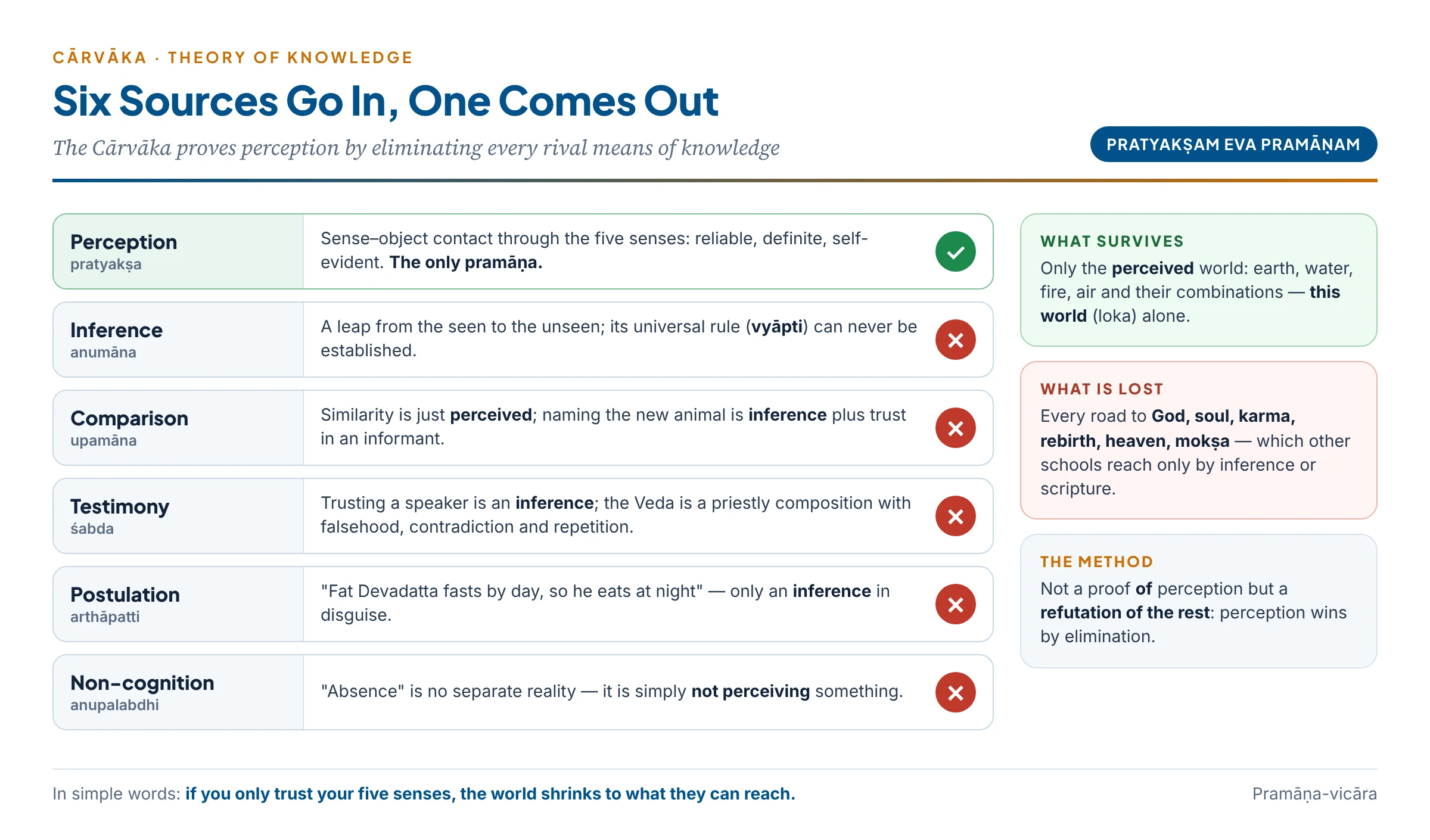
- The Cārvāka list has one item. Pratyakṣam evaikaṃ pramāṇam — “perception alone is a pramāṇa“.
- The strategy is negative. Rather than proving positively that perception is the only pramāṇa, the Cārvāka refutes all other pramāṇas one by one; what survives by elimination is perception.
- The aim is metaphysical. The point of the whole exercise is to remove the only roads by which other schools reach God, soul, karma and the other world. Nyāya proves God by inference (the world is an effect, so it has a maker); Mīmāṃsā knows heaven and dharma from the Veda (testimony). Close those roads and the transcendent entities lose their support.
| School | Number of pramāṇas | Pramāṇas accepted |
|---|---|---|
| Cārvāka | 1 | Perception |
| Buddhist, Vaiśeṣika | 2 | Perception, inference |
| Sāṃkhya, Yoga, Jaina | 3 | Perception, inference, testimony |
| Nyāya | 4 | + comparison (upamāna) |
| Prābhākara Mīmāṃsā | 5 | + postulation (arthāpatti) |
| Bhāṭṭa Mīmāṃsā, Advaita | 6 | + non-cognition (anupalabdhi) |
Core Doctrine
1. Perception (Pratyakṣa): the Only Pramāṇa
- Definition. Perception is knowledge produced by direct contact between a sense organ and its object (indriyārtha-sannikarṣa). It is immediate: nothing stands between the knower and the known.
- Five kinds. Corresponding to the five senses: visual (colours, shapes — a wall, a mountain, a book), auditory (sounds), olfactory (pleasant and unpleasant smells), gustatory (sweet, sour, pungent tastes) and tactual (soft, hard, hot, cold).
- Why perception is trusted. It alone gives knowledge that is reliable, definite and free from error (avisaṃvādi), because its object is present before the senses. It is self-evident: when I see the table, I do not need a further argument that the table is there.
- The test of reality. “What is perceived exists; what is not perceived does not exist.” Reality is equated with perceptibility. This is a form of naïve realism: the world is just as the senses show it to be.
- Knowledge belongs to the senses and the body. One account reports the Cārvāka proving this by agreement in presence and absence (anvaya-vyatireka): the colour of a flower is present only when the flower is present; likewise, sight is present when the eye is intact and absent when one is blind. So knowledge is located in the sense organs, which are parts of the body.
- Perception as the limit of the world. If knowledge stops where the senses stop, then for the knower the world stops there too: the limits of my perception are the limits of my knowledge, and the limits of my knowledge are the limits of my world. There is no “other world” (paraloka) — the only loka is the perceived one.
In simple words
Ask someone: “Have you ever seen the fragrance of a jasmine?” No — you cannot see a smell. But you can smell it, and you are perfectly sure it is there. Each sense has its own object, and each is a doorway to the real. The Cārvāka says: count the doorways — five. Whatever comes in through one of them is real. Whatever is supposed to lie behind all five doors at once — a soul, a god, a heaven — is something nobody has ever smelt, seen, heard, tasted or touched.
Common confusion
Did the Cārvāka accept “inner” perception (mānasa pratyakṣa) of pleasure, pain and consciousness? Most accounts say yes: pleasure, pain, desire and the fact of being conscious are felt directly, so they count as perception, and the Cārvāka uses this very perception to say that consciousness exists — in the living body. What the Cārvāka denies is that the mind (manas) is a separate, non-physical sixth organ that could perceive things the five senses cannot. Some reports go further and say the Cārvāka refused to treat the mind as an independent sense at all, because the mind itself is never perceived and everything in it first came through the outer senses. Both reports agree on the key point: no perception reaches beyond the body and its senses.
2. What Exactly Is Being Attacked: the Structure of Inference
- Inference (anumāna) literally means “measuring after” — knowledge that comes after and through another piece of knowledge.
- The stock example. I see smoke on a distant hill and conclude that there is fire on the hill, though I cannot see the fire.
- The five technical terms.
- Pakṣa — the subject of inference, where something is being proved: the hill.
- Hetu or liṅga — the reason or mark that is perceived: smoke.
- Sādhya — what is to be proved: fire.
- Vyāpti — invariable concomitance: the universal rule “wherever there is smoke, there is fire“. It must be invariable (no exception), universal (all cases, everywhere, always) and unconditional (not depending on any further factor).
- Pakṣadharmatā — the presence of the reason in the subject: “this hill has smoke”. The resulting knowledge “the hill has fire” is the anumiti.
- The five-membered form (Nyāya’s inference for others):
- Pratijñā (thesis): the hill has fire.
- Hetu (reason): because it has smoke.
- Udāharaṇa (example with the rule): whatever has smoke has fire, as in a kitchen.
- Upanaya (application): this hill has smoke, which is always accompanied by fire.
- Nigamana (conclusion): therefore the hill has fire.
- The nerve of inference. Everything depends on step 3 — the vyāpti. If the universal rule is uncertain, every conclusion drawn from it is uncertain. That is why the Cārvāka calls vyāpti the nerve (prāṇa) of inference and aims its whole attack there.
| Indian term | Meaning | Western equivalent | Smoke-on-the-hill case |
|---|---|---|---|
| Pakṣa | Subject | Minor term | The hill |
| Hetu / liṅga | Reason, mark | Middle term | Smoke |
| Sādhya | What is proved | Major term | Fire |
| Vyāpti | Universal rule | Major premise | Wherever smoke, there fire |
| Pakṣadharmatā | Reason present in subject | Minor premise | The hill has smoke |
| Anumiti | Inferential knowledge | Conclusion | The hill has fire |
3. Inference Is a “Leap in the Dark”
- The basic charge. A pramāṇa must give knowledge that is beyond doubt and true to reality. Inference cannot meet this condition, because it jumps from the perceived (smoke) to the unperceived (fire). The jump is a leap in the dark.
- Inference is only sometimes right. Some inferences turn out true; others turn out false. Truth is therefore not a necessary feature of inference but an accident — and a separable accident, found in some inferences and missing in others. Something that is true only by luck is not a pramāṇa.
- We act on inference uncritically. It is true that in daily life we constantly act on inferences. But that only shows that we act on the unexamined belief that our inference is true. Success, when it comes, is a happy coincidence, not proof of validity.
- At best probability. Inference yields probability (sambhāvanā), never certainty. A general statement may be true of all the cases we have perceived; there is no guarantee it will hold for the cases we have not perceived.
4. Why Vyāpti Can Never Be Established
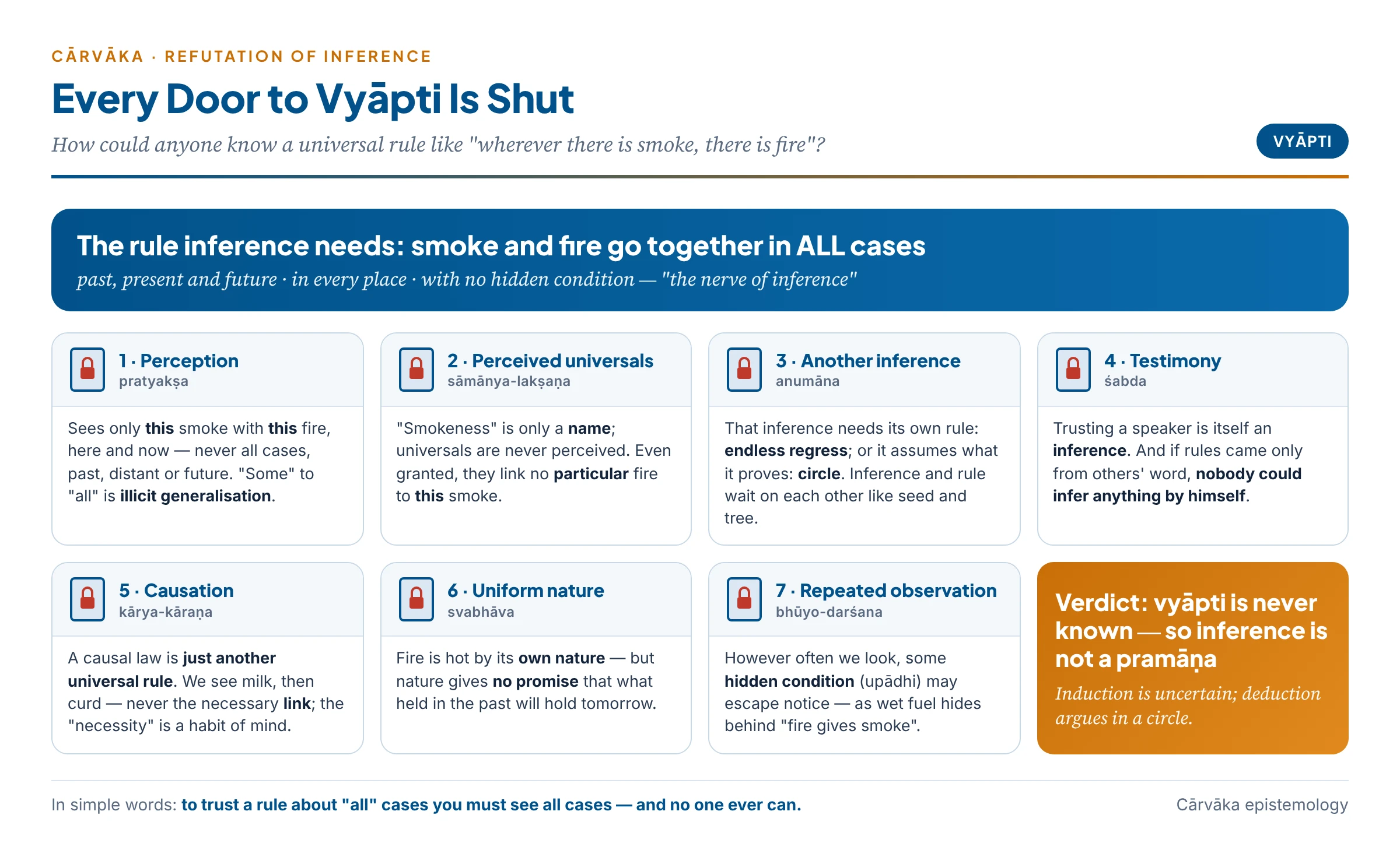
The Cārvāka now asks: how could anyone come to know a vyāpti such as “wherever there is smoke there is fire”? Every possible source is examined and shut.
(a) Not by perception.
- Perception is confined to particular things here and now. It shows me this smoke with this fire, in the kitchen today.
- A universal rule needs knowledge of all cases of smoke and fire — past, present, future, and in every place. We cannot perceive even all the smoke and fire existing now in different parts of the world, let alone those that existed in the past or will exist in the future.
- To jump from “some observed cases” to “all cases” is the fallacy of illicit generalisation: we have seen many black crows; that does not show that the next crow will be black.
(b) Not by perceiving “universals” (sāmānya-lakṣaṇa).
- The Nyāya proposal. When we perceive one particular smoke, we also perceive the universal “smokeness” present in it, and through that universal we have an extraordinary (alaukika) perception of all smokes, and likewise of all fires. So the relation between all smokes and all fires is perceived at once.
- First reply — there are no universals. The Cārvāka is a nominalist: only particulars are real. “Cowness” is just a name (nāma-mātra) we use for many similar cows; nobody has ever perceived “cowness” apart from cows. An extraordinary perception of a non-existent universal is no perception at all.
- Second reply — even granting it, it does not help. Suppose we perceive a link between smokeness and fireness. To infer this fire, we must know that this particular fire is tied to this particular smoke. The link between universals says nothing about any particular.
- Third reply — we cannot even know what the universal is. To know what “smokeness” is — the character present in all smokes — we would need to have seen all smokes. “What is found in the perceived cases may be absent in the unperceived ones.” The gap from particulars to the universal remains exactly where it was.
- A neat dilemma. A later verse states it compactly: if the rule is about particulars, there is no “going across” to the unseen cases; if it is about universals, it only proves what is already known. Either way, inference collapses — and “the elephants of debate sink in the mud of the collapse of inference“.
(c) Not by another inference.
- If the vyāpti “wherever smoke, there fire” is proved by an inference, that inference needs its own vyāpti, which needs another inference, and so on — an infinite regress (anavasthā).
- If instead we use inference to prove the very vyāpti on which inference rests, we assume what we set out to prove — arguing in a circle (petitio principii; in Indian logic ātmāśraya or cakraka).
- Mutual dependence. Inference needs vyāpti, and the knowledge of vyāpti needs inference: each waits for the other, like the seed and the tree — which came first? This mutual dependence (anyonyāśraya) is a recognised fallacy.
(d) Not by testimony.
- Someone might say: reliable people have told us that “wherever there is smoke there is fire”. But
- testimony is itself not a pramāṇa (see section 8): we accept a person’s word only because we infer that he is reliable, so testimony rests on inference and inherits all its defects;
- if every vyāpti came from testimony, inference would always depend on someone else’s word, and nobody could ever infer anything by himself;
- the informant must himself have learned the rule from another informant, who learned it from another — a chain of hearsay that never reaches anyone who has actually observed all the cases.
(e) Not by causation.
- The obvious move: smoke and fire are related as effect and cause; fire produces smoke; so wherever smoke is, fire must be. But a causal relation is itself a kind of invariable relation — it is just another vyāpti, and it faces all the same difficulties.
- We perceive the antecedent and the consequent — the milk and, later, the curd — but never the link between them. Nobody can point to the moment at which milk “becomes” curd and see the necessity in it. (Section 6 treats the rejection of causation in full.)
(f) Not by the “uniformity of nature”.
- Why, then, is fire always hot and water always cool? The Cārvāka answers: because each thing acts according to its own nature (svabhāva). Fire is hot by nature; no supernatural law is needed.
- But nature gives no promise about the future: a uniformity perceived in the past may not continue. Things act according to their nature, and that nature may itself change.
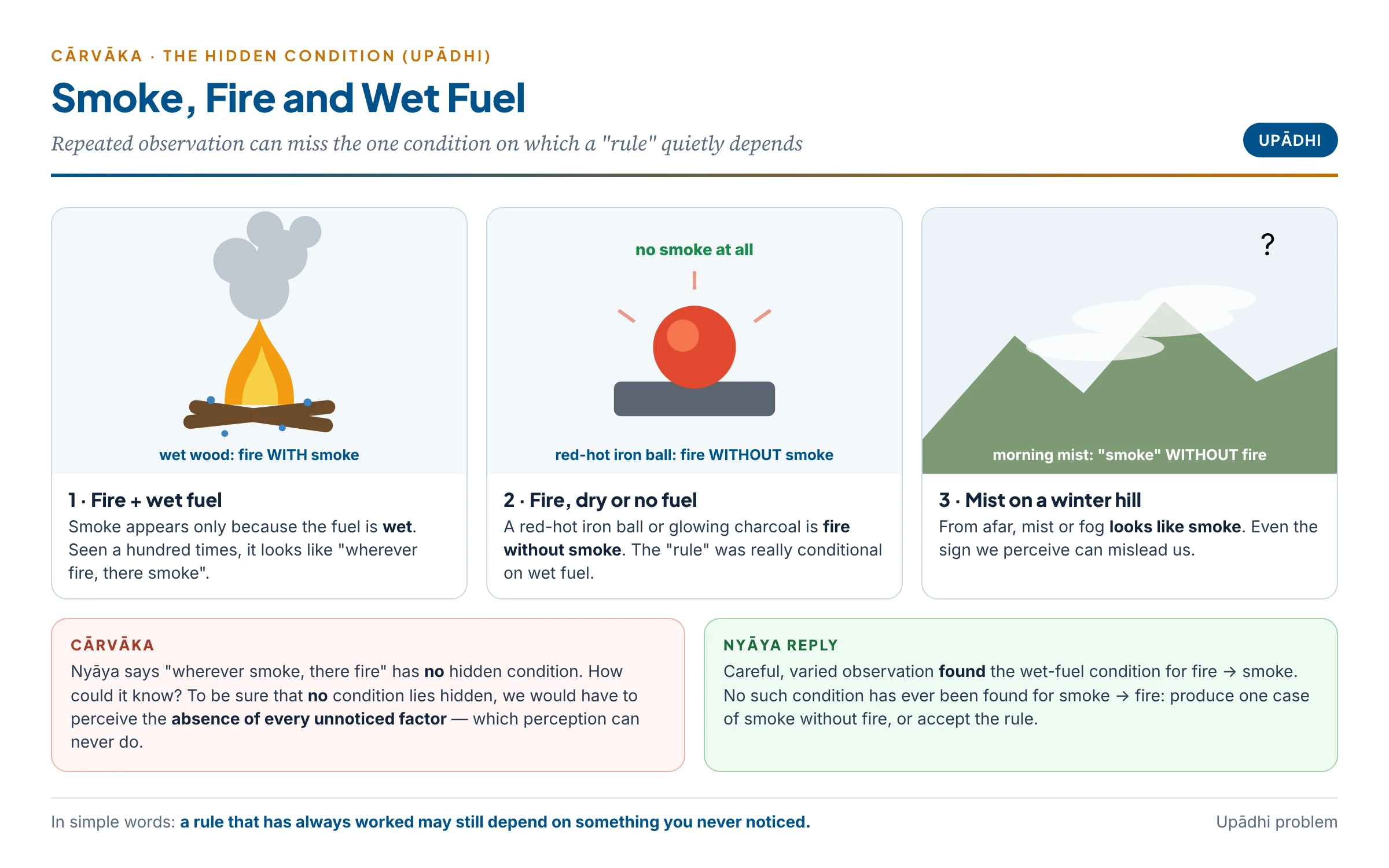
(g) Not by repeated observation — the problem of hidden conditions (upādhi).
- The Nyāya proposal. We do not rely on a single sighting. We observe smoke and fire together many times and under varied circumstances (bhūyo-darśana), and never see smoke without fire. Is that not enough?
- The Cārvāka reply: the upādhi. A vyāpti must be unconditional. But many relations hold only under a hidden condition (upādhi). Fire produces smoke only when the fuel is wet (ārdrendhana): a red-hot iron ball or a glowing charcoal fire gives fire without smoke. A man who has often seen fire with smoke and then infers smoke from fire will be wrong, because he failed to notice the condition — wetness of fuel — on which the relation depended.
- Unconditionality cannot be perceived. To be sure that a relation is free of every hidden condition, we would have to know that no condition lies concealed anywhere — and perception can never show the absence of all unnoticed factors. Some conditions may always escape notice.
- Nor can inference or testimony prove it — that would again be circular, since the validity of inference and testimony is the very point in question.
- Even the sign can mislead. On a winter morning a hill may look smoky when the “smoke” is only mist or fog. The perceived mark itself can be mistaken, and recognising it correctly already needs conditions.
In simple words
Every day for three years you have seen Rahul and Amit walk into the canteen together. “Wherever Rahul is, Amit is” seems a perfect rule. Then one day Amit has fever, and Rahul walks in alone. The rule always depended on a hidden condition — Amit being well — that you never noticed because it was always present. The Cārvāka’s point is simple: however many times you have seen two things together, you can never be sure there is no hidden condition you have missed.
- Conclusion of the attack. Vyāpti cannot be known by perception, by perceived universals, by inference, by testimony, by causation, by the uniformity of nature, or by repeated observation. Therefore induction is uncertain, deduction argues in a circle, and inference cannot be a pramāṇa. The logicians, says the Cārvāka, “find themselves stuck in the mud of inference“.
5. Deduction and Induction Both Fail: “Socrates Is Mortal”
The Cārvāka attack applies to both forms of reasoning that Western logic distinguishes.
- Induction moves from particular to general: crow one is black, crow two is black, crow three is black … therefore all crows are black. It goes from the known to the unknown without warrant — the fallacy of illicit generalisation.
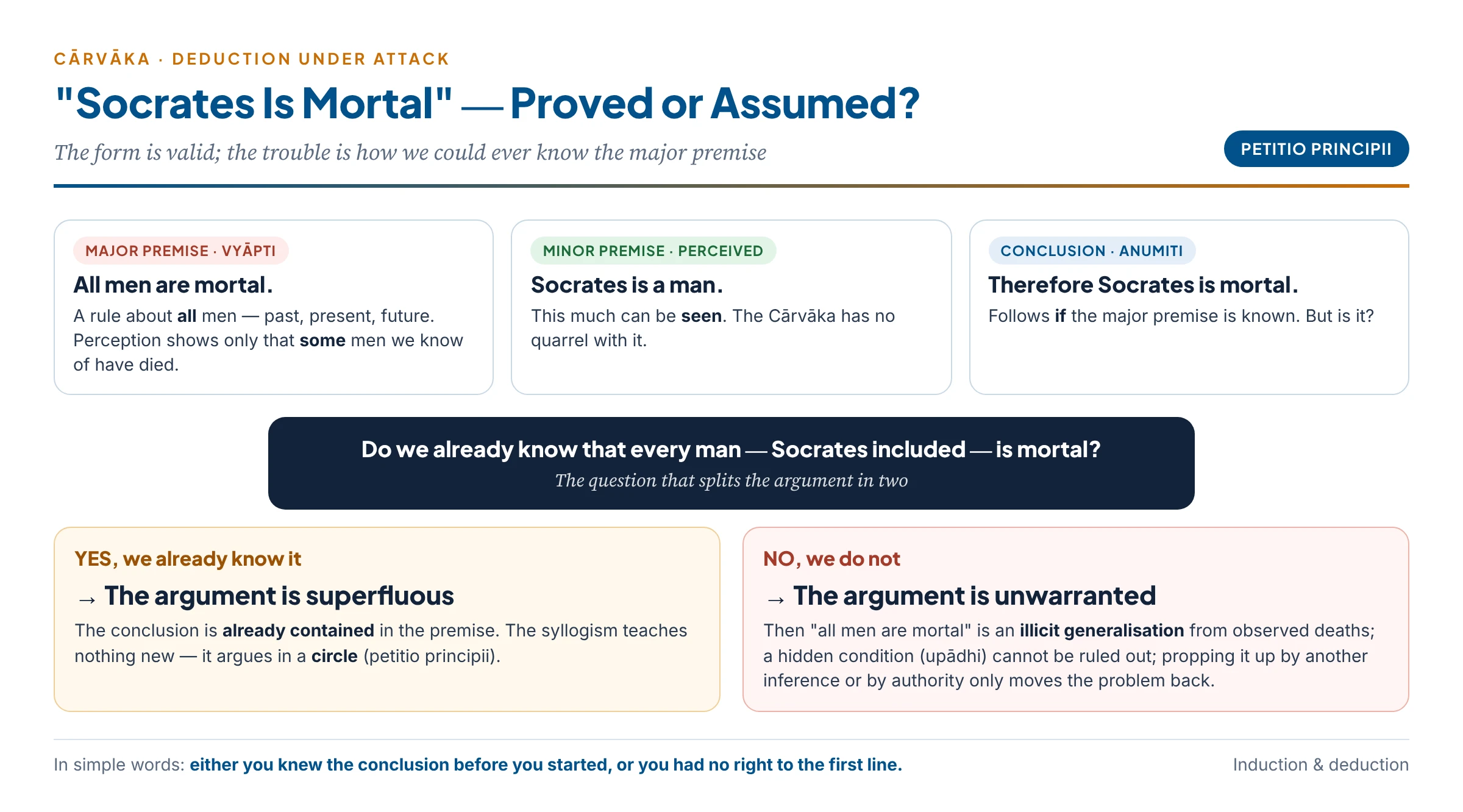
- Deduction moves from general to particular: all men are mortal; Socrates is a man; therefore Socrates is mortal. Its weakness lies in the major premise.
What is wrong with “All men are mortal; Socrates is a man; therefore Socrates is mortal”?
- The major premise is a vyāpti that has not been proved. “All men are mortal” claims an invariable, universal relation between being a man and being mortal — for all men, past, present and future. Perception shows only that some men — those we know of — have died. Concluding “all” from “some” is illicit generalisation.
- Hidden conditions cannot be excluded. We cannot rule out an upādhi under which men die (and in its absence might not). Repeated observation of deaths is still only repeated observation.
- The argument is circular. To be entitled to say “all men are mortal”, we must already know that every man — including Socrates — is mortal. So the conclusion is already contained in the premise: the argument assumes what it claims to prove (petitio principii).
- Propping up the premise fails. If we prove “all men are mortal” by another inference, we fall into regress or circularity; if we prove it by authority, we rely on testimony, which itself rests on inference.
- The dilemma. Either we do not know that all men are mortal — then the argument is unwarranted; or we already know it, Socrates included — then the argument is superfluous and tells us nothing new. Either way, the conclusion is not new knowledge gained by inference.
Common confusion
Did the Cārvāka say that the Socrates argument is logically invalid? No. The form of the argument is perfectly valid: if all men are mortal and Socrates is a man, Socrates must be mortal. The Cārvāka attacks the truth of the major premise and the knowledge-value of the conclusion, not the logical form. Indian logic in general judges an inference by the material soundness of its reason and rule rather than by form alone. The Cārvāka’s charge is the one the British logician J. S. Mill later made against the syllogism: in every syllogism “considered as an argument to prove the conclusion, there is a petitio principii“.
6. The Rejection of the Cause–Effect Relation
The Cārvāka does not merely say that causation cannot prove vyāpti; it denies that a necessary causal relation between things can be known at all.
- What other schools hold. Every effect has a cause; cause and effect are necessarily and invariably related; the relation is unconditional. Indian schools differ only on how the effect relates to its cause — whether it pre-exists in it (satkāryavāda of Sāṃkhya) or is a new beginning (asatkāryavāda of Nyāya).
- Cārvāka arguments.
- Causation is just another vyāpti. “Wherever the cause, there the effect” is an invariable-relation claim, and every argument against vyāpti applies to it.
- We never perceive the “link”. We see milk first and curd later, the seed and then the sprout, but never the necessary connection between them. Perception gives only this happened, then that happened — antecedent and consequent.
- We can never know all the conditions. A relation is unconditional only if no further condition is needed; we can never survey all the conditions, so we can never know that a causal relation is unconditional.
- The same cause may give different effects. Under some circumstances, at some times, the same antecedent is followed by different consequents. A hard-working student fails; the same medicine cures one patient and harms another.
- Causation does not explain the diversity of the world. Why is fire hot, water cool, the thorn sharp, the peacock’s feathers many-coloured? Not because something caused them so, but because that is their nature (svabhāva). “Who sharpens the thorns? Who paints the peacock?” — nobody; nature is its own cause.
- The necessity is psychological. Because two events have been seen together many times, the mind is trained to expect one when it sees the other, and it mistakes this habit of expectation for a necessity in the things. The invariability is a psychological necessity, not a logical or real one.
- What replaces causation. Svabhāva-vāda (naturalism: things behave by their own nature) and yadṛcchā-vāda (accidentalism: combinations happen by chance, without any purpose behind them). A later commentator describes the Cārvāka view as ākasmikatva-vāda — “everything happens without a cause”. The metaphysical side of svabhāva-vāda, and its use against God and karma, is taken up in the article on the rejection of transcendent entities.
Indian Connect — Hume and the Cārvāka on causation
The sixth argument above is almost word for word David Hume’s analysis eighteen centuries later: we observe only constant conjunction, never a necessary connection; the “necessity” is a custom or habit of the mind, a felt expectation projected onto the world. Both conclude that no reasoning from past experience can guarantee the future. The difference is in use: Hume still lets custom guide life and science; the Cārvāka uses the argument mainly to block metaphysical inferences to God, soul and karma.
7. The Refutation of Comparison (Upamāna)
- What Nyāya means by upamāna. A city-dweller does not know what a gavaya (a wild ox) is. A forester tells him: “A gavaya is an animal like a cow.” Later, in the forest, he sees an animal resembling a cow, remembers the forester’s words, and knows: “This is a gavaya.” Upamāna gives knowledge of the relation between a name and the thing named (saṃjñā-saṃjñi-sambandha), through similarity.
- The Cārvāka replies.
- The similarity is perceived. Seeing that this animal is like a cow is plain perception; remembering the forester’s words is memory. Nothing new is added that needs a separate pramāṇa.
- The rest is inference or testimony. Concluding “therefore this is what the word ‘gavaya’ means” is an inference from the forester’s description, and trusting the forester is testimony. Both are already rejected, so upamāna falls with them. Since the Cārvāka regards it as a form of inference, rejecting inference is rejecting upamāna.
- It gives only a name, not a universal rule or true knowledge of what words denote. At most upamāna tells us what to call something; it gives no knowledge of what is beyond perception.
- Which similarity? If the similarity is complete, the comparison is useless: “a cow is like a cow” teaches nothing, and two names for one thing would be pointless. If it is partial, one can easily mistake a buffalo for the gavaya. If it is only slight, everything resembles everything — a mustard seed is “like” a mountain, since both exist — and the comparison picks out nothing. Upamāna therefore cannot reliably identify anything.
- It depends on the informant. If the forester describes the gavaya wrongly, or we misunderstand him, we will misidentify the animal. The knowledge is only as good as the word of the informant.
- Other schools agree in part. Vaiśeṣika, Sāṃkhya and the Buddhists also reduce upamāna to inference; the Jainas treat it as a kind of recognition (pratyabhijñā). So the Cārvāka is not alone in denying upamāna an independent status — it is alone in rejecting inference too.
8. The Refutation of Testimony (Śabda)
- What is testimony? Nyāya defines śabda as the statement of a trustworthy person (āpta-vākya) — one who knows the truth and speaks it without any wish to deceive. It is of two kinds:
- Laukika (ordinary) — the word of reliable human beings: a doctor, a teacher, a sage;
- Vaidika / alaukika (scriptural) — the Veda, held by Mīmāṃsā to be authorless (apauruṣeya) and eternal, and by Nyāya to be composed by an omniscient God.
- Who accepts it. Nyāya, Sāṃkhya, Yoga, Mīmāṃsā, Vedānta and the Jainas accept śabda as a pramāṇa. The Buddhists and the Vaiśeṣikas treat it as a form of inference. The Cārvāka rejects both ordinary and Vedic testimony.
The Cārvāka arguments against testimony:
- What is valid in testimony is just perception. Testimony consists of words. As sounds heard by the ear, words are perceived, and so far knowledge of them is valid. But insofar as words claim to tell us about things we do not perceive, they are not free from error and doubt.
- Trusting a speaker is an inference. We accept someone’s word because we believe him reliable. The belief runs: “this person is reliable; whatever reliable persons say is true; so what he says is true” — an inference. Testimony therefore inherits every weakness of inference. And a speaker who was right yesterday need not be right tomorrow; past truthfulness gives no guarantee of future truthfulness.
- Ordinary testimony is error-prone. Human statements suffer from lying, exaggeration, ignorance, bias, faulty memory and miscommunication. Without checking by perception, they are untrustworthy.
- Testimony about the unseen cannot be checked. Statements about soul, heaven, karma or the other world can never be cross-checked by perception. Accepting them is blind belief, and blind belief is the raw material of exploitation by priests.
- Testimony adds nothing. Even when testimony is true, it must be verified by perception before we can be sure of it. Then it is the perception, not the testimony, that gives the knowledge: testimony is redundant.
- The Veda is a human, and interested, composition. The claim that the Veda is authorless cannot be tested: if there is no author, there is no way to examine his credibility. In fact, the Cārvāka says, the Vedas were composed by cunning priests to earn a livelihood by duping the ignorant and the credulous. With false hopes and promises they persuade men to perform rites whose only tangible benefit goes to the priests who conduct them. “The three authors of the Vedas were buffoons, knaves and demons” (bhaṇḍa-dhūrta-niśācarāḥ).
- The Veda has three defects. The objection, which Nyāya itself records in order to answer it, says the Veda suffers from:
- Anṛta — falsehood: a sacrifice prescribed for obtaining a son is performed and no son is born;
- Vyāghāta — self-contradiction: it gives conflicting instructions (for example about the proper time of an offering), praises now one god and now another (Agni, Indra, Varuṇa) as supreme, and says “do not injure any living being” while commanding the sacrifice of animals — how can killing be a merit?
- Punarukti — useless repetition: the same things are said again and again.
- The Veda’s authority is circular. Its authority is proved from God (its author, for Nyāya), and God’s existence is proved from the Veda. Each leans on the other.
- No eternal sound. Mīmāṃsā defends the Veda by holding that sound and words are eternal. The Cārvāka replies that there is no sound when nobody utters it; eternity of sound is never perceived; and since the Cārvāka rejects ākāśa (ether), the supposed eternal substratum of sound, nothing remains to carry an eternal word.
In simple words
You want to cross a river and ask the washerman on the bank where it is shallow. He points left; you go left and cross safely. Did the washerman’s word give you knowledge? The Cārvāka says no: you trusted him because you inferred that a man who washes clothes there every day must know the river. Had he been wrong, you would have drowned. The only thing you knew was what your feet felt as you crossed. Now imagine the “washerman” is describing a river no one has ever crossed and come back from — the river of death. That, says the Cārvāka, is what scripture does when it describes heaven.
9. Postulation and Non-Cognition Are Rejected Too
- Arthāpatti (postulation). Mīmāṃsā’s example: “Fat Devadatta does not eat by day” — so we postulate that he eats at night. The Cārvāka, like Nyāya, treats this as an inference (“all fat persons who do not eat by day eat at night”), and since inference is rejected, arthāpatti goes with it.
- Anupalabdhi (non-cognition). Bhāṭṭa Mīmāṃsā and Advaita hold that we know the absence of a jar on the floor by a special pramāṇa, the non-perception of the jar. The Cārvāka denies absence (abhāva) any independent reality: “non-existence” is simply the absence of perception, a way of speaking, not a separate category of the real.
10. From Theory of Knowledge to Theory of Reality
- The conclusion of the epistemology. Perception is the only pramāṇa. Therefore only perceptible things can be known, and only they can be asserted to be real.
- “Limits of knowledge and world are determined by my sense perception.” This is the Cārvāka claim in one line.
- Knowledge: nothing is known except through the five senses.
- World: the real world is the world the senses reveal — earth, water, fire, air and their combinations. There is no other world (paraloka).
- Self: even the “I” is the perceived, conscious body.
- What follows (developed in the next articles):
- Materialism — only four perceptible elements; ākāśa (ether), which is only inferred from sound, is rejected; consciousness is a product of matter; the soul is the conscious body.
- Rejection of transcendent entities — God, an immortal soul, karma and its unseen force (adṛṣṭa), rebirth, heaven and hell, mokṣa — all are beyond perception and are rejected.
- Ethics — pleasure in this life is the only end; wealth is its means; dharma and mokṣa are discarded.
- The weak link that critics seize on: from “not perceived” the Cārvāka moves to “does not exist“. That step is examined in the next article, on the consistency of the Cārvāka position.
Critical Evaluation
Objections to the Cārvāka Theory of Knowledge
- Perception also errs. We see a rope as a snake, a mirage as water; we perceive the earth as flat and motionless and the sun as a small moving disc. If inference is rejected because it sometimes misleads, perception should be rejected too — and it is inference that corrects these perceptual errors.
- Bare sensation is not knowledge. Pure sense-contact gives only loose sense-data. To become knowledge (“this is a cow”), the data must be ordered and interpreted by concepts — and conceptual thought is already beyond bare perception. The Jainas therefore class even ordinary perception as mediate knowledge (mati).
- Knowledge would shrink to a point. Without inference and testimony we could know nothing of the past, the future, the distant, other people’s minds, history, geography, or the meaning of words. Scientific knowledge and expertise rest wholly on inference and testimony.
- Practical life would be impossible. Seeing clouds, we expect rain; seeing smoke, we avoid fire; we eat expecting food to nourish. To deny inference is to deny the basis of every decision.
- Memory and recognition (“this is the same man I met yesterday”) cannot be explained by present perception alone.
- Other minds. Thoughts and ideas are not material objects; they cannot be perceived, only inferred from words and behaviour. To understand an opponent — and to make him understand — the Cārvāka must infer.
- Self-refutation. “Inference is invalid” and “perception alone is valid” are general claims about all inferences and all perceptions — themselves the product of inference. (This charge is developed fully in the next article.)
Replies on the Cārvāka’s Behalf
- The target is certainty, not usefulness. The Cārvāka need not deny that people act on inferences; it denies that inference gives pramā — knowledge beyond doubt. Even its critics’ examples (clouds and rain) are probable, not certain.
- Perceptual error is corrected by perception. One account reports the Cārvāka reply that the rope–snake error is cleared by looking more closely — a further perception, not an inference.
- The problem of induction is real. From Hume to the present, nobody has produced a non-circular proof that the future will resemble the past. Bertrand Russell’s chicken, fed every morning by the farmer, “inferred” that it would always be fed — until the day the farmer wrung its neck. Western philosophy took this problem seriously only in the 18th century; the Cārvāka stated it two thousand years earlier.
- A positive, not a sceptical, theory. The Cārvāka does not doubt everything. It confidently affirms the perceived world. Its theory of knowledge is not total scepticism or agnosticism but a thorough-going positivism: it trusts positive, observable facts and nothing else.
Critics and Defenders
Criticism — Critics
- Perception errs too — rope and snake, flat earth, small sun; inference corrects it.
- Sensation needs concepts; bare perception is not yet knowledge.
- Knowledge of past, future, distant places and other minds becomes impossible.
- Daily life, memory, language and science all rest on inference and testimony.
- The rejection is itself an inference — “all inference is invalid” is a generalisation.
Defence — Defenders and strengths
- The Cārvāka targets certainty, not practical usefulness; inference stays as probability.
- Upādhi is a sharp point: no number of observations excludes all hidden conditions.
- The problem of induction (Hume, Russell’s chicken) remains unsolved.
- Testimony about the unseen cannot be cross-checked — a fair warning against blind belief.
- It is a positive empiricism about the perceived world, not total scepticism.
Cross-Tradition Comparison
The Cārvāka and Western Empiricism
| Issue | Cārvāka | Hume | J. S. Mill | Logical positivists |
|---|---|---|---|---|
| Source of knowledge | Perception only | Impressions (experience) | Experience | Sense-experience + analytic truths |
| Induction | Vyāpti unprovable; illicit generalisation | Problem of induction; no rational ground | Accepts it as the basis of science | Accept it as probable |
| Deduction / syllogism | Petitio principii; conclusion in premise | Relations of ideas are certain but empty | Syllogism is a petitio principii | Analytic, tautological |
| Causation | Antecedent–consequent; necessity is psychological | Constant conjunction; necessity is custom | Uniformity of nature | Regularity |
| Unperceivables | Do not exist | Unknowable | Inferable from experience | Statements about them are meaningless |
Indian Connect — Key takeaways
- The Cārvāka’s problem of induction and its upādhi objection forced Nyāya to build its six-step method for establishing vyāpti — repeated observation, agreement in presence and in absence, elimination of conditions, tarka, and sāmānya-lakṣaṇa perception (examined in the next article).
- Śūnyavāda Buddhism and Advaita (in Śrīharṣa’s attack on the logician Udayana) also deny the ultimate validity of inference — but they reject all pramāṇas, perception included, at the highest level while accepting them all empirically. The Cārvāka keeps perception and rejects inference from the same standpoint — the feature critics call self-contradictory.
- The Buddhists and Vaiśeṣikas also deny that testimony and comparison are independent pramāṇas; the Cārvāka is unique only in rejecting inference itself.
Synthesis (Siddhānta)
- The thesis. Perception — sense-object contact — is the only pramāṇa; whatever is not perceived cannot be known and need not be believed.
- The method. Elimination: inference fails because its universal rule (vyāpti) cannot be known by perception, perceived universals, inference, testimony, causation, the uniformity of nature, or repeated observation (the upādhi problem); deduction is circular and induction is illicit generalisation; causation is only antecedent and consequent, its necessity a mental habit; comparison is perception plus inference; testimony is inference about a speaker’s reliability, and the Veda is a priestly composition marred by falsehood, contradiction and repetition.
- The purpose. To close every road to the transcendent — and thereby ground a materialist metaphysics and a this-worldly ethics.
- The verdict. As a theory of certainty, the Cārvāka critique is powerful and remarkably modern; as a complete theory of knowledge it fails, since it cannot account for science, memory, language or even its own arguments without the inference it rejects.
- Contemporary relevance. The Cārvāka demand to check claims against observation lives on in the scientific temper that Article 51A(h) of the Indian Constitution asks every citizen to develop; in the evidence-based approach of modern medicine and law, where hearsay is treated with caution; and in today’s fight against misinformation, where “who told you, and how could they know?” is exactly the Cārvāka question about testimony.
“Perception alone is the means of valid knowledge.” — the Cārvāka maxim
Previous Year Questions
- 2025Explain the ground on which Cārvāka rejects inference (anumāna) as a valid source of knowledge.
- 2019What is wrong according to the Carvakas with the following argument? All men are mortal. Socrates is a man. Therefore, Socrates is mortal. Justify your answer with arguments.
- 2016What would be Carvaka’s view on Vyapti? Can this view be acceptable to the Naiyayikas? Give reasons for your answer.
- 2014“Limits of knowledge and world are determined by my sense perception“. Discuss this claim of Carvaka.
- 2012Why do Carvaka do not believe in the validity of inference? What logic do they give for their belief?
- 2012On what basis does Carvaka reject the cause-effect relationship?
- 2006Discuss the theory of knowledge, according to Charvaka Philosophy.
- 2002State and evaluate critically Carvaka’s view that perception is the only valid source of knowledge.