

Quine and Strawson: Critique of Empiricism; Theory of Basic Particulars and Persons.
Official Syllabus: Paper I, Section A, Unit 11
W. V. O. Quine and P. F. Strawson were the two great philosophers who led analytic philosophy out of logical positivism — but they took opposite roads. Quine went toward science: he rejected the analytic–synthetic distinction, made philosophy continuous with natural science, and preferred a regimented logical language to ordinary speech. Strawson went toward ordinary language and Kant: he defended the analytic–synthetic distinction (with Grice), revived metaphysics as the description of our conceptual scheme, and in “On Referring” (1950) attacked Russell’s theory of descriptions for ignoring how language is actually used. This article sets out Strawson’s critique of Russell, compares Quine and Strawson on language, meaning, metaphysics, mind and scepticism, assesses their legacy, and draws the Indian parallels.
In simple words
Two engineers inherit an old, crowded city. One says: “Let us redraw everything on a scientific grid, with numbered streets and exact coordinates — even if the old names disappear.” The other says: “First let us map the city as people actually use it — the lanes, the landmarks, the names everyone knows — because that map works and everyone depends on it.” Quine is the first engineer; Strawson is the second. Both are rigorous; they disagree about whether ordinary life or science should have the last word.
Context & Problem
Two Roads out of Logical Positivism
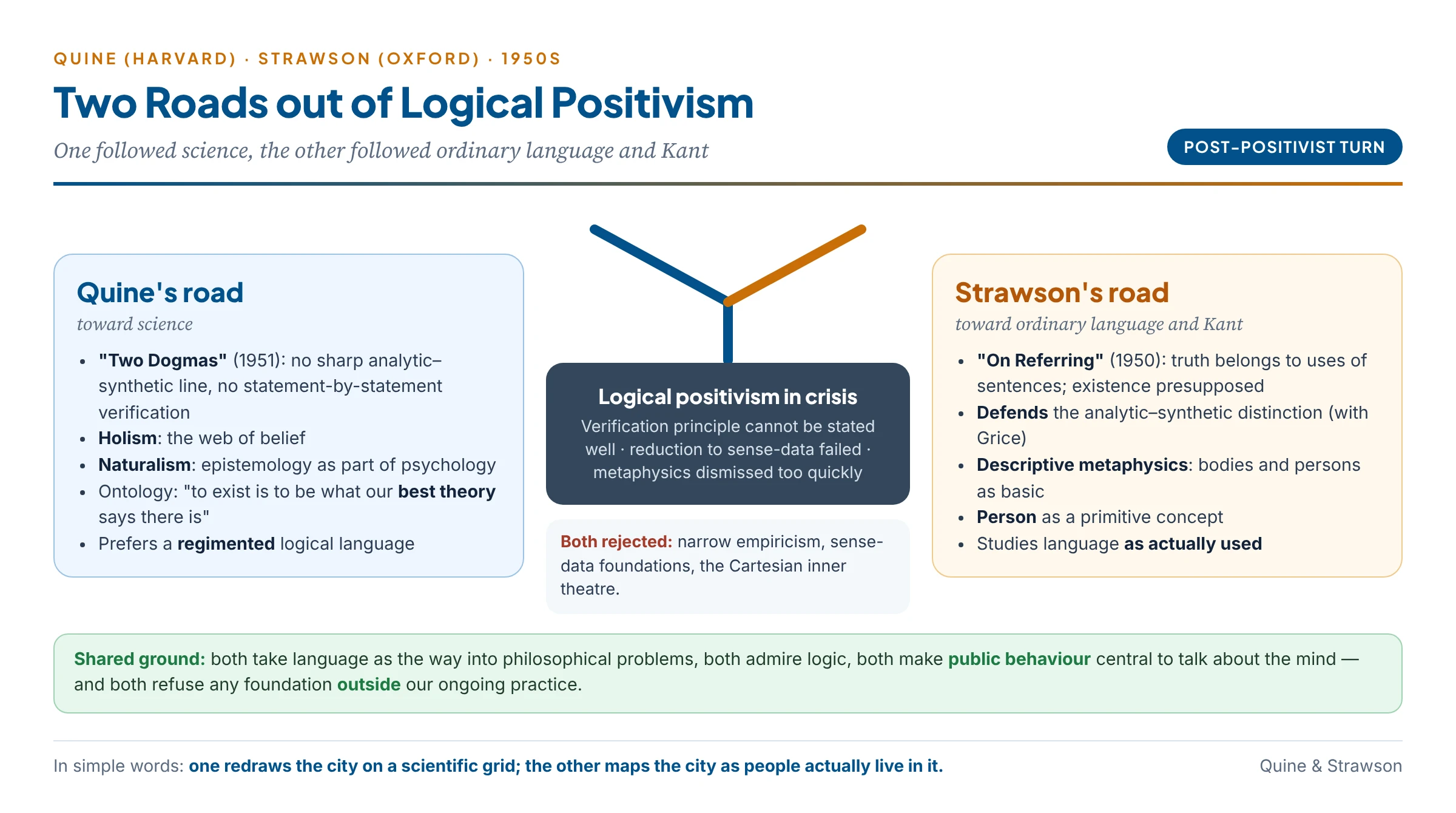
By 1950 logical positivism was in trouble. Its verification principle could not be stated satisfactorily, its reduction of science to sense-experience had failed, and its rejection of metaphysics seemed too hasty. Two responses emerged in the English-speaking world:
- Quine (Harvard) — post-positivist naturalism. Keep the positivists’ respect for science and logic, but drop their dogmas: there is no sharp analytic–synthetic line, no statement-by-statement verification, no “first philosophy”. Philosophy becomes the most general and abstract part of science.
- Strawson (Oxford) — ordinary language and descriptive metaphysics. Keep the positivists’ respect for clarity, but drop their contempt for ordinary language and metaphysics. Study how language actually works in use, and describe the conceptual scheme it expresses.
- What they shared. Both rejected the positivists’ narrow empiricism; both took language as the route to philosophical problems; both admired logic; both argued against Cartesian and sense-data pictures of knowledge.
- Where they parted. On whether ordinary language or science sets the standard; on the analytic–synthetic distinction; on whether metaphysics should be revised or described; on the nature of mind; and on how to answer the sceptic.
Core Doctrine
1. Strawson’s “On Referring”: the Critique of Russell
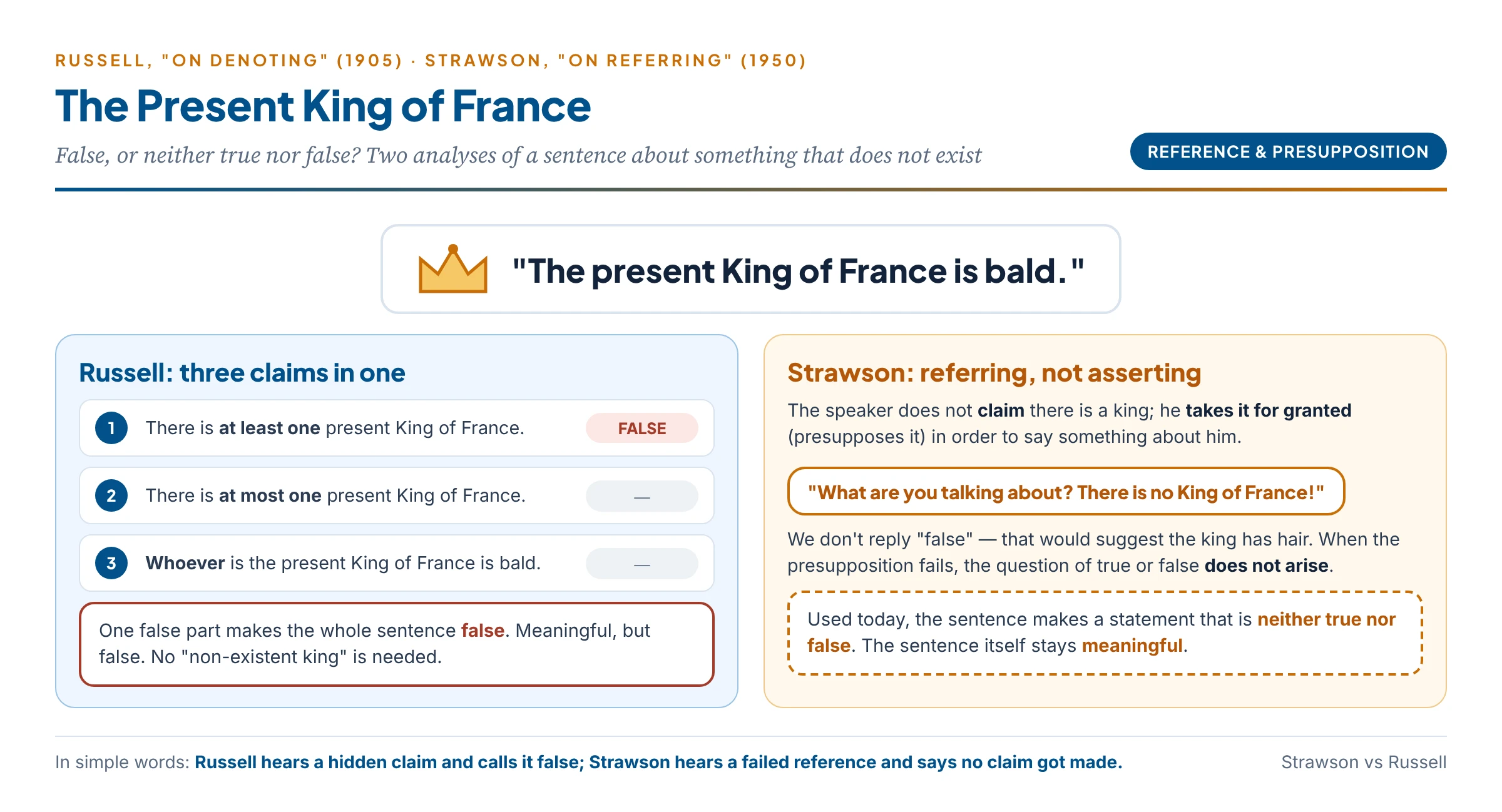
Russell’s theory in plain words (1905). Take “The present King of France is bald.” Russell said this sentence really makes three claims at once:
- There is at least one present King of France.
- There is at most one present King of France.
- Whoever is the present King of France is bald.
Since France has no king, claim 1 is false — so the whole sentence is meaningful but false. (Russell’s aim was to avoid having to say that a non-existent king somehow “exists” in order to be talked about.)
Strawson’s objections (1950):
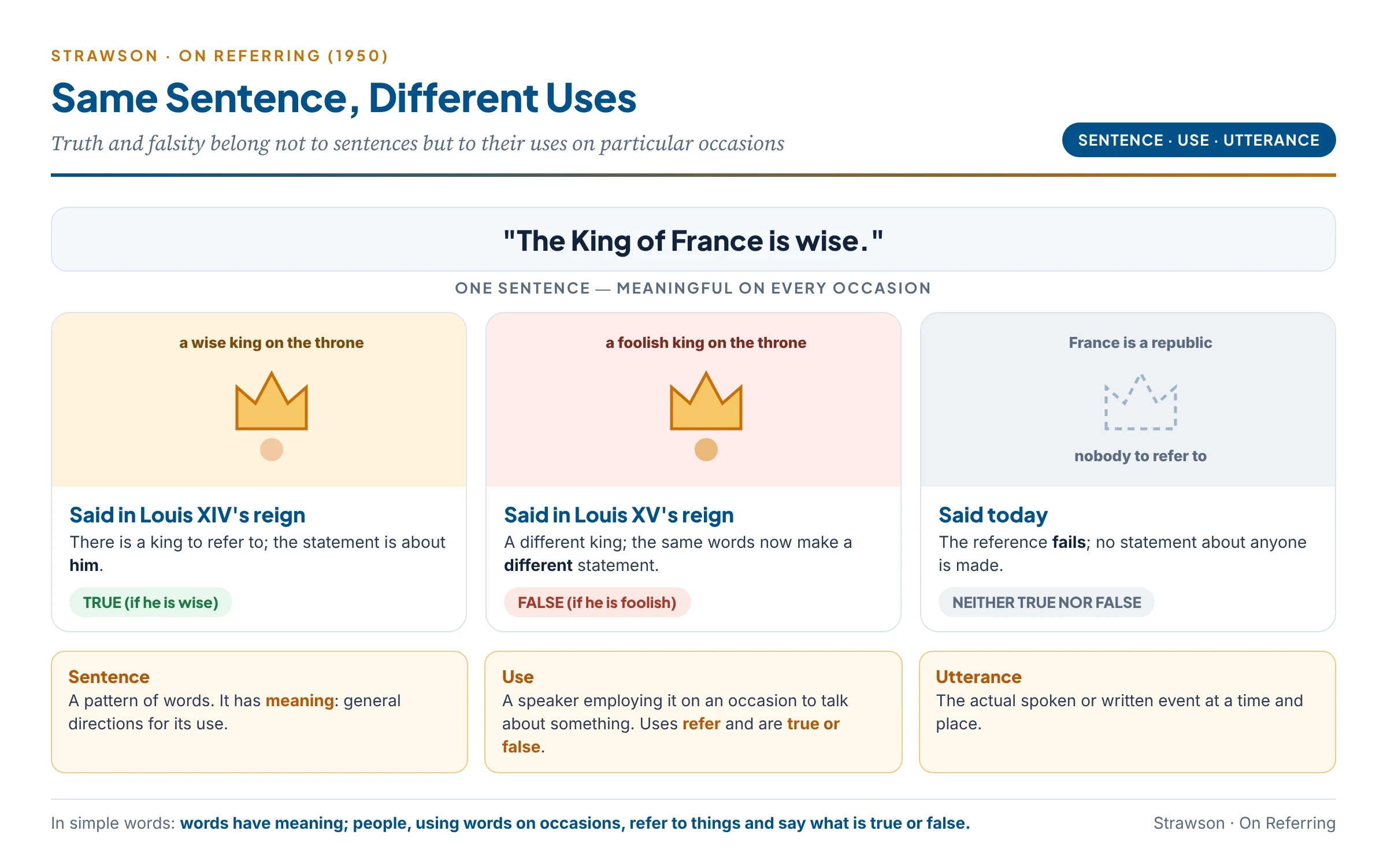
- Sentence, use and utterance must be distinguished.
- A sentence is a type of words — “The King of France is wise”.
- A use of a sentence is the employment of it by a speaker on a particular occasion to say something about something.
- An utterance is the actual spoken or written event.
- The same sentence used in the reign of Louis XIV might have made a true statement, and used in the reign of Louis XV a false one; used today, it makes neither. So truth and falsity belong not to sentences but to uses of sentences.
- Meaning is not referring. “Meaning (in at least one important sense) is a function of the sentence or expression; mentioning and referring and truth or falsity are functions of the use of the sentence or expression.” To give the meaning of an expression is to give general directions for its use; it is not to point to an object.
- Russell confused meaning with the object meant. Russell thought that if “the King of France” is meaningful it must stand for something. But the meaning of an expression is not the thing it refers to. “The brick is broken” does not mean that the meaning of “brick” is broken; when I say “this” while pointing at a pen, the meaning of “this” is not the pen — the same word can point at anything. A sentence is meaningful in its own right if it is properly formed from meaningful words — whether or not, on a particular use, anything answers to it.
- Referring is not asserting. Someone who says “The King of France is wise” does not assert that a king of France exists; he presupposes it. Existence is not part of what is stated but a condition of stating anything with that sentence at all.
- When the presupposition fails, the question of truth does not arise. If someone said, in all seriousness, “The King of France is wise”, we would not say “That’s false” (which suggests he is foolish) but “What are you talking about? There is no King of France.” The statement is neither true nor false — philosophers call this a “truth-value gap“.
- Uniqueness depends on context. “The table is covered with books” does not claim that there is only one table in the universe, as Russell’s second clause seems to require. Ordinary definite descriptions pick out an item in a context shared by speaker and hearer.
- “Ordinary language has no exact logic.” Russell built a logic for an ideal language; Strawson insists that the rules of ordinary language are subtler and context-bound, and cannot be captured by formal logic alone.
Presupposition, explained:
- A statement presupposes another when the second must be true for the first to be either true or false.
- “The King of France is bald” and “The King of France is not bald” both presuppose “There is a King of France”. If that is false, neither statement is true — and neither is false.
- By contrast, a statement entails what must be true if it is true. Russell treated existence as entailed (asserted); Strawson treats it as presupposed.
Common confusion
Does Strawson say “The present King of France is bald” is meaningless? No. The sentence is perfectly meaningful — we know how it could be used to say something true or false (in 1680, for example). What fails, when it is used today, is reference: there is nothing for “the present King of France” to pick out, so the statement made is neither true nor false. Russell said the same sentence is meaningful but false; Strawson says it is meaningful, but this use of it yields no true-or-false statement at all.
2. Russell’s Reply and the Later Debate
- Russell’s answer (1957). In “Mr Strawson on Referring”, Russell replied that:
- Strawson was concerned with the everyday use of words, while he himself was concerned with constructing a precise logical language for science and mathematics — different tasks.
- Whether we call the sentence “false” or “neither true nor false” is largely a verbal choice.
- Strawson’s appeal to the time and occasion of utterance only raises the old problem of “egocentric words” (I, here, now, this), which Russell had already discussed.
- A middle position. Later philosophers noticed that a description can be used in two ways: attributively (“the murderer of Smith, whoever he is, is insane”) and referentially (to pick out a particular person in front of us, “the man drinking a martini is a famous scientist”). Russell’s analysis fits the first use better; Strawson’s fits the second.
- Assessment. Russell’s theory remains the standard tool of formal logic and analysis of existence claims; Strawson’s notion of presupposition became central to linguistics, pragmatics and the study of ordinary conversation. Each was right about a different job language does.
In simple words
A child asks, “Why did the moon fall into the sea last night?” You don’t answer “No reason — it’s false”, and you don’t answer “Because of gravity”. You say, “It didn’t fall!” The question took something for granted that isn’t so. Strawson says sentences like “The King of France is bald” are similar: they take for granted that there is a king, and when that fails, the question of true or false never gets started.
3. Language: Regimentation versus Ordinary Use
- Quine — regimentation. Quine wanted to paraphrase ordinary sentences into a clear, standard logical form (“canonical notation“) in order to see exactly what a theory says and what it is committed to. He welcomed Russell’s theory of descriptions as a model: it lets us say “Pegasus does not exist” without committing ourselves to a ghostly non-existent Pegasus. Ordinary language, for Quine, is a useful but untidy tool to be improved for scientific purposes.
- Strawson — ordinary use. Strawson held that ordinary language has no exact logic, but it is not therefore defective: its rules are tied to context, purpose and speaker–hearer relations. Paraphrasing it into logical notation can distort what speakers actually do (as with “the table”, or with presupposition).
- The disagreement. For Quine, the philosopher’s task is to improve our language for science; for Strawson, it is to understand our language — and the scheme it expresses — before trying to improve anything.
4. Analyticity: Quine’s Attack and Strawson’s Defence
- Quine. No non-circular account of “analytic” exists — every explanation uses synonymy, definition or necessity, which presuppose it. The analytic–synthetic line is “a metaphysical article of faith” (see the first article).
- Grice and Strawson, “In Defense of a Dogma” (1956).
- The distinction is used with agreement by speakers; a distinction that can be applied consistently is not empty.
- Quine’s demand for a definition outside the family of related concepts is too high — few important concepts meet it.
- “My neighbour’s three-year-old child understands Russell’s theory of types” is rejected as false; “My neighbour’s three-year-old child is an adult” is rejected as unintelligible — the difference shows the line is real.
- If “synonymy” is meaningless, so is “what does this word mean?” — which is absurd.
- The upshot. The debate shaped analytic philosophy for decades: most philosophers came to accept Quine’s point that the distinction cannot do the foundational work the positivists wanted, while keeping some version of it, as Grice and Strawson urged, for ordinary purposes.
5. Metaphysics: Science Generalised versus Descriptive Metaphysics
- Quine — “To be is to be the value of a variable.” What exists is what our best scientific theory, stated clearly, says there is. Metaphysics is “science generalised” — continuous with physics, settled by simplicity and success. Physical objects are posits, epistemically on a par with Homer’s gods but far better.
- Strawson — descriptive metaphysics. Metaphysics describes the “massive central core of human thinking which has no history” — bodies, persons, space, time, cause. Its categories are not hypotheses to be replaced by better science; they are the framework within which science itself is done.
- Revisionary or descriptive? In Strawson’s terms, Quine’s programme is largely revisionary: it would replace ordinary categories by those of physics where they diverge, and treats our ordinary scheme as one theory among possible others. Strawson’s is descriptive: it maps the scheme that any theory, including physics, presupposes.
- Points of agreement. Both reject the positivist idea that metaphysics is meaningless; both reject Platonic, Cartesian and sense-data metaphysics; both give material bodies a central place (for Quine, as the most successful posits; for Strawson, as basic particulars).
In simple words
A physicist may tell you that your dining table is mostly empty space filled with buzzing particles. Quine would say: then our best theory is about particles, and “table” is a convenient shorthand we may one day refine. Strawson would say: the physicist still eats at the table, walks to the lab and talks to colleagues — and every experiment she does is planned and reported in the language of tables, bodies and persons. Physics adds to that scheme; it never replaces it.
6. Mind and Persons
- Quine. A physicalist with behaviourist leanings: talk of meanings, ideas and mental entities should be replaced, as far as possible, by talk of behaviour and dispositions to respond to stimulation. There is no private realm of meanings; even translation is indeterminate beyond what behaviour shows.
- Strawson. The concept of a person is primitive: one entity with M-predicates and P-predicates. P-predicates are ascribed to others on logically adequate behavioural criteria — but to oneself without observation, so behaviourism is incomplete. Strawson rejects both Cartesian dualism and reduction of the mind to matter.
- Common ground. Both deny a private, Cartesian inner theatre; both make public behaviour central to the meaning of mental words.
- Difference. Quine is willing to reduce or replace mental vocabulary; Strawson insists it is irreducible and essential to our scheme.
7. Scepticism and Knowledge: Two Kinds of Naturalism
In Skepticism and Naturalism: Some Varieties (1985), Strawson himself drew the contrast between his position and Quine’s.
| Quine’s “strict” naturalism | Strawson’s “liberal” naturalism | |
|---|---|---|
| Answer to the sceptic | Give up first philosophy; study knowledge scientifically (epistemology as a chapter of psychology) | Show the sceptic’s doubts are idle: our basic beliefs (in bodies, other minds, the past) are inescapable, part of our nature — a line Strawson traces to Hume and Wittgenstein |
| Method | Natural science — psychology, linguistics, neuroscience | Transcendental arguments (in Individuals and The Bounds of Sense) and, later, appeal to the inescapability of ordinary thought |
| Status of ordinary concepts | Revisable parts of the web | A framework we cannot give up |
| Values, persons, meanings | Suspect unless reducible to science | Real, part of the human standpoint |
- Strawson’s earlier transcendental arguments. In Individuals the sceptic about re-identification and about other minds is shown to presuppose the very scheme he doubts.
- His later view. Sceptical doubts are not refuted by proof but set aside as not serious: no one is, or could be, persuaded by them in practice. The response to scepticism is never a demonstration from a point outside our ordinary thought.
- Quine’s view. There is no point outside science either; but the right response is not to describe our unavoidable beliefs but to study scientifically how they arise — Neurath’s boat.
In simple words
A philosopher who says “I doubt that the floor exists” still walks across it to reach the door. Quine answers him by studying how our belief in floors is formed by the senses and the brain. Strawson answers by pointing out that the doubt is idle: nobody can actually live by it, and the very words of the doubt (“the floor”, “the door”, “I”) belong to the scheme being doubted.
8. The Kant Connection
- Quine and Kant. Quine rejects Kant’s synthetic a priori as a “metaphysical article of faith” — together with the whole idea of truths immune to experience.
- Strawson and Kant. In The Bounds of Sense (1966) Strawson reconstructs Kant’s Critique without transcendental idealism and without Kant’s “transcendental psychology”, keeping its core: that self-conscious experience requires an objective world of enduring things in space and time. Descriptive metaphysics is Kant’s project in a linguistic key.
- The contrast. Quine dissolves Kant’s a priori into an empirical web; Strawson keeps a Kantian framework of necessary conditions, but locates it in the structure of our conceptual scheme rather than in the mind’s synthesising activity.
9. Strawson on Freedom and Moral Responsibility
- “Freedom and Resentment” (1962). Strawson argued that the debate between determinism and free will misses how moral responsibility actually works in human life. We hold one another responsible through reactive attitudes — resentment, gratitude, indignation, love, forgiveness — which belong to our ordinary participation in human relationships.
- The point. Even if determinism were true, we could not give up these attitudes wholesale; they are part of our nature as persons. Moral responsibility rests not on a metaphysical theory of free will but on this interpersonal framework.
- Link with persons. This continues Strawson’s theme: the concept of a person — an embodied subject whom we see, address, resent and thank — is basic to our whole form of life.
10. The Comparative Picture
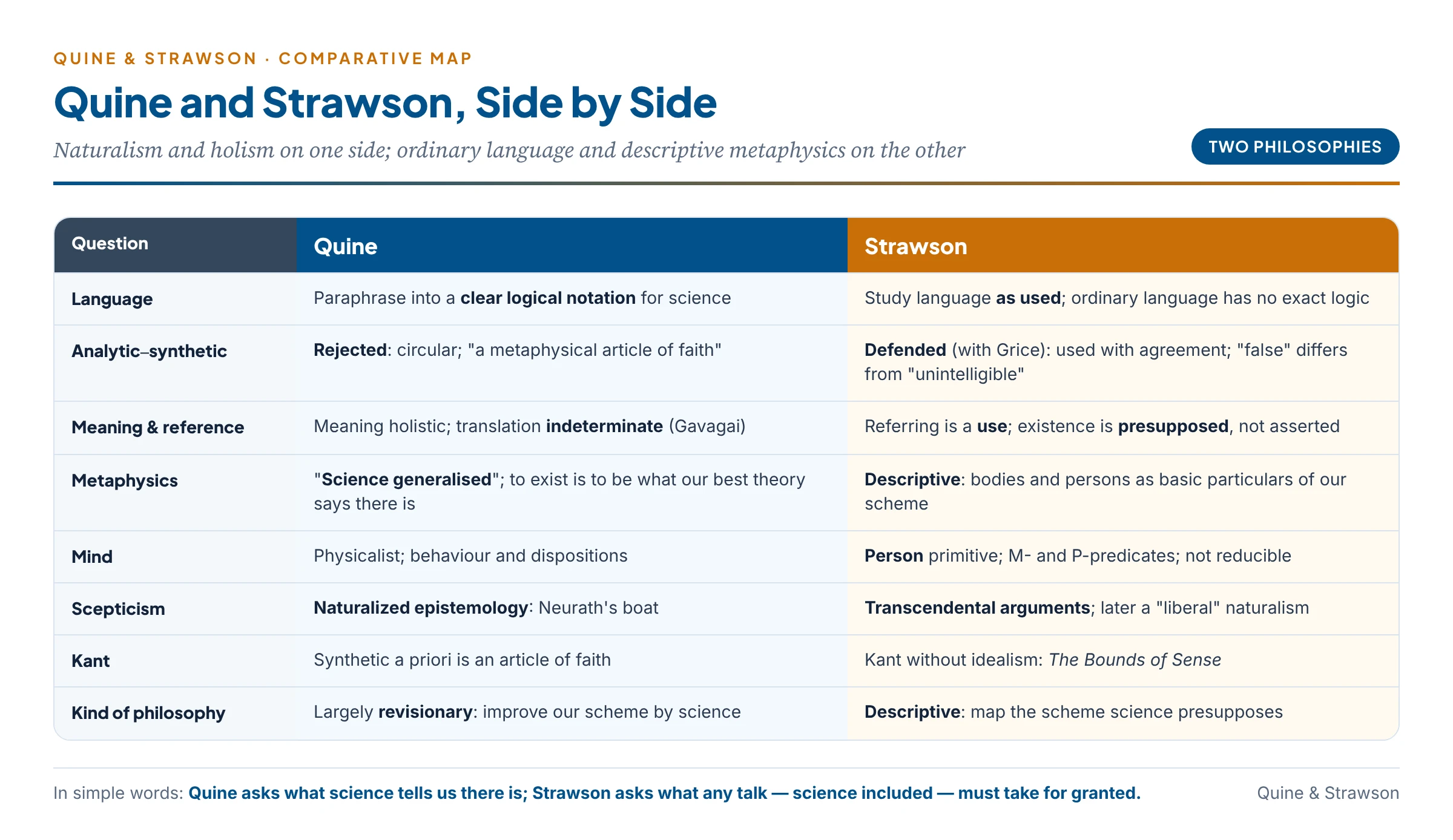
| Dimension | Russell | Logical positivists | Quine | Strawson |
|---|---|---|---|---|
| View of language | Ideal logical language reveals structure | Logical syntax; verifiable vs nonsense | Regimented language for science; web of belief | Ordinary language; meaning lies in use and context |
| Analytic–synthetic | Accepted | Foundation of the system | Rejected as a dogma | Defended as real and usable |
| Metaphysics | Logical analysis replaces bad metaphysics | Eliminated as nonsense | “Science generalised“; ontology by best theory | Descriptive metaphysics of our conceptual scheme |
| Mind | Logical construction from neutral stuff | Physicalism or private experience | Physicalism; behavioural dispositions | Primitive concept of person (M- and P-predicates) |
| Reference | Descriptions are disguised assertions of existence | Reduced to observation | Inscrutable; relative to a background language | Referring is a use; existence presupposed |
| Answer to scepticism | Knowledge by acquaintance and description | Verification | Naturalized epistemology | Transcendental arguments; liberal naturalism |
Critical Evaluation
Assessing the Two Programmes
Quine’s strengths and weaknesses:
- Strengths. Exposed the circularity behind “analytic”; showed that hypotheses face experience together; brought philosophy into close contact with science; gave a clear criterion of ontological commitment.
- Weaknesses. Holism can be overstated; naturalized epistemology risks losing the normative question of justification; behaviourism neglects intentionality; a purely scientific ontology seems too narrow for values, persons and social reality; ordinary concepts are treated as too easily revisable.
Strawson’s strengths and weaknesses:
- Strengths. Restored metaphysics without speculation; showed how identification works; gave the most influential account of persons; corrected Russell on reference and presupposition; offered a humane account of moral responsibility.
- Weaknesses. May be too conservative and too trusting of ordinary language; offers conceptual rather than scientific solutions (as with mind and body); transcendental arguments show at most how we must think, not how things are; may underrate how science reshapes our scheme.
How far Quine’s arguments in “Two Dogmas” are justified (a balanced view):
- Justified in showing that the analytic–synthetic line cannot be drawn by the notions available to empiricists; that reductionism fails; that confirmation is holistic; and that no belief is in principle beyond revision.
- Less justified in concluding that there is no distinction at all (Grice and Strawson); in treating all revisions as alike in kind (changing logic is not like changing a belief about brick houses); and in assuming that meaning can be dismissed because it cannot be reduced to behaviour.
- Verdict. Quine succeeded in dethroning the distinction from its foundational role — the positivist programme did not survive — but not in abolishing it from our thought and language.
Critics and Defenders
Criticism — Critics
- Of Quine: Grice and Strawson (analyticity is real); Kim (naturalism loses normativity); defenders of meaning and intentionality; critics of a science-only ontology.
- Of Strawson: scientific realists (metaphysics must follow physics); critics of ordinary language (it is confused); critics of transcendental arguments; mind–body theorists (persons “explained away”).
- Of Strawson on Russell: Russell (different tasks; a verbal dispute); formal logicians (presupposition complicates logic).
Defence — Defenders and strengths
- Quine: ended the positivist dogmas; holism matches scientific practice; philosophy continuous with science.
- Strawson: revived metaphysics; persons as primitive; presupposition now central to linguistics.
- Together: the two dominant post-positivist options — naturalism and descriptive metaphysics — still frame analytic philosophy today.
Cross-Tradition Comparison
Indian Parallels to the Quine–Strawson Debates
| Debate | Indian parallel | Point of contact |
|---|---|---|
| Empty terms (King of France) | Nyāya and Buddhist logicians on empty terms — “the hare’s horn” (śaśa-viṣāṇa), “the son of a barren woman” (vandhyā-putra), “the sky-flower” (khapuṣpa) | Can a sentence about a non-existent thing be true or false? Nyāya holds such terms fail to refer and the cognition is defective — closer to Strawson’s failed reference than to Russell’s “false” |
| Presupposition | Mīmāṃsā’s principle of implication (arthāpatti) — “Fat Devadatta does not eat by day” implies he eats at night | Meaning includes what an utterance takes for granted or requires, not only what it explicitly states |
| Meaning and use | Mīmāṃsā: word-meaning is learned from elders’ usage (vṛddha-vyavahāra) | Like Strawson and the later Wittgenstein: meaning is fixed by use |
| Sentence holism | Prābhākara anvitābhidhāna (words mean only as related in a sentence); Bhartṛhari’s sentence as an indivisible unit | Quine’s move from word to sentence to whole theory |
| Descriptive vs revisionary | Nyāya–Vaiśeṣika categories (descriptive) vs Buddhist momentariness and Advaita (revisionary) | Strawson’s two kinds of metaphysics |
| Persons | Pudgalavāda — the person neither the same as nor different from the aggregates | Strawson’s primitive person |
| Re-identification | Nyāya recognition (pratyabhijñā: “this is that Devadatta”) against Buddhist momentariness | Strawson’s defence of re-identification against the sceptic |
Indian Connect — Key takeaways
- The empty-term debate (“hare’s horn”) shows Indian logicians facing Russell’s and Strawson’s problem centuries earlier; Nyāya’s treatment of such terms as failing to refer is close to Strawson’s account.
- Mīmāṃsā’s theory that meaning is learned from usage and that utterances carry implications anticipates Strawson’s emphasis on use and presupposition.
- Bhartṛhari and the Prābhākaras anticipate Quine’s holism of meaning; Nyāya–Vaiśeṣika anticipates Strawson’s descriptive metaphysics; the Pudgalavādins anticipate his primitive person.
- Indian philosophy thus contains both a Quinean strand (meaning as a whole; validity by coherence and success) and a Strawsonian strand (categories read off ordinary experience; the reality of enduring persons and things).
Synthesis (Siddhānta)
- Two exits from positivism. Quine kept positivism’s scientific spirit and dropped its dogmas; Strawson kept its clarity and dropped its contempt for ordinary language and metaphysics.
- On reference. Strawson showed that truth and falsity belong to uses of sentences, that existence is presupposed rather than asserted by referring expressions, and that ordinary language has no exact logic — while Russell’s analysis remains the right tool for formal logic.
- On analyticity. Quine showed the distinction cannot be the foundation of knowledge; Grice and Strawson showed it is still a real feature of thought and language.
- On metaphysics and mind. Quine’s ontology is scientific and revisable; Strawson’s is the description of a scheme of bodies and persons that even science presupposes. Quine leans to physicalism; Strawson defends the primitive person.
- On scepticism. Quine’s naturalized epistemology and Strawson’s transcendental arguments and liberal naturalism are two ways of refusing a foundation outside our ordinary practice — “repair the boat at sea” versus “describe the boat we cannot leave”.
- Legacy. Today’s analytic philosophy still moves between these two poles: naturalism (philosophy as continuous with cognitive science) and descriptive metaphysics (the analysis of our concepts of object, person, cause and responsibility). The best work combines Quine’s respect for science with Strawson’s respect for the human standpoint.
- Contemporary relevance. Presupposition is a working tool in law (“loaded questions” in cross-examination presuppose facts not in evidence) and in fact-checking (“Why did the minister resign?” presupposes that he did); holism informs how scientists weigh anomalies; and Strawson’s reactive attitudes shape current debates on punishment, forgiveness and responsibility in criminal justice.
“Mentioning, or referring, is not something an expression does; it is something that someone can use an expression to do.” — Strawson
Previous Year Questions
- 2014How far are Quine’s arguments in ‘Two Dogmas of Empiricism‘ justified? Discuss.
- 2012Explain critically Quine’s rejection of the analytic-synthetic distinction and his subsequent philosophical arguments.
- 2010Is Strawson’s concept of person a refutation of Hume’s concept of self? Discuss.
- 1997Elucidate Bertrand Russell’s theory of descriptions, and examine it with special reference to its criticism by P. F. Strawson.