

Moore, Russell and Early Wittgenstein: Defence of Commonsense; Refutation of Idealism; Logical Atomism; Logical Constructions; Incomplete Symbols; Picture Theory of Meaning; Saying and Showing.
Official Syllabus: Paper I, Section A, Unit 6
The Picture Theory of Meaning is the central doctrine of Ludwig Wittgenstein’s Tractatus Logico-Philosophicus (1921). It answers a basic question: how can a sentence say something about the world — and how can a false sentence still be meaningful? Wittgenstein’s answer is that a proposition is a logical picture (Bild) of a possible situation. Just as a model of a road accident uses toy cars to show how real cars were placed, a proposition uses names to stand for objects, and the way the names are arranged shows how the objects are arranged in a possible state of affairs. What the picture and the pictured must share is their logical form. A proposition has sense when it pictures a possible state of affairs; it is true if that state of affairs exists, false if it does not. Everything that cannot be pictured in this way — logic itself, ethics, the mystical — cannot be said, though it may show itself (the subject of the next article).
In simple words
In a court case about a road accident, a lawyer puts toy cars and little dolls on a table to show how the accident happened. Each toy stands for a real car or person, and their positions show the real positions. The model makes a claim: “this is how it was”. The claim may be right or wrong, but either way we understand it. Wittgenstein says every meaningful sentence is a model like this — words are the toys, and the sentence’s structure is their arrangement.
Context & Problem
Wittgenstein and the Tractatus
- The man. Ludwig Wittgenstein (1889–1951) was born in Vienna into one of Europe’s wealthiest families, the son of a steel magnate. He studied engineering in Berlin and Manchester, became fascinated by the foundations of mathematics, and in 1911 went to Cambridge to study with Russell, who quickly recognised his genius. He was intensely serious, ascetic and morally driven, and later gave away his entire fortune.
- The book. During the First World War Wittgenstein served as a volunteer in the Austrian army and wrote the Tractatus in notebooks at the front. As a prisoner of war in Italy (1918–19) he sent the manuscript to Russell. It appeared in German in 1921 and in English in 1922, with an introduction by Russell.
- Its form. The book consists of short numbered remarks, organised under seven main propositions:
- The world is everything that is the case.
- What is the case, the fact, is the existence of atomic facts (states of affairs).
- The logical picture of the facts is the thought.
- The thought is the significant proposition.
- Propositions are truth-functions of elementary propositions.
- The general form of truth-function (the general form of a proposition).
- Whereof one cannot speak, thereof one must be silent.
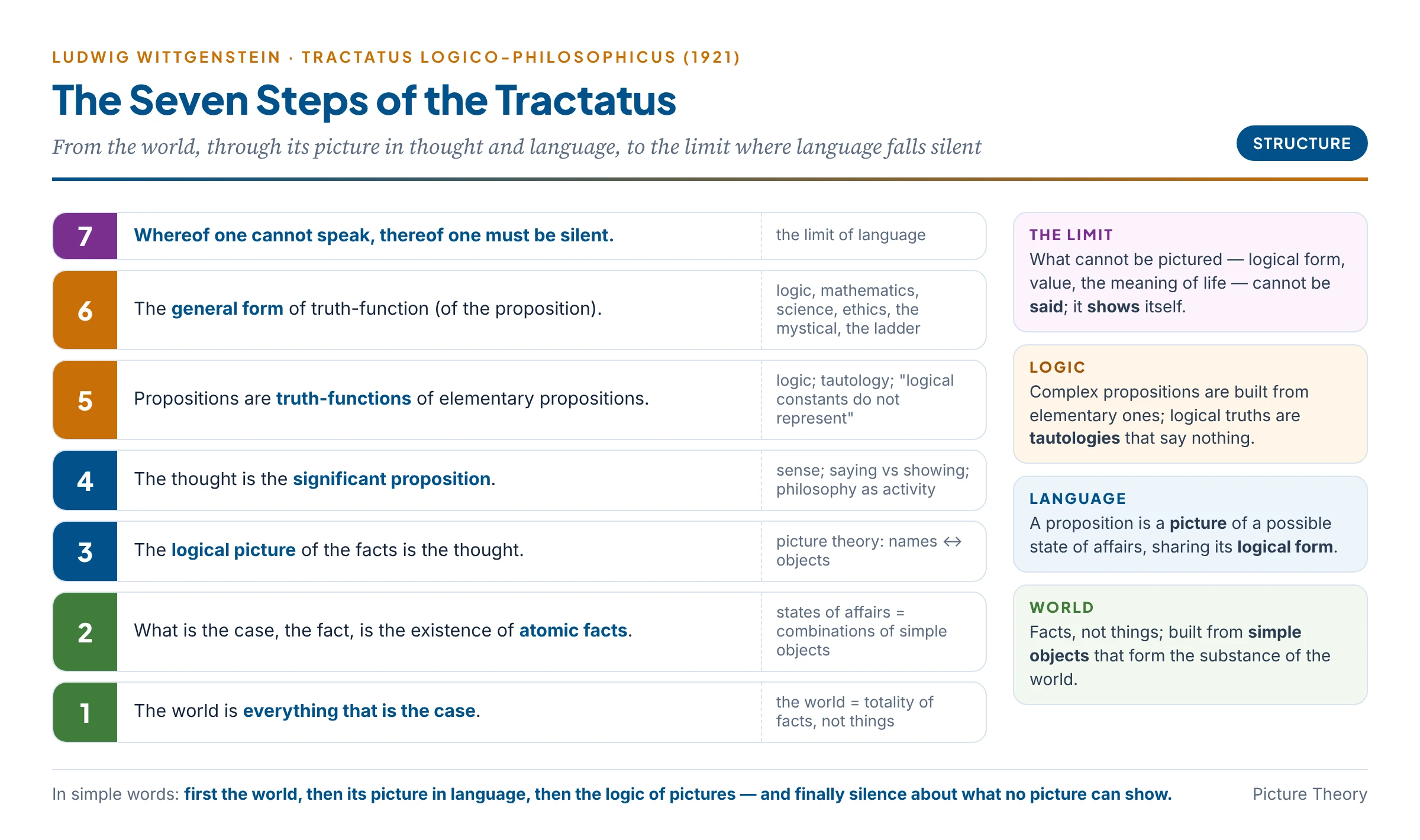
- Its ambition. In the Preface, Wittgenstein says that the whole sense of the book might be summed up thus: “what can be said at all can be said clearly, and whereof one cannot speak thereof one must be silent“. He claimed that the truth of its thoughts was “unassailable and definitive“, and that the problems of philosophy had “in essentials been finally solved“. Having written it, he left philosophy for years.
The Problem the Picture Theory Solves
- Language and reality. What must be true of language and of the world for a sentence to represent the world? Why does “the book is on the table” say something about books and tables?
- The puzzle of falsehood. If the meaning of a sentence were simply the fact it corresponds to, a false sentence — which corresponds to no fact — would be meaningless. Yet “the book is under the table” is perfectly meaningful even when false. Russell had struggled with this in his theory of judgement.
- Language disguises thought. “Language disguises the thought; so that from the external form of the clothes one cannot infer the form of the thought they clothe.” Ordinary grammar hides the logical form of what we say; philosophy must uncover it. “All philosophy is ‘Critique of language’ … Russell’s merit is to have shown that the apparent logical form of the proposition need not be its real form.“
From Russell’s Atomism to Picturing
- Shared starting point. From Russell, Wittgenstein took the idea that the world consists of facts, that facts are built from simple elements, and that complex propositions are truth-functions of elementary ones.
- Wittgenstein’s radical step. Russell explained meaning mainly by reference — words stand for things. Wittgenstein replaced this with picturing: a proposition represents a fact by sharing its structure. Russell’s logical atomism supplied the metaphysical groundwork; the picture theory supplied a theory of how language reaches the world.
Core Doctrine
1. The Logical Structure of the World
- Facts, not things. “The world is the totality of facts, not of things.” A heap of things is not yet a world; the world is how things stand to one another.
- Atomic facts (states of affairs). “An atomic fact is a combination of objects (entities, things).” The fact that “the book is on the table” involves the objects book and table in the relation “being on”.
- Simple objects. “The object is simple.” Objects are the indestructible, logically simple elements that form the substance of the world. “Objects form the substance of the world. Therefore they cannot be compound.“
- Why there must be simple objects. If there were no simple objects — no fixed substance — then “whether a proposition had sense would depend on whether another proposition was true“, and it would be impossible to form any determinate picture of the world. So simples are a logical requirement of meaningful language. Wittgenstein never says what they are.
- Possibility built into objects. Each object carries within it the possibilities of combining with other objects. The totality of existing states of affairs is the world; the totality of possible states of affairs is logical space — everything that could be the case.
| World | Description |
|---|---|
| Object | Simple, indestructible, the substance of the world |
| Atomic fact (state of affairs) | A combination of objects |
| Fact | The existence of atomic facts |
| World | The totality of facts (existing states of affairs) |
| Logical space | The totality of possible states of affairs |
In simple words
Think of the pieces in a chess set. Each piece carries in itself the moves it can make. The set of all positions the pieces could form is like logical space; the actual position on the board right now is like the world. The pieces themselves (the objects) stay the same in every game — only their arrangement changes.
2. The Origin of the Idea: A Model of an Accident
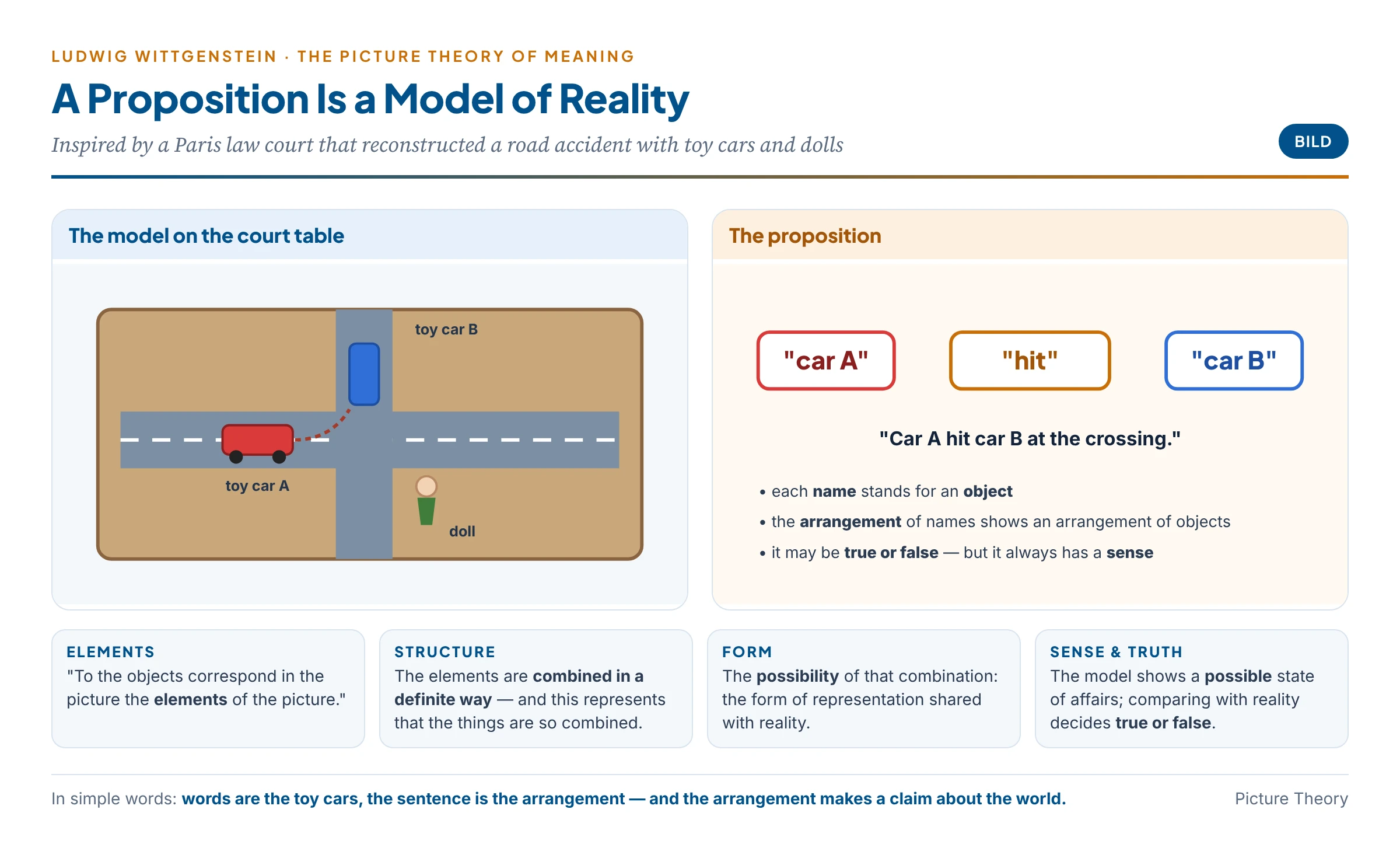
- The Paris court case. In 1914 Wittgenstein read about a law court in Paris where a road accident was reconstructed with model cars and dolls. It struck him that the model works as a proposition: it represents a possible state of affairs by the arrangement of its elements. Here was the essence of all representation.
- Literal, not metaphorical. For Wittgenstein, propositions are pictures in a literal sense — not in the sense of looking like their objects, but in the sense of sharing a structure with them. “Blood is thicker than water” does not look like a picture, because “language disguises thought“.
3. A Proposition Is a Picture
Wittgenstein builds his theory step by step.
- “We make to ourselves pictures of facts.“
- “The picture is a model of reality.“
- “To the objects correspond in the picture the elements of the picture.” The elements stand for the objects.
- “The picture consists in the fact that its elements are combined with one another in a definite way.” A picture is itself a fact.
- “That the elements of the picture are combined with one another in a definite way, represents that the things are so combined with one another.“
- “The proposition is a picture of reality. The proposition is a model of the reality as we think it is.“
- What a picture must share. “If a fact is to be a picture, it must have something in common with what it depicts.” This common feature is the form of representation.
- The proposition as a fact. A written sentence is itself a fact — words standing in certain spatial relations on the page. In the sentence “Delhi is north of Agra“, the relation is not a third thing named by the words “is north of”; rather, the fact that the name “Delhi” stands in a certain arrangement with the name “Agra” is what says that Delhi is north of Agra.
4. The Three Components of a Picture
- Elements (names). The simplest parts of the proposition correspond one-to-one with objects. In “the cat is on the mat”, the words “cat” and “mat” stand for the cat and the mat.
- Relations among the elements (structure). The way the names are arranged mirrors how the objects are related. “A is to the left of B” pictures reality only if A and B really stand in that spatial relation; if not, the proposition is false — but still meaningful.
- Form of representation. The possibility that the elements can be arranged in that way, matching the possibility that the objects can be so arranged.
- An everyday case. “Bristol is west of London” says something different from “London is west of Bristol“, though it uses the same words. What makes the difference? Which name comes first — on a written page, the word “Bristol” stands to the left of “London”. A spatial relation between words symbolises a spatial relation between cities — as on a map. Spoken, a temporal order of sounds does the same work, because the spoken and written sentences share an abstract structure.
In simple words
On a cricket scoreboard, the numbers are not runs and the lights are not wickets — yet the board tells you exactly how the match stands, because each element matches something in the match and their arrangement matches the state of play. A proposition is a scoreboard of the world: its words match objects, and its arrangement matches how things stand.
5. Pictorial Form and Logical Form
This distinction is the subject of the 2022 question.
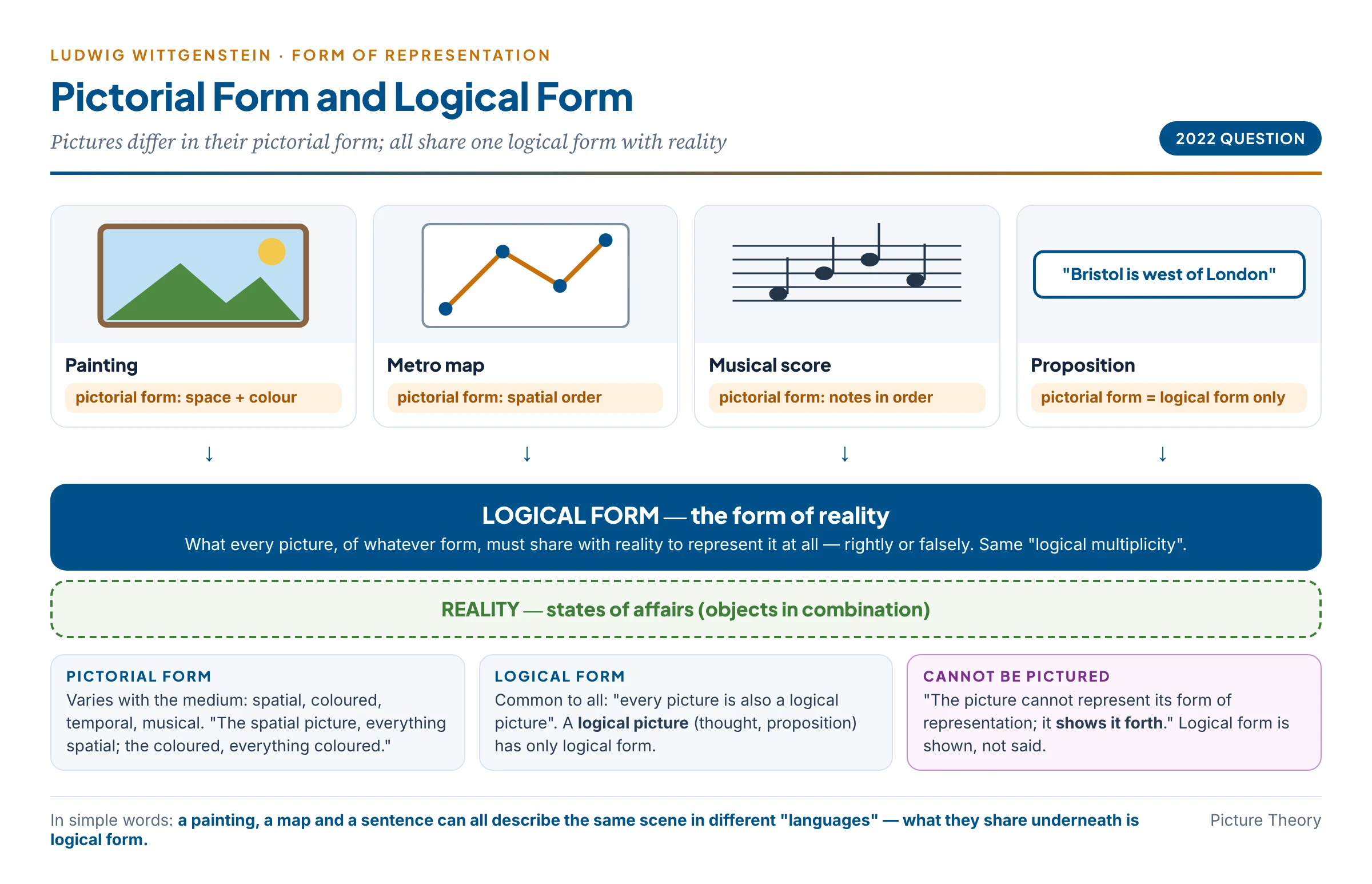
- Pictorial form (form of representation). “The form of representation is the possibility that the things are combined with one another as are the elements of the picture.” It is what a picture must have in common with reality in order to represent it in its own way — rightly or falsely.
- Different pictures, different pictorial forms. “The picture can represent every reality whose form it has. The spatial picture, everything spatial, the coloured, everything coloured, etc.” A painting represents by colour and space, a map by space, a musical score by notes on staves, a gramophone record by grooves. These are different pictorial forms.
- Logical form: the shared minimum. “What every picture, of whatever form, must have in common with reality in order to be able to represent it at all — rightly or falsely — is the logical form, that is, the form of reality.” Not every picture is spatial or coloured, but “every picture is also a logical picture“.
- So the difference is:
- Pictorial form is specific to a kind of picture (spatial, coloured, temporal, musical); it varies from medium to medium.
- Logical form is common to all pictures; it is the minimum that any picture must share with what it pictures — the same logical multiplicity (the same number of distinguishable elements and the same possibilities of combination).
- When the form of representation is just the logical form, the picture is called a logical picture. Thoughts and propositions are logical pictures.
- The gramophone record. “The gramophone record, the musical thought, the score, the waves of sound, all stand to one another in that pictorial internal relation, which holds between language and the world. To all of them the logical structure is common.” A tune can be “translated” from score to sound to groove because they share logical structure, though their pictorial forms differ.
- How logical form defines the relation between language and reality:
- It is the condition of the possibility of representation: a proposition can represent a fact only because both share logical form.
- It is the form of reality itself: the possibilities of combination among objects are mirrored by possibilities of combination among names.
- It decides sense: only arrangements of names that match possible arrangements of objects have sense; logically impossible combinations are not pictures at all.
- It is the bridge, not a third thing: logical form is neither a fact nor an object nor a proposition; it is the shared structure in virtue of which language reaches the world.
- It cannot itself be pictured: “The picture, however, cannot represent its form of representation; it shows it forth.” To represent logical form, “we should have to be able to put ourselves with the propositions outside logic, that is outside the world“. Logical form is therefore shown, not said.
- Two levels. The logical structure of reality belongs to the ontological level (what facts are); logical form belongs to the semantic level (how propositions can represent facts). The picture theory joins the two.
Common confusion
Are “pictorial form” and “logical form” two names for the same thing? Not exactly. Some notes treat them as synonyms. Pictorial form (form of representation) is whatever a particular picture shares with reality — for a map, spatial form; for a painting, spatial and colour form. Logical form is the minimum that every picture must share — the form of reality as such. A logical picture is one whose pictorial form is just logical form. Every picture is a logical picture, but not every picture is spatial or coloured.
6. Elementary Propositions and Names
- Complete analysis. “In propositions thoughts can be so expressed that to the objects of the thoughts correspond the elements of the propositional sign.” These elements are “simple signs“, and a proposition so expressed is “completely analysed“.
- Names. “The simple signs employed in propositions are called names.” “The name means the object. The object is its meaning.” A name stands for a simple object and cannot be further defined.
- Names have meaning only in propositions. “Only the proposition has sense; only in the context of a proposition has a name meaning.“
- Elementary proposition. “The elementary proposition consists of names. It is a connection, a concatenation, of names.” It “asserts the existence of an atomic fact“: if it is true, the atomic fact exists; if false, it does not.
- Independence. Elementary propositions are logically independent of each other: no elementary proposition can contradict another. “It is a sign of an elementary proposition, that no elementary proposition can contradict it.“
- Ordinary language is in order — but disguised. Wittgenstein held that “all propositions of our colloquial language are actually, just as they are, logically completely in order“; but their logical form is concealed. Because ordinary words often signify complex things (“Bristol”, “Austria-Hungary”), an analysis — using an extension of Russell’s theory of descriptions — is needed to reach names of simple objects. “Austria-Hungary is fighting Russia” becomes “there are x and y such that x is Austria, y is Hungary, x is united to y, and both are fighting Russia” — and Austria and Hungary themselves must be analysed further. Full analysis is humanly impossible, but the thought already has that complexity.
- Need for a logical notation. To display logical form clearly we need a symbolism that obeys logical grammar — like Frege’s and Russell’s notation, which “does still not exclude all errors“. Wittgenstein compares the essence of a proposition to hieroglyphic writing, “which pictures the facts it describes“, from which the alphabet developed without losing the essence of representation.
7. Thought, Proposition and Language
- “The logical picture of the facts is the thought.” A thought is a picture whose form of representation is purely logical.
- “In the proposition the thought is expressed perceptibly through the senses.” The proposition is the perceptible expression of a thought — sounds or marks on paper.
- “The thought is the significant proposition.” And “the totality of propositions is the language“.
- Method of projection. A propositional sign becomes a picture of a particular situation when we think its sense — when we correlate its elements with objects. This “method of projection” (compare projection in geometry: one figure projected in many ways) is the link between sign and world. Russell explained it by analogy: a geometrical figure can be projected in many ways, each corresponding to a different language, but its projective properties remain the same.
- A difficulty. How exactly names are correlated with objects Wittgenstein does not explain; it seems a mental act each speaker must perform for himself — a point that later troubled him.
8. Sense, Truth and Falsity
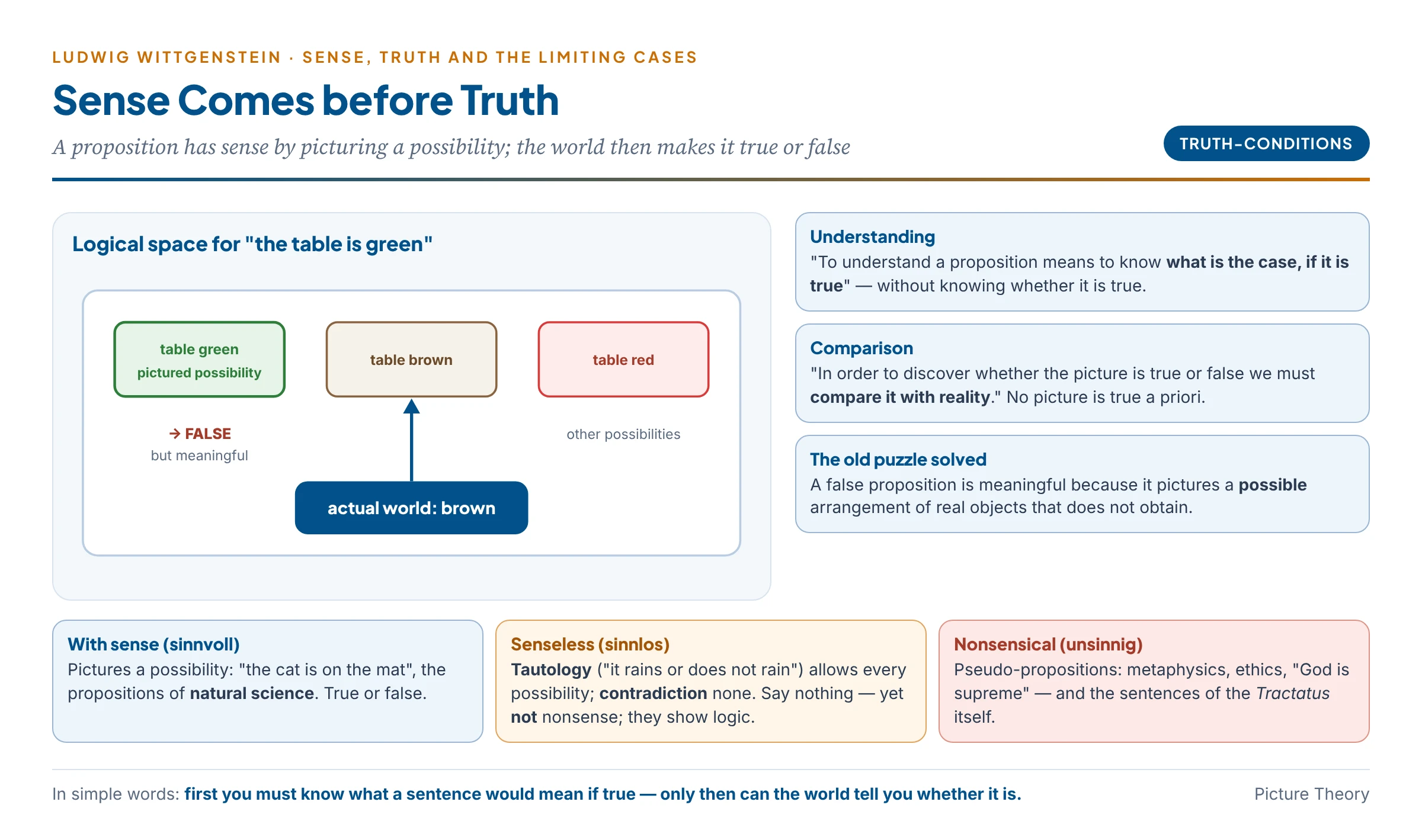
- Sense is prior to truth. A proposition has sense if it pictures a possible state of affairs in logical space. It is then true if the state of affairs exists, and false if it does not. “The picture agrees with reality or not; it is right or wrong, true or false.“
- We must compare. “In order to discover whether the picture is true or false we must compare it with reality.” “It cannot be discovered from the picture alone whether it is true or false.” There are no pictures that are true a priori.
- Understanding without knowing truth. “To understand a proposition means to know what is the case, if it is true. (One can therefore understand it without knowing whether it is true or not.)” “I understand the proposition, without its sense having been explained to me.“
- Showing and saying sense. “The proposition shows its sense. The proposition shows how things stand, if it is true. And it says, that they do so stand.“
- Examples. “The Eiffel Tower is in Paris” has sense because it depicts a possible configuration of objects, whether or not it is true. “The table is green” is meaningful; whether it is true depends on whether the table is in fact green. If it is brown, the proposition is false — and still meaningful.
- The puzzle of falsehood solved. A false proposition is meaningful because it pictures a possible combination of real objects — a combination that happens not to obtain. Meaning comes from the possibility of the arrangement, not from its actuality.
In simple words
A weather forecast saying “Heavy rain in Chennai tomorrow” is perfectly clear before tomorrow comes. You know exactly what would make it true. If the day turns out sunny, the forecast was false — but it was never meaningless. Wittgenstein says every meaningful proposition is like a forecast: it lays out a possibility, and the world decides whether it is true.
9. Truth-Functions, Tautologies and Contradictions
- Complex propositions. “Propositions are truth-functions of elementary propositions.” A complex proposition is true or false depending only on the truth or falsity of its elementary components.
- Logical constants do not represent. “My fundamental thought is that the ‘logical constants’ do not represent. That the logic of the facts cannot be represented.” Words like “not”, “and”, “or” do not stand for objects; there are no “logical objects”.
- The general form of the proposition. Every proposition can be generated from elementary propositions by repeated joint negation (“neither … nor …”). In plain words: start with the elementary propositions, and keep applying “neither … nor …” to any selection of the propositions obtained. This gives the whole of language from its atoms.
- No causal nexus. “From an elementary proposition no other can be inferred.” “There is no causal nexus which justifies such an inference.” “Superstition is the belief in the causal nexus.” Laws of nature are not explanations; “that the sun will rise to-morrow is an hypothesis“.
- Two limiting cases. Among all truth-functions there are two extremes:
- Tautology — true for every combination of truth-values: “it rains or does not rain“.
- Contradiction — false for every combination: “it rains and does not rain”.
- Senseless, not nonsensical. “The proposition shows what it says, the tautology and the contradiction that they say nothing.” “Tautology and contradiction are without sense.” (“I know, e.g. nothing about the weather, when I know that it rains or does not rain.“) Yet “tautology and contradiction are, however, not nonsensical; they are part of the symbolism“, in the way that “0” is part of the symbolism of arithmetic.
- Logic says nothing. “The propositions of logic are tautologies.” “The propositions of logic therefore say nothing.” But the fact that certain combinations of propositions yield tautologies shows the formal properties of language and the world: “Logic is not a theory but a reflection of the world. Logic is transcendental.” Mathematics consists of equations, which are “pseudo-propositions“.
- Three kinds of “propositions” (answering the 2010 question):
- Significant (with sense — sinnvoll): pictures of possible states of affairs — the propositions of natural science and everyday fact (“the cat is on the mat”).
- Senseless (without sense — sinnlos): tautologies and contradictions — they say nothing about the world, but are a legitimate part of the symbolism and show the logic of the world.
- Nonsensical (unsinnig): pseudo-propositions that violate logical syntax or try to say what can only be shown — metaphysics, ethics, “God is supreme“, “the Good is more or less identical than the Beautiful” — and, finally, the propositions of the Tractatus itself.
- So, are tautologies meaningless? In one sense yes: they have no sense, picture nothing, and say nothing. In another sense no: they are not nonsense; they are well-formed, they belong to the symbolism, and they show the logical form of the world.
Common confusion
Are tautologies “nonsense” for the early Wittgenstein? No. Many notes put tautologies together with metaphysics as “meaningless”. Wittgenstein separates senseless (sinnlos) from nonsensical (unsinnig). Tautologies and contradictions are senseless — limiting cases of propositions that say nothing; metaphysical sentences are nonsensical — they only look like propositions. Also beware of using “2 + 2 = 4” as the example of a tautology: for Wittgenstein mathematical propositions are equations, not tautologies; the standard example is “it rains or it does not rain“.
10. Everyday Analogies of Picturing
- A metro map. Stations and lines on the map correspond to real stations and routes; the map is useful because of its structural similarity to the network. But the map cannot depict the conventions (scale, colour codes) by which it represents — they are presupposed, shown in its use.
- A chessboard. Each piece stands for a role (pawn, rook), and their positions picture the state of a game. “The white queen threatens the black king” pictures a configuration; the rules of the game are presupposed, not represented within the proposition.
- An engineering blueprint. Lines and symbols correspond to beams and cables; the angles and distances among them depict the structural relations of the bridge.
- A musical score. Notes on a staff correspond to sounds; the score, the performance and the recording share logical structure.
11. Significance of the Picture Theory
- A precise theory of representation. It explains how language connects with the world: through shared structure, not resemblance.
- Meaning separated from truth. It explains why false propositions are meaningful and why understanding precedes verification.
- The limits of sense. It draws a sharp line between what can be said (the propositions of natural science) and what cannot — preparing the doctrine of saying and showing.
- Philosophy as clarification. “Philosophy is not a theory but an activity.” Its result is “not a number of ‘philosophical propositions’, but to make propositions clear“.
- Influence. The theory deeply influenced the Vienna Circle (logical positivism), which took from it the idea that necessary truths are tautologies and that metaphysics is meaningless — though Wittgenstein himself held the “unsayable” to be the most important part of life.
12. Why Wittgenstein Gave Up the Picture Theory
The 2017 question asks for this; the later questions (2023, 2025) ask about the transition to the use theory (treated fully under Later Wittgenstein).
- The colour-exclusion problem. Elementary propositions were supposed to be independent. But “this spot is red” and “this spot is green” exclude each other, and neither seems further analysable. In 1929 Wittgenstein admitted that elementary propositions are not independent — and the system began to unravel.
- No simples found. “Simple” and “complex” turned out to have no absolute meaning: whether a chessboard is simple or composed of 64 squares (or of black and white) depends on the context of the question.
- Language does far more than picture facts. Commands, questions, greetings (“hello“), prayers, jokes, thanks — these are not pictures of states of affairs. The economist Piero Sraffa is said to have made a Neapolitan gesture of contempt (brushing his chin with his fingertips) and asked: “What is the logical form of that?“
- Meaning is not the bearer. If the meaning of a name were the object it names, then when Mr N.N. dies, “Mr N.N. is dead” would lose its meaning — which is absurd. The bearer of a name is not its meaning.
- Dogmatism and the “craving for generality”. Wittgenstein came to see the Tractatus as imposing a single, crystalline ideal on language — what he later described as a picture that “held us captive”.
- From picture to tool. In the Philosophical Investigations he treated words as tools in a toolbox and meaning as use within language-games embedded in forms of life — looking not to an ideal language with a precise logical structure, but to the ways in which languages are actually used.
- What he kept. Wittgenstein never abandoned the view that philosophy is an activity of clarification, not a body of doctrine, and that philosophical problems arise from misunderstanding the logic of our language.
Critical Evaluation
Objections to the Picture Theory
- It presupposes a fixed world and fixed meanings. But words acquire meaning only in the whole context of their use, and the same word may have several senses: “please” can express a request, permission or pleasure.
- Many words denote nothing yet have well-established use — “hello“, “ouch”, “thanks”.
- Language is dynamic. New words are added (“bits, bytes, mouse“) and old ones die; a static picture of language loses its richness.
- Names without bearers. If a proposition is meaningful only when its names stand for existing objects, sentences like “Mr Sharma is dead” would become meaningless after Mr Sharma’s death.
- Proper names are not simple. A name like “Ashoka” calls up many descriptions; it is hard to say what single object is its “meaning”.
- Negative, conditional and general propositions. “Not”, “if”, “something” and “everything” do not seem to picture anything; the theory must treat them as truth-functional operations — an artificial solution for ordinary speech.
- Are there really simple objects? Critics doubt that the world can be reduced to a fixed set of logically simple objects, given the fluidity of empirical reality.
- Perfect isomorphism vs vagueness. Natural language is vague, ambiguous and context-dependent, and resists the strict correspondence the theory demands.
- The correlation of names and objects is left mysterious, and logical form itself cannot be represented — the theory cannot state its own foundations.
- Wittgenstein’s own verdict. In later life Wittgenstein said he had paid attention neither to actual language nor to the actual world: atomic facts and simple objects were a myth.
Replies and Strengths
- Structure matters. Every serious theory of meaning since has accepted that a sentence means what it does partly because of its structure — “Bristol is west of London” vs “London is west of Bristol”.
- Truth-conditions. The idea that “to understand a proposition means to know what is the case if it is true” became the foundation of truth-conditional semantics in modern logic and linguistics.
- Sense independent of truth solved the ancient puzzle of how false statements can be meaningful.
- The nature of logic. The account of logical truths as tautologies that say nothing transformed the philosophy of logic.
- The theory was meant for the logic of language, not its sociology. Many criticisms (greetings, slang, new words) target ordinary usage, which the Tractatus never claimed to describe.
Critics and Defenders
Criticism — Critics
- Later Wittgenstein: simples and atomic facts are a myth; meaning is use.
- Colour exclusion: elementary propositions are not independent.
- Ordinary-language philosophers: greetings, commands and jokes are not pictures.
- Bearer argument: the meaning of a name is not its bearer.
- Contextualists: words change meaning with context and time.
- Sraffa’s gesture: what is its logical form?
Defence — Defenders and strengths
- Structure explains how sentences differ in meaning.
- Truth-conditions became the core of formal semantics.
- False propositions are meaningful because possible.
- Tautologies explain the necessity and emptiness of logic.
- Limits of sense clarify the task of philosophy.
- Logical positivists built on it.
Cross-Tradition Comparison
The Picture Theory and Indian Theories of Sentence-Meaning
| Point | Early Wittgenstein | Nyāya (śābdabodha) | Bhāṭṭa Mīmāṃsā (abhihitānvayavāda) | Prābhākara Mīmāṃsā (anvitābhidhānavāda) | Bhartṛhari (sphoṭa) |
|---|---|---|---|---|---|
| Unit of meaning | Proposition; names mean only in a proposition | Sentence built from word-meanings | Words first express their meanings; then they are related | Words express meanings already related in a sentence | The sentence as an indivisible whole |
| How words link to things | Names stand for simple objects | Words denote by a fixed power (śakti) | Each word denotes a universal | Word-meaning grasped only in a sentence context | Meaning flashes forth as a whole (pratibhā) |
| Conditions of meaningfulness | Shared logical form; picture of a possible state of affairs | Syntactic expectancy (ākāṅkṣā), semantic fitness (yogyatā), proximity (āsatti) | Same conditions | Same conditions | — |
| Closest parallel | — | Yogyatā ≈ having sense | Atomistic — like the picture theory’s names | “Only in the context of a proposition has a name meaning“ | Holism of the later Wittgenstein |
Indian Connect — Key takeaways
- Yogyatā and sense. For the Naiyāyikas, “he wets it with fire” (agninā siñcati) is grammatically complete but lacks semantic fitness (yogyatā) — fire cannot wet — so it produces no valid verbal knowledge. This is close to Wittgenstein’s idea that only combinations matching possible arrangements of objects have sense.
- Word and sentence. The Mīmāṃsā debate between word-first (abhihitānvaya) and sentence-first (anvitābhidhāna) theories mirrors the Tractatus: names stand for objects (atomism), yet “only in the context of a proposition has a name meaning” (contextualism).
- Bhartṛhari’s holism. For Bhartṛhari the sentence-meaning is an indivisible flash of understanding (pratibhā) that cannot be built from word-meanings — closer to the later Wittgenstein’s rejection of atomistic analysis.
Synthesis (Siddhānta)
The picture theory is a theory of representation through shared structure. The world is the totality of facts; facts are combinations of simple objects; a proposition is a logical picture in which names stand for objects and the arrangement of the names represents a possible arrangement of the objects. What every picture shares with what it pictures is logical form — the form of reality — while pictorial forms (spatial, coloured, musical) vary. A proposition has sense if it pictures a possible state of affairs and is true if that state of affairs obtains; tautologies and contradictions are senseless limiting cases that show the logic of the world, while metaphysical sentences are nonsense. Logical form itself cannot be pictured: it shows itself — the bridge to the doctrine of saying and showing.
Wittgenstein himself later rejected the theory: elementary propositions were not independent, no simples could be found, and language turned out to be a motley of activities rather than a mirror of facts. Yet the picture theory’s core insights — that structure carries meaning, that understanding a proposition means knowing its truth-conditions, and that logic says nothing about the world — remain foundations of modern logic, linguistics and philosophy.
- Truth-conditional semantics in linguistics and knowledge representation in artificial intelligence descend from the idea that a sentence’s meaning is the possible situation it describes.
- Data visualisation and models — maps, circuit diagrams, architectural plans — work exactly by sharing structure with what they represent.
- Indian theories of sentence-meaning offer remarkably close parallels in the debate between word-first and sentence-first accounts.
A proposition is a model of reality: its words stand for things, and its form shows how they could stand to one another.
Previous Year Questions
- 2025“We should look not to an ideal language which derives its meaning from facts and has a precise logical structure but empirically, to the ways in which languages are actually used.” Explain the transition from early views of Wittgenstein to his later views on language and meaning with reference to this statement.
- 2023What were the main reasons that led Wittgenstein to shift from picture-theory of meaning to use-theory of meaning? Critically discuss.
- 2022Is there any difference between pictorial form and logical form in Ludwig Wittgenstein’s picture theory of language? How does the logical form define the relation between language and reality? Explain.
- 2017What is Wittgenstein’s theory of picture theory of meaning? What are his reasons for giving up his theory and suggesting the use theory of meaning?
- 2014Why does Wittgenstein disagree with Bertrand Russell’s interpretation of atomism in the philosophy of Tractatus? Discuss.
- 2010Are tautologies meaningless according to Wittgenstein?