

Kant: Possibility of Synthetic a priori Judgments; Space and Time; Categories; Ideas of Reason; Antinomies; Critique of Proofs for the Existence of God.
Official Syllabus: Paper I, Section A, Unit 4
Kant’s theory of space and time is the first building block of his critical philosophy. In the part of the Critique called the Transcendental Aesthetic — “aesthetic” here means the study of sensibility (aisthēsis, sense perception), not of beauty — Kant argues that space and time are neither things that exist on their own (as Newton held) nor relations between things abstracted from experience (as Leibniz held). They are a priori forms of intuition (Anschauung): the built-in ways in which the human mind must receive anything given to the senses. Space is the form of outer sense; time is the form of inner sense and therefore of all appearances whatever. This explains how geometry and arithmetic can be both synthetic and a priori, and it also sets the first limit of knowledge: space and time are empirically real but transcendentally ideal — valid for everything we can experience, but not for things as they are in themselves.
In simple words
Imagine a cookie-cutter shaped like a star. Whatever dough you press with it — sweet, salty, chocolate or plain — comes out star-shaped. You can predict the shape of every cookie before you see the dough, because the shape comes from the cutter, not from the dough. Kant says space and time are like the mind’s cutter. Whatever sensations reach us — colours, sounds, pressures — come out arranged side by side in space and one after another in time. That is why we can know truths about all shapes and all counting in advance — and also why we can never know what the “dough” was like before it was cut.
Context & Problem
What the Transcendental Aesthetic Asks
- Sensibility (Sinnlichkeit) is the mind’s receptive capacity — its ability to be affected by objects and so to receive representations.
- Intuition (Anschauung) is the representation through which knowledge relates immediately to a single object. Human intuition is always sensible: objects are given to us only through the senses. (A concept, by contrast, relates to objects mediately, through marks common to many.)
- Sensation is the effect of an object on our capacity to receive; an intuition that relates to its object through sensation is empirical, and its object is an appearance.
- Matter and form of appearance.
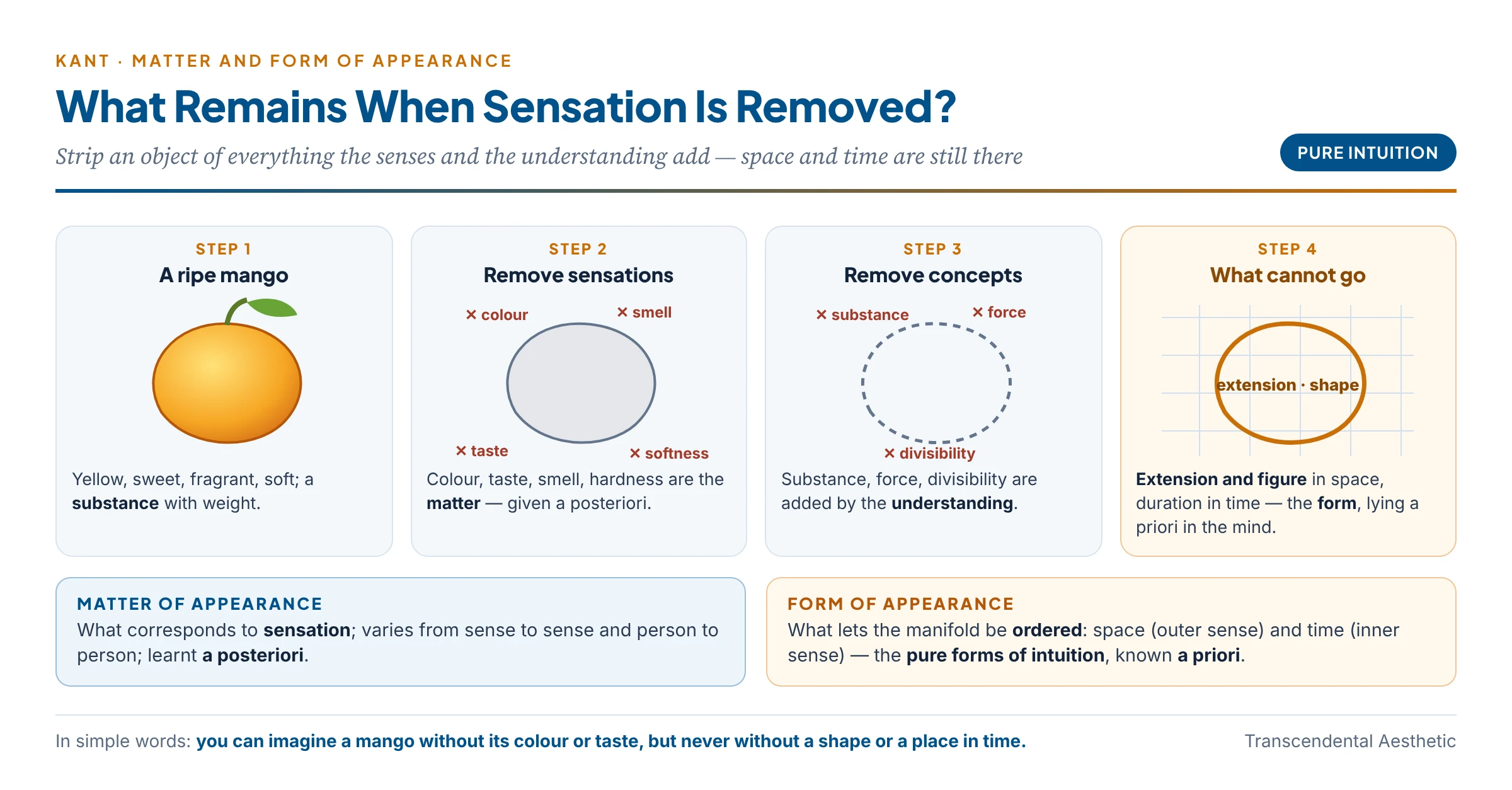
- The matter of an appearance is what corresponds to sensation (colour, hardness, warmth).
- The form is that which allows the manifold of the appearance to be ordered in certain relations.
- The matter is given a posteriori; the form must lie ready in the mind a priori.
- The question. Are there such pure forms of intuition, and what are they? Kant’s answer: there are exactly two — space and time.
In simple words
Take a mango in your mind and strip away everything the senses add: its yellow colour, its sweet taste, its smell, its softness. Strip away, too, what the understanding thinks into it — that it is a substance, that it has force or weight. What is left? Its extension and shape — the fact that it occupies a region of space — and the fact that it lasts through time. These cannot be removed even in thought. Kant calls what remains the pure form of intuition: it belongs to the way we sense anything at all, not to this or that sensation.
Two Rival Theories Before Kant
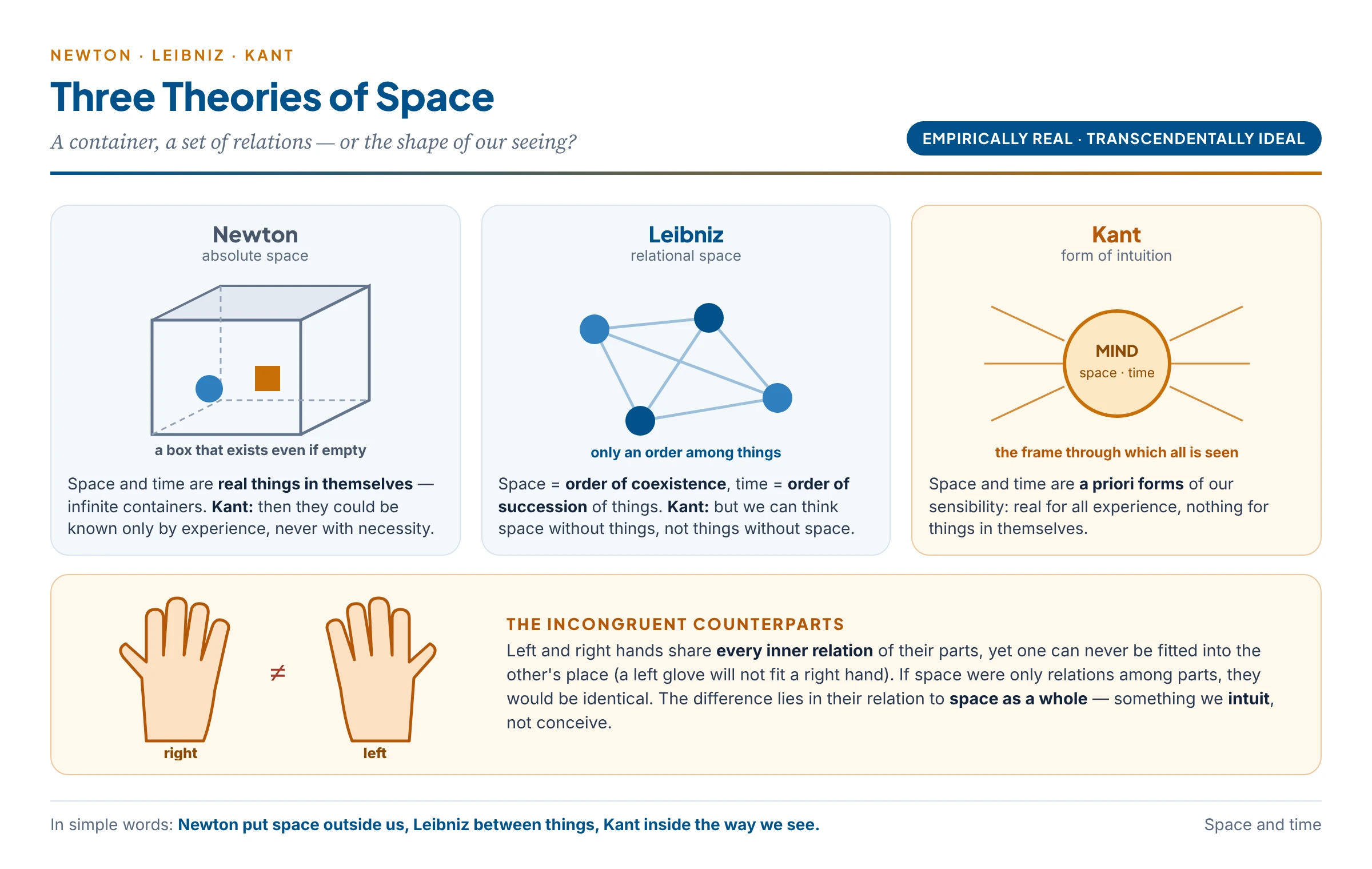
- Newton — absolute space and time.
- Space and time are objective realities existing in their own right, independent of objects and of minds.
- Space is an infinite container in which objects are placed; time flows uniformly whether or not anything happens.
- Objects exist in space and time.
- Leibniz — relational space and time.
- Space and time have no independent reality. Space is the order of coexistence of things; time is the order of succession of their states.
- Time depends on the successive states of monads, which are causally connected — so Leibniz gives a causal theory of time.
- Space and time are relations founded in the accidents (states) of things: place is grounded in the situation of each body, time in the succession of monadic states. They are “well-founded phenomena,” confused perceptions of relations that reason grasps clearly.
- Kant’s dissatisfaction.
- Against Newton: if space and time were self-existing realities, they could be known only through experience, and so never with strict universality and necessity. And they would be two strange “eternal and infinite non-entities” that exist without being anything, merely to contain all real things.
- Against Leibniz: if space and time were derived from relations among things, geometry would be an empirical generalisation and could not be certain. Moreover, we can think space and time without objects (empty space, an empty stretch of time), but we cannot think objects without space and time.
Core Doctrine
1. The Metaphysical Exposition: What Space and Time Are
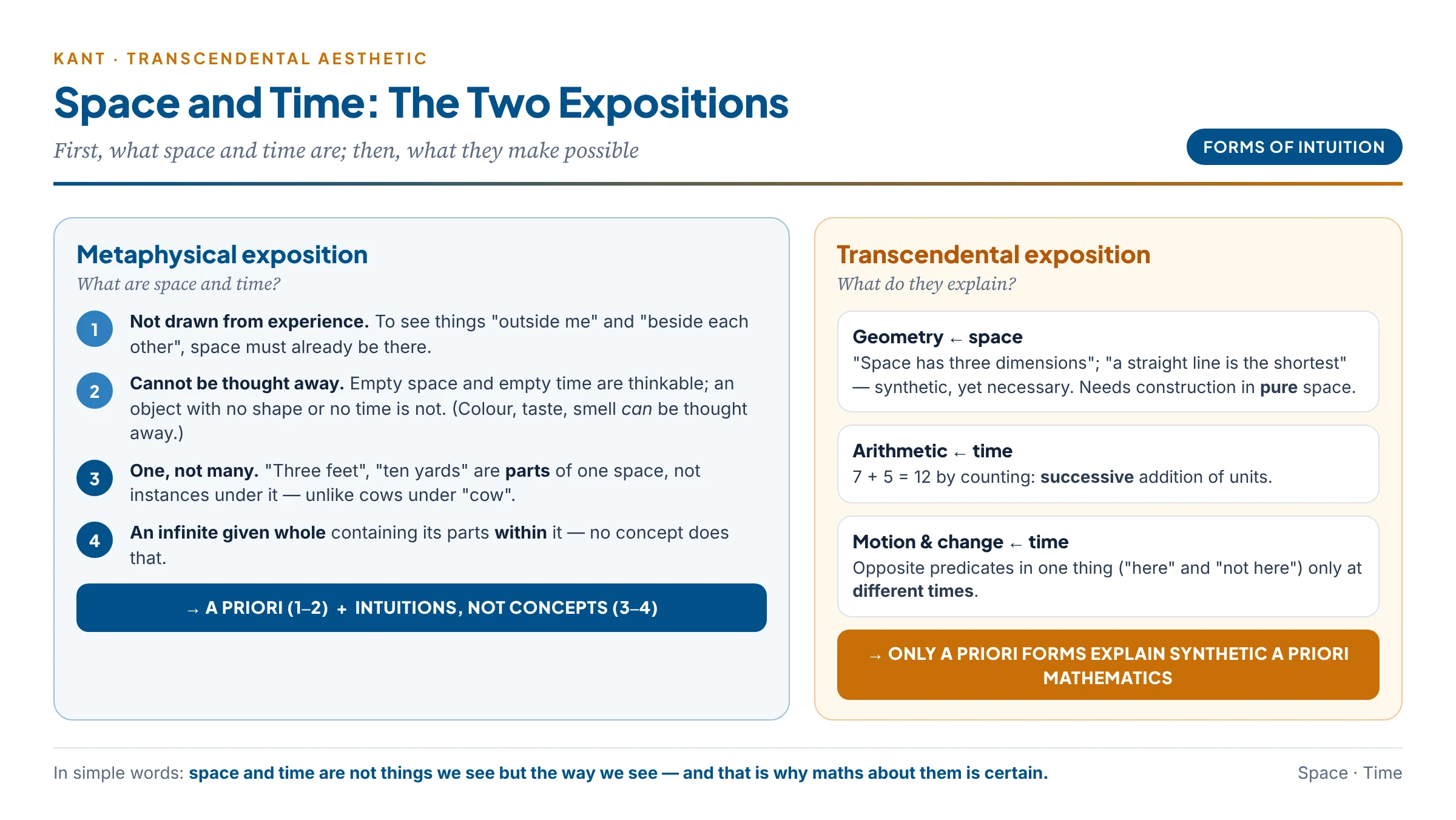
An exposition is a clear presentation of what belongs to a concept; it is metaphysical when it shows that the representation is given a priori. Kant presents four arguments for space and parallel arguments for time. The first two show that space and time are a priori; the last two show that they are intuitions, not concepts.
Space:
- Not an empirical concept drawn from outer experience. To represent things as outside me and as beside one another in different places, I must already have the representation of space. So space is not learnt from outer experience; outer experience is possible only through it.
- A necessary a priori representation. We can never represent that there is no space, although we can easily think of space empty of objects. So space is the condition of the possibility of appearances, not something that depends on them.
- Not a general concept but a pure intuition. There is only one space. When we speak of “many spaces,” we mean parts of one and the same space. These parts do not come before the whole as its building blocks; they are limitations within it. A concept, by contrast, is a general idea under which many separate instances fall.
- An infinite given magnitude. Space is represented as an infinite whole that contains all its parts within it. No concept can contain an infinite number of representations within itself in this way (a concept contains them under itself). So the original representation of space is an intuition.
Time:
- Not an empirical concept. Simultaneity and succession could not even be perceived unless the representation of time lay at their base a priori.
- A necessary representation underlying all intuitions. We cannot remove time from appearances, though we can think time empty of appearances.
- Ground of necessary principles about time. Time has only one dimension; different times are not simultaneous but successive (just as different spaces are not successive but simultaneous). Such principles could not be drawn from experience, which would give neither strict universality nor certainty.
- Not a discursive concept but a pure form of intuition. Different times are only parts of one and the same time.
- Infinite. Every determinate quantity of time is possible only through limitations of one single underlying time; so the original representation of time must be given as unlimited.
The cow and the giant cow — space and time are particulars, not universals.
- A concept is formed by comparing many instances and keeping what is common and essential. The concept “cow” is reached from many cows and subsumes them — but if we lumped all particular cows of every build and colour together, we would get a gigantic cow, not the concept “cow.”
- Space and time are exactly the opposite. “Three feet,” “ten yards,” “this room” are not instances of space falling under it, like cows under “cow”; they are parts of it that constitute one single space. There are no instances of space as there are instances of cow or man.
- So space and time are percepts (particulars, individual entities), not concepts (universals).
Space and time are not empirical — the colour test.
- We can imagine an object without this colour or that, without any smell or taste, even without any colour at all.
- But we can never imagine an object without spatial character — without extension and shape — or outside time.
- What can be thought away is empirical; what cannot be thought away is a condition of experience — a priori.
2. The Transcendental Exposition: Why Mathematics Needs Them
A transcendental exposition shows that a representation is the principle that explains the possibility of other synthetic a priori knowledge.
- Space and geometry.
- Geometry determines the properties of space synthetically and yet a priori: “space has only three dimensions”; “the straight line is the shortest between two points”; “the angles of a triangle equal two right angles.”
- Such propositions cannot be derived from concepts alone (that would make them analytic) — they need an intuition, in which we construct the figure.
- They cannot be derived from empirical intuition (that would make them contingent and particular) — they are apodictic, necessary.
- So the intuition must be pure and a priori: space is a form in the subject, the form of outer sense. Only so can we understand how geometry, made in our heads, applies with certainty to every object we will ever meet.
- Time, motion and arithmetic.
- The concepts of change and motion (change of place) are possible only through and in the representation of time: only in time can contradictory predicates belong to one thing — a thing existing and not existing in the same place, but at different times.
- So time explains the synthetic a priori knowledge found in the general doctrine of motion — and, through counting as successive addition of units, in arithmetic.
- The conclusion. Unless space and time are a priori, the universality and necessity of mathematics cannot be explained. If they were derived from experience, mathematical statements would lack strict universality — they could have exceptions, like any generalisation from observation.
Common confusion
What is the difference between the “metaphysical” and the “transcendental” exposition?
- The metaphysical exposition asks what space and time are: it shows that they are (i) not concepts but intuitions (percepts) and (ii) not empirical but a priori.
- The transcendental exposition asks what space and time explain: it shows that unless they are a priori intuitions, the synthetic a priori knowledge of geometry, arithmetic and motion cannot be explained.
The first establishes the nature of space and time; the second shows their use as the ground of other a priori knowledge.
3. Kant’s Conclusions about Space and Time
- Space is nothing but the form of all appearances of outer sense — the subjective condition under which alone outer intuition is possible for us.
- Time is the form of inner sense — of the intuition of ourselves and our inner states. Since all representations, whether they have outer things as objects or not, belong as states of the mind to inner sense, time is the a priori condition of all appearances whatever: immediately of inner appearances and mediately of outer ones.
- Space and time are in us, not we in them. “We are not in space and time; space and time are within us.” They are subjective forms of perceiving any object for all human beings.
- Subjective yet objective. Because they are subjective in the same way for all human beings, they are truly objective — for Kant, “objective” here means the same for all knowers at all times and places. “A dream which all men dream together, and which all must dream, is not a dream but reality.”
- Moulds, doors and glasses. Space and time are two glasses through which we see the world; without them we cannot perceive at all. They are the doors between sense perception and the categories of understanding: sense content passes through them to reach the categories and become knowledge proper.
- Percepts. Sensations that have been spaced and timed are percepts; they are still unconnected and do not yet form knowledge. At this level, both experience (the data) and reason (the forms) play an equal part.
- Euclidean space. For Kant, space meant Euclidean space — for him the unalterable, all-pervasive feature of every perception of outer things.
4. Empirical Reality and Transcendental Ideality
- Empirical reality. Space and time are objectively valid for every object that can ever be given to our senses. Within experience, a table really is next to the wall; the train really does leave before noon. Space and time are real “for practical concerns of life” and for science.
- Transcendental ideality. Space and time are nothing once we abstract from the conditions of sensible intuition. They are not properties or relations of things in themselves. If we take away the subject, the spatial and temporal character of things vanishes.
- What follows.
- Space and time yield knowledge of phenomena only. Whatever we perceive, we colour, modify and transform by spacing and timing it; what lies beyond, we cannot know.
- If we try to apply space and time to things in themselves — the world as a whole, God, the soul — we trespass the limits of knowledge and fall into transcendental illusion (see the antinomies).
- Not Berkeley’s illusion. Transcendental ideality does not mean objects are mere illusion (Schein). Appearances are real objects of experience; the illusion would arise only if we ascribed space and time to things in themselves and then found ourselves forced to deny that such things exist.
In simple words
A rainbow is a good picture of “empirically real, transcendentally ideal.” Everyone standing in the right place sees it, photographs it, measures its angle — it is no private dream. Yet it exists only for an observer placed between the sun and the rain; take away all observers and there is sunlight and water drops, but no arc of colours “out there.” Kant says space and time are like this, but more deeply: they are real and binding for every possible human observer, yet they are not features of things apart from all observers.
Common confusion
Kant asks for “the transcendence of space and time”? Does Kant say space and time are transcendent? No. In Kant’s language space and time are transcendental, never transcendent. They are transcendental because they are a priori conditions of the possibility of experience; they are transcendentally ideal because they do not belong to things in themselves. A question about the “transcendence” of space and time is really asking how Kant shows that they are prior to and independent of experience (a priori), and not real beyond experience. Space and time never extend beyond experience — that is exactly what Kant denies.
5. Kant against Newton and Leibniz: The Incongruent Counterparts
- Newton refuted. Space and time are not objective containers: such realities could only be known through experience and could never yield necessary geometry. Kant keeps from Newton the idea that space is one, infinite and prior to its contents — but places it in the subject.
- Leibniz refuted. Space is not merely a set of relations among things:
- Without space and time we could not perceive co-existence or succession in the first place, so they cannot be derived from them.
- We can imagine space and time without objects and events, but not the reverse.
- The incongruent counterparts. Your left and right hands are alike in every inner relation — the same fingers, the same proportions, the same distances between their parts. Yet a left glove will never fit a right hand; one cannot be made to coincide with the other. If space were only the relations between parts of things, the two hands would be identical. The difference lies in how each is related to space as a whole — so space is not reducible to relations among objects. For Kant, this difference can only be intuited, not conceived — confirming that space is a form of intuition.
- Kant’s synthesis. With Newton, space is a single, prior whole; with Leibniz, it is not a thing in itself. Kant combines them: space and time are a priori forms of pure intuition belonging to the subject.
Leibniz and Kant on space and time — the basic difference:
| Point | Leibniz | Kant |
|---|---|---|
| What space and time are | Relations — order of coexistence (space) and succession (time) among things | Forms of intuition — the mind’s a priori ways of receiving any object |
| Dependence | Depend on things and their states (monads) | Things (as appearances) depend on them; they can be thought without things |
| Source of knowledge | Confused perceptions of real relations; clarified by reason | Pure intuition, distinct in kind from concepts |
| Sense vs intellect | Differ only in degree (sense = confused thought) | Differ in kind — receptivity vs spontaneity |
| Status | Well-founded phenomena based on monadic states | Empirically real, transcendentally ideal |
| Geometry | Ultimately analytic truths of reason | Synthetic a priori, by construction in pure intuition |
| Incongruent counterparts | Cannot explain the left–right difference | Explained by relation to space as a whole, grasped in intuition |
| Time | Causal theory — order of causally connected states | Form of inner sense; prior to any causal order |
6. Apperception and the Forms of Space and Time
- Apperception means self-consciousness — the awareness that all my representations belong to one and the same subject, the “I think.” Kant distinguishes:
- Empirical apperception — the changing awareness of my mental states in inner sense (my present mood, my train of thought). It is given in time, the form of inner sense; it is contingent and psychological.
- Transcendental apperception — the original, unchanging “I think” that must be able to accompany all my representations. It is not an experience but a formal condition of experience.
- Why space and time need apperception. Space and time supply a manifold — a “many” of positions and moments. But a manifold becomes one space or one time, and a figure becomes a definite figure, only when it is combined in one consciousness.
- To represent a line, I must draw it in thought, holding its earlier parts together with its later ones; to represent a stretch of time, I must hold the earlier moments together with the later.
- This combining is the work of synthesis, which presupposes the unity of apperception: only because it is one and the same “I” that apprehends each part can the parts form a whole.
- Geometry depends on both. The transcendental exposition shows that geometry needs pure space; but geometrical construction — producing a triangle in imagination and knowing it as one figure — needs the synthetic unity of apperception. So the Aesthetic (space and time) and the Analytic (synthesis and the “I think”) work together: forms of intuition supply the many, apperception supplies the one.
- Time and self-knowledge. Because inner sense is under the form of time, I know myself only as I appear to myself in time (empirical self), not as I am in myself. This prepares Kant’s criticism of Descartes’ claim to know the soul as a substance (see the article on the Ideas of reason).
In simple words
Think of watching a film. The projector throws separate frames on the screen one after another — that is the manifold in time. But you see one continuous story only because the same you holds the earlier frames together with the later ones. If each frame were seen by a different viewer who forgot the last one, there would be frames but no film. Space and time give the frames; the “I think” turns them into one experience.
Critical Evaluation
Criticisms
- Non-Euclidean geometry. Kant based his theory on Euclidean geometry, regarding it as necessarily true of all space we can experience. In the nineteenth century, Lobachevsky, Bolyai and Riemann constructed consistent non-Euclidean geometries. So Euclid’s axioms are not the only thinkable ones; geometry is either pure (derived from chosen axioms) or applied (an empirical question about physical space).
- Relativity. According to Einstein, space and time are relative to frames of reference and to matter; physical space is curved by mass. Space and time are not fixed, independent forms but parts of a single space-time continuum studied by physics.
- Space and time without objects? Kant says we can imagine space and time without objects; critics reply that we can never imagine empty space or empty time without some content — so the argument against Leibniz is weak.
- The “neglected alternative” (a nineteenth-century objection). Even if space is an a priori form of our intuition, it does not follow that it cannot also be a property of things in themselves. Kant moves from “space is in us” to “space is only in us” without proof.
- Strawson and Russell reject the transcendental ideality of space and time. Strawson keeps Kant’s insight that experience requires a spatio-temporal framework but drops the claim that this framework is only “in the mind.”
- Modern science treats space and time as a continuum and as objects of physical measurement, not merely as forms of human perception.
- A deliberate assumption? Critics say Kant deliberately made space and time a priori because he had to defend the synthetic a priori character of mathematics; the theory is shaped by the conclusion it must reach.
Replies and Defences
- Psychological space vs physical space. Defenders argue that Kant’s claim concerns the space of human perception — the space in which we can picture things — which remains Euclidean in ordinary experience; non-Euclidean geometry concerns the physical space of very large scales and is grasped through mathematics, not intuition.
- A framework is still needed. Even Einstein’s physics needs some spatio-temporal framework to measure and compare; Kant’s core insight — that experience of objects requires such a framework, which is not itself learnt from any single experience — survives.
- Cognitive science. Studies of infants suggest that some sense of space, continuity and order in time is built in before learning — an empirical echo of Kant’s a priori forms.
- Unity of Newton and Leibniz. Kant’s view explains what was right in both: the unity and priority of space (Newton) and its non-thing-like character (Leibniz).
Critics and Defenders
Criticism — Critics
- Non-Euclidean geometers (Lobachevsky, Riemann): Euclid’s geometry is not the only possible one.
- Einstein: space and time are relative and form a curved space-time.
- The “neglected alternative”: an a priori form might still belong to things in themselves.
- Strawson, Russell: no need for transcendental idealism.
- Leibnizians: space without objects is unthinkable.
Defence — Defenders and lasting value
- Kant’s space is the space of possible perception, not the physicist’s space.
- Some framework of space and time is presupposed by any experience — Strawson accepts this much.
- The incongruent counterparts remain a famous argument that space is more than relations.
- Kant explains why mathematics is both certain and applicable to experience.
- Developmental psychology finds built-in spatial and temporal expectations in infants.
Cross-Tradition Comparison
Space and Time in Indian Philosophy
| Point | Kant | Nyāya–Vaiśeṣika | Jainism | Buddhism | Advaita Vedānta |
|---|---|---|---|---|---|
| Status | A priori forms of intuition in the subject | Real substances (dravya): dik (space/direction) and kāla (time), eternal, one, all-pervasive | Ākāśa (space) and kāla (time) are real substances (dravya) | Often treated as conceptual constructions (vikalpa); ākāśa as unconditioned (Vaibhāṣika) | Belong to māyā; real at the empirical level only |
| Known by | Pure intuition | Inference (from “here–there”, “earlier–later”) | Scripture and inference | Analysis shows they lack own-being | Sublated by knowledge of Brahman |
| Closest Western parallel | — | Newton (absolute, real) | Newton | Leibniz/Kant (relational or constructed) | Kant (empirically real, transcendentally ideal) |
Indian Connect — Key takeaways
- Vyāvahārika vs pāramārthika. Kant’s space and time are empirically real and transcendentally ideal — in Vedāntic language, they have vyāvahārika sattā (reality for practical life) but not pāramārthika sattā (ultimate reality). Śaṅkara likewise places space, time and causality within māyā, the realm of name and form.
- Nyāya–Vaiśeṣika is closest to Newton: dik and kāla are real, eternal, all-pervading substances, known by inference from our notions of “near/far” and “earlier/later.”
- Buddhist thinkers, especially in the Mādhyamika and Yogācāra schools, treat space and time as dependent on mental construction — nearer to Kant, though without his claim that these forms are necessary for every possible experience.
Synthesis (Siddhānta)
Kant’s Transcendental Aesthetic moves space and time from the world into the knower. Against Newton, they are not self-existing containers; against Leibniz, they are not relations abstracted from things. The metaphysical exposition shows that space and time are a priori intuitions — one, infinite, prior to their parts, impossible to think away. The transcendental exposition shows that only such forms can explain how geometry, arithmetic and the doctrine of motion are synthetic a priori. The result is a double claim: space and time are empirically real — binding on every object of experience — and transcendentally ideal — not properties of things in themselves. With the unity of apperception, which turns the manifold of space and time into one experience, the Aesthetic supplies the “many” that the understanding will order.
Non-Euclidean geometry and relativity have shaken Kant’s confidence that the geometry of space is fixed in advance, and the “neglected alternative” shows a gap in his argument for ideality. Yet his deeper thesis has proved durable: experience comes already arranged in a spatial and temporal frame that we do not learn from any single experience, and the limits of that frame are the limits of possible knowledge.
- Physics and mathematics: the distinction between pure geometry, applied geometry and the space of perception descends from debates about Kant.
- Cognitive science: research on how the brain builds spatial maps and time-perception is a scientific continuation of Kant’s question.
- Metaphysics of time: whether time “flows” or is a feature of our representation is still debated in Kant’s terms.
- Indian thought: Kant’s empirical reality and transcendental ideality offer a clear bridge to Advaita’s levels of reality.
We do not find things in space and time; we find them only because space and time are the shape of our finding.
Previous Year Questions
- 2022What is apperception, according to Immanuel Kant? Discuss with reference to his transcendental exposition of space and time.
- 2019How does Kant argue for the transcendence of Space and Time? Discuss.
- 2017Elaborate Kant’s theory of space and time. How does this theory enable him to explain how mathematical propositions can be both synthetic and a priori?
- 2010What is the basic difference between Leibniz and Kant on the concept of space and time?
- 2001Kant’s conception of space and time.
- 1996What do you understand by Kant’s claim that space and time are forms of pure intuition? Explain the arguments he gives in support of his position in this regard.
- 1990Give a critical account of Kant’s theory about space and time.