The Charter Act of 1793

The East India Company Act, 1793, popularly known as the Charter Act of 1793, was an Act of the Parliament of Great Britain that renewed the Company’s charter for twenty years, granting it continued possession of all its territories in India during that period and extending Company rule in the subcontinent. Coming after two decades of contentious legislation on British India — the Regulating Act, the Act of Settlement, and Pitt’s India Act — the 1793 Act stands out for how quietly it passed, making only modest changes to the existing system of government in India and to British oversight of the Company’s activities. For UPSC History Optional aspirants, the Charter Act of 1793 is significant less for radical reform and more for consolidating and extending the framework built by Pitt’s India Act of 1784.
- In contrast to the legislation on British India proposed over the preceding two decades, the 1793 Act “passed with minimal trouble.”
- The Act made only fairly minimal changes to either the system of government in India or British oversight of the Company’s activities.
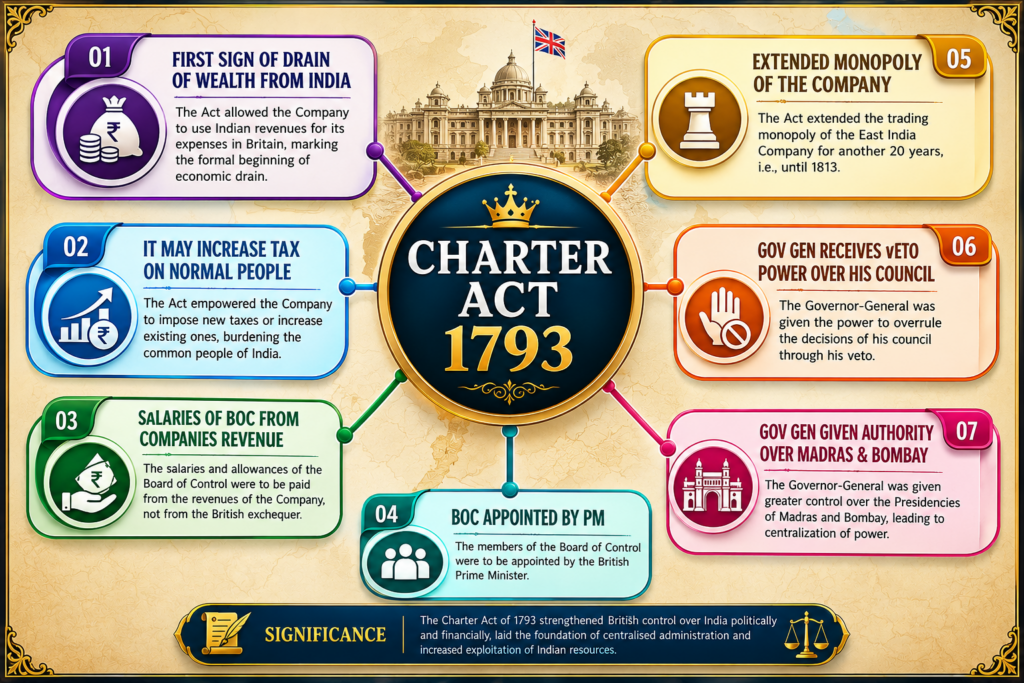
- The Company’s trade monopoly was continued for a further 20 years; its charter was next renewed by the Charter Act of 1813.
Provisions of the Act
- The Act formally recognised the Company’s political functions, clearly establishing that “the acquisition of sovereignty by the subjects of the Crown is on behalf of the Crown and not in its own right.”
- The Company was allowed to increase its dividend to 10%.
- A key financial provision required the Company, after meeting its necessary expenses, interest, dividends, and salaries from Indian revenues, to pay 5 lakh British pounds annually out of its surplus revenue to the British Government — a payment often regarded as an early sign of the “drain of wealth” from India to Britain.
Indian Administration
- The Governor-General was granted extensive powers over the subordinate presidencies of Madras and Bombay, bringing their Governors more decisively under his control.
- The Governor-General was empowered to disregard the majority in Council in special circumstances, thus entrusting him with greater authority — the Governor-General, and the respective Governors of the other presidencies, could now override the decisions of their own councils.
- This power, which had earlier been given specifically to Cornwallis upon his appointment, allowing him to override his Council, was now extended to all future Governors-General and Governors.
- The Commander-in-Chief was no longer automatically a member of the Governor-General’s Council, unless he was specially appointed to that role by the Court of Directors.
- A regular code of regulations was framed for the internal government of the British territories in Bengal.
- This code applied to the rights, person, and property of the Indian people, and bound the courts to base their decisions on the rules and directives it contained.
- All laws were to be printed with translations in Indian languages, so that people could know their rights, privileges, and immunities.
- The Act thus introduced into India the concept of a civil law — enacted by a secular human agency and applied universally.
- The Act also reorganised the courts and redefined their jurisdictions. Revenue administration was formally divorced from judicial functions, a change that led to the disappearance of the Maal Adalats.
Home Government
- Regarding the Home Government, the first-named Commissioner of the Board of Control was to serve as its President, and the two junior members were no longer required to be members of the Privy Council.
- Salaries for the staff and paid members of the Board of Control were now charged to the Company — meaning all Board members were, henceforth, to be paid not out of the State Exchequer but out of Indian revenues, a practice that continued up to 1919.
- Royal approval was made mandatory for the appointment of the Governor-General, the Governors, and the Commander-in-Chief.
Other Provisions
- Senior officials were forbidden from leaving India without permission; if a high official departed without such permission, it was to be treated as a resignation.
- The Company was empowered to grant licences to both individuals and Company employees to trade in India — known as the “privilege” or “country” trade — a provision that paved the way for opium shipments to China.
- William Wilberforce had sought to include two additional clauses in the Act: one declaring that the purpose of British rule in India was to work towards the moral and spiritual uplift of Indians, and permitting the entry of “appropriate persons,” such as teachers and missionaries, into India to further that imperial goal.
Conclusion
The Charter Act of 1793 was, above all, an Act of continuity rather than reform — it extended the Company’s trade monopoly for another twenty years and consolidated the administrative architecture laid down by Pitt’s India Act, while making only incremental adjustments to the powers of the Governor-General, the Board of Control, and the courts. Its most consequential feature for later economic history was the mandatory annual payment of 5 lakh pounds to Britain out of Indian surplus revenue — an early marker of the colonial “drain of wealth” that would become a central theme of nationalist economic critique in the nineteenth century. The next major overhaul of the Company’s constitution would come only two decades later, with the Charter Act of 1813.