

Q. Consider the following statements about Raja Ram Mohan Roy:
I. He possessed great love and respect for the traditional philosophical systems of the East.
II. He desired his countrymen to accept the rational and scientific approach and the principle of human dignity and social equality of all men and women.
Which of the statements given above is/are correct?
(a) I only
(b) II only
(c) Both I and II
(d) Neither I nor II
Answer: (c) Both I and II
Raja Ram Mohan Roy
- Raja Ram Mohan Roy (22 May 1772 – 27 September 1833) was an Indian reformer and writer who was one of the founders of the Brahmo Sabha in 1828, the precursor of the Brahmo Samaj, a socio-religious reform movement in the Indian subcontinent.
- He has been dubbed the “Father of Indian Renaissance.” He was given the title of Raja by Mughal emperor Akbar II (r. 1806–1837.)
- Raja Ram Mohan Roy was moved by deep love for his people and country and worked hard all his life for their social, religious, intellectual and political regeneration.
- Raja Ram Mohan Roy possessed great love and respect for the traditional philosophic systems of the East; but, at the same time, he believed that modern culture alone would help regenerate Indian society.
- In particular, he wanted his countrymen to accept the rational and scientific approach and the principle of human dignity and social equality of all men and women. He also wanted the introduction of modern capitalism and industry in the country.
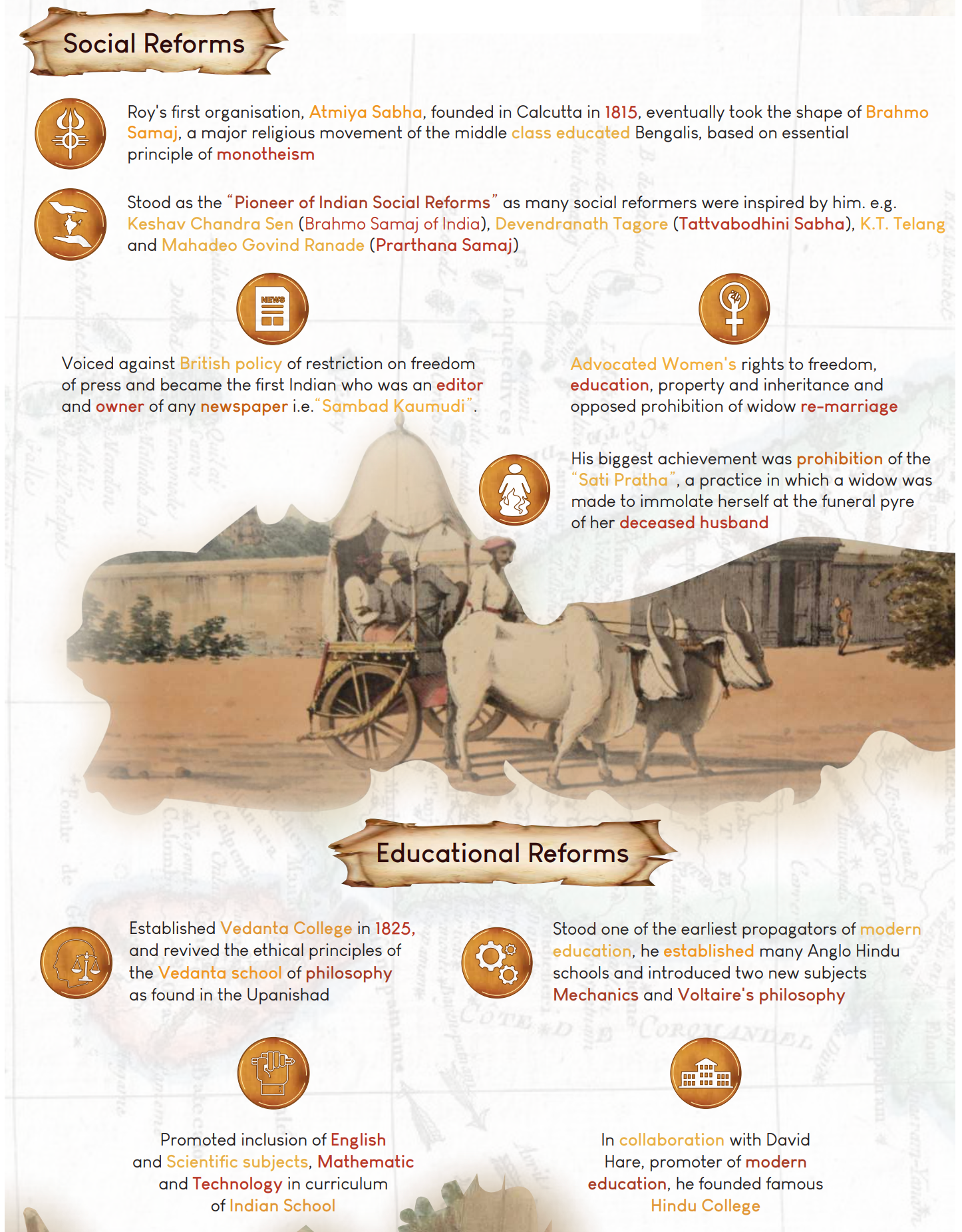
- Raja Ram Mohan Roy represented a synthesis of the thought of East and West. In 1814, he set up the Atmiya Sabha (or Society of Friends) in Calcutta to propagate the monotheistic ideals of the Vedanta and to campaign against idolatry, caste rigidities, meaningless rituals, and other social ills.
- Strongly influenced by rationalist ideas, he declared that Vedanta is based on reason and that, if reason demanded it, even a departure from the scriptures is justified. He said the principles of rationalism applied to other sects also, particularly to the elements of blind faith in them.
- In his Precepts of Jesus (1820), he tried to separate the moral and philosophical message of the New Testament, which he praised, from its miracle stories. He earned the wrath of missionaries over his advocacy to incorporate the message of Christ into Hinduism.
Raja Ram Mohan Roy – Reforms
- Social Reform Initiatives: Founded Atmiya Sabha (1814) in Kolkata as an intellectual discussion group to criticise idol worship, rigid caste hierarchy and meaningless rituals; actively campaigned against Sati, which resulted in its abolition through Regulation XVII of 1829 by Governor-General Lord William Bentinck; also opposed child marriage and polygamy while strongly advocating women’s rights and female education as essential tools for social transformation.
- Religious Reform Ideas: Promoted monotheism and rational religion, influenced by Islamic and Christian theological ideas; wrote Tuhfat-ul-Muwahhidin (1803) advocating belief in one God and rational interpretation of religion; criticised idol worship and superstition in Hindu society while emphasising ethical teachings over rituals; supported religious tolerance and interfaith dialogue, praised moral teachings of Christianity in Precepts of Jesus (1820) but rejected miracle stories and ritualism; established Brahmo Samaj (1828) which promoted monotheism, rationalism, social reform and rejection of idol worship.
- Educational Reforms: Considered modern education and scientific thinking essential for India’s progress; founded Anglo-Hindu School (1822) combining traditional Indian learning with Western science and humanities, encouraging critical thinking and modern curriculum; established Vedanta College (1826) where Vedanta philosophy was taught alongside modern subjects; strongly supported female education, believing educated women would contribute to family welfare, social development and gender equality.
- Political and Administrative Reforms: Among the early nationalist thinkers advocating rights for Indians under colonial rule; demanded civil liberties, fair governance and participation of Indians in administration; strongly supported freedom of the press and started newspapers such as Brahmanical Magazine (1821), Samvad Kaumudi (Bengali weekly, 1821) and Mirat-ul-Akbar (Persian weekly) to spread reformist ideas; criticised oppressive zamindari practices in Bengal and demanded minimum rents and removal of taxes on tax-free lands.
- Language and Literary Contributions: Promoted vernacular languages so that education and reform ideas could reach the common population rather than only elites; contributed significantly as a writer, translator and intellectual, producing translations of Vedic texts, philosophical treatises and essays on social, religious and political issues, helping shape the intellectual foundation of modern Indian reform movements.
Q. Consider the following subjects with regard to Non-Cooperation Programme:
I. Boycott of law-courts and foreign cloth
II. Observance of strict non-violence
III. Retention of titles and honours without using them in public
IV. Establishment of Panchayats for settling disputes
How many of the above were parts of the Non-Cooperation Programme?
(a) Only one
(b) Only two
(c) Only three
(d) All the four
Answer: (c) Only three
Non-Cooperation Movement (NCM)
- “The Non-Cooperation Movement (NCM) was the first nationwide movement launched by Gandhiji in 1920 during British rule.”
- The Non-Cooperation Movement (1920–22) was the first large-scale mass movement under Mahatma Gandhi, mobilising people across regions, classes and communities against British colonial rule through non-violent resistance.
- “It emerged as a powerful and fervent response to a culmination of grievances and disillusionment that had been building up among the Indian populace.”
- The movement developed due to widespread resentment caused by repressive colonial policies, economic hardship after World War I, and dissatisfaction with limited constitutional reforms offered by the British.
- “Rowlatt Act and the brutal Jallianwala Bagh Massacre were the immediate causes for launching the movement.”
- The Rowlatt Act (1919) permitted detention without trial, while the Jallianwala Bagh massacre (1919) exposed the brutality of colonial rule, intensifying nationalist anger and leading to mass mobilisation.
Approval of the Movement
- “Congress, at its special session of Calcutta in September 1920, approved the Non-Cooperation movement, which was later endorsed by the Nagpur session of Congress in December 1920.”
- The Calcutta Session (1920) of the Indian National Congress accepted Gandhi’s proposal for Non-Cooperation. The Nagpur Session (1920) subsequently ratified the programme and reorganised Congress to facilitate mass participation.
- “The movement saw tremendous participation of masses throughout the country.”
- For the first time, the nationalist movement involved students, peasants, workers, traders, lawyers, and women, transforming the freedom struggle into a broad-based popular movement.
Organisational Changes at the Nagpur Session (1920)
- “Provincial Congress Committees were reorganised on the basis of linguistic areas.”
- Congress units were reorganised on linguistic lines to improve communication with the masses and strengthen grassroots political mobilisation.
- “The Congress was now to be led by a Working Committee of 15 members, including the president and the secretaries.”
- A 15-member Working Committee was created as the central executive body to guide the organisation and coordinate political activities.
- “This would enable the Congress to function as a continuous political organisation and would provide it with the machinery for implementing its resolutions.”
- These organisational reforms converted Congress from a periodic deliberative body into a permanent mass political organisation capable of directing nationwide movements.
- “Congress membership was thrown open to all men and women of the age of 21 or more on payment of 4 annas as annual subscription.”
- Membership was broadened to include the masses through a nominal fee of four annas, enabling wider public participation.
- “In 1921 the age limit for membership was reduced to 18.”
- Lowering the membership age further expanded youth participation in the nationalist movement.
Programmes of the Non-Cooperation Movement
- “Surrender of titles and honorary positions.”
- Participants were asked to renounce British-granted titles and honours, such as “Sir,” “Rai Bahadur,” etc. Hence, retention of titles without using them publicly was not part of the programme.
- The Non-Cooperation Programme involved the renunciation of government titles and honorary positions (not the retention of titles and honours without using them in public).
- “Resignation of membership from the local bodies.”
- Indians were encouraged to withdraw from government-controlled local bodies and institutions, symbolising refusal to cooperate with colonial administration.
- “Boycott of foreign goods; Courts, Government functions and legal practise; government schools and colleges and elections held in accordance with the provisions of the 1919 Act;
- The movement called for the boycott of colonial institutions and goods, including:
- Law courts and legal practice
- Government schools and colleges
- Elections under the Government of India Act, 1919
- Foreign goods, particularly foreign cloth
- Many leading lawyers of the country, like C.R. Das, Motilal Nehru, Saifuddin Kitchlew, C. Rajagopalachari, M.R. Jayakar, Vallabhbhai Patel, Asaf Ali and T. Prakasham, quit their practice.
- The movement called for the boycott of colonial institutions and goods, including:
- “Thousands of volunteers went from house to house, trying to persuade people of the importance of adopting Swadeshi.”
- Congress volunteers actively mobilised the public to adopt Swadeshi goods and reject foreign products, spreading nationalist awareness.
- “The foreign-made clothing was gathered and set ablaze.”
- Public bonfires of imported cloth became a symbolic act of protest against British economic dominance.
- “Boycott of legislative councils (There were differences over boycott of councils). The boycott movement against liquor and toddy shops.”
- The programme included boycott of legislative councils and campaigns against liquor and toddy shops, reflecting moral and social reform objectives.
- “National schools, colleges, and private panchayat courts were established.”
- Alternative national institutions were promoted to replace colonial structures, including:
- National educational institutions
- Private panchayat courts for dispute settlement
- Alternative national institutions were promoted to replace colonial structures, including:
- “Kashi Vidyapeeth, Bihar Vidyapeeth, and Jamia Millia Islamia were established.”
- These institutions symbolised the creation of indigenous education systems independent of British control.
- Establishing panchayats for settlement of disputes formed part of the constructive programme.
- “Popularising Swadeshi goods and Khadi.”
- The movement emphasised economic self-reliance, encouraging people to wear khadi and use indigenous goods instead of British imports.
- “It marked the first time the Indian National Congress appealed directly to the masses, leading to a significant increase in membership.”
- The Non-Cooperation Movement transformed Congress into a mass-based organisation, dramatically increasing popular participation.
- “Maintenance of Hindu-Muslim unity and practice of strict nonviolence.”
- The movement sought to promote communal harmony, particularly through cooperation with the Khilafat movement, while strictly adhering to non-violent methods.
- “Promotion of Charkha and Khadi and Jail Bharo Andolan by Congress volunteers.”
- Volunteers promoted charkha (spinning wheel) as a symbol of self-reliance and willingly courted arrest in acts of civil resistance (Jail Bharo).
- “Tilak Swaraj Fund was announced by Gandhi, which aimed at collecting Rs 1 crore to aid constructive work.”
- To finance the movement and constructive programmes, Gandhi launched the Tilak Swaraj Fund in 1921, aiming to raise ₹1 crore to support organisational expansion and nationalist activities.
Q. Consider the following statements in respect of the Non-Cooperation Movement:
I. The Congress declared the attainment of ‘Swaraj’ by all legitimate and peaceful means to be its objective.
II. It was to be implemented in stages with civil disobedience and non-payment of taxes for the next stage only if ‘Swaraj’ did not come within a year and the Government resorted to repression.
Which of the statements given above is/are correct?
(a) I only
(b) II only
(c) Both I and II
(d) Neither I nor II
Answer: (c) Both I and II
Non-Cooperation Movement (1920–22)
- The Non-Cooperation Movement (1920–22) was formally adopted by the Indian National Congress at the Nagpur Session in December 1920 (presided over by C. Vijayaraghavachariar). The Congress accepted Gandhi’s programme of non-violent mass struggle aimed at achieving Swaraj by withdrawing cooperation from British institutions.
- The Congress declared that the attainment of Swaraj through legitimate and peaceful means would be its objective. Gandhi emphasised non-violent methods (Ahimsa) and moral resistance against colonial authority. The strategy involved persuading Indians to withdraw support from British administration rather than using violent rebellion.
- The Non-Cooperation Movement was planned as a phased programme.
- Initial stage (Non-Cooperation):
- Renunciation of government titles and honorary positions
- Boycott of government schools, colleges, courts and legislative councils
- Boycott of foreign goods, especially cloth
- Promotion of Swadeshi, Khadi and Charkha
- Establishment of national schools, colleges and panchayats as alternative institutions
- Resignation from government services and participation in picketing liquor and foreign cloth shops
- Next stage (if conditions persisted):
- Gandhi declared that if Swaraj was not achieved within one year or if the government resorted to repression, the movement would escalate to Civil Disobedience, including non-payment of taxes.
- The movement also supported the Khilafat issue, demanded the repeal of the Rowlatt Act, and promoted Hindu–Muslim unity, leading to wide participation by lawyers, students, women, and Congress volunteers.
Q. “Sedition has become my religion” was the famous statement given by Gandhiji at the time of
(a) the Champaran Satyagraha
(b) publicly violating Salt Law at Dandi
(c) attending the Second Round Table Conference in London
(d) the launch of the Quit India Movement
Answer: (b) publicly violating Salt Law at Dandi
- With no response from the government regarding the 11 demands, Gandhi decided to launch the Civil Disobedience Movement. Among all the demands, he chose to violate the salt law because the British were inhumanely taxing this basic necessary item and had a near monopoly over it.
- The Civil Disobedience Movement (1930–34) was launched by Mahatma Gandhi as a mass movement against British colonial rule, beginning with the Salt Satyagraha (Dandi March).
- On 12 March 1930, Gandhi started the historic Dandi March from Sabarmati Ashram with 78 volunteers, walking about 375 km to Dandi on the Gujarat coast. The march lasted nearly 24 days, attracting widespread national and international attention. Newspapers closely followed the march, and the movement inspired mass participation across the country.
- On 6 April 1930, Gandhi picked up a handful of salt at Dandi, symbolically breaking the British salt law, which had imposed a monopoly and tax on salt production. This act marked the formal beginning of the Civil Disobedience Movement, encouraging Indians to openly violate unjust colonial laws.
- During this moment of defiance, Gandhi strongly criticised British rule, describing it as morally and materially destructive for India. In this context, he declared that “Sedition has become my religion.” By this statement, Gandhi meant that resisting unjust colonial authority had become a moral duty, though it would be pursued strictly through non-violent methods. He emphasised that the struggle was not aimed at harming individuals but at ending an unjust system of government.
- The Salt Satyagraha soon triggered widespread civil disobedience across India, including violation of salt laws, boycott of foreign goods, refusal to pay certain taxes, and mass participation of peasants, students, women, and political activists.
- Thus, the famous statement “Sedition has become my religion” was made by Gandhi while publicly violating the Salt Law at Dandi during the Civil Disobedience Movement.
Q. Who provided legal defence to the people arrested in the aftermath of Chauri Chaura incident?
(a) C. R. Das
(b) Madan Mohan Malaviya and Krishna Kant
(c) Dr. Saifuddin Kitchlew and Khwaja Hasan Nizami
(d) M. A. Jinnah
Answer: (b) Madan Mohan Malaviya and Krishna Kant
Madan Mohan Malaviya
- The Chauri Chaura incident (5 February 1922) occurred during the Non-Cooperation Movement, when a violent clash between protesters and police led to the burning of a police station in Chauri Chaura (Gorakhpur district, United Provinces), resulting in the death of 22 policemen. Following the incident, the British authorities carried out mass arrests and initiated legal proceedings against hundreds of participants.
- A total of 225 persons were tried in the Gorakhpur Sessions Court under charges of rioting and arson. In the initial judgement delivered by Sessions Judge H. E. Holmes, severe punishments were awarded:
- 170 persons were sentenced to death,
- several others received imprisonment,
- and some accused died in police custody during the trial process.
- At this stage, Madan Mohan Malaviya, a prominent nationalist leader and distinguished lawyer, returned to legal practice to defend the accused. Although he had earlier reduced his involvement in law after entering active politics, he appeared before the Allahabad High Court to challenge the harsh sentences.
- Malaviya, along with Krishna Kant, provided legal defence for the accused. Through detailed legal arguments and appeals, they successfully demonstrated weaknesses in the prosecution’s case and the excessive nature of the punishments.
- As a result of this defence:
- The number of death sentences was drastically reduced,
- 153 accused were acquitted, and
- only a small number ultimately faced capital punishment.
- Malaviya’s intervention is considered an important example of legal humanitarianism within the nationalist movement, as it helped save many people from wrongful execution.
- Thus, the legal defence for those arrested after the Chauri Chaura incident was provided by Madan Mohan Malaviya and Krishna Kant.
C. R. Das (Chittaranjan Das)
C. R. Das (1870–1925) was one of the most famous nationalist lawyers of his time and participated in several important political trials.
- Alipore Bomb Case (1908–1909)
- Das served as the defence lawyer for Aurobindo Ghosh, who had been accused of involvement in revolutionary activities related to the Anushilan Samiti.
- Through a powerful legal argument, he demonstrated the lack of direct evidence linking Aurobindo to the conspiracy, leading to Aurobindo’s acquittal in 1909.
- This case brought Das national recognition as a brilliant advocate.
- Other Contribution: Later, he gave up his lucrative legal practice to participate in the Non-Cooperation Movement and subsequently founded the Swaraj Party (1923).
Dr. Saifuddin Kitchlew and Khwaja Hasan Nizami
Dr. Saifuddin Kitchlew (1888–1963)
- A nationalist leader from Punjab and an important figure in the Khilafat and Non-Cooperation movements.
- His arrest along with Dr. Satyapal in April 1919 triggered protests in Amritsar that culminated in the Jallianwala Bagh massacre.
- Although he was trained in law, his historical significance lies primarily in political leadership and nationalist activism, rather than courtroom defence.
Khwaja Hasan Nizami (1878–1955)
- A Sufi scholar, writer, and social reformer from Delhi.
- Known for promoting communal harmony and social reform through his writings.
- He did not play a notable role in legal defence of major nationalist cases.
M. A. Jinnah (Muhammad Ali Jinnah)
Muhammad Ali Jinnah (1876–1948) was one of the most prominent barristers in colonial India, practising at the Bombay High Court.
- Bal Gangadhar Tilak Sedition Trial (1916)
- Jinnah acted as the defence lawyer for Bal Gangadhar Tilak, who had been charged with sedition by the British government.
- His legal arguments helped secure Tilak’s acquittal, strengthening Jinnah’s reputation as a skilled constitutional lawyer.
- Other Legal Role: Jinnah was also known for his constitutional approach to politics, advocating reforms through legal and legislative methods rather than mass agitation.
Q. Subsequent to which one of the following events, Gandhiji, who consistently opposed untouchability and appealed for its eradication from all spheres, decided to include the upliftment of ‘Harijans’ in his political and social programme?
(a) The Poona Pact
(b) The Gandhi-Irwin (Delhi Pact) Agreement
(c) Arrest of Congress leadership at the time of the Quit India Movement
(d) Promulgation of the Government of India Act, 1935
Answer: (a) The Poona Pact
The Poona Pact (1932)
In September 1932, Mahatma Gandhi undertook a fast unto death in Yerwada Jail (Poona) to oppose the provision of separate electorates for the Depressed Classes announced by the British government under the Communal Award (1932). The proposal, supported by Dr. B. R. Ambedkar, aimed to provide separate political representation to the Depressed Classes.
Gandhi believed that separate electorates would divide Hindu society permanently, and therefore strongly opposed the measure. His fast created intense political pressure and negotiations between leaders of the caste Hindus and representatives of the Depressed Classes.
The crisis was resolved through the Poona Pact signed on 24 September 1932 between Gandhi and Ambedkar. The agreement provided:
- Joint electorates for Hindus instead of separate electorates for the Depressed Classes.
- A significant increase in reserved seats for the Depressed Classes in provincial legislatures.
- Special provisions to ensure adequate political representation of the Depressed Classes within the joint electorate framework.
Gandhi’s Campaign against Untouchability
After the Poona Pact, Gandhi intensified his campaign for the eradication of untouchability and incorporated the upliftment of the Depressed Classes into his social and political programme.
- Gandhi began referring to the Depressed Classes as “Harijans” (Children of God), a term he considered less derogatory than “Untouchables” or the colonial expression “Depressed Classes.”
- The term “Harijan” had earlier been used by the medieval Bhakti saint Narsinh Mehta, whom Gandhi admired.
Institutional Initiatives
To promote social reform and the removal of untouchability:
- Gandhi had earlier established the Anti-Untouchability League (1932).
- After the Poona Pact, it was renamed the Harijan Sevak Sangh, which worked for the social, educational, and economic upliftment of the Depressed Classes.
- Gandhi also renamed his weekly journal Young India as Harijan (1933) to spread awareness about the campaign against untouchability.
Thus, it was after the Poona Pact (1932) that Gandhi more actively incorporated the upliftment of ‘Harijans’ into his political and social programme.
Q. Who among the following was the founder of the ‘Self-Respect Movement’?
(a) Periyar E. V. Ramaswamy Naicker
(b) Dr. B. R. Ambedkar
(c) Bhaskarrao Jadhav
(d) Dinkarrao Javalkar
Answer: (a) Periyar E. V. Ramaswamy Naicker
Self-Respect Movement
E. V. Ramasamy Naicker (Periyar) (1879–1973) was a prominent social reformer and political leader from Tamil Nadu, widely regarded as the father of the Dravidian movement. He strongly opposed caste hierarchy, Brahminical dominance, and social inequality prevalent in South Indian society.
Periyar was a vocal critic of the caste system and religious orthodoxy. He advocated social justice, rationalism, women’s rights, and the upliftment of non-Brahmin communities. A firm believer in atheism and rational thinking, he rejected traditional religious practices that he believed reinforced caste discrimination.
In 1925, Periyar founded the Self-Respect Movement in Tamil Nadu. The movement aimed to:
- Promote self-respect and dignity among non-Brahmin communities
- Challenge Brahminical social dominance and caste-based oppression
- Encourage rationalism and oppose superstition and social orthodoxy
- Advocate women’s rights, including widow remarriage and equal social status
- Promote Self-Respect marriages, which rejected Brahmin priests and caste rituals
The Self-Respect Movement played a crucial role in shaping the Dravidian socio-political movement, which later influenced major regional political parties such as the Dravida Munnetra Kazhagam (DMK) and All India Anna Dravida Munnetra Kazhagam (AIADMK) in Tamil Nadu.
Thus, the Self-Respect Movement (1925) was founded by E. V. Ramasamy Naicker (Periyar).
Dr. B. R. Ambedkar
Dr. Bhimrao Ramji Ambedkar was the foremost leader of the Depressed Classes (Dalits) and a powerful advocate of social equality, political representation, and the abolition of caste discrimination.
Major Movements and Initiatives:
- Bahishkrit Hitakarini Sabha (1924): Founded to promote education, socio-political awareness, and economic upliftment of the Depressed Classes.
- Mahad Satyagraha (1927): A historic movement asserting the right of untouchables to draw water from the public Chavdar Tank in Mahad (Maharashtra). It symbolized the struggle for equal civic rights.
- Temple Entry Movements: Ambedkar led several campaigns demanding equal access of Dalits to Hindu temples, including the Kalaram Temple Entry Movement (1930) in Nashik.
- Independent Labour Party (1936): A political organisation formed to represent the interests of workers, peasants, and marginalized communities.
- All India Scheduled Castes Federation (1942): Established to secure political rights and representation for Scheduled Castes.
These movements formed the foundation of Dalit political assertion and social justice movements in modern India.
Bhaskarrao Jadhav
Bhaskarrao Jadhav was an important non-Brahmin leader and social reformer from Maharashtra, associated with the Non-Brahmin Movement.
Major Movement:
- Non-Brahmin Movement in Maharashtra: This movement aimed to challenge Brahmin dominance in administration, education, and social institutions.
Objectives included:
- Promoting education among non-Brahmin communities
- Increasing political representation for backward classes
- Opposing social hierarchy based on caste
Bhaskarrao Jadhav also worked closely with the Justice Party and other non-Brahmin political organisations advocating social reform and equality.
Dinkarrao Javalkar
Dinkarrao Javalkar was a social reformer, writer, and activist from Maharashtra, associated with the anti-caste and non-Brahmin movements.
Associated Movements:
- Non-Brahmin Movement: Javalkar actively supported the struggle against caste hierarchy and Brahminical dominance.
- Satyashodhak tradition revival: His ideas were influenced by Jyotiba Phule’s Satyashodhak Samaj, which promoted social equality, rationalism, and education for oppressed communities.
He used writings, journalism, and public campaigns to mobilise people against social discrimination and caste oppression.
| Leader | Major Movement |
|---|---|
| E. V. Ramasamy (Periyar) | Self-Respect Movement (1925) |
| Dr. B. R. Ambedkar | Mahad Satyagraha, Temple Entry Movements, Dalit rights movements |
| Bhaskarrao Jadhav | Non-Brahmin Movement in Maharashtra |
| Dinkarrao Javalkar | Non-Brahmin / Satyashodhak-inspired social reform movement |