

Q. In the Government of India Act 1919, the functions of Provincial Government were divided into “Reserved” and “Transferred” subjects. Which of the following were treated as “Reserved” subjects?
- Administration of Justice
- Local Self-Government
- Land Revenue
- Police
Select the correct answer using the code given below:
(a) 1, 2 and 3
(b) 2, 3 and 4
(c) 1, 3 and 4
(d) 1, 2 and 4
Answer: (c) 1, 3 and 4
Government of India Act 1919:
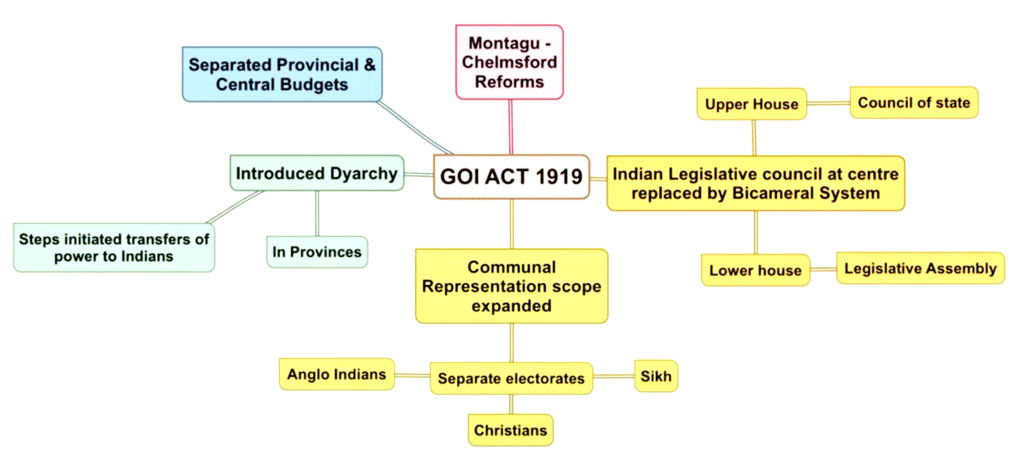
- The Government of India Act 1919 was a legislative framework designed to reform British India’s governance. It was based on the Montagu-Chelmsford Report, which was drafted by Edwin Montagu, Secretary of State for India, and Lord Chelmsford, Viceroy of India at the time.
- The primary goal of the Act was to introduce a more responsible form of government in India by increasing Indian participation in the administrative machinery while retaining ultimate authority with the British Crown. The Act established a dual governance structure (dyarchy) at the provincial level and a more inclusive legislative framework, but with some limitations.
- The Government of India Act 1919 introduced dyarchy, allowing Indian ministers control over some provincial subjects, while the British retained power over finance and law.
- The Viceroy held significant authority at the central level, with limited Indian involvement in key areas like defence and foreign policy.
Executive Changes in the Government of India (Centre)
- The governor-general was to be the chief executive authority.
- The Act did not introduce responsible government at the Centre though Indians were to have greater influence there.
- The number of Indians in the Governor General’s Executives Council was raised to 3 in a Council of 8.
- The Indian members were entrusted with departments like that of Law, Education, Labour, Health and Industries.
- The new scheme of Government envisaged a division of Subjects into the Central List and the Provincial List.
- A List of Central subjects was drawn up which were to be administered by the Governor General in Council.
- Central List:
- Those subjects which were of national importance or which related to more than one province, such as:
- Foreign Affairs, Defence, Political Relations, Posts and Telegraphs, Public Debt, Communications, Civil and Criminal Law and Procedure, etc.
- Any subject not specially transferred to the provinces was a Central subject.
- Those subjects which were of national importance or which related to more than one province, such as:
- Provincial List:
- Subjects of provincial importance, such as
- Public Health, Local Self Government, Education, Medical Administration, Land Revenue Administration, Water Supply, Famine Relief, Law and Order, Agriculture, etc.
- Subjects of provincial importance, such as
- The revenue resources were divided between the centre and the provinces, with land revenue going to the provinces, and income tax remaining with the centre.
- Analysis:
- Though a step was taken towards increasing association of Indians by raising their strength to 3, yet the departments assigned to them were comparatively unimportant.
- Nor were these members made responsible to the Legislative.
- The division of subjects into two lists was not clear-cut or based on proper consideration.
- Although all subjects in the Provincial List were provincial for purposes of administration, that was not the case for purpose of legislation.
- The chief executive authority still remained with the Governor-General. He exercised full control over his Councillors and enjoyed vast powers over the country.
- Thus the wishes of the people of the country in respect of the appointment, powers and functions of the Governor General were ignored in the Act.
Executive Changes in Provincial Government (Introduction of Dyarchy)
- Dyarchy, i.e., rule of two—executive councillors and popular ministers—was introduced. The governor was to be the executive head in the province.
- Under the system of Dyarchy, the subject to be dealt with by the Provincial Government were divided into two parts:
- Reserved subjects:
- They were administered by the Governor with the help of the members of the Executive Council who were nominated by him and who were not to be responsible to the Legislature.
- The Reserved subjects were:
- Land Revenue,
- Famine Relief,
- Justice, Police,
- Criminal Tribes,
- Printing Presses,
- Irrigation and Waterways,
- Mines, Factories, Electricity,
- Labour Welfare, Industrial Disputes,
- Excluded Areas,
- Public Services etc.
- Transferred subjects:
- They were administered by the Governor acting with ministers appointed by him from among the elected members of the Legislature and who were to be responsible to the Legislature and were to hold office during his pleasure.
- The ministers were to be responsible to the legislature and had to resign if a no-confidence motion was passed against them by the legislature.
- The secretary of state and the governor-general could interfere in respect of “reserved” subjects while in respect of the “transferred” subjects; the scope for their interference was restricted.
- In case of failure of constitutional machinery in the province the governor could take over the administration of “transferred” subjects also.
- Transferred subjects:
- Education (other than European and Anglo Indian Education),
- Libraries, Museums,
- Local Self Government, Medical Relief,
- Public Health and Sanitation, Agriculture,
- Co-operative Societies,
- Veterinary Department, Fisheries,
- Public Works,
- Excise,
- Industries,
- Religious and Charitable Endowments, etc.
- The law did not require meetings of all ministers together to take decisions on all Transferred subjects. The Governor dealt with each minister individually.
- On matters of common concern, particularly on the allocation of the revenues, there was joint consultation between the Reserved and Transferred halves of the Government, the Governor presiding and having the last word of the subject.
- Reserved subjects:
Q. Consider the following freedom fighters:
- Barindra Kumar Ghosh
- Jogesh Chandra Chatterjee
- Rash Behari Bose
Who of the above was/were actively associated with the Ghadar Party?
(a) 1 and 2
(b) 2 only
(c) 1 and 3
(d) 3 only
Answer: (d) 3 only
Ghadar Party:
- The Ghadar Party was a revolutionary group founded by Indians in the United States with the aim of securing India’s independence from British rule.
- Taraknath Das, a prominent Indian in the USA, established the Indian Independence League in California in 1907 and later began publishing the paper Free Hindustan.
- In 1913, Sohan Singh Bhakna founded the Hind Association of America, which started the weekly publication Ghadar in English, Urdu, Marathi, and Gurmukhi.
- This paper promoted revolutionary ideas and inspired the name of the Ghadar Party.
- Lala Hardayal emerged as a key leader in the Ghadar movement, establishing a central committee with headquarters at the Yugantar Ashram in San Francisco.
- The Ghadar Party also had notable figures such as Bhai Parmanand and Ram Chandra, and the publication Ghadar consistently encouraged armed struggle and revolt against British rule.
- Revolutionaries Raja Mahendra Pratap and Barkatullah supported the Ghadar Party from abroad and, with the help of Germany and Russia, attempted to set up a provisional government of India in Kabul.
- Founder of Ghadar Party:
- The Ghadar Party’s founders, including Taraknath Das, Sohan Singh Bhakna, and Lala Hardayal, among others, were Indian expatriates committed to liberating India from British control.
- These leaders harnessed the collective discontent of Indian immigrants in North America and the nationalist fervor within India to form an organized resistance.
- Key participants in the Ghadar Movement included K. B. Menon, Sohan Singh Bhakna, Mewa Singh Lopoke, Bhai Parmanand, Vishnu Ganesh Pingle, Bhagwan Singh Gyanee, Har Dayal, Tarak Nath Das, Bhagat Singh Thind, Kartar Singh Sarabha, Udham Singh, Abdul Hafiz Mohamed Barakatullah, Rashbehari Bose, and Gulab Kaur.
Q. With reference to the proposals of Cripps Mission, consider the following statements:
- The Constituent Assembly would have members nominated by the Provincial Assemblies as well as the Princely States.
- Any Province, which is not prepared to accept the new Constitution would have the right to sign a separate agreement with Britain regarding its future status.
Which of the statements given above is/are correct?
(a) 1 only
(b) 2 only
(c) Both 1 and 2
(d) Neither 1 nor 2
Answer: (b) 2 only
Cripps Mission 1942:
- The Cripps Mission was sent after the decision taken by the British War Cabinet in 1942 to grant Dominion Status to India after the War and equal treatment to the Indians on par with other dominions such as Canada and Australia.
- It was sent amidst the political belligerence in India on various fronts, such as the lack of faith in the British Army’s capacity to defend India against aggressive Japan and the increasing demand for a separate state by the League and Jinnah. But the most important factor was the pressure on Churchill to win the support of Indians for the British cause in the War.
- Based on the draft declaration prepared by the All India Committee, chaired by Attlee, Stafford Cripps came to India and proposed the following constitutional reforms:
- Dominion status: The Cripps Mission proposed to create a new Indian Union with Dominion statusafter the War, associated with the UK and other dominions, equal in every respect – domestic as well as external affairs.
- Constituent Assembly: Setting up a Constitution-making body for India after the War, whose members would be elected by the Provincial Assemblies and nominated by the rulers in the case of the Princely States. The constitution was to be drafted entirely by Indians now.
- Right to secede for the provinces: There would be provisions for any British Indian Province unwilling to accept this Constitution to either maintain its current constitutional status or frame its own constitution.
- Any province that refused to abide by the new Constitution could create its own union and constitution.
- The new Constitution-making body and the British government would negotiate a treaty to sort out matters arising out of the transfer of powers to Indian hands.
- Intact powers of the Viceroy: The Viceroy’s authority would be unaffected, and British control over India’s defence would continue until the War. After that, the dominion government could reorganise its own defence.
Why Cripps Mission Failed:
(a)The Cripps Mission proposals failed to satisfy Indian nationalists and turned out to be merely a propaganda device for US and Chinese consumption. Cripps had designed the proposals himself, but they were too radical for Churchill and the Viceroy, and too conservative for the Indians; no middle way was found. Congress moved toward the Quit India movement whereby it refused to cooperate in the war effort. Various parties and groups had objections to the proposals on different points.
The Congress’s objections:
- The offer of dominion status instead of a provision for complete independence
- Representation of the states by nominees and not by elected representatives
- Right to provinces to secede as this went against the principle of national unity
- Absence of any plan for immediate transfer of power and absence of any real share in defence; the governor- general’s supremacy had been retained, and the demand for governor-general being only the constitutional head had not been accepted. Nehru and Maulana Azad were the official negotiators for the Congress.
The Muslim League’s objections:
- Criticised the idea of a single Indian Union.
- Did not like the machinery for the creation of a constituent assembly and the procedure to decide on the accession of provinces to the Union.
- Thought that the proposals denied to the Muslims the right to self-determination and the creation of Pakistan.
Other groups’ objections:
- The Liberals considered the secession proposals to be against the unity and security of India.
- The Hindu Mahasabha criticised the basis of the right to secede.
- The depressed classes thought that partition would leave them at the mercy of the caste Hindus.
- The Sikhs objected that partition would take away Punjab from them.
(b)The explanation that the proposals were meant not to supersede the August Offer but to clothe general provisions with precision put British intentions in doubt.
(c) There was confusion over what Cripps had been authorised to offer India’s nationalist politicians by Churchill and Leo Amery (His Majesty’s Secretary of State for India), and he also faced hostility from the Viceroy, Lord Linlithgow.The incapacity of Cripps to go beyond the Draft Declaration and the adoption of a rigid “take it or leave it” attitude added to the deadlock. Cripps had earlier talked of “cabinet” and “national government” but later he said that he had only meant an expansion of the executive council.
(d), in public, he failed to present any concrete proposals for greater self-government in the short term, other than a vague commitment to increase the number of Indian members of the Viceroy’s Executive Council. Cripps spent much of his time in encouraging Congress leaders and Jinnah to come to a common, public arrangement in support of the war and government.
(e)The procedure of accession was not well-defined. The decision on secession was to be taken by a resolution in the legislature by a 60% majority. If less than 60% of” members supported it, the decision was to be taken by a plebiscite of adult males of that province by a simple majority. This scheme weighed against the Hindus in Punjab and Bengal if they wanted accession to the Indian Union.
(f)It was not clear as to who would implement and interpret the treaty effecting the transfer of power.
(g)Churchill (the British prime minister), Amery (the secretary of state), Linlithgow (the viceroy) and Ward (the commander-in-chief) consistently torpedoed Cripps’ efforts.
(h)Talks broke down on the question of the viceroy’s veto.
(i)Gandhi described the scheme as “a post-dated cheque drawn on a crashing bank”; Nehru pointed out that the “existing structure and autocratic powers would remain and a few of us will become the viceroy’s liveried camp followers and look after canteens and the like”.
(j)Stafford Cripps returned home leaving behind a frustrated and embittered Indian people, who, though still sympathising with the victims of Fascist aggression, felt that the existing situation in the country had become intolerable and that the time had come for a final assault on imperialism.
Q. With reference to Indian history, consider the following statements:
- The Dutch established their factories/warehouses on the east coast on lands granted to them by Gajapati rulers.
- Alfonso de Albuquerque captured Goa from the Bijapur Sultanate.
- The English East India Company established a factory at Madras on a plot of land leased from a representative of the Vijayanagara empire.
Which of the statements given above are correct?
(a) 1 and 2 only
(b) 2 and 3 only
(c) 1 and 3 only
(d) 1, 2 and 3
Answer: (b) 2 and 3 only
Dutch East Indian Company
- In March 1602, by a charter of the Dutch parliament, the Dutch East India Company was established with powers to make wars, settle treaties, acquire territories and build fortresses.
- The main purpose of the Dutch remained determined in eliminating the Portuguese and British merchandise powers from India and South East Asia.
- The Dutch East India Company established factories in India at Masulipatnam in 1605 AD, Pulicat (1610 AD), Surat (1616 AD), Bimlipatam (1641 AD), Karaikal (1645 AD).
- The Gajapati rulers ruled over Kalinga, large parts of Andhra Pradesh and West Bengal, and the eastern and central parts of Madhya Pradesh and Jharkhand from 1435 to 1541 CE.
- Kapilendra, the minister of Bhanudeva IV (1414-1435), usurped the throne in 1435 and laid the foundation of the Gajapati rule in Odisha. After Pratapa Rudra’s death (1540), his successors could hardly hold the empire intact, and the end of Suryavamsi (Gajapati) dynasty came soon after (1542), whereas the Dutch East India Company was formed in 1602 through a charter.
- In India, the most significant event was the Battle of Colachel in 1741, which was fought between the Dutch East India Company and State of Travancore army.
- This was a major defeat of European power in India and marked the beginning of the end of the Dutch.
- Due to the corruption and bankruptcy, the Dutch East India Company was formally dissolved in 1800.
Alfonso De Albuquerque (1509-1515)
- He is considered to be the real founder of the Portuguese power in India.
- In 1510 AD, Afonso de Albuquerque captured Goa from the Sultan of Bijapur, Ismail Adil Shah.
- It was done with the help of Krishnadev Raya, ruler of the Vijaynagar empire.
- His rule was dominated by the persecution of Muslims.
- He captured Bhatkal from Sri Krishna Devaraya (1510) of the Vijayanagara empire.
- He initiated the policy of marrying the natives of India and banned the practice of Sati in his area of influence.
English East India Company in South India
- The Vijayanagar rulers appointed chieftains known as Nayaks who ruled over the different regions of the province almost independently.
- Damarla Venkatapathy Nayak, an influential chieftain under Venkata III, gave the grant of a piece of land lying between the river Cooum almost at the point it enters the sea and another river is known as Egmore river to the English in 1639.
- English East India Company established a factory in Madras in 1639 on land leased from representatives of the Vijayanagara Empire called the Nayakas.