

Q. The irrigation device called ‘Araghatta’ was
(a) A water bag made of leather pulled over a pulley
(b) A large wheel with earthen pots tied to the outer ends of its spokes
(c) A larger earthen pot driven by bullocks
(d) A large water bucket pulled up by rope directly by hand
Answer: (b) A large wheel with earthen pots tied to the outer ends of its spokes
- The ‘ara-ghatta’ originates from the blend of the words “ara” which means talked, and “ghatta” which means pot. There is confirmation to contend that this arrangement of lifting water from open wells was presumably designed in India of the past.
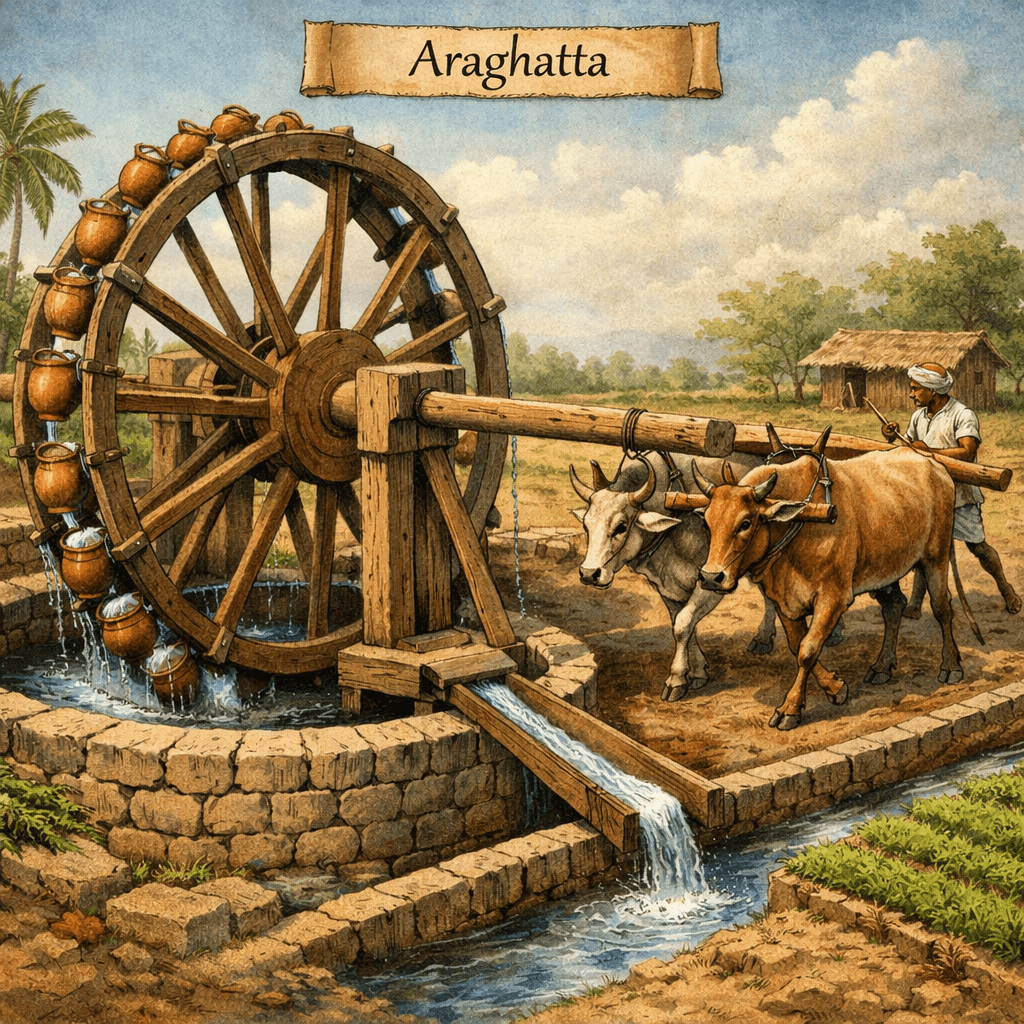
Comparison with Persian Wheel Saqiyah and Noria
- Araghatta vs Persian Wheel (Saqiyah): While often equated with the Persian wheel in exam explanations, the early Indian Araghatta had distinct developmental features. The later Persian wheel — known as saqiyah — became widespread across West Asia and eventually in India, typically employing gears and animal power more systematically. The Persian wheel typically used advanced gear mechanisms, while the Araghatta remained simpler in construction.
- Araghatta vs Noria: The noria is a water-lifting device powered by flowing water — often a river or stream — unlike the Araghatta, which relied on external power sources (human or animal).
Q. Who among the following led a successful military campaign against the kingdom of Srivijaya, the powerful maritime State, which ruled the Malay Peninsula, Sumatra, Java and the neighbouring islands?
(a) Amoghavarsha (Rashtrakuta)
(b) Prataparudra (Kakatiya)
(c) Rajendra I (Chola)
(d) Vishnuvardhana (Hoysala)
Answer: (c) Rajendra I (Chola)
Rajendra Chola I
Rajendra Chola I (reigned 1014–1044 CE) was one of the most powerful rulers of the Chola dynasty and the son and successor of Rajaraja Chola I. He continued the imperial expansion of the Chola Empire and is often referred to as Rajendra the Great. He also bore titles such as Gangaikonda Chola (“the Chola who conquered the Ganges”) and Kadaram Kondan.
Northern Campaign
Rajendra Chola I first expanded his power in the Indian subcontinent.
- His army marched through Kalinga and Odisha and reached the Ganges valley.
- To commemorate this victory, he brought sacred water from the Ganges to his capital and founded a new capital city named Gangaikondacholapuram.
Naval Expedition against Srivijaya
One of the most remarkable achievements of Rajendra Chola I was his naval expedition to Southeast Asia.
- Around 1025 CE, he launched a large naval campaign against the Srivijaya Empire, a powerful maritime state that controlled major trade routes in the Malay Peninsula, Sumatra, Java and surrounding islands.
- The Chola navy attacked important Srivijayan ports such as Kadaram (Kedah) and other strategic centres.
- This campaign demonstrated the naval strength of the Chola Empire and its influence over maritime trade networks of the Indian Ocean.
Significance
- The campaign weakened the Srivijaya maritime dominance in Southeast Asia.
- It strengthened Chola control over Indian Ocean trade routes.
- Rajendra Chola also maintained commercial and diplomatic relations with China, continuing the policy initiated by his father.
Q. Consider the following fruits:
I. Papaya
II. Pineapple
III. Guava
How many of the above were introduced in India by the Portuguese in the sixteenth and seventeenth centuries?
(a) Only one
(b) Only two
(c) All the three
(d) None
Answer: (c) All the three
The European ‘discovery’ of America in 1492 led to the global diffusion of several New World crops to Asia, Africa and Europe. The Portuguese, who were among the earliest Europeans to establish maritime contacts with India in the 16th century, played a crucial role in introducing many American crops and fruits into the Indian subcontinent. These included crops such as maize, sweet potato and capsicum, as well as fruits like pineapple, papaya, sapodilla and guava, which gradually became integrated into Indian agriculture and food culture.
1. Pineapple
Pineapple, native to the Americas, was brought to India by the Portuguese during the sixteenth century, most likely from Brazil. The Dutch traveller Jan Huyghen van Linschoten, who visited India in the 1580s, recorded the presence and cultivation of pineapple in the region.
The fruit was initially considered rare and expensive, but with the spread of cultivation its price declined and it became more widely available. Abul Fazl’s Ain-i-Akbari (1590s) refers to pineapple as one of the “sweet fruits” cultivated in India. He described it as resembling an elongated orange in shape and mango in taste and aroma. Pineapples were also referred to as “Kathal-i-safari” or “jackfruit for travels”, as young plants could be transported easily and grown elsewhere.
2. Papaya
Another fruit introduced to India was the papaya, which reached India via the Philippines and Malacca through Portuguese trade networks. Early European travellers recorded its spread in India.
The Italian traveller Pietro Della Valle, who visited India in 1623, observed papaya growing in Portuguese Daman. He described the fruit as similar in appearance to European melons but much sweeter. Since Abul Fazl did not mention papaya in the Ain-i-Akbari, historians infer that the fruit was not widely available in North India during the late sixteenth century and probably spread more widely in the early seventeenth century.
3. Guava
Guava (Psidium guajava), native to Central America, was also introduced into India by Portuguese traders in the early seventeenth century. Over time it adapted well to Indian climatic conditions and became one of the most widely cultivated tropical fruits in the country.
Thus, pineapple, papaya and guava were all introduced into India by the Portuguese during the sixteenth and seventeenth centuries.