1. Consider the following statements:
Statement I: Activated carbon is a good and attractive tool to remove pollutants from effluent streams and to remediate contaminants from various industries.
Statement II: Activated carbon exhibits a large surface area and a strong potential for adsorbing heavy metals.
Statement III: Activated carbon can be easily synthesized from environmental wastes with high carbon content.
Which one of the following is correct in respect of the above statements?
(a) Both Statement II and Statement III are correct, and both of them explain Statement I
(b) Both Statement II and Statement III are correct but only one of them explains Statement I
(c) Only one of the Statements II and III is correct and that explains Statement I
(d) Neither Statement II nor Statement III is correct
Answer: (a) Both Statement II and Statement III are correct and both of them explain Statement I
Activated Carbon
- Activated carbon (or activated charcoal) is a highly porous material processed from carbonaceous sources like coconut shells or coal, featuring an immense internal surface area designed to trap impurities.
- It works via adsorption, attracting and holding contaminants, VOCs, and heavy metals from air, water, and liquids.
- Activated carbon is a highly versatile material used primarily for its adsorption capabilities, which allow it to trap toxins, chemicals, and impurities within its massive network of microscopic pores. Its applications span from life-saving medical treatments to everyday household products.
- Key uses include drinking water filtration, air purification, industrial emissions control, and medical treatments for poisoning.
- Activated carbon is widely recognised for its effectiveness in environmental applications, particularly in the treatment of industrial effluents and polluted water or air.
- It functions primarily through adsorption, a process in which contaminants adhere to the surface of the carbon material.
- Due to its high efficiency in removing a wide range of pollutants—including dyes, organic compounds, and heavy metals—activated carbon is extensively used in sectors such as chemical manufacturing, textiles, food processing, and water treatment.
- One of the most important physical properties of activated carbon is its extremely large surface area.
- This large surface area is due to its highly porous structure. This large surface area provides numerous active sites for adsorption. This makes it especially useful in removing toxic metals from industrial effluents and contaminated water sources.
- Activated carbon can be produced from a wide range of carbon-rich waste materials, including agricultural by-products like coconut shells, rice husks, sawdust, sugarcane bagasse, and nutshells.
- These materials are subjected to carbonization and activation processes to create the porous structure necessary for adsorption.
- This ease of synthesis from waste makes activated carbon accessible and attractive, especially in developing countries and for large-scale industrial applications.

Uses of Activated Carbon
- Environmental & Household Purification
- Water Filtration: It is the core component of home water filters, removing chlorine, bad tastes, odors, and organic pollutants from tap water.
- Air Cleaning: Used in air purifiers and gas masks to capture volatile organic compounds (VOCs), smoke, and hazardous fumes.
- Aquariums: It helps keep fish tank water crystal clear by absorbing fish waste and leftover medications.
- Medical & Health
- Emergency Poisoning: In hospitals, it is administered to treat drug overdoses or accidental poisoning. It binds to toxins in the stomach to prevent them from entering the bloodstream.
- Digestive Relief: Some people use it in capsule form to reduce bloating and intestinal gas.
- Wound Care: Specialized carbon dressings are used to absorb odors and bacteria from infected wounds.
- Industrial Processes
- Food and Beverage: It is used to decolorize sugar, decaffeinate coffee, and purify alcoholic spirits like vodka and whiskey to ensure a clean taste.
- Mining: It plays a critical role in gold recovery, where it is used to “soak up” gold from cyanide solutions.
- Automotive: Carbon canisters in cars trap gasoline vapors before they can escape into the atmosphere.
- Beauty & Personal Care
- Skincare: Often added to face masks and cleansers to pull dirt, oil, and toxins out of pores.
- Oral Hygiene: Used in whitening toothpastes to lift surface stains from teeth and neutralize bad breath.
How It is Produced
- Activated carbon is manufactured from carbon-rich materials such as coconut shells, wood, coal, or peat. The material undergoes two main stages:
- Carbonisation: The raw material is heated to high temperatures (400–600°C) in an environment without oxygen to drive off volatile components.
- Activation: The resulting “char” is then exposed to an activating agent—either high-temperature steam (physical activation) or chemicals like phosphoric acid (chemical activation) — to create millions of microscopic pores.
Forms of Activated Carbon
- Granular (GAC): Coarse particles (0.2–5 mm) used primarily for continuous flow water and gas treatment.
- Powdered (PAC): Very fine particles (<0.1 mm) often added directly to liquid processes for rapid adsorption and then filtered out.
- Extruded/Pelletized (EAC): Cylindrical pellets designed for gas-phase applications due to their low-pressure drop and high strength.
- Impregnated: Carbon infused with specific chemicals (like silver or iodine) to target specific pollutants like mercury or bacteria.
Safety and Limitations
- While generally safe, activated carbon is not effective against all substances. It does not bind well to alcohol, metals (like iron or lithium), electrolytes, or corrosive chemicals like acids and bases.
2. Consider the following statements:
Statement I: At the 28th United Nations Climate Change Conference (COP28), India refrained from signing the ‘Declaration on Climate and Health’.
Statement II: The COP28 Declaration on Climate and Health is a binding declaration, and if signed, it becomes mandatory to decarbonise the health sector.
Statement III: If India’s health sector is decarbonized, the resilience of its health-care system may be compromised.
Which one of the following is correct in respect of the above statements?
(a) Both Statement II and Statement III are correct and both of them explain Statement I
(b) Both Statement II and Statement III are correct but only one of them explains Statement I
(c) Only one of the Statements II and III is correct and that explains Statement I
(d) Neither Statement II nor Statement III is correct
Answer: (c) Only one of the Statements II and III is correct and that explains Statement I
- COP28 is the 28th annual United Nations (UN) climate meeting, which took place from November 30 to December 12, 2023, in Dubai, United Arab Emirates (UAE).
- COP stands for the 28th Conference of the Parties to the United Nations Framework Convention on Climate Change. The conference is where governments discuss how to prepare for and limit future climate change.
- At the 28th United Nations Climate Change Conference (COP28), India refrained from signing the ‘Declaration on Climate and Health’. The declaration calls for deep, rapid, and sustained reductions in greenhouse gas emissions to achieve health benefits, including those from lower air pollution and sustainable diets.
- COP28 Declaration on Climate and Health is a non-binding, voluntary political declaration that aims to galvanize support for action on climate change and health. It’s a call to action and a joint vision, not a legally enforceable treaty.
- At COP28, India chose not to sign the “Declaration on Climate and Health”. This decision is primarily due to concerns about the practicality of reducing greenhouse gas emissions from cooling in the country’s healthcare infrastructure, a point within the declaration. Concerns were reportedly raised about the practicality of implementing cooling-related decarbonization in a country where access to affordable and reliable cooling (especially in rural or under-resourced health facilities) is essential for resilience. India feared that rigid decarbonization efforts in such critical infrastructure might undermine operational capacity or resilience, particularly in heat-prone and underserved areas.
Key Highlights of the COP28
- Loss and Damage (L&D) Fund
- COP28 countries agreed to launch the Loss and Damage (L&D) fund, hosted by the World Bank for four years, aligning with UNFCCC and the Paris Agreement. All developing countries are eligible, and contributions are voluntary, with a specific percentage earmarked for Least Developed Countries and Small Island Developing States.
- Global Stocktake
- Global stocktake is a process for countries to see where they’re collectively making progress towards meeting the goals of the Paris Agreement. As per the Paris Agreement (2015), it was decided that countries would assess their progress for the first time in 2023 and, then, every five years.
- It noted that there is a need to cut 43% of GHG emissions by 2030, compared to 2019 levels, and countries are off-track in meeting their climate goals.
- COP28 released the fifth iteration of the Global Stocktake (GST), adopting eight steps to limit global temperature rise to 1.5 degrees C. These steps include:
- Tripling renewable energy capacity by 2030 (to at least 11,000 GW by 2030) and collectively double the global energy efficiency improvements from around 2% to over 4% every year until 2030.
- Phase-down of unabated coal power
- Accelerating efforts globally towards net zero by around mid-century
- Accelerating zero and low emissions technologies, e.g., Nuclear, CCUS, Hydrogen
- Transitioning away from fossil fuels in energy systems, in a just, orderly and equitable manner, so as to achieve net zero by 2050
- Reducing non-CO2 emissions e.g., methane emissions globally by 2030
- Emissions reductions from road transport
- Phasing out of inefficient fossil fuel subsidies
- Global stocktake is a process for countries to see where they’re collectively making progress towards meeting the goals of the Paris Agreement. As per the Paris Agreement (2015), it was decided that countries would assess their progress for the first time in 2023 and, then, every five years.
- Global Cooling Pledge
- 66 national signatories committed to a 68% reduction in cooling-related emissions by 2050
- Climate Finance
- UNCTAD estimates that developed nations owe developing countries $500 billion in 2025 under the New Collective Quantified Goal (NCQG) for climate finance, confirmed in the Paris Agreement.
- The goal, starting at $100 billion annually, allocates $250 billion for mitigation, $100 billion for adaptation, and $150 billion for loss and damage.
- With the current $100 billion goal unmet, developing countries face debt distress.
- Global Goal on Adaptation (GGA) framework
- Draft text introduced to enhance climate change adaptation like Climate-Induced Water Scarcity Reduction, Climate-resilient food and Agriculture Production and Strengthening Resilience Against Climate-Related Health Impacts
- Triple Nuclear Energy
- The text calls to triple global nuclear energy capacity by 2050
- Powering Past Coal Alliance (PPCA)
- PPCA, a coalition involving governments, businesses, and organizations, focuses on transitioning from unabated coal power to clean energy. At COP28, PPCA welcomed new national and subnational governments, advocating for cleaner energy alternatives. India is not part of PPCA as it has not committed to phasing out of coal.
- Coal Transition Accelerator
- Introduced for knowledge-sharing and financial support in transitioning from coal.
- Coalition for High Ambition Multilevel Partnership (CHAMP)
- 65 national governments signed commitments for enhanced cooperation with subnational governments in climate strategies.
- Buildings Breakthrough Initiative
- The goal of the Buildings Breakthrough Initiative is to make near-zero emissions and resilient buildings the new normal by 2030. The initiative is co-led by France and the Kingdom of Morocco, coordinated under the umbrella of UNEP, and hosted by the Global Alliance for Buildings and Construction (Global ABC).
- India Led Initiatives at COP28:
- Global River Cities Alliance (GRCA):
- It was launched at COP 28, led by the National Mission for Clean Ganga (NMCG) under the Ministry of Jal Shakti, Government of India.
- The GRCA is a unique alliance covering 275+ global river-cities in 11 countries.
- Partner countries include Egypt, Netherlands, Denmark, Ghana, Australia, Bhutan, Cambodia, Japan and river-cities of The Hague (Den Haag) from the Netherlands, Adelaide from Australia, and Szolnok of Hungary.
- GRCA highlights India’s role in sustainable river-centric development and climate resilience.
- The GRCA platform will facilitate knowledge exchange, river-city twinning, and dissemination of best practices.
- Green Credit Initiative:
- India launched the Green Credit Initiative here at COP28, to create a participatory global platform for exchange of innovative environmental programs and instruments.
- There are two main priorities of the initiative are water conservation and afforestation.
- The main purpose of this initiative is to boost voluntary environmental activities like tree plantation, water conservation, sustainable agriculture, and waste management by incentivizing it for big corporations and private companies, bringing about a change in the climate issues faced by the country.
- Global River Cities Alliance (GRCA):
3. Consider the following statements:
Statement I: Article 6 of the Paris Agreement on climate change is frequently discussed in global discussions on sustainable development and climate change.
Statement II: Article 6 of the Paris Agreement on climate change sets out the principles of carbon markets.
Statement III : Article 6 of the Paris Agreement on climate change intends to promote inter-country non-market strategies to reach their climate targets.
Which one of the following is correct in respect of the above statements?
(a) Both Statement II and Statement III are correct and both of them explain Statement I
(b) Both Statement II and Statement III are correct but only one of them explains Statement I
(c) Only one of the Statements II and III is correct and that explains Statement I
(d) Neither Statement II nor Statement III is correct.
Answer: (a) Both Statement II and Statement III are correct and both of them explain Statement I
- Article 6 of the Paris Agreement is frequently discussed in relation to sustainable development and climate change due to its provisions for international cooperation in the implementation of Nationally Determined Contributions (NDCs). It enables countries to voluntarily cooperate through carbon markets (6.2 and 6.4) and non-market approaches (6.8) to achieve their climate targets, while also promoting sustainable development and environmental integrity.
- Article 6 of the Paris Agreement on climate change sets out the principles for carbon markets. It provides a framework for international cooperation on emissions reductions, enabling countries to work together through carbon trading and other mechanisms to achieve their climate targets. Article 6 allows countries to transfer emission reductions from one country to another, helping them meet their nationally determined contributions (NDCs).
- Article 6 of the Paris Agreement facilitates both market-based and non-market-based international cooperation for countries to achieve their climate targets. It’s a key mechanism for countries to collaborate in reducing emissions and meeting their Nationally Determined Contributions (NDCs)
Article 6 of the Paris Agreement
- Article 6 of the Paris Agreement enables countries to voluntarily cooperate to meet their Nationally Determined Contributions (NDCs), promoting higher climate ambition through carbon markets and non-market approaches.
- It sets rules for trading emission reductions (carbon credits), including bilateral transfers (6.2), a centralised UN mechanism (6.4), and non-market frameworks (6.8).
- Key Components of Article 6:
- Article 6.2 (Cooperative Approaches): Allows countries to use Internationally Transferred Mitigation Outcomes (ITMOs) to meet NDCs. It provides a framework for bilateral or multilateral carbon trading, ensuring accounting accuracy through a Centralised Accounting and Reporting Platform (CARP).
- Article 6.4 (UN Crediting Mechanism): Establishes a formal, centralized market mechanism under the supervision of a UN Supervisory Body to trade emissions reductions, serving as a successor to the Kyoto Protocol’s Clean Development Mechanism (CDM).
- Article 6.8 (Non-Market Approaches): Recognizes non-market approaches to support mitigation and adaptation, focusing on international cooperation, finance, technology transfer, and capacity building without trading carbon credits.
- Objectives and Impact:
- Environmental Integrity: Ensures that carbon credits are real, additional, and verifiable, avoiding double-counting of emissions reductions.
- Sustainable Development: Promotes sustainable development while accelerating the implementation of climate actions.
- Financial Flow: Encourages investment in developing countries to reduce emissions, such as the Norway-Pakistan agreement to facilitate technology transfer.
4. With reference to ‘Direct Air Capture’ (DAC), which of the following statements is/are correct?
I. It can be used as a way of carbon sequestration.
II. It can be a valuable approach for plastic production and in food processing.
III. In aviation, it can be a source of carbon for combining with hydrogen to create synthetic low-carbon fuel.
Select the correct answer using the code given below.
(a) I and II only
(b) III only
(c) I, II and III
(d) None of the above statements is correct
Answer: (c) I, II and III
- Direct air capture (DAC) is a method that can be used for carbon sequestration, also known as direct air carbon capture and sequestration (DACCS). DACCS involves extracting carbon dioxide (CO2) directly from the atmosphere using chemical or physical processes, followed by the long-term storage of that captured CO2, effectively removing it from the atmosphere.
- Direct air capture (DAC) can be a valuable approach for certain aspects of plastic production and food processing by utilizing captured CO2. DAC extracts CO2 from the atmosphere, which can then be used as a feedstock for producing some types of plastics and in food production processes.
- Direct air capture (DAC) technology can be used in aviation to create synthetic low-carbon fuels. DAC extracts carbon dioxide (CO2) from the atmosphere. This captured CO2 can then be combined with hydrogen, which can be produced through renewable energy sources, to create synthetic fuels like e-fuels
Direct Air Capture (DAC):
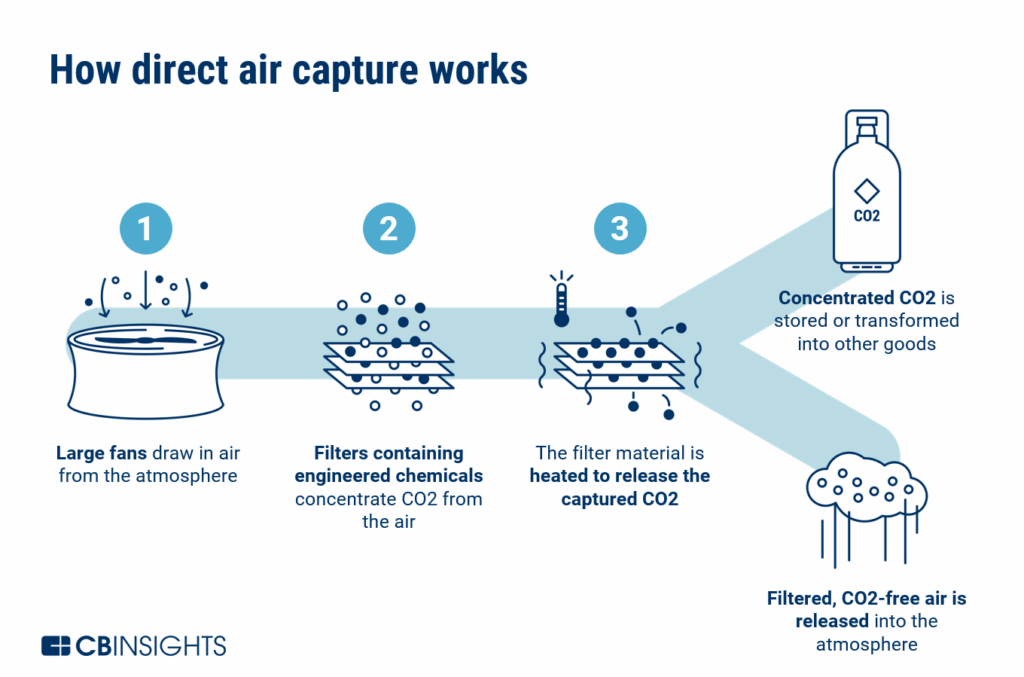
- Direct Air Capture (DAC) technologies remove carbon dioxide (CO2) directly from the atmosphere using liquid solvents or solid sorbents, providing a crucial tool for mitigating climate change.
- Captured carbon dioxide (CO2) is permanently stored underground or used in products, with over 130 facilities planned to reach net-zero goals.
- Process: Fans draw in ambient air, passing it over chemical agents that selectively bind with CO2. Heat is then applied to release the CO2 and regenerate the chemical.
- Techniques: Two main approaches exist: liquid solvent-based systems (using high heat) and solid sorbent-based systems (using lower heat and vacuum).
- Applications: Captured carbon can be sequestered in geological formations (direct air carbon capture and storage – DACCS) or utilized in synthetic fuels, materials, or carbonated beverages.
- Advantages: Unlike point-source capture, DAC can be located anywhere, requires minimal land compared to nature-based solutions, and addresses “legacy” emissions.
- Challenges: The process is energy-intensive and currently costly, with estimates ranging from $600–$1,000 per tonne, though costs are expected to decrease by the 2030s.
5. Regarding Peacock tarantula (Gooty tarantula), consider the following statements:
I. It is an omnivorous crustacean.
II. Its natural habitat in India is only limited to some forest areas.
III. In its natural habitat, it is an arboreal species.
Which of the statements given above is/are correct?
(a) I only
(b) I and III
(c) II only
(d) II and III
Answer: (d) II and III
Peacock tarantula (Gooty tarantula)
- The Peacock tarantula, also known as the Gooty tarantula (Poecilotheria metallica), is a spider, not a crustacean. It is an arachnid, specifically a tarantula species belonging to the family Theraphosidae.
- It is endemic to India. It’s native to deciduous forests in Andhra Pradesh, and is known for its vibrant blue colour, which is also why it’s called the “peacock tarantula”.
- The Gooty (Peacock) Tarantula’s natural habitat in India is limited to specific forest areas, primarily in the Eastern Ghats and degraded forests near Nandyal in Andhra Pradesh. This makes it a critically endangered species.
- The Gooty tarantula is arboreal, meaning it lives in trees, as opposed to burrowing in the ground like some other tarantulas. In its forest habitat, it makes use of tree hollows and bark crevices.
- Renowned for its brilliant metallic blue colouration and striking appearance, it is highly sought after in the pet trade, leading to population decline. Tarantulas are biological pest controllers, and there is a huge demand for them by collectors in the pet trade.

6. Consider the following statements:
I. Carbon dioxide (CO2) emissions in India are less than 0.5 t CO2/ capita.
II. In terms of CO2 emissions from fuel combustion, India ranks second in the Asia-Pacific region.
III. Electricity and heat producers are the largest sources of СО2 emissions in India.
Which of the statements given above is/are correct?
(a) I and III only
(b) II only
(c) II and III only
(d) I, II and III
Answer: (c) II and III only
- In 2022, India’s per capita emissions were 1.89 t CO2 per person. Per capita carbon dioxide (CO₂) emissions in India have soared in recent decades, climbing from 0.4 metric tons per person in 1970 to a high of 2.07 metric tons per person in 2023.
- India ranks second in the Asia-Pacific region in terms of CO2 emissions from fuel combustion. China ranks first in the region, and India is second with 2,516.967 Mt CO2 emissions, according to data from the International Energy Agency (IEA).
- In India, electricity and heat production are the largest sources of CO2 emissions. Specifically, the power sector, which is heavily reliant on coal, contributes significantly to the nation’s overall CO2 emissions, which directly impact climate change. In 2019, the power sector was responsible for about 70% of India’s total CO2 emissions, making it the single largest contributor.
India’s CO₂ Emission Trends:
- Annual Growth: Fossil fuel CO₂ emissions rose from 3.19 billion tonnes (2024) to 3.22 billion tonnes (2025) a 1.4% increase, significantly slower than the 4% rise seen in 2024.
- Decadal Trend: Average annual growth fell to 3.6% (2015–2024) from 6.4% (2005–2014), indicating efficiency gains and rapid renewable energy deployment.
- Sectoral Profile: Roughly 90% of emissions originate from power generation, transport, industry, and buildings; 10% from land-use factors like deforestation.
- Drivers of 2025 Slowdown: An early monsoon in 2024 reduced electricity demand for cooling; renewable energy growth reduced reliance on coal.
- Electricity Sector Shift: CREA reported that India’s power-sector CO₂ emissions declined in early 2025 for the first time, due to strong solar and wind generation.
- Global Context: India is the third-largest CO₂ emitter, yet its per capita emissions (~2.3 tonnes) remain far below the global average and major emitters like the U.S. (14.4 t) and China (8.7 t).
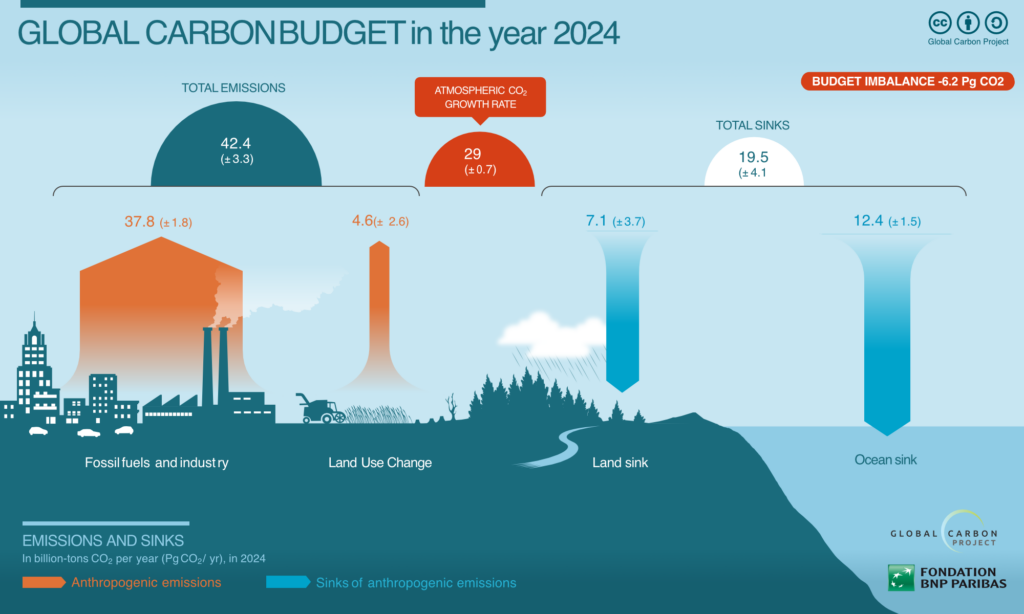
- Outlook: Global fossil CO₂ emissions expected to rise 1.1% to 38.1 Gt, with total emissions (including land use) stabilising near 42 Gt.
Global Carbon Budget
- It is an annual scientific assessment by Global Carbon Project (GCP) that quantifies global CO₂ sources and sinks across fossil fuels, land use, and oceans, forming the most authoritative dataset on global carbon trends.
- GCP Origins:
- Established in 2001 under Future Earth and the World Climate Research Programme as a global consortium of climate scientists.
- Mandate:
- To measure, monitor, and explain the global carbon cycle and its influence on the climate system.
- Purpose of the Global Carbon Budget:
- Quantifies CO₂ sources and sinks globally.
- Tracks emission trends, carbon sequestration, and atmospheric CO₂ levels.
- Provides authoritative data for COP negotiations and national climate assessments.
- Scope and Methodology
- Covers CO₂, methane (CH₄), and nitrous oxide (N₂O) using global datasets.
- Combines national inventories, satellite data, and earth system models.
- Uses the Global Carbon Atlas to visualise national and sector-wise emissions.
- Significance:
- Produces transparent, peer-reviewed carbon accounting.
- Helps evaluate national performance under Paris Agreement targets.
- Supports policy design on energy transition, carbon removal, and land use.
- Key Collaborations:
- Works with major climate bodies including: IPCC, UNFCCC, WMO.
- The 2024 Global Carbon Budget reports that global fossil CO2 emissions have reached a record high of 37.4 billion tonnes, keeping the world on track for 3°C warming by 2100.
- At current emission rates, the remaining carbon budget to limit warming to 1.5°C will likely be exhausted in about six years.
7. Consider the following pairs:
| Plant | Description |
| I. Cassava | Woody shrub |
| II. Ginger | Herb with pseudostem |
| III. Malabar spinach | Herbaceous climber |
| IV. Mint | Annual shrub |
| V. Papaya | Woody shrub |
How many of the above pairs are correctly matched?
(a) Only two
(b) Only three
(c) Only four
(d) All the five
Answer: (b) Only three
- Cassava is a perennial woody shrub with an edible root, which grows in tropical and subtropical areas of the world. It is also called yuca, manioc, and mandioca. It is cultivated for its starchy tuberous roots, which are a major source of carbohydrates.
- Ginger is an herbaceous perennial plant with a unique structure that includes a rhizome (underground stem) and a pseudostem (false stem). The rhizome, the fleshy underground stem, is the part we commonly consume. The pseudostem, made up of tightly wrapped leaf bases, supports the aerial leaves and flowers. This plant is a member of the Zingiberaceae family, which also includes plants like turmeric and cardamom.
- Malabar spinach (Basella alba) is an herbaceous climber. It is a fast-growing, soft-stemmed, twining vine that can grow up to 10 feet long. It is also known as vine spinach, Indian spinach, and Ceylon spinach.
- Mint is not a shrub. It is classified as an aromatic perennial herb. Shrubs are typically woody plants with multiple stems, while herbs have softer, non-woody stems. Mint plants have soft, square stems and spread via underground and overground runners.
- The papaya (Carica papaya) is a large, herbaceous perennial, not a woody shrub. It has a single, non-woody trunk that is somewhat succulent and soft-wooded. The trunk does not develop true bark and is marked by scars from old leaf bases. The papaya is a tree-like plant, but its trunk is not as woody as a typical tree.

8. With reference to the planet Earth, consider the following statements:
I. Rain forests produce more oxygen than that produced by oceans.
II. Marine phytoplankton and photo synthetic bacteria produce about 50% of the world’s oxygen.
III. Well-oxygenated surface water contains several folds higher oxygen than that in atmospheric air.
Which of the statements given above is/are correct?
(a) I and II
(b) II only
(c) I and III
(d) None of the above statements is correct
Answer: (b) II only
- Rainforests do not produce more oxygen than oceans. The ocean, particularly through phytoplankton, is estimated to produce a significantly larger portion of Earth’s oxygen than land-based ecosystems like rainforests.
- While estimates vary, the ocean is thought to produce a substantial portion of the world’s oxygen, ranging from 50% to 80%, while land-based ecosystems like rainforests contribute around 28%
- Marine phytoplankton are primarily responsible for a significant portion of Earth’s oxygen production, with estimates suggesting they produce between 50% and 80% of the oxygen in the atmosphere.
- Synthetic bacteria, while involved in oxygen production in some cases, are not the primary source of oxygen for the planet
- The concentration of dissolved oxygen in surface water is much lower than the concentration of oxygen in air. Air contains about 21% oxygen by volume, which is significantly higher than dissolved oxygen levels in water (typically around 8–10 mg/L).

9. Artificial way of causing rainfall to reduce air pollution makes use of
(a) Silver iodide and potassium iodide
(b) Silver nitrate and potassium iodide
(c) Silver iodide and potassium nitrate
(d) Silver nitrate and potassium chloride
Answer: (a) Silver iodide and potassium iodide
Artificial Rainfall
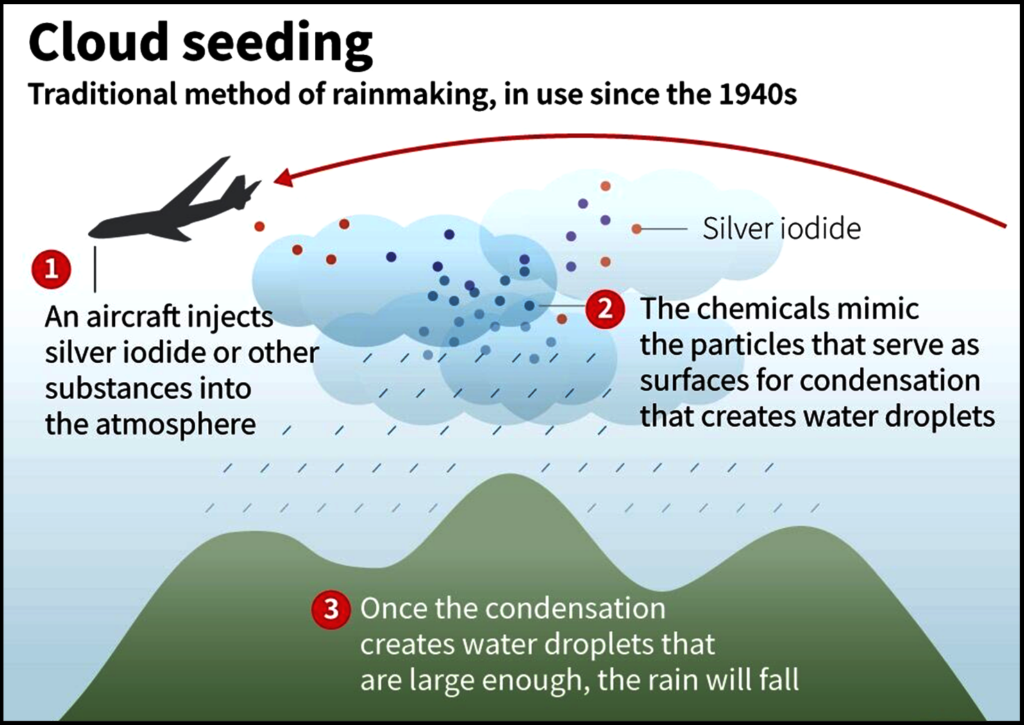
- Artificial rainfall, more commonly known as cloud seeding, is a technique used to induce or enhance precipitation from clouds. It is increasingly being explored in India as a way to combat severe air pollution, particularly in cities like Delhi, where high levels of particulate matter and smog make air quality dangerous.
- The process of cloud seeding involves dispersing certain substances into the atmosphere that serve as cloud condensation or ice nuclei. These particles encourage water vapor in the atmosphere to condense into water droplets or ice crystals. When these droplets become heavy enough, they fall as rain.
- One of the most commonly used chemicals for this purpose is silver iodide (AgI). This compound has a crystalline structure similar to ice, which makes it effective in stimulating the formation of ice crystals within cold clouds. Once seeded, the silver iodide helps initiate the process of condensation and precipitation.
- In addition to silver iodide, potassium iodide (KI) is also used. It can serve a similar function by acting as a condensation nucleus, though it is less commonly used than silver iodide. Together, these chemicals can enhance the cloud’s ability to produce rainfall, helping to clear out pollutants from the air by washing them down to the ground.
- This method has been considered by Indian authorities during peak pollution seasons as a way to create artificial rain and thereby reduce the concentration of pollutants in the lower atmosphere.
Types of Cloud Seeding:
- Static Cloud Seeding:
- This method involves introducing ice nuclei, such as silver iodide or dry ice, into cold clouds that have supercooled liquid water droplets.
- The ice nuclei can trigger the formation of ice crystals or snowflakes, which can grow at the expense of the liquid droplets and fall as precipitation.
- Dynamic Cloud Seeding:
- Dynamic cloud seeding is a technique to artificially stimulate rainfall by enhancing vertical air currents, thereby promoting the formation and growth of rain clouds.
- The process is considered more complex than static cloud seeding because it depends on a sequence of events working properly.
- Hygroscopic Cloud Seeding:
- This method involves spraying fine particles of hygroscopic materials, such as salts through flares or explosives into the base of warm clouds.
- The particles can act as cloud condensation nuclei and increase the number and size of the cloud droplets, which can enhance the reflectivity and stability of the clouds.
- Glaciogenic Cloud Seeding:
- It involves inducing ice formation in supercooled clouds by dispersing ice nuclei such as silver iodide or dry ice, leading to ice nucleation and precipitation.
Applications of the Technique:
- Cloud seeding is also used to enhance winter snowfall and increase mountain snowpack, supplementing the natural water supply for nearby communities.
- Cloud seeding can also be done to prevent hailstorms, dissipate fog, induce rainfall in drought-prone regions, or reduce air pollution.
Challenges in Implementation of Cloud Seeding:
- Environmental Impact: As artificial rain falls, seeding agents like silver iodide, dry ice or salt will also fall.
- Residual silver discovered in places near cloud-seeding projects is considered toxic. As for dry ice, it can also be a source of greenhouse gas that contributes to global warming (carbon dioxide).
- Temporary Relief: While cloud seeding may provide short-term relief from air pollution by washing away particulate matter, it does not address the root causes of pollution such as vehicular emissions and industrial discharges.
- Example: Cloud seeding in Lahore, improved AQI from “poor” to “moderate.” However, the effects were short-lived.
- Availability Issues: Cloud seeding requires the presence of moisture-filled clouds, which are not always available or predictable.
- Specific cloud characteristics, including liquid water content and vertical motion, were used to identify clouds with potential for rainfall.
- Costly: It involves processes such as delivering chemicals to the sky and releasing them into the air by flare shots or aeroplanes, which involves huge costs and logistic preparation.
- Example: Cloud seeding in Delhi requires Rs 13 crore to cover the entire aerial area of 1,300 square kilometers.
10. Which organization has enacted the Nature Restoration Law (NRL) to tackle climate change and biodiversity loss?
(a) The European Union
(b) The World Bank
(c) The Organisation of Economic Cooperation and Development
(d) FAO
Answer: (a) The European Union
Nature Restoration Law (NRL)
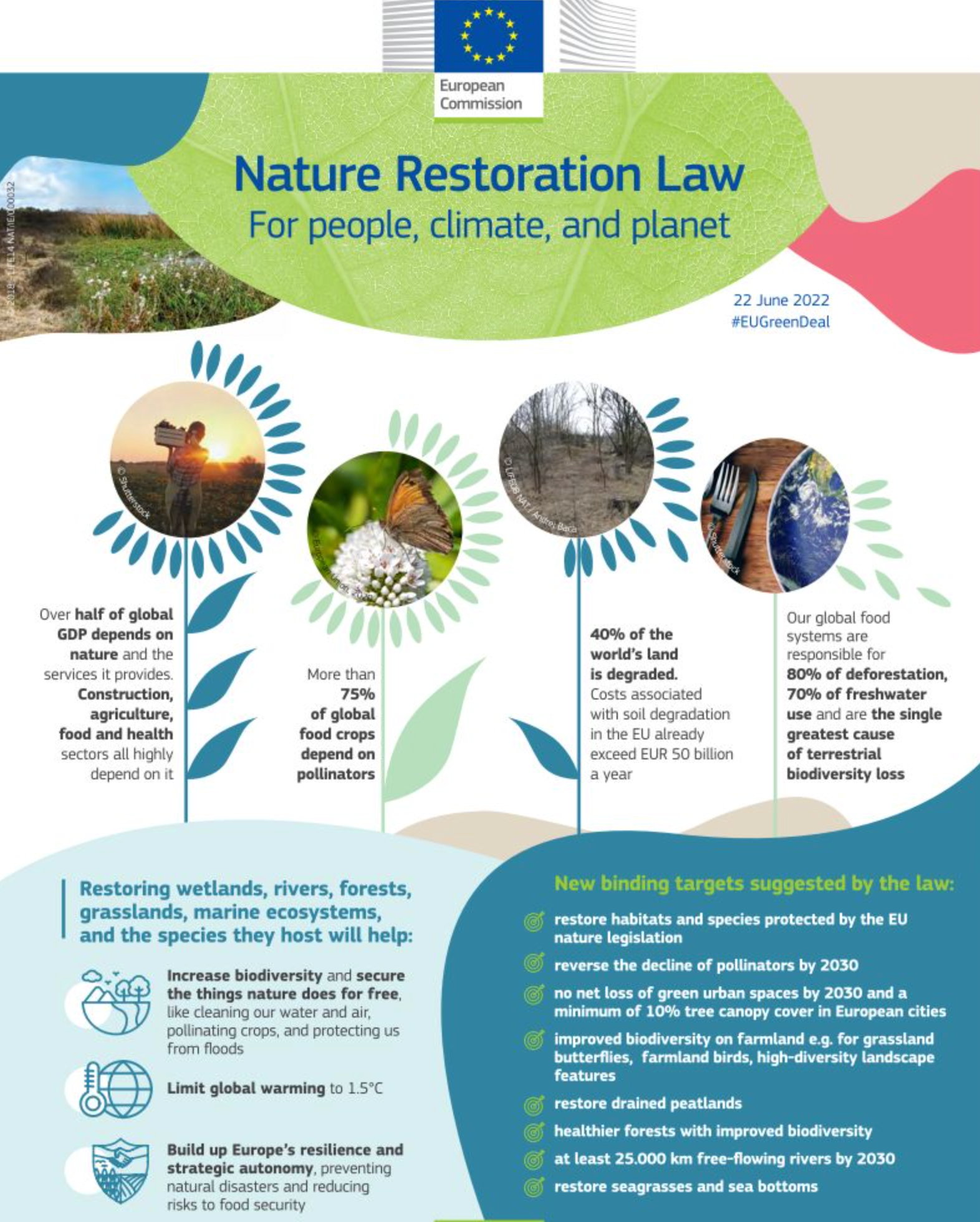
- The Nature Restoration Law (NRL) is a landmark environmental regulation enacted by the European Union (EU).
- The EU Nature Restoration Law (NRL), adopted in June 2024, is a pioneering regulation requiring member states to restore at least 20% of the EU’s land and sea areas by 2030, and all degraded ecosystems by 2050.
- It aims to boost biodiversity, combat climate change, and enhance natural carbon sinks.
- Key Features of the NRL:
- Legally Binding Targets: The law sets binding targets to restore degraded ecosystems, particularly those with high potential to capture and store carbon and to prevent and reduce the impact of natural disasters.
- Restoration Goals: Member States are required to implement restoration measures covering at least 20% of the EU’s land and sea areas by 2030.
- Ecosystem Focus: The law emphasizes restoring wetlands, rivers, forests, grasslands, marine ecosystems, and the species they host to increase biodiversity and secure ecosystem services like water and air purification, crop pollination, and flood protection.
- Climate and Biodiversity Commitments: The NRL supports the EU’s commitment to climate neutrality by 2050 and aligns with international biodiversity commitments under the Kunming-Montreal Global Biodiversity Framework.
- River Connectivity: Aiming to remove barriers to make at least 25,000 km of rivers free-flowing by 2030.
- Urban Green Spaces: No net loss of urban green space and tree cover by 2030, with an increase thereafter.
- Targeted Goals: Contribution to planting 3 billion additional trees and protecting marine habitats like seagrass beds.
- Funding & Economics: The law is part of the European Green Deal, offering significant economic returns of up to €4–€38 for every euro invested.