Q. Who among the following rulers in ancient India had assumed the titles ‘Mattavilasa’, Vichitrachitta’ and ‘Gunabhara?
(a) Mahendravarman I
(b) Simhavishnu
(c) Narasimhavarman I
(d) Simhavarman
Answer: (a) Mahendravarman I
Mahendravarman I
Mahendravarman I (c. 600–630 CE) was an important ruler of the Pallava dynasty who ruled from Kanchipuram in South India. He was known not only as a powerful king but also as a patron of art, architecture, literature, and music.
Titles of Mahendravarman I
Mahendravarman I assumed several notable titles, including:
- Mattavilasa – associated with his literary work and cultural achievements.
- Vichitrachitta – meaning “curious-minded” or “one with a creative intellect,” highlighting his artistic temperament.
- Gunabhara – meaning “one who is full of virtues.”
These titles reflect his intellectual, artistic, and cultural accomplishments.
Contributions to Temple Architecture
Mahendravarman I is regarded as one of the earliest builders of rock-cut temples in South India.
- The Mandagapattu inscription praises him as Vichitrachitta who constructed a temple dedicated to Brahma, Vishnu, and Shiva.
- The inscription proudly states that the temple was built without the use of bricks, timber, metal, or mortar, indicating the beginning of stone temple architecture in the Pallava period.
He commissioned several rock-cut cave temples at places such as:
- Mandagapattu
- Mahendravadi
- Vallam
- Dalavanur
- Pallavaram
- Tiruchirappalli
These monuments represent an early stage of Pallava architectural development that later culminated in the grand temples of the Pallava and Chola periods.
Literary and Cultural Contributions
Mahendravarman I was also a scholar and writer in Sanskrit.
- He composed the satirical Sanskrit drama “Mattavilasa Prahasana.”
- His title Chitrakarapuli indicates his skill in painting.
- He was also skilled in music and is associated with the music inscription at Kudumiyanmalai.
Q. Fa-hien (Faxian), the Chinese pilgrim, travelled to India during the reign of
(a) Samudragupta
(b) Chandragupta II
(c) Kumaragupta I
(d) Skandagupta
Answer: (b) Chandragupta II
Fa-Hien (Faxian)
Fa-Hien (Faxian) was a Chinese Buddhist pilgrim who travelled to India during the Gupta period in search of Buddhist scriptures and sacred sites. His journey took place between 399 CE and 414 CE, and he recorded his observations in the travel account “Foguo Ji” (Record of Buddhist Kingdoms).
Fa-Hien visited India during the reign of Chandragupta II (Vikramaditya) (c. 375–415 CE), when the Gupta Empire was at the height of its political stability, prosperity, and cultural development.
Chandragupta II and the Gupta Golden Age
- Chandragupta II significantly expanded the Gupta Empire by defeating the Western Kshatrapas, thereby gaining control over important trade routes and ports in western India.
- He adopted the prestigious title “Vikramaditya.”
- His reign is often regarded as the high point of the Gupta Empire, marked by economic prosperity, political stability, and cultural achievements.
Fa-Hien’s Observations in India
Fa-Hien’s travel accounts provide valuable insights into the social, religious, and administrative conditions of Gupta India:
- He noted the peaceful administration and mild criminal laws.
- The society appeared prosperous with flourishing trade and agriculture.
- Buddhism was widely practiced, and several monasteries and learning centres existed.
- He visited important Buddhist sites such as Kapilavastu, Bodh Gaya, Sarnath, and Kushinagar.
Q. With reference to ancient India (600–322 BC), consider the following pairs:
| Territorial region | River flowing in the region |
| I. Asmaka | Godavari |
| II. Kamboja | Vipas |
| III. Avanti | Mahanadi |
| IV. Kosala | Sarayu |
How many of the pairs given above are correctly matched?
(a) Only one
(b) Only two
(c) Only three
(d) All the four
Answer: (b) Only two
During the period 600–322 BCE, northern and central India witnessed the rise of sixteen Mahajanapadas (large territorial states). These kingdoms were generally associated with specific geographical regions and river systems, which influenced settlement patterns, agriculture and trade.
Pair 1: Asmaka – Godavari ✔
Asmaka (Assaka) was one of the sixteen Mahajanapadas and the only Mahajanapada located in the Deccan region.
- It was situated on the banks of the Godavari River in present-day Maharashtra–Telangana region.
- The capital of the kingdom is believed to have been Potali (or Paudanya).
Pair 2: Kamboja – Vipasa ✘
Kamboja was a Mahajanapada located in the north-western region of the Indian subcontinent, covering areas of present-day Afghanistan, Pakistan and parts of Kashmir.
- The Vipasa River (modern Beas) flows through the Punjab region.
- The core area of Kamboja lay further northwest, beyond the Beas river basin.
Pair 3: Avanti – Mahanadi ✘
Avanti was an important Mahajanapada located in the Malwa region of present-day Madhya Pradesh.
- It had two main centres: Ujjain (Ujjayini) and Mahishmati.
- The region is associated mainly with rivers such as the Shipra and Narmada.
The Mahanadi River, however, flows through Chhattisgarh and Odisha, far to the east of Avanti’s territory.
Pair 4: Kosala – Sarayu ✔
Kosala was a powerful Mahajanapada located in the Awadh region of present-day Uttar Pradesh.
- Its important cities included Ayodhya and Shravasti.
- The Sarayu River (a tributary of the Ghaghara) flows through this region and is closely associated with Ayodhya.
Q. Ashokan inscriptions suggest that the Pradeshika’, Rajuka’ and Yukta’ were important officers at the
(a) village-level administration
(b) district-level administration
(c) provincial administration
(d) level of the central administration
Answer: (b) district-level administration
Mauryan Empire: Administration
The administrative system during the Mauryan Empire (4th–3rd century BCE) was highly organised and hierarchical. Ashokan inscriptions and the Arthashastra of Kautilya provide important information about the structure of administration and the officials responsible at different levels.
According to the Arthashastra, the village was the smallest administrative unit. Several villages together formed a district, and multiple districts constituted a province. Administration at each level was carried out by designated officials responsible for governance, revenue collection and maintenance of law and order.
District-Level Administration
Ashokan inscriptions mention three key officials functioning at the district level:
1. Pradesika
- The Pradesika was the chief officer in charge of the district.
- He supervised administration, conducted inspections and ensured the implementation of royal orders.
2. Rajuka
- The Rajuka functioned as an important administrative and judicial officer.
- He was responsible for land measurement, revenue assessment and administration of justice.
- Ashoka’s edicts also indicate that Rajukas had considerable authority in local governance.
3. Yukta
- The Yukta was generally a junior administrative officer who assisted the higher officials.
- He performed secretarial and record-keeping duties and helped implement administrative orders.
Functions of District Officials
These officials collectively carried out several administrative responsibilities, such as:
- Survey and assessment of land
- Collection of revenue and taxes
- Tours and inspections of local areas
- Maintenance of law and order
- Record keeping related to land, population and livestock
Each district also had an accountant responsible for maintaining records of boundaries, registered land, and property deeds, along with maintaining a census of population and livestock. Additionally, there was a tax collector responsible for collecting various forms of revenue.
Since the officials Pradesika, Rajuka and Yukta were responsible for administrative functions at the district level, the inscriptions indicate that they were important officers in district administration.
| Administrative Level | Administration | Key Officials |
|---|---|---|
| (a) Village level | Local administration | Gramika (village headman) |
| (b) District level | Intermediate administration | Pradeshika, Rajuka, Yukta |
| (c) Provincial level | Regional administration | Kumara/Aryaputra, Mahamatras |
| (d) Central administration | Imperial administration | Emperor, Mantriparishad, Samaharta, Sannidhata |
Q. The first Gandharva Mahavidyalaya, a music training school, was set up in 1901 by Vishnu Digambar Paluskar in
(a) Delhi
(b) Gwalior
(c) Ujjain
(d) Lahore
Answer: (d) Lahore
Pandit Vishnu Digambar Paluskar
Pandit Vishnu Digambar Paluskar (1872–1931) was one of the most influential figures in the revival and popularisation of Hindustani classical music in modern India. He played a pioneering role in institutionalising music education, which earlier was largely confined to hereditary musicians and royal patronage.
Paluskar believed that classical music should be accessible to the wider public rather than restricted to courts and elite circles. To achieve this, he introduced a structured system of music education through formal institutions.
Establishment of Gandharva Mahavidyalaya
- On 5 May 1901, Vishnu Digambar Paluskar founded the first Gandharva Mahavidyalaya at Lahore.
- The institution aimed to systematise the teaching of Hindustani classical music and promote it among the general public.
- It offered formal training, music notation, and organised teaching methods, which helped standardise music education.
The establishment of Gandharva Mahavidyalaya marked an important transition in Indian music history, as it shifted music learning from the traditional guru–shishya household system to institutional education.
Contributions of Vishnu Digambar Paluskar
- Popularised bhajans and devotional music, including the widely sung “Raghupati Raghava Raja Ram.”
- Played a significant role in standardising the tune of “Vande Mataram.”
- Worked to revive and democratise Hindustani classical music by making it accessible to students from different social backgrounds.
Later, several branches of Gandharva Mahavidyalaya were established across India, continuing his mission of promoting classical music education.
Thus, the first Gandharva Mahavidyalaya was established in 1901 at Lahore by Vishnu Digambar Paluskar.
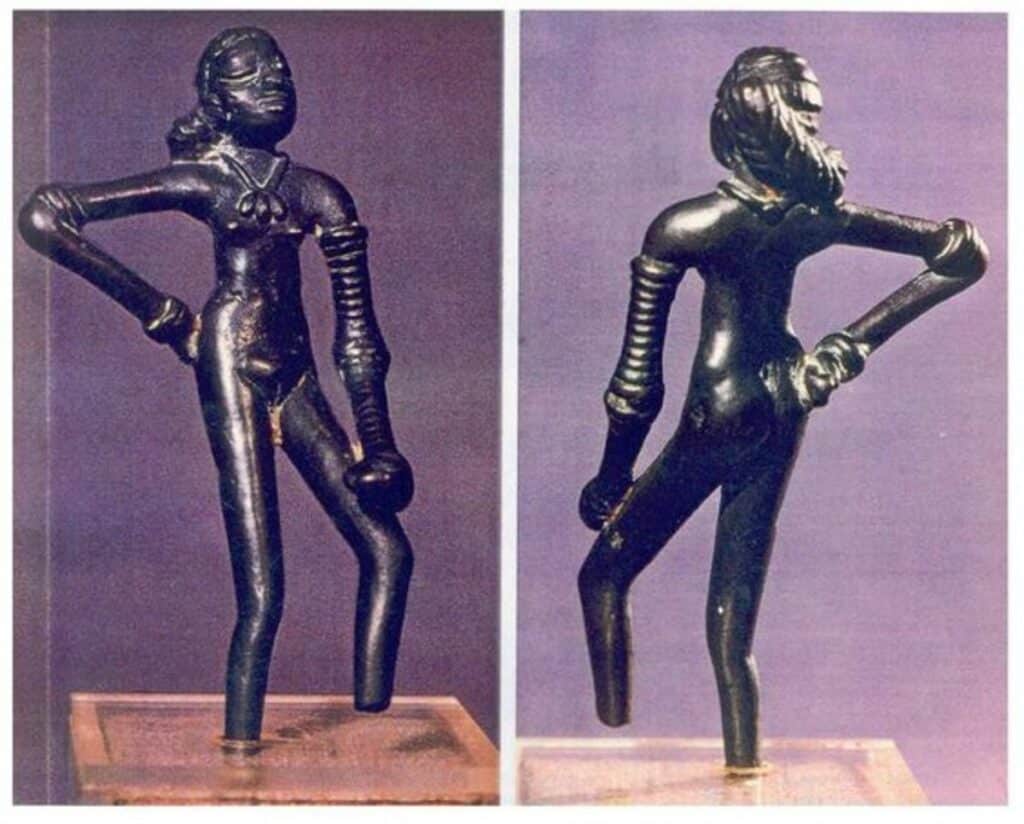
Q. The famous female figurine known as ‘Dancing Girl’, found at Mohenjo-daro, is made of
(a) carnelian
(b) clay
(c) bronze
(d) gold
Answer: (c) bronze
Dancing Girl” of Mohenjo-daro
- The “Dancing Girl” of Mohenjo-daro is one of the most famous artefacts of the Indus Valley Civilization (c. 2600–1900 BCE) and reflects the advanced artistic and metallurgical skills of the Harappan people.
- This figurine was discovered at Mohenjo-daro (in present-day Sindh, Pakistan) during archaeological excavations in the 1920s. The statue is a small bronze sculpture, about 10–11 cm (around 4 inches) in height.
- The figurine depicts a young female standing confidently, with one hand placed on her hip and the other hanging freely. Her left arm is covered with numerous bangles, and she wears a necklace, suggesting knowledge of ornamentation and artistic detailing. The posture conveys naturalism, movement, and confidence, highlighting the aesthetic sensibilities of the Harappan craftsmen.
- The statue was produced using the lost-wax casting technique (cire perdue), an advanced metallurgical process in which a wax model is coated with clay, heated to remove the wax, and molten metal is poured into the mould. This indicates that the Harappans possessed sophisticated knowledge of bronze metallurgy and metal casting.
- The Dancing Girl is therefore considered an important example of Harappan bronze sculpture and artistic expression.
- Thus, the famous figurine “Dancing Girl” of Mohenjo-daro is made of bronze.