

1. Which one of the following launched the ‘Nature Solutions Finance Hub for Asia and the Pacific’?
(a) The Asian Development Bank (ADB)
(b) The Asian Infrastructure Investment Bank (AIIB)
(c) The New Development Bank (NDB)
(d) The International Bank for Reconstruction and Development (IBRD)
Answer: (a) The Asian Development Bank (ADB)
- The organization that launched the “Nature Solutions Finance Hub for Asia and the Pacific” is the Asian Development Bank (ADB).
- The ADB unveiled this hub at COP28 with the goal of attracting significant investments in nature-based solutions projects across the Asia Pacific region.
- It aims to mobilize funding for projects that incorporate nature-based solutions to address climate change and biodiversity loss. The hub aims to attract at least $2 billion in investments.
Asian Development Bank (ADB)
- The Asian Development Bank (ADB), founded in 1966 and headquartered in Manila, Philippines, is a multilateral lender dedicated to reducing poverty in the Asia-Pacific through inclusive, sustainable growth.
- It is owned by 69 members, with top shareholders being Japan, the USA, China, India, and Australia.
- The ADB was modelled closely on the World Bank and has a similar weighted voting system where votes are distributed in proportion to members’ capital subscriptions.
- ADB’s five largest shareholders are Japan and the United States (each with 15.6% of total shares), the People’s Republic of China (6.4%), India (6.3%), and Australia (5.8%).
- Purpose: Promotes economic cooperation, technical assistance, and funding for infrastructure (transport, energy).
- India’s Status: India is a founding member and the 4th largest shareholder.
- Governance: Led by a Board of Governors (1 rep per member) and a Board of Directors. The President is traditionally Japanese.
- Key Reports: Publishes Asian Development Outlook (ADO).
- Recent Initiatives (India): $10 billion investment planned (2025-2030) for urban infrastructure (metro, sanitation, TOD).
- Membership:
- Membership in the ADB is open to members and associate members of the United Nations Economic Commission for Asia and the Far East.
- It’s also open to other regional countries and non-regional developed countries that are members of the U.N. or of any of its specialized agencies.
- From 31 members at its establishment in 1966, ADB has grown to encompass 69 members, including 49 regional members from Asia and the Pacific, such as India, China, Japan, South Korea, Australia, and many others, and 20 non-regional members from Europe, North America, and other regions.
2. Consider the following statements:
I. India has joined the Minerals Security Partnership as a member.
II. India is a resource-rich country in all the 30 critical minerals that it has identified.
III. The Parliament in 2023 has amended the Mines and Minerals (Development and Regulation) Act, 1957 empowering the Central Government to exclusively auction mining lease and composite license for certain critical minerals.
Which of the statements given above are correct?
(a) I and II only
(b) II and III only
(c) I and III only
(d) I, II and III
Answer: (c) I and III only
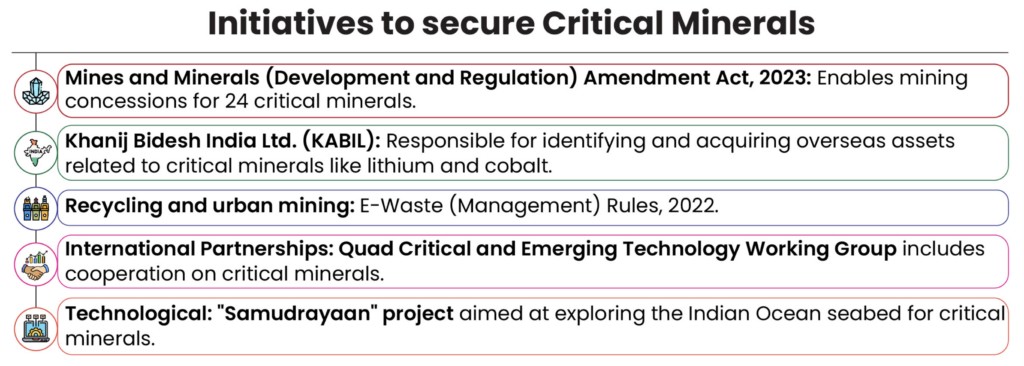
- The Minerals Security Partnership (MSP) is a U.S.-led initiative aimed at strengthening and diversifying global critical mineral supply chains. It seeks to promote strategic projects and attract investments across the value chain through collaboration with industry and partner governments. In June 2023, India became the 14th member of the MSP.
- India is not resource-rich in many critical minerals essential for its economic and strategic needs.
- To address this, the Government released a list of 30 critical minerals in June 2023 and has enhanced exploration efforts through the Geological Survey of India (GSI) and other agencies. In 2025, the National Critical Mineral Mission (NCMM) was launched to build a robust framework for self-reliance in this sector. Under the mission, GSI will undertake 1,200 exploration projects between 2024–25 and 2030–31.
- In 2023, the Indian Parliament amended Mines and Minerals (Development and Regulation) Act, 1957 to give the Central Government exclusive powers to auction mining leases and composite licenses for for 24 critical minerals listed in the new Part-D of the First Schedule to the said Act which includes the Lithium bearing minerals, Niobium bearing minerals and minerals of the “rare earths” group not containing Uranium and Thorium.
Mineral Security Partnership
- Genesis: a US-led, 14-member international initiative launched in June 2022 to catalyse public and private investment in critical mineral supply chains.
- Objective: To facilitate public and private sector investments in strategic critical minerals projects to help build more secure, diverse, and sustainable critical mineral supply chains.
- Members: It includes 14 countries and the European Union, which collectively account for over 50% of Global GDP.
- India joined in 2023.
- Investments by MSP are not limited to projects in MSP partner countries.
- MSP Finance Network:
- An initiative of the Minerals Security Partnership, it is a joint financing body designed to fund critical minerals projects across the globe.
- Objectives: To unite institutions from the Indo-Pacific region and Europe to strengthen cooperation, promote information exchange and co-financing among participating institutions, with the aim of advancing diverse, secure, and sustainable supply chains for critical minerals.
- It will also drive sustainable investmentin global critical mineral supply chains, including by mobilizing private sector capital, in production, extraction, processing, recycling, and recovery projects.
- Members:14 countries including India and the European Commission.
- It also includes the US International Development Finance Corporation (DFC), European Investment Bank (EIB), Japan International Cooperation Agency (JICA), among others.
What are Critical Minerals?
- These minerals are building blocks of essential modern-day technologies and are at risk of supply chain disruptions due to limited global production and geopolitical factors.
- e.g., Lithium, cobalt, nickel, copper, rare earth elements, etc.
- Government of India has released a list of 30 critical minerals for India.
- These minerals are – Antimony, Beryllium, Bismuth, Cobalt, Copper, Gallium, Germanium, Graphite, Hafnium, Indium, Lithium, Molybdenum, Niobium, Nickel, PGE, Phosphorous, Potash, REE, Rhenium, Silicon, Strontium, Tantalum, Tellurium, Tin, Titanium, Tungsten, Vanadium, Zirconium, Selenium, and Cadmium.
3. Consider the following countries:
- Austria
- Bulgaria
- Croatia
- Serbia
- Sweden
- North Macedonia
How many of the above are members of the North Atlantic Treaty Organization?
(a) Only three
(b) Only four
(c) Only five
(d) All the six
Answer: (b) Only four
- The North Atlantic Treaty Organization (NATO) is a 32-member intergovernmental military alliance established on April 4, 1949, to provide collective security against external threats, primarily rooted in the principle that an attack against one member is an attack against all.
- Headquartered in Brussels, Belgium, NATO promotes transatlantic defense cooperation, with members recently committing to 5% GDP defense spending by 2035.
- Collective Defence (Article 5): The cornerstone of the alliance, stipulating that members agree to mutual defense in response to an armed attack.
- Members: As of 2026, there are 32 member countries, including the United States, Canada, the United Kingdom, France, and many European nations. Recent additions include Finland (2023).
- Full List of NATO Members (32):
- Albania (2009)
- Belgium (1949)
- Bulgaria (2004)
- Canada (1949)
- Croatia (2009)
- Czech Republic (1999)
- Denmark (1949)
- Estonia (2004)
- Finland (2023)
- France (1949)
- Germany (1955)
- Greece (1952)
- Hungary (1999)
- Iceland (1949)
- Italy (1949)
- Latvia (2004)
- Lithuania (2004)
- Luxembourg (1949)
- Montenegro (2017)
- Netherlands (1949)
- North Macedonia (2020)
- Norway (1949)
- Poland (1999)
- Portugal (1949)
- Romania (2004)
- Slovakia (2004)
- Slovenia (2004)
- Spain (1982)
- Sweden (2024)
- Turkey (1952)
- United Kingdom (1949)
- United States (1949)
- Founding Members: The original 12 members are Belgium, Canada, Denmark, France, Iceland, Italy, Luxembourg, Netherlands, Norway, Portugal, the United Kingdom, and the United States.
- Expansion: Membership is open to any European state capable of furthering the principles of the treaty and contributing to security.
- Article 5: This defines the core principle of collective defense, stating that an attack on one member is an attack on all.
- Aspiring Members: Bosnia and Herzegovina currently participates in the Membership Action Plan (MAP).
- Austria and Serbia are not NATO members.
4. Consider the following statements about the Rashtriya Gokul Mission:
- It is important for the upliftment of rural poor as majority of low producing indigenous animals are with small and marginal farmers and landless labourers.
- It was initiated to promote indigenous cattle and buffalo rearing and conservation in a scientific and holistic manner.
Which of the statements given above is/are correct?
(a) I only
(b) II only
(c) Both I and II
(d) Neither I nor II
Answer: (c) Both I and II
- The Rashtriya Gokul Mission was initiated by the Government of India under the Department of Animal Husbandry and Dairying, Ministry of Fisheries, Animal Husbandry & Dairying.
- The Rashtriya Gokul Mission (RGM) is crucial for upliftment of rural poor as more than 80% low producing indigenous animals are with small and marginal farmers and landless labourers. The scheme is important in enhancing milk production and productivity of bovines to meet growing demand of milk and making dairying more remunerative to the rural farmers of the country.
- The Rashtriya Gokul Mission was launched to promote the rearing and conservation of indigenous cattle and buffalo breeds in a scientific and holistic manner.
- The mission aims to enhance the productivity of native breeds, preserve their genetic diversity, and improve rural livelihoods. It focuses on the development of high-genetic merit animals through modern breeding technologies, establishment of Gokul Grams (cattle care centers), and support for traditional animal husbandry practices.
- Gokul Grams: It provides for the setting up of 16 Gokul Grams as Integrated Indigenous Cattle development Centres with the aim of conservation & development of indigenous bovine breeds in a scientific and holistic manner.
- Funding: 100% grant-in-aid (with specific exceptions for subsidies).
- Key Initiatives: Promotion of sex-sorted semen, IVF technology (subsidy of ₹5,000 per pregnancy), and 50% subsidy for establishing breed multiplication farms.
Key Features of Revised RGM
- Outlay: ₹3,400 crore for 15th Finance Commission cycle (2021-22 to 2025-26).
- Two New added Activities:
- Heifer Rearing Centres (HRCs): One-time assistance of 35% of capital cost for establishment of HRCs to Implementing Agencies for creation of 30 housing facilities having total 15000 heifers.
- Interest Subvention for Farmers: To encourage purchase of high genetic merit (HGM) in vitro fertilization (IVF) heifers, farmers will receive a 3% interest subvention on loans taken from milk unions, financial institutions, or banks.
Achievements of Rashtriya Gokul Mission
- Milk production: Increased by 63.55% in the last 10 years.
- Per capita milk availability: Increased from 307 grams per day in 2013-14 to 471 grams per day in 2023-24.
- Dairy productivity: Increasing by 26.34% in the last ten years.
- Artificial Insemination: Nationwide Artificial Insemination Programme (NAIP) under the RGM provides free of cost Artificial Insemination at the farmer’s doorstep in 605 districts
5. Consider the following statements in respect of BIMSTEC:
I. It is a regional organization consisting of seven member states until January 2025.
II. It came into existence with the signing of the Dhaka Declaration, 1999.
III. Bangladesh, India, Sri Lanka, Thailand and Nepal are founding member States of BIMSTEC.
IV. In BIMSTEC, the subsector of ‘tourism’ is being led by India.
Which of the statements given above is/are correct?
(a) I and II
(b) II and III
(c) I and IV
(d) I only
Answer: (d) I only
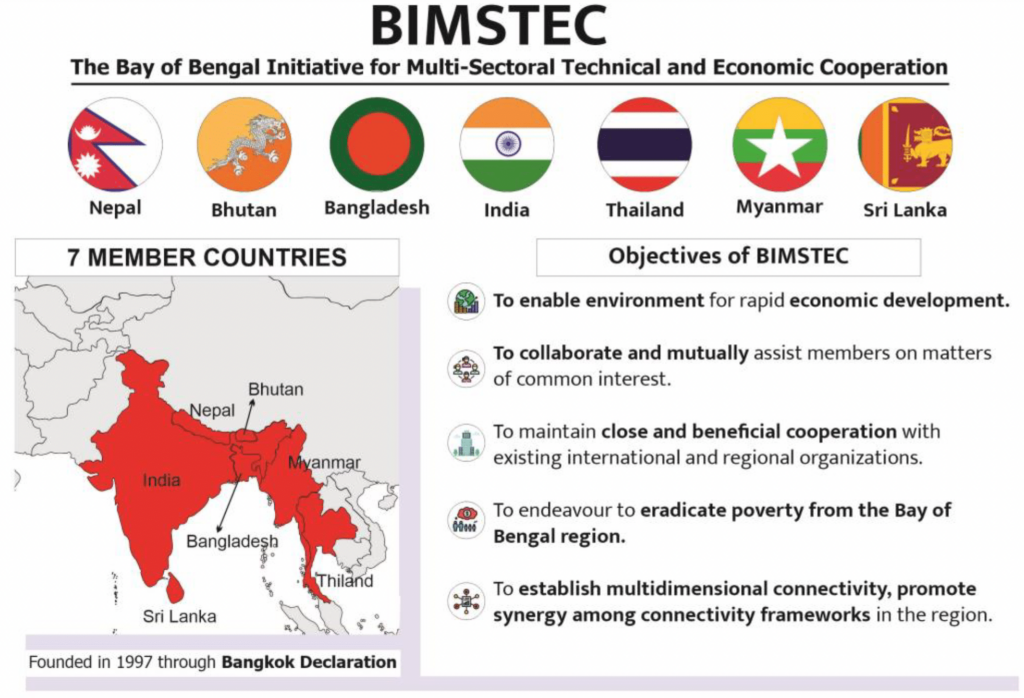
- The Bay of Bengal Initiative for Multi-Sectoral Technical and Economic Cooperation (BIMSTEC) is a regional organization comprising of 7 member states that are in the littoral and adjacent areas of the Bay of Bengal, thus constituting a contiguous regional unity.
- Formation: Formed in 1997 through the Bangkok Declaration.
- It was initially formed with 4 member states (Bangladesh, India, Sri Lanka and Thailand). Myanmar became a member in 1997, followed by Nepal and Bhutan in 2004.
- BIMSTEC has celebrated 20 years of its formation in 2017.
6. Consider the following pairs:
I. International Year of the Woman Farmer: 2026
II. International Year of Sustainable and Resilient Tourism: 2027
III. International Year of Peace and Trust: 2025
IV. International Year of Asteroid Awareness and Planetary Defence: 2029
How many of the pairs given above are correctly matched?
(a) Only one
(b) Only two
(c) Only three
(d) All the four
Answer: (d) All the four
- The UN General Assembly has declared 2026 as the International Year of the Woman Farmer.
- This initiative aims to highlight the crucial role of women farmers in food security, nutrition, and poverty eradication, and to address the challenges they face.
- The United Nations has proclaimed 2027 as the International Year of Sustainable and Resilient Tourism.
- The United Nations General Assembly adopted a resolution on 26 February 2024 to declare 2027 as the International Year of Sustainable and Resilient Tourism. It aims to emphasize the active promotion of sustainable and resilient tourism as a vital tool for poverty eradication, supporting the involvement of women, youth, older persons, and persons with disabilities, expanding economic opportunities, and creating decent jobs and income sources.
- The UN General Assembly has adopted a resolution to declare 2025 as the International Year of Peace and Trust. It calls on the international community to resolve conflicts through inclusive dialogue and negotiation in order to ensure the strengthening of peace and trust in relations between UN member states as a value that promotes sustainable development, peace and security, and human rights.
- 2025 has been proclaimed an international year devoted to four different themes: International Year of Glaciers, Peace, Quantum science and Cooperatives.
- In 2024, the UN General Assembly declared 2029 the International Year of Asteroid Awareness and Planetary Defence to take advantage of the close approach of 99942 Apophis and raise global awareness about asteroids.
- On 13 April 2029, the asteroid 99942 Apophis will pass safely at a distance of about 32,000 kilometers above Earth’s surface, within the geostationary orbit, posing no threat to the planet. This extremely close approach will make the asteroid visible to billions of people with the naked eye in the clear night sky.
Upcoming and Recent International Years:
- 2029:
- International Year of Asteroid Awareness and Planetary Defence: Raises awareness about asteroid threats and defense mechanisms.
- 2027:
- International Year of Sustainable and Resilient Tourism: Promotes sustainable and resilient tourism.
- 2026:
- International Year of Rangelands and Pastoralists: Highlights the importance of rangelands and the role of pastoralists.
- International Year of Volunteers for Sustainable Development: Recognizes the role of volunteers in achieving SDGs.
- International Year of the Woman Farmer: Focuses on closing gender gaps in agrifood systems.
- 2025: Quantum Science and Technology, Cooperatives, Glaciers’ Preservation, and Peace and Trust.
- 2024: International Year of Camelids.
- 2023: International Year of Millets, & International Year of Dialogue as a Guarantee of Peace.
- 2022: International Year of Glass, Basic Sciences for Sustainable Development, and Sustainable Mountain Development.
7. Consider the following statements with regard to BRICS:
I. The 16th BRICS Summit was held under the Chairship of Russia in Kazan.
II. Indonesia has become a full member of BRICS.
III. The theme of the 16th BRICS Summit was Strengthening Multiculturalism for Just Global Development and Security.
Which of the statements given above is/are correct?
(a) I and II
(b) II and III
(c) I and III
(d) I only
Answer: (a) I and II
- The BRICS is a forum for cooperation among a group of leading emerging economies. BRICS stands for Brazil, Russia, India, China, and South Africa, the original five members. The BRICS now includes 10 countries – Brazil, China, Egypt, Ethiopia, India, Indonesia, Iran, Russian Federation, South Africa, United Arab Emirates.
- The 16th BRICS Summit was held under Russia’s Chairship, in Kazan. At the conclusion of the Summit, the leaders adopted the ‘Kazan Declaration’.
- The 17th BRICS Summit will be hosted by Brazil.
- Recently, Indonesia has officially joined the BRICS group as the 10th member, effective from January 2025. Indonesia has been admitted as a full member of the BRICS bloc of developing economies.
- The theme of the 16th BRICS Summit was “Strengthening Multilateralism for Just Global Development and Security.” While the statement says Strengthening Multiculturalism.
8. Consider the following statements in respect of the first Kho-Kho World Cup:
I. The event was held in Delhi, India.
II. Indian men beat Nepal with a score of 78-40 in the final to become the World Champion in the men category.
III. Indian women beat Nepal with a score of 54—36 in the final to become the World Champion in women category.
Which of the statements above is/are correct?
(a) I only
(b) II and III only
(c) I and III only
(d) I, II and III
Answer: (a) I only
- The inaugural Kho Kho World Cup took place from 13 to 19 January 2025 at the Indira Gandhi Indoor Stadium in New Delhi, India.
- Organised by the Kho Kho Federation of India (KKFI) and the International Kho Kho Federation (IKKF), the event featured 20 men’s and 19 women’s teams from 23 countries spanning six continents.
- Final Standings: Both finals featured a clash between India and Nepal.
- India secured the titles in both men’s and women’s competitions.
- The men’s team also secured a 54-36 win over Nepal in the title clash.
- India’s women’s team clinched the inaugural Kho Kho World Cup with a commanding 78-40 win over Nepal.
- Mascots: The event featured two mascots—Tejas, a blue gazelle for the men’s team, and Tara, an orange gazelle for the women’s team.
- Format: Matches used the fast-paced, seven-a-side format similar to Ultimate Kho Kho.
9. Consider the following statements:
I. In the finals of the 45th Chess Olympiad held in 2024, Gukesh Dommaraju became the world’s youngest winner after defeating the Russian player Ian Nepomniachtchi.
II. Abhimanyu Mishra, an American chess player, holds the record of becoming world’s youngest ever Grandmaster.
Which of the statements given above is/are correct?
(a) I only
(b) II only
(c) Both I and II
(d) Neither I nor II
Answer: (b) II only
- Chess Olympiad is a biennial event in which teams representing nations of the world compete. International Chess Federation (FIDE) organises the tournament and selects the host nation. The 45th FIDE Chess Olympiad was held in Budapest, Hungary.
- D Gukesh won his second individual gold medal in a row at the 45th Chess Olympiad.
- Indian Grandmaster D Gukesh, at 18, became the youngest world chess champion by defeating Ding Liren in the 2024 FIDE World Chess Championship held in Singapore.
- Abhimanyu Mishra, a U.S. player of Indian origin, is the youngest GrandMaster in history, at 12 years, four months and 25 days. He obliterated the long-standing record held by Sergey Karjakin, who was 12 years and seven months old when he attained the title.
- Knowledge Base:
- India clinched their first-ever gold medal at the 45th Chess Olympiad.
- India’s men and women won the gold at the Chess Olympiad in Budapest.
- The Indian men’s team defeated Slovenia with a score of 3.5-0.5 in the 11th and final round of the 45th Chess Olympiad.
- Simultaneously, the Indian women’s team dominated Azerbaijan, securing victory with a 3.5-0.5 margin.
10. Consider the following statements:
I. Indian Railways have prepared a National Rail Plan (NRP) to create a future-ready railway system by 2028.
II. ‘Kavach’ is an Automatic Train Protection (ATP) system developed in collaboration with Germany.
III. ‘Kavach’ system consists of RFID tags fitted on tracks in station sections.
Which of the above statements given above are not correct?
(a) I and II only
(b) II and III only
(c) I and III only
(d) I, II and III
Answer: (a) I and II only
- The Indian Railways has undertaken two major initiatives: the National Rail Plan (NRP) and the ‘Kavach’ Automatic Train Protection (ATP) system. Both are designed to modernize and secure the railway infrastructure and operations.
- The National Rail Plan (NRP) has been developed with the aim of creating a ‘future ready’ railway system by the year 2030, not 2028. The plan intends to meet future demand (both passenger and freight) up to 2050, and to increase the modal share of railways in freight transport to 45%. It includes investment planning, capacity building, and infrastructure upgrades.
- ‘Kavach’ is an indigenous ATP system developed by the Research Designs and Standards Organisation (RDSO) under Indian Railways. There is no German collaboration involved in its creation.
- The Kavach system uses Radio Frequency Identification (RFID) tags placed on the railway tracks, especially in station sections. These tags work in coordination with onboard and trackside equipment to detect train location, and automatically apply brakes in case of collision threats, signal violations, or overspeeding.
‘Kavach’:
- It is India’s own automatic protection system, which has been in development since 2012 under the name Train Collision Avoidance System (TCAS) and has been renamed Kavach or “armour.”
- It is a collection of electronic devices and Radio Frequency Identification (RFID) devices that are installed in locomotives, the signaling system, and the tracks.
- They communicate with one another via ultra-high radio frequencies in order to control train brakes and alert drivers, all based on the logic programmed into them.
- TCAS, also known as Kavach, incorporates key elements from existing and tried-and-tested systems such as the European Train Protection and Warning System and the indigenous Anti Collision Device.
- Kavach, in its current form, adheres to the highest level of safety and reliability standard known as Safety Integrity Level (SIL) 4.
- A higher SIL Level indicates a higher level of process hazard, and a higher level of protection is required.
- In its new guise, India wants to position Kavach as an exportable system, a cheaper alternative to the European systems that are popular around the world.
- While Kavach is currently using Ultra High Frequency, work is being done to make it compatible with 4G Long Term Evolution (LTE) technology and to make the product available in global markets.
11. India is one of the founding members of the International North-South Transport Corridor (INSTC), a multimodal transportation corridor, which will connect
(a) India to Central Asia to Europe via Iran
(b) India to Central Asia via China
(c) India to South-East Asia through Bangladesh and Myanmar
(d) India to Europe through Azerbaijan
Answer: (a) India to Central Asia to Europe via Iran
International North – South Transport Corridor
- India, Iran and Russia had in September 2000 signed the INSTC agreement to build a corridor to provide the shortest multi-model transportation route linking the Indian Ocean and the Persian Gulf to the Caspian Sea via Iran and St Petersburg. ‘
- It is a 7,200-km-long multi-mode network of ship, rail, and road route for moving freight.
- Regions involved: India, Iran, Afghanistan, Azerbaijan, Russia, Central Asia and Europe.
- From St Petersburg, North Europe is within easy reach via the Russian Federation. The estimated capacity of the corridor is 20-30 million tonnes of goods per year.
- The route primarily involves moving freight from India, Iran, Azerbaijan and Russia via ship, rail and road.
- The objective of the corridor is to increase trade connectivity between major cities such as Mumbai, Moscow, Tehran, Baku, Bandar Abbas, Astrakhan, Bandar Anzali and etc.
- Currently, there are 13 Members of INSTC (India, Iran, Russia, Azerbaijan, Armenia, Kazakhstan, Kyrgyzstan, Tajikistan, Turkey, Ukraine, Belarus, Oman and Syria).
- Bulgaria has joined as an Observer State.
Significance of the corridor:
- Conceived well before China’s Belt and Road Initiative (BRI), INSTC will not only help cut down on costs and time taken for transfer of goods from India to Russia and Europe via Iran but also provide an alternative connectivity initiative to countries in the Eurasian region.
- This will also synchronize with the Ashgabat agreement, a Multimodal transport agreement signed by India, Oman, Iran, Turkmenistan, Uzbekistan and Kazakhstan, for creating an international transport and transit corridor facilitating transportation of goods between Central Asia and the Persian Gulf.

12. Consider the following statements:
Statement I: Of the two major ethanol producers in the world, i.e., Brazil and the United States of America, the former produces more ethanol than the latter.
Statement II: Unlike in the United States of America where corn is the principal feedstock for ethanol production, sugarcane is the principal feedstock for ethanol production in Brazil
Which one of the following is correct in respect of the above statements?
(a) Both Statement I and Statement II are correct and Statement II explains Statement I
(b)Both Statement I and Statement II are correct but Statement II does not explain Statement I
(c) Statement I is correct but Statement II is not correct
(d) Statement I is not correct, but Statement II is correct
Answer: (d) Statement I is not correct but Statement II is correct
- The United States is the largest producer of ethanol in the world, consistently accounting for over 50% of global ethanol production in recent years.
- For example, In 2024, the U.S. produced approximately 16.2 billion gallons of ethanol, accounting for about 52% of global production.
- In contrast, Brazil produced around 8.78 billion gallons, representing 28% of global output. Thus, the United States produces nearly twice as much ethanol as Brazil.
- In the United States, ethanol is primarily produced from corn, which is abundantly cultivated in the Midwest and forms the backbone of the American ethanol industry.
- In contrast, Brazil produces most of its ethanol from sugarcane, which is well-suited to its tropical climate. Sugarcane-based ethanol is considered more energy-efficient and has a lower carbon footprint compared to corn-based ethanol.
13. Consider the following statements about PM Surya Ghar Muft Bijli Yojana:
I. It targets installation of one crore solar rooftop panels in the residential sector.
II. The Ministry of New and Renewable Energy aims to impart training on installation, operation, maintenance and repairs of solar_rooftop systems at grassroot levels.
III. It aims to create more than three lakhs skilled manpower through fresh skilling, and upskilling, under scheme component of capacity building.
Which of the statements given above are correct?
(a) I and II only
(b) I and III only
(c) II and III only
(d) I, II and III
Answer: (d) I, II and III
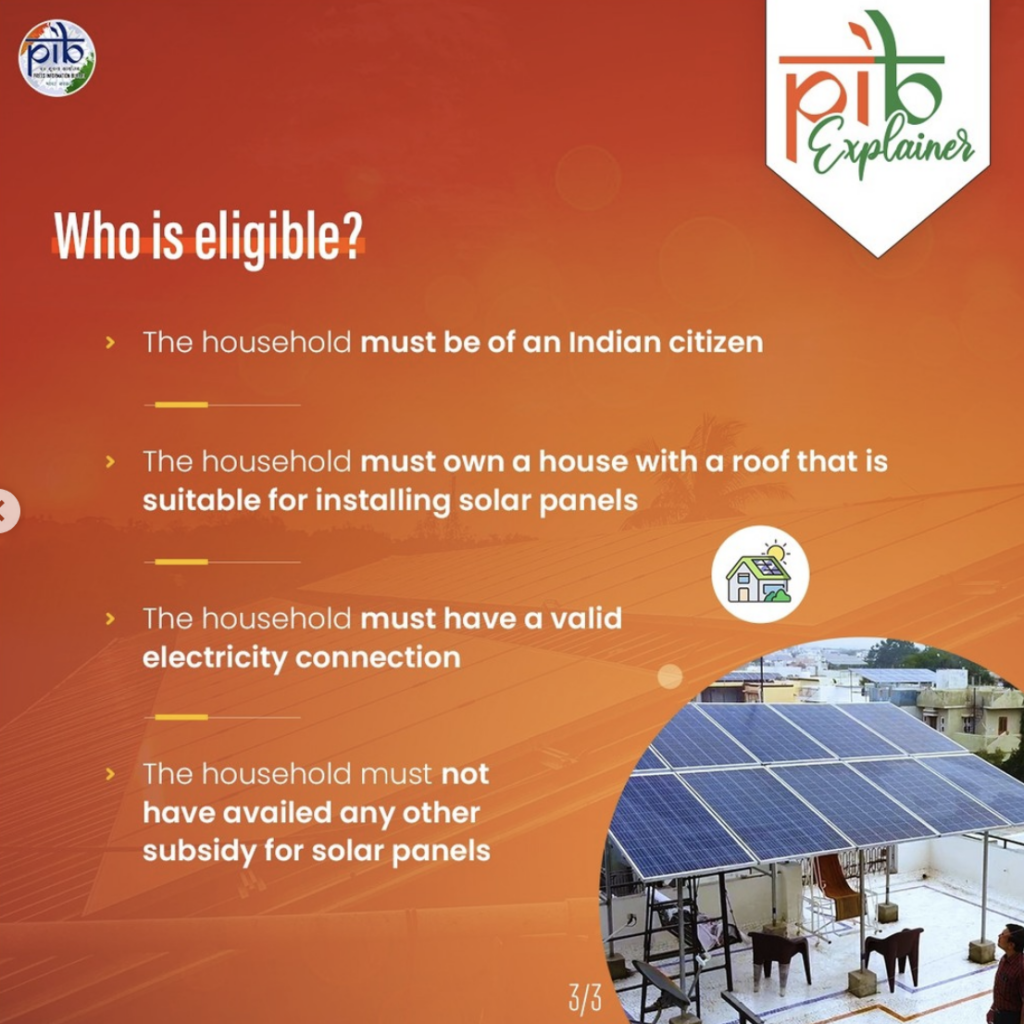
- The PM Surya Ghar: Muft Bijli Yojana, launched in February 2024, is an ambitious initiative by the Government of India aiming to install rooftop solar panels in one crore (10 million) households in the residential sector by March 2027. This large-scale adoption of solar energy is a significant step towards achieving energy self-reliance and promoting sustainable energy practices across the nation.
- The Ministry of New and Renewable Energy (MNRE) has emphasized the importance of capacity building under this scheme.
- It plans to provide training at the grassroots level on the installation, operation, maintenance, and repair of solar rooftop systems. This initiative ensures that there is adequate skilled manpower to support the widespread adoption of solar energy.
- A critical component of the scheme is the development of a skilled workforce to support the solar energy sector.
- The objectives include:
- Training Over 3 Lakh Individuals: Through a combination of fresh skilling and up-skilling programs.
- Specialized Roles: Out of these, at least 1 lakh individuals will be trained as Solar PV Technicians, specializing in photovoltaic systems.
- These initiatives are part of the scheme’s capacity building component, aiming to empower individuals with the necessary skills to contribute to the solar energy ecosystem.
14. Consider the following activities:
I. Production of crude oil
II. Refining, storage, and distribution of petroleum
III. Marketing and sale of petroleum products
IV. Production of natural gas
How many of the above activities are regulated by the Petroleum and Natural Gas Regulatory Board (PNGRB) in India?
(a) Only one
(b) Only two
(c) Only three
(d) All four
Answer: (b) Only two
- The Petroleum and Natural Gas Regulatory Board (PNGRB) was constituted under the Petroleum and Natural Gas Regulatory Board Act, 2006.
- The Act provides for the establishment of a Petroleum and Natural Gas Regulatory Board to protect the interests of consumers and entities engaged in specified activities relating to petroleum, petroleum products and natural gas and to promote competitive markets.
- As per the Petroleum and Natural Gas Regulatory Board Act, the board has been mandated to regulate the refining, processing, storage, transportation, distribution, marketing and sale of petroleum, petroleum products and natural gas excluding production of crude oil and natural gas.
- It thus aims to ensure uninterrupted and adequate supply of petroleum, petroleum products and natural gas in all parts of the country.
PNGRB
- PNGRB is a regulatory and statutory body constituted under the Petroleum and Natural Gas Regulatory Board Act, 2006.
- The Board functions like a tribunal with powers similar to a Civil Court and performs quasi-judicial duties.
- Objective: It aims to protect consumer interests, regulate petroleum and natural gas activities (excluding crude oil production), promote competitive markets, and ensure uninterrupted supply across India.
- Dispute Resolution: It can adjudicate disputes among entities or individuals over petroleum and gas operations, including refining, storage, transportation, distribution, and marketing.
- It also handles complaints on retail obligations, price displays, pipeline terms, city gas networks, and can issue orders, directions, or refer matters for investigation.
- Appeal Mechanism: The Appellate Tribunal, established under Section 110 of the Electricity Act, 2003, serves as the appeal authority under the PNGRB Act, 2006.