

1. Consider the following statements:
Statement I: Scientific studies suggest that a shift is taking place in the Earth’s rotation and axis.
Statement II: Solar flares and associated coronal mass ejections bombarded the Earth’s outermost atmosphere with tremendous amount of energy.
Statement III: As the Earth’s polar ice melts, the water tends to move towards the equator.
Which one of the following is correct in respect of the above statements?
(a) Both Statement II and Statement III are correct and both of them explain Statement I
(b) Both Statement II and Statement III are correct but only one of them explains Statement I
(c) Only one of the Statements II and III is correct and that explains Statement I
(d) Neither Statement II nor Statement III is correct
Answer: (b) Both Statement II and Statement III are correct but only one of them explains Statement I
- Recently, researchers used more than 120 years of data to decipher how melting ice, dwindling groundwater, and rising seas are nudging the planet’s spin axis and lengthening days. Days on Earth are growing slightly longer, and that change is accelerating. The reason is connected to the same mechanisms that have also caused the planet’s axis to meander by about 30 feet (10 meters) in the past 120 years. The findings come from two recent NASA-funded studies focused on how the climate-related redistribution of ice and water has affected Earth’s rotation.
- In recent decades, the faster melting of ice sheets has shifted mass from the poles toward the equatorial ocean. This redistribution occurs when ice sheets and glaciers melt more than they grow from snowfall, and when aquifers lose more groundwater than precipitation replenishes.
- These resulting shifts in mass cause the planet to wobble as it spins and its axis to shift location — a phenomenon called polar motion. They also cause Earth’s rotation to slow, measured by the lengthening of the day. Both have been recorded since 1900. This flattening causes Earth to decelerate and the day to lengthen, similar to when an ice skater lowers and spreads their arms to slow a spin.
- Although solar flares and associated coronal mass ejections can bombard Earth’s outermost atmosphere with tremendous amounts of energy, most of that energy is reflected back into space by the Earth’s magnetic field. While the energy doesn’t decisively affect Earth’s rotation and axis, it causes heating and expansion of the thermosphere, disrupts radio communications, and affects satellites and power grids. Auroras, or the northern and southern lights, are also a direct result of these interactions.
2. Consider the following countries:
- Bolivia
- Brazil
- Colombia
- Ecuador
- Paraguay
- Venezuela
Andes mountains pass through how many of the above countries?
(a) Only two
(b) Only three
(c) Only four
(d) Only five
Answer: (c) Only four
- The Andes Mountains are one of the longest continental mountain ranges in the world, stretching about 7,000 km along the western coast of South America, from Venezuela in the north to Chile and Argentina in the south.
- The Andean Mountains, or Andes, passes through
- Venezuela.
- Ecuador.
- Peru
- Bolivia.
- Colombia.
- Chile
- Argentina.
- Brazil does not lie within the Andes Mountain range. Brazil is east of the Andes and geographically separated from it.
- The Andes do not pass through Paraguay. Paraguay lies east of the Andes, on the Paraguayan Plateau.
- Andes were formed by the collision of the Nazca and South American tectonic plates.
- Highest Peak: Mount Aconcagua (6,961 m) in Argentina; it is the highest peak outside of Asia.
- Chimborazo’s Bulge: Due to the Earth’s equatorial bulge, the peak of Mt. Chimborazo in Ecuador is the point on Earth farthest from its centre.
- The Altiplano: The world’s second-highest plateau (after Tibet), located mainly in Bolivia and Peru.
- Rain Shadow Effect: The mountains block Pacific winds, creating the hyper-arid Atacama Desert to the west while fueling the lush Amazon Rainforest on the eastern slopes.
- Climatic Divisions: Categorized into three zones: Tropical Andes (North), Dry Andes (Central), and Wet Andes (South).

3. Consider the following water bodies:
- Lake Tanganyika
- Lake Tonlé Sap
- Patos Lagoon
Through how many of them does the equator pass?
(a) Only one
(b) Only two
(c) All the three
(d) None
Answer: (d) None
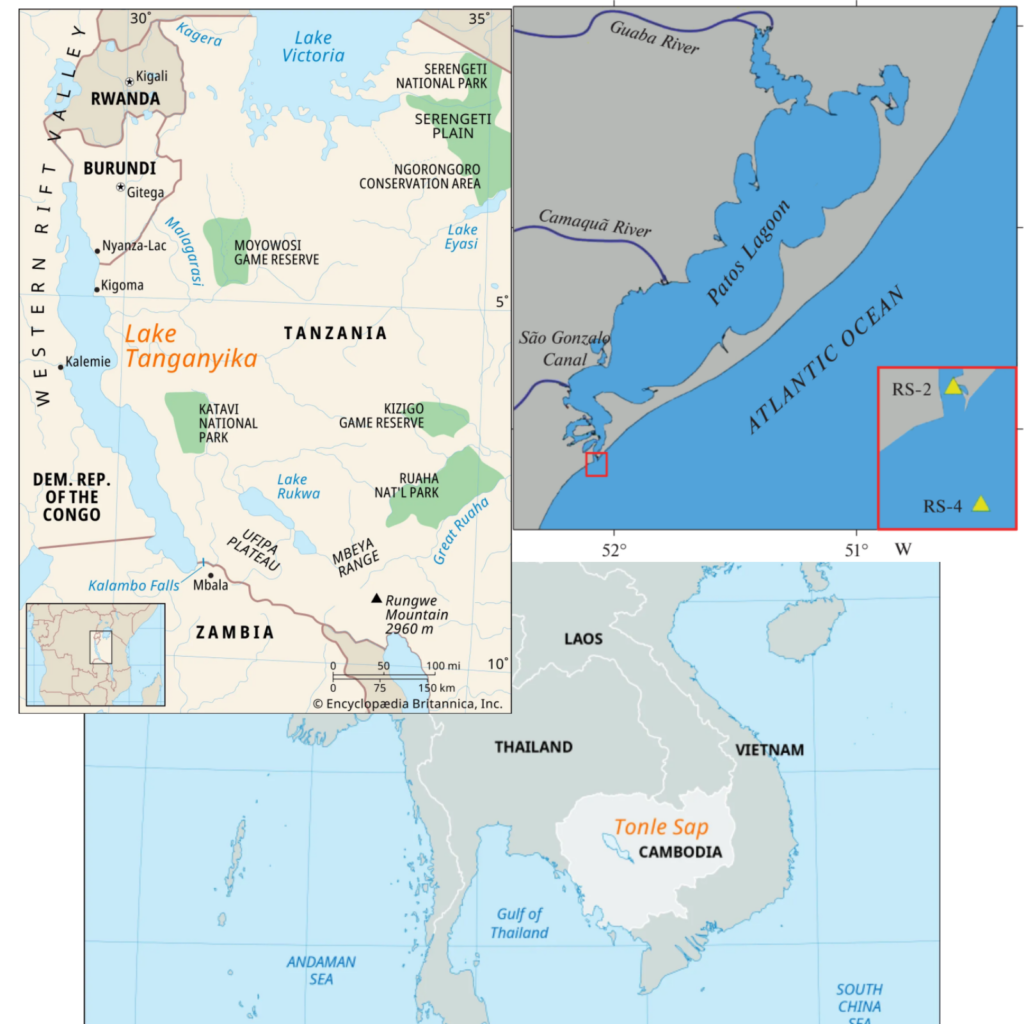
- Lake Tanganyika is located in central Africa. It is one of the deepest and oldest freshwater lakes in the world. Geographically, it lies entirely south of the Equator.
- Lake Tonle Sap is one of the largest freshwater lakes in Cambodia. It is located in the central plains of Cambodia and lies at a latitude of approximately 13° north of the Equator.
- Patos Lagoon, known locally as Lagoa dos Patos, is a large coastal lagoon in the southern part of Brazil. It is one of the largest lagoons in South America. It lies around 30° south of the Equator.
4. Which of the following are the evidences of the phenomenon of continental drift?
I. The belt of ancient rocks from Brazil coast matches with those from Western Africa.
II. The gold deposits of Ghana are derived from the Brazil plateau when the two continents lay side by side.
III. The Gondwana system of sediments from India is known to have its counterparts in six different landmasses of the Southern Hemisphere.
Select the correct answer using the code given below.
(a) I and III only
(b) I and II only
(c) I, II and III
(d) II and III only
Answer: (c) I, II and III
- Radiometric dating techniques have confirmed that the rock formations along the eastern coast of South America (Brazil) and the western coast of Africa are similar in age, type, and structure. This is one of the most compelling geological evidences supporting the theory of continental drift.
- Ghana, located on the west coast of Africa, has rich gold deposits along its coast, yet there is no local source rock to account for this mineral wealth. The likely explanation is that these gold deposits originated from the Brazil Plateau which, before the continents drifted apart, lay adjacent to what is now Ghana. This is one of the pieces of evidence supporting the theory of continental drift.
- The Gondwana system of sedimentary rocks, particularly tillite deposits (sediments formed from glacial activity), found in India, have strikingly similar counterparts in Africa, Antarctica, Australia, Madagascar, Falkland Islands, and South America. These similarities provide evidence that these landmasses were once part of a supercontinent called Gondwanaland.

Evidence in support of Continental Drift
- Apparent Affinity of Physical Features
- The bulge of Brazil (South America) seems to fit into the Gulf of Guinea (Africa).
- Greenland seems to fit in well with Ellesmere and Baffin islands of Canada.
- The west coast of India, Madagascar and Africa seem to have been joined.
- North and South America on one side and Africa and Europe on the other fit along the mid-Atlantic ridge.
- The Caledonian and Hercynian mountains of Europe and the Appalachians of USA seem to be one continuous series.
- Botanical Evidence
- Presence of glossopteris vegetation in Carboniferous rocks of India, Australia, South Africa, Falkland Islands (Overseas territory of UK), Antarctica, etc. (all split from the same landmass called Gondwana) can be explained from the fact that parts were linked in the past.
- Distribution of Fossils
- The observations that Lemurs occur in India, Madagascar and Africa led some to consider a contiguous landmass “Lemuria” linking these three landmasses.
- Mesosaurus was a small reptile adapted to shallow brackish water. The skeletons of these are found only in South Africa and Brazil. The two localities presently are 4,800 km apart with an ocean in between them.
- Rocks of Same Age Across the Oceans
- The belt of ancient rocks of 2,000 million years from Brazil coast matches with those from western Africa.
- Tillite deposits
- Tillite deposits are sedimentary rocks formed out of deposits of glaciers.
- The Gondwana system of sediments are found in India, Africa, Falkland Island, Madagascar, Antarctica and Australia (all were previously part of Gondwana).
- Overall resemblance demonstrates that these landmasses had remarkably similar histories.
- Placer Deposits
- Rich placer deposits of gold are found on the Ghana coast (West Africa) but the source (gold-bearing veins) are in Brazil, and it is obvious that the gold deposits of Ghana are derived from the Brazil plateau when the two continents lay side by side.
5. Consider the following statements:
Statement I: The amount of dust particles in the atmosphere is more in subtropical and temperate areas than in equatorial and polar regions.
Statement II: Subtropical and temperate areas have less dry winds.
Which one of the following is correct in respect of the above statements?
(a) Both Statement I and Statement II are correct and Statement II explains Statement I
(b) Both Statement I and Statement II are correct but Statement II does not explain Statement I
(c) Statement I is correct but Statement II is not correct
(d) Statement I is not correct but Statement II is correct
Answer: (c) Statement I is correct but Statement II is not correct
- The Earth’s atmosphere is not just composed of gases but also holds various solid particles such as dust, sea salt, pollen, etc. These particles are known as aerosols, and they play an essential role in weather phenomena such as cloud formation, precipitation, and visibility.
- The amount of atmospheric dust is higher in subtropical and temperate regions than in equatorial and polar zones. Subtropical areas contain major arid deserts (like the Sahara), where dry winds, such as trade winds and westerlies, efficiently lift and transport significant dust. Subtropical deserts are major dust sources.
- Key Factors Driving Higher Dust in Subtropical/Temperate Regions:
- Aridity & Dry Winds: Subtropical high-pressure belts, which produce sinking, dry air, dominate these areas, reducing precipitation and creating ideal conditions for dust suspension.
- Low Precipitation/Wet Deposition: Unlike the equatorial region, which experiences high convectional rainfall that “washes” (wet deposition) particles out of the air, these regions have less frequent rain to remove dust.
- Land Exposure: These regions feature extensive exposed soil, whereas polar regions are largely covered by ice, restricting dust generation.
- Anthropogenic Activity: Human activities, including agriculture (ploughing) and grazing, often increase dust production in temperate and subtropical environments.
- Comparison with Other Regions:
- Equatorial Regions: Consistently high humidity and frequent rainfall keep the air relatively “clean”.
- Polar Regions: Very low temperatures and extensive snow/ice cover prevent significant soil erosion and dust production.
- Dry winds are prevalent in subtropical and temperate regions, and these winds are precisely the reason dust concentration is higher in these areas. In the subtropics, for example, descending air from the subtropical high-pressure belts results in dry and stable conditions, which are associated with low humidity and dusty environments.
6. Consider the following statements:
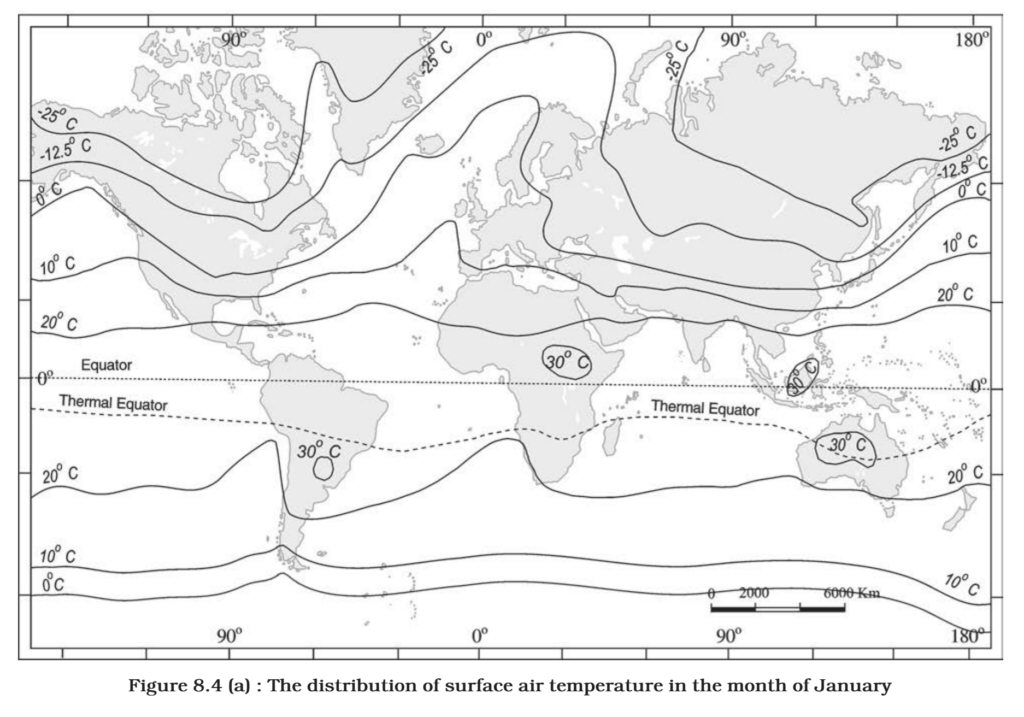
Statement I: In January, in the Northern Hemisphere, the isotherms bend equatorward while crossing the landmasses, and poleward while crossing the oceans.
Statement II: In January, the air over the oceans is warmer than that over the landmasses in the Northern Hemisphere.
Which one of the following is correct in respect of the above statements?
(a) Both Statement I and Statement II are correct and Statement II explains Statement I
(b) Both Statement I and Statement II are correct but Statement II does not explain Statement I
(c) Statement I is correct but Statement II is not correct
(d) Statement I is not correct but Statement II is correct
Answer: (a) Both Statement I and Statement II are correct and Statement II explains Statement I
- In January, the Northern Hemisphere’s large landmasses cool down rapidly, leading to lower temperatures. Isotherms shift southward (towards the equator) over the continents. In contrast, oceans retain heat longer, so the isotherms bend northward (poleward) when passing over oceans like the North Atlantic, where warm currents like the Gulf Stream increase the surrounding air temperature.
- Due to the high specific heat capacity of water, oceans cool down more slowly than land. Therefore, in winter (January), the marine areas remain warmer than the adjacent continental interiors. Because of this temperature contrast the isotherms bend equatorward while crossing the landmasses and poleward while crossing the oceans in the month of January in the northern hemisphere.
7. Consider the following statements:
Statement I: In the context of effect of water on rocks, chalk is known as a very permeable rock whereas clay is known as quite an impermeable or least permeable rock.
Statement II: Chalk is porous and hence can absorb water.
Statement III: Clay is not at all porous.
Which one of the following is correct in respect of the above statements?
(a) Both Statement II and Statement III are correct and both of them explain Statement I
(b) Both Statement II and Statement III are correct but only one of them explains Statement I
(c) Only one of the Statements II and III is correct and that explains Statement I
(d) Neither Statement II nor Statement III is correct
Answer: (c) Only one of the Statements II and III is correct and that explains Statement I
- Chalk is a soft, sedimentary rock composed primarily of calcium carbonate and has a structure with large, well-connected pores. These pores allow water to pass through easily, making chalk a highly permeable rock. In contrast, clay is made up of very fine particles that are tightly packed together, with extremely small pores. As a result, water moves through clay very slowly, making it one of the least permeable types of soil or rock. Therefore, in terms of water movement, chalk allows easy water flow, while clay resists it.
- Chalk is not only permeable but also highly porous, meaning it has many tiny holes or voids within its structure. These pores can hold water, allowing chalk to absorb and retain moisture. This is one of the reasons why chalk feels damp in humid conditions and can crumble easily when wet. Its porous nature is directly responsible for its ability to absorb water, which also contributes to its use in agriculture and construction, where water interaction is important.
- Clay is highly porous, as it contains many tiny pores between its fine particles. However, these pores are so small that water moves through them very slowly, making clay poorly permeable. This is why clay retains water and drains slowly, despite having high porosity.
| Feature | Chalk | Clay |
|---|---|---|
| Composition | Mainly Calcium Carbonate ( | Silicate minerals |
| Porosity | High (many tiny air spaces) | High (but with very tiny pores) |
| Permeability | High (water passes through easily) | Very Low (impermeable; holds water) |
| Texture | Dry, crumbly, and light | Dense, creamy, or sticky when wet |
| Geological Origin | Fossilised skeletons of marine organisms | Weathering of rocks like mudstone |
8. Consider the following statements:
I. Without the atmosphere, the temperature would be well below the freezing point everywhere on the Earth’s surface.
II. Heat absorbed and trapped by the atmosphere maintains our planet’s average temperature.
III. Atmosphere’s gases, like carbon dioxide, are particularly good at absorbing and trapping radiation.
Which of the statements given above are correct?
(a) I and III only
(b) I and II only
(c) I, II and III
(d) II and III only
Answer: (d) II and III only
- Without an atmosphere, there’s no air/clouds to scatter or absorb sunlight. So, places in direct sunlight would become extremely hot, especially near the equator. Surface temperatures can exceed 100°C, much like the Moon, which has no atmosphere. Without an atmosphere to trap heat (no greenhouse effect) or distribute it via wind, temperatures would plummet rapidly after sunset. Places in shadow or during nighttime would become extremely cold.
- The atmosphere helps regulate the Earth’s temperature by absorbing heat from the Sun during the day and slowing its escape at night. This heat-trapping ability is what keeps the planet’s average surface temperature around 15°C (59°F), making it suitable for life. Without this natural insulation, Earth would experience harsh temperature fluctuations between day and night, similar to what occurs on planets and moons with thin or no atmospheres.
- Certain gases in the Earth’s atmosphere, particularly greenhouse gases like carbon dioxide (CO₂), methane, and water vapor, have the unique ability to absorb and trap radiation. This property makes them especially effective in trapping heat within the atmosphere, contributing significantly to the greenhouse effect.
9. The World Bank warned that India could become one of the first places where wet-bulb temperatures routinely exceed 35 °C. Which of the following statements best reflect(s) the implication of the above-said report?
I. Peninsular India will most likely suffer from flooding, tropical cyclones and droughts.
II. The survival of animals including humans will be affected as shedding of their body heat through perspiration becomes difficult.
Select the correct answer using the code given below.
(a) I only
(b) II only
(c) Both I and II
(d) Neither I nor II
Answer: (c) Both I and II
- Wet-bulb temperature is a measure that combines dry air temperature and humidity to indicate to reflect the lowest temperature to which air can be cooled by the evaporation of water. In essence, it is a measure of heat-stress conditions on humans.
- When the wet-bulb temperature reaches 35 °C, it becomes extremely dangerous for humans and animals because sweat can no longer evaporate to cool the body. The World Bank has warned that parts of India, due to rising global temperatures and increasing humidity, could be among the first regions in the world where wet-bulb temperatures routinely exceed 35 °C, posing a grave risk to life.
- The region’s tropical location makes it particularly vulnerable to intensified monsoon variability, resulting in both extreme rainfall events causing floods and cyclones, as well as periods of inadequate rainfall leading to droughts.
- Therefore, while the World Bank’s warning emphasizes the health hazards of extreme heat and humidity, it also implicitly highlights that the same underlying climate shifts will exacerbate Peninsular India’s susceptibility to these damaging hydrometeorological events.
- When wet-bulb temperatures exceed 35 °C, the human body can no longer effectively cool itself through sweating and evaporation, which are essential to regulate internal body temperature. This creates life-threatening conditions even for healthy individuals, and especially for vulnerable populations such as the elderly, outdoor workers, or those without access to cooling.
- The same threat applies to many animal species, which also rely on various forms of heat dissipation.
10. Consider the following countries:
- United Kingdom
- Denmark
- New Zealand
- Australia
- Brazil
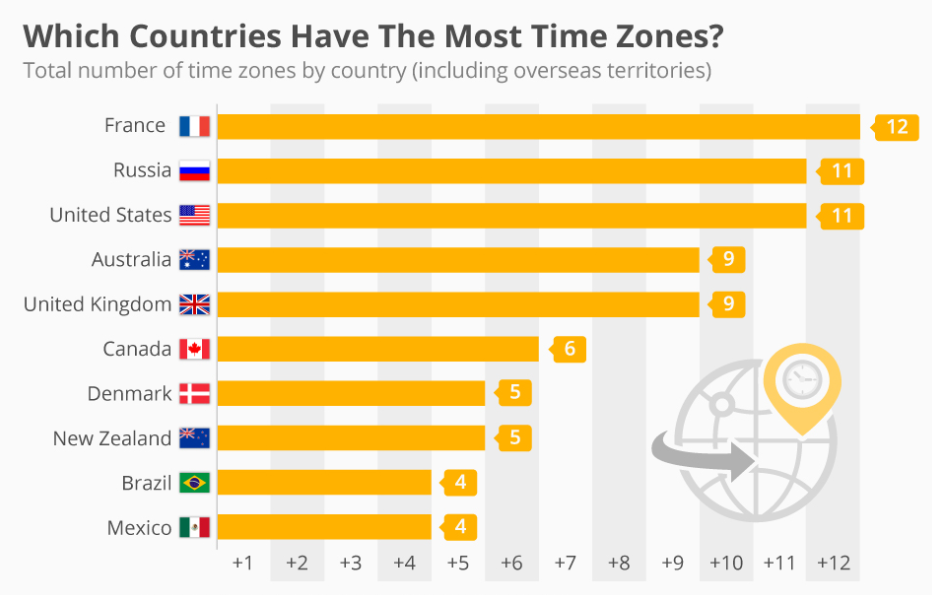
How many of the above countries have more than four time zones?
(a) All the five
(b) Only four
(c) Only three
(d) Only two
Answer: (b) Only four
- Different countries may span multiple time zones due to their wide east-west geographical extent or because of overseas territories. However, not all large countries have more than four actual operating time zones.
- UK has 9 time zones
- The UK spans nine time zones—from the Pitcairn Islands (UTC-08:00) to the British Indian Ocean Territory (UTC+06:00)—including places like the Cayman Islands, Bermuda, and Gibraltar. The main UK region, around London, is in the UTC±00:00 time zone, showing the lasting impact of GMT/UTC in global navigation
- Denmark has 5 time zones.
- Denmark spans five time zones, including Greenland, which operates at UTC-04:00, while the main territory operates at UTC+01:00. Greenland itself has three additional time zones, mostly at UTC-03:00. Near the Arctic Circle, time becomes fluid, with summers of perpetual daylight and winters of prolonged darkness, making time zones crucial for communication and balance.
- New Zealand has 5 time zones.
- The UTC line between New Zealand’s islands of Niue and Tokelau seems arbitrary given their proximity. Despite a 24-hour difference justified by 700 miles of longitude separation, inhabitants practically experience the ‘same day.’ This Pacific location was chosen in 1884 to avoid global frustration, although the line could have been drawn elsewhere, such as between Colorado and Kansas or Austria and Hungary. New Zealand’s three other time zones cover its main territory, the Cook Islands, and the Chatham Islands.
- Australia has 9 time zones.
- Australia’s expansive territory includes its mainland and nearby islands. Settlement on the mainland dates back thousands of years, with British control established in 1788 through convict colonisation. Australia claims islands like Heard and McDonald Islands (UTC+05:00), Christmas Island (UTC+07:00), and Norfolk Island (UTC+11:00), while its mainland operates within time zones ranging from UTC+08:00 to UTC+10:00.
- Brazil has 4 time zones.
- Brazil spans four time zones due to its immense size and inclusion of adjacent islands. The easternmost zone, UTC-02:00, covers the Rocas Atoll and Saint Peter and Saint Paul Archipelago. Moving west, the Amazonas territory falls under UTC-05:00, known for its vast jungle. This extends to the segment governed by UTC-04:00, while the southeastern region follows UTC-03:00.
11. Consider the following statements:
1. Anadyr in Siberia and Nome in Alaska are a few kilometers from each other, but when people are waking up and getting set for breakfast in these cities, it would be different days.
2. When it is Monday in Anadyr, it is Tuesday in Nome.
Which of the statements given above is/are correct?
(a) I only
(b) II only
(c) Both I and II
(d) Neither I nor II
Answer: (a) I only
- Anadyr is a town located in the far eastern part of Russia in the region of Chukotka, and Nome is a town in western Alaska, USA. Although they are geographically close — separated only by the Bering Strait — they lie on opposite sides of the International Date Line (IDL). The IDL is an imaginary line, roughly along the 180° longitude, where the calendar date changes by one day when crossed.
- Anadyr in Russia and Nome in Alaska are geographically close and separated only by the Bering Strait. However, they lie on opposite sides of the International Date Line (IDL). This means that although it may be the same clock time, say, 8:00 AM in both places, the calendar date would be different. For example, if it’s Monday morning in Anadyr, it would still be Sunday morning in Nome. The IDL causes this one-day difference despite the small distance between the two locations.
- When it is Monday in Anadyr, it cannot be Tuesday in Nome. In fact, it’s the reverse. Nome lags behind Anadyr by a day. So if it is Monday in Anadyr, it is still Sunday in Nome. The International Date Line adds a day as one travels westward, and subtracts a day as one travels eastward — which makes Russia (west of the IDL) ahead of the U.S. (east of the IDL).
International Date Line (IDL)
- The International Date Line (IDL) is an imaginary, zigzag line at the meridian in the Pacific Ocean, separating two consecutive calendar days.
- Established in 1884, it prevents date confusion, ensuring a 24-hour shift rather than a straight line split across island nations.
- Location & Zigzag: While roughly following the longitude (opposite the Prime Meridian), the IDL deviates to avoid cutting through countries, particularly in the Bering Strait, Aleutian Islands, and South Pacific (e.g., Kiribati, Fiji).
- Date Changes:
- Crossing Westward (e.g., USA to Japan): Add one day (gain a day).
- Crossing Eastward (e.g., Japan to USA): Subtract one day (lose a day).
- Significance: It serves as the demarcation line for the start of a new calendar date, essential for global commerce and navigation.
- Time Zone Deviation: While it separates days, the specific time on either side can vary based on the local time zone chosen by the country.
- Legal Status
- International Date Line (IDL) has no legal international status.
- Countries are free to decide their own time zones and date observance.
- Therefore, the line shifts when nations adjust their time zones for economic or political reasons.
- Examples: In 1994, Kiribati shifted the line eastward to keep all its islands on the same day. In 2011, Samoa moved west of the date line to improve trade links with Australia and New Zealand, effectively skipping December 30, 2011.
12. Consider the following pairs:
| Country | Resource-rich in |
| I. Botswana | Diamond |
| II. Chile | Lithium |
| III. Indonesia | Nickel |
In how many of the above rows is the given information correctly matched?
(a) Only one
(b) Only two
(c) All the three
(d) None
Answer: (c) All the three
- Botswana is one of the world’s largest producers of diamonds by value. The discovery of diamonds in the 1960s transformed its economy. The country has maintained stable governance and efficient management of its diamond resources, especially through its partnership with De Beers.
- Chile forms part of the “Lithium Triangle” along with Argentina and Bolivia. It has some of the largest lithium reserves in the world, primarily extracted from salt flats (like Salar de Atacama). Lithium is vital for batteries in electric vehicles and electronics.
- Indonesia is the world’s largest producer of nickel. It holds vast reserves and has become a major player in the global nickel supply chain, crucial for stainless steel production and electric vehicle batteries. The country has also imposed export bans to encourage domestic processing.
Diamond
- Mineralogy: Diamond is an allotrope of carbon and the hardest naturally occurring substance on Earth. It is 100% carbon, unlike graphite which is usually 95% carbon.
- Geological Formation: Formed in the Earth’s mantle under extreme heat and pressure, diamonds are brought to the crust via volcanic activity. They are primarily found in Kimberlite or Lamproite pipes.
- Industrial vs. Gem-Quality: Approximately 80% of global diamond production is used for industrial purposes (drilling, cutting, polishing) due to its hardness.
- India’s Global Standing:
- India is the world’s largest hub for cutting and polishing, handling over 90% of the global supply.
- Surat, Gujarat is the primary centre for this industry.
- Historically, India was the world’s only supplier of diamonds for nearly 3,000 years until discoveries in Brazil.
- India’s Domestic Production:
- Madhya Pradesh is the only state in India currently producing diamonds.
- The Majhgaon Mine in Panna is the only mechanized diamond mine in Asia, operated by the National Mineral Development Corporation (NMDC).
- Other notable Indian locations include the Wajrakarur Kimberlite field and the Krishna River basin in Andhra Pradesh.
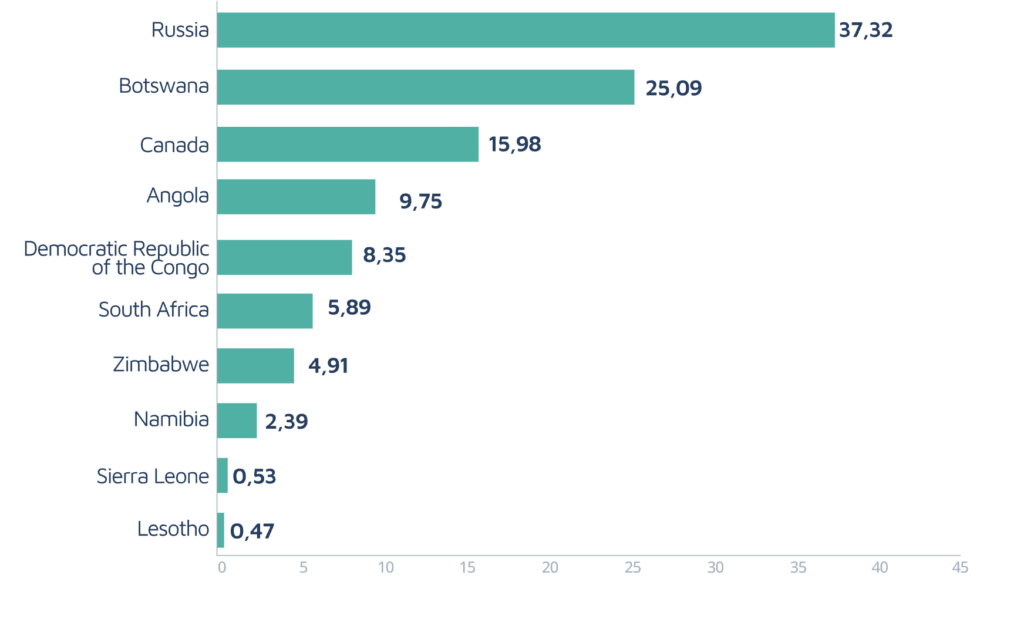
Diamond-Producing Countries
- Russia: The largest producer by volume and holder of the world’s largest reserves (~750 million carats). Major mines include Udachny and Mirny.
- Botswana: The leading producer by value. It houses the Jwaneng mine, often called the “richest diamond mine in the world”.
- Canada: Known for high-quality, ethical, and traceable diamonds. Key mines include Ekati and Diavik.
- Democratic Republic of Congo (DRC): Africa’s largest producer by volume, though most of its output is industrial-grade.
- South Africa: Famous for large, high-value stones like the Cullinan diamond. The Venetia mine is a major contributor.
- Australia: Historically a top producer (Argyle Mine), though output has significantly fallen since the Argyle Mine closed in 2020. It was famous for pink and colored diamonds.
- Namibia: Distinguished for its unique offshore marine mining operations on the ocean floor.
13. Consider the following pairs:
| Region | Country |
| I. Mallorca | Italy |
| II. Normandy | Spain |
| III. Sardinia | France |
In how many of the above rows is the given information correctly matched?
(a) Only one
(b) Only two
(c) All the three
(d) None
Answer: (d) None
- Mallorca is the largest island in the Balearic Islands archipelago, located in the Mediterranean Sea. It belongs to Spain, not Italy. The island is a popular tourist destination, known for its beaches, limestone mountains, and historic architecture.
- Normandy is located in northern France, along the English Channel. It is historically significant for the D-Day landings during World War II. It is not a part of Spain.
- Sardinia is the second-largest island in the Mediterranean, after Sicily. It is an autonomous region of Italy, not France. It lies to the west of the Italian Peninsula and south of the French island of Corsica.
14. Consider the following statements about turmeric during the year 2022-23:
- India is the largest producer and exporter of turmeric in the world.
- More than 30 varieties of turmeric are grown in India.
- Maharashtra, Telangana, Karnataka and Tamil Nadu are major turmeric producing States in India.
Which of the statements given above are correct?
(a) I and II only
(b) II and III only
(c) I and III only
(d) I, II and III
Answer: (d) I, II and III
- The Government of India in 2023 constituted the National Turmeric Board. This board is designed to coordinate efforts across various ministries and institutions to enhance production, promote exports, encourage value addition, and improve income for turmeric farmers.
- According to official data for the year 2022–23, India had a turmeric cultivation area of approximately 3.24 lakh hectares, producing 11.61 lakh tonnes of turmeric. India alone accounted for over 75% of global turmeric production, making it by far the largest producer of turmeric in the world. Furthermore, India is also the top exporter of turmeric, accounting for over 62% of the global turmeric trade.
- India’s diverse soil types and climatic conditions enable the cultivation of more than 30 known varieties of turmeric across various states. Each variety differs in aspects such as curcumin content, aroma, colour, and market use.
- Maharashtra, Telangana, Karnataka, and Tamil Nadu are consistently among the top turmeric producers in India.
Turmeric (Curcuma longa)
- Turmeric (Curcuma longa) is a tropical perennial plant belonging to the ginger family (Zingiberaceae).
- Climate: Requires a warm and humid climate with a temperature range of 20°C to 35°C.
- Rainfall: High annual rainfall is necessary, typically 1,500 mm or more. It can be grown as both a rainfed and an irrigated crop.
- Soil: Thrives best in well-drained sandy or clayey loam soils with a pH range of 4.5–7.5 and high organic matter. It cannot tolerate waterlogging or alkalinity.
- Altitude: Can be cultivated from sea level up to 1,500 m above mean sea level.
- Properties:
- Active ingredient in turmeric called curcumin has antioxidant and anti-inflammatory properties.
- Traditionally used for disorders of the skin, upper respiratory tract, joints, digestive system etc.
- A natural indicator that changes color depending on the pH of a solution.
- Active ingredient in turmeric called curcumin has antioxidant and anti-inflammatory properties.
Turmeric production in India
- Area under turmeric cultivation: 3.05 lakh hectare with 30 varieties (2023-24)
- Production: 70% of global turmeric production
- Telangana, Maharashtra, Tamil Nadu, and Andhra Pradesh together contribute 63.4% of India’s turmeric production.
- Export: >62% share of world trade in turmeric
- The leading export markets for Indian Turmeric are Bangladesh, UAE, USA and Malaysia.
- Turmeric in India with GI Tag:
- Maharashtra: Sangli Turmeric, Waigaon Turmeric
- Tamil Nadu: Erode Manjal (Erode Turmeric)
- Meghalaya: Lakadong Turmeric
- Odisha: Kandhamal turmeric

National Turmeric Board
- It has been established to promote the cultivation, production, processing, and marketing of turmeric in India and to enhance the income of turmeric farmers.
- The Ministry of Commerce & Industry has increased its product-dedicated boards to six, after tea, coffee, rubber, spices, and tobacco.
- Board Representation: The Board will consist of a Chairperson appointed by the Central Government with representatives of the Ministry of AYUSH, Department of Pharmaceuticals, Department of Agriculture & Farmers Welfare and Department of Commerce, along with rotating senior representatives from three states.
- Key Objectives: Farmer welfare across 20 states, including Maharashtra, Tamil Nadu, and others.
- Promoting research, new products, and value addition for domestic and international markets.
- Raising awareness about turmeric’s medical benefits.