Mauryan Empire: Art, Architecture and Sculpture
- The Mauryan period marked the revival of stone art in India after the decline of the Indus Valley Civilization.
- There was a significant shift from the use of wood to stone for constructing buildings, sculptures, and monuments.
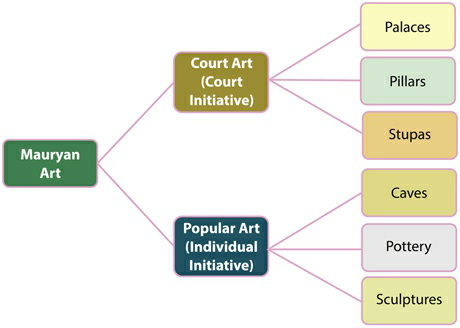
- Mauryan art is classified into two broad categories:
- Court Art – Art created under royal patronage.
- Folk Art – Art developed by local artisans without royal support.
Features of Mauryan Art and Architecture
- By the fourth century BC, the Mauryas had established their power in the Magadh region and by the third century BC, a large part of India was under Mauryan control.
- Indigenous in origin: Many scholars believe that Mauryan art originated indigenously as a combination of court and folk elements.
- Departure from earlier tradition: Mauryan art was different from the earlier art traditions in that it departed from the use of wood, sun-dried brick, clay, ivory, and metal to that of stone in huge dimensions.
- Achaemenid Influence: One of the important features of Mauryan art is its Achaemenid connection.
- It was due to Mauryan dominions touching Afghanistan, which had been erstwhile Achaemenid possessions.
- The Persian influence can be observed in Ashokan pillars and bell capitals.
- Stambha architecture, which originated indigenously in wood, was taken place by stone. Gradually, it included bases and capitals.
Mauryan Palaces
- The palaces of the Mauryan empire have been described in high regard by all the writers, such as Megasthenese, Patanjali (in his Mahabhasya), and Arrian (He compared Chandragupta’s palace with the buildings of Achaemenian cities such as Susa and Ekbatan).
- The overall planning of the palaces was inspired by Achaemenid palace art, with some differences such as the use of wood and the simple monolithic style of pillar construction.
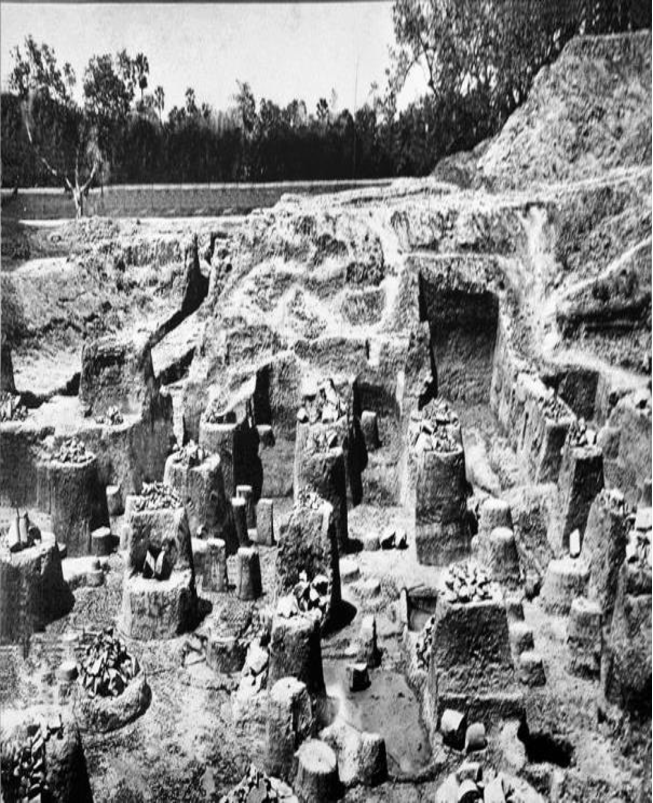
- The 80-pillared hall discovered at Kumhrar (Patna) is believed to be part of the grand Mauryan Palace.
- The hall was used for various purposes including the third Buddhist Council, during the reign of Ahsoka.
- According to the Greek ambassador Megasthenes, the capital city of Patliputra was protected by wooden palisades, deep ditches, and had 570 watchtowers and 64 gates. This shows the advanced planning and defensive architecture of the time.
Ashokan Pillars
- Mauryan pillars are of two types:
- Pillars attached to buildings (e.g., Kumhrar Hall) – These pillars usually lack any decorative capital.
- Free-standing pillars – These are independent monuments often associated with Emperor Ashoka, and are used to spread Buddhist messages and royal edicts.
➤ Distribution of Ashokan Pillars:
- In Bihar:
- Kolhua (Vaishali) – Lion capital, but no inscription. It is the largest known Ashokan pillar.
- Lauriya Areraj – No animal capital, but has inscriptions in early Brahmi script.
- Lauriya Nandangarh – Has a lion capital.
- Rampurva – Two pillars have been found here: one with a lion and the other with a bull capital.
- Other places where Ashokan pillars are found include Meerut, Delhi (Topra), Allahabad, Sarnath, Sanchi, Lumbini, Nigalisagar, Basarh, and Kosam.
➤ Features of Ashokan Pillars:
- These pillars are usually made from buff-grey sandstone from Chunar (near Varanasi) and sometimes from red and white spotted sandstone from Mathura.
- Most inscriptions on the pillars are written in Pali and Prakrit, but some are in Greek and Aramaic, which shows cultural interactions.
- The typical structure of a pillar includes:
- A long, monolithic shaft (single stone column).
- A lotus-shaped or bell-shaped base.
- An abacus (platform) with engravings of animals or flowers.
- A capital figure (like a lion, bull, or elephant), often symbolic.
- The four-lion capital at Sarnath is especially significant as it has been adopted as the National Emblem of India.
- These pillars were highly polished using a method called agate burnishing, which gave them a shiny finish.
Persian (Achaemenian) Influence on Mauryan Art
Similarities:
- Both Mauryan and Achaemenian (Persian) pillars used polished stone and included lotus designs and animal figures on top.
- In both traditions, royal proclamations were inscribed on the pillars.
- Inscriptions often began in the third person and shifted to the first person, showing similarity in literary style.
Differences:
- Achaemenian pillars were fluted (grooved), while Mauryan pillars had smooth surfaces.
- Persian pillars often had double animal figures seated back-to-back, whereas Mauryan ones had either one or four animals.
- Achaemenian pillars had a base and were made of segmented stones, while Mauryan pillars were monolithic and lacked a base.
- Persian pillars were part of larger architectural complexes, but Mauryan pillars stood independently.
- The symbolism also differed: Persian pillars celebrated military conquests, while Ashokan pillars represented Buddhist values (Dhamma-vijaya).
Stupa Architecture
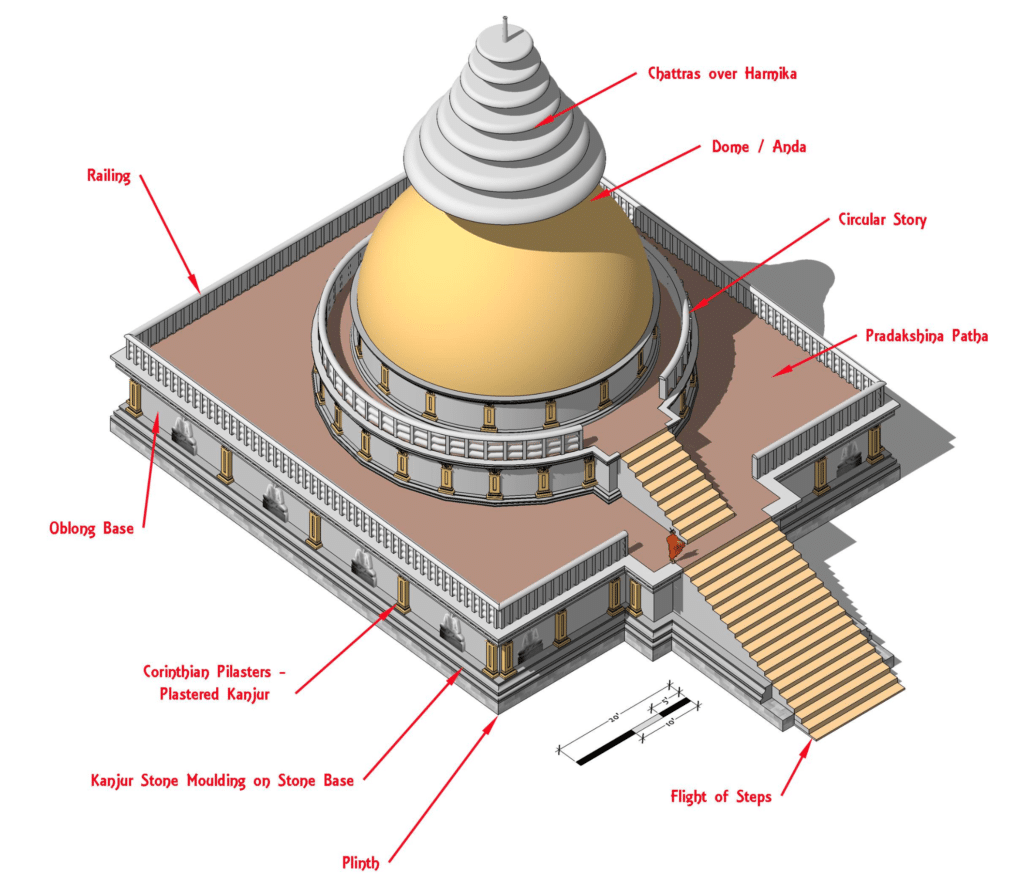
- A stupa is a hemispherical burial mound that holds the relics of the Buddha or Buddhist monks.
- After the death (Mahaparinirvana) of the Buddha, his relics were divided into eight parts, and stupas were built over them.
- The real development of stupas began under Ashoka, who is believed to have built 84,000 stupas.
➤ Structure of a Stupa:
- Anda: The large dome representing the burial mound.
- Harmika: A square railing placed at the top of the dome.
- Chhatra: A triple umbrella-like structure symbolizing high rank.
- Vedika: A railing encircling the stupa.
- Torana: Entry gateways on all four sides.
- Materials used included unburnt bricks for the core and burnt bricks for the outer surface, often plastered and decorated.
➤ Famous Examples:
- Sanchi Stupa (Madhya Pradesh): Built by Ashoka and expanded by the Sungas, featuring Jataka story carvings on its gateways and a symbolic triple umbrella representing the Buddha, Dharma, and Sangha.
- Bharhut Stupa (Madhya Pradesh): A significant early stupa with stone gateways and reliefs of Buddhist themes such as Jataka tales.
- Dharmarajika Stupa at Sarnath, also attributed to Ashoka.
- Dhauli Shanti Stupa (Orissa): Located at the site of Ashoka’s Kalinga War, featuring stone carvings of key events from Buddha’s life.
Cave Architecture
- The Mauryan period introduced rock-cut cave architecture in India.
- These caves were mainly used as residences (viharas) for Ajivikas, Jains, and Buddhists.
- The interiors were highly polished, giving them a mirror-like finish, even though they were made from hard granite.
➤ Important Mauryan Caves:
- Barabar Hills (Gaya) – Includes famous caves like Lomasha Rishi, Sudama, and Karna Chaupar.
- The Lomas Rishi cave in Barabar Hill is famous for its semicircular chaitya arch at the entrance, with a rectangular interior hall & circular chamber at the back, reflecting the influence of wooden architecture.
- The Sudama cave (Barabar Hill), resembling a wooden building, and the Vahiyaka cave (Nagarjuni Hill), dedicated to the Ajivika sect, further demonstrate the architectural ingenuity of the period.
- Inscriptions from King Piyadassi (Ashoka) for the Barabar caves and King Dasaratha for the Nagarjuni caves provide historical and religious context, adding to their significance.
- Nagarjuni Hills – Contain three other caves built by Dasharatha, Ashoka’s grandson.
- The Lomasha Rishi cave is especially famous for its ornate arched gateway and well-planned interior.
Sculpture during Mauryan Period
Court Sculpture:
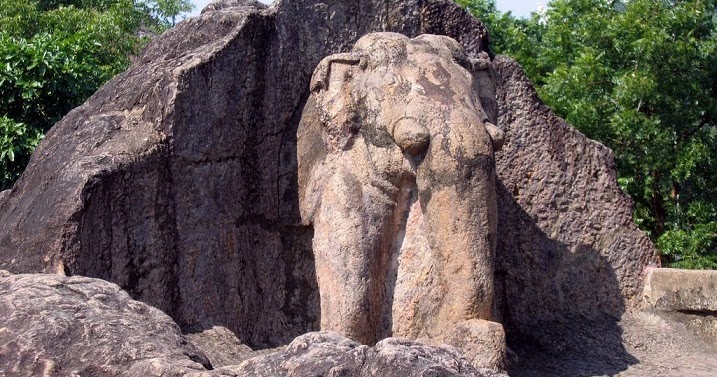
- Mauryan court sculptures were made from stone, metal, and clay.
- The elephant sculpture at Dhauli (Odisha) and Kalsi (Dehradun) are known for their realistic and natural appearance.
- Sculptures carved on or near pillars, such as lions and bulls, show high technical skill.
Folk Sculpture:
- Created by common artisans, not under royal patronage.
- Made primarily from clay or gray sandstone.
- These often depict Yakshas and Yakshinis (folk deities).
➤ Examples of Folk Art:
- Yaksha statue at Parkham (Mathura) – Also called Manibhadra.
- Yakshini statue at Didarganj (Patna) – Famous for its high polish and ornamentation.
- Laughing boy sculpture at Bulandibag, and Jain figures at Lohanipur.
- Tri-mouthed Yaksha found at Rajghat (Varanasi).

Pottery of the Mauryan Period
- The pottery of this time is known as Northern Black Polished Ware (NBPW).
- It is characterized by a black, shiny surface and was used mainly for luxury and elite consumption.
- Important centers for NBPW pottery were Kosambi and Patliputra.
Mauryan Literature
- Literature flourished under Ashoka’s peaceful reign due to liberal religious practices and a thriving Mauryan economy.
- Kautilya’s Arthashastra
- The exact year of its writing is unknown; even the identity of the writer (one or many) is doubtful. But Chanakya, Kautilya and Vishnugupta (all these names are for the same person) are credited as the writer.
- It is a detailed work on statecraft.
- It consists of 15 volumes (Adhikarnas).
- The first five deal with internal administration (tantra).
- The next eight with inter-state relations (avapa) and
- The last two with miscellaneous topics.
- Kautilya clearly distinguishes between Dharmasthiya (civil law) and Kantaka Sodhana (penal law).
- Several types of enslavement are mentioned in Arthashastra.
- There was a variety of protection offered to the slaves, especially to the enslaved women.
- The Arthashastra states that the mother and the child are immediately accepted as being free if a child is born to a female slave by her owner.
- A boy born to a female slave who was fathered by her master was granted the legal status of the master’s son, according to the Arthshastra.
- Kautilya also wrote Chanakya-shataka.
- Works of Bhadrabahu
- Spiritual teacher of Chandragupta Maurya.
- Works:
- Kalpa Sutra
- Bhadrabahu Samhita
- Vasudevcharita
- Indica by Megasthenes
- It tells the story of India during the reign of the Maurya Dynasty.
- According to it, the legendary Greek hero Heracles contributed to the construction of Pataliputra, a magnificent metropolis.
- It talked about the nature of the economy and society of the Mauryan period.
- Other sources mentioning Mauryan Empire
- Mudrarakshasa of Vishakadutta
- The Mudrarakshasa is a Sanskrit play portraying the political intrigues and strategies employed by Chanakya to establish Chandragupta Maurya on the throne.
- Rajtrangini of Kalhana
- Mahabhashya of Patanjali
- Vishnu Purana
- Buddhist literature:
- Dipavamsa and Mahavamsa
- The Mahavamsha and Dipavamsha are chronicles of early Buddhist history in Sri Lanka, narrating the spread of Buddhism and its influence during the Mauryan period. These works were enriched under Emperor Ashoka’s patronage.
- Divyavadana and Ashokavandana
- The Ashokavadana and Divyavadana are Buddhist texts highlighting Ashoka’s conversion to Buddhism and his role in propagating Dhamma through edicts and missions.
- Mahabodhivamsha
- Pali text that recounts the story of the Bodhi tree at Bodh Gaya, where Buddha attained enlightenment.
- Digghanikaya
- The Digha Nikaya is a collection of discourses attributed to the Buddha, emphasising moral teachings, meditation, and ethical conduct, and reflecting the intellectual and spiritual milieu of the Mauryan period.
- Milindpanho
- The Milindapanho records the dialogues between King Menander (Milinda) and the Buddhist monk Nagasena, providing insights into the philosophical exchange between Hellenistic and Indian thought during the Mauryan era.
- Dipavamsa and Mahavamsa
- Mudrarakshasa of Vishakadutta
Important Facts
- The Sarnath Lion Capital was adopted as the National Emblem of India.
- The Ashoka Chakra from Sarnath is present on the National Flag of India.
- Ashoka’s inscriptions are a major source of information about Buddhist philosophy, governance, and ethics.
- Use of Brahmi and Kharosthi scripts, along with Greek and Aramaic, shows wide cultural reach of the Mauryan empire.
- Mauryan caves laid the foundation for later developments in Indian rock-cut architecture such as Ajanta and Ellora caves.