

The Mughal Empire was ruled by emperors of the Timurid dynasty (House of Babur) from 1526 to 1857. Babur founded it after the First Battle of Panipat, the “Great Mughals” expanded it until it covered most of the subcontinent by 1707, and the “Later Mughals” presided over its decline until the British deposed Bahadur Shah II after the Revolt of 1857.
At its height the empire spanned most of present-day India, Pakistan, Bangladesh and Afghanistan. This page lists every Mughal emperor in order with reign dates, the events each reign is remembered for, a succession timeline, the key wazirs of the later period and the causes of decline.
Mughal Emperors: Quick Facts
- First emperor: Babur (1526–1530), after defeating Ibrahim Lodi at Panipat on 21 April 1526.
- Last emperor: Bahadur Shah II “Zafar” (1837–1857), exiled to Rangoon in 1858, where he died in 1862.
- Number of emperors: 18 in the standard list, from Babur to Bahadur Shah II; some lists add short-lived claimants.
- Longest reign: Akbar, about 49 years (1556–1605).
- Great Mughals: the first six rulers, Babur to Aurangzeb (1526–1707).
- Interruption: the Sur dynasty of Sher Shah Suri ruled north India from 1540 to 1555, between Humayun’s two reigns.
List of All Mughal Emperors (1526-1857)
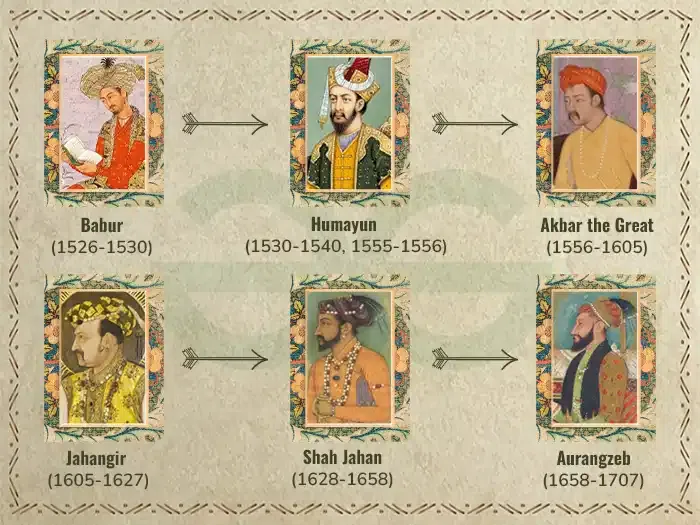
The Great Mughals (1526–1707)
| # | Emperor | Reign | Remembered for |
|---|---|---|---|
| 1 | Babur | 1526–1530 | First Battle of Panipat; founded the empire |
| 2 | Humayun | 1530–1540, 1555–1556 | Lost the throne to Sher Shah; regained it in 1555 |
| – | Sur dynasty (Sher Shah Suri and successors) | 1540–1555 | Interregnum between Humayun’s two reigns |
| 3 | Akbar | 1556–1605 | Mansabdari, Dahsala, sulh-i-kul, Rajput alliances |
| 4 | Jahangir | 1605–1627 | Chain of justice, Nur Jahan, Sir Thomas Roe |
| 5 | Shah Jahan | 1628–1658 | Taj Mahal, Red Fort, Peacock Throne |
| 6 | Aurangzeb (Alamgir) | 1658–1707 | Greatest territorial extent; Deccan wars |
The Later Mughals (1707–1857)
| # | Emperor | Reign | Remembered for |
|---|---|---|---|
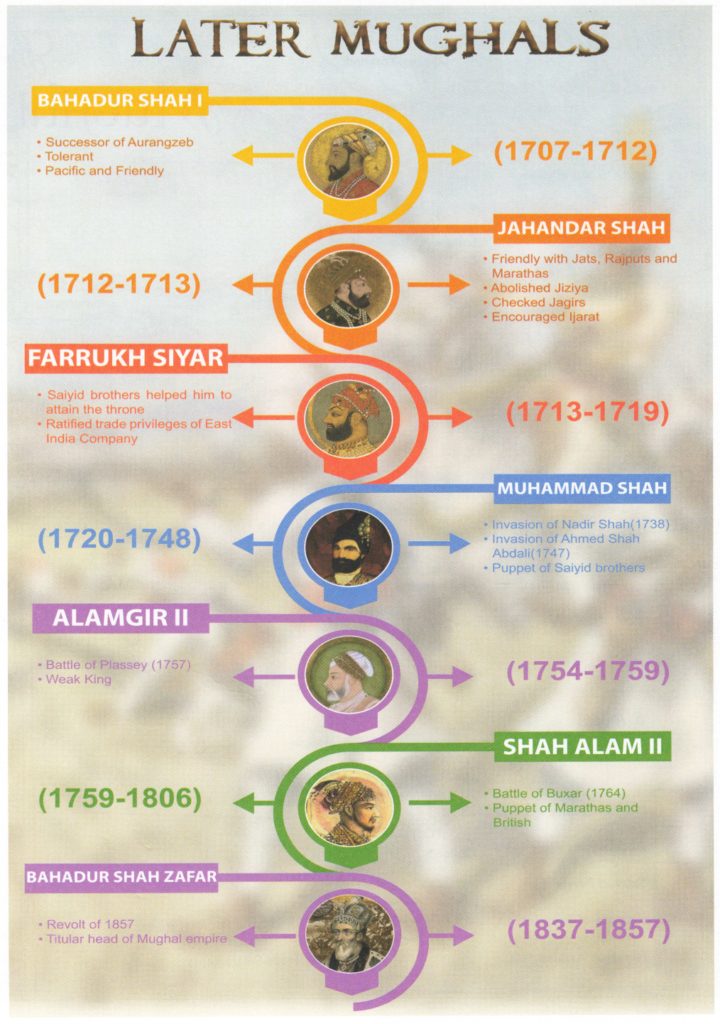
| 7 | Bahadur Shah I (Shah Alam I) | 1707–1712 | Conciliatory policy; Banda Bahadur’s rising |
| 8 | Jahandar Shah | 1712–1713 | Rule through wazir Zulfiqar Khan; revenue farming (ijara) |
| 9 | Farrukhsiyar | 1713–1719 | Sayyid brothers as king-makers; 1717 farman to the East India Company |
| 10 | Rafi ud-Darajat | February–June 1719 | Puppet of the Sayyid brothers |
| 11 | Rafi ud-Daulah (Shah Jahan II) | June–September 1719 | Puppet of the Sayyid brothers |
| 12 | Muhammad Shah “Rangila” | 1719–1748 | Nadir Shah’s invasion (1739); rise of autonomous states |
| 13 | Ahmad Shah Bahadur | 1748–1754 | Deposed and blinded by Imad-ul-Mulk |
| 14 | Alamgir II | 1754–1759 | Abdali’s sack of Delhi and Plassey (both 1757) |
| 15 | Shah Jahan III | 1759–1760 | Puppet installed by Imad-ul-Mulk |
| 16 | Shah Alam II | 1760–1806 | Buxar (1764); Diwani granted to the Company (1765) |
| 17 | Akbar Shah II | 1806–1837 | British pensioner; gave Ram Mohan Roy the title “Raja” |
| 18 | Bahadur Shah II (Zafar) | 1837–1857 | Symbolic leader of the Revolt of 1857; the last Mughal emperor |
Note: Muhammad Ibrahim was proclaimed emperor by the Sayyid brothers in 1720 as a rival to Muhammad Shah, but his claim ended with their defeat at Hasanpur the same year. Most lists do not count him.
The Great Mughals: Emperor by Emperor
1. Babur (1526–1530)
- A Timurid prince from Ferghana (Central Asia), descended from Timur on his father’s side and Chinggis Khan on his mother’s.
- First Battle of Panipat (1526): defeated Ibrahim Lodi, using field artillery and the tulughma flanking tactic.
- Khanwa (1527) against Rana Sanga of Mewar, Chanderi (1528) against Medini Rai, and Ghaghra (1529) against the Afghans consolidated his hold on north India.
- Wrote his memoir, the Tuzuk-i-Baburi (Baburnama), in Chagatai Turkish. Died at Agra in 1530; buried at Kabul.
- Read more: Mughal Empire, First Phase: Babur.
2. Humayun (1530–1540 and 1555–1556)
- Faced his half-brothers’ ambitions and the rising Afghan power of Sher Khan (later Sher Shah).
- Defeated by Sher Shah at Chausa (1539) and Kannauj (1540); spent about 15 years in exile, including at the court of Shah Tahmasp of Persia.
- Regained Delhi after the Battle of Sirhind (1555), but died in January 1556 after a fall from the stairs of his library at the Sher Mandal, Delhi.
- His sister Gulbadan Begum wrote the Humayun-nama.
- Read more: Mughal Empire, First Phase: Humayun.
The Sur Interregnum (1540–1555)
Sher Shah Suri (1540–1545) ruled north India between Humayun’s two reigns. He is remembered for the silver rupiya, the revival of the road from Sonargaon to the northwest (later the Grand Trunk Road), sarais along trade routes, and land measurement for revenue assessment, which influenced Akbar’s later system. He died at the siege of Kalinjar in 1545, and his successors lost the throne to Humayun in 1555.
3. Akbar (1556–1605)
- Came to the throne at 13, with Bairam Khan as regent. Second Battle of Panipat (1556): defeated Hemu.
- Administration: the mansabdari system (zat and sawar ranks) and Raja Todar Mal’s Dahsala (zabt) system of land revenue (1580).
- Religious policy: abolished the pilgrim tax (1563) and jizya (1564), built the Ibadat Khana at Fatehpur Sikri (1575), issued the Mahzar (1579) and promoted sulh-i-kul; Din-i-Ilahi (Tauhid-i-Ilahi) followed in 1582.
- Rajput policy: matrimonial and political alliances; the Battle of Haldighati (1576) against Maharana Pratap.
- Built Fatehpur Sikri; the Buland Darwaza commemorates the conquest of Gujarat.
- Read more: Mughal Empire: Akbar, Rajput Policy of Akbar and Land Revenue System under Akbar.
4. Jahangir (1605–1627)
- Known for the “chain of justice” hung at Agra Fort for petitioners.
- Executed Guru Arjan Dev (1606) for supporting the rebel prince Khusrau.
- Married Nur Jahan in 1611; she and her family (the “Nur Jahan junta”) wielded great influence at court.
- Received the English envoys William Hawkins and Sir Thomas Roe (1615–1619); made peace with Mewar (1615); lost Kandahar to Persia (1622).
- Mughal painting reached its height under artists such as Ustad Mansur; he wrote the Tuzuk-i-Jahangiri.
- Read more: Mughal Empire: Jahangir.
5. Shah Jahan (1628–1658)
- The “golden age” of Mughal architecture: the Taj Mahal (begun 1632), the Red Fort and the new capital of Shahjahanabad (1639–1648), and the Jama Masjid of Delhi. Commissioned the Peacock Throne.
- Annexed Ahmadnagar (1633) and forced treaties on Bijapur and Golconda (1636); campaigns in Balkh (1646–1647) failed, and Kandahar was finally lost in 1649.
- The war of succession (1657–1658) among his sons ended with Aurangzeb’s victory at Samugarh. Shah Jahan was confined in Agra Fort until his death in 1666.
- Read more: Mughal Empire: Shah Jahan and Mughal Architecture.
6. Aurangzeb (1658–1707)
- Under him the empire reached its greatest territorial extent.
- Deccan: Treaty of Purandar with Shivaji (1665); annexed Bijapur (1686) and Golconda (1687); executed Sambhaji (1689). He spent his last 26 years campaigning in the Deccan.
- Religious policy: reimposed jizya (1679); executed Guru Tegh Bahadur (1675); compiled the Fatawa-i-Alamgiri.
- Faced revolts by the Jats, Satnamis (1672), Sikhs and Rajputs (after the Marwar succession dispute of 1679).
- Died at Ahmednagar in 1707; buried at Khuldabad.
- Read more: Mughal Empire: Aurangzeb, Deccan Policies of Aurangzeb and Religious Policies of Aurangzeb.
The Later Mughals: Emperor by Emperor
After Aurangzeb, real power passed to nobles, wazirs and regional rulers. See Later Mughals (1707-1858) for the full story.
- Bahadur Shah I (1707–1712): won the succession war at Jajau (1707); followed a conciliatory policy towards the Rajputs and Marathas; faced the Sikh rising under Banda Bahadur.
- Jahandar Shah (1712–1713): ruled through his wazir Zulfiqar Khan; abolished jizya and expanded revenue farming (ijara).
- Farrukhsiyar (1713–1719): raised to the throne by the Sayyid brothers (Abdullah Khan and Husain Ali Khan), the “king-makers”; Banda Bahadur was executed (1716); his 1717 farman gave the East India Company duty-free trade in Bengal for ₹3,000 a year. Deposed and killed by the Sayyids.
- Rafi ud-Darajat and Rafi ud-Daulah (1719): short-lived puppets of the Sayyid brothers.
- Muhammad Shah “Rangila” (1719–1748): ended the Sayyids’ dominance (1720); Nizam-ul-Mulk founded Hyderabad after Shakar Kheda (1724); Bengal and Awadh became virtually independent; Nadir Shah defeated the Mughals at Karnal (1739) and carried off the Peacock Throne and the Koh-i-Noor.
- Ahmad Shah Bahadur (1748–1754): Safdar Jang was his wazir; deposed and blinded by Imad-ul-Mulk in 1754.
- Alamgir II (1754–1759): a puppet of Imad-ul-Mulk; Ahmad Shah Abdali sacked Delhi and the British won at Plassey (both 1757); murdered in 1759.
- Shah Jahan III (1759–1760): briefly installed by Imad-ul-Mulk.
- Shah Alam II (1760–1806): in exile during the Third Battle of Panipat (1761); defeated at Buxar (1764); the Treaty of Allahabad (1765) gave the Company the Diwani of Bengal, Bihar and Orissa. Returned to Delhi under Maratha (Mahadji Scindia) protection in 1772; blinded by Ghulam Qadir (1788); came under British protection after they took Delhi in 1803.
- Akbar Shah II (1806–1837): a pensioner of the Company; sent Ram Mohan Roy to England and gave him the title “Raja”; in 1835 the Company stopped issuing coins in the emperor’s name.
- Bahadur Shah II “Zafar” (1837–1857): an Urdu poet; proclaimed leader by the rebel sepoys in May 1857. After the British recaptured Delhi in September 1857 he was tried (1858), exiled to Rangoon, and died there in 1862.
Mughal Succession Timeline (Key Dates)
| Year | Event |
|---|---|
| 1526 | First Battle of Panipat: Babur defeats Ibrahim Lodi |
| 1527 | Battle of Khanwa: Babur defeats Rana Sanga |
| 1540 | Battle of Kannauj: Humayun loses to Sher Shah; Sur rule begins |
| 1555 | Humayun regains Delhi |
| 1556 | Second Battle of Panipat: Akbar (Bairam Khan) defeats Hemu |
| 1576 | Battle of Haldighati |
| 1605 | Jahangir succeeds Akbar |
| 1628 | Shah Jahan crowned |
| 1658 | Battle of Samugarh; Aurangzeb takes the throne |
| 1679 | Jizya reimposed |
| 1686–1687 | Bijapur and Golconda annexed |
| 1707 | Death of Aurangzeb; decline begins |
| 1717 | Farrukhsiyar’s farman to the East India Company |
| 1739 | Nadir Shah’s invasion; Battle of Karnal |
| 1757 | Battle of Plassey; Abdali sacks Delhi |
| 1761 | Third Battle of Panipat |
| 1764–1765 | Battle of Buxar; Treaty of Allahabad |
| 1803 | British capture Delhi |
| 1857 | Revolt of 1857; British recapture Delhi |
| 1858 | Bahadur Shah II tried and exiled to Rangoon; Crown rule begins |
Later Mughal Emperors and Their Wazirs
After 1707 the wazir (chief minister) often held more power than the emperor. The table pairs each emperor with his most important wazir.
| Mughal emperor | Wazir |
|---|---|
| Aurangzeb (1658–1707) | Asad Khan (1675–1707) |
| Bahadur Shah I (1707–1712) | Munim Khan (1707–1711) |
| Jahandar Shah (1712–1713) | Zulfiqar Khan (1712–1713) |
| Farrukhsiyar (1713–1719) | Abdullah Khan, the elder Sayyid brother (1713–1720) |
| Muhammad Shah (1719–1748) | Nizam-ul-Mulk Asaf Jah (1722–1724) |
| Ahmad Shah Bahadur (1748–1754) | Safdar Jang (1748–1753) |
| Alamgir II (1754–1759) | Imad-ul-Mulk (1754–1760) |
| Shah Alam II (1760–1806) | Shuja-ud-Daula (1760s–1775) |
Safdar Jang (1748–1753)
- Safdar Jang, the second Nawab of Awadh, was a major figure at the Mughal court in its declining years. He helped the weakened emperor Muhammad Shah, who gave him the title “Safdar Jang”.
- When Ahmad Shah Bahadur took the throne in 1748, Safdar Jang became his Wazir-ul-Mamalik-i-Hindustan. Court politics turned against him and he was dismissed in 1753. He died in October 1754 near Faizabad.
Imad-ul-Mulk (1754–1760)
- Imad-ul-Mulk, a grandson of Nizam-ul-Mulk Asaf Jah I, was appointed Mir Bakhshi in 1752 on Safdar Jang’s recommendation.
- Emperor Ahmad Shah Bahadur backed him to counter the powerful Safdar Jang, but with Maratha support Imad-ul-Mulk became the de facto ruler of Delhi and fell out with the emperor.
- He defeated the emperor’s army at Sikandrabad (May 1754) with Maratha help, entered Delhi with Raghunath Rao, and deposed Ahmad Shah Bahadur on 2 June 1754, who was then blinded and imprisoned in Salimgarh Fort.
- He placed Prince Aziz-ud-Din on the throne as Alamgir II, had him murdered in 1759, and briefly installed Shah Jahan III.
Causes of the Decline of the Mughal Empire
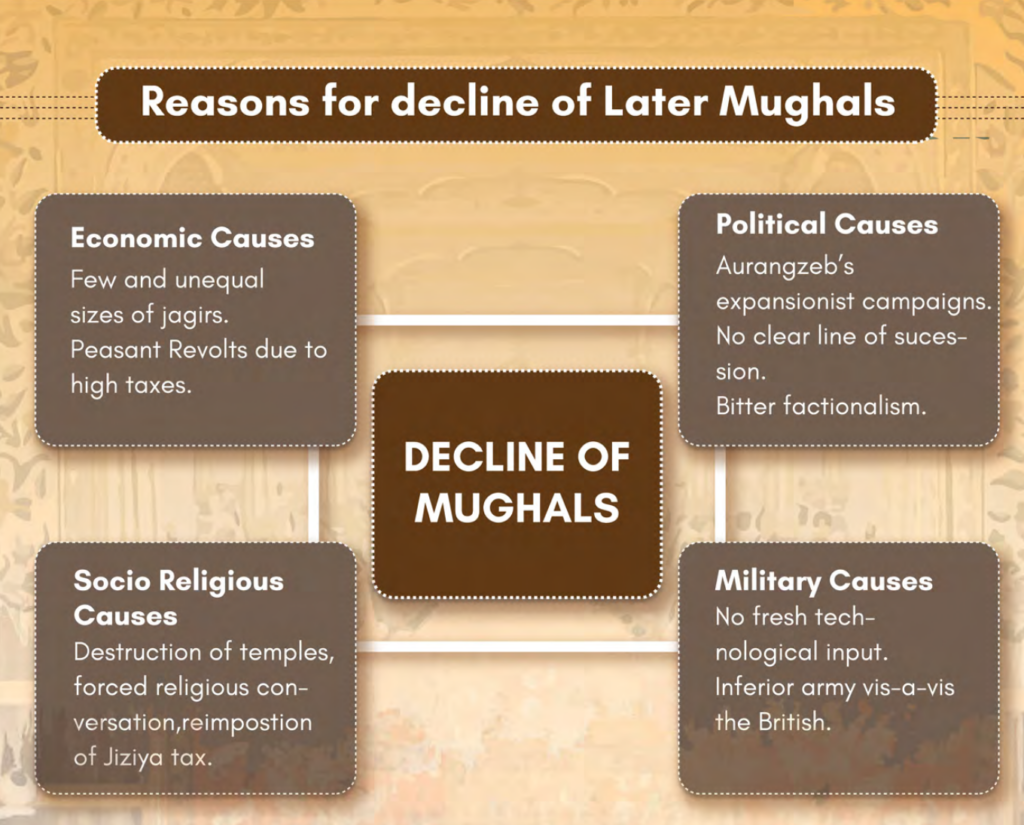
- Wars of succession after 1707 and weak, short-lived rulers.
- Crisis of the jagirdari and mansabdari systems: too many mansabdars for too few jagirs (be-jagiri).
- Aurangzeb’s long Deccan wars drained the treasury and kept the emperor away from the north.
- Court factions (Turani, Irani, Hindustani nobles) and powerful wazirs who made and unmade emperors.
- Rise of regional powers: the Marathas, Sikhs, Jats, and autonomous Bengal, Awadh and Hyderabad.
- Foreign invasions by Nadir Shah (1739) and Ahmad Shah Abdali, and the growing power of the East India Company.
- Read more: Causes of the Decline of Mughal Empire.
good very helpful for middle schoolers
History notes kha milegi sir please bata do
Visit: https://store.lotusarise.com/
Explain in a lucid and brief form. Looks helping a lot.