

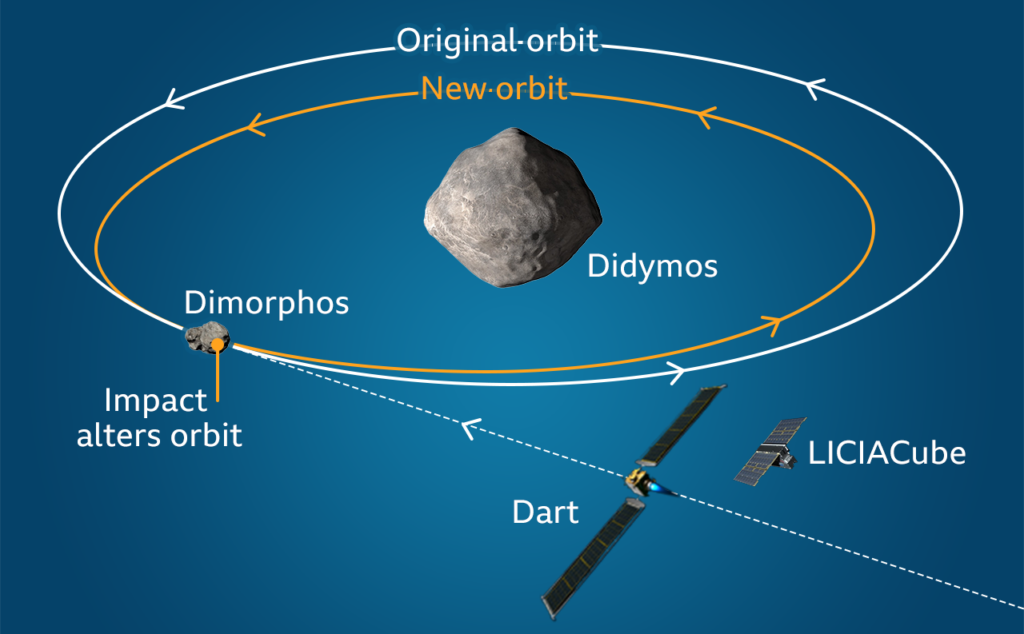
- NASA’s DART Mission (Double Asteroid Redirection Test) was a spacecraft designed to test a method of deflecting an asteroid for planetary defense, using the “kinetic impactor” technique (in simplest terms means smashing a thing into another thing).
- It has two solar arrays and uses hydrazine propellant for maneuvering the spacecraft.
- It also carries about 10 kg of xenon which will be used to demonstrate the agency’s new thrusters called NASA Evolutionary Xenon Thruster–Commercial (NEXT-C) in space.
- NEXT-C gridded ion thruster system provides a combination of performance and spacecraft integration capabilities that make it uniquely suited for deep space robotic missions.
- The spacecraft carries a high-resolution imager called Didymos Reconnaissance and Asteroid Camera for Optical Navigation (DRACO).
- Images from DRACO will be sent to Earth in real-time and will help study the impact site and surface of Dimorphos (the target asteroid).
- DART will also carry a small satellite or CubeSat named LICIACube (Light Italian CubeSat for Imaging of Asteroids).
- LICIACube is expected to capture images of the impact and the impact crater formed as a result of the collision.
- DART was the first-ever space mission to demonstrate asteroid deflection by kinetic impactor.
- The target of the spacecraft was a 160-meter-wide asteroid known as Dimorphos, which is a moonlet in orbit around the larger asteroid, Didymos.
- It was launched in November 2021.
- DART spacecraft successfully collided with Dimorphos on 26 September 2022, altering the asteroid’s orbit by 33 minutes.
- It is the first time humanity intentionally changed the motion of a celestial object in space.
Objectives of DART Mission:
- The mission is to test the new technology to be prepared in case an asteroid heads towards Earth in the future.
- The aim is to test the newly developed technology that would allow a spacecraft to crash into an asteroid and change its course.
- The target of the spacecraft is a small moonlet called Dimorphos (Greek for “two forms”).
- Dimorphos orbits a larger asteroid named Didymos (Greek for “twin”).
- It is a suicide mission and the spacecraft will be completely destroyed.
Reason for Choosing Dimorphos
- The goal of the mission is to determine how much DART’s impact alters the moonlet’s velocity in space by measuring the change in its orbit around Didymos.
- Scientists think the collision will change the speed of Dimorphos by a fraction of one percent.
- It should alter the moonlet’s orbital period around the larger asteroid by several minutes – enough to be observed and measured by telescopes on Earth.
Planetary Defense
- Planetary defense encompasses all the capabilities needed to detect and warn of a potential asteroid or comet impact with Earth, and then either prevent them or mitigate their possible effects.
- Planetary defense is “applied planetary science” to address the NEO impact hazard.
- Near-Earth objects (NEOs) are asteroids and comets that orbit the Sun like the planets, but with orbits that bring them into or through a zone between approximately 91 million and 121 million miles (195 million kilometers) from the Sun.
- Meaning that they can pass within about 30 million miles (50 million kilometers) of Earth’s orbit.
- Near-Earth objects (NEOs) are asteroids and comets that orbit the Sun like the planets, but with orbits that bring them into or through a zone between approximately 91 million and 121 million miles (195 million kilometers) from the Sun.
- DART is one part of NASA’s larger planetary defense strategy. The DART mission addresses the “mitigate” component of the overall planetary defense efforts, demonstrating a potential technology for deflecting an asteroid off a predicted impact course with Earth if such action was warranted.