

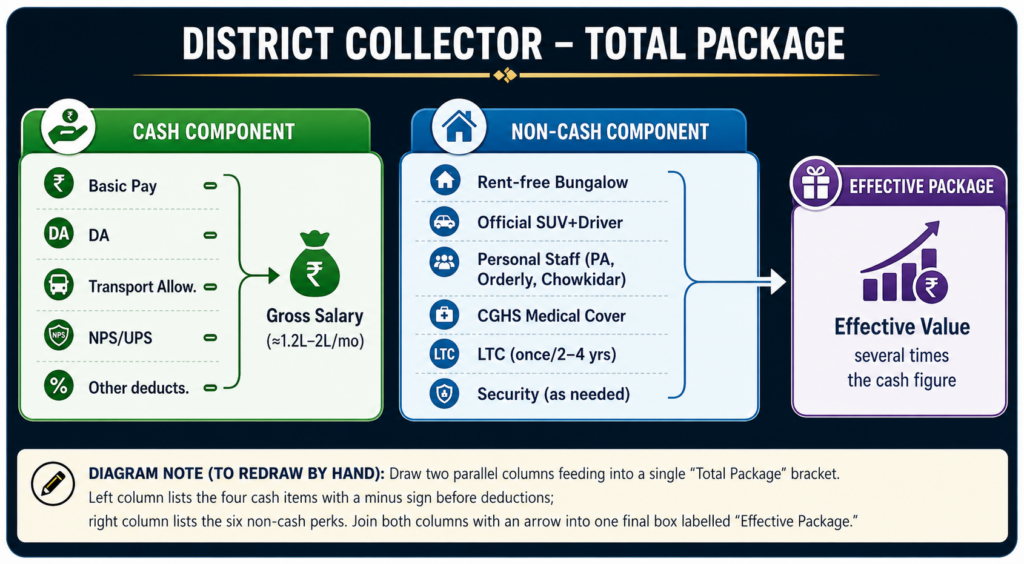
A District Collector is an IAS officer, usually posted at Pay Level 12 of the 7th Pay Commission (basic pay ₹78,800). With Dearness Allowance at 60% (effective 1 January 2026) — rising to a calculated 63% from 1 July 2026 — plus Transport Allowance, entry-level cash in-hand is approximately ₹1,20,000-1,26,000 a month, before counting the rent-free bungalow, official vehicle with driver, and household staff. Senior Collectors of major districts, holding Level 13 (₹1,23,100) or Level 14 (₹1,44,200) pay, take home roughly ₹1,85,000-2,00,000 in cash.
Who is a District Collector?
The District Collector is the field-level face of the Indian Administrative Service. Formally, the same officer usually carries three separate titles at once — Collector (head of district revenue administration), District Magistrate or DM (head of the executive magistracy), and, in eight states including Karnataka, Assam and the north-eastern states, Deputy Commissioner. Most officers reach this post between the 9th and 16th year of IAS service, once they have been promoted to Pay Level 12 — the Junior Administrative Grade — of the 7th Central Pay Commission matrix.
Because a Collector’s compensation is a central-government pay scale rather than a fixed “salary,” the number that any listicle quotes depends entirely on which pay level and which DA cycle it is calculated at. That is exactly what this guide breaks down, line by line.
District Collector Salary: 7th CPC Pay Matrix Explained
A Collector’s basic pay is not a single figure — it is a position in the 18-level pay matrix drawn up by the 7th Central Pay Commission and notified by the Ministry of Finance in 2016. An officer enters a level at “Cell 1” and moves down the same column by roughly 3% with every annual increment (granted each 1 July), until promotion moves them across into the next level.
| Pay Level | Grade | Basic Pay Range (₹) | Typical Post | IAS Service Years |
|---|---|---|---|---|
| Level 10 | Junior Time Scale | 56,100 – 1,77,500 | Sub-Divisional Magistrate / Assistant Collector | 0–4 yrs |
| Level 11 | Senior Time Scale | 67,700 – 2,08,700 | Additional District Magistrate / Deputy Secretary | 4–9 yrs |
| Level 12 | Junior Administrative Grade | 78,800 – 2,09,200 | District Collector / DM (first posting) | 9–16 yrs |
| Level 13 | Selection Grade | 1,23,100 – 2,15,900 | Collector of a major district / Divisional Commissioner | 16–24 yrs |
| Level 14 | Super Time Scale | 1,44,200 – 2,18,200 | Collector of a state-capital district / Principal Secretary | 24+ yrs |
| Level 15 | Above Super Time Scale (HAG) | 1,82,200 – 2,24,100 | Additional Chief Secretary / Additional Secretary, GoI | 30+ yrs |
| Level 17 | Apex Scale | 2,25,000 (fixed) | Chief Secretary / Secretary to Government of India | 34+ yrs |
| Level 18 | Apex | 2,50,000 (fixed) | Cabinet Secretary | 37+ yrs |
Most officers get their first Collector posting at Level 12, straight after a run as SDM (Level 10) and Additional District Magistrate (Level 11). Senior officers posted to a major, high-profile, or state-capital district may carry Level 13 or Level 14 pay while still functionally titled “District Collector.”
📌 India Focus — Reading the Pay Matrix
To find any officer’s exact pay: look up their Pay Level (fixed by post/grade) on the horizontal axis, then move down that column by one cell for every annual increment already drawn. Level 12, Cell 1 is ₹78,800; Cell 2 is roughly ₹81,200; and so on, up to a ceiling of ₹2,09,200 before the next promotion.
Current Dearness Allowance and Its Impact on Collector Pay
Basic pay under the 7th CPC has been frozen since 2016 — it is Dearness Allowance (DA), revised every 1 January and 1 July against the All-India Consumer Price Index for Industrial Workers, that keeps pushing take-home pay upward each cycle.
| Effective From | DA / DR Rate | Status (as of 9 Aug 2026) |
|---|---|---|
| 1 July 2025 | 58% | Notified, paid |
| 1 January 2026 | 60% | Notified, paid |
| 1 July 2026 | 63% | Confirmed by CPI-IW calculation; formal Cabinet order/OM typically follows a few months later |
⏱ Current-Affairs Update
Labour Bureau CPI-IW data through June 2026 completes the calculation window for the July 2026 DA revision, and the number works out to 63% (rounded down from 63.75%). Treat 63% as the reliable working figure for any salary calculation from July 2026 onward, while noting that the government’s formal order typically arrives a few months after the effective date, along with arrears.
Full Salary Breakdown: Collector’s In-Hand Pay
Below are two separate, clearly labelled scenarios — a first-time Collector at entry-level Level 12 pay, and a senior Collector of a major or state-capital district at Level 13. Treating these as one blended number, the way many quick-answer articles do, is the single biggest source of confusion around this topic.
Scenario A — First-Time Collector (Level 12, Cell 1, government bungalow provided)
| Component | @ DA 60% (Jan 2026) | @ DA 63% (Jul 2026) |
|---|---|---|
| Basic Pay | 78,800 | 78,800 |
| Dearness Allowance | 47,280 | 49,644 |
| Transport Allowance + DA on TA (A1 city) | 11,520 | 11,736 |
| House Rent Allowance | Nil — rent-free bungalow provided instead | Nil |
| Gross Emoluments | ≈ 1,37,600 | ≈ 1,40,180 |
| Less: NPS/UPS employee contribution (10% of Basic+DA) | −12,608 | −12,844 |
| Less: CGEGIS, professional tax & misc. | −1,500 | −1,500 |
| Net Cash In-Hand | ≈ 1,23,500 | ≈ 1,25,800 |
Scenario B — Senior Collector, Major District (Level 13, Cell 1, government bungalow provided)
| Component | @ DA 60% (Jan 2026) |
|---|---|
| Basic Pay | 1,23,100 |
| Dearness Allowance | 73,860 |
| Transport Allowance + DA on TA | 11,520 |
| Gross Emoluments | ≈ 2,08,480 |
| Less: NPS/UPS contribution + CGEGIS/misc. | −21,700 |
| Net Cash In-Hand | ≈ 1,86,800 |
Figures are illustrative, based on an A1/X-category posting city, standard NPS deduction, and current DA. Actual figures vary with city class, specific state allowances, income-tax slab opted, and whether the officer has switched to the Unified Pension Scheme (see below). Income tax has not been netted out above since it depends on the individual’s regime and other income.
HRA vs. Government Bungalow
Almost every Collector is allotted an official bungalow at district headquarters, in which case HRA is not paid in cash at all — the accommodation itself is the benefit. Where no government residence is available, HRA is paid at the standard central government rates: 30% of basic in X-category (metro) cities, 20% in Y-category cities, and 10% in Z-category towns, following the revision triggered once DA crossed the 50% threshold.
The typical Collector’s bungalow runs to 3-5 bedrooms with a study, guest room, government-maintained garden and compound, and a resident cook, orderly and chowkidar — a standard of living that a cash HRA of ₹20,000-25,000 could not replicate in most Indian cities. Independent estimates put its open-market rental equivalent at ₹30,000-80,000 a month or more in metro districts.
Non-Monetary Perks of a District Collector
The perquisites attached to the post are a large part of why it remains one of the most sought-after assignments in the IAS, and they sit entirely outside the cash-salary figure quoted above.
| Perk | What it covers |
|---|---|
| Official Vehicle | Government SUV with a driver on government payroll; fuel reimbursed. Practical value: roughly ₹15,000-25,000/month in avoided transport cost. |
| Personal Staff | Personal Assistant, orderly/peon, chowkidar, gardener, and in several states a government-paid cook — all on the government’s payroll, not the officer’s salary. |
| Security | Not universal. Threat-perception based: sensitive, high-profile, or Left-Wing-Extremism-affected districts may get 2-4 armed personnel up to a full escort; peaceful rural postings usually don’t. |
| Medical Cover | Central Government Health Scheme (CGHS) in Delhi and equivalent state health schemes elsewhere, including cashless treatment at empanelled hospitals. |
| Leave Travel Concession | Fully reimbursed travel anywhere in India, once in a block of two years (with a home-town trip permitted more often) — worth roughly ₹50,000-1,00,000 for a family of four. |
| Official Bungalow | See the section above — market-rent equivalent of ₹30,000-80,000+ per month. |
Pension & Retirement: OPS, NPS or UPS?
An IAS officer’s long-term compensation also depends on which pension track they are on — a detail most salary explainers skip entirely.
- Old Pension Scheme (OPS): applies only to officers who joined before 1 January 2004 — a defined-benefit, non-contributory pension.
- National Pension System (NPS): the default for everyone who joined on or after 1 January 2004. The officer contributes 10% of Basic+DA every month, matched by a government contribution, into a market-linked corpus.
- Unified Pension Scheme (UPS): introduced as an option under the NPS framework from 1 April 2025, following the Somanathan Committee’s recommendations. UPS guarantees 50% of the last 12 months’ average basic pay as pension after 25 years of qualifying service (with a minimum floor and 60% family pension), in exchange for a higher 18.5% government contribution rate. The Centre asked serving IAS officers to make a final, largely irreversible choice between OPS, NPS and UPS by 30 November 2025.
Since UPS raises the government’s own contribution rate rather than the officer’s monthly deduction, choosing it does not change a Collector’s in-hand salary today — but it materially changes the guaranteed pension at retirement.
Does a Collector’s Salary Differ by State?
⚠ Common Misconception, Corrected
A number of salary articles claim that Collectors in states like Maharashtra, Karnataka or Tamil Nadu draw a higher basic pay than those in, say, Uttar Pradesh or Bihar because of “state pay revisions.” This is not accurate for IAS officers.
Under the IAS (Pay) Rules, 2016, every IAS officer — regardless of cadre state — sits on the same central 7th CPC pay matrix, and the Department of Personnel & Training has specifically directed states to protect AIS officers’ pay and allowances from cadre-related variation. The genuine state-to-state variation exists among State Civil Service (PCS) officers who hold charge as Sub-Collector or Additional Collector — their pay does follow separate, state-specific pay commissions, which can differ meaningfully in fitment factor and allowance structure.
Collector Salary vs. Other Senior Officers
| Post | Pay Level | Approx. Cash In-Hand | Distinguishing Perk |
|---|---|---|---|
| Sub-Divisional Magistrate (IAS, entry) | 10-11 | ₹95,000 – 1,05,000 | Smaller government quarters, official vehicle |
| District Collector (IAS, entry) | 12 | ₹1,20,000 – 1,26,000 | Full bungalow, staff, magisterial powers |
| Superintendent of Police (IPS, comparable seniority) | 12 | ₹1,18,000 – 1,24,000 | Bungalow, vehicle, standing security cover |
| Collector, Major District (IAS, senior) | 13-14 | ₹1,85,000 – 2,00,000 | Larger bungalow, bigger staff sanction |
| Commissioner of Income Tax (IRS) | 14 | ₹2,00,000 – 2,10,000 | Government housing, no field magisterial powers |
| IFS Officer, Director-rank (posted abroad) | 12 | Basic + tax-free Foreign Allowance | Embassy housing; allowance often 2-4× basic |
| Secretary to Government of India | 17 | ₹3,00,000+ | Type-VII bungalow, Z/Z+ security where applicable |
The headline cash figure for a Collector and an SP of similar seniority is broadly comparable, since both sit on the same civil-services pay matrix. What genuinely sets the Collector apart is the combination of a larger residence, a bigger personal-staff sanction, and — uniquely — the magisterial powers described next.
Powers of the District Magistrate
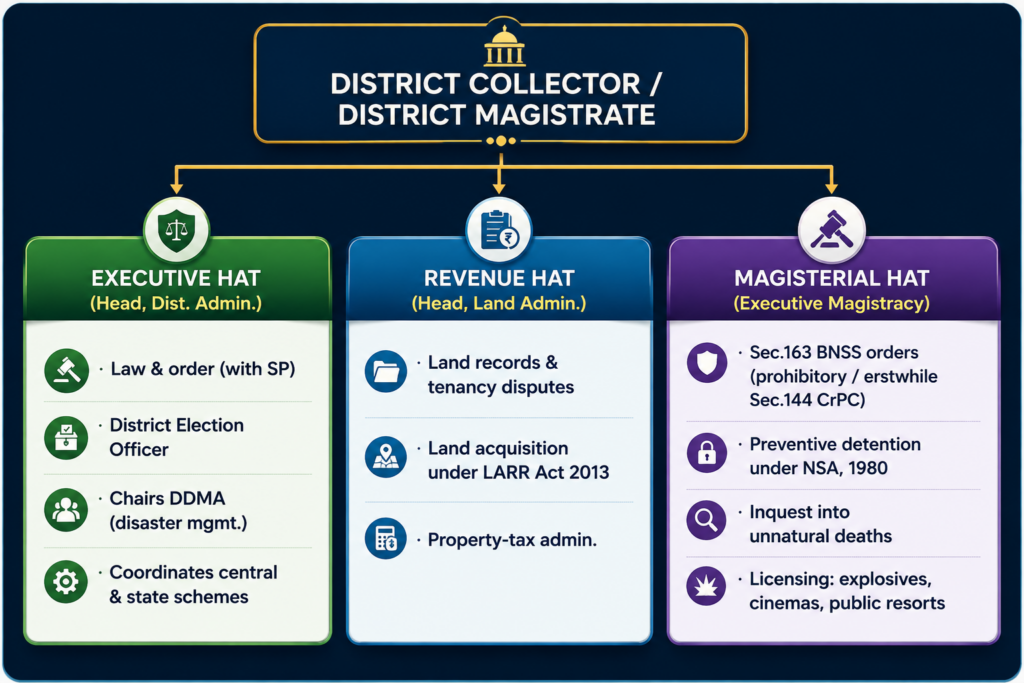
The Collector wears three distinct hats simultaneously, and UPSC questions on district administration are almost always built around this three-way structure.
⏱ Law Update Most Articles Miss
The old “Section 144 CrPC” power to issue prohibitory orders is no longer called that. When the Bharatiya Nagarik Suraksha Sanhita (BNSS), 2023 replaced the Code of Criminal Procedure on 1 July 2024, this power was re-enacted, almost word for word, as Section 163 BNSS. The authority (District Magistrate, Sub-Divisional Magistrate, or a specially empowered Executive Magistrate), the grounds (urgent nuisance or apprehended danger), and the two-month outer limit are unchanged — only the section number and the surrounding code have changed. For Prelims, know both numbers; for Mains, cite the current one.
📚 Case Study — Courts Keep Checking Section 163
Section 163 BNSS is an emergency, preventive power, and courts continue to police its limits. In one 2025 Karnataka High Court matter, a district-wide, two-month order restricting a religious figure’s movement was tested against the requirements of proportionality and least-restrictive means — a reminder that an order under this section must be backed by recorded material facts and cannot be used as a blanket, long-duration ban. Gujarat High Court has similarly cautioned against “rolling” prohibitory orders that effectively extend beyond the two-month statutory ceiling by repeated renewal. For Mains answers, cite this line of reasoning to show that the Collector’s magisterial power, though wide, is not unchecked.
📚 Case Study — The Collector as DDMA Chairperson
Under the Disaster Management Act, 2005, the Collector chairs the District Disaster Management Authority. In a flood or cyclone alert, this means the same officer who signs land-acquisition awards in the morning coordinates evacuation, relief-camp logistics, and inter-departmental response (police, health, PWD, irrigation) by evening — illustrating why UPSC treats the Collector’s post as a study in role integration rather than a narrow desk job.
Career Progression After Collector
| Stage | Typical Post | Pay Level |
|---|---|---|
| 1 | Sub-Divisional Magistrate | 10 |
| 2 | District Collector / DM | 12-14 |
| 3 | Divisional Commissioner | 13 |
| 4 | Principal Secretary (State) | 14-15 |
| 5 | Secretary to Government of India | 17 |
| 6 | Cabinet Secretary (apex, one post nationally) | 18 |
A Divisional Commissioner typically oversees 3-8 districts and coordinates between Collectors on larger administrative matters. From there, most officers alternate between state secretariat postings and central deputation — where the Department of Personnel & Training places officers in ministries such as Finance, Home Affairs, or the PMO — before the small number who reach Apex Scale become Chief Secretary of their state or Secretary to the Government of India.
How to Become a District Collector
- Clear the UPSC Civil Services Examination (Prelims → Mains → Personality Test).
- Secure an IAS allocation. In the CSE 2025 cycle, 958 candidates were finally recommended across all services against a general-category cut-off of 963 marks; IAS allocations are drawn from roughly the top-ranking candidates within that list, with IAS vacancies running to a few hundred each year.
- Complete foundational and professional training at LBSNAA, Mussoorie.
- Serve as Assistant Collector / Sub-Divisional Magistrate and later Additional District Magistrate during the first several years.
- Receive the first full Collector/DM posting, typically in year 9-12 of service, once promoted to Pay Level 12.
A handful of states also allow senior State Civil Service (PCS) officers to hold charge as Collector in specific districts, but for assured posting to a Collector’s chair across major districts, the IAS route remains the standard path.
8th Pay Commission: What Could Change?
Every “Collector salary” figure in this guide, like every other such article published in 2026, is still a 7th CPC figure. The 8th Central Pay Commission was formally constituted by Gazette notification on 3 November 2025, chaired by former Supreme Court judge Justice Ranjana Prakash Desai, with a mandate to submit its report within 18 months. The government has indicated 1 January 2026 as the intended reference date for the new pay structure, but the Commission’s own data-collection window (extended to 31 July 2026 for government departments) means the final report — and any revised pay matrix — is realistically expected only in 2027, with arrears payable for the intervening period once notified.
Employee associations are pressing for a fitment factor in the 2.86-3.25 range (against 2.57 under the 7th CPC), which would translate into a meaningfully higher starting basic pay at every level, including Level 12. Until the Commission reports and the Cabinet notifies revised scales, however, a Collector’s basic pay remains anchored to the 7th CPC figures in Table 1, with DA continuing to be the only lever that moves take-home pay every six months.
Critical Evaluation: Debates Around the Collector System
No answer on this topic scores well without engaging the underlying tension in the office itself:
- Colonial origin, welfare-state function: Lord Cornwallis formalised the post in 1793 chiefly to secure land revenue for the East India Company. Post-independence, the same office was repurposed as the principal implementing arm of a welfare state — a lineage critics argue still shows up in its top-down, control-oriented instincts.
- Generalist vs. specialist: The Administrative Reforms Commission (1966-70) flagged the tension between the Collector’s generalist coordination role and the growing need for domain specialists in health, environment and finance — a debate that has only sharpened as district governance has grown more technical.
- 73rd Amendment friction: The 1992 constitutional mandate for elected Panchayati Raj Institutions created a genuine overlap between the Collector’s developmental functions and the mandate of elected local bodies, a tension UPSC has tested repeatedly (see 2012 and 2000 PYQs above).
- Concentration of power: Combining revenue, executive and magisterial authority in one officer is administratively efficient but raises legitimate separation-of-powers questions — which is precisely why courts continue to scrutinise individual exercises of power such as Section 163 BNSS orders (see case study above).
A well-rounded Mains answer typically argues for retaining the Collector as a coordinating hub while strengthening domain expertise underneath — rather than either fully dismantling the office or leaving it unreformed.