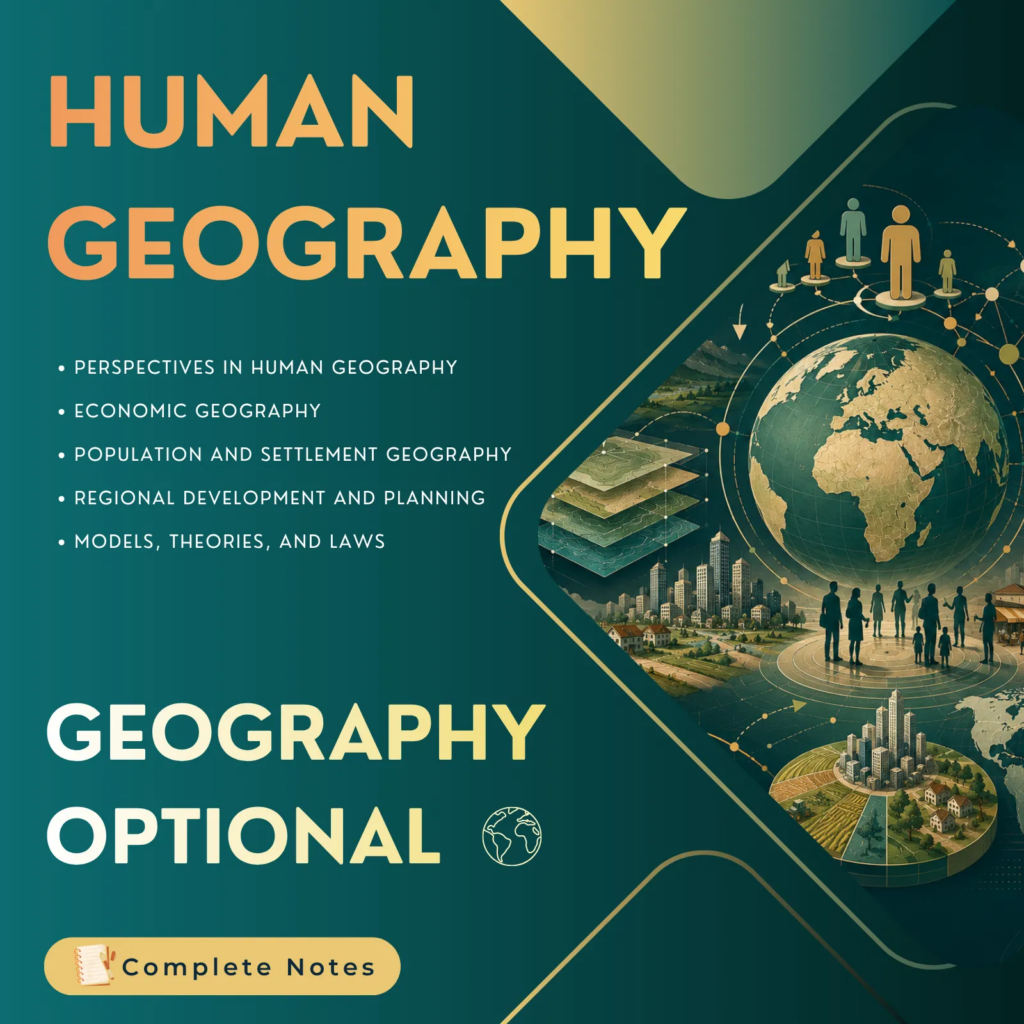
The Most Comprehensive Human Geography Notes for UPSC Geography Optional Preparation
UPSC Geography Optional is one of the most dynamic and scoring optional subjects in the Civil Services Examination. However, many aspirants struggle in Human Geography because of fragmented sources, theoretical complexity, lack of interlinkages, and poor answer-writing orientation.
To solve these problems, LotusArise IAS presents the {Updated} Complete Human Geography: Geography Optional Notes PDF — a structured, syllabus-oriented, exam-focused, and highly analytical resource specially designed for UPSC Geography Optional aspirants.
This updated edition comprehensively covers all major Human Geography sections of Geography Optional with integrated concepts, theories, models, Indian examples, current relevance, diagrams, thinkers, and topic-wise PYQ orientation.
Why Human Geography Becomes Difficult for Most Aspirants
Most aspirants face multiple challenges while preparing Human Geography:
- Human Geography is highly conceptual and abstract compared to Physical Geography.
- Standard books explain theories academically, but not from the UPSC answer-writing perspective.
- Coaching notes are often incomplete, outdated, or excessively bulky.
- Aspirants struggle to connect Paper-1 concepts with the Indian Geography Paper-2 examples.
- Important thinkers, models, schools of thought, and regional planning concepts remain confusing.
- Lack of integrated preparation leads to weak analytical answers in Mains.
As a result:
- Answers become generic.
- Thinker-based questions remain weak.
- Conceptual clarity suffers.
- Diagrams and examples are missing.
- Marks stagnate despite hard work.
This is exactly where LotusArise Human Geography Notes create a major difference.
What Makes LotusArise Human Geography Notes Different?
Unlike conventional coaching material, these notes are designed specifically according to:
- UPSC Geography Optional syllabus
- Latest PYQ trends
- Interdisciplinary analytical approach
- Integrated Paper-1 + Paper-2 preparation
- Answer-writing requirements
- Conceptual understanding + revision efficiency
These notes are not merely compiled content. They are a carefully curated academic resource created for serious UPSC aspirants.
Complete Coverage of Human Geography Syllabus
The updated Human Geography Notes comprehensively cover the following major sections:
1. Perspectives in Human Geography (Updated)
One of the most important and difficult sections of Geography Optional has been simplified systematically.
Major Areas Covered:
- Evolution of Geographical Thought
- Greek, Arab, German, French, British, American & Russian Schools
- Humboldt and Ritter
- Regional vs Systematic Geography
- Quantitative Revolution
- Critical Revolution
- Behaviouralism
- Humanism
- Welfare Geography
- Radical Geography
- Environmentalism
- Neo-determinism and Probabilism
- Cultural Regions
- Human Development
Why This Section Matters
This section forms the theoretical backbone of the Geography Optional. Many UPSC toppers struggle here because standard books become excessively philosophical and difficult to revise.
LotusArise Notes simplify:
- Thinkers
- Schools of thought
- Ideologies
- Debates
- Approaches
- Conceptual evolution
with:
- flowcharts
- comparative tables
- thinker summaries
- chronology-based understanding
- PYQ-oriented explanations
This helps aspirants write mature analytical answers instead of merely reproducing definitions.
2. Economic Geography (Updated)
Economic Geography is increasingly important because UPSC now asks highly analytical and applied questions.
Major Topics Covered:
- Evolution and Approaches in Economic Geography
- Spatial Concepts
- World Economic Development
- World Industries
- Agricultural Typology
- Food Security
- Famine
- Energy Crisis
- New Economic Geography
- NIDL
- Colonialism and Neo-colonialism
- World Trade Patterns
Special Features
The notes integrate:
- current global developments
- India-specific examples
- geopolitical dimensions
- economic linkages
- spatial interpretations
- contemporary case studies
This makes answers multidimensional and highly relevant for UPSC Mains.
3. Population and Settlement Geography (Updated)
This section integrates:
- Population Geography
- Cultural Setting (Indian Geography)
- Settlements (Indian Geography)
which is extremely important for integrated preparation.
Population Geography Coverage
Topics Included
- Population Distribution
- Migration
- Demographic Attributes
- Fertility
- Age Composition
- Population Theories
- Optimum Population Theory
- Epidemiological Transition
- Neo-Malthusian Theory
- Social Well-being
- Population as Social Capital
Why These Notes Help
Most aspirants study Population Geography and Indian Population separately, which creates duplication and confusion.
LotusArise integrates:
- World + Indian dimensions
- Theory + case studies
- Human Geography + Indian Geography
- Static + current affairs
This saves time and improves answer quality significantly.
Cultural Setting (Integrated Indian Geography)
Important Areas Covered
- Linguistic Diversity
- Tribal Areas
- Religious Minorities
- Cultural Regions
- Population Policy
- Literacy Patterns
- Caste and Tribe Composition
Special Advantage
The notes connect Indian examples directly with Human Geography concepts, helping aspirants write richer and more India-centric answers.
Settlement Geography Coverage
Major Topics Included
- Rural Settlements
- Urban Settlements
- Settlement Morphology
- Hierarchy of Urban Settlements
- Rank-Size Rule
- Primate City
- Rural-Urban Fringe
- Functional Classification
- Conurbation
- Metropolitan Regions
- Urban Sprawl
- Slums
- Urbanization Problems
- Sustainable Development of Cities
Why It Is Better Than Conventional Notes
Most coaching notes provide descriptive settlement content with poor conceptual linkage.
LotusArise Notes provide:
- diagrams
- urban models
- conceptual clarity
- Indian urban examples
- sustainable development perspective
- analytical frameworks for answer writing
This is extremely useful for:
- 15-marker answers
- urbanization questions
- case-study-based answers
4. Regional Development and Planning (Updated)
Regional Planning is one of the most scoring yet neglected sections of Geography Optional.
Topics Covered
- Concept of Region
- Types of Regions
- Regional Imbalances
- Growth Poles
- Sustainable Development Planning
- Backward Area Planning
- Hill Area Development
- Tribal Area Development
- Watershed Management
- Multi-level Planning
- Decentralized Planning
Why This Section Is Important
UPSC increasingly asks:
- planning-oriented questions
- sustainable development questions
- regional imbalance questions
- governance-linked geographical questions
These notes integrate:
- planning theories
- Indian examples
- government programmes
- regional disparities
- policy dimensions
This helps aspirants produce mature policy-oriented answers.
5. Models, Theories and Laws (Updated)
One of the highest-scoring components of Geography Optional.
Models Covered
- System Analysis
- Malthusian Theory
- Marxian Theory
- Demographic Transition Theory
- Christaller’s Central Place Theory
- Von Thunen Model
- Weber’s Industrial Location Theory
- Heartland & Rimland Theory
- Rostow’s Stages of Growth
- Organic State Theory
Why These Notes Are Exceptional
Most aspirants fear Geography models because:
- theories appear technical
- diagrams are confusing
- application is unclear
LotusArise simplifies each model through:
- easy explanations
- visual diagrams
- limitations
- criticisms
- contemporary relevance
- answer-writing applications
- inter-topic linkages
This makes even difficult theories highly understandable and revision-friendly.
Updated According to Latest UPSC Trends
The updated edition includes:
- improved conceptual explanations
- better organization
- integrated syllabus approach
- refined diagrams
- updated examples
- enhanced answer-writing orientation
- topic-wise structuring
- better readability and revision flow
Why LotusArise Notes Are Better Than Many Coaching Materials
| Conventional Coaching Notes | LotusArise Human Geography Notes |
|---|---|
| Bulky and poorly structured | Systematic and syllabus-oriented |
| Often outdated | Updated according to latest UPSC trends |
| Generic explanations | Analytical and exam-oriented |
| Weak integration with PYQs | Strong PYQ alignment |
| Minimal diagrams | Rich conceptual presentation |
| Poor Paper-1 & Paper-2 linkage | Integrated preparation approach |
| Difficult revision | Revision-friendly structure |
| Coaching-centric | Self-study friendly |
Best Suitable For
These notes are highly useful for:
- Beginners in Geography Optional
- Working professionals
- Self-study aspirants
- Aspirants switching optional subjects
- Repeaters seeking better conceptual clarity
- Aspirants targeting 300+ in Geography Optional
How These Notes Improve Answer Writing
The notes help aspirants:
- develop conceptual clarity
- write analytical answers
- use geographical terminology effectively
- integrate Indian examples
- include thinkers and theories properly
- draw diagrams and flowcharts
- improve structure and presentation
This directly contributes to better Mains scores.
Revision-Friendly Structure
One of the biggest strengths of these notes is efficient revision design.
The content is structured through:
- headings
- subheadings
- conceptual segmentation
- logical sequencing
- simplified explanations
- concise analytical presentation
This is extremely important during:
- Prelims-Mains overlap
- test series phase
- final revision before Mains
Why Serious UPSC Aspirants Prefer LotusArise IAS
LotusArise IAS has become a trusted platform among Geography Optional aspirants because of:
- syllabus-focused preparation
- high-quality academic content
- integrated approach
- conceptual depth
- exam-oriented presentation
- updated material
- affordability compared to expensive coaching
The focus is not merely on providing notes, but on helping aspirants understand Geography as a scoring and analytical optional subject.