

The United Nations was built in wartime by governments that had watched one collective-security experiment collapse and were determined not to repeat its architecture. What they produced was neither a world government nor a debating club: near-universal membership, a plenary body that can say almost anything, an executive body that can decide almost nothing without great-power agreement, and a permanent international civil service holding the whole together.
The design lesson the Charter drew from 1919–1939

The Charter’s drafters were not theorists. They were officials of governments at war, working from a list of what had gone wrong between the wars, and the Charter reads as a point-by-point answer to it. Collective security as a doctrine, and the League’s record in applying it, are treated separately.
- The unanimity rule crippled the League. The Covenant required unanimity for substantive decisions, so any member could block action. The Charter substituted majority voting — simple or two-thirds in the Assembly, nine of fifteen in the Council — and confined the blocking power to five states.
- The League had no enforcement machinery.Article 16 of the Covenant obliged members to apply sanctions but left each to judge for itself whether a breach had occurred, and provided no force.
- The Charter made the Council the sole authoritative judge of whether a threat to the peace exists, and made its decisions binding under Article 25.
- The great powers were absent. The United States never joined; the USSR joined in 1934 and was expelled in 1939; Japan, Germany and Italy walked out. The Charter’s answer was to build the veto in deliberately, so that the great powers would have no reason to leave.
The Charter is best read as a corrected draft of the Covenant, written by people who knew precisely which clauses had failed.
The wartime chain that produced the Charter
The Atlantic Charter and the naming of the United Nations
- The Atlantic Charter of 14 August 1941 was issued by Roosevelt and Churchill after a shipboard meeting off Newfoundland, four months before the United States entered the war — not a treaty and not signed, but a joint statement of eight principles including self-determination and the abandonment of force.
- Its self-determination language was at once turned against its authors: Churchill insisted it did not apply to the British Empire, a reading the colonial world rejected and kept quoting.
- The Declaration by United Nations of 1 January 1942, signed in Washington by 26 states, turned those principles into a war coalition’s programme and pledged each signatory not to make a separate peace.
- The name “United Nations” was coined by Roosevelt for the wartime alliance and carried over to the postwar body — the Organisation is named after a military coalition, not a peace plan.
- India was among the 26 original signatories while still a British dependency, alongside the Philippines. India is therefore a founding member without having been a sovereign state when the process began.
Moscow, Tehran and Dumbarton Oaks
- The Moscow Declaration of 30 October 1943 — the Declaration of the Four Nations on General Security, signed by the United States, Britain, the USSR and China — is the first inter-governmental commitment to the Organisation in terms.
- Its fourth paragraph recognised “the necessity of establishing at the earliest practicable date a general international organization, based on the principle of the sovereign equality of all peace-loving States, and open to membership by all such States, large and small”.
- The Tehran Conference of 28 November – 1 December 1943 brought Roosevelt, Churchill and Stalin together for the first time; Roosevelt’s preference at this stage was still the “Four Policemen“, a directorate of great powers rather than a chartered organisation.
- The Dumbarton Oaks Conversations, 21 August – 7 October 1944, produced the Dumbarton Oaks Proposals, the draft from which the Charter was written. They ran in two phases because the USSR was not at war with Japan and would not sit with China.
- Agreed: the name, a General Assembly of all members, a Security Council of eleven with five permanent members, an Economic and Social Council, a Secretariat, an international court and enforcement powers.
- Left unresolved: the voting formula in the Council — whether a permanent member party to a dispute could vote on it — and the Soviet demand that its constituent republics be separately admitted. Trusteeship was postponed altogether, and the human-rights content was thin.
Yalta and the voting formula
- The Yalta Conference, 4–11 February 1945, settled what Dumbarton Oaks could not.
- The Yalta voting formula became Article 27: procedural questions by a majority; all other questions requiring the concurring votes of the permanent members — the veto — with a party to a dispute obliged to abstain on pacific settlement under Chapter VI.
- The Soviet republics question was compromised: Ukraine and Byelorussia were admitted as separate original members, so the USSR effectively held three Assembly seats.
- Yalta fixed 25 April 1945 at San Francisco as the founding conference, agreed the trusteeship system in outline, and limited invitations to states that had declared war on the Axis by 1 March 1945.
San Francisco and the revolt of the smaller powers
- The United Nations Conference on International Organization ran from 25 April to 26 June 1945, with 50 states and 282 delegates, in four commissions and twelve technical committees; the four sponsoring powers presented the Dumbarton Oaks Proposals as an agreed basis and resisted reopening them.
- The smaller and middle powers mounted a sustained revolt over the veto, led by Herbert Vere Evatt of Australia with Latin American, Benelux and New Zealand support.
- What they won: the veto was excluded from procedural questions, so no permanent member can stop the Council placing an item on its agenda or discussing it; ECOSOC and the Trusteeship Council were raised to principal-organ status; and human rights were written into the Preamble and into Articles 1, 55 and 56.
- What they lost: the veto itself, in substance and over Charter amendment. The sponsoring powers made plain that there would be no Organisation without it. They did secure Article 109’s review provision, a promised general review conference never held.
- The Charter was signed on 26 June 1945 in Chinese, English, French, Russian and Spanish. Poland, whose government was still disputed between London and Moscow, was unrepresented but signed later as the 51st original member.
- The Charter entered into force on 24 October 1945, when the five permanent members and a majority of other signatories had ratified — observed since as United Nations Day.
“We the peoples of the United Nations determined to save succeeding generations from the scourge of war, which twice in our lifetime has brought untold sorrow to mankind…” — Preamble to the Charter of the United Nations
The Charter as treaty and as constitution
- The Charter is a multilateral treaty in form — negotiated, signed, ratified and registered like any other, binding only those who consent by becoming members.
- It functions as a constitution in substance, and the dual character is the source of its distinctive authority.
- It is amended by a supermajority binding on dissenters: Articles 108 and 109 require two-thirds of members including all five permanent members, after which the amendment binds every member.
- It has been developed by interpretation and practice far beyond its text — peacekeeping, abstention treated as not a veto, and the erosion of Article 12 are creations of practice, not amendment.
- The document’s shape: a Preamble, 19 chapters and 111 articles, with the Statute of the International Court of Justice annexed and declared by Article 92 an integral part of it. The Preamble speaks for “we the peoples”; what follows is a compact between governments.
- Article 103 gives the Charter supremacy: where Charter obligations conflict with those under any other agreement, the Charter prevails. Its practical bite is on Security Council decisions, and it is the nearest thing international law has to a hierarchy of norms.
Purposes and principles: Articles 1 and 2
Article 1 states four purposes and Article 2 seven principles. Together they are the Charter’s normative core, and almost every later argument about what the Organisation may do is an argument about how to read them.
| Purpose | Article 1, in substance | What it generated |
|---|---|---|
| Peace and security | Maintain peace; take effective collective measures against threats; settle disputes peacefully | Chapters VI and VII, the Council’s primacy, peacekeeping |
| Friendly relations | Based on equal rights and self-determination of peoples | The decolonisation agenda and Resolution 1514 |
| International cooperation | On economic, social, cultural and humanitarian problems and human rights | ECOSOC, the agencies, the treaty system |
| A centre for harmonising | A centre for harmonising the actions of nations | The Organisation as forum rather than actor |
- The fourth purpose is the most revealing. The Charter’s own final word on what the Organisation is for describes a centre for harmonising, not a government.
The seven principles
- Sovereign equality of all members (2(1)) — the foundation of one state, one vote, and formally unaffected by the veto, which is a special voting rule rather than a denial of equality.
- Good faith fulfilment of Charter obligations (2(2)) and pacific settlement of disputes (2(3)), the positive obligation pairing with the prohibition that follows.
- Prohibition of the threat or use of force (2(4)) — the single most important sentence in the Charter, forbidding force against the territorial integrity or political independence of any state.
- It is accepted as customary international law and as jus cogens, so it binds non-members and cannot be contracted out of.
- The only Charter exceptions are self-defence under Article 51 and Council authorisation under Chapter VII; every contested intervention since 1945 has argued for stretching one of them.
- Article 2(6) — the Organisation shall ensure that non-member states act in accordance with these principles so far as necessary for peace and security, a striking claim to bind non-parties.
- Non-intervention in domestic jurisdiction (2(7)) — nothing authorises the Organisation to intervene in matters essentially within the domestic jurisdiction of a state, except that this shall not prejudice enforcement measures under Chapter VII.
Article 2(7) and the shrinking domain of domestic jurisdiction
- The clause is addressed to the Organisation, not to states, and its scope has narrowed because what is “essentially domestic” is itself determined by an expanding international law.
- Human-rights supervision was the first breach. Once states accepted obligations on the treatment of their own populations, that treatment ceased to be exclusively domestic — the argument used against apartheid South Africa from the 1950s and now routine in the Human Rights Council’s country work.
- The Chapter VII proviso is the second. Where the Council determines a threat to the peace, 2(7) does not apply at all, and the Council has used this to reach internal conflict, humanitarian catastrophe and state collapse.
- The Responsibility to Protect reframed the clause rather than deleting it, treating sovereignty as responsibility. Its content and record belong with the collective-security debate; it did not amend 2(7) and cannot.
- The counter-mobilisation is real. Russia, China and much of the Global South read 2(7) expansively and treat human-rights and R2P practice as encroachment — an argument that surfaced at the Summit of the Future, where a Russian amendment reinserting non-interference language was defeated only by a no-action motion.
The three pillars and the Charter’s own weighting
- The Organisation describes itself as resting on three pillars — peace and security, human rights, and development — and is organised, funded and reformed around that triad.
- The Charter itself is not balanced across them. The peace and security machinery dominates the operative text; human rights appear in seven scattered references with no organ of their own; economic and social cooperation gets a Council with recommendatory powers only. The imbalance was deliberate.
- The later system inverted the emphasis in practice. Most of the Organisation’s personnel, spending and field presence is now developmental and humanitarian, so judging it by its enforcement record alone misreads what it has become.
Membership: from 51 states to 193
- Article 3 defines original members — the states at San Francisco or signatories of the Declaration by United Nations that then ratified. Fifty-one qualify, Poland included.
- Article 4 governs admission, open to “all other peace-loving states” which accept the Charter obligations and are, in the judgement of the Organisation, able and willing to carry them out.
- The procedure is two-stage — a Security Council recommendation, then an Assembly decision by a two-thirds majority as an important question.
- The recommendation is subject to the veto, which made admission a Cold War battleground and remains the obstacle in the Palestinian case.
- Article 5 provides for suspension of the rights of membership and Article 6 for expulsion, both by the Assembly on the Council’s recommendation. Neither has ever been used.
- The Organisation uses credentials rejection and suspension from subsidiary bodies instead — South Africa’s delegation was refused its credentials from 1974 to 1994, and Russia was voted off the Human Rights Council in 2022. A universal organisation loses its point when it starts subtracting members.
The admission deadlock and the 1955 package
- Between 1945 and 1955 admission was hostage to the Cold War: each bloc vetoed the other’s applicants, and membership crept from 51 to 60 in a decade.
- The deadlock broke on 14 December 1955 with a package deal admitting sixteen states at once — Albania, Austria, Bulgaria, Cambodia, Ceylon, Finland, Hungary, Ireland, Italy, Jordan, Laos, Libya, Nepal, Portugal, Romania and Spain — balancing the two blocs’ candidates against each other.
- The package was exactly what the Court’s Conditions of Admission opinion (1948) had said was impermissible, and went through anyway — an early demonstration that Charter law yields to great-power bargaining.
- Decolonisation then transformed the Organisation. Seventeen states joined in 1960 alone, sixteen of them African; membership passed 100 in 1961 and 150 in 1979, reversing the Assembly’s founding arithmetic within twenty years.
- The post-Cold War wave added the Soviet and Yugoslav successor states, Czechia and Slovakia, and a single seat for reunified Germany. South Sudan, admitted 14 July 2011, is the 193rd and newest member.
Palestine and the unresolved cases
- The State of Palestine has been a non-member observer state since resolution 67/19 of 29 November 2012, upgraded from the observer status the PLO had held since 1974 — the change that allowed accession to the Rome Statute and other treaties.
- Full membership requires a Council recommendation, and the Council has not given one. A draft recommending admission failed on 18 April 2024 on a United States veto, twelve members in favour with two abstentions.
- The Assembly responded on 10 May 2024 with resolution ES-10/23, adopted 143–9 with 25 abstentions, determining that Palestine is qualified, asking the Council to reconsider, and granting eleven additional participatory rights — alphabetical seating, the right to speak on all agenda items, and to submit and co-sponsor proposals.
- Palestine still cannot vote or stand for election to UN organs. The resolution stretched observer status as far as the Assembly can without trespassing on the Council’s Article 4 function.
- The other unsettled cases differ in kind. Taiwan lost the China seat rather than membership, when resolution 2758 of 25 October 1971 recognised the People’s Republic as China’s only lawful representative; Kosovo cannot obtain a Council recommendation; and Western Sahara remains a non-self-governing territory with its status unresolved since 1975.
The Organisation’s legal personality
- The Charter never says the Organisation has international legal personality, and in 1945 the question was open — the League had been treated as an association of states rather than a subject of international law.
- The Reparation for Injuries Suffered in the Service of the United Nations advisory opinion of 11 April 1949 settled it, on facts arising from the assassination of the mediator Count Folke Bernadotte in Jerusalem in September 1948.
- The Court held the Organisation is an international person — not a state, and without all the rights a state possesses, but a subject of international law capable of holding rights and duties and maintaining them by international claim.
- It held the Organisation can claim for damage to itself and, through functional protection, for damage to its agents — a doctrine parallel to but distinct from a state’s diplomatic protection of its nationals.
- Its most consequential passage is on “objective international personality”: fifty states, representing the vast majority of the international community, could bring into being an entity whose personality was opposable to non-members too, not merely recognised between themselves.
- The practical apparatus is treaty-based. The Convention on the Privileges and Immunities of the United Nations of 13 February 1946 confers juridical personality in domestic law, immunity from legal process and inviolability of premises, and obliges the Secretary-General to waive an official’s immunity where it would impede justice.
- The Headquarters Agreement with the United States of 26 June 1947 created the New York headquarters district and obliges the host to permit transit to it irrespective of its own relations with the state concerned.
- Host-state visa disputes are the recurring stress point, because the obligation is clear and the host is sovereign. In August and September 2025 the United States revoked or denied visas to the Palestinian delegation; the Assembly voted 145–5 with 6 abstentions to permit a pre-recorded address.
- The workaround is an admission that the Assembly has no remedy against its host beyond embarrassment.
A headquarters in the territory of the largest funder was convenient in 1945 and is a standing vulnerability now.
The six principal organs
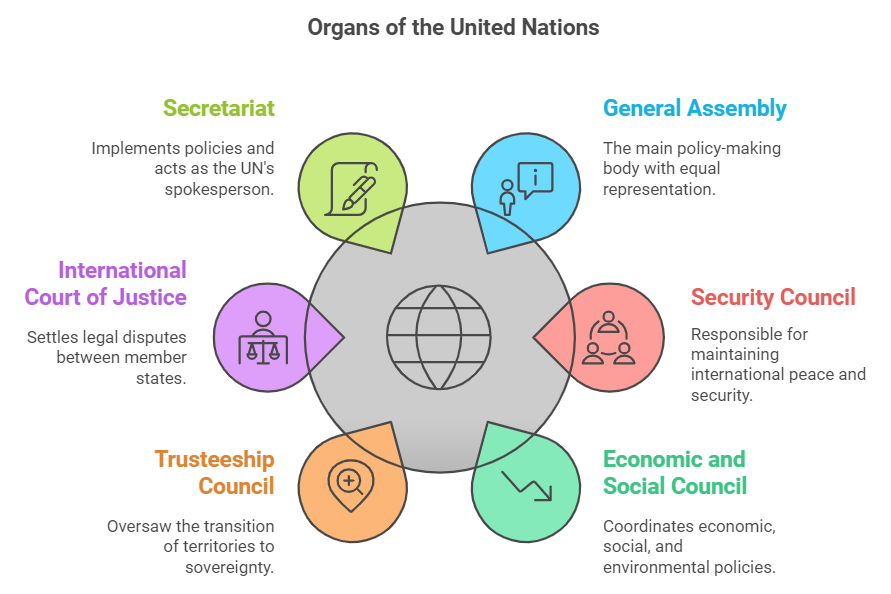
Article 7 establishes six principal organs. None is subordinate to another and each derives its authority directly from the Charter, but they are unequal in power, and the inequality is written into the text.
| Organ | Charter chapter | Composition | Core function |
|---|---|---|---|
| General Assembly | IV (Articles 9–22) | All 193 members, one vote each | Deliberation, budget, elections, recommendations on any Charter matter |
| Security Council | V (Articles 23–32) | 15 — five permanent, ten elected for two years | Primary responsibility for peace and security; its decisions bind |
| Economic and Social Council | X (Articles 61–72) | 54 members, three-year terms | Coordination of economic, social and health work; relations with the agencies; NGO consultative status |
| Trusteeship Council | XIII (Articles 86–91) | Suspended since 1994 | Supervision of trust territories towards self-government |
| International Court of Justice | XIV (Articles 92–96) | 15 judges, nine-year terms | Contentious cases between states on consent; advisory opinions |
| Secretariat | XV (Articles 97–101) | Secretary-General and staff | Servicing the other organs, and the political functions the office has acquired |
- The Security Council is the only organ whose decisions bind, under Article 25, and the only one able to authorise force. Its composition, working methods and the law of the veto are a subject of their own, as is the reform argument that follows.
- The International Court of Justice is the principal judicial organ; every member is automatically a party to its Statute, though not automatically subject to its jurisdiction, which rests on consent. Its jurisprudence and India’s record before it are treated in their own right.
- ECOSOC is the coordinating hub of the economic and social pillar, the channel through which the specialised agencies are brought into relationship and several thousand non-governmental organisations hold consultative status. The development system is a separate subject.
The Trusteeship Council: a completed mandate
- Eleven trust territories were placed under the system, administered by seven states, among them Tanganyika, Ruanda-Urundi, Cameroon, Togoland, Somaliland, Western Samoa, Nauru, New Guinea and the Pacific Islands.
- Palau, the last trust territory, became independent on 1 October 1994, and the Council suspended operation on 1 November 1994, amending its rules to meet only as occasion requires.
- It has not been abolished, because abolition needs a Charter amendment with all five permanent members ratifying, so it still exists in the Charter with no work. Proposals to repurpose it — as trustee of the global commons, or for future generations — have never attracted the amendment majorities.
What is, and is not, part of the United Nations
The most common structural error is to treat everything with a UN acronym as the same kind of body. Four legally distinct categories are in play, and the difference determines who controls a body, who funds it, and whether the Assembly can instruct it.
| Category | How created | Governance | Funding | Examples |
|---|---|---|---|---|
| Principal organs | By the Charter (Article 7) | Charter provisions | Regular budget | Assembly, Council, ECOSOC, ICJ, Trusteeship Council, Secretariat |
| Subsidiary organs, funds and programmes | By resolution under Articles 22 and 29 | Executive boards reporting through ECOSOC | Almost entirely voluntary | UNDP, UNICEF, UNFPA, UNHCR, WFP, UNEP, UN Women, UNCTAD, UNRWA |
| Specialised agencies | By their own treaties, under Articles 57 and 63 | Own membership, assemblies and executive heads | Own scales | ILO, FAO, UNESCO, WHO, ICAO, IMO, ITU, UPU, WMO, WIPO, IFAD, UNIDO, the Bank and the Fund |
| Related organisations | By separate treaty, outside Article 57 | Independent | Own budgets | IAEA, OPCW, CTBTO Preparatory Commission, WTO |
- Funds and programmes are creatures of the Assembly, created, merged or wound up by resolution. UNICEF began in 1946 as a temporary emergency fund and was made permanent in 1953; UNDP was formed in 1965 from two earlier funds; UNCTAD became a permanent organ in 1964.
- Specialised agencies are separate international organisations, not departments. The Organisation cannot instruct the World Health Organization or the International Labour Organization; it can only coordinate through relationship agreements negotiated case by case under Article 63, which is why those agreements differ so widely.
- The Bretton Woods institutions negotiated the loosest agreements of all, preserving weighted voting and effective autonomy. The agencies’ aims and functioning are a subject in their own right.
- Related organisations are neither. The IAEA reports to the Assembly and the Council under a 1957 relationship agreement but was created by its own statute; so were the OPCW and the WTO, which has no relationship agreement at all beyond cooperation arrangements.
- The practical consequence is that “the UN failed” is usually imprecise: a failure by an agency governed by its own member states is not a failure of the Security Council, nor is a failure of a voluntarily funded programme whose donors changed their minds.
The General Assembly: the plenary organ
The General Assembly is the only organ in which every member sits, and the only universal political forum in existence. Its authority is broad and its power is narrow, and almost everything interesting about it lies in that gap.
- Composition is universal: 193 members, each with one vote under Article 18(1) and up to five representatives.
- One state, one vote is the operative expression of sovereign equality, and produces the arithmetic that defines the Assembly’s politics: a two-thirds majority can be assembled by states representing a small fraction of world population and output.
- Sessions run for a full year. A regular session opens on the Tuesday of the third week of September and continues until the day before the next; the general debate occupies the first week and the Main Committees do the bulk of their work from September to December, with resumed sessions in the spring.
- Special sessions may be convened by the Council or a majority of members; more than thirty have been held, on disarmament, apartheid, Palestine and the environment.
- Emergency special sessions are convened within twenty-four hours under the Uniting for Peace procedure. Eleven have been held; the eleventh, on Ukraine, opened on 28 February 2022 and remains open.
The Main Committees and the machinery of the session
- Six Main Committees divide the agenda, and every member may sit on each, which makes them plenary bodies, not restricted committees.
| Committee | Subject |
|---|---|
| First | Disarmament and international security |
| Second | Economic and financial |
| Third | Social, humanitarian and cultural — including country human-rights resolutions |
| Fourth | Special political and decolonization — peacekeeping, Palestine, the remaining non-self-governing territories |
| Fifth | Administrative and budgetary — the only committee whose output binds member states |
| Sixth | Legal — treaty law, the International Law Commission’s reports, the terrorism conventions |
- The General Committee — the President, the 21 Vice-Presidents and the six committee chairs — manages the agenda and allocates items; its gatekeeping has itself been contested, most persistently over Taiwan-related items.
- The Credentials Committee of nine members verifies who lawfully represents each state — the Assembly’s back-door instrument on recognition and legitimacy, because the Charter provides no other.
- China, 1971: resolution 2758 restored the rights of the People’s Republic and expelled “the representatives of Chiang Kai-shek” — a representation question, not a membership one.
- Afghanistan and Myanmar since 2021: the Committee has repeatedly deferred a decision, so the seats are still held by representatives of the governments displaced by the Taliban takeover and the coup. Deferral is a decision in substance and everyone treats it as one.
The President of the General Assembly
- The President of the General Assembly is a distinct elected office and is not the Secretary-General. The confusion matters, because the President presides over the one organ the Secretary-General does not head.
- The President is elected by the Assembly for the one-year duration of a session, at least three months before it opens, and serves in a personal capacity.
- The office rotates among the five regional groups — African, Asia-Pacific, Eastern European, Latin American and Caribbean, and Western European and Others.
- Twenty-one Vice-Presidents are elected alongside, distributed by region with the five permanent members among them; they are Vice-Presidents of the session, not deputies of the Secretary-General.
- The 80th session’s President is Annalena Baerbock of Germany, elected in June 2025 by secret ballot with 167 votes against a write-in candidacy that drew seven — unusually contested for an office normally filled by acclamation.
- The office has grown but remains thin: a small support office and a convening role, including the mandatory debate after any veto, but no budget of its own, a one-year horizon and no executive machinery.
How the Assembly decides
- Article 18 sets two thresholds. Decisions on “important questions” need a two-thirds majority of members present and voting; everything else, including whether a question is important, needs a simple majority.
- The Charter’s own list of important questions is specific: recommendations on peace and security; election of the non-permanent members of the Council and of members of ECOSOC and the Trusteeship Council; admission, suspension and expulsion of members; trusteeship questions; and budgetary questions.
- Abstentions and absences do not count — “present and voting” means casting an affirmative or negative vote, so a resolution can pass on two-thirds of a fraction of the membership.
- Consensus has displaced voting for most business: roughly four-fifths of Assembly resolutions are now adopted without a vote, after negotiation on every word.
- The cost is dilution. Consensus gives every delegation an effective veto over language, which is why so many texts are unobjectionable and unmemorable, and why contested questions still go to a vote.
- Article 19 removes the vote of a member two full years in arrears, unless the Assembly is satisfied the failure was beyond its control.
- The Assembly routinely grants exemptions: in the 80th session only Afghanistan and Venezuela were actually deprived of a vote.
- It has never bitten a permanent member. The calculation is on assessed contributions for the two preceding full years, and a large debtor that pays just enough to stay under the threshold keeps its vote — the near-miss was the United States in 1998–99.
The Assembly’s powers under Articles 10 to 17
- Article 10 gives a general competence: the Assembly may discuss any question within the scope of the Charter or relating to the powers of any organ, and recommend on it. No subject is closed to it.
- Article 11 extends this to peace and security, including disarmament principles, and allows any member, non-member, the Council or the Secretary-General to bring a situation before it.
- Any question on which action is necessary must be referred to the Security Council. The Assembly may talk about anything and act on nothing requiring enforcement.
- Article 12 was meant to be the hard limit: while the Council is exercising its functions on a dispute, the Assembly shall make no recommendation unless the Council requests.
- Practice has hollowed this out. The Assembly now resolves routinely on matters concurrently before the Council, and the Court accepted this in the Wall advisory opinion, noting a tendency for the two organs to deal in parallel with the same matters.
- Articles 13 and 14 give the standard-setting and peaceful-adjustment functions — studies for the progressive development of international law and its codification, under which the International Law Commission was created in 1947.
- The elective and appointive powers are the most concrete. The Assembly elects the ten non-permanent members of the Council and the members of ECOSOC, elects the judges of the Court concurrently with the Council, admits members, and appoints the Secretary-General on the Council’s recommendation.
The budget as the Assembly’s one binding power
- Article 17 empowers the Assembly to approve the budget, and provides that the expenses of the Organisation shall be borne by the members as it apportions them.
- This is the only Charter provision under which an Assembly decision creates a legal obligation for member states. Everything else is recommendatory.
- The Court confirmed that reach in Certain Expenses of the United Nations (1962), holding that the costs of the Suez and Congo operations were “expenses of the Organisation” within Article 17(2), binding even on members that had opposed them.
- France and the USSR refused to pay anyway, precipitating the Article 19 crisis of 1964–65, in which the Assembly took no vote at all for a session rather than test the sanction.
- The episode set the pattern: the obligation is legal, the sanction is political, and the Organisation flinches from applying it to a great power.
What Assembly resolutions actually are
- Assembly resolutions are recommendations and do not bind member states. The Charter uses “recommend” throughout Chapter IV, and San Francisco rejected proposals to give the Assembly legislative power.
- They nonetheless generate law by an indirect route. A resolution can be evidence of opinio juris, the belief that a practice is legally required, which with state practice forms customary international law; it can crystallise existing custom; and it can begin a treaty process, as the Universal Declaration of Human Rights of 1948 did.
- The Court has used them in exactly that way.
- In Nicaragua (1986) it treated consent to resolutions such as the Friendly Relations Declaration of 1970 as an expression of opinio juris on the prohibition of force and on non-intervention.
- In the Nuclear Weapons advisory opinion (1996) it examined resolutions declaring nuclear use unlawful and held that, given substantial negative votes and abstentions, they revealed a desire for a rule without establishing one — resolutions are evidence, not self-executing law.
- “Soft law” is the usual label for declarations, codes and standards that do not bind but shape behaviour and often harden. The defence is that soft law lets states agree on content before they can agree on obligation, which is how most modern regimes began.
- The critics answer that a graduated normativity dissolves the binary quality on which legal obligation depends — Prosper Weil‘s objection — and that calling a resolution “law” flatters the Assembly’s real authority.
Uniting for Peace, in outline
- Resolution 377(V) of 3 November 1950 provides that where the Council fails to exercise its primary responsibility because of a lack of unanimity among the permanent members, the Assembly shall consider the matter immediately and may recommend collective measures, including the use of force in a case of aggression.
- It creates the emergency special session, convened within twenty-four hours on the vote of any nine Council members — a procedural vote, so not vetoable — or a majority of Assembly members.
- The eleventh emergency special session, on Ukraine, is the most recent invocation. Its origins, its use over Suez and the Congo, and its compatibility with Article 11(2) belong with the collective-security debate.
The politics of the Assembly, 1945 to now
- The Assembly began as a Western instrument. Of the 51 founding members twenty were Latin American and most of the rest aligned with the United States, which could assemble a two-thirds majority almost at will — Uniting for Peace was itself an American device for routing around Soviet vetoes.
- Decolonisation reversed the arithmetic within twenty years. By the mid-1960s Afro-Asian states with the Latin Americans could deliver majorities the West could not stop. The Group of 77, formed in 1964 at the first UNCTAD, became the standing coalition of the developing world, overlapping with the Non-Aligned Movement.
- The 1970s were the high-water mark of that majority, and its most confrontational period.
- The New International Economic Order was adopted by a special session in 1974, with the Charter of Economic Rights and Duties of States the same year — a programme for commodity prices, technology transfer and resource sovereignty. The NIEO campaign and its defeat are a subject of their own.
- Resolution 3379 of 10 November 1975 determined that Zionism is a form of racism, adopted 72–35 with 32 abstentions, and was revoked by resolution 46/86 on 16 December 1991 — the only outright repeal of its kind.
- Western disenchantment followed, and shaped the modern Organisation. The United States and its allies shifted serious business to the Security Council, where they could not be outvoted, and to forums outside the system; and they used funding as leverage, withdrawing from UNESCO in 1984 and withholding assessed contributions.
- The result is a genuine asymmetry: the majority that controls the Assembly does not control the money, and the minority that provides the money does not control the votes.
- The standing charge is that the Assembly is where resolutions go to be ignored — declaration substituting for action, the same texts every year, no means of compelling anything.
- The defence is that a universal forum’s value is not measured in enforcement. It confers and withholds legitimacy, generates norms other bodies later apply, gives small states their only hearing, and is where decolonisation and apartheid were fought and won.
The Assembly can say anything and decide almost nothing — except how much the Organisation may spend, which is why the budget is where its real fights happen.
Revitalising the Assembly
- “Revitalisation” is the Organisation’s own term for restoring the Assembly’s central place, pursued through an ad hoc working group re-established at each session.
- Its clusters cover the Assembly’s role and authority; working methods; the selection and appointment of the Secretary-General and other executive heads; and strengthening the President’s office.
- What it has delivered is procedural: rationalisation and biennialisation of agenda items, earlier elections so incoming presidents have transition time, shorter resolutions, and an inventory tracking more than 200 implemented recommendations. The 2016 opening of the Secretary-General’s selection came from this working group.
- What it has not delivered is any change in the balance between Assembly and Council, and implementation of Assembly resolutions remains unmonitored.
- Resolution 76/262 of 26 April 2022 is the one recent gain of substance: the President must convene a formal Assembly debate within ten working days of any veto, with the vetoing state invited to speak first — a reputational cost, not a legal one, but it makes the Council answerable to the plenary.
- The perennial structural proposals go further and go nowhere.
- A United Nations Parliamentary Assembly — a chamber of parliamentarians, advisory at first and eventually elected. The objections: it would duplicate the Inter-Parliamentary Union; seats weighted by population would reproduce the majority problem in a new form; and it needs Charter amendment or an organ the great powers would not fund.
- Weighted voting is refused by the overwhelming majority of members, for whom sovereign equality in the one universal organ is the point of belonging.
- Making resolutions binding would require Charter amendment and would be vetoed instantly; it also assumes states would comply with a body they currently ignore precisely because they need not.
The Secretariat and the international civil service
Chapter XV — Articles 97 to 101 — is four articles long, and creates both the Organisation’s bureaucracy and its only individual officeholder. Almost everything the office has become was built on that slender base.
- Article 97 makes the Secretary-General “the chief administrative officer of the Organization”, appointed by the Assembly on the Council’s recommendation — an administrative description the officeholders have consistently exceeded.
- Article 98 has the Secretary-General act in that capacity in all meetings of the other organs and report annually to the Assembly — the office’s standing platform for setting an agenda.
- Article 100 guarantees the exclusively international character of the staff: officials neither seek nor receive instructions from any government, and members undertake not to influence them.
- This is the international civil service idea, inherited from the League and shaped by Eric Drummond — a permanent, impartial career staff loyal to the organisation rather than seconded from capitals.
- It has been under continuous pressure: Soviet insistence on fixed-term secondment of its nationals, American loyalty screening in the early 1950s, and lobbying by states of every kind for their nationals’ promotion.
- Article 101 sets two criteria that pull against each other: the paramount consideration is “the highest standards of efficiency, competence, and integrity”, with due regard to as wide a geographical basis as possible.
Article 99: the office’s one independent instrument
- Article 99 lets the Secretary-General bring to the Council’s attention any matter which in his opinion may threaten international peace and security — the only Charter provision giving an international official an independent political initiative.
- It has been formally invoked only a handful of times in eighty years — Hammarskjöld over the Congo in 1960, Waldheim over the Iran hostage crisis in 1979, Pérez de Cuéllar over Lebanon in 1989.
- Guterres invoked it on 6 December 2023 over Gaza, warning that public order was about to break down completely — his first use in seven years.
- It forced a Council meeting, at which the resolution that followed was vetoed. The invocation showed both the power’s reach and its limit: it can compel the Council to meet, and nothing more.
- Most of what the office does under Article 99’s shadow is never formally invoked; the threat of invocation is more useful than the act.
Administrative officer or political actor
- Two conceptions of the office have competed since 1946.
- The administrative conception treats the Secretary-General as a servant of member states — efficient, discreet, without an independent political position, and preferred by the great powers.
- The political conception treats the office as a custodian of the Charter with an independent voice, able to act where states cannot agree.
- Hammarskjöld built the political conception and defended it at its greatest cost — reading Article 99 expansively, inventing peacekeeping without Charter authority, and arguing that a deadlocked Council obliges the Secretary-General to act on the Charter’s principles rather than wait.
- The Soviet “troika” proposal of 1960–61 was the counter-attack. Enraged by the Congo operation, Khrushchev demanded that the office be replaced by three officials representing the Western, socialist and non-aligned blocs, each with a veto.
- Hammarskjöld answered the Assembly in October 1960 that the Organisation existed above all for the small states, and that he would not resign at one power’s demand.
- The proposal collapsed after his death at Ndola on 18 September 1961, mainly because the non-aligned saw that a triple veto would paralyse the one organ that served them.
“The United Nations is what member nations made it, but… much depends on what the secretariat makes it. It has creative capacity. It can introduce new ideas.” — Dag Hammarskjöld
The nine Secretaries-General
| Secretary-General | Tenure | Nationality | What defines the tenure |
|---|---|---|---|
| Trygve Lie | 1946–1952 | Norway | Korea; the Soviet boycott after he backed the intervention forced his resignation |
| Dag Hammarskjöld | 1953–1961 | Sweden | Suez and the invention of peacekeeping; “preventive diplomacy”; the Congo; killed at Ndola |
| U Thant | 1961–1971 | Burma | Cuban missile crisis mediation; the 1967 withdrawal of UNEF and the Six-Day War |
| Kurt Waldheim | 1972–1981 | Austria | Denied a third term by a Chinese veto; his concealed wartime service emerged in 1986 |
| Javier Pérez de Cuéllar | 1982–1991 | Peru | The Iran–Iraq ceasefire, Namibian independence — the Cold War’s end unlocked the office |
| Boutros Boutros-Ghali | 1992–1996 | Egypt | An Agenda for Peace; Somalia and Rwanda; denied a second term by a single American veto |
| Kofi Annan | 1997–2006 | Ghana | The 1997 reform, the Millennium Declaration, the 2001 Nobel Peace Prize; Iraq 2003 called “illegal”; oil-for-food |
| Ban Ki-moon | 2007–2016 | Korea | Paris and the Sustainable Development Goals; criticised as deferential |
| António Guterres | 2017– | Portugal | The 2019 restructuring, the Pact for the Future, UN80, a funding collapse |
- Lie’s fate set the precedent that a Secretary-General who crosses a permanent member cannot function; his remark to his successor, that he was taking over “the most impossible job on this earth“, has been quoted by every incumbent since.
- U Thant’s withdrawal of UNEF from Sinai in May 1967, on the ground that a consent-based force cannot stay without consent, shows how narrow the office’s legal room is; he was blamed for a war he had no power to prevent.
- Annan is the office’s high point and its cautionary tale together — the 1997 reform and the Nobel Prize, then the oil-for-food procurement scandal and an open breach with Washington over Iraq.
“The United Nations was not created to take mankind to heaven, but to save humanity from hell.” — Dag Hammarskjöld
Choosing a Secretary-General
- Article 97 says only that the Assembly appoints on the Council’s recommendation. Everything else is convention, and the conventions are strong.
- The recommendation is a substantive decision and therefore vetoable — nine affirmative votes with no permanent member opposed.
- No national of a permanent member has ever held the office.
- Regional rotation is a claim rather than a rule, invoked by whichever candidate it favours.
- Two five-year terms is the norm; only Lie, Hammarskjöld and Boutros-Ghali did not serve two.
- The Council’s method is the straw poll, each member marking every candidate encourage, discourage or no opinion.
- Coloured ballots distinguish permanent from elected members in later rounds, so a candidate can see whether a discourage carries a veto — the device that ended Boutros-Ghali in 1996.
- The opacity critique is old and largely conceded: for seventy years the choice was made privately among the permanent members and presented to the Assembly as a single name for acclamation.
- The 2016 selection was the first real opening, driven by Assembly revitalisation and the civil-society “1 for 7 Billion” campaign — a joint Assembly–Council letter inviting nominations, published candidate lists, public informal dialogues before the whole membership, and circulated vision statements.
The 2026 succession
- Guterres’s second term ends on 31 December 2026. The joint Assembly–Council letter opened the process on 25 November 2025, and the President of the Assembly called for further candidacies on 16 January 2026.
- The first Council straw poll was held on 30 July 2026 and the second on 21 August 2026, with eight candidates — five women and three men, six from Latin America and the Caribbean and two from Africa.
- Second poll, encourage–discourage–no opinion:Carolyn Rodrigues Birkett (Guyana) 8–3–4; Rebeca Grynspan (Costa Rica) 7–4–4; Rafael Grossi (Argentina) 7–6–2; Macky Sall (Senegal) 6–7–2; Olara Otunnu (Uganda) 5–5–5; María Fernanda Espinosa (Ecuador) 4–3–8; Michelle Bachelet (Chile) 2–6–7; Ivonne A-Baki (Ecuador) 0–8–7.
- Grynspan led the first poll with ten encouragements and fell to seven; Rodrigues Birkett overtook her. No candidate has yet reached nine affirmative votes with no permanent-member discourage.
- Two arguments frame the contest: that no woman has held the office in eighty years, and that Latin America and the Caribbean are owed the rotation, last held when Pérez de Cuéllar left in 1991.
- The reform that will not go away is a single non-renewable seven-year term. An incumbent seeking reappointment must spend a first term avoiding offence to the five states that can block it, so candour and re-election are incompatible. Every review body since the 1990s has recommended it; no permanent member has.
The Secretariat in practice
- The 2019 restructuring was the largest reorganisation in decades. The peace and security department was split into the Department of Political and Peacebuilding Affairs (DPPA), carrying prevention, mediation and special political missions, and the Department of Peace Operations (DPO), carrying field operations, with shared regional divisions.
- Management was similarly split into the Department of Management Strategy, Policy and Compliance (DMSPC) and the Department of Operational Support (DOS), with authority delegated to managers and a compliance function to check it.
- The other principal entities are DESA on economic and social affairs, DGACM on conference management, OCHA on humanitarian coordination and OLA as the legal office.
- Four main duty stations — New York and the United Nations Offices at Geneva, Vienna and Nairobi, the last the only one in the developing world and long the least resourced.
- The criticisms are consistent across every review since the 1960s.
- Bureaucratic sclerosis — slow recruitment, layered clearance, budgeting by input rather than result, and a mandate stock that only grows.
- Patronage in senior appointments, with under-secretary-general posts treated as national entitlements under informal understandings.
- Weak whistleblower protection, criticised by the Organisation’s own oversight bodies, resting on the administration it is meant to police.
- Accountability gaps — functional immunity leaving victims of misconduct without an ordinary remedy, and internal justice that reaches staff but not troop contingents.
- Where the 2026 cuts have landed, stated factually — the reform agenda itself is a separate subject.
- The 2026 budget abolishes roughly 2,900 posts, close to a fifth of the regular-budget establishment and the largest single reduction the Secretariat has taken.
- About 220 posts have moved out of high-cost duty stations and some 1,900 more across the system; eleven administrative teams have merged into one platform, ten payroll operations into one, and a Digital Hub has opened at Valencia.
- The objection is that consolidation forced by one member’s non-payment is retrenchment, not redesign — the Secretariat’s shape is being set by a cash constraint rather than by a judgement about what the Organisation should do.
How the United Nations is paid for
The Organisation has two sources of money and they behave in opposite ways. Assessed contributions are a legal obligation, modest in total and controlled by the Assembly; voluntary contributions are discretionary, far larger, and controlled by the donor. Almost every complaint about the Organisation’s autonomy traces back to that ratio.
Assessed contributions and the scale
- The scale of assessments is fixed by the Assembly for three years on the Committee on Contributions’ recommendation, and applies to the regular budget.
- The base is capacity to pay — gross national income averaged over base periods, adjusted for external debt and low per capita income — but the scale is bounded at both ends by political decisions.
- A 22% ceiling applies to the largest contributor, lowered from 25% in 2000 at United States insistence and below what capacity to pay would produce, so every other member subsidises the largest economy’s share.
- A floor of 0.001% applies to the smallest, with least-developed countries capped at 0.01%.
- The current scale: the United States 22%, China about 20%, then Japan, Germany, the United Kingdom and France. China’s share has risen faster than any in the Organisation’s history, from about 1% in 2000.
- Peacekeeping uses a separate and steeper scale. Members are grouped in levels with developing countries discounted and the permanent members paying a premium, on the ground that they alone can authorise the operations.
- The United States is assessed at about 26% of peacekeeping against a statutory domestic cap of 25%, which has generated arrears for three decades. The peacekeeping budget is larger than the regular budget, and the two are separately assessed and separately in arrears.
Voluntary contributions and the earmarking problem
- Voluntary contributions dwarf assessed contributions across the system. The regular budget funds the Secretariat and the intergovernmental machinery; almost everything the public associates with the Organisation — relief, refugees, food, children, development — is funded voluntarily.
- The overwhelming majority of voluntary funding is earmarked to a country, project or theme chosen by the donor.
- The consequence is structural: donors, not governing bodies, set priorities. A board can adopt a strategic plan and find money arriving only for the parts a few capitals care about.
- The World Health Organization is the sharpest illustration — roughly four-fifths of its funding is voluntary and earmarked, which is why it can be criticised for neglecting a priority it has no means of funding.
- The defence is that voluntary money grew the system far beyond what assessed budgets would have supported, and that donors answerable to parliaments cannot write blank cheques.
The 2026 position
- The regular budget for 2026 is US$3.45 billion, approved in December 2025 — about US$270 million and 7.3% below the 2025 budget of US$3.715 billion — and it abolishes roughly 2,900 posts.
- Arrears stood at about US$1.586 billion on 1 December 2025: US$709 million left from 2024 and US$877 million of unpaid 2025 dues, with the United States accounting for the overwhelming majority.
- The Secretariat was required to cut 15% of expenditure in 2026, and cash was projected to run out around July; peace operations cut 15% and repatriated a quarter of their uniformed personnel in 2025.
- In early 2026 the Organisation returned US$227 million to member states — credits for money it had never collected — and offset a further US$72 million against arrears, an absurdity produced by rules treating unspent appropriations as members’ property.
- In mid-2026 the Fifth Committee eased that rule, letting unspent balances be retained against liquidity — the first structural fix to the cash problem in decades — alongside a US$5.1 billion peacekeeping budget for 2026–27.
The politics of the purse
- A single dominant funder converts an assessed obligation into leverage, and the record is long enough to be a pattern rather than an episode.
- Arrears are the instrument. Withholding is cheap, reversible, needs no majority and no amendment, and its effects can be disowned as the Organisation’s own mismanagement.
- The 1980s precedent is the clearest case. The Kassebaum–Solomon Amendment of 1985 directed that the United States cut its assessed contribution to 20% unless budgetary decisions were weighted by contribution.
- The Organisation conceded through resolution 41/213 of 1986, which settled that the budget outline and programme budget would be agreed by consensus in the Committee for Programme and Coordination and the Fifth Committee.
- That gave the major contributors a de facto veto over the budget without formal weighted voting — the substance of what the amendment demanded, obtained by withholding rather than by amendment.
- What dependence buys is not mysterious: senior appointments informally reserved for nationals of major contributors; mandates and programmes reshaped when funding to UNRWA, UNFPA, UN Women or the Human Rights Council is cut for policy reasons; and candour, since an administration that must ask its largest debtor for money has an incentive to soften what it says about it.
- The counter-argument is legal and strong. Assessed contributions are treaty obligations under Article 17(2), not subscriptions; non-payment is a breach of the Charter, not the exercise of a right, so withholding is leverage obtained by breaking a legal obligation and treating it as legitimate influence rewards non-compliance.
- Dependence runs both ways: the largest funder buys agenda-setting, convening power and legitimation it cannot get elsewhere, which is why the withdrawals of 2025 and 2026 are widely read as costly to their author.
An organisation that must ask one member for a fifth of its income has already conceded something about its independence.
Independent revenue, and why states refuse it
- Proposals for an independent revenue base recur whenever a cash crisis does, and none has been adopted.
- A currency transaction tax — a very small levy on foreign-exchange dealing, in the family of the Tobin tax.
- A levy on the arms trade, on the argument that those who profit from armament should fund peace.
- Aviation, shipping and carbon levies, whose base is genuinely international.
- Royalties on the global commons — deep-seabed minerals, orbital slots, Antarctic and high-seas resources — as common heritage funding common institutions.
- The refusal is political, not technical.
- The power to tax is the core attribute of sovereignty, and no state will concede it to a body it does not control.
- An independently funded Organisation would be an autonomous one, which is exactly what its funders do not want; the leverage described above would vanish.
- Developing states are not enthusiasts either, fearing levies falling on the trade and transport they depend on, and a self-funding Secretariat less answerable to the Assembly they dominate.
India, the founding and the finances
- India was a founding member while still a dependency — a signatory of the Declaration by United Nations on 1 January 1942 and a delegation at San Francisco — and its delegates pressed anti-colonial and racial-equality arguments the Charter’s self-determination language later carried.
- The Assembly, not the Council, has been India’s most productive forum. Its campaign from 1946 against the treatment of Indians in South Africa put a state’s internal racial policy on the agenda and began the erosion of Article 2(7) as a shield.
- India was instrumental in creating the Group of 77 and in making UNCTAD, UNDP, UNEP and a permanent UNICEF part of the Assembly’s machinery.
- Vijaya Lakshmi Pandit presided over the eighth session in 1953 — the only Indian, and the first woman, to hold the presidency.
- On money, India’s position since 1993 has been that contributions must be judged relatively, not absolutely: an assessed share on the Organisation’s scale entails a proportionately greater sacrifice for a low per capita income country, and readiness to meet obligations matters more than the quantum at any moment.
- India’s contemporary formulation is “reformed multilateralism” — not abandoning the Organisation but making it representative, since the institutions of 1945 encode a distribution of power that no longer exists. The case for a permanent seat belongs with India’s own record at the Organisation.
Not a political system acting in a vacuum
The Organisation is a derivative institution. It was created by states, is composed of states, is funded by states and acts through states, so its outputs are largely a function of the distribution of power outside it rather than of anything internal to it.
- The Charter encodes the 1945 distribution of power. The permanent membership is that war’s victorious coalition, and the veto exists because those five would not join a body that could act against them.
- For most business it is an arena rather than an actor. What emerges from the Council is the resultant of great-power preferences and what emerges from the Assembly the resultant of bloc arithmetic; neither is an independent institutional judgement.
- The realist reading follows directly. Mearsheimer‘s argument that institutions are epiphenomenal — reflections of the balance of power with little independent effect — takes the Organisation as its exhibit.
- The evidence is the correlation: Council productivity rises and falls exactly with great-power relations — paralysis to 1989, an authorisation boom to 1994, paralysis again after 2022.
- The counter-case is institutional, and it is not weak.
- Regime theory, and Keohane in particular, holds that institutions persist because they lower transaction costs, supply information and make commitments credible, so they change what states can achieve without changing what they want.
- Barnett and Finnemore treat international organisations as bureaucracies with authority of their own, derived from rational-legal form, delegated mandates, moral standing and control of expertise — an authority that lets them classify problems, fix meanings and diffuse norms, and that also generates pathologies.
- The Secretariat’s agenda-setting is the concrete case: peacekeeping was invented there rather than mandated by the Charter, and An Agenda for Peace, the Millennium Declaration and the SDGs were Secretariat-driven frameworks governments then adopted.
- The accurate formulation is intermediate: the Organisation is constrained by the distribution of power and consequential at the margin, and the margin is where most of what it has achieved lies.
A microcosm of world politics
The Organisation has no separate weather. Whatever is happening among its members is happening inside it, usually within weeks, and its institutional history is legible as a reflection of the political history.
- The Cold War freeze, 1946–1989. The Council was deadlocked almost from the start and admissions blocked in both directions until 1955; the Soviet boycott of January to August 1950 is the only reason the Korea authorisation passed, and its lesson has governed permanent-member behaviour since.
- The Assembly became the venue of whichever bloc held the majority, which is why Uniting for Peace was an American device in 1950 and an embarrassment to the West by 1975.
- The decolonisation surge, 1955–1970. Membership more than doubled, the Afro-Asian bloc took the Assembly’s arithmetic, Resolution 1514 of 1960 turned self-determination into a programme, and the agenda moved to colonialism and apartheid.
- North–South confrontation in the 1970s. Commodity power emboldened the majority; the NIEO passed over Western objection; and the Zionism resolution marked the point at which the West concluded the Assembly could not be worked with.
- The 1990s window. Great-power alignment produced the Gulf authorisation, a fivefold expansion of peacekeeping, the Yugoslav and Rwandan tribunals — and also Somalia, Rwanda and Srebrenica, the failures that closed it.
- The counter-terrorism turn after 2001. The Council legislated for all states for the first time in resolution 1373 and extended the 1267 sanctions regime to individuals — an expansion of Council power whose due-process problems persist.
- The post-2022 relapse. The Council is paralysed on Ukraine and Gaza, the largest funder is withdrawing from a third of the system, the Assembly has fallen back on emergency special sessions and the veto debate, and states are building minilateral substitutes outside the Charter.
- The pattern across all six phases is one pattern. When the great powers agree the Organisation acts; when they divide it deliberates; and the composition of its majorities tracks the composition of the international system. This is not a defect in the design — it is the design.
Assessment
The Charter’s authors built an organisation that assumes great-power agreement and provides very little for its absence, and eighty years have shown that assumption doing exactly what it was designed to do. The Assembly gives every state a voice and almost no power; the Secretariat has an independence the Charter barely authorises; and the money arrives from members who can withhold it.
- The design held where its predecessor’s collapsed: universality was achieved, the great powers never left, and the prohibition on force is now peremptory law.
- The structural weaknesses are the ones the drafters accepted knowingly: a veto that immunises the powerful, a plenary body whose resolutions do not bind, and no independent revenue.
- Financing has become the most immediate of the three, because a body dependent on one member’s discretion cannot claim the impartiality its authority rests on.
- What has changed since 1945 is not the design but the world it maps. Whether the structure can reflect a distribution of power the Charter never anticipated is a question about amendment, and therefore about the veto — and therefore back where it began.
Previous Year Questions
- In what way does the predominance of the USA in the UN funding affect the decision making? (2019)
- “From the start, the United Nations become a microcosm of world politics, with developments within the institution tending to mirror the atmosphere and happenings outside its walls.” Comment. (1995)
- ‘The United Nations is not political system acting in a vacuum: nor does it operate above international system/ Comment. (1992)
