

The trading order built after 1945 did something no earlier trade arrangement had managed: it took disputes always settled by who could hurt whom more and turned them into arguments about what a text meant. That conversion — from power bargaining to rule application — is the achievement on which the system rests, and it is what is now being unwound, deliberately, by the member that designed it.
Why a trade institution was attempted at all

The case for writing trade rules down came from a decade in which the absence of rules had been tried and had produced a catastrophe.
- The interwar collapse is the founding memory of the postwar trade order, and every rule of the 1947 text answers a failure of the 1930s.
- The Smoot-Hawley Tariff Act of 1930 raised United States duties on over twenty thousand goods to near-record levels just as world demand contracted.
- Retaliation followed within months from Canada, France, Spain, Italy and Switzerland, and Britain abandoned free trade for Imperial Preference at Ottawa in 1932. World trade fell by roughly two-thirds in value between 1929 and 1934 in the resulting retaliatory spiral, transmitting the depression across borders rather than containing it.
- Competitive devaluation compounded it, so trade and monetary policy each made the other worse — the reason the 1944 planners treated them as one problem with two institutions.
- Cordell Hull, Roosevelt’s Secretary of State and author of the Reciprocal Trade Agreements Act of 1934, held that unhindered trade was a condition of peace and that economic warfare had helped produce the shooting kind.
The International Trade Organisation and the charter that died
- Bretton Woods created two institutions in 1944 and envisaged a third pillar for trade, but the trade negotiation was deferred and conducted separately under United Nations auspices.
- The Havana Conference on Trade and Employment (November 1947 to March 1948) produced the Havana Charter, signed by fifty-three states, establishing an International Trade Organisation. It was extraordinarily ambitious: beyond tariffs it covered employment policy, economic development, restrictive business practices, commodity agreements and foreign investment.
- The United States never ratified it. Truman withdrew the Charter from Congressional consideration in December 1950, and without American membership the ITO was pointless.
- Protectionists objected that it surrendered too much tariff autonomy; free-traders objected that its employment and development chapters conceded too much to planning. It was killed from both directions at once — a pattern that recurs whenever a trade instrument tries to carry non-trade objectives.
- What survived was the General Agreement on Tariffs and Trade, negotiated at Geneva in 1947 by twenty-three contracting parties as the tariff-schedule chapter of the coming ITO.
- Signed on 30 October 1947 and applied from 1 January 1948 through a Protocol of Provisional Application — a device meant to bring tariff cuts into effect for a year or two while the Charter was ratified — the arrangement lasted forty-seven years.
What “provisional” actually meant
The word was not decorative: GATT’s provisional status shaped what it could do for half a century.
- The contracting parties were never members of anything. GATT had no legal personality, no founding treaty in force and formally no secretariat — its staff were borrowed from the Interim Commission for the ITO, a body for an organisation that never existed.
- The grandfather clause is the sharper consequence: the Protocol obliged signatories to apply Part II — national treatment, quantitative restrictions, subsidies, anti-dumping — only to the fullest extent not inconsistent with existing legislation.
- Domestic laws already on the books when a country acceded were therefore immune from challenge, permanently, without any requirement to phase them out.
- The clause is why GATT’s Part I obligations — most-favoured-nation treatment and the tariff schedules — were hard law while much of Part II was soft, and why the single undertaking of 1995 had to sweep the grandfathering away.
Provisionality was not a technicality. It is the reason a trade agreement could bind tariffs absolutely while leaving whole bodies of protectionist domestic law untouched.
The principles of the General Agreement, explained
GATT’s substance is a small number of rules doing a great deal of work. Each answers a specific way a state can cheat on a trade bargain.
Most-favoured-nation treatment — Article I
- MFN is the load-bearing rule of the entire system, and everything else is arranged around it.
- Article I requires that any advantage granted to a product of any country be extended immediately and unconditionally to the like product of all other contracting parties.
- It is unconditional MFN: nineteenth-century treaties used conditional MFN, under which a third state got a concession only if it paid separately, producing a tangle of discriminatory rates.
- Economically, MFN converts every bilateral bargain into a multilateral public good: a concession bought by one country is enjoyed by all, so the tariff structure converges on a single schedule rather than a web of preferences.
- It denies states the ability to divide and rule — punishing a small partner while sparing a large one — which is what the 1930s spiral consisted of.
- Politically, a small economy receives the same treatment as a great power without buying it, which is the trading system’s most genuine equalising feature.
National treatment — Article III
- National treatment governs what happens after the goods clear customs, and it is the rule that stops a tariff concession being taken back through the internal tax code.
- Article III forbids internal taxes and regulations applied so as to afford protection to domestic production, and requires imported products to be treated no less favourably than like domestic products.
- Border and behind-the-border discrimination is the analytically important distinction.
- Border measures — tariffs, quotas, customs procedures — are visible, quantifiable and negotiable, and GATT disciplines them by binding them.
- Behind-the-border measures — excise taxes, standards, labelling, distribution licences, environmental requirements — are where protection migrates once tariffs are locked down, and are far harder to police because they are usually also genuine regulation.
- MFN forbids discriminating between foreigners; national treatment forbids discriminating against foreigners.
Reciprocity, and why it is not neutral
- Reciprocity is a negotiating norm, not a legal obligation: concessions are exchanged for concessions of roughly equivalent commercial value. Its mercantilist framing — imports a cost, exports a gain — is deliberate, because it gives export lobbies a stake in liberalisation.
- The asymmetry problem is structural, not incidental. Reciprocity presumes both parties have something the other wants.
- A developing economy exporting a narrow band of primary commodities has little market access to offer, so equivalent exchange yields it very little; and its tariffs are often its principal revenue source and its main infant-industry instrument, so what it is asked to give up costs disproportionately.
- Formally equal bargaining therefore produces substantively unequal outcomes — the analytical core of the Southern critique, and the reason non-reciprocity became the developing world’s central demand.
Binding of tariffs, and the preference for tariffs over quotas
- A bound tariff is a legal ceiling entered in a member’s schedule under Article II, not to be exceeded without renegotiation and compensation to affected suppliers.
- Applied rates may be lower, and the gap — tariff water — is legal policy space many developing members retain. Binding matters less for the level of protection than for its predictability.
- Article XI prohibits quantitative restrictions as a general rule, with exceptions for balance-of-payments difficulties, agriculture and food security.
- The preference for tariffs over quotas is a considered position, not a prejudice.
- A tariff is transparent — a published number whose cost to consumers can be measured — and negotiable, cuttable by a stated percentage in a round, which a quota is not.
- A tariff yields revenue to the state; a quota yields rents to the licence-holder, creating a constituency for keeping it and inviting corruption in its allocation.
- The Uruguay Round’s agricultural tariffication applied the preference systematically: convert every non-tariff barrier into its tariff equivalent, then bind and cut it.
Transparency
- Transparency is the enforcement precondition for everything else, since a rule against hidden protection is unenforceable if the protection cannot be seen.
- Article X requires prompt publication of trade laws and rulings of general application, and their uniform, impartial and reasonable administration; the individual agreements add notification obligations for subsidies, standards and trade remedies.
The exceptions, without which the system would not have survived
A trade agreement with no escape valves is a trade agreement no legislature will ratify. GATT’s exceptions are what allowed governments to sign rules that would sometimes hurt them.
| Provision | What it permits | The controlling limit |
|---|---|---|
| Article XX — General exceptions | Measures necessary for public morals, human, animal or plant life or health, conservation of exhaustible natural resources, compliance with domestic law, and other listed grounds | The chapeau: no “arbitrary or unjustifiable discrimination” or “disguised restriction on international trade”; measures must be necessary or relating to the listed aim |
| Article XXI — Security exception | Action a member “considers necessary for the protection of its essential security interests” in defined circumstances, including “war or other emergency in international relations” | Long treated as self-judging; a 2019 panel held otherwise (below) |
| Article XIX — Safeguards | Temporary emergency protection against a surge of imports causing serious injury to a domestic industry | Requires injury findings, is time-limited, and originally required compensation to affected exporters |
| Article XXIV — Customs unions and free trade areas | Preferential arrangements that would otherwise breach MFN | Duties must not rise against outsiders, and the arrangement must cover “substantially all the trade“ |
| Article XII / XVIII:B | Quantitative restrictions for balance-of-payments reasons | Article XVIII:B is the developing-country version; India relied on it heavily until 1997 |
| Enabling Clause, 1979 | Permanent legal basis for preferences in favour of developing countries and for South-South preferential arrangements | Preferences must be generalised, non-discriminatory and non-reciprocal |
- Article XXIV is the largest hole in MFN and everyone knows it. Its “substantially all the trade” test has never been authoritatively quantified, and the result is that 387 regional trade agreements are in force out of 640 notifications — a preferential architecture running alongside the multilateral one.
- Jagdish Bhagwati‘s objection is the standard one: overlapping preferential deals with differing rules of origin create a “spaghetti bowl” in which the applicable tariff depends on documentary provenance rather than on the product, which is the opposite of what MFN was for.
The eight rounds
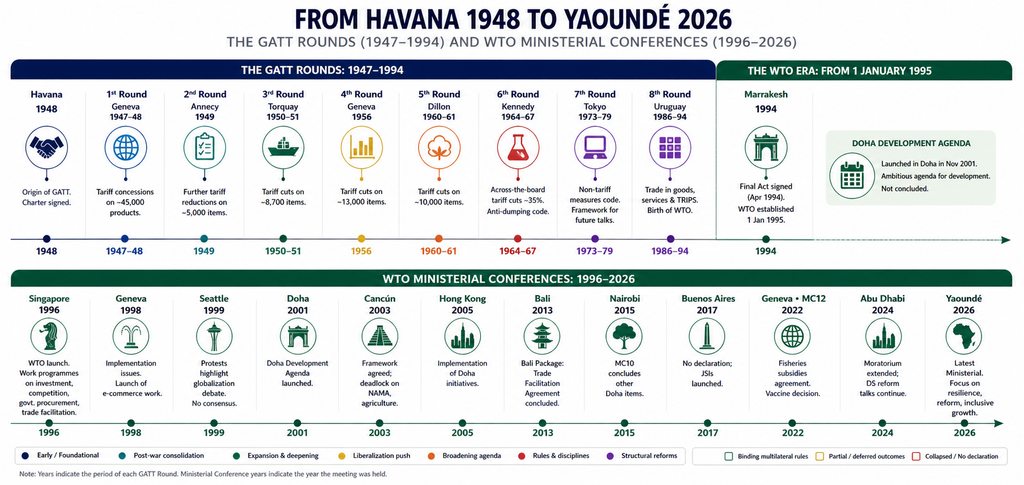
Tariff negotiation proceeded in rounds — multi-year conferences ending in a single package. The early ones were short and about tariffs; the later ones grew longer, larger and more concerned with everything tariffs are not.
| Round | Dates | Participants | What it did |
|---|---|---|---|
| Geneva | 1947 | 23 | Founding round; 45,000 tariff concessions covering about a fifth of world trade |
| Annecy | 1949 | 13 | Accessions and about 5,000 concessions |
| Torquay | 1950–51 | 38 | About 8,700 concessions; the United States rejected the ITO in this period |
| Geneva | 1955–56 | 26 | Modest cuts; $2.5 billion of trade covered |
| Dillon | 1960–61 | 26 | Prompted by the EEC’s common external tariff; item-by-item bargaining reached its limits |
| Kennedy | 1964–67 | 62 | Across-the-board linear cuts; average industrial tariffs cut by about a third; first Anti-Dumping Code |
| Tokyo | 1973–79 | 102 | Further tariff cuts of about a third; plurilateral codes on non-tariff barriers; the Enabling Clause |
| Uruguay | 1986–94 | 123 | Services, intellectual property, agriculture, textiles, the single undertaking and the WTO itself |
The Kennedy Round and the linear method
- The Kennedy Round changed the method of negotiation, which mattered more than the numbers.
- Earlier rounds proceeded item by item between principal suppliers — unmanageable as membership grew, and easy to game by protecting sensitive lines.
- The Trade Expansion Act of 1962 authorised the American President to cut tariffs by up to 50% across the board, and the round adopted linear cuts with negotiated exceptions instead. Industrial tariffs fell by roughly 35%.
- The first Anti-Dumping Code was agreed here — the earliest attempt to discipline a trade remedy rather than a border barrier, and the system’s first move into how states regulate rather than what they charge.
- Developing countries gained little, because linear cuts on industrial tariffs did not touch the agricultural and textile products they actually exported — the immediate background to Part IV and to UNCTAD.
The Tokyo Round and the “GATT à la carte” problem
- The Tokyo Round was the first serious attempt on non-tariff barriers, and its method created a defect that took fifteen years to repair.
- It produced six codes: on subsidies and countervailing measures, anti-dumping, technical barriers to trade (the “standards code”), import licensing, customs valuation and government procurement.
- The codes were plurilateral — binding only on those who signed them — and most developing countries did not sign, having no wish to accept obligations they had not sought.
- The consequence was a fragmented rulebook, remembered as “GATT à la carte”: different members bound by different rules on the same subject, with obligations checkable only pair by pair.
- It weakened MFN in practice, since code benefits were often extended only to signatories, and let developing members stay out at the cost of having no voice in the codes. The single undertaking was the direct answer.
- The Enabling Clause was also agreed at Tokyo in 1979, giving permanent legal cover to preferences for developing countries.
The Uruguay Round: the transformative one
The Uruguay Round is the hinge of the subject. It ran eight years, nearly collapsed twice, and produced not a set of tariff cuts but a new legal order.
- Punta del Este, September 1986 launched the round, and the launch itself was contested.
- The United States pressed for services, intellectual property and investment; India and Brazil led a group of ten developing countries in resisting, arguing these belonged to UNCTAD and the World Intellectual Property Organization.
- The compromise was procedural — services were negotiated on a separate track, which is why GATS is a distinct agreement — and agriculture and textiles went on the agenda as the price of Southern participation.
- The Montreal mid-term review of December 1988 deadlocked over agriculture, the United States demanding elimination of all trade-distorting support and the European Community refusing. Salvaged at Geneva in April 1989, it produced one durable result: the Trade Policy Review Mechanism.
- The Dunkel Draft of December 1991 — the Draft Final Act assembled by Director-General Arthur Dunkel — was the turning point in method.
- With negotiations stalled, Dunkel put forward a complete text on his own responsibility, take-it-or-leave-it, covering all fifteen negotiating groups. Nearly all of it survived, which is why the Uruguay Round outcome is substantially the Dunkel text.
- Its reception in India was fierce and formative, because the draft was read as an assault on the developmental state.
- Product patents in pharmaceuticals would end the cheap generics that Indian process-patent law had made possible.
- Patents on seeds and plant varieties were taken to threaten farmers’ customary right to save and exchange seed.
- The Agreement on Agriculture would constrain the Public Distribution System and input subsidies; services liberalisation would expose banking and insurance.
- Farmers’ movements — the Karnataka Rajya Raitha Sangha and the Bharatiya Kisan Union — mobilised against it, with mass protests at Bangalore and Delhi in 1993.
- The government signed nonetheless, judging exclusion from the emerging system worse than adverse terms inside it — and India’s subsequent WTO diplomacy has been an attempt to recover the ground lost in that calculation.
- Marrakesh, 15 April 1994: 123 participants signed the Final Act, the Marrakesh Agreement Establishing the World Trade Organization and its annexes — some 22,000 pages with the schedules. The WTO came into being on 1 January 1995.
“…strengthen the world economy and lead to more trade, investment, employment and income growth throughout the world.” — Marrakesh Declaration, 15 April 1994
What GATT could not do
GATT worked: average industrial tariffs among developed members fell from around 40% in 1947 to under 4%, and world trade grew far faster than world output throughout. Its failures were nonetheless structural, which is why it had to be replaced rather than amended.
- No legal personality and no organisational base. GATT could not conclude treaties, its budget and staff were improvised, and it had no standing to represent the trade regime in other forums.
- A dispute mechanism the losing party could switch off.
- Every consequential step — establishing a panel, adopting its report, authorising retaliation — required positive consensus of the CONTRACTING PARTIES.
- Because the losing party was itself a contracting party it could block adoption of a report against it by objecting, and there were no deadlines, no appellate review, no compliance rules and no surveillance of implementation.
- Agriculture was effectively carved out.
- The United States obtained an open-ended waiver in 1955 for import restrictions under its agricultural legislation, and the precedent legitimised everyone else’s exceptions.
- Article XI’s quota ban carried agricultural exceptions, and export subsidies on primary products were permitted under Article XVI where they took no “more than an equitable share” of world trade — a phrase that disciplined nothing.
- The Common Agricultural Policy was built inside these gaps, and by the 1980s the transatlantic export-subsidy war in cereals was depressing world prices for every other exporter.
- Textiles and clothing were governed by a parallel regime of managed quotas.
- The Short-Term and Long-Term Arrangements on Cotton Textiles gave way to the Multi-Fibre Arrangement of 1974, extending country-by-country, product-by-product quotas across cotton, wool and synthetics.
- It was explicitly discriminatory — bilateral quotas against named developing exporters — an institutionalised breach of MFN in the one manufactured sector where developing countries had a clear comparative advantage, and it lasted thirty-one years.
- Services, investment and intellectual property were outside the system altogether, just as services became the larger part of developed output.
- Grey-area measures spread as tariffs fell, because Article XIX safeguards required proof of serious injury and originally compensation to exporters.
- Voluntary export restraints — an exporter “voluntarily” limiting shipments under threat of worse — were the principal device: Japanese cars, steel, machine tools, semiconductors. They were outside GATT’s disciplines by design, discriminatory, opaque, and handed the quota rent to the exporter’s producers rather than the importing treasury.
Part IV and the origins of special and differential treatment
- Part IV on Trade and Development was added in 1965, the first formal recognition that identical rules for unequal parties produce unequal outcomes.
- Article XXXVI states the principle of non-reciprocity: developed parties “do not expect reciprocity” for commitments to reduce barriers to less-developed parties’ trade. Its weakness was that the obligations were drafted as best endeavours and were never justiciable.
- The Generalised System of Preferences required a legal carve-out, because preferences for some countries and not others breach Article I. A ten-year waiver in 1971 permitted non-reciprocal tariff preferences to developing countries.
- Preference schemes are autonomous and unilateral: the granting country sets coverage, depth and graduation and can withdraw them. That non-contractual character is their permanent weakness.
- The Enabling Clause of 1979 made the arrangement permanent, and is the standing legal basis for GSP schemes, preferences among developing countries, special treatment of least-developed members and non-reciprocity in negotiations.
- Preferences must be generalised, non-discriminatory and non-reciprocal — the words on which EC — Tariff Preferences turned when India challenged the European Union’s drug-arrangements preference.
- Special and differential treatment descends from these provisions in four shapes: longer transitions; higher thresholds and lower reduction commitments; positive commitments by developed members; and flexibility in the use of policy instruments.
The campaign that produced Part IV, UNCTAD and the preference system was led substantially by India within a wider Southern coalition; that political history belongs with the New International Economic Order.
The World Trade Organization from 1 January 1995
The WTO is not GATT renamed. Four changes separate them, and every current controversy is traceable to one of the four.
| GATT 1947 | WTO 1995 | |
|---|---|---|
| Legal status | A provisional agreement; no legal personality | An organisation with legal personality |
| Participants | Contracting parties | Members, with defined rights and obligations |
| Coverage | Goods only | Goods, services, intellectual property, agriculture, investment measures |
| Acceptance of rules | Selective — codes bound only signatories | Single undertaking — all agreements bind all members |
| Domestic law | Grandfather clause shielded existing legislation | No grandfathering; conformity required |
| Dispute settlement | Adoption by positive consensus, so the loser could block | Appellate review, negative consensus, fixed timetables |
| Remedies | Retaliation rarely authorised | Authorised retaliation, including cross-retaliation |
| Surveillance | Ad hoc | Trade Policy Review Mechanism on a fixed cycle |
- The single undertaking is the most consequential of the four, and it is a bargain rather than a tidying-up.
- Nothing is agreed until everything is agreed: members accept the whole package or none of it, which ended à la carte fragmentation and gave the system one rulebook.
- It made cross-sectoral linkage unavoidable. Developing members obtained the agricultural and textile disciplines they wanted only by accepting TRIPS and TRIMS, which most would not have signed alone — the Southern reading of the round as an unequal bargain rests on this.
- Its later cost is paralysis: at 166 members a package needing universal agreement across every subject is unclosable, which killed Doha.
Structure
- The Ministerial Conference, all members, meets at least once every two years and may decide any matter under any agreement.
- The General Council of resident ambassadors runs the organisation between ministerials and wears three hats — General Council, Dispute Settlement Body, Trade Policy Review Body: the same delegates under different rules of procedure.
- Three sectoral councils report to it, for goods, services and TRIPS, with committees beneath them on agriculture, sanitary measures, technical barriers, subsidies, trade remedies, regional agreements and trade and development.
- The Secretariat at Geneva has roughly 650 staff and, unlike the Fund and the Bank, no operational or lending power at all — it services negotiations it cannot direct.
- The Director-General is Ngozi Okonjo-Iweala, the first woman and first African to hold the post, reappointed on 29 November 2024 to August 2029. Membership is 166, after Comoros and Timor-Leste acceded in February 2024.
Decision-making: consensus, and what it costs
- The WTO decides by consensus, defined negatively: a decision is taken if no member present formally objects. Abstention and silence do not block.
- Voting is provided for and essentially never used. The Marrakesh Agreement permits one-member-one-vote decisions, but members avoid them: a vote would concede that a member can be bound against its will.
- The result is a genuinely member-driven organisation, which is at once its strength and its disease.
- The strength: no member, however small, can be legislated over. Against the IMF’s weighted voting the WTO’s formal equality is real, and the Global South’s ability to block at Seattle and Cancún is its proof.
- The paralysis: any one of 166 members can stop anything. The e-commerce moratorium lapsed in 2026 because two members declined to join a consensus — the rule working exactly as written.
- The informal correction is worse than the formal rule. Consensus is built in the “Green Room”, small invitation-only meetings convened by the Director-General, then presented to the membership. Exclusion from the room, not the vote, is where power operates — the proximate cause of the collapse at Seattle in 1999.
Formal equality with informal exclusion is not a contradiction the WTO has resolved. It is the way the organisation has always actually worked.
The covered agreements
The Marrakesh Agreement is a short framework treaty with four annexes: Annex 1 the multilateral agreements binding on all; Annex 2 the Dispute Settlement Understanding; Annex 3 the Trade Policy Review Mechanism; Annex 4 plurilaterals binding only on signatories.
| Agreement | What it governs | Who it favours |
|---|---|---|
| GATT 1994 | Goods; incorporates GATT 1947 without the Protocol of Provisional Application | Broadly neutral; the grandfather clause is gone |
| GATS | Services, across four modes of supply | Developed economies; the Mode 4 gains the South sought were minimal |
| TRIPS | Patents, copyright, trademarks, designs, geographical indications, trade secrets | Net technology exporters |
| Agreement on Agriculture | Market access, domestic support, export competition | Developed subsidisers, through box reclassification and the reference price |
| SPS and TBT | Health measures; technical regulations and standards | Ambiguous — compliance capacity is costly for small exporters |
| TRIMS | Investment measures affecting trade in goods | Foreign investors; local content requirements are removed from the development toolkit |
| SCM | Subsidies and countervailing measures | Ambiguous; the export-subsidy ban binds developing exporters hardest |
| Anti-Dumping and Safeguards | Trade remedies; voluntary export restraints prohibited | Heavy users of anti-dumping; safeguards discipline benefits all |
| Textiles and Clothing | MFA phase-out to 1 January 2005 | Developing exporters — the round’s clearest Southern gain |
| Trade Facilitation | Customs procedures; in force February 2017 | Broadly positive; the only Doha-era multilateral deal |
| Fisheries Subsidies | IUU, overfished stocks, high seas; in force 15 September 2025 | Sustainability; contested on special and differential treatment |
| GPA (plurilateral) | Government procurement markets | Signatories only; India is an observer |
| TPRM (Annex 3) | Peer review of members’ trade policies | Transparency; not enforceable |
GATS and the four modes
- GATS extended trade rules to services, harder than goods because most services cannot be shipped — so it defines trade by how supplier and consumer meet.
- Mode 1, cross-border supply: the service crosses, the people do not — outsourcing, software, telemedicine.
- Mode 2, consumption abroad: the consumer travels — tourism, education, medical treatment.
- Mode 3, commercial presence: the supplier establishes abroad — foreign bank branches, insurance, retail. This is investment law inside a trade agreement.
- Mode 4, movement of natural persons: staff travel temporarily to deliver the service.
- The scheduling method is the crucial difference. GATT is a negative list — everything covered unless excepted. GATS is a positive list: market access and national treatment bind only in the sectors a member schedules, to the extent of the limitations it inscribes, so its liberalisation is shallow by construction.
- Mode 4 is the developing world’s principal unrealised interest. India has pressed since the round for binding commitments on temporary movement of professionals, and developed members have kept them minimal because Mode 4 collides with immigration policy. Modes 1 and 3 were liberalised; Mode 4 was not.
TRIPS and the shift from process to product patents
- TRIPS made intellectual property trade law, taking it out of the World Intellectual Property Organization: standards became binding and backed by trade retaliation. Its core requirement is patents for twenty years from filing, in all fields of technology, for products and processes alike.
- The process-to-product shift is the substantive change and the reason TRIPS is contested.
- A process patent protects one method of making a compound; a rival who invents a different route to the same molecule may make and sell it. A product patent protects the molecule itself, by any route, for twenty years.
- India’s Patents Act, 1970 allowed only process patents for pharmaceuticals, and that choice built the Indian generics industry. Indian generic competition took first-line HIV therapy from roughly $10,000 per patient a year to under $350 in 2000–01, which is what made treatment programmes in Africa conceivable.
- The distributive objection is straightforward. Industrialised states hold the overwhelming majority of patents, and countries with little research capacity gain almost nothing from stronger protection while paying more for it. TRIPS is a transfer from net technology importers to net technology exporters.
- Traditional knowledge and biopiracy are the second grievance: patents granted on the healing properties of turmeric and the pesticidal properties of neem, both later revoked on challenge, prompted India to build the Traditional Knowledge Digital Library as defensive prior art.
- The flexibilities are real but conditional.
- The Doha Declaration on TRIPS and Public Health, November 2001 affirmed that the agreement “can and should be interpreted and implemented in a manner supportive of members’ right to protect public health”, and confirmed each member’s freedom to grant compulsory licences and to set the grounds.
- The 2003 waiver and the 2005 amendment, in force since 2017 as Article 31bis, permit export under compulsory licence to members lacking manufacturing capacity.
The Agreement on Agriculture
- The AoA brought agriculture inside the rules for the first time. Its design — three pillars, and a box classification of subsidies — is where the asymmetry is built in.
| Pillar | Discipline | The asymmetry |
|---|---|---|
| Market access | Tariffication of non-tariff barriers, then binding and reduction | Dirty tariffication — barriers converted into inflated tariff equivalents, then cut from that base; tariff peaks and escalation survived |
| Domestic support | Reduction of trade-distorting support, measured as the Aggregate Measurement of Support | Support was reclassified into exempt boxes rather than cut; total OECD farm support has not fallen |
| Export competition | Reduction, and since Nairobi 2015 abolition, of export subsidies | Only members that had scheduled export subsidies could ever use them; the rest were barred from an instrument the subsidisers grandfathered |
| Box | Content | Discipline |
|---|---|---|
| Amber | Trade-distorting support: market price support, input subsidies, output payments | Capped and reducible; the AMS measures it |
| Blue | Direct payments under production-limiting programmes | Exempt — designed around the EU’s reformed Common Agricultural Policy |
| Green | Support with “no, or at most minimal, trade-distorting effects”: decoupled income support, research, environmental and regional payments | Unlimited and unchallengeable — the box the largest subsidisers moved into |
| De minimis | Support below a share of the value of production is disregarded | 5% for developed, 10% for developing members |
- The green box let the AoA discipline the form of subsidy rather than its quantity. Developed members restructured price-linked payments as decoupled direct payments and moved them into the green box, meeting their reduction commitments without reducing the transfer to farmers.
- Decoupled payments are not neutral: they relax credit constraints, insure against risk and keep land in production. The classification is a legal fiction that survived because the two largest subsidisers designed it.
- The 1986–88 external reference price is the technical detail with the largest political consequence.
- Market price support — the core of India’s minimum support price system — is measured as the gap between the administered price and a fixed external reference price, multiplied by eligible production.
- That reference price is frozen at the 1986–88 average world price and not adjusted for inflation across four decades, so measured support balloons even when real support is flat. A member can breach its de minimis limit while spending less in real terms than before.
- The measurement rule, not the level of subsidy, is what puts developing-country programmes in breach — the foundation of India’s food-security case.
The rest of the rulebook, briefly
- SPS and TBT discipline health measures and technical regulations, the first requiring risk assessment and scientific basis, the second that regulation be no more trade-restrictive than necessary. Both try to separate genuine regulation from disguised protection, and both load compliance costs onto small exporters.
- TRIMS prohibits investment measures inconsistent with national treatment or the quota ban, naming local content and trade-balancing requirements. It removed from the development toolkit exactly the instruments Korea, Taiwan and Japan had used, and it is the provision India lost on in the solar-cells dispute.
- The SCM Agreement sorts subsidies as prohibited, actionable and originally non-actionable — the last category lapsed in 1999, which is why industrial policy now sits in a legal grey zone. Members below $1,000 GNP per capita in Annex VII escape the export-subsidy ban; India crossed that threshold and lost the exemption.
- The Agreement on Textiles and Clothing phased the MFA out to 1 January 2005 but back-loaded the sensitive products, so the gains came a decade late and the beneficiary was China rather than the exporters the MFA had sheltered.
- The Government Procurement Agreement binds forty-nine WTO members through twenty-two parties; India is an observer and has declined to accede, public purchasing being a principal instrument of its industrial and social policy. The Trade Policy Review Mechanism has no enforcement power and works through publicity alone.
The Dispute Settlement Understanding
The DSU was called the crown jewel of the Uruguay Round, and the description held for a quarter-century.
“The dispute settlement system of the WTO is a central element in providing security and predictability to the multilateral trading system.” — Dispute Settlement Understanding, Article 3.2
- Consultations are compulsory and come first; if no settlement follows in sixty days the complainant may request a panel, and most disputes end here.
- Panel establishment is where negative consensus first bites: a panel is set up at the second DSB meeting at which the request appears unless the DSB decides by consensus not to establish it.
- The panel is normally three trade experts in their individual capacity, examining the measure against the covered agreements and reporting in principle within six months.
- Appeal lies to the standing Appellate Body and is limited to issues of law, not fact. It may uphold, modify or reverse, and was given ninety days.
- Adoption is automatic unless the DSB decides by consensus to reject the report. A reasonable period of time for compliance is then fixed by agreement or arbitration.
- Compliance panels under Article 21.5 determine whether a measure taken to comply in fact complies.
- Retaliation under Article 22 is the last resort: absent compliance or agreed compensation, the DSB authorises suspension of concessions equivalent to the nullification suffered.
Why negative consensus is the whole point
| Positive consensus (GATT) | Negative consensus (WTO) | |
|---|---|---|
| The rule | A step is taken only if all agree | A step is taken unless all agree to stop it |
| Who must be persuaded | Every party, including the loser | Nobody — the winner will never agree to block |
| Effect on the losing party | Can veto the report against it | Cannot block anything |
| Character of adjudication | Diplomatic, consent-based | Quasi-judicial and quasi-automatic |
| Where power operates | Inside the procedure | Only outside it, at compliance |
- The reversal makes the outcome independent of the loser’s consent — which is what converts bargaining into adjudication. A rule that binds only when the loser agrees is not a rule; it is a negotiating position with a footnote.
- Retaliation follows a defined sequence: the same sector first, then another sector under the same agreement, and only if that is impracticable, cross-retaliation under another agreement — most consequentially, suspending TRIPS obligations for a goods violation.
- Ecuador obtained such authorisation against the European Communities in the bananas dispute, and Antigua and Barbuda against the United States in the gambling dispute. The threat of legalised generic copying is one of the few sticks a very small economy holds.
The record, and the standing critiques
- Over 640 disputes have been filed since 1995, panels established in roughly 60% and most cases settled in consultations. Major powers complied far more often than not: the United States and the European Union each lost repeatedly and changed the measures.
- Cost and capacity exclude much of the membership. A litigated dispute runs to millions in fees and years of specialist attention; the Advisory Centre on WTO Law subsidises developing-country litigation but cannot close the gap, and African participation as complainant is negligible.
- Retaliation is useless to the economies that most need it. Suspending concessions means taxing your own consumers, and a small economy’s tariffs do not register on a large one. The remedy is calibrated to the injury, not to the retaliator’s capacity to inflict harm.
- There is no remedy for past harm. Remedies are prospective only; years of unlawful duties are not refunded, so an illegal measure is a cheap option with a delayed cost and delay is itself a strategy.
The Appellate Body crisis
- The Appellate Body was designed as seven members, appointed by consensus in the DSB for four-year terms renewable once, sitting in divisions of three with a quorum of three.
- The United States began blocking appointments in 2017 and has blocked every one since, under both parties. The practice began earlier: the Obama administration blocked a South Korean member’s reappointment in May 2016, the first time any state objected to another’s judge.
- On 11 December 2019 the Appellate Body fell below quorum and could no longer hear appeals. The term of its last member expired on 30 November 2020. It was never abolished — it exists in the treaty, with a mandate, and cannot convene.
The American case, stated fairly
- Overreach beyond the text — filling gaps and, in the American reading, creating obligations members never accepted, contrary to Article 3.2’s instruction that rulings “cannot add to or diminish the rights and obligations” in the covered agreements.
- De facto precedent. The Appellate Body held that absent cogent reasons panels should follow its adopted interpretations, though the DSU provides for no precedent and reserves authoritative interpretation to the Ministerial Conference and General Council.
- Obiter dicta — advisory reasoning on questions not necessary to the dispute, read as legislating.
- Disregard of the ninety-day deadline, routinely exceeded, sometimes by a year.
- Rule 15 continuation, under which the body’s own procedures let a member whose term had expired finish a pending appeal — a decision about its own composition, which is for members alone.
- On zeroing, the Appellate Body repeatedly condemned the American practice of treating negative dumping margins as zero when averaging, which inflates duties. The counter-argument is that the grievances cluster tightly around trade remedies, where the United States has lost most often, and that the constitutional complaint generalises a losing streak.
Appeals into the void
- A losing party may appeal to a body that cannot convene. The DSU has no provision for an appeal that is never heard, so the report is never adopted, no obligation to comply arises, and no retaliation may be authorised.
- The manoeuvre requires no consensus, no argument and no cost, converting the appeal from a check on error into an escape hatch available on demand. Roughly thirty reports now sit in this limbo.
- India has used it too — appealing the panel report against its export promotion schemes in November 2019, and the sugar and sugarcane panel reports in January 2022. The device is available to everyone, which is precisely why it is corrosive.
A court that cannot sit is worse than no court, because the right of appeal survives as a way of escaping judgment.
The MPIA and the reform options
- The Multi-Party Interim Appeal Arbitration Arrangement, notified 30 April 2020, uses DSU Article 25 — a dormant provision for arbitration as an alternative to panels — to reproduce appellate review among consenting members.
- Participants agree in advance not to appeal into the void, and to arbitration by three arbitrators from a standing pool on the same standard of review.
- It has grown to around sixty participants covering roughly 60% of world trade, including the European Union, China, Canada, Brazil, Japan and Australia. The United States is not a participant, and neither is India.
- MC13 at Abu Dhabi in 2024 committed members to “a fully and well-functioning dispute settlement system accessible to all members by 2024.” The deadline passed without result, and MC14 produced no dispute-settlement outcome either.
| Option | What it involves | Cost and feasibility |
|---|---|---|
| Restore with reform | Fill vacancies alongside binding limits: strict timelines, no obiter, explicit rejection of precedent, a member-controlled route to correct interpretations | Technically ready; requires the blocking member’s consent, which is the entire problem |
| Expand the interim arrangement | Widen the MPIA toward universality | Feasible now; institutionalises a two-track system and leaves the largest trader outside |
| Accept panel finality | Agree, bilaterally or generally, not to appeal | Cheap and available; sacrifices consistency and invites forum-shopping among panels |
| Regional and plurilateral settlement | Move adjudication into trade agreements and coalitions | Works for those with strong agreements; abandons multilateral consistency and leaves small members with nothing |
- None of the four is a technical problem. The drafting for option one has existed since the Walker process of 2019. The obstacle is that one member gains more from the absence of binding adjudication than from its restoration, and no procedural ingenuity dissolves that.
Doha and the death of multilateral negotiation
Launched at Doha in November 2001, weeks after the September attacks and immediately after China’s accession, the round was named the Doha Development Agenda to signal that developing-country concerns would be central. It has produced two agreements in twenty-five years.
- The mandate covered agriculture, industrial market access, services, rules, dispute settlement reform, environment and Uruguay Round implementation issues, under a single undertaking.
- The Singapore issues — investment, competition policy, transparency in procurement and trade facilitation, pushed by the EU since 1996 — were the first breaking point. Cancún collapsed in 2003 when developing members refused to negotiate them; three were dropped in the July 2004 framework and only trade facilitation survived.
- The 2008 collapse turned on the special safeguard mechanism: how far a developing country could raise tariffs above bound rates when import surges threatened its farmers. India and China wanted a low trigger, the United States a high one, and talks never recovered.
- The coalitions formed in Doha are the round’s most durable legacy.
- G-20 (developing) — Brazil, India, China, South Africa and others, pressing for cuts in developed-country farm support.
- G-33 — over forty members led by Indonesia and India, defending special products and the safeguard mechanism for food and livelihood security.
- Cotton Four — Benin, Burkina Faso, Chad and Mali, demanding the elimination of American cotton subsidies, the clearest single case of Northern support impoverishing Southern producers.
| Ministerial | Outcome |
|---|---|
| Singapore 1996 | The “Singapore issues”; Information Technology Agreement |
| Seattle 1999 | Collapsed amid Green Room exclusion and street protest |
| Doha 2001 | Round launched; Declaration on TRIPS and Public Health |
| Cancún 2003 | Collapsed over Singapore issues and cotton |
| Hong Kong 2005 | Export subsidies to end by 2013; duty-free quota-free access for LDCs |
| Bali 2013 | Trade Facilitation Agreement; public stockholding peace clause |
| Nairobi 2015 | Agricultural export subsidies abolished; declaration records that members no longer share a commitment to the Doha mandate |
| Buenos Aires 2017 | No declaration; Joint Statement Initiatives launched |
| MC12 2022 | Fisheries Subsidies Agreement; vaccine-only TRIPS decision |
| MC13 Abu Dhabi 2024 | Moratorium extended; dispute-settlement deadline set and missed |
| MC14 Yaoundé 2026 | No declaration; e-commerce moratorium lapses; fisheries talks continue to MC15 |
- Bali’s peace clause shields developing members’ public stockholding for food security from challenge under the AoA’s support limits. Agreed in 2013 as interim, made indefinite in 2014, with the permanent solution still unagreed.
- Doha is dead, and four things killed it.
- The single undertaking made a package of that breadth unclosable at 150-plus members.
- The rise of China changed the arithmetic: developed members would not grant a manufacturing superpower the flexibilities designed in 2001 for poor agrarian economies, and the self-designation fight follows directly from this.
- Preferential agreements offered a faster route to the same liberalisation without the veto problem, and the negotiating energy migrated.
- The American loss of interest in multilateral rule-making removed the demandeur whose pressure had driven every previous round.
Fisheries subsidies
- Capacity-enhancing fisheries subsidies run to roughly $22 billion a year, and about 35% of assessed stocks are fished beyond biologically sustainable levels.
- The mandate came from outside the WTO: SDG target 14.6 required members to prohibit subsidies contributing to overcapacity, overfishing and IUU fishing by 2020, and negotiations ran over twenty years from the Doha mandate before producing anything.
- The Agreement on Fisheries Subsidies, adopted at MC12 in June 2022, entered into force on 15 September 2025. It is the WTO’s first agreement centred on environmental sustainability and only its second new multilateral agreement since 1995.
- What it covers: subsidies for illegal, unreported and unregulated fishing, for fishing overfished stocks, and for fishing the unregulated high seas.
- What it does not cover: subsidies contributing to overcapacity and overfishing — which is the great majority of harmful support, and the whole of the developed world’s fuel and fleet subsidies.
- India accepted the agreement on 20 July 2026, becoming the 123rd member to do so.
- The deadlock over the second phase has a clear structure, and is not a simple refusal to protect fish.
- Historical responsibility: distant-water industrial fleets, overwhelmingly subsidised by developed economies and China, did the depleting, and disciplines calculated on current subsidy levels lock in that advantage.
- The per-capita point: India’s support is a very small sum per fishing family against tens of thousands of dollars per vessel elsewhere, so per-capita-blind disciplines penalise a large artisanal sector for its size rather than its impact.
- The demands: a permanent carve-out for artisanal and small-scale fishers, a long transition — India pressed for twenty-five years — and cuts allocated on a polluter-pays, common-but-differentiated basis.
- The counter-argument: fish stocks do not observe development status, twenty-five years is a generation, and India and Indonesia are themselves among the largest producers.
- India’s ministerial position at Yaoundé was that the challenge of overcapacity and overfishing arises from heavily subsidised industrial fleets, not from the small-scale fishermen of developing countries and least-developed countries.
- MC14 did not close the second phase; members agreed only to continue negotiating toward MC15.
The e-commerce moratorium and the digital question
- The moratorium on customs duties on electronic transmissions has existed since the 1998 Geneva ministerial, renewed at every ministerial since — a temporary measure sustained twenty-eight years.
- It lapsed at MC14 in March 2026, the first lapse in its history. The long-standing opponents were India, South Africa and Indonesia; the members that actually held out at Yaoundé were Brazil and Turkey.
- The case against it: forgone customs revenue as physical trade digitises — films, music, software, books, prospectively three-dimensional printing files; lost policy space for domestic digital industry; and beneficiaries concentrated in a few large platform firms. Estimates of revenue loss vary widely.
- The case for it: duties on data flows are close to unadministrable, would fall on inputs to every other sector, and would fragment the internet.
- What the lapse permits: members are now free to impose such duties, and no member has yet been reported to have done so — classification and collection remain unsolved, and most digital taxation runs through domestic equalisation levies and digital services taxes the moratorium never covered.
- The plurilateral E-Commerce Agreement, led by Australia, Japan and Singapore, has 66 members representing about 70% of world trade. It is weaker than the digital chapters of recent regional agreements — no data-localisation, data-flow or source-code disciplines — and sits outside the WTO’s architecture. India and South Africa are not participants.
Plurilateralism and the Joint Statement Initiatives
- Joint Statement Initiatives were launched at Buenos Aires in 2017 as the structural answer to consensus paralysis: coalitions of the willing negotiate a subject, and others may join later.
- The main ones cover e-commerce, investment facilitation for development, domestic regulation in services (concluded and incorporated into schedules in 2024), and micro, small and medium enterprises.
- The Indian and South African objection is procedural and serious.
- These initiatives have no mandate from the membership, and the Marrakesh Agreement admits a plurilateral to Annex 4 only by consensus.
- Legitimising negotiation outside consensus converts the WTO into a venue coalitions use, leaving outsiders facing rules they had no part in writing.
- Investment Facilitation for Development is the test case: 129 members backed it by joint declaration and 165 of 166 the related ministerial decision in March 2026, and it is still outside the WTO architecture, because India and South Africa hold that investment is not a WTO subject.
The tariff war and the challenge to the rules
The crisis is no longer confined to the courtroom. Since 2018 the member that wrote the rules has applied tariffs under domestic statutes making no reference to WTO obligations at all.
- 2018 was the opening.Section 232, a national security provision, carried tariffs of 25% on steel and 10% on aluminium against allies and adversaries alike; Section 301 carried tariffs on hundreds of billions of dollars of Chinese goods.
- Both bypass the WTO by design. Section 301 authorises unilateral determination that a foreign practice is unreasonable and unilateral retaliation — the conduct Article 23 of the DSU prohibits by requiring redress only through the dispute system.
- A panel found the Section 232 measures inconsistent in 2022; the United States rejected the finding on principle and appealed into the void.
- 2025 escalated the method. Tariffs were imposed under the International Emergency Economic Powers Act (IEEPA), a sanctions statute never before used for tariffs.
- The package: a global “reciprocal” band of roughly 10–41%, trafficking tariffs on China, Canada and Mexico, an extra 40% on Brazil, and an additional 25% on India from 27 August 2025, framed around Russian oil purchases.
- Learning Resources, Inc. v. Trump, decided 20 February 2026, 6–3, Roberts CJ, held that IEEPA confers no tariff power at all: authority to “regulate importation” is not authority to tax, and a delegation of the taxing power must be explicit. All IEEPA tariffs terminated on 24 February 2026.
- The substitution was immediate — and it is the analytically important fact.
- A 10% global tariff under Section 122 took effect the same day, rising to 15% in March; capped at 150 days, it lapsed on 24 July 2026.
- Two Section 301 actions replaced it — Brazil at 25%, and a forced-labour action over roughly sixty economies at 10% and 12.5%.
- The trade-weighted average American tariff moved from 11.0% to 11.2%, Congress legislated no statutory replacement, and Section 232 duties on steel, aluminium, vehicles, copper, timber and semiconductors were never touched.
The protection survived the instrument. A judgment that struck down the legal basis of a tariff wall changed the wall’s paperwork and almost nothing else.
- The security exception is the deeper legal problem. Article XXI permits measures a member “considers necessary” for essential security interests in specified circumstances, and was long treated as self-judging — the member decides, and no panel may review.
- In Russia — Traffic in Transit (2019) a panel held for the first time that Article XXI is justiciable: the enumerated circumstances, including “war or other emergency in international relations”, are objective and reviewable, and good faith constrains what a member may plausibly call security.
- That saved the exception from becoming a general escape clause — and gave the United States a further reason to want no functioning appellate review, since a self-judging Article XXI is the one theory that would legitimate the whole tariff programme.
- Managed trade has returned in substance: bilateral deals setting purchase commitments, tariff ceilings and investment pledges are voluntary export restraints in a new grammar — the outcome-based bargains the 1994 Safeguards Agreement was written to abolish.
- The alternative architecture is already built: 387 regional trade agreements in force out of 640 notifications, with the WTO’s negotiating function largely migrated into them.
WTO reform: the three-pillar agenda
- Restoring dispute settlement — the four options above, all blocked by the same veto.
- Updating the rulebook for what the 1994 texts do not reach: industrial subsidies and state-owned enterprises, disciplined by rules written for a world without China’s state-capital model, and digital trade, where there are no multilateral rules at all.
- Self-designation of developing-country status is the sharpest live fight, and India’s position is genuinely exposed here.
- There is no definition of a developing country in WTO law. Members self-designate, and that unlocks longer transitions, higher de minimis limits and lower reduction commitments across every agreement.
- The American and European objection is that the world’s second-largest economy, high-income Gulf states and Singapore claim the same flexibilities as Malawi, and that a category with no criteria has no meaning.
- India’s answer is not weak: per-capita income, not aggregate size, determines whether a farmer survives an import surge; and the flexibilities were the consideration for accepting TRIPS and TRIMS in 1994, so withdrawing them reopens a closed bargain from one side.
- The position is nonetheless exposed, because it defends a binary category on grounds that would justify a graduated one, and because several members have voluntarily forgone S&DT while India has not.
India and the WTO
India’s WTO record is a coherent thirty-year position rather than a series of refusals: the demand that formal equality of rules be measured against substantive inequality of capacity.
- Special and differential treatment is the organising claim: transition periods, policy space, non-reciprocity, and the right to use instruments the developed economies used and then prohibited.
- Food security and public stockholding. India’s minimum support price and Public Distribution System are measured against the 1986–88 external reference price, which pushes measured support past the 10% de minimis limit even where real support has not risen.
- At Bali in 2013 India refused the Trade Facilitation Agreement without protection for stockholding and obtained the peace clause, made indefinite in 2014. The permanent solution remains its principal demand and was again unmet at MC14.
- India works through the G-33, and its point that developed members’ support is far larger per farmer is not disputed.
- TRIPS flexibilities are where India has been most effective.
- Section 3(d) of the Patents Act, inserted in 2005, denies patents to new forms of known substances that show no enhancement of efficacy — a statutory bar on evergreening, written to keep the generic industry viable inside TRIPS rather than outside it.
- Novartis AG v. Union of India (2013) upheld rejection of a patent on the beta-crystalline form of imatinib mesylate, holding that increased bioavailability is not enhanced therapeutic efficacy — a TRIPS-compliant law may still set a high bar for incremental innovation.
- Compulsory licensing: in 2012 the Controller granted Natco a licence over Bayer’s sorafenib for unaffordability and non-working, cutting the monthly price by roughly 97%. It remains India’s only granted compulsory licence, its value as much deterrent as remedy.
- The India–South Africa TRIPS waiver proposal of October 2020 sought suspension of patents, designs, copyright and trade secrets on all COVID-19 health products. Backed by over a hundred members and resisted for eighteen months, it yielded at MC12 in June 2022 only a narrow easing of compulsory licensing for vaccines alone.
- The disputes give a fair measure of India as litigant.
- Lost — India — Solar Cells (2016): the domestic content requirements of the National Solar Mission breached national treatment and TRIMS, and the Article XX defences failed. Environmental purpose does not excuse discrimination between domestic and imported goods.
- Lost — India — Export Related Measures (2019): export promotion schemes breached the SCM Agreement once India crossed the Annex VII per-capita threshold. India appealed into the void.
- Won — US — Countervailing Measures (2014): the Appellate Body upheld India’s challenge to American countervailing duties on hot-rolled carbon steel, on public-body determinations and benefit calculation.
- The pattern is instructive: India loses where it uses local-content industrial policy and wins where it challenges discretionary trade remedies — the argument for restoring binding adjudication rather than abandoning it.
- On fisheries and e-commerce India has held out for artisanal carve-outs and against the moratorium, in a minority large enough to matter.
- The “spoiler” charge deserves an answer rather than a reflex.
- For the charge: India blocked the TFA in 2014 after agreeing it in 2013; it resists plurilaterals with overwhelming support; and it declines to join the MPIA while demanding appellate review be restored.
- Against it: consensus is the rule and using it is not abuse. India has not blocked texts it did not first try to amend, and its positions on the reference price, artisanal fishing and generic medicines have repeatedly been vindicated on the merits.
- The fair verdict: India is a defensive power inside a system it needs, seeking reform rather than exit. The real cost is that a state which so often withholds consent forfeits some of its claim to shape what the consensus contains.
Does a rules-based trading system survive its architect’s defection?
- The achievement is not reversible in retrospect: bound tariffs, a body of interpreted law across hundreds of adopted reports, and the habit of justifying trade measures in legal terms all still operate.
- But the load-bearing element has been removed. Adjudication without a final instance is arbitration among the willing, and a rule that binds only those who consent to be bound is the pre-1995 position with better documentation.
- What survives is a two-track order: a multilateral floor of MFN, bound tariffs, transparency and policy review, above which the real action has migrated into regional agreements, coalition plurilaterals and bilateral managed-trade bargains. In such an order the strong contract efficiently and the weak lose the one forum where they could win.
- The developing membership has the strongest interest in restoration. Rule-based settlement is the only mechanism by which a small economy has ever compelled a large one to change a measure; the 2025 tariffs demonstrated the alternative, in which states with no leverage had no remedy either.
- The fate of the system turns on a political question, not a legal one — whether the United States concludes that predictable rules serve it better than unpredictable leverage.
- Until then members can hold the floor, widen the interim arrangement and keep the text intact. Preserving an institution through a period in which its most powerful member has no use for it is the realistic ambition.
Previous Year Questions
- Trump’s unilateral imposition of reciprocal tariffs on scores of countries poses impending threat to the future of the rule-based multilateral global trading system under the WTO. What options do the WTO members have to salvage the organization? (2025)
- The return of trade barriers and economic sanctions has diminished the spirit of GATT. In this context, discuss the factors contributing to the decline of WTO in recent times. (2024)
- Identify and evaluate the reasons for deadlock in the WTO negotiations on fisheries between the developing and developed countries. (2022)
- Critically evaluate the role of the United States of America in the World Trade Organization (WTO) dispute settlement mechanism and its implications for the future of the WTO. (2020)
- Comment: Main features of WTO. (2003)
- Comment: Intellectual Property Rights and free world trade. (1996)
- Comment: GATT treaty and developing countries. (1994)
