

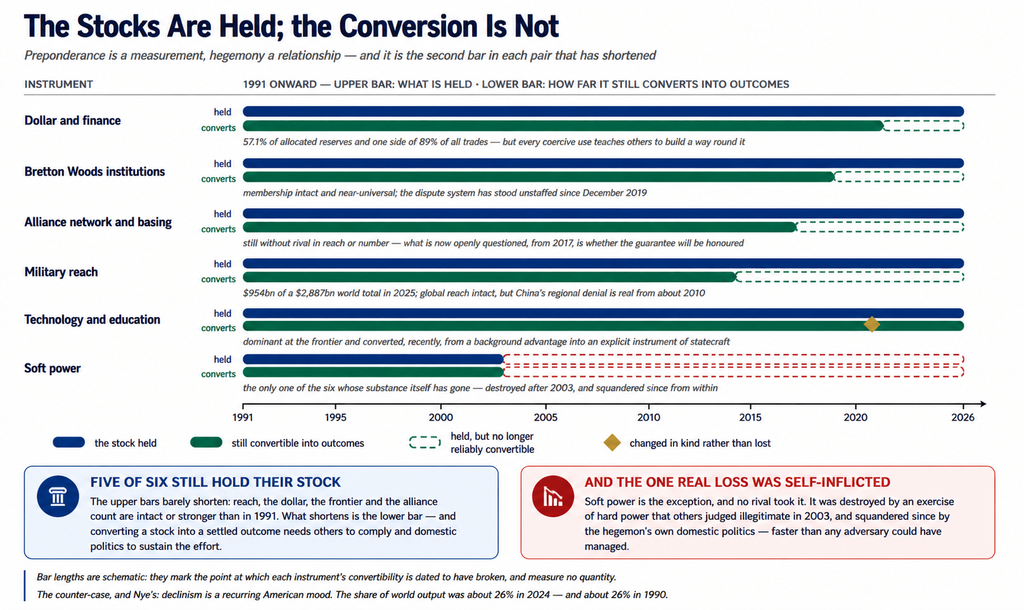
For roughly two decades after 1991 one state possessed a margin of military, economic and technological advantage over every other that had no modern precedent. What is disputed is not that the margin existed but what it amounted to. Preponderance is a measurement; hegemony is a relationship, and a state can hold the first without securing the second. The argument about whether American hegemony has ended is, at bottom, an argument about which of the two was really there.
Hegemony, Primacy and Unipolarity: Sorting the Vocabulary

The words in this field are used interchangeably in ordinary commentary and mean quite different things in the literature. Getting them apart is not pedantry: almost every disagreement about American decline turns out on inspection to be a disagreement about which of these conditions is being claimed to have ended.
The words and what they pick out
| Term | What it describes | Test of its presence |
|---|---|---|
| Unipolarity | A distribution of capabilities in which one state’s power resources so far exceed every other’s that no single rival, and no plausible coalition, can balance it | A structural measurement of relative capability. Says nothing about behaviour |
| Primacy | Simply being first in the ranking of capabilities, without any claim about the size of the gap | Comparative ranking; compatible with a close second |
| Preponderance | Primacy of a very large margin, usually across several dimensions at once | Aggregate capability share |
| Hegemony | Leadership over an order, exercised through a mix of coercion, inducement and consent, in which the leader sets rules others largely accept | Whether others’ behaviour conforms to rules the leader has set, without continuous compulsion |
| Empire | Direct political control over the internal affairs of subordinate polities | Formal or informal sovereignty over the periphery |
| Pax Americana | The whole condition named by analogy with Pax Britannica — a long peace among major powers underwritten by one state’s preponderance | Descriptive shorthand, and a claim about who supplies the peace |
| Hyperpower | A polemical coinage of the French foreign minister Hubert Védrine for a state whose dominance runs across military, economic, technological and cultural fields simultaneously | Rhetorical rather than analytical, but it captured the 1990s |
Preponderance against the capacity to use it
- Unipolarity and hegemony are not the same condition and can come apart in either direction. A state can be the only pole and fail entirely to lead — commanding capabilities it cannot convert into outcomes others accept. Equally, a hegemon can exist inside a multipolar system, as Britain arguably did in the nineteenth century without ever being the sole pole.
- The distinction that carries the whole decline debate is between material preponderance and the political capacity to convert it. Aircraft carriers, patents, reserve holdings and alliance counts are stocks; converting them into a settled outcome requires that others comply, that domestic politics sustains the effort, and that the exercise is seen as legitimate rather than merely irresistible.
- This is why the American record after 2001 is so contested. Nobody argues that the United States lacked the capability to take Baghdad in three weeks. The argument is about everything that followed.
Two readings of what hegemony rests on
- Realist and Gramscian readings differ on where hegemony actually lives.
- The realist reading treats it as an aggregate of measurable capabilities — economy, military, technology, population — with leadership following from preponderance. On this view hegemony rises and falls with material share, and the interesting question is the rate of change.
- The Gramscian reading, carried into international relations by Robert Cox and applied to American power by Stephen Gill, treats hegemony as consent manufactured through ideas and institutions. A hegemonic order rests on a transnational historic bloc that presents the dominant state’s interests as the general interest, so that compliance feels like common sense rather than submission.
- The practical difference is enormous. On the realist reading, American hegemony declines when China’s GDP approaches parity. On the Gramscian reading it declines when the model stops being persuasive — which is why Gill dates the crisis not to any shift in tonnage but to the collapse of the neoliberal model’s intellectual authority.
- Hegemonic stability theory — that an open international economy requires a single state willing to bear the costs of providing it — is treated in depth elsewhere in this archive, as is power transition theory. Stated compactly:
- Charles Kindleberger argued the depression of the 1930s occurred because Britain could no longer supply global public goods and the United States would not yet do so.
- Robert Gilpin generalised this into an account in which hegemons build orders that serve them, then decay under the costs of maintaining them.
- Joseph Nye’s inversion of the point is the more useful one today. Alongside the familiar worry about a China too strong — the Thucydides trap — he identifies a Kindleberger trap: a China too weak or too unwilling to help produce the public goods a stable order needs, free-riding on an order it did not build. Under-provision, not confrontation, is the other way orders fail.
What actually changed in 1991
- The bipolar order and the order that replaced it are treated elsewhere in this archive as separate subjects. What belongs here is the short list of properties that changed, because the unipolar moment is defined by them.
| The Cold War order | The order after 1991 | |
|---|---|---|
| Structure | Two poles of roughly comparable capability | One pole with no counterweight, and no coalition able to assemble one |
| Organising conflict | A single ideological and military axis dividing the world into blocs | Diffuse and issue-specific — proliferation, terrorism, civil war, trade |
| The Security Council | Paralysed by the certainty of a veto | Briefly functional, then bypassed when it would not authorise |
| Alignment | Bloc membership, with non-alignment as the third option | Multi-alignment — states hedge across partners rather than choosing one |
| Economic order | Two separated economies with limited traffic between them | One integrated global market organised on a single set of rules |
| Use of force | Restrained by the risk of superpower escalation | Restrained only by domestic politics and legitimacy costs |
“The immediate post-Cold War world is not multipolar. It is unipolar.” — Charles Krauthammer
Naming the Moment: The Theories of 1990 to 2008
The founding claims and their critics
- Charles Krauthammer named the condition in an essay written in the winter of 1990–91 and gave it the label that stuck. His claim was double-edged and the second edge is usually forgotten.
- The descriptive half: the world that emerged from the Cold War was not multipolar, as almost everyone had predicted; the centre of world power was an unchallenged superpower attended by its Western allies.
- The normative half: the United States should use the moment rather than apologise for it, confronting the “Weapon State” — regimes combining weapons of mass destruction, weak domestic legitimacy and grievance against the Western order, of which Iraq was the type.
- The warning half: the moment would be brief, and he was scathing about the pretence of collective action, which he called “pseudo-multilateralism” — a dominant power acting essentially alone while recruiting a ship here and a brigade there to give unilateral action a multilateral sheen.
- Revisiting the argument after 2001, he grew markedly more confident about its durability — itself a marker of how the decade felt from inside Washington.
- Francis Fukuyama supplied the ideological register, and the caricature of his argument is now more famous than the argument.
- What he actually claimed was that history in the Hegelian sense — the evolution of ideas about how humans should be governed — had reached its terminus, because liberal democracy had no remaining ideological competitor with universal appeal. Fascism had been destroyed and communism had discredited itself.
- What he did not claim was that events would stop, that conflict would end, or that every state would shortly become a democracy. He explicitly expected violence to continue in the parts of the world still inside history.
- He was also ambivalent rather than triumphal, worrying that a world reduced to economic calculation and technical problem-solving would be a spiritually thin place. His later work on political decay in the United States argues that the danger to the liberal model is now internal.
- William Wohlforth made the strongest case that unipolarity was both peaceful and durable, against the realist expectation that it would be neither.
- His argument was about the size of the gap. American advantages in economic size, military reach, technology and geography were so large and so comprehensive that no state could balance without a coalition, and no coalition could form without a leader willing to bear the risk of being first.
- Peace followed from the same fact: where the hierarchy is unambiguous there is little to fight about, since the two great sources of great-power war — uncertainty about relative position, and hegemonic rivalry — are both absent.
- With Stephen Brooks he extended this after 2008: even a China growing rapidly must climb a very long way to reach the capability for global power projection, which requires accumulated technological and institutional depth that GDP alone does not buy.
- Kenneth Waltz predicted the opposite and on impeccably structural grounds. Unbalanced power frightens others, whatever the intentions of the state holding it, and states respond to capabilities rather than to declared purposes.
- He therefore expected balancing behaviour to appear — new great powers, counter-coalitions, or at minimum systematic resistance. He also thought unipolarity the least durable of configurations, because the sole pole takes on tasks beyond its capacity while others are provoked into acquiring the means to resist it.
- The verdict is genuinely mixed. Hard balancing of the classical kind did not appear for two decades; soft balancing — diplomatic obstruction, institutional coalition-building, refusal to cooperate — did, in 2003 above all, and China’s post-2010 military build-up is hard balancing on any reading.
- Samuel Huntington argued that the label was wrong even in the 1990s and offered “uni-multipolar” in its place: a system with one superpower and several major regional powers, in which the settlement of key issues requires the superpower plus some combination of the others, and no issue can be settled by the superpower alone.
- He noted the psychological consequence, describing the United States as “the lonely superpower” — resented for a preponderance it exercised, and expected by others to exercise restraint it saw no reason to accept.
- His better-known thesis, the clash of civilisations, was a claim about the axis of future conflict: with ideology exhausted, the fault lines would run between civilisational blocs defined by culture and religion rather than between states or economic systems.
- G. John Ikenberry made the argument that the order would outlast the power that built it. The post-1945 American order was unusual because it was institutionalised and negotiated, not merely imposed.
- The mechanism is strategic restraint: by binding itself into institutions — alliances, trade rules, monetary arrangements — the dominant state made its power more predictable and less threatening, and in exchange secured willing participation. Weaker states accepted rules they had some voice in making.
- The consequence is stickiness. An order in which many states hold a stake and have adapted their economies and militaries to it is expensive to abandon. Ikenberry’s later work is far bleaker, since the threat he identifies to the liberal order now comes from within its founding state.
- Christopher Layne supplied the sharpest early dissent, calling unipolarity an illusion and a passing phase of the post-war system; and Nye insisted throughout that the United States was a predominant rather than a dominant power — able to shape outcomes it could not command.
The positions compared
| Position | Core claim | Prediction about duration | Where it stands now |
|---|---|---|---|
| Krauthammer | Genuine unipolarity; the United States should act on it | A moment, though he later extended it | Right about the description, wrong about the political sustainability of acting alone |
| Fukuyama | No remaining universal ideological competitor to liberal democracy | Indefinite at the level of ideas | The competitor came not from abroad but from inside the democracies |
| Wohlforth / Brooks | The gap is too large to balance; unipolarity is peaceful and durable | Decades | The gap in global reach persists; the gap in aggregate economic weight has closed sharply |
| Waltz | Unbalanced power provokes balancing; unipolarity is the least stable configuration | Short | Balancing was slower and softer than predicted but has arrived |
| Huntington | Uni-multipolar, not unipolar; conflict along civilisational lines | The system was already mixed | The structural claim has aged better than the civilisational one |
| Ikenberry | A negotiated, institutionalised order in which others hold a stake | Outlasts the hegemon | The institutions persist; the founder’s commitment is what wavered |
| Layne | Unipolarity is an illusion of transition | A decade or two | Vindicated on timing, less so on the pace of the successor order |
The disagreement was never about how much power America held. It was about whether power of that size can be converted into an order without consent.
The Instruments: What American Hegemony Actually Ran On
How the United States became a superpower — geography, wartime industrial mobilisation, an untouched homeland, a nuclear monopoly and half of world output in 1945 — belongs to the story of the ascent and is treated elsewhere in this archive. What matters here is the machinery built on that foundation, because it is the machinery, not the founding advantage, that either persists or erodes. By 1945 the United States held the dominant navy, the world’s only intact major industrial base, and the capital everyone else needed; the achievement was turning those assets into standing institutions.
The financial instrument
- The dollar is the deepest of the instruments and the one least eroded. Under Bretton Woods the dollar was fixed to gold and other currencies to the dollar; when that convertibility ended in 1971 the dollar’s centrality survived the system that created it, which is itself the striking fact.
- It remains 57.1% of allocated foreign-exchange reserves against 20.0% for the euro and roughly 2% for the renminbi, and stands on one side of 89% of all foreign-exchange trades in a market turning over $9.6 trillion a day.
- Exorbitant privilege, the phrase of the French finance minister Valéry Giscard d’Estaing, names the consequence: the issuer of the reserve currency borrows cheaply in its own money, runs deficits others would be punished for, and never faces a balance-of-payments constraint in the ordinary sense.
- Financial centrality is also a coercive instrument, and this part has grown rather than shrunk. Control of dollar clearing turns access to the payments system into leverage, and secondary sanctions reach firms with no American presence at all, because almost every large firm needs dollars.
- The Iranian sanctions rounds are the clearest demonstration. Pressure applied through the banking system contracted Iran’s economy, cut its oil exports by more than half after 2018, and did so against the declared wishes of Britain, France and Germany, who could not construct a workable trade channel to circumvent it.
- The reverse of the coin is that overuse teaches others to build alternatives — national payment systems, currency-swap lines, commodity settlement outside the dollar. None yet approaches substitution, and the constraint is structural: reserve status requires deep, open, liquid capital markets with enforceable property rights, which no rival currency’s home jurisdiction supplies.
The institutional and economic instruments
- The Bretton Woods institutions placed the United States at the centre of the machinery of adjustment. The IMF and World Bank are weighted by shareholding, and Washington retains an effective veto over the decisions requiring a supermajority.
- The trade regime widened steadily under American sponsorship, from the GATT rounds to the WTO, founded in 1995 and now 166 members, whose accession negotiations became the standard route by which states adopted the rules of an open economy. China’s accession in 2001 was the largest single act of that expansion — and, in retrospect, the most contested.
- The Washington Consensus gave the order its development doctrine. The term was coined by the economist John Williamson in 1989 for the set of reforms on which the Treasury, the IMF and the Bank had converged, offered to states in crisis as the price of assistance.
| Williamson’s ten prescriptions | The recurring criticism |
|---|---|
| Fiscal discipline and low government borrowing; redirection of spending from subsidies to primary education, primary health and infrastructure; tax reform broadening the base at moderate rates | Austerity imposed in downturns deepens them, and cuts fall on the services the poor use |
| Market-determined interest rates; competitive, freely floating exchange rates | Exposure to volatile capital flows before institutions exist to manage them |
| Trade liberalisation and removal of tariffs and quotas; relaxed rules on foreign direct investment | Infant and strategic industries need protection to mature — the East Asian states that grew fastest did not follow the prescription |
| Privatisation of state enterprises; deregulation of barriers to entry; secure property rights | Privatised utilities abandon low-income markets; deregulation produced the volatility that culminated in 2008 |
- The deeper objection is that the package was presented as technical when it was political — a particular model of capitalism generalised as economic science, which is exactly the Gramscian point about how hegemonic ideas travel. The rise of Chinese infrastructure finance, offered without conditionality on domestic policy, has given borrowers an alternative and thereby weakened the leverage the conditionality rested on.
The military and alliance instruments
- The alliance network is the instrument with no rival at all. The United States maintains mutual-defence commitments covering roughly fifty states, and around 750 installations in some 80 countries, an architecture no other power approaches or has attempted.
- Forward basing converts capability into presence. The distinction between a force that can fight at home and one that can arrive anywhere is the practical content of global military reach, and only one state possesses it — carrier strike groups, global airlift, worldwide logistics, satellite communications and a positioning system on which everyone else’s forces also depend.
- The Cold War pattern in which allies outsourced much of their defence to Washington was not an accident of generosity. It bought the United States influence over allied strategy, standardisation on American equipment, and the absence of independent European or Japanese military ambition.
- Military spending remains the starkest single number. The United States spent $954 billion in 2025 against a world total of $2,887 billion — roughly a third of global expenditure, more than the next several states combined, and more than double China’s $336 billion.
- Spending is a poor proxy for capability, since costs differ enormously across economies. But it purchases something no rival has: decades of accumulated stock in platforms, bases, trained personnel and command systems that cannot be bought quickly at any price.
The technological, educational and cultural instruments
- Technological and educational primacy underwrites the rest. American universities dominate global rankings and absorb a large share of the world’s mobile scientific talent; American firms hold the commanding positions in semiconductor design, cloud computing, software platforms and now frontier artificial intelligence.
- The most consequential recent development is that this asset has been converted into an explicit instrument of statecraft, through export controls on advanced chips and manufacturing equipment. That is a change of kind: technological leadership used to be a background advantage, and is now a lever.
- Soft power, the concept Nye introduced, is the ability to obtain preferred outcomes through attraction rather than payment or coercion — the pull of culture, political values and foreign policy that others find legitimate.
- Its sources are largely not governmental: universities, films, music, technology brands, an immigrant society’s demonstration that a plural polity can work.
- Its vulnerability is that it is destroyed by the exercise of hard power that others judge illegitimate, which is precisely what happened after 2003 — and that it can be squandered by the hegemon’s own domestic politics faster than any rival can attack it.
| Instrument | Position in the 1990s | Position now |
|---|---|---|
| Dollar and financial centrality | Unchallenged | Slightly reduced share, sharply increased coercive use |
| Bretton Woods institutions and trade regime | Expanding, near-universal reach | Membership intact; the WTO’s dispute system broken, the development doctrine contested |
| Alliance network and forward basing | Expanding through NATO enlargement | Still without rival, but its political reliability is now openly questioned |
| Military reach | Absolute | Global reach intact; regional denial by China is real |
| Technology and education | Dominant and diffusing | Dominant at the frontier, weaponised through export controls |
| Soft power | At its historical peak | The most degraded of the six, and degraded largely from within |
The Unipolar Record, 1991 to 2008
Between the liberation of Kuwait and the collapse of Lehman Brothers the United States fought four significant wars, enlarged its principal alliance, universalised its trade regime and rebuilt its security apparatus around a non-state threat. The record holds both the clearest vindication of collective security in the UN’s history and the act that did most to destroy the legitimacy of American leadership — twelve years apart.
The Gulf War and the announcement of a new world order
- The war of 1990–91 is collective security’s cleanest success and the reason the phrase “new world order” entered general use. Iraq’s invasion of Kuwait in August 1990 was an unambiguous act of aggression against a UN member, and the response was correspondingly unambiguous.
- The Security Council authorised “all necessary means”, Moscow did not veto, a coalition of some thirty-five states contributed forces, and the Gulf states and Japan met much of the cost. The operation restored the status quo ante and stopped.
- What made it possible was precisely the disappearance of the second pole. For forty-five years the Council had been paralysed by the certainty that one permanent member would block whatever the other proposed; briefly, that ceased to be true.
- The war also announced the shape of American military superiority. Precision munitions, stealth, integrated air campaigns and satellite-enabled command produced a lopsidedness that reorganised every serious military’s thinking about the revolution in military affairs.
- Washington drew a quieter second lesson: the campaign had depended wholly on transoceanic power projection and on the availability of overseas basing — both thereafter treated as things to be secured rather than assumed.
Humanitarian intervention and the limits of the moment
- The 1990s posed a question bipolarity had suppressed: what a preponderant power owes to people being killed inside states that are not attacking anyone. The decade’s four answers were inconsistent, and their inconsistency is the point.
- Somalia, 1992–93. A famine-relief operation expanded into disarming factions; eighteen American soldiers died in Mogadishu in October 1993 and the force withdrew. The political consequence outlasted the operation: a formal restriction on future peacekeeping commitments.
- Rwanda, 1994. Roughly 800,000 people were killed in a hundred days while the Security Council reduced rather than reinforced the force present on the ground, and while officials avoided the word genocide precisely because using it would have triggered obligations. The failure was one of will, not capability, and it followed directly from Somalia.
- Bosnia, 1992–95. Three years of ineffectual UN protection ended after the massacre at Srebrenica in July 1995; NATO air power and American diplomacy produced the Dayton Accords. The lesson drawn was that force worked and the UN framework did not.
- Kosovo, 1999. NATO bombed for seventy-eight days without Security Council authorisation, since Russia and China would have vetoed. An independent international commission afterwards reached the formulation that has defined the problem since: the intervention was illegal but legitimate.
- That formula is the unipolar moment’s core dilemma in six words. If the law cannot authorise action that most states consider right, either the law or the practice will give way — and after 2003 it became clear which.
Enlargement, the trade regime and the peak
- NATO enlargement proceeded in waves: Poland, Hungary and the Czech Republic in 1999, seven states including the Baltic republics in 2004, Albania and Croatia in 2009, then Montenegro, North Macedonia, and Finland and Sweden after the invasion of Ukraine.
- Defenders present it as the voluntary choice of sovereign states seeking security and democratic consolidation. Critics — including many American realists at the time — argued it extended a guarantee to territory the United States would not realistically fight for, and guaranteed Russian hostility for no compensating gain.
- The economic order expanded in parallel, through the WTO’s creation, the spread of the reform package and the integration of the former communist economies. Roughly 1995 to 2001 is the high-water mark — the moment when the American model, currency, alliance system and military were all simultaneously without alternative.
9/11, the war on terror, and 2003 as the turning point
- The attacks of 11 September 2001 produced an immediate and near-universal alignment behind the United States. NATO invoked Article 5 for the only time in its history, and the Security Council authorised action against al-Qaeda without dissent. The intervention in Afghanistan began with as broad a base of legitimacy as any use of force in the period.
- The invasion of Iraq in March 2003 destroyed that base, and it is the hinge of the whole subject. No Security Council resolution authorised it; the attempt to obtain one was abandoned when it became clear the votes were not there. France, Germany, Russia and China opposed; so did most of the world’s publics, including in states whose governments joined.
- The stated grounds — weapons of mass destruction and a link to al-Qaeda — did not survive inspection, which converted a dispute about authorisation into a dispute about truthfulness.
- The Secretary-General of the United Nations stated publicly in 2004 that the war had not conformed to the Charter and was, from the Charter’s standpoint, illegal. That a serving Secretary-General said so about the organisation’s principal financier is itself a measure of the damage.
- The significance is not that force was used without the Council — Kosovo had established that — but that it was used without the Council in a case most states did not accept as necessary. Kosovo was illegal and widely thought legitimate. Iraq was both illegal and widely thought illegitimate, and it is the second half that mattered.
- Two costs followed and neither has been recovered. The first is legitimacy: the proposition that American power was exercised on behalf of a general interest became much harder to sustain, and every subsequent argument about intervention has been conducted in its shadow.
- The second is capability tied down. Two long occupations consumed a decade of military attention, an enormous fiscal commitment and the political appetite for further engagement, at precisely the moment when China’s growth was compounding.
- The occupations also exposed the limit of the instrument itself. Preponderance is decisive in conventional war between organised forces and close to irrelevant against insurgency, political reconstruction and the manufacture of legitimacy in someone else’s society. Nothing in the capability gap addressed the problem the wars actually posed.
Kosovo showed that law could lag legitimacy. Iraq showed what happens when a hegemon loses both at once.
- The verdict on the record has to be split.
- Where the United States acted with the institutions it had built — Kuwait, Bosnia’s settlement, the enlargement of the trade regime, the reintegration of Central Europe — the results were durable and the leadership was accepted.
- Where it acted around them — Kosovo defensibly, Iraq indefensibly — it demonstrated that no one could stop it and simultaneously that stopping it was unnecessary, because the exercise damaged the actor more than the target.
- The unipolar moment was not ended by a rival. It was spent. The financial crisis of 2008 arrived when the reputational capital was already gone.
The Decline Debate
Three propositions are routinely run together in this argument and pull apart under pressure: that America’s share of world power is falling, that its capabilities are shrinking, and that its willingness to underwrite an order has weakened. Sorting them is the single most useful move available here, and it is made at the end of this section.
The declinist case
- Paul Kennedy supplied the framework in his study of the rise and fall of the great powers, and the term imperial overstretch is his.
- The mechanism is a mismatch: great powers acquire strategic commitments during their period of economic ascendancy, the commitments outlive the economic base that financed them, and defence spending crowds out the investment on which future economic strength depends. Spain, the Netherlands, France and Britain all followed the pattern.
- His prediction about America was made in 1987 and was, in its immediate terms, wrong — the Soviet Union collapsed first. The mechanism, however, is not refuted by having been mistimed, and the fiscal arithmetic of the 2020s is closer to it than the 1980s ever was.
- The fiscal position is now the sharpest version of the argument. Federal debt held by the public is around 99% of GDP and projected to reach 120% by 2036; annual deficits run above 6% of GDP; and net interest costs, already above $1 trillion a year, are projected to roughly double and to exceed defence spending within the decade.
- The strategic implication is not bankruptcy — a reserve-currency issuer does not run out of its own money — but crowding out. Every dollar of interest is a dollar unavailable for force structure, alliances, aid or research, and the political fight over that trade-off is domestic.
- The 2008 financial crisis damaged the model more than the economy. The crisis originated on Wall Street, in the deregulated capitalism that the reform doctrine had spent two decades exporting.
- Growth recovered; the claim to know how economies should be run did not. The episode transferred authority to states that had not followed the prescription, and China’s stimulus-driven recovery was read across the developing world as a verdict on two models.
- Deindustrialisation and persistent trade deficits hollowed out manufacturing regions, producing the domestic constituency that later rejected the open trading order outright. The order’s principal architect became the principal source of protectionist pressure against it — a development no version of hegemonic stability theory anticipated.
- The COVID-19 pandemic compounded the reputational damage of 2008. A chaotic early American response, set against more effective handling elsewhere, weakened the residual claim that the American model was simply the competent one.
- Allied hedging began with allies, not rivals. After the first Trump administration’s tariffs on European goods and its exits from the Iran agreement and the Paris accord, Angela Merkel stated publicly that the days when Europe could rely completely on others were over, and Emmanuel Macron pressed the case for European strategic autonomy. The most sophisticated states in the American order began planning for its unreliability.
- War fatigue is a real and measurable constraint. Two decades of inconclusive war, the chaotic withdrawal from Afghanistan in 2021, and a public unwilling to accept casualties for objectives it does not regard as vital, together narrow the range of options that can survive domestic politics.
- Fareed Zakaria reframed the whole argument, and his version is the one that has aged best. What is happening, he argued, is not American decline but the rise of the rest — the diffusion of growth, technology, capital and confidence to dozens of states at once.
- On this account the United States is not falling; the floor is rising underneath it. Its absolute capabilities may grow while its share of a much larger world shrinks, and the political challenge is one of adjustment rather than recovery.
- The corollary is that relative decline is compatible with everyone becoming better off — and that resisting it is futile in a way that responding to a hostile rival is not.
- The academic declinists supply the longer arc, and they date the turn much earlier than the public debate does.
- Robert Gilpin thought American hegemony fragile from the beginning because it rested on three revocable assets — the dollar, the multinational corporation and the nuclear guarantee — and dated the economic decline to the exchange-rate and oil shocks of the 1970s, when growth fell to a fraction of its post-war rate.
- Robert Keohane located the turn earlier still, in European integration and the Japanese challenge, and argued that hegemony is intrinsically hard to sustain because the burdens are concentrated and the benefits diffuse.
- Immanuel Wallerstein periodised it: dominance from 1945 to about 1970; decline from 1970 to 2001 as competitors emerged; and after 2001 a unilateralism that accelerated the decline it was meant to arrest.
The anti-declinist case
- Joseph Nye’s central point is historical: declinism is a recurring American mood rather than a finding. The United States has been confidently declared to be in decline after Sputnik in 1957, in the malaise of the 1970s, in the face of Japan in the 1980s, and after 2008 — four times, each time wrongly.
- His analytical move is the three-dimensional chessboard, and it dissolves most of the confusion in the debate. Military power is close to unipolar, with the United States dominant. Economic power is multipolar, distributed among the United States, Europe, China and Japan. Transnational power — climate, pandemics, terrorism, finance, cyber — is diffused among non-state actors and belongs to nobody.
- Anyone who says the world is unipolar or multipolar without saying which board they mean is making a mistake, not a claim.
- Wohlforth and Brooks press the size of the remaining gap. Global power projection is not a function of GDP but of accumulated capability — carriers and the industrial base that sustains them, worldwide logistics, satellite architecture, nuclear command systems, and the alliances that grant access. A rival can match economic output long before it can match reach.
- Structural power is the strongest form of the anti-declinist case, and Susan Strange made it most sharply. Power in the international economy, she argued, lies not in bargaining outcomes but in the ability to shape the frameworks within which others must operate — the structures of security, production, finance and knowledge.
- By that measure the United States remained dominant even in the decades when relational measures suggested decline: control over international credit, the largest banking assets, dominance in services, the leading energy and aerospace firms, the reserve currency and the world’s most attractive universities.
- Stephen Gill’s version is the Gramscian one: American hegemony did not decline in the 1970s and 1980s, it transformed — globalisation extended the reach of the ideological and cultural dimensions even as the relative economic share fell.
- The dollar’s stubborn centrality is the empirical anchor. Predictions of its displacement are older than most of the people making them; the share has drifted down slowly and no rival has emerged, for the structural reason set out above.
- Demography and innovation favour the United States against every peer. It is the only large rich economy with a non-catastrophic population trajectory, sustained by immigration; it leads the frontier of artificial intelligence, biotechnology and advanced semiconductor design; and it became the world’s largest energy producer, removing the vulnerability that constrained it for fifty years.
- The American share of world output is the fact that most embarrasses simple declinism. It was about 40% in 1960 and roughly 26% in 2024 — but it was also about 26% in 1990. The share lost since 1960 went mainly to the recovery of Europe and Japan, and the share lost since 2000 to China; the United States has been broadly flat for three decades while Europe and Japan have fallen sharply.
Three kinds of decline, which must be kept apart
| What is claimed | Is it true? | Why it matters |
|---|---|---|
| Relative decline in share | Yes, and irreversibly. No state retains a quarter of world output and a third of world military spending forever when four billion people industrialise | It is the normal consequence of others’ success, not of American failure. Zakaria’s point |
| Absolute decline in capability | Largely no. Military reach, financial centrality, technological frontier and university system are all intact or stronger than in 1991 | Capabilities have grown while share has shrunk. A hegemon can be absolutely stronger and relatively weaker at once |
| Erosion of the willingness to underwrite an order | Yes, and this is the live one. Domestic consensus for bearing the costs of leadership has broken down across parties and administrations | Orders are sustained by commitment, not capacity. This is the variable that has actually moved |
Material preponderance has eroded far less than the political capacity to convert it into outcomes others accept.
Constraints on American Hegemony, and Which of Them Will Grow
- The constraints divide into external — what other actors do — and internal — what American society and its political system will bear. Listing them is easy; the analytical work is in separating present severity from trajectory, since the two do not run together.
| The constraint now | Where it is heading | |
|---|---|---|
| External: China | Named the primary strategic competitor by the National Security Strategy of 2017 and the National Defense Strategy of 2018; economic scale approaching parity; sustained military modernisation; technological competition at the frontier; the Belt and Road as an alternative infrastructure of influence across some seventy states | Rising, and the most consequential single constraint. It compounds as the economy and technology base mature |
| External: Russia | Nuclear parity, energy leverage, and a demonstrated willingness to use force — Georgia in 2008, Crimea in 2014, Ukraine from 2022 | Conventionally reduced by the exposure in Ukraine; undiminished as a disruptive power |
| External: middle powers | India, Brazil, Turkey, the Gulf states and Indonesia hedging rather than aligning; BRICS enlarged to eleven members — Saudi Arabia appears on the official listing though Riyadh has never formally confirmed accession — with a partner category | Rising. Multi-alignment is now the default posture of capable states, not a deviation |
| External: institutions and legitimacy | Reputational costs of unilateral action; Security Council constraint; declining international appetite for intervention | Stable, not rising — for the reason given below |
| Internal: fiscal | Debt near 99% of GDP, interest costs above $1 trillion, entitlement growth crowding the discretionary budget | Rising, mechanically and predictably |
| Internal: political | Polarisation, no cross-party foreign-policy consensus, and radical unpredictability across administrations | Rising, and now the binding constraint |
| Internal: societal | War fatigue after Afghanistan and Iraq; unwillingness to accept casualties for non-vital objectives | Stable to rising |
Which of them will grow
- The judgement to defend is that the internal constraints are now the binding ones. Material preponderance persists in military reach, the dollar and frontier technology; what has eroded is the political consensus to spend it on maintaining an order.
- Polarisation bites hardest through credibility, which is the currency of alliance. An ally cannot plan around a guarantee that may be reinterpreted in four years, so allies hedge — and the hedging is rational rather than disloyal.
- Fiscal pressure bites through competition, not insolvency. Defence, alliances and development assistance must win an argument against health, pensions and interest, and the arithmetic of that argument gets worse every year.
- Institutional constraint is the one that will not grow, and the reason is instructive. The same state that is constrained by institutions can also bypass them, as 2003 showed. Institutions restrain a hegemon that wants their legitimacy; they do not restrain one prepared to do without it.
- What they impose is a price, not a prohibition — and a state that has already paid the price once has less left to lose the second time.
- Specific theatres show the shape of the limit rather than its size.
- The North Korean programme has advanced through three decades of sanctions, summitry and pressure across four administrations, with roughly 29,000 American troops on the peninsula and a THAAD battery at Seongju that irritated China more than it deterred Pyongyang.
- Iran absorbed maximum pressure, outlasted the abandonment of the nuclear agreement, and by 2025 had provoked strikes on its facilities and the reimposition of UN sanctions — without the question being resolved.
- Neither case is a defeat. Both show that preponderance does not produce compliance from a determined weak state.
NATO as an Instrument of American Hegemony
The proposition that the United States uses NATO to perpetuate its hegemony is neither obviously true nor obviously false, and the honest answer requires taking both sides seriously. Founded in 1949 by twelve states, now 32 members, NATO is the longest-lived and most effective military alliance in modern history — and the question is whether that success belongs to Washington or to the alliance.
The case for the proposition
- The command structure institutionalises American leadership permanently. The Supreme Allied Commander Europe has been an American officer without exception since 1951, and the integrated military command means allied forces plan, exercise and fight inside a structure Washington designed and leads.
- Article 5 buys strategic influence, not merely security. A guarantee whose credibility depends on one member gives that member leverage over the others’ foreign policy far beyond the defence question itself.
- Nuclear sharing extends American control into the most sovereign of decisions. American weapons are stationed in several European states whose aircraft would deliver them, under American custody and release authority — a dependency no European capital can replicate.
- Enlargement from 12 to 32 members extended an American security perimeter deep into territory that was hostile in 1989, and did so through a process — the Membership Action Plan — that required aspirants to reshape their defence establishments to alliance standards before entry.
- Out-of-area operations converted a defensive pact into an instrument of expeditionary policy. Kosovo in 1999, Afghanistan from 2003, Libya in 2011: none was a defence of allied territory, and each supplied legitimacy and burden-sharing for objectives set largely in Washington.
- Interoperability requirements generate procurement dependence. Common standards in communications, munitions, air-to-air refuelling and data links mean that buying into the alliance often means buying American, which is why the pressure to raise allied defence spending is simultaneously industrial policy — a large share of the increase returns as orders to American firms.
The case against
- NATO is a bargain, and Europeans got the better end of it for decades. European states obtained a nuclear guarantee and territorial security at a fraction of the cost of providing them, which is precisely why American administrations have complained about burden-sharing continuously since the 1950s.
- The alliance also constrains American unilateralism. Consensus decision-making gives every member a veto; a hegemon that must negotiate with 31 partners before acting has accepted a real restriction. Ikenberry’s strategic restraint describes NATO exactly: binding oneself makes one’s power tolerable to others.
- Allied refusal is frequent and has been consequential. France withdrew from the integrated military command in 1966 and stayed out for forty-three years while remaining in the alliance; France and Germany led the opposition to the invasion of Iraq in 2003, which is a strange thing for an instrument of hegemony to permit; Turkey refused transit for the northern front that year.
- Turkey’s divergence is the standing counter-example. A member since 1952 with the alliance’s second-largest army, it purchased the Russian S-400 system and was expelled from the F-35 programme for it; it pursues unilateral military action in Syria, Iraq and Libya and a maritime agenda opposed by two fellow members; and during the India–Pakistan crisis of May 2025 it backed Islamabad politically while Turkish-made drones were used against India. No instrument behaves like this.
- Article 5 has been invoked exactly once in the alliance’s history, and it was invoked for the United States, after 11 September 2001. The alliance’s one operative act of collective defence flowed towards Washington, not away from it.
- Divergent threat perceptions pull the alliance in three directions at once. Southern members are preoccupied with North Africa and the Middle East — migration, instability, terrorism; eastern members with Russia and nothing else; the United States with Russia and, increasingly, China globally. An instrument does not have three purposes its wielder must reconcile.
Burden-sharing, from two per cent to five
- The dispute is as old as the alliance, and the numbers moved only under pressure. European budgets shrank after 1991 in pursuit of the peace dividend, and in 2006 defence ministers agreed a floor of 2% of GDP.
- The pledge was ignored for a decade. Three of 28 members met it in 2014; ten met it in 2023; 23 of 32 met it in 2024; and in 2025, for the first time, all 32 did.
- The Hague summit of 25 June 2025 replaced the target altogether. Allies committed to 5% of GDP by 2035, split into 3.5% for core defence and 1.5% for defence-related investment — infrastructure, cyber, civil preparedness and the industrial base — with a review in 2029.
- The split is doing political work: the 1.5% category is loose enough to admit roads, ports and digital resilience, which is what made an otherwise implausible figure agreeable.
- The movement is nonetheless real. NATO-wide spending passed $1.4 trillion in 2025 at 2.77% of combined GDP; European allies and Canada spent $574 billion, about 20% up in real terms in a single year; the United States spent 3.19% of its own, much larger, GDP.
“For the first time, all Allies have met the target agreed in 2014: to spend at least 2 per cent of their GDP on defence.” — Mark Rutte
- The judgement. NATO is best described as an instrument that is also a bargain, and the bargain constrains the instrument.
- It plainly serves American strategic purposes: it keeps Europe inside an American security architecture, forecloses independent European military power, supplies coalitions for wars of American choosing, and channels allied money towards American industry.
- But it is not a tool in the sense the proposition implies, because tools do not refuse. France in 1966, Franco-German opposition in 2003, and Turkey continuously are not malfunctions of an instrument; they are the price of an alliance of sovereign states.
- The sharper reading is that NATO’s function has inverted since 2016. It was built as an instrument of American hegemony; it is now, increasingly, the thing Europeans are trying to preserve against American disengagement — which is what an instrument looks like when the hand holding it starts letting go.
The Second Trump Term and the Transatlantic Rupture
The friction of the first term — tariffs on European goods, withdrawal from the Iran agreement and the Paris accord, and public hints that the mutual defence commitment was conditional — was treated in Europe as an aberration to be waited out. The second term ended that assumption, and the change in European behaviour dates from the recognition that it was not an aberration at all.
What Washington signalled
- Conditionality about mutual defence moved from hint to premise: the guarantee was repeatedly framed as contingent on allied spending rather than as a treaty obligation, which is a different kind of statement about Article 5.
- The Munich Security Conference of February 2025 was the rhetorical break. The Vice-President used the address to argue that the principal threat to Europe was internal — its own governments’ handling of speech, migration and elections — rather than Russia, and the speech was received in the hall with something close to silence.
- Tariffs were applied to allies as readily as to rivals, on the reasoning that trade deficits are themselves the injury. Allies discovered that alliance conferred no exemption.
- On Ukraine, American assistance was paused in March 2025, direct talks with Moscow resumed without Kyiv, a Trump–Putin meeting in Alaska in August 2025 produced nothing, and a 28-point draft circulated in November 2025 required Ukrainian territorial concessions and permanent exclusion from NATO. A three-day ceasefire attempt in May 2026 collapsed within days.
- The National Security Strategy released in December 2025 made the posture doctrine. It elevates the Western Hemisphere, speaks of burden-shifting rather than burden-sharing, is openly critical of the European Union’s political direction, and explicitly disavows global domination in favour of regional balances of power. The message to Europe was that European security is Europe’s problem.
“Without the American pacifier, Europe is not guaranteed to remain peaceful.” — John Mearsheimer
Europe’s response
- ReArm Europe was announced on 4 March 2025 and rebranded Readiness 2030, aiming to mobilise up to €800 billion through four channels:
- a national escape clause from the EU fiscal rules, worth roughly €650 billion over four years, permitting members to raise defence spending without triggering deficit procedures;
- €150 billion in joint-procurement loans under the SAFE instrument, deliberately structured to reward collective rather than national purchasing;
- repurposed cohesion and EU budget funds, an expanded European Investment Bank mandate, and measures to draw in private capital.
- Germany’s fiscal turn is the substantive change. In March 2025 the Bundestag and Bundesrat amended the Basic Law to exempt defence spending above 1% of GDP from the debt brake and created a €500 billion off-budget infrastructure fund to be spent over twelve years. A constitutional constraint that had defined German policy for fifteen years was removed in weeks.
- The spending followed. European military expenditure rose about 14% in 2025 to $864 billion, the fastest increase since the Cold War, and the NATO figures confirm the same movement.
- The argument is economic and technological as much as military, and the Draghi report of September 2024 is its reference text.
- It put the annual investment needed to close Europe’s innovation gap at €750–800 billion, roughly 4–5% of EU GDP.
- It identified the binding problems: energy costs three to five times American levels for gas and two to three times for electricity; a widening productivity gap; no European firm at the frontier of cloud computing or advanced semiconductors; and fragmented capital markets. Digital-sovereignty measures follow from the same diagnosis.
Is this strategic autonomy, or another cycle of declarations?
- The case that it is real rests on three things Europe had never previously done: borrowing at scale for defence, amending a constitutional fiscal rule, and treating American reliability as a planning assumption that may fail rather than as a certainty.
- The case for scepticism is stronger than the headline figures suggest.
- Dependence on American enablers is the hard constraint. Strategic airlift, satellite intelligence, suppression of enemy air defences, aerial refuelling and integrated command are capabilities Europe cannot substitute this decade at any level of spending, as the Libya operation of 2011 demonstrated when European air forces ran short of munitions within weeks.
- Money is not capability. Fragmented national procurement across dozens of incompatible programmes converts spending into duplication; the SAFE instrument’s joint-purchase design is an attempt to fix exactly this, and it is a fix that must survive national industrial lobbies.
- The escape clause is permission to borrow, not money spent. Most of the €800 billion is headroom that member states must choose to use, and fiscally stressed southern members face a different calculation from Poland or the Baltic states.
- Threat perceptions diverge sharply. Eastern members see an existential Russian threat and spend accordingly; southern members prioritise the Mediterranean, migration and North Africa; the divergence is the same one that complicates NATO, and the EU has no mechanism to resolve it that NATO lacks.
- The honest verdict: the most serious European turn since the European Defence Community collapsed in 1954, and still short of autonomy. Europe is buying insurance against American withdrawal rather than building an independent pole — and the distinction matters, because insurance can lapse if Washington becomes reassuring again.
Europe has begun to pay for its own defence. It has not yet begun to be able to conduct it alone.
India and the Unipolar Order
From 1991 to the nuclear settlement
- India met unipolarity at its weakest moment and adjusted faster than its rhetoric suggested. The Soviet collapse removed its principal arms supplier, its diplomatic counterweight and a payments arrangement it depended on, and coincided with the balance-of-payments crisis of 1991.
- Liberalisation, the opening to Washington and the establishment of full relations with Israel all belong to the same eighteen months. Strategic necessity, not conversion, produced the opening.
- The 1998 tests tested the relationship to destruction and rebuilt it. Sanctions followed under American non-proliferation law, and were succeeded by fourteen rounds of talks between the Indian External Affairs Minister and the American Deputy Secretary of State that turned a proliferation dispute into a strategic conversation.
- The nuclear settlement was the decisive act. The joint statement of July 2005 committed Washington to seek full civil nuclear cooperation with a state outside the NPT; the 123 Agreement and the Nuclear Suppliers Group waiver of September 2008 followed. India obtained access to civil nuclear trade without signing the NPT or surrendering its weapons — the single largest exception ever made to the non-proliferation order, and made for one state.
- The foundational defence agreements built the plumbing: the general security of military information agreement in 2002, the logistics exchange memorandum in 2016, the communications compatibility agreement in 2018 and the geospatial cooperation agreement in 2020. Together they permit interoperability of the kind the United States maintains with treaty allies, with India remaining a treaty ally of nobody.
- The Quad is the clearest expression of the pattern — a consultative grouping with no secretariat, no mutual defence clause and no permanent commitments, which is precisely why India joined it.
Hedging as the settled posture
- Strategic autonomy was never abandoned, and is asserted most visibly where it costs most. India continued to buy Russian energy after 2022 and took delivery of the S-400 despite American sanctions legislation; it declined to align on Ukraine; and it maintains its own conversations with Moscow and Beijing.
- The friction became public in 2025, when tariffs on Indian goods reached 50%, half of it explicitly penalising purchases of Russian crude. An agreement in February 2026 cut the reciprocal rate to 18% and removed the oil penalty, against Indian commitments on purchases — and New Delhi’s response to the episode was to accelerate trade agreements with the EU, the United Kingdom and others rather than to align more closely.
- India is both a beneficiary of the American-led order and a constraint on any single power’s dominance. It gained from open trade, capital access, technology partnership and the nuclear exception; and it declines, consistently, to convert those gains into alignment.
- It has also demonstrated a willingness to use hard power on its own account in response to terrorist attacks from Pakistan, without seeking permission and without waiting for a great-power sponsor. Indian support can no longer be assumed by anyone.
- That posture is only available in a world where the sole pole cannot compel. India’s ability to hedge is itself evidence about the state of American hegemony — and its refusal to bandwagon is a constraint on China’s ambitions in Asia at the same time.
What American Hegemony Is Now
- Unipolarity as a distribution of capabilities has ended in one dimension and survives in another. Economic weight is genuinely distributed; military reach, financial centrality and frontier technology are not, and no state is close to matching them.
- Hegemony as a relationship has weakened much further than the capability numbers suggest, because it depended on consent that Iraq damaged, that the 2008 crisis undermined intellectually, and that the hegemon’s own domestic politics has since withdrawn.
- The result is a state that remains the strongest single actor without being the organiser of the system: able to disrupt any outcome, unable to determine most, and no longer reliably willing to underwrite the arrangements it built. The successor is not another hegemon but a thinner, more contested and more regionalised order, and its naming is a separate argument.
- The instruments have outlived the intention. The alliances, the currency, the bases and the institutions are all still there; what is missing is a settled domestic answer to the question of what they are for. That is why the decline debate now runs on willingness rather than on capability — and why the argument is being conducted inside the United States rather than against it.
Previous Year Questions
- “Trump’s return to the White House is a jolt to push the European Union to invest in its own defence and economic and technological revival.” Comment. (2025)
- Do you agree with the view that the USA uses NATO as a traditional tool of strategy to perpetuate its hegemony in the world? (2024)
- Discuss the various constraints on American hegemony today. Which of these are likely to become more prominent in the future? (2023)
- Critically examine the decline of the United States of America as a hegemon and its implications for the changing international political order. (2021)
- Identify the challenges to American hegemony in post-Soviet world. (150 words) (2013)
- How would you differentiate the post-Cold War global order from its predecessor? (2007)
- The new world order as conceived by USA is an effort to re-establish the American century in military terms as the American economic and industrial dominance of the last 50 years is lost. Comment. (1993)
