

Three things that are constantly confused

Feminism, women’s participation and the women’s movement are three different objects, and almost every weak treatment of this topic collapses them into one.
- Feminism is a body of theory — an argument about why the subordination of women exists and what would end it. It can be held by one writer with no organisation behind her.
- Women’s participation is the presence of women inside a movement whose demands are not about women. Women were central to Tebhaga, Telangana, Chipko and the anti-CAA sit-ins; none of those is a women’s movement.
- A women’s movement is sustained collective action, by women, making claims about the position of women, with its own organisations and adversaries.
The Indian case makes the distinction sharp, because here the three came apart in time. Feminist argument appeared first, in Tarabai Shinde’s 1882 polemic and Rokeya Sakhawat Hossain’s fiction. Mass participation came second, under Gandhi, in a movement whose demands were national and not gendered. An autonomous women’s movement came last, only after 1975. A country can have very large numbers of women in public agitation and still have a weak women’s movement, and for three decades after independence India was exactly that country.
Where the movement sits among social movements
- A social movement is sustained collective action outside routine institutional channels, carrying a shared identity and a challenge to authority or distribution. The standard division runs between old social movements — class-based, redistributive — and new social movements, which from the 1960s took identity, autonomy and quality of life as their objects.
- The Indian women’s movement is prismatic: it carries features of both at once and cannot be filed on either side.
- As an old movement it fights over wages, land titles, food prices, liquor money and work participation — SEWA organising head-loaders is redistributive politics of the plainest kind.
- As a new movement it fights over the body, consent and the definition of the private; “the personal is political” is a claim about meaning, not output. Its form is what new-movement theory predicts: small, non-hierarchical collectives refusing party affiliation.
- The Indian argument about non-party political processes fits the autonomous groups of the late 1970s better than almost anything else — as does the worry attached to it, that such space would be depoliticised into funded project work.
Is it a feminist movement? The argument about the label
The label has been contested inside the movement for fifty years, and the objection was that “feminist” named a Western import — middle-class in base, individualist in assumption, anti-family in instinct — and that accepting it handed opponents an easy charge of foreignness.
- Madhu Kishwar, who edited Manushi, wrote the best-known refusal in an essay explaining why she does not call herself a feminist: an imported vocabulary imposes an imported diagnosis. The alternative offered was “Indian womanism” — a politics rooted in family and community rather than the autonomous individual, reforming relationships rather than exiting them.
- The counter-argument was blunt: every emancipatory idea in modern India arrived through the colonial encounter, nationalism and democracy included. The test of an idea is whether it explains Indian conditions, not where it was first written down.
- Joanna Liddle and Rama Joshi, in Daughters of Independence, argued that Indian women drew a sense of their own power from indigenous sources and not only from Western feminism.
- The source they name is the shakti tradition of female power running through Indian religious imagination.
- On this reading the movement is not merely an oppositional force born of anger but a creative one.
- Chandra Talpade Mohanty’s Under Western Eyes gives the postcolonial objection its sharpest form: Western feminist scholarship constructs a singular “third-world woman” — poor, tradition-bound, uniformly victimised — and thereby produces the object it claims to discover.
Indian feminism is plural, and the argument about the noun has become less interesting than the argument about the constituency. What splintered the movement after 1990 was not the word “feminist” but the claim that “women” was a single category at all.
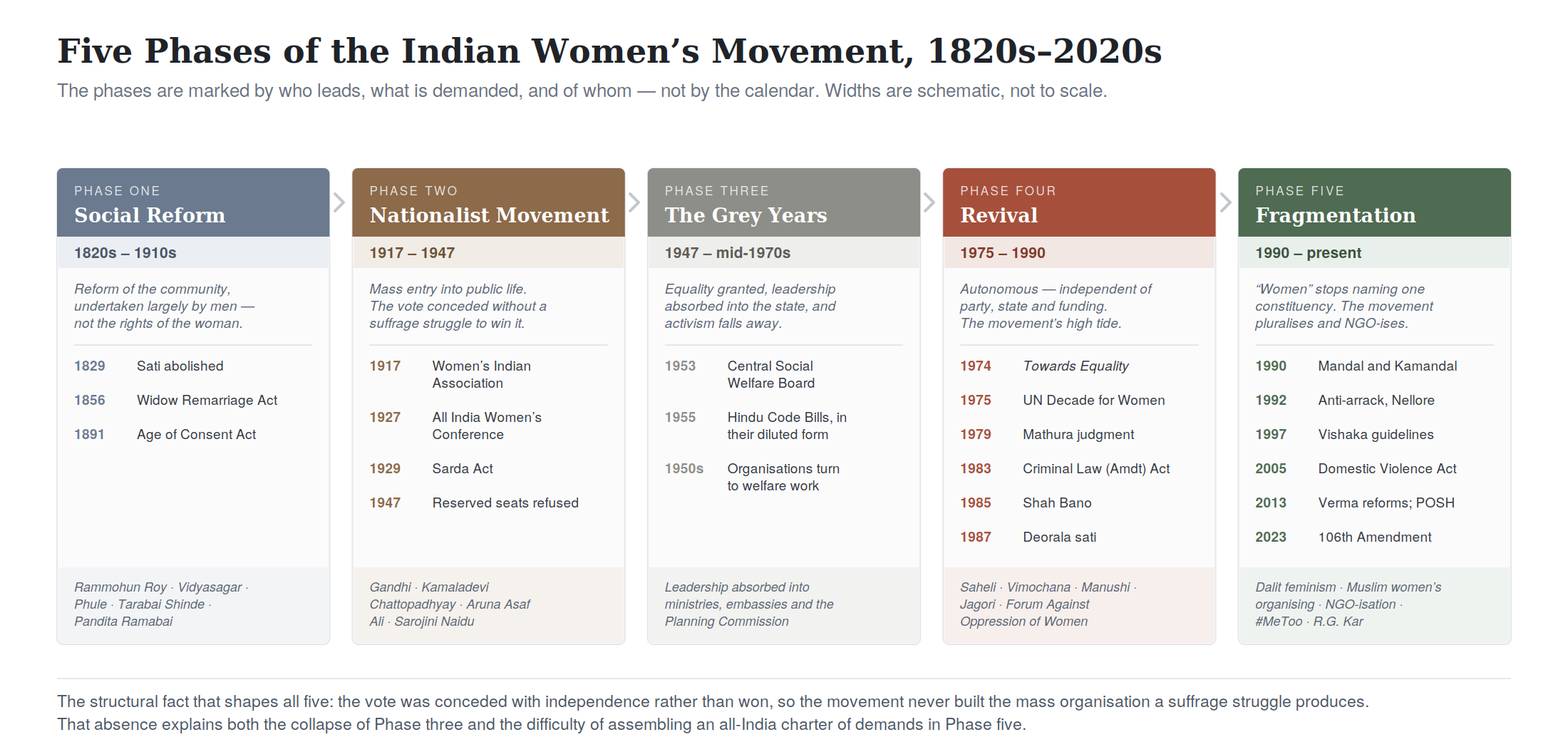
Phase one: nineteenth-century social reform
The first phase was reform of the community, undertaken largely by men, not assertion of the rights of the woman.
The reformers
- Rammohun Roy campaigned against sati from the 1810s on scriptural grounds — that widow-burning had no textual sanction — and supplied the intellectual ground for its abolition.
- Ishwar Chandra Vidyasagar used the same method to carry the Hindu Widows’ Remarriage Act 1856, and founded girls’ schools across Bengal.
- Jyotirao Phule broke the pattern by tying women’s subordination directly to caste: a school for girls at Pune in 1848, a home for widows, and brahmanical authority named as the source of both oppressions.
- Dayanand Saraswati and the Arya Samaj attacked child marriage and the exclusion of women from Vedic learning; Sir Syed Ahmad Khan carried reform into Muslim society, though his priority was education for men.
- Behramji Malabari, a Parsi journalist, forced child marriage into the open with his Notes on Infant Marriage and Enforced Widowhood (1884), which led to the Age of Consent Act 1891; Kandukuri Veeresalingam did the same work in the Telugu country.
| Measure | Year | What it did | What it did not do |
|---|---|---|---|
| Bengal Sati Regulation | 1829 | Made widow-burning a criminal offence | Left the conditions producing it untouched |
| Hindu Widows’ Remarriage Act | 1856 | Legalised remarriage of Hindu widows | Made the widow forfeit her husband’s property |
| Age of Consent Act | 1891 | Raised the age of consent from 10 to 12 | Applied to consummation, not marriage |
| Child Marriage Restraint (Sarda) Act | 1929 | Marriage age 14 for girls, 18 for boys | Left violating marriages valid |
The Age of Consent collision
The 1891 measure matters beyond its content: it is the moment the reform and nationalist impulses split apart in public.
- The trigger was the death of Phulmoni Dasi, a girl of about ten, from injuries inflicted by her adult husband.
- He was acquitted of rape, because she was his wife.
- Bal Gangadhar Tilak opposed the Bill — not by defending child marriage, but by denying the colonial legislature any competence over Hindu domestic ritual.
- The argument was about sovereignty, and women’s bodies were the terrain on which it was fought.
- The reformers won the Bill and lost the argument: after 1891 social questions were subordinated to the national one and deferred to the day after independence.
The civilising mission and the nationalist counter-move
The colonial state used the condition of Indian women as its central justification for rule. Sati, child marriage, enforced widowhood and purdah were assembled into an indictment of the civilisation, licensing the “civilising mission” — the claim that a people who treated their women thus could not be trusted to govern themselves. The nationalist counter-move was not to deny the facts but to relocate them: degradation was a late corruption, a classical past had honoured women, and reform was restoration, not Westernisation.
- Lata Mani’s analysis of the sati debate is the decisive contribution, and it reaches far beyond sati.
- Reading the colonial archive, she found that both sides argued about scripture, tradition and authority, and neither argued about the woman.
- Her testimony was not sought; her suffering was evidence in someone else’s case.
- The formulation that follows is that women were the ground of the debate rather than its subject.
“Concern for women seems secondary to concern for ‘tradition’ or for the general good of society.” — Lata Mani
- Partha Chatterjee’s “resolution of the women’s question” explains what nationalism did next, and is the most important theoretical claim here.
- Nationalist thought split the world into an outer, material domain — economy, statecraft, science — where Western superiority was conceded, and an inner, spiritual domain of culture, religion and family where the nation claimed the sovereignty it had lost outside.
- The home was declared that sovereign inner domain, and woman was made its emblem. The bhadramahila — educated, refined, middle-class — was to be modern enough to be presentable and traditional enough to prove the nation’s essence intact.
- Because the woman’s question had been “resolved”, it could be taken off the political agenda. Reform continued as a nationalist domestic project rather than a contest of rights — which is why India produced a huge nationalist mobilisation of women and an anaemic women’s movement in the same decades.
Women’s own voices
A parallel and sharper literature was produced by women, asking questions the reformers did not.
- Savitribai Phule ran the girls’ schools founded with Jyotirao and wrote poetry attacking caste and ignorance; Fatima Sheikh taught alongside her. Pandita Ramabai, founder of the Sharada Sadan and the Mukti Mission, wrote The High-Caste Hindu Woman to indict a religious order rather than a custom.
- Tarabai Shinde’s Stri Purush Tulana (1882) is the first fully argued feminist text in a modern Indian language: written after a widow was tried for infanticide, it asks why every vice attributed to women is practised freely by men.
- Rassundari Devi’s Amar Jiban is the first full autobiography in Bengali by anyone, and records a housewife teaching herself to read in secret. Begum Rokeya wrote Sultana’s Dream (1905), a utopia in which men are secluded and women run the state, and founded the Sakhawat Memorial Girls’ School.
- Swarnakumari Devi edited Bharati and founded the Sakhi Samiti (1886); her daughter Sarala Devi Chaudhurani founded the Bharat Stree Mahamandal (1910). Ramabai Ranade built the Seva Sadan into a training institution for thousands of working women.
The gap between the two lists is the point: the men reformed customs, while the women, when they wrote, questioned the arrangement of authority itself.
Phase two: the nationalist movement
| Organisation | Founded | Contribution |
|---|---|---|
| Bharat Stree Mahamandal | 1910 | Sarala Devi Chaudhurani’s body — the first all-India organisation founded by an Indian woman |
| Women’s Indian Association | 1917 | Margaret Cousins, Annie Besant, Dorothy Jinarajadasa; first demand for the vote |
| National Council of Women in India | 1925 | International Council of Women affiliate; welfare work, elite in composition |
| All India Women’s Conference | 1927 | Sarda Act 1929, Lady Hardinge Medical College, the Hindu Code campaign |
| Mahila Atma Raksha Samiti | 1942 | Communist-led in Bengal; famine relief and women’s self-defence |
| Andhra Mahila Sabha | 1937 | Durgabai Deshmukh’s body; education, welfare and legal aid |
| Women’s Self Defence League | 1940s | Punjab; organisation of working and peasant women |
| National Federation of Indian Women | 1954 | Carried the left women’s tradition into the republic |
The AIWC is the pivotal body: begun as a conference on female education, within two years it was drafting legislation.
Gandhi and the mass entry of women
Gandhi’s achievement was to make the public presence of women ordinary. Before him a woman on a street protest was scandalous; after him she was expected.
- The methods he chose — non-violence, spinning, boycott, fasting, picketing of liquor and foreign-cloth shops — could be performed from within respectable domesticity.
- The salt satyagraha of 1930 was the turning point; Sarojini Naidu led the raid on the Dharasana salt works and thousands of women courted arrest. Picketing was assigned to women deliberately, and built the repertoire that the anti-arrack women would use sixty years later.
- Madhu Kishwar’s critique is that Gandhi mobilised women by sanctifying qualities the tradition already assigned them — endurance, self-sacrifice, chastity, moral force — with Sita and Draupadi as his models of the political woman. Women entered politics as the morally superior sex, not the equal one.
- Sujata Patel made the structural point: a womanhood built on suffering and service left the sexual division of labour intact, and never proposed that entry into public life should change what happened at home.
- A politics of sacrifice can mobilise enormous numbers and still generate no claim on power — the women who filled the jails did not fill the cabinets.
Radical and left currents
- Tebhaga (1946-47), the Bengal sharecroppers’ demand for two-thirds of the crop, drew peasant women into the Nari Bahini, who fought police parties with brooms and staves.
- Telangana (1946-51), the armed struggle against the Nizam and the doras, used women in every role from courier to combatant — and then, when it ended, sent them home. Stree Shakti Sanghatana’s oral history of the survivors found that the movement had asked nothing about the household and settled nothing there.
- The retreat after the revolt is the recurring pattern: women’s mobilisation inside a general movement yields no durable gain for women unless the movement’s own demands are gendered.
- Three careers mark the outer edge of what a nationalist woman could become.
- Kamaladevi Chattopadhyay was the first woman to stand for a legislative seat in India.
- Aruna Asaf Ali hoisted the flag at Gowalia Tank in 1942 and went underground.
- Captain Lakshmi Sahgal commanded the Rani of Jhansi Regiment of the INA — the only all-woman combat regiment of the period, and the most complete inversion of the sacrificial model in the record.
Suffrage conceded, and the organisation India never built
Indian women received the vote without a suffrage struggle, and this is a structural explanation for the movement’s later weakness.
- Limited franchise came province by province through the 1920s and was extended by the Government of India Act 1935; universal adult franchise arrived with the Constitution in 1950, for men and women together, as a by-product of independence.
- In Britain and the United States the fight for the vote ran for decades and built the infrastructure of twentieth-century feminism — mass membership, funds, newspapers, trained organisers, a habit of confrontation with the state.
- India got the outcome and skipped the process. The movement inherited a guarantee it had not had to fight for, and none of the muscle that fighting produces — which is why it entered the 1950s with legal equality and no capacity.
The Constituent Assembly and the refusal of reserved seats
Women’s organisations asked the Constituent Assembly not to reserve seats for them, and that fact is the hinge of the whole reservation debate.
- The Karachi Congress resolution on Fundamental Rights (1931) had already committed the movement to equality irrespective of sex, equal rights in public employment — the charter from which the Constitution’s equality provisions descend.
- The AIWC, WIA and NCWI submitted memoranda demanding equal rights, a uniform civil code, equal pay and equal access to public employment, and expressly declined reservation of seats. Their reasoning had three parts:
- Reservation was a colonial instrument. Separate electorates were how the Raj had divided Indians by community; taking the device for women would extend a technique of rule the movement had spent thirty years opposing.
- Reservation implied inferiority. A group needing protected seats concedes it cannot win open ones.
- Equality had been won on principle and would work itself out in practice.
- Hansa Mehta, Rajkumari Amrit Kaur, Renuka Ray, Sarojini Naidu, Durgabai Deshmukh, Begum Aizaz Rasul and Dakshayani Velayudhan were among the fifteen women in the Assembly who held this position.
- They were right about the principle and wrong about the practice. Women’s share of the Lok Sabha was under 5% in the first general election and had still not reached 10% forty years later.
Phase three: the grey years, 1947 to the mid-1970s
The three decades after independence are commonly called the movement’s grey years, and the paradox that label names is exact: activism was higher before independence than after it.
- Constitutional equality had been granted. Articles 14, 15 and 16, with Article 15(3) permitting special provision for women, appeared to settle the legal question, and universal adult franchise removed the one demand capable of organising a mass campaign.
- The state was now “ours”. Agitation against a government elected by Indians, women included, felt illegitimate.
- The leadership was absorbed into ministries, governorships, embassies and the Planning Commission, moving from the street into the state and taking the movement’s capacity with it.
- The organisations turned to welfare, becoming implementing agencies for government schemes.
The Hindu Code Bill: the one real fight
- B.R. Ambedkar, as Law Minister, piloted a comprehensive Hindu Code Bill covering marriage, divorce, adoption, maintenance and — the explosive part — daughters’ rights in their fathers’ property.
- Opposition came from within the Congress, from President Rajendra Prasad and from Hindu orthodoxy; the Bill was stalled, split and diluted, and Ambedkar resigned in 1951 citing its fate.
- What passed after the 1952 election was four Acts of 1955-56 — Hindu Marriage, Hindu Succession, Hindu Minority and Guardianship, Hindu Adoptions and Maintenance.
- They delivered monogamy, judicial divorce and a daughter’s share in her father’s separate property.
- They retained the Mitakshara coparcenary, from which daughters were excluded, so ancestral property stayed in the male line.
- That was corrected only by the Hindu Succession (Amendment) Act 2005, its retrospective operation settled in Vineeta Sharma (2020).
- Muslim personal law was left untouched, setting the pattern that produced Shah Bano.
- The lesson was bleak: even a sympathetic government with a Law Minister of Ambedkar’s conviction could not carry family-law reform against organised religious opposition, and there was no movement outside Parliament to supply the pressure.
The Central Social Welfare Board (1953), under Durgabai Deshmukh, channelled grants to voluntary organisations and became the institutional face of the period. Its assumptions define the welfare approach: woman is a dependent; her needs are health, nutrition, child care and supplementary income; the state provides; and the beneficiary makes no claims. Nothing in the model touches the distribution of power.
Constitutional equality without organisation produced three decades in which Indian women had rights on paper and nobody to enforce them.
Phase four: revival and the autonomous movement, 1975–1990
Towards Equality and the Committee that wrote it
- The United Nations declared 1975 International Women’s Year and 1976-85 the Decade for Women, and asked member states to report on the status of their women.
- The Committee on the Status of Women in India was constituted on 22 September 1971, chaired by Phulrenu Guha, with Vina Mazumdar as Member-Secretary and Lotika Sarkar, Leela Dube, Maniben Kara and others as members. Towards Equality was submitted on 31 December 1974.
It found that the position of Indian women had deteriorated in the very decades in which the Constitution had promised equality, and that finding shocked the government that had commissioned it.
- The sex ratio was falling, almost continuously across the census decades since 1901.
- Female work participation was falling. Women were being pushed out of organised employment into unrecorded, casual and unpaid work as mechanisation and the decline of household industry displaced the occupations they held.
- Legal reform had not reached women. The 1955-56 Acts changed the statute book without changing practice, because women did not know the law, could not afford litigation and could not survive the social consequences of using it.
- Women’s unpaid work was invisible to the census, to national accounts and therefore to policy.
- Political participation had shrunk rather than grown after the extension of the franchise.
- Development itself was gendered. Planning had assumed a household that shared its gains equally; the committee found that it did not, and that women had absorbed a disproportionate share of the costs of modernisation.
Its importance is that it converted the status of women from a welfare subject into a political and developmental one, using the state’s own data. A report the government wrote about itself is very hard to dismiss.
- It recommended a statutory watchdog body, the ancestor of the National Commission for Women, established in 1992.
- It pushed the state’s approach through a decisive sequence — welfare to development to empowerment. The Sixth Five Year Plan (1980-85) carried the first dedicated chapter on women and development.
- It made women’s studies a discipline in India: the Centre for Women’s Development Studies (1980), founded by Mazumdar and Sarkar, the Indian Association for Women’s Studies (1982), and UGC funding for university centres. Research capacity was the decade’s most durable institutional gain.
- It gave the reviving movement a shared factual base, functioning as its charter in the absence of one it had written itself.
Towards Equality on reservation, and the dissent
The committee rejected reservation of seats for women in legislatures by a majority — and two of its members dissented.
- The majority reasoned in the inherited idiom: reservation would be a form of separatism, would treat women as a minority when they are half the population, and carried the taint of the colonial device.
- Vina Mazumdar and Lotika Sarkar filed a note of dissent favouring reservation in local bodies.
- Their case was that a political system cannot rest on ideology alone but must keep in touch with the actualities of the social situation.
- Where an ideal has visibly failed for twenty-five years, insisting on it is not principle but obstinacy.
- The dissent is the first authoritative crack in a position that the movement had held since 1946.
Why the position changed, in five steps:
- The evidence of failure accumulated. Formal equality had run for a quarter-century and women’s share of legislatures had not moved. The prediction on which the 1940s refusal rested had been tested and had failed.
- The argument shifted from protection to representation. Reservation was no longer defended as a shield for the weak — the framing the 1940s leaders rejected — but as a corrective to a structurally closed political market in which parties would not nominate women in winnable seats.
- A new generation had different politics. The women of the 1940s were nationalist leaders with personal access to power; the activists of the 1980s came from anti-price-rise agitations, trade unions and rural and Dalit organisations.
- The Mandal moment normalised group quotas. Once reservation had become India’s standard instrument for redistributing political opportunity, refusing it for women looked less like principle than exception.
- The panchayat experiment supplied proof of concept. The National Perspective Plan for Women (1988) recommended reservation in local bodies; the 73rd and 74th Amendments (1992-93) delivered it; within a decade there was evidence that reserved seats produced real officeholders and not only proxies.
The agitations that trained a generation
- The anti-price-rise movement in Maharashtra (1972-74) was the largest of them.
- The United Women’s Anti-Price Rise Front brought tens of thousands of housewives onto the streets of Bombay against food inflation and hoarding, led by Mrinal Gore and the communist organiser Ahilya Rangnekar.
- Its signature was women marching with rolling pins and thalis, beating them outside the houses of hoarders and ministers — domestic implements converted into political instruments.
- The Nav Nirman agitation in Gujarat (1974) began over hostel food prices and brought down a state government; it fed into the JP movement, which radicalised a generation, many of whom left it disillusioned with party politics — a precondition for the autonomous form.
- The Shahada movement in Dhulia organised Bhil landless labourers against moneylenders and landlords; its women’s wing turned it towards liquor, attacking drunkenness and wife-beating — the direct forerunner of the anti-arrack campaigns.
- Chipko (1973-74) showed that rural women would defend a resource base against the state, and made Gaura Devi’s stand at Reni a founding image of women’s collective action.
- SEWA, founded by Ela Bhatt in Ahmedabad in 1972 as a trade union of self-employed women, organised the informal workforce that labour law ignored as labour rather than as beneficiaries.
What “autonomous” meant
- Independent of political parties, whose women’s wings were bound by the party line and had to defer women’s demands to the class question; independent of the state, with no sponsorship, schemes or official positions; and initially independent of funding, many groups refusing foreign money to avoid becoming service providers.
- Non-hierarchical in form: collectives without presidents, consensus decisions, rotated tasks, no spokesperson.
- Consciousness-raising as method — small-group discussion in which individual experience is examined for its shared structure. This is the practical content of “the personal is political”: battering, harassment and unpaid work treated not as private misfortunes but as evidence of a system.
Mathura: the case that founded the movement
Tuka Ram v. State of Maharashtra (1979) is the most consequential judgment in the history of the Indian women’s movement, and it is consequential because it was wrong.
- Mathura, an Adivasi girl of around sixteen, was raped by two constables inside the Desai Ganj police station in Chandrapur district in 1972. The Sessions Court acquitted; the Bombay High Court convicted, distinguishing passive submission from consent; the Supreme Court restored the acquittal.
- Its reasoning became notorious: that Mathura was “habituated to sexual intercourse” and therefore unreliable; that there were no injuries, so she had not resisted; and that absence of resistance meant consent.
- The judgment thereby exposed three assumptions built into the law of rape.
- That a sexually active woman cannot be raped; that a woman who does not fight is consenting; and that the accused’s authority over her is legally irrelevant.
- The open letter of September 1979 — by Upendra Baxi, Vasudha Dhagamwar, Raghunath Kelkar and Lotika Sarkar, four law teachers asking the Court to reconsider — is the movement’s founding document.
- The Forum Against Rape was formed in Bombay in 1980, later widening into the Forum Against Oppression of Women; 8 March 1980 saw the first co-ordinated nationwide demonstrations for reform of the rape law.
| The 1983 Act did | The 1983 Act did not |
|---|---|
| Create the offence of custodial rape with enhanced minimum punishment | Touch the marital rape exception |
| Insert Section 114A, Evidence Act — the court shall presume absence of consent in custodial cases | Widen rape beyond peno-vaginal penetration |
| Provide for in-camera trial (Section 327 CrPC) | Bar “character of the prosecutrix” evidence, which survived to 2003 |
| Bar disclosure of the victim’s identity (Section 228A IPC) | Address custodial violence outside the rape provisions |
- The burden shift is the substantive victory: for the first time in Indian law the presumption ran in the complainant’s favour, and it ran because the offender held power over her.
- The marital rape exception was left standing, and it still stands.
- Exception 2 to Section 375 IPC, carried into Section 63 of the Bharatiya Nyaya Sanhita 2023, exempts a man’s intercourse with his own wife above a specified age.
- The Delhi High Court split on 11 May 2022 — Shakdher J striking it down, C. Hari Shankar J upholding it.
- The appeal, with the Union opposing criminalisation, remains pending before the Supreme Court. It is the movement’s oldest unfinished demand.
Dowry
- The Dowry Prohibition Act 1961 was dead law. What revived it was a campaign against dowry deaths — young wives dying in kitchen fires whose statistical improbability was the campaign’s first and best argument.
- Stri Sangharsh in Delhi pioneered the defining tactic: demonstrating outside the marital home of a dead woman, naming the family, and using street theatre — Om Swaha was performed hundreds of times — to convert a private death into a public accusation.
- The campaign produced three distinct legislative results in as many years.
- Section 498A IPC (1983) — cruelty by a husband or his relatives, cognizable and non-bailable.
- Section 304B IPC with Section 113B of the Evidence Act (1986) — the offence of dowry death where a woman dies unnaturally within seven years of marriage after dowry-related cruelty, with a statutory presumption against the husband.
- The Dowry Prohibition (Amendment) Acts 1984 and 1986, tightening definitions and creating Dowry Prohibition Officers.
- This is the movement’s clearest demonstration that it could write criminal law.
The 498A backlash, stated fairly and then answered.
- The charge is that the section is used to pressure husbands and above all their extended families in matrimonial disputes, that omnibus complaints name elderly parents and distant relatives without specific allegations, and that arrest itself becomes the punishment.
- The courts have responded repeatedly, and the line of authority is worth knowing precisely.
- Arnesh Kumar (2014) barred automatic arrest and required reasons to be recorded under Section 41 CrPC.
- Rajesh Sharma (2017) set up Family Welfare Committees to screen complaints — a direction substantially recalled in Social Action Forum for Manav Adhikar (2018).
- Through 2025 the Supreme Court repeatedly quashed proceedings naming relatives without specific allegations, warning against criminalising ordinary matrimonial discord.
- The answer is not to deny the misuse but to keep the proportions visible.
- Crime in India 2024 records 1,20,027 cases of cruelty by husband or his relatives — 27.2% of all crimes against women and the single largest head (1,33,676, about 30%, in 2023), which is what an offence looks like when it is widely committed and not merely widely alleged.
- Low conviction under Indian trial conditions is weak evidence of falsity.
- A provision can be both genuinely necessary and genuinely abused; the remedy is discipline at the point of arrest, not dilution of the offence.
Deorala, September 1987
The immolation of Roop Kanwar, an eighteen-year-old widow, on her husband’s pyre at Deorala in Sikar district, Rajasthan, on 4 September 1987 produced the movement’s most disorienting confrontation.
- The event drew enormous crowds, a chunri mahotsav was announced at the site, and the act was defended publicly as tradition, faith and Rajput honour. Women were prominent among the defenders, joining pro-sati rallies in Jaipur in large numbers.
- Legislatively the movement succeeded: Parliament enacted the Commission of Sati (Prevention) Act 1987, criminalising not only abetment but glorification — temples, processions, trusts and the collection of funds. Judicially it failed: prosecutions dragged for decades and all the accused were eventually acquitted.
- The lesson was that culture is not an external constraint on the movement but an internal contest, and that women can be mobilised in defence of practices that harm women.
Shah Bano, 1985
- Shah Bano Begum, divorced at sixty-two after four decades of marriage, claimed maintenance under Section 125 CrPC, a secular provision against destitution. In Mohd. Ahmed Khan v. Shah Bano Begum the Supreme Court upheld her claim and added a remark on the desirability of a uniform civil code.
- A large mobilisation followed against what was presented as judicial interference in personal law, and the government enacted the Muslim Women (Protection of Rights on Divorce) Act 1986, removing divorced Muslim women from Section 125.
- The Act was later read down in Danial Latifi (2001), and access to Section 125 restored in Shabana Bano (2009).
- Its importance is the fracture rather than the doctrine. The movement split three ways — those backing the judgment as a victory for a destitute woman, those seeing the UCC remark as an opening for majoritarian politics, and Muslim women activists caught between a community under pressure and a law that failed them.
- The assumption of a single female constituency broke here.
- After Shah Bano no campaign could assume that all women wanted the same thing from the state.
- It also began the communalisation of the women’s question: gender justice became available as an argument for majoritarian politics, and any feminist demand touching Muslim personal law could be recruited to it.
Amniocentesis, and the organisations of the period
- Prenatal diagnostic technology, introduced to detect foetal abnormality, was in open commercial use for sex determination by the late 1970s.
- Clinics advertised on the reasoning that a small fee now saved a large dowry later.
- The Forum Against Sex Determination and Sex Pre-Selection (Bombay, 1982) ran the campaign, framing it as the elimination of females rather than a question of reproductive choice.
- The results were the Maharashtra Act of 1988, the first such law in India, and the national Pre-natal Diagnostic Techniques Act 1994, amended in 2003 and renamed the PCPNDT Act.
- The organisational map of the decade divides three ways.
- Autonomous collectives: Saheli (Delhi, 1981), Vimochana (Bangalore), Jagori (Delhi, 1984), Sachetana (Calcutta), Ekta (Madras), Stree Shakti Sanghatana (Hyderabad), Anveshi, and Manushi, founded in 1978 by Madhu Kishwar and Ruth Vanita.
- Muslim women’s organisations: Awaaz-e-Niswaan (1987) and Majlis, founded by Flavia Agnes and Madhushree Dutta.
- Dalit women organised through the All India Dalit Women’s Conference.
- The change of names is itself evidence. Where the older bodies were conferences, councils and associations, the new ones took Indian words meaning friend, liberation, awakening, unity and voice — named for a relationship rather than a constituency.
Phase five: the 1990s and after — fragmentation and diversification
The decade opened with two mobilisations that reorganised Indian politics around identity — Mandal, the implementation of OBC reservation in central services in 1990, and Kamandal, the Ram Janmabhoomi movement culminating in December 1992. Both cut through the women’s movement, because both asked women to choose a prior identity.
- Mandal exposed the caste composition of the movement’s own leadership, overwhelmingly upper-caste and urban. Ayodhya demonstrated that large numbers of women could be organised for a majoritarian project, and that “women’s issues” could be deployed against a minority community.
- The consequence was the abandonment of an assumption: that “women” names a single political constituency with common interests. Caste, class, religion, region, sexuality and disability structure the experience of being a woman so deeply that a single charter of demands may not be constructible.
Dalit feminism
- Gopal Guru’s essay “Dalit Women Talk Differently” (1995) put it sharpest: Dalit women carry a triple burden of caste, class and gender, and are represented neither by an upper-caste-led women’s movement that does not see caste nor by a Dalit movement led by men that does not see gender.
- Sharmila Rege developed this into a Dalit feminist standpoint — a position rather than an identity, which anyone can adopt by learning from Dalit women’s lives, and which claims that the most subordinated location yields the least distorted view of the whole structure.
- Uma Chakravarti’s concept of brahmanical patriarchy is the analytical foundation the earlier movement lacked.
- Building on Ambedkar’s argument that caste is maintained by endogamy, she showed that caste purity requires control over women’s sexuality.
- The seclusion of upper-caste women and the sexual availability of lower-caste women are therefore two outputs of one system.
- Ruth Manorama and others founded the National Federation of Dalit Women in 1995; its intervention at the World Conference Against Racism at Durban in 2001 made Dalit feminism a transnational actor. The effect was permanent: no organisation formed after 1995 could describe its constituency without saying which women.
Muslim women’s autonomous organising
- The Bharatiya Muslim Mahila Andolan, founded in 2007 by Zakia Soman and Noorjehan Safia Niaz, took the position unavailable in 1986: reform of Muslim personal law demanded by Muslim women from within the community, on Quranic grounds, rather than by the state from outside.
- Shayara Bano v. Union of India (2017) set aside talaq-e-biddat by 3:2. The Muslim Women (Protection of Rights on Marriage) Act 2019 then made its pronouncement a criminal offence punishable with up to three years’ imprisonment.
- The movement split over criminalisation, and the split was principled on both sides.
- Supporters argued that without a penalty the practice simply continued.
- Opponents argued that a pronouncement already void needs no criminal sanction, that imprisoning the husband destroys the maintenance the wife needs, and that a criminal law aimed at one community’s men serves a majoritarian purpose whatever its drafters intended.
The right-wing mobilisation of women
- The Rashtra Sevika Samiti, founded in 1936 by Lakshmibai Kelkar, has run shakhas for women for nearly ninety years.
- Its training is in discipline, physical culture and an ideology of the woman as mother, heroine and ascetic.
- The Durga Vahini (1991) and orators such as Sadhvi Rithambara and Uma Bharti brought women to the front of the Ayodhya mobilisation.
- Tanika Sarkar and Amrita Basu took this seriously rather than dismissing it as false consciousness.
- Their finding is uncomfortable: these organisations do give women authority, public space, mobility and a role beyond the household — a real and experienced empowerment.
- They bind that gain to communal hostility and to a thoroughly patriarchal ordering of the family.
- Mobilising women is therefore not inherently progressive. Agency is not a synonym for emancipation, and a movement that assumes women’s collective action must point leftward will misread much of contemporary Indian politics.
NGO-isation
- From the late 1980s, and rapidly after 1991, funding transformed the landscape: registered societies with staff, budgets and reporting obligations replaced unfunded collectives. The gains were real — legal aid, shelter homes, counselling, research.
- The costs were structural. Accountability turned upwards to the donor rather than downwards to the constituency; demands became deliverables, since what can be counted gets funded; confrontation became risky for bodies dependent on registration and foreign-contribution clearance; and a movement became a sector, with careers and hierarchies inside organisations founded to abolish hierarchy.
- The state’s programmes ran the same logic: DWCRA (1982), Mahila Samakhya (1988) — genuinely empowerment-oriented, built on collective learning through sanghas — and then the mass expansion of self-help groups.
- The microfinance critique is that the SHG model measures empowerment by loan repayment, makes women responsible for household survival without any additional claim on household resources, and — as the Andhra Pradesh crisis of 2010 showed — can turn a poverty instrument into a debt trap.
Liberalisation’s double effect
- New employment: services, IT-enabled work, retail and export manufacturing absorbed large numbers of young women. New precarity: contractualisation, erosion of the organised sector where maternity and safety provisions actually applied, home-based piece-rate work, and the transfer of risk to the worker.
- The feminisation of agriculture is the largest labour change of the period.
- As men move to non-farm and migrant work, women run farms as cultivators while recorded as “helpers”, without land titles, credit or membership of farmer bodies.
- Bina Agarwal’s A Field of One’s Own explains why this matters: land rights, not employment or income alone, are the decisive determinant of a woman’s bargaining power.
- The care economy is the other structural question: Indian women perform among the world’s highest volumes of unpaid domestic and care work, unmeasured by the national accounts and uncompensated by policy — the same invisibility Towards Equality identified in 1974.
The new urban idiom
- SlutWalk / Besharmi Morcha (Delhi, 2011) imported a Toronto form against victim-blaming and drew modest numbers and heavy criticism — partly justified, since the vocabulary did not translate. Blank Noise (2003) pioneered participatory public art against street harassment.
- Why Loiter (2011) made the move that gave this strand coherence.
- Women’s claim to public space is usually argued through safety, which concedes that a woman needs a reason to be outside.
- The counter-claim is a right to loiter — to occupy public space for pleasure and without purpose, exactly as men do. The demand shifts from protection to entitlement.
- Pinjra Tod (2015) applied it against curfews and hostel rules in Delhi colleges.
- The class critique is fair and does not dispose of them. These are urban, English-speaking and digital, and their concerns are not those of a woman cutting cane in Beed; but they hold the field on mobility, night and the right to be unafraid.
| Current | Core claim | Indian exponents |
|---|---|---|
| Liberal | Equal rights and access; reform through law and education | AIWC tradition; Hansa Mehta; the legislative campaigns |
| Marxist / socialist | Oppression rooted in class and production relations | Ahilya Rangnekar; AIDWA; NFIW; Tebhaga and Telangana fronts |
| Radical | Patriarchy is the primary system; the private is political | Saheli, Forum Against Oppression of Women, Manushi |
| Dalit | Brahmanical patriarchy fuses caste and gender | Gopal Guru, Sharmila Rege, Uma Chakravarti, Ruth Manorama |
| Ecofeminist | Subordination of women and of nature share a logic of domination | Vandana Shiva; the (contested) Chipko reading |
| Islamic / minority | Reform of personal law from within, on the community’s own authority | Bharatiya Muslim Mahila Andolan; Awaaz-e-Niswaan |
The ecofeminist strand is the one that travels furthest outside the movement: the claim that the subordination of women and the exhaustion of nature are two expressions of one logic, argued in India through women’s dependence on forest, water and fuel. It is treated at length in the literature on Indian environmentalism rather than here.
Empowerment as a concept
The word did more work in Indian policy after 1990 than any other in the vocabulary of gender.
- Naila Kabeer supplies the standard definition: empowerment is the expansion in people’s ability to make strategic life choices where this ability was previously denied them.
- It is a process, so a woman born powerful is not “empowered”.
- The choices are strategic — marriage, childbearing, livelihood and mobility, not consumption.
- Her three dimensions are resources, agency (defining goals and acting on them, including bargaining and resistance) and achievements. A programme that delivers resources without agency delivers nothing.
- Srilatha Batliwala insists on the word inside the word: the operative concept is power, so empowerment means shifting power from those who hold it, and therefore means conflict.
- Her original formulation asked for change on three fronts — the ideologies that justify inequality, the patterns of control over resources, and the institutions that reproduce both.
- Srilatha Batliwala’s later objection is that the term has since been so thoroughly mainstreamed and depoliticised that it has been stripped of its original meaning and its strategic value.
- Amartya Sen approaches it as agency rather than well-being: women are agents of change, not recipients of welfare, and their agency improves child survival, fertility and nutrition. His “missing women” calculation converted a moral claim into a demographic one.
- Martha Nussbaum’s capabilities approach supplies the normative floor: what matters is what a person is actually able to do and to be. It answers the problem of adaptive preference, where women subjected to deprivation report satisfaction because they have learned not to want what they cannot have.
| Welfare | Development | Empowerment | |
|---|---|---|---|
| Woman is | A dependent and beneficiary | An underused productive resource | An agent with a claim |
| Problem is | Deficiency in provision | Exclusion from growth | Unequal distribution of power |
| Instrument | Grants, nutrition, creches | Credit, training, income generation | Organisation, rights, quotas |
| Measured by | Services delivered | Incomes and enrolment | Decisions women can actually make |
| Indian marker | Social Welfare Board 1953 | Sixth Five Year Plan 1980 | 73rd Amendment; NPEW 2001 |
| Weakness | Leaves power untouched | Adds work without authority | Rhetorically captured |
Political representation
- 1946-47 — women’s organisations decline reserved seats and ask for equality instead.
- 1974 — Towards Equality rejects legislative reservation by majority; Mazumdar and Sarkar dissent in favour of reservation in local bodies.
- 1988 — the National Perspective Plan for Women recommends reservation in local bodies, moving the argument from principle to design.
- 1992-93 — the 73rd and 74th Amendments reserve not less than one-third of seats and chairperson posts in panchayats and municipalities under Article 243D.
- 1996 — the Women’s Reservation Bill is first introduced, and fails again in 1998, 1999, 2003 and 2008. The Rajya Sabha passed it in 2010; the Lok Sabha never voted on it and it lapsed.
- 2023 — the 106th Amendment, the Nari Shakti Vandan Adhiniyam, reserves one-third of the Lok Sabha and of state assemblies, including within the SC/ST quota, for fifteen years.
- 2026 — the Constitution (131st Amendment) Bill, which would have de-linked implementation from a fresh census, was negatived in the Lok Sabha on 17 April 2026 with 298 votes in favour, short of the required two-thirds.
| For legislative reservation | Against |
|---|---|
| Formal equality for seventy-five years produced 13.6% | Reservation treats half the population as a minority |
| Parties will not give women winnable seats | It substitutes descriptive for substantive representation |
| Panchayat evidence shows reserved seats shift spending priorities | It may entrench dynastic proxies and elite women |
| Critical mass changes what a legislature discusses | Rotation destroys constituency-nursing and accountability |
| Quotas are India’s standard redistributive instrument | Without an OBC and minority sub-quota, upper-caste women capture the gain |
- The OBC parties’ “quota within quota” demand is the single reason the Bill failed for twenty-seven years, and the 106th Amendment does not concede it. The objection was not to women’s representation but to which women — the Dalit feminist argument arriving through electoral politics.
- Implementation is suspended. Article 334A ties commencement to delimitation after the first census taken following the amendment’s commencement — the 2027 Census — and the failure of the de-linking Bill leaves the reservation operative, on current timelines, only around the 2034 general election.
- The 18th Lok Sabha (2024) has 74 women members, 13.6%, down from 78 in 2019; women are about 9% of sitting MLAs.
Reservation at the local level produced the objection that reserved seats would be filled by proxies — the “Pati Panchayat” — and early field studies found exactly that. Later evidence complicates it: officeholders who resist family dictation, measurable shifts in spending towards drinking water and sanitation, higher aspirations for daughters in villages that have had a woman pradhan. Proxy rule described the first cycle rather than a permanent condition, and that is the strongest empirical argument available for the legislative quota.
The anti-arrack movement
This is the clearest case in the record of poor rural women producing a state-level policy change from nothing, and it began in a literacy class.
- Andhra Pradesh’s arrack — cheap distilled country liquor — was sold through a state-licensed auction system that made excise one of the largest sources of state revenue. Household wages went to arrack and came back as violence and debt.
- In 1990-91 the Total Literacy Campaign reached Nellore district. Its adult primer for women carried a lesson, remembered as “Seetha Katha”, about a woman whose household is destroyed by her husband’s drinking and who is finally driven to her death.
- In the literacy class at Dubagunta village, the women recognised the story as their own.
- The causal link runs from the literacy programme to the movement, and that is the whole point of the case.
- The state had put a critical text in the hands of poor women without thinking about what they would do with it.
- Vardhineni Rosamma, a widow later known as Dubagunta Rosamma, led the first action in 1991, marching with a group of women to the village arrack shop and forcing it to close.
Method, spread and outcome
- The repertoire was picketing — blocking arrack auctions, obstructing shops, stopping delivery vehicles, seizing and destroying stocks, and shaming buyers at the point of sale.
- Supporting tactics: street plays, social boycott of sellers, monitoring of drinking within the village, petitions to collectors, mass processions. The literacy classes themselves became the organisational network, and the movement’s own story was later printed as a reader, Adavallu Ekamaithe — “If Women Unite”.
- It spread village to village across Nellore, then coastal Andhra, then the state, drawing tens of thousands of women with the Telugu press amplifying it. No political party started it; prohibition became a central promise of the 1994 assembly election.
- The state banned arrack in 1993; N.T. Rama Rao imposed total prohibition on 16 January 1995; and Chandrababu Naidu lifted it on 1 April 1997, citing bootlegging, smuggling across state borders and revenue loss.
- The rollback belongs in the analysis, not outside it.
- It shows the structural limit the movement ran into: the state was not a neutral arbiter but the seller.
- A demand that removes a major revenue head will be reversed once the mobilisation that forced it subsides. A movement can win a policy without acquiring the power to keep it.
Why it matters
- Led by poor rural women, mostly Dalit and backward-caste agricultural labourers, without urban organisations, NGOs or trained cadre — the inverse of the movement’s usual social base.
- It joined the private to the public. Drinking, violence and the diversion of wages are household matters; excise policy is fiscal. The movement’s achievement was to show they were the same question — “the personal is political” arrived at independently and from below.
- It succeeded, which very few Indian movements do, and on the most fiscally expensive demand available; and it demonstrated the political consequences of literacy, which is why it recurs in the adult-education literature as often as in the movement literature.
- Parallel mobilisations run across four states.
- The Uttarakhand anti-liquor agitations, which fed into the statehood movement.
- Haryana’s prohibition of 1996-98, also women-driven and also reversed; and Tamil Nadu’s recurring anti-TASMAC campaigns.
- Bihar’s prohibition of April 2016, which followed from demands raised by women at public meetings and has produced the same enforcement and revenue problems that ended the Andhra experiment.
What the movement wrote into law
| Campaign | Statute or judgment |
|---|---|
| Anti-rape agitation after Mathura | Criminal Law (Amendment) Act 1983 |
| Anti-dowry agitation | Sections 498A and 304B IPC; Dowry Prohibition Amendments 1984, 1986 |
| Anti-sati mobilisation after Deorala | Commission of Sati (Prevention) Act 1987 |
| Campaign against sex determination | Maharashtra Act 1988; PCPNDT Act 1994 |
| Vishaka, after the assault on Bhanwari Devi | Vishaka guidelines (1997); POSH Act 2013 |
| Campaign on domestic violence | Domestic Violence Act 2005 |
| Post-December 2012 mobilisation | Justice Verma Committee; Criminal Law (Amendment) Act 2013 |
| Muslim women on instant divorce | Shayara Bano (2017); Act of 2019 |
- Vishaka (1997) arose from the gang-rape of Bhanwari Devi, a saathin in Rajasthan’s Women’s Development Programme attacked for stopping a child marriage, whose assailants were acquitted. In the absence of legislation the Supreme Court framed binding guidelines using CEDAW; the POSH Act 2013 followed sixteen years later.
- The Justice Verma Committee reported in twenty-nine days after December 2012.
- The Criminal Law (Amendment) Act 2013 widened the definition of rape beyond peno-vaginal penetration and created offences of stalking, voyeurism, acid attack and disrobing.
- Three central recommendations were not accepted — criminalising marital rape, removing the sanction requirement for prosecuting armed forces personnel, and refusing the death penalty, which Parliament instead moved towards.
- The Protection of Women from Domestic Violence Act 2005 is the movement’s most distinctive drafting achievement, because it is civil rather than criminal.
- It defines domestic violence to include physical, sexual, verbal, emotional and economic abuse.
- It gives protection, residence, custody and monetary orders — including the right to reside in the shared household regardless of ownership.
- Also the Prohibition of Child Marriage Act 2006; the Maternity Benefit (Amendment) Act 2017, raising paid leave to 26 weeks, with the objection that it raises the cost of hiring women where there is no paternity provision; and Section 377 read down in Navtej Singh Johar (2018).
- Sabarimala (2018) held the exclusion of women of menstruating age unconstitutional by 4:1, with Indu Malhotra J dissenting.
- Review petitions were referred to a larger bench in 2019; a nine-judge bench headed by Chief Justice Surya Kant heard the reference from 7 April 2026 and reserved judgment in May 2026.
- The 2018 judgment remains unimplemented.
The implementation gap
- Aureliano Fernandes v. State of Goa (12 May 2023) found a “sorry state of affairs” in the constitution of POSH Internal Committees and issued nationwide directions. Compliance in the unorganised sector, where the Act relies on district Local Committees, is close to nominal.
- The Justice Hema Committee report on the Malayalam film industry, released on 19 August 2024, documented coercion, casting practices and the absence of any redressal mechanism; it produced resignations, a special investigation team and FIRs, but most cases have stalled because survivors will not proceed, which is itself the finding.
- Crime in India 2024 records 4,41,534 crimes against women, a rate of 64.6 per lakh women — down 1.4% on 2023’s 4,48,211 — with over 90% of cases pending trial.
- The gap is not in the statute book; it is between the statute and the police station, and between the police station and the court.
- The National Commission for Women — the body Towards Equality asked for — remains recommendatory, without enforcement powers.
Assessment
The harshest verdicts on the movement come from inside it, and both are about the same thing — the reliance on law.
- Madhu Kishwar’s charge is that the movement’s principal achievement has been a set of badly conceived laws, and that law reform became a substitute for social change rather than an instrument of it.
- Criminal statutes drafted in response to atrocity are enforced by a police force, and adjudicated by courts, that the movement never reformed.
- Flavia Agnes makes the professional version of the same point: each new law is celebrated at enactment and abandoned at implementation.
- The movement keeps returning to legislation because it is the one arena in which it reliably wins.
Neera Desai and Usha Thakkar set out four standing challenges:
- Identity — who the movement speaks for and in what name, and whether “feminist” can be that name.
- Women’s issues are not only women’s issues — violence, water, fuel, wages, land and health belong to the general politics of the country, and a movement that fences off a “women’s” sphere concedes the rest.
- Division along caste, class, religion and ideology, which after 1990 became the movement’s defining condition rather than an occasional strain.
- The absence of an all-India charter of demands — no agreed programme that organisations across the country can be mobilised behind.
Five bodies of work frame the field, and a reader who knows only the chronology should know these.
- Vina Mazumdar — architect of Towards Equality and of women’s studies in India.
- Radha Kumar — The History of Doing, the standard narrative history of the movement from 1800 to 1990.
- Kumkum Sangari and Sudesh Vaid — Recasting Women, which established that gender in India is made historically, by colonialism, nationalism and caste together.
- Nivedita Menon — Seeing Like a Feminist, which argues that gender is a continuously maintained arrangement, and that the family rather than the state is where the maintenance happens.
- Mary John — on the institutional history of women’s studies and the politics of the sex ratio.
| Achievement | Against it |
|---|---|
| A body of law that did not exist in 1975 — rape, dowry, sati, sex selection, domestic violence, harassment | Enforcement is weak and over 90% of cases pend |
| Jurisprudence on equality, dignity and bodily autonomy | The marital rape exception survives |
| Girls’ school enrolment and higher-education parity | LFPR of 41.7%, largely unpaid and own-account rural work |
| Over a million women in local government | 13.6% of the Lok Sabha, the quota suspended to the 2030s |
| Women’s studies as a discipline and a research base | Fragmented, professionalised, without a common charter |
| Sex ratio at birth improving from its trough | Improvement slow; several states far below the natural ratio |
The fair verdict is that the Indian women’s movement has been very successful at changing what the state says and much less successful at changing what the state does — and that this is a description of its method rather than of its failure. It won by legislating because legislating was the arena open to it; a movement without a suffrage struggle behind it and without mass membership had no other lever, and the choice of lever determined the shape of the achievement.
The contemporary movement
- #MeToo India (October 2018) began with Tanushree Dutta’s allegation and moved through media, entertainment, advertising and academia.
- It produced resignations, a Union minister’s departure, and the Priya Ramani acquittal of 2021, in which the court held that a woman may put her grievance on any platform of her choice, even decades later.
- Its limits were as visible as its reach: English-speaking, urban and salaried, it did little for domestic workers or factory labour.
- The LoSHA list controversy of 2017 had already raised that criticism from a Dalit feminist position.
- Nirbhaya (December 2012) produced the largest spontaneous urban mobilisation on a gender issue in Indian history, the Verma Committee, the 2013 Act, fast-track courts and the Nirbhaya Fund.
- R.G. Kar, Kolkata: the rape and murder of a postgraduate trainee doctor, discovered on 9 August 2024, produced the “Reclaim the Night” marches.
- Women occupied streets at midnight across West Bengal and beyond, alongside a doctors’ strike over workplace safety.
- Sanjay Roy was convicted and sentenced to life imprisonment on 20 January 2025; West Bengal’s Aparajita Woman and Child Bill 2024, reserved for the President, has not been brought into force as of August 2026.
- The wrestlers’ protest of 2023 is the sharpest test of POSH in practice.
- National medallists alleged sexual harassment by the president of their own federation, and sat on the pavement at Jantar Mantar because the internal mechanism did not exist.
- On 3 August 2026 a Delhi court acquitted Brij Bhushan Sharan Singh, citing inconsistencies in the testimony; the complainants have said they will appeal.
- When the most decorated women in Indian sport cannot make the machinery work, the machinery is the problem.
- Women in movements that are not women’s movements: the Shaheen Bagh sit-in of 2019-20, sustained by Muslim women who had never protested before, and the farmers’ movement, in which women were a large share of participants.
- The data as it stands is the movement’s own scorecard.
- 4,41,534 crimes against women recorded in 2024, against 4,48,211 in 2023.
- Female LFPR of 41.7% in 2023-24, up from 23.3% in 2017-18 but composed overwhelmingly of rural self-employment and unpaid family labour.
- Sex ratio at birth improving but still short of the natural ratio.
- The widest gap of all, between girls’ educational attainment — now at or above parity — and women’s employment, which is not.
India has closed the schooling gap and not the working one, which means the next phase of the movement is about the household, not the statute book.
Previous Year Questions
- Write approximately 150 words on Women’s role in anti-arrack movement. (2024)
- Examine the scope and limitations of women’s movements in India. (2014)
- Point out and comment on the historic importance of the document “Towards Equality (1974)”, for women’s movement in India. (2013)
- Comment: The Concept of Women Empowerment. (2006)
- The women activists did not support Quota till 1974. What led to the subsequent change in their stand? (2001)
- Comment: Women empowerment in India and its impact on democracy. (2000)
