

Why This Movement Family Matters

Every other social movement in India asks the state for something — land, wages, a dam stopped, a law changed. The civil liberties movement asks the state to stop doing something. Its subject matter is the coercive apparatus itself, which gives it the smallest mass base and the fewest natural allies — and makes its fortunes the most direct measure of how a democracy works between elections.
Civil Rights and Civil Liberties: The Conceptual Base
- Civil rights are the rights considered necessary for a civilised existence — life, personal liberty, property, equality before the law, freedom of speech and of the press, freedom of association, and protection against arbitrary arrest and detention.
- They are what a person needs to be treated as a legal person rather than an object of administration.
- The parentage is liberal — the natural rights tradition of Locke’s life, liberty and estate, and the constitutionalist idea that government holds only delegated power.
- Their function is negative and structural: they restrain arbitrary executive power and thereby maintain the rule of law, telling the state what it may not do rather than what it must provide.
- The point usually missed is that civil rights are what prevent a state from becoming a police state.
- A government can hold elections honestly and still detain its critics without trial; civil rights are the guarantee against exactly that combination.
- They guard equally against a Hobbesian sovereign whose commands are law simply because it can enforce them.
First-Generation Rights and the Wider Human Rights Idea
The vocabulary of civil liberties predates that of human rights, and the second grew out of the first after 1945. Human rights are held by virtue of being human rather than of membership in any state or community, which is what the Universal Declaration of Human Rights 1948 asserts in its opening article.
- Karel Vasak’s three generations, drawn from the French revolutionary triad, order the field.
- Civil and political rights sit in the first generation (liberty).
- Socio-economic and cultural rights in the second (equality), collective or solidarity rights in the third (fraternity).
- Louis B. Sohn adds a fourth of subjective rights.
- India’s position has always been double: a drafter of the UDHR, and a target of the claim — pressed in the Asian values debate, answered by Amartya Sen — that rights discourse is a Western import.
The Distinction That Organises the Whole Field
The two are not synonyms, and the difference explains why they have different histories, organisations and critics. Civil liberties are negative and state-directed; human rights are broader, include material claims, and are asserted against non-state actors too.
| Civil liberties movement | Human rights movement | |
|---|---|---|
| Core claim | Freedom from state coercion | Freedom from coercion plus entitlement to conditions of a dignified life |
| Rights covered | Mainly first-generation: life, liberty, speech, fair trial | All three generations — food, health, education, environment, development |
| Adversary | Almost always the state — police, army, prisons, executive | The state, but also corporations, communities, families, insurgents, patriarchy |
| Characteristic method | Litigation, habeas corpus, fact-finding, legal defence | Litigation plus campaigning, documentation, international advocacy, service delivery |
| Indian period of dominance | 1930s–1980s, peaking after the Emergency | 1980s onward, accelerating after 1991 |
| Typical Indian body | PUCL, PUDR, APCLC, APDR — volunteer, lawyer-heavy | NHRC, SHRCs, funded NGOs, international organisations |
| Standard criticism | Elitist, legalistic, urban, dependent on courts that do not enforce | Professionalised, donor-driven, an “industry” rather than a movement |
Where Rights Movements Sit Among Social Movements
A social movement is sustained collective action outside routine institutional channels, carrying a shared identity and a challenge to existing authority. Rights movements fit the standard classification badly, and saying why is more useful than forcing them into a box.
- The old/new distinction is the usual starting point.
- Old social movements were class-based and redistributive, demanding a larger share of output.
- New social movements, theorised by Touraine, Melucci and Offe from the 1960s, are issue- or identity-based, decentralised and post-materialist, demanding autonomy and recognition.
- Rajni Kothari’s non-party political process is the standard Indian frame — groups outside party politics taking up issues parties would not touch.
- Civil liberties organisations are its purest case, because no party has an electoral incentive to defend the rights of the accused.
The Colonial and Nationalist Phase
The Indian freedom struggle was itself the largest civil rights movement in Indian history. This is not rhetoric: the concrete demands of the early nationalists were civil-libertarian demands, and the mass movements were disobedience to laws characterised as unjust.
- The nationalist demand was civil-libertarian in content.
- The early demands were first-generation claims — freedom of the press, freedom of association, trial by jury, and greater representation in the legislative councils.
- The agitation against the Rowlatt Bills of 1919 was the clearest case: they allowed trial without jury and detention without trial, and the answering slogan — “no appeal, no vakil, no daleel” — was a complaint about procedure, not policy.
- The Civil Disobedience Movement was protest against unjust law as such.
- Its logic — that a citizen may disobey an illegitimate law and accept the penalty — supplied the movement’s permanent repertoire of the fast, the padayatra and the courting of arrest.
The Press Laws Worth Naming
- Three statutes carried colonial press regulation, each a response to a particular political fear.
- The Vernacular Press Act 1878, pushed through by Lord Lytton on 14 March 1878, let magistrates demand bonds from publishers of Indian-language newspapers and forfeit presses, with no appeal to a court. Exempting the English press earned it the name Gagging Act; Ripon repealed it in 1881.
- The Indian Press Act 1910 required printers and publishers to deposit forfeitable securities and was aimed at the revolutionary press; it was repealed in 1921 on the recommendation of a committee chaired by Tej Bahadur Sapru.
- The Indian Press (Emergency Powers) Act 1931 was enacted to suppress propaganda for the Civil Disobedience Movement, again through securities and forfeiture.
- The pattern is the point: each created executive power without judicial supervision — the defect civil liberties organisations would attack in MISA, TADA, POTA and UAPA half a century later.
Sedition’s Colonial Career
- Section 124A was inserted into the Indian Penal Code in 1870, from James Fitzjames Stephen’s hand, criminalising bringing the government into hatred or contempt or exciting disaffection towards it.
- Bal Gangadhar Tilak was its most famous target — tried in 1897 over articles in Kesari and again in 1908, when he was sentenced to six years’ transportation to Mandalay.
- The 1897 trial ruled that “disaffection” meant absence of affection, not incitement — the widest possible reading.
- Gandhi, tried in 1922, called the section the prince among the political sections of the Penal Code, and invited the highest penalty.
- Sedition became the movement’s symbolic target because it is the one law under which the founders of the Republic were themselves convicted.
The Indian Civil Liberties Union, 1936
- The ICLU was founded on 24 August 1936 at the Blavatsky Lodge Hall in Bombay — India’s first organised civil liberties body.
- Jawaharlal Nehru was the driving founder, modelling it on the American Civil Liberties Union and Britain’s National Council for Civil Liberties, and designing it as a cross-party body of professionals rather than a Congress front.
- Rabindranath Tagore was President and Sarojini Naidu Working President.
- Nehru promised there would be no “black law” in independent India — no statute of the Rowlatt type surviving the transfer of power.
- The irony is exact.
- After independence Nehru argued that a separate monitoring body was unnecessary in a free country and recommended the ICLU’s dissolution.
- His own government became the first to use preventive detention, enacting the Preventive Detention Act in February 1950 and detaining the Communist leader A.K. Gopalan under it.
The founder of India’s first civil liberties organisation dissolved it on independence, and then presided over the Republic’s first preventive detention statute.
The Constitutional Settlement and Its Flaw
Part III is an unusually early and generous rights charter, drafted alongside the Universal Declaration of Human Rights and in force barely fifteen months after it, when most of the world’s rights instruments were still aspirational declarations rather than enforceable law.
- Several features were advanced for 1950.
- A number of the rights — Article 14’s equality before the law, and the protections of Articles 20, 21, 22 and 25 — run to non-citizens as well as citizens.
- Part III’s civil and political rights sit beside Part IV’s Directive Principles, so India wrote both generations of rights into one document before the two covenants of 1966 separated them.
- Article 32 made the rights justiciable, with the Supreme Court as guarantor and the writs as instruments.
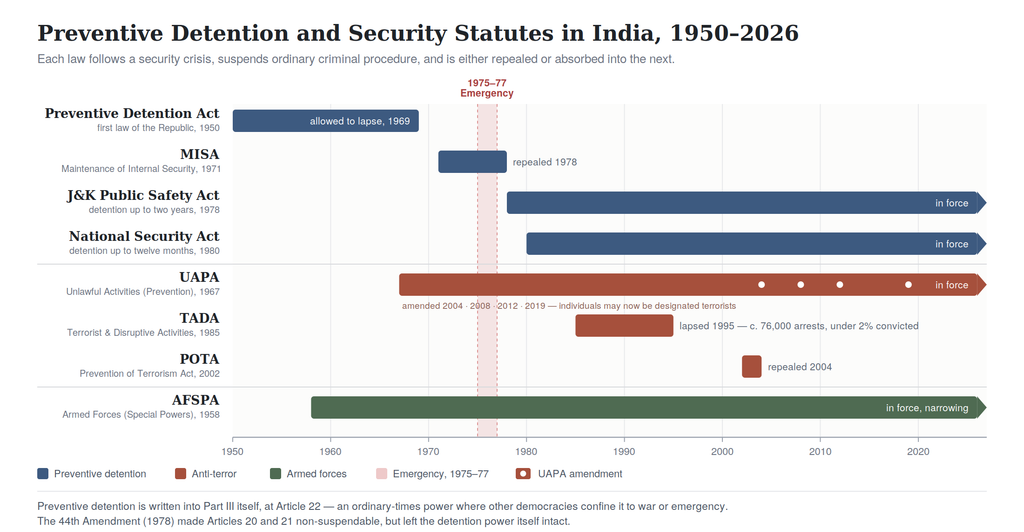
The Flaw: Preventive Detention Written Into Part III
- The defect is not that India has preventive detention but where it is written.
- Article 22 places it inside the fundamental rights chapter, so the power to detain without trial is not merely tolerated by the Constitution but constitutionalised by it.
- It is an ordinary-times power: most democracies confine detention without trial to war or a declared emergency, while in India both Parliament and the states may legislate for it in normal times.
- Article 22’s safeguards look substantial and are thin.
- The rights to be told the grounds of arrest, to consult a lawyer and to be produced before a magistrate within twenty-four hours are denied to preventive detainees by clause (3).
- Detention beyond three months needs an Advisory Board’s opinion, but there is no right to counsel before it and no cross-examination.
- Article 22(6) lets the state withhold facts it considers against the public interest, so a detainee may be denied the very material on which the order rests.
- The 44th Amendment’s tightening never took effect: it cut the period without an Advisory Board opinion from three months to two, and that provision was never brought into force.
From A.K. Gopalan to Maneka Gandhi
- A.K. Gopalan v. State of Madras (1950), the Republic’s first great civil liberties case, upheld the Communist leader’s detention under the Preventive Detention Act 1950.
- The reasoning mattered more than the result: “procedure established by law” was read literally, so the courts would not ask whether a validly enacted procedure was fair.
- The rights were treated as watertight compartments, a law valid under Article 22 needing to satisfy neither Article 19 nor Article 14.
- Fazl Ali J dissented, holding that the rights are interconnected and that “procedure” imports the minimum content of natural justice. His was the position that eventually won.
- Maneka Gandhi v. Union of India (1978) completed the reversal: a procedure depriving a person of liberty must be right, just and fair, and not arbitrary, fanciful or oppressive, and Articles 14, 19 and 21 form a golden triangle read together.
- The arc from 1950 to 1978 is the movement’s founding narrative — courts that began by deferring to the executive were pushed by the Emergency into the opposite posture.
The Statutory Chain
- The chain is short and continuous.
- Preventive Detention Act 1950 — enacted within weeks of the Constitution’s commencement, repeatedly renewed, allowed to lapse in 1969.
- MISA 1971 — the Emergency’s principal instrument, repealed in 1978.
- National Security Act 1980 — brought in by the returning Indira Gandhi government and still in force, permitting detention up to twelve months on grounds of national security, public order or essential supplies.
- The state Public Safety Acts are the least visible and most heavily used layer.
- The Jammu and Kashmir Public Safety Act 1978 permits detention for up to two years without trial, and is the standard administrative answer to political activity in the Valley.
- Amnesty International’s description of it as a “lawless law” is the movement’s settled view.
- Chhattisgarh’s Special Public Security Act 2005 and the “goondas” acts of Tamil Nadu, Telangana and Gujarat extend preventive detention beyond terrorism into ordinary crime.
- The High Court record is the sharpest evidence of misuse.
- Jammu and Kashmir’s courts have quashed PSA detentions in batches for non-application of mind, copied grounds, factual error and mistaken identity.
- One bench observed that the Act had been invoked with less scrutiny than a routine traffic challan attracts.
Emergency Provisions: The Weimar Borrowing
- Articles 358 and 359 were drawn from the Weimar Constitution, whose Article 48 had been the instrument of the Nazi seizure of power.
- Article 358 automatically suspends the freedoms of Article 19 during a proclamation of emergency.
- Article 359 lets the President suspend the right to move any court to enforce specified fundamental rights.
- One suspends the right, the other only the remedy — which is why the Emergency’s central legal question was about habeas corpus rather than liberty.
- The 44th Amendment Act 1978 made both survivable.
- It confined Article 358 to emergencies proclaimed on grounds of war or external aggression.
- It excluded Articles 20 and 21 from suspension under Article 359.
- It replaced “internal disturbance” with “armed rebellion” as a ground of proclamation, and required the Cabinet’s written recommendation.
Sedition: The Movement’s Longest Argument
Sedition is the issue on which the movement has campaigned continuously for ninety years, and the one where its record best shows how partial its victories are.
The Constituent Assembly Deliberately Removed It
- The draft Constitution’s Article 13 originally listed “sedition” as a ground for restricting free speech, and it was deliberately deleted.
- The objection was led by K.M. Munshi, whose point was that the section confuses the government with the state — criticism of a ministry is not disloyalty to the country.
- What survives in Article 19(2) is a restriction on speech affecting the security of the State and public order, not on disaffection.
- Section 124A nevertheless survived unamended, which is the constitutional anomaly the movement has attacked ever since: a ground of restriction the framers rejected continued to operate as a criminal offence.
Kedar Nath Singh and the Compromise
- Kedar Nath Singh v. State of Bihar (1962) upheld Section 124A but read it down.
- Sedition would be constitutional only where the speech tended to incite violence or public disorder; strong criticism of government, however vehement, was protected.
- The narrowing was ignored in practice, because Kedar Nath limited the offence at conviction and not at registration — the police could still register, arrest and hold while the courts applied the test years later.
- Cases rose sharply after 2014 while convictions stayed near zero, so the offence worked almost entirely as a process punishment. It was cognizable, non-bailable and non-compoundable, punishable with three years or life.
Vombatkere and the Present Position
- In S.G. Vombatkere v. Union of India, on 11 May 2022, the Supreme Court held Section 124A in abeyance.
- No fresh FIRs, investigations paused, pending trials and appeals in stasis, while the Union reconsidered a section the Court called engineered for a colonial regime.
- The challenge was referred to a Constitution Bench on 12 September 2023; on 8 August 2025 a bench led by Chief Justice B.R. Gavai agreed to examine Section 152 of the Bharatiya Nyaya Sanhita alongside it. The matter has not been disposed of.
- In May 2026, in Kamran v. State of Madhya Pradesh, the Court softened the freeze, allowing pending trials and appeals to proceed where the accused consents.
- The result is a limbo the movement did not anticipate: the offence is neither struck down nor operative, and the accused’s own consent has become the switch that turns a criminal trial on.
The Law Commission and the Bharatiya Nyaya Sanhita
- The Law Commission’s 279th Report (2023) went the other way.
- It recommended retaining sedition, raising the maximum term from three years to seven, and requiring a preliminary inquiry by an officer of at least Inspector rank before registration.
- Section 152 of the Bharatiya Nyaya Sanhita 2023 replaced 124A when the new codes came into force on 1 July 2024.
- Titled “Act endangering sovereignty, unity and integrity of India”, it drops the word “sedition” and widens the conduct — secession, armed rebellion, subversive and separatist activities, including by “financial means”.
- The punishment rises to life, or up to seven years, plus fine.
- It retains an explanation protecting comments expressing disapprobation of government measures with a view to their alteration by lawful means.
- The critique is precise: the offence has not been abolished but renamed, broadened and made more severely punishable, and terms such as “subversive activities” give the police wider discretion than the section they replace. The claim that India has repealed sedition is inaccurate.
The Emergency and the Birth of the Movement
By the early 1970s the conditions for a rights movement had assembled: the memory of the freedom struggle had faded, the economic promise of planning had not been delivered, and the state had grown more intrusive and less accountable — what critics of the period called a drift towards a police state.
The Pre-Emergency Ferment
- Three agitations converged to make extra-parliamentary politics respectable again.
- The anti-price-rise agitation in Maharashtra from 1972, driven substantially by women’s organisations, made inflation a mass political question.
- The Nav Nirman movement in Gujarat in 1973–74 began over hostel food costs and ended by forcing out the Chimanbhai Patel government — proof that agitation could unseat a state government.
- Jayaprakash Narayan’s “total revolution” generalised both, demanding a transformation of society and polity rather than a change of government.
- JP took the step that made confrontation certain: calling on the armed forces and the police not to obey illegal orders.
The Emergency, June 1975 – March 1977
- The proclamation of 25 June 1975 was made on the ground of “internal disturbance” — the phrase the 44th Amendment would later delete.
- The detentions were mass and unexamined.
- Roughly 35,000 people were held under MISA, with tens of thousands more under the Defence of India Rules.
- The Shah Commission found them made without fair trial, without proper grounds and without meaningful opportunity to challenge them.
- Censorship was pre-publication.
- Newspapers submitted copy to censors, and electricity to Delhi’s newspaper offices was cut on the night of the proclamation.
- Recalcitrant papers faced newsprint quotas and withdrawal of advertising.
- The 42nd Amendment Act 1976 tried to entrench the change — extending legislatures’ life, curtailing judicial review, asserting unlimited amending power — and the 43rd and 44th Amendments reversed most of it.
- The period’s doctrine was the “committed judiciary” and “committed bureaucracy”, first applied when three judges were superseded in 1973 to make A.N. Ray Chief Justice.
- The most concrete violations fell on the poor.
- The forced sterilisation campaign ran to over 80 lakh procedures in 1976-77 alone, with 1,774 reported deaths.
- The Turkman Gate demolitions cleared settlements with minimal notice or legal protection.
ADM Jabalpur: The Case That Made the Movement
Additional District Magistrate, Jabalpur v. Shivkant Shukla (1976) is the most important case in this article, because the civil liberties movement was formed by the discovery that the Supreme Court would not save it.
- The question was narrow and total: given the presidential order under Article 359, could a detainee move a High Court for habeas corpus at all — even to say the order was unauthorised by MISA, made in bad faith, or against the wrong person?
- Nine High Courts had said yes. The Supreme Court, by 4:1, said no.
- The majority — Chief Justice A.N. Ray with Beg, Chandrachud and Bhagwati JJ — held that during the emergency no person had any locus standi to move any court for Article 21.
- Their logic was that Article 21 was the sole repository of the right to life and liberty, so nothing survived its suspension.
- Counsel for the state conceded that on this reasoning there would be no remedy even if a detainee were shot dead.
- H.R. Khanna J alone dissented, holding that the right to life and personal liberty is not the gift of Article 21 but pre-exists it.
“Even in absence of Article 21 in the Constitution, the State has got no power to deprive a person of his life or liberty without the authority of law.” — H.R. Khanna
- The dissent cost him the Chief Justiceship: senior-most when the vacancy arose in January 1977, he was superseded in favour of M.H. Beg and resigned the same day.
“If India ever finds its way back to the freedom and democracy that were proud hallmarks of its first eighteen years as an independent nation, someone will surely erect a monument to Justice H. R. Khanna of the Supreme Court.” — The New York Times, 1976
- The Court repudiated the judgment in K.S. Puttaswamy (2017).
- The nine-judge privacy bench declared ADM Jabalpur seriously flawed and expressly overruled, and said Khanna had been clearly right.
- Forty-one years separate the failure from its correction.
- The 44th Amendment had already fixed the hole in the text, but the movement’s lesson was not textual: paper guarantees fail precisely when they are needed, and a standing, non-party watchdog is therefore necessary.
The Shah Commission
- The Janata government appointed the Shah Commission in May 1977 under former Chief Justice J.C. Shah to inquire into the excesses of the twenty-one months.
- It produced three reports — two interim in 1978 and a final report on 6 August 1978.
- They covered the proclamation, press suppression, police conduct, the Turkman Gate demolitions, prison conditions, torture and the family planning campaign.
- None of it produced accountability.
- The special courts constituted to try Emergency offences were held not to have been validly constituted, and no trials followed.
- Returning to power in January 1980, the Indira Gandhi government tried to withdraw copies from circulation; the report was never tabled in Parliament.
- This is the movement’s second formative lesson: an inquiry that documents everything and punishes nobody is the standard Indian answer to a rights catastrophe.
The Organisations That Came Out of It
- The People’s Union for Civil Liberties and Democratic Rights (PUCLDR) was launched at a national seminar on 17 October 1976.
- It was inaugurated by Acharya J.B. Kripalani and convened around Jayaprakash Narayan, with V.M. Tarkunde, the former Bombay High Court judge who became the movement’s presiding figure, as President.
- It lost momentum after the Janata victory of 1977 and JP’s death in 1979.
- It was revived and renamed the People’s Union for Civil Liberties (PUCL) in November 1980, with Arun Shourie as General Secretary.
- Formal membership came with safeguards against party capture: no office-bearer could hold party office, and no single party more than a tenth of an executive body.
- The Delhi unit, dating from 1977, continued separately and became the People’s Union for Democratic Rights (PUDR) in February 1981. The split was over orientation, not personality.
- Other bodies fed the same current and supplied its documentation methods.
- Citizens for Democracy, founded by JP in 1974, produced early inquiries including the Tarkunde Committee’s on the Bhagalpur blindings.
- The Association for Protection of Democratic Rights (APDR) in West Bengal was formed in 1972 against the state’s counter-insurgency towards the Naxalites.
- The Andhra Pradesh Civil Liberties Committee (APCLC) was formed in the early 1970s over encounter killings.
- The Association for Democratic Reforms (ADR) carried the logic to the electoral process, winning disclosure of candidates’ criminal and financial records; the Coordination of Democratic Rights Organisations (CDRO), formed in August 2007, is the current umbrella.
- Lawyers were the movement’s characteristic personnel — Shanti Bhushan, Tarkunde, and later Prashant Bhushan, Indira Jaising and Colin Gonsalves — and the courtroom its characteristic venue.
PUCL and PUDR: The Movement’s Internal Division
| PUCL | PUDR | |
|---|---|---|
| Origins | PUCLDR of 1976, revived and renamed in 1980 | Delhi unit of PUCLDR (1977), separate from February 1981 |
| Ideological orientation | Liberal and constitutionalist | Marxist, reading rights through class and state power |
| Rights emphasised | Civil liberties — detention, custody, free speech, fair trial | Civil liberties plus social and economic rights — labour, land, wages |
| Preferred method | The judicial route — PIL, habeas corpus, test cases, legal aid | Grassroots mobilisation with tribals, peasants and workers, plus fact-finding reports |
| Conception of the state | The state can be held to its own constitutional promises | The state is structurally aligned with dominant classes; rights are won, not granted |
| Membership and funding | Formal membership, state units, national convention | Volunteer-based; funded by literature and donations, refusing government and institutional money |
| Signature case | PUCL (1997) on telephone tapping; PUCL (2001) on food | PUDR v. Union of India (1982), the Asiad workers case |
The Human Rights Phase from the 1980s
From the 1980s the vocabulary changed: organisations that had spoken of civil liberties began to speak of human rights, and the claims widened from freedom from detention to entitlements of food, health, shelter and information.
- The international turn supplied both the language and the institutional template.
- The Vienna Declaration and Programme of Action of 25 June 1993 declared all human rights universal, indivisible, interdependent and interrelated, and urged states to establish national human rights institutions.
- It also recommended the creation of a UN High Commissioner for Human Rights.
- The Paris Principles, framed in 1991 and endorsed by the UN General Assembly in December 1993, set the standards such institutions must meet — a broad legal mandate, pluralist composition, independent appointment and real investigative powers.
- India’s NHRC was created in response and is measured against them still.
- International organisations arrived — Amnesty International, Human Rights Watch and donor-funded bodies — giving domestic groups money, methodology and an international audience.
- Domestically, Public Interest Litigation, developed by P.N. Bhagwati and V.R. Krishna Iyer, supplied the procedural key that turned an activist’s fact-finding report into a justiciable claim. The movement did not create PIL; it was PIL’s principal user.
The Jurisprudential Yield
This is the movement’s strongest evidence of effect. Each case below carries a distinct argument.
- Prisons and the undertrial are where the yield began.
- Hussainara Khatoon v. State of Bihar (1979) — a report on Bihar’s undertrials, taken up by the advocate Kapila Hingorani, revealed prisoners held longer awaiting trial than the maximum sentence for the offence charged.
- The Court read a right to speedy trial into Article 21 and ordered mass release. This is the first PIL, and its subject is the prison.
- Sunil Batra v. Delhi Administration (1978, 1980) — a convict’s letter about the torture of a fellow prisoner was treated as a petition, establishing that a prisoner does not lose fundamental rights at the prison gate.
- Sheela Barse (1983) followed with directions on separate lock-ups for women.
- Custody and the police produced the enforceable safeguards.
- Nilabati Behera v. State of Orissa (1993) — compensation in public law for a custodial death, sovereign immunity being no defence under Articles 32 and 226.
- D.K. Basu v. State of West Bengal (1997) — eleven mandatory arrest and detention requirements, including an arrest memo attested by a witness, intimation to a relative, medical examination every forty-eight hours and access to a lawyer during interrogation. Most now sit in the Bharatiya Nagarik Suraksha Sanhita.
- Privacy, dignity and the workplace extended the reach.
- PUCL v. Union of India (1997) — the telephone-tapping case held conversations protected by Articles 19(1)(a) and 21 and read safeguards into Section 5(2) of the Telegraph Act; it is the ancestor of the privacy jurisprudence culminating in Puttaswamy (2017).
- Vishaka v. State of Rajasthan (1997) — after the gang rape of the saathin Bhanwari Devi, the Court framed binding guidelines on workplace sexual harassment out of an unincorporated international convention. It shows the movement using international law domestically.
- Navtej Singh Johar (2018), reading down Section 377, closes the arc on dignity and autonomy.
- Two cases are the movement’s own.
- PUDR v. Union of India (1982), the Asiad workers case: Bhagwati J held that labour rendered below the minimum wage is “forced labour” under Article 23, and that an organisation may sue for those who cannot sue for themselves. A civil liberties group thereby created a doctrine of economic rights.
- Nandini Sundar v. State of Chhattisgarh (2011): the petition of Nandini Sundar, Ramachandra Guha and E.A.S. Sarma against Salwa Judum, the state-backed vigilante force of tribal Special Police Officers.
- The bench led by B. Sudershan Reddy J held that arming poorly trained tribal youth for counter-insurgency violated Articles 14 and 21, and disarmed the SPOs rather than let citizens be treated as expendable instruments of counter-insurgency.
The Statutory and Institutional Response
- The Protection of Human Rights Act 1993 created the National Human Rights Commission, the State Human Rights Commissions and Human Rights Courts.
- It was enacted under international pressure while India’s record in Punjab, Kashmir and the North-East was under scrutiny.
- Around it sit the National Commissions for Scheduled Castes and Scheduled Tribes, for Women and Minorities (both 1992), for Child Rights (2007) and for Safai Karamcharis.
- The RTI Act 2005 is the outlier, because it was not conceded to international pressure but extracted by a domestic movement.
- The rights-based legislative decade of 2005–2013 — the Forest Rights Act, the Right to Education Act, the land acquisition Act and the National Food Security Act — is the high-water mark of the phase.
The Movement’s Critique of the NHRC
- Section 19 is the central grievance.
- For violations by the armed forces the Commission may only seek a report from the Central Government and then recommend; it cannot summon witnesses, inspect or investigate.
- The one category of violation the movement most wants investigated is the one category exempted from investigation.
- Three further defects are structural.
- The one-year limitation in Section 36(2) bars inquiry into anything older than a year, excluding the systematic abuses that surface late.
- Its powers are recommendatory only.
- Its composition is bureaucratic and unpluralistic, and its selection committee executive-dominated.
- The blunt verdict inside the movement is that it is a “toothless tiger” — an institution whose existence lets the state claim compliance with the Paris Principles while withholding accountability.
The Right to Information Campaign
The RTI campaign is the clearest case in Indian history of a movement writing a statute, and it is unusual in three further ways: it began among the rural poor rather than among urban professionals, its demand was procedural rather than substantive, and it succeeded.
MKSS and the Jan Sunwai
- The Mazdoor Kisan Shakti Sangathan (MKSS) was formed in 1990 at Devdungri, Rajsamand district, Rajasthan, by Aruna Roy, Nikhil Dey and Shankar Singh, among agricultural labourers and small peasants.
- The original demand had nothing to do with information.
- It was about minimum wages on drought relief works: labourers were paid less than the statutory rate and told the muster rolls showed otherwise.
- To prove underpayment they had to see the muster rolls, bills and vouchers held by the panchayat and the public works department — documents about their own labour they were not allowed to see.
- The jan sunwai, or public hearing, was the campaign’s invention.
- Official records were read aloud in the village they concerned and verified in public by the people named in them — labourers never employed on the days recorded, wells paid for but never built, the dead listed as present.
- “Hamara paisa, hamara hisab” — our money, our accounts — turned an abstract demand for transparency into a claim of ownership over public spending.
- The first hearings were held from December 1994, and the technique spread because it needed no lawyer and no institution.
- The campaign then scaled, through sustained public sitting and a national body.
- A forty-day dharna at Beawar in 1996 and a fifty-three-day dharna in Jaipur in 1997.
- The National Campaign for People’s Right to Information (NCPRI), formed in 1996 from MKSS, journalists, lawyers, retired civil servants and academics, carried the demand nationally and drafted the successive versions of the law.
From State Laws to the Act of 2005
- The states legislated first — Tamil Nadu and Goa in 1997, then Rajasthan in 2000 (the direct product of the MKSS agitation), Karnataka, Delhi and Maharashtra.
- The constitutional footing already existed: from State of U.P. v. Raj Narain (1975) through S.P. Gupta the Court held the right to know implicit in Article 19(1)(a).
- The Freedom of Information Act 2002 was a false start — assented to in January 2003, it was never notified into force, having no independent appellate authority and no penalties.
- The Right to Information Act 2005, in force from 12 October 2005, replaced it, and its architecture is the campaign’s.
- A thirty-day limit, Public Information Officers in every public authority, and a two-tier appeal ending in an independent Information Commission.
- A penalty of ₹250 a day up to ₹25,000; Section 4’s duty of proactive disclosure; Section 8(2)’s public-interest override.
- The most radical provision was the least noticed: by making the penalty personal to the officer rather than to the department, the Act shifted the incentive from institutional inertia to individual liability.
The Record
- RTI is the most heavily used transparency law in the world: well over three crore applications since 2005, at fifty to sixty lakh a year, overwhelmingly by ordinary citizens chasing rations, pensions, wages and land records rather than by journalists or activists.
- The price has been paid by the users.
- Media reports document more than three hundred attacks and fifty-one murders connected to information sought under the Act, concentrated in Maharashtra and Gujarat.
- Amit Jethwa, shot dead outside the Gujarat High Court in 2010, is the best-known case.
- The Whistle Blowers Protection Act 2014 has never been operationalised.
The Counter-Current
- The RTI (Amendment) Act 2019 is the campaign’s central grievance.
- The original Act fixed Commissioners’ tenure at five years and their salaries at Election Commissioner level, insulating them from the government they review.
- The amendment handed the power to prescribe tenure and salary to the Central Government by rules, which cut terms to three years.
- The objection is structural: an adjudicator whose pay and term are set by the executive whose refusals he reviews is not independent.
- Vacancies and pendency are strangling the appellate tier.
- On data to 30 June 2024, over 4.05 lakh appeals and complaints were pending across the twenty-nine commissions.
- Jharkhand, Tripura, Telangana and Goa were entirely defunct; eight commissions had no Chief Information Commissioner.
- Penalties were imposed in about five per cent of the cases where they were due, two-fifths of appeals were returned without any order, and over half the Commissioners are retired government officials.
- The Digital Personal Data Protection Act 2023 delivered the sharpest blow.
- Its Section 44(3) rewrote Section 8(1)(j) of the RTI Act, deleting both the qualification that personal information be exempt only where it has no relationship to public activity and the public-interest override, and substituting a flat exemption for “information which relates to personal information”.
- This matters because most RTI use is about identifiable people: muster rolls, beneficiary lists, transfer orders and asset declarations all contain personal information, so a blanket exemption makes the MKSS’s founding demand refusable.
- The campaign against it, led by NCPRI, Anjali Bhardwaj and Aruna Roy, argues that Section 8(1)(j) already balanced privacy against transparency and that the amendment protects officials rather than citizens.
- The DPDP Rules were notified on 13–14 November 2025, and a constitutional challenge is pending in the Supreme Court.
- On 7 August 2026 a bench headed by Chief Justice Surya Kant gave the Union two weeks to answer petitions by NCPRI, the campaigner Venkatesh Nayak and the Reporters Collective, on whether a data protection statute can repeal an earlier transparency statute.
A movement that succeeded in writing a law now spends its energy defending the law it wrote.
The Other Movement-to-Statute Chains
- The right to food began with a PUCL writ petition of April 2001, arguing that grain rotting in godowns while people starved violated Article 21.
- Rather than decide it, the Court issued a decade of interim orders converting the mid-day meal, the PDS and the ICDS into enforceable entitlements, with Commissioners of the Supreme Court to monitor compliance; the National Food Security Act 2013 codified them.
- The right to work ran the other way, campaign first and statute after: the employment guarantee demand produced MGNREGA 2005, whose social audit provisions came from the MKSS experience.
- MGNREGA is no longer on the statute book.
- It was replaced by the Viksit Bharat — Guarantee for Rozgar and Ajeevika Mission (Gramin) Act 2025, assented to on 21 December 2025.
- It raises the guarantee from 100 to 125 days but shifts funding from a demand-driven model to normative allocations shared 60:40 with the states.
- A guarantee financed on demand is a right; an allocation-capped guarantee is a scheme.
- The right to education ran from Unni Krishnan through the 86th Amendment (2002) inserting Article 21A to the Right to Education Act 2009.
| Campaign | Movement vehicle | Judicial step | Statute |
|---|---|---|---|
| Information | MKSS, then NCPRI, from 1990 | Raj Narain (1975) on the right to know | State laws from 1997; RTI Act 2005 |
| Food | Right to Food Campaign around the PUCL petition | PUCL (2001) and its interim orders | National Food Security Act 2013 |
| Work | Employment guarantee campaign, NAC | — | MGNREGA 2005, replaced by the VB–G RAM G Act 2025 |
| Custodial safeguards | PUCL, PUDR, legal aid bodies | D.K. Basu (1997) | Written into CrPC ss. 41B–41D, now the BNSS |
The Security-Law Question
Extraordinary laws are the movement’s permanent adversary, and the sequence is consistent: each follows a real security crisis, suspends the ordinary protections of criminal procedure, is used far beyond its stated target, and is finally repealed or absorbed into the next.
| TADA 1985 | POTA 2002 | UAPA 1967, as amended | |
|---|---|---|---|
| Occasion | Punjab militancy | Attack on Parliament, 2001 | Anti-secession law of 1967, turned anti-terror by amendments in 2004, 2008, 2012 and 2019 |
| Detention without charge | Up to one year | Up to 180 days | Up to 180 days |
| Confession to police | Admissible in evidence | Admissible | Not admissible — the one protection restored |
| Bail | Barred unless the court was satisfied the accused was not guilty | Similar reverse test | Section 43D(5): barred if the accusation is prima facie true on the case diary |
| Designation | Organisations | Organisations | Organisations and, since 2019, individuals |
| Fate | Lapsed 1995 after sustained campaigning | Repealed 2004 | In force, with NIA property-attachment powers added in 2019 |
- TADA is the canonical example of misuse by numbers.
- About 76,000 people were arrested by mid-1994; a quarter of the cases were dropped without charge, barely a third came to trial, and the conviction rate was under two per cent of those arrested.
- Its heaviest use was in Gujarat and Maharashtra, states with no terrorism problem of the kind it was written for.
- POTA repeated the pattern in miniature and was repealed within two years.
- UAPA has absorbed both.
- Its 2019 amendment allows the Union to designate an individual a terrorist without charge or trial.
- 2,914 arrests were made under the Act in 2023 at a national conviction rate of roughly four per cent.
- Jammu and Kashmir alone accounted for 1,206 arrests — 42 per cent of the total — at a conviction rate below one per cent.
- The objection is not that terrorism should go unpunished, but that these statutes shift the punishment from the sentence to the process: where bail is barred and trial takes years, the years in custody are the penalty, imposed without a finding of guilt and unrecoverable on acquittal.
AFSPA
- The Armed Forces (Special Powers) Act 1958, descended from the 1942 ordinance promulgated against the Quit India movement, applies wherever an area is declared “disturbed”.
- Section 4 lets any officer fire upon and cause death on suspicion of a breach of prohibitory orders, arrest and search without warrant, and destroy structures.
- Section 6 is the provision the movement attacks: no prosecution may be instituted without the previous sanction of the Central Government, and sanction has been refused or left undecided in the overwhelming majority of cases, converting a procedural filter into effective immunity.
- The official record on AFSPA runs one way, and has been ignored.
- The Supreme Court upheld the Act in Naga People’s Movement of Human Rights v. Union of India (1997) while issuing do’s and don’ts binding on the forces.
- The Justice Jeevan Reddy Committee (2005), appointed after the protests over the death of Thangjam Manorama, recommended repeal, and was never accepted.
- The Santosh Hegde Commission (2013) examined six encounter deaths in Manipur and found all six fake.
- Extra Judicial Execution Victim Families Association v. Union of India (2016) is decisive. Considering 1,528 alleged extra-judicial killings in Manipur, the Court held there is no blanket immunity, that retaliatory force is impermissible even in a disturbed area, and that every death caused by the forces must be investigated.
- The campaign has been carried by two episodes above all.
- Irom Sharmila’s fast ran from 2 November 2000 to 9 August 2016 — sixteen years, prompted by the Malom massacre, sustained by force-feeding in judicial custody under a charge of attempted suicide. It is the longest hunger strike on record and it did not secure repeal.
- The Oting killings of 4 December 2021 in Mon district, Nagaland, where security forces killed thirteen coal miners and villagers, brought the sanction question back: the state police filed a chargesheet and the Centre declined sanction.
- AFSPA’s extent has genuinely shrunk — to parts of Manipur, Nagaland and Arunachal Pradesh and three districts of Assam, extended in six-month tranches, after withdrawal from Tripura in 2015 and Meghalaya in 2018. The movement can claim the contraction; it cannot claim repeal.
Bail, and Process as Punishment
- Section 43D(5) of the UAPA bars bail where, on the case diary and police report, the court is of opinion that there are reasonable grounds for believing the accusation prima facie true.
- NIA v. Zahoor Ahmad Shah Watali (2019) made it severe, holding that the court must take the prosecution’s material at face value and neither weigh the evidence nor assess admissibility.
- The loosening since 2021 is real but case-by-case.
- K.A. Najeeb (2021) allowed bail despite Section 43D(5) where trial will not conclude in reasonable time.
- Vernon Gonsalves (2023) required courts to examine whether the material is capable of supporting the accusation.
- Sheikh Javed Iqbal (2024) and Jalaluddin Khan v. State of Bihar (2024) granted bail and restated the general rule.
“The basic rule may perhaps be tersely put as: bail, not jail.” — V.R. Krishna Iyer
- Bhima Koregaon is the standing illustration. Sixteen academics, lawyers, poets and activists were arrested from 2018 under the UAPA over the Elgar Parishad of December 2017 and an alleged Maoist conspiracy.
- The custody has outlasted the case. By May 2026 fourteen of the sixteen had been released on bail, several after five to eight years.
- The lawyer Surendra Gadling, arrested on 6 June 2018, was granted bail on 4 May 2026 after nearly eight years, the Bombay High Court relying on prolonged incarceration. The trial has not begun.
- Arsenal Consulting reported that documents had been planted by malware on the computers of Rona Wilson and Gadling before their arrests; the NIA disputes the finding and it remains judicially undetermined.
- Father Stan Swamy is the sharpest single fact available on undertrial detention in India.
- An 83-year-old Jesuit priest who had worked four decades with Adivasi undertrials in Jharkhand, he was arrested on 8 October 2020 and suffered from Parkinson’s disease.
- He applied for a straw and sipper because he could not hold a glass; the NIA took twenty days to reply that it had seized none.
- Bail was refused repeatedly and he died in custody on 5 July 2021, untried.
The Critique
The most searching criticisms come from inside the movement, made by people who want it to work.
Upendra Baxi
- Baxi’s central charge is a crisis of legitimacy: what exists in India is not a human rights movement but a human rights industry.
- Organisations recruit management professionals rather than people with a record of rights work, operate by corporate method, and become money-minting institutions.
- He calls the process the NGO-isation of human rights, and warns that it risks infection by the very governance processes it exists to check.
- His positive contribution is more interesting than the indictment.
- Baxi distinguishes the politics of human rights — the appropriation of rights language by states and corporations to legitimate what they were doing anyway — from the politics for human rights, which retains the capacity to challenge oppressive practice. The vocabulary is identical and the politics are opposite.
- He argues that human rights are authored from below: their originary authors are not treaty-drafters or Enlightenment philosophers but people in struggle, and rights are the sediment of resistance rather than a gift of the powerful.
- “Taking suffering seriously” is his methodological demand — a rights discourse not built out of concrete narratives of pain is empty.
- His late warning is that the UDHR paradigm is being displaced by a “trade-related, market-friendly” paradigm in which corporations claim rights while evading accountability.
- The two halves fit together. If rights are authored by the suffering, a movement staffed by professionals who have not suffered and funded by institutions that benefit from the arrangement has lost the source of its authority.
Nandita Haksar
- Haksar’s argument is about limits.
- The Indian human rights movement has to work within limits the state itself sets, and the state does not tolerate activism that goes beyond the boundaries of the permitted national discourse.
- The consequence is a self-censoring movement: it may criticise excess within a framework, but questioning the framework — the security paradigm, the legitimacy of the counter-insurgency itself — invites the charge of disloyalty.
- Her sharpest formulation of the point is that a state which adopts zero tolerance towards terrorists ends by extending that zero tolerance to human rights itself.
- The point is causal: a state that adopts an absolutist security posture cannot make exceptions for its critics, because the logic of zero tolerance treats anyone who complicates the operation as an obstacle.
The Selectivity Charge, From Both Directions
- The state’s charge is that rights organisations document abuses by police and armed forces exhaustively and are near-silent about killings of civilians, informers and security personnel by insurgents and Maoists.
- The movement’s answer is that human rights obligations bind the state, which holds the monopoly of legitimate force, while insurgents are already prosecuted.
- The answer is coherent and it is not persuasive to the public.
- The counter-charge from radical quarters is the opposite — that mainstream organisations are too legalistic, treating the constitutional state as a good-faith defaulter rather than as a structure of class and caste power.
- The dispute split an organisation, which is the best evidence that it is real.
- K. Balagopal, general secretary of the APCLC from 1983 to 1998, left over this question and founded the Human Rights Forum on 11 October 1998.
- He documented thousands of encounter killings by the state while criticising Maoist violence publicly — a rights position exempting revolutionary killing being, for him, no rights position at all.
Kothari and the Depoliticisation of the Non-Party Space
- Kothari had celebrated the non-party political process as a new channel of representation for constituencies parties had abandoned.
- His later worry was that the space would be hollowed out — movements converted into project-funded NGO work, grant cycles replacing programmes, and accountability running upward to donors rather than downward to constituents.
- The FCRA regime is the institutional form of that worry, applied by the state rather than by donors.
- The Foreign Contribution (Regulation) Act 2010, tightened in 2020, bars transfer of foreign funds between registered bodies, caps administrative expenditure at twenty per cent, and requires all receipts through a single designated State Bank of India account in Delhi.
- By mid-2026 roughly 14,500 associations held active FCRA certificates against about 22,500 cancelled and 15,200 expired — well over two-thirds of those ever registered are now outside the system.
- Amnesty International India halted operations in 2020 after its accounts were frozen; the Centre for Policy Research and Oxfam India later lost registration.
- The state’s justification is regulatory — foreign money in domestic politics, diversion, non-filing. The movement’s answer is selectivity: renewal denial carries fewer appeal rights than cancellation, and the effect is to defund the organisations that litigate against the government.
Composition and Distance
- The movement is urban, English-speaking and lawyer-led.
- Its habitats are the Supreme Court, the university and the press; its documents are in English; its methods presuppose access to courts.
- The people it represents are none of these things — undertrials, Adivasis in counter-insurgency zones, manual scavengers, detainees in Kashmir — and that gap is the reason the charge of elitism lands.
The Anti-National Framing
- The label shifts with the period: activists were CIA agents in the 1970s, old-fashioned socialists in the 1990s, and since roughly 2010 “anti-national” and “urban Naxal”.
- Its function is to move the argument off the merits: once an activist is called a front for an armed movement, whether the encounter was fake or the detention lawful need not be answered.
- Binayak Sen’s case is the template.
- A paediatrician and PUCL vice-president who had run rural health services in Chhattisgarh for decades was arrested on 14 May 2007 under the Chhattisgarh Special Public Security Act 2005 and the UAPA, for allegedly carrying letters for a jailed Maoist leader.
- On 24 December 2010 a Raipur court convicted him of sedition and sentenced him to life imprisonment.
- On 15 April 2011 the Supreme Court granted bail, observing that being a sympathiser does not make a person guilty of sedition.
The Gap Between Guidelines and Practice
- D.K. Basu has been law since 1997 and is routinely disregarded: arrest memos are written after the fact, medical examinations are perfunctory, and the guidelines are enforced, when at all, by compensation orders years later rather than by discipline at the time.
- Prakash Singh v. Union of India (2006) issued seven directives.
- A State Security Commission to insulate the police from political direction, and a two-year minimum tenure for the DGP and operational officers.
- A Police Establishment Board for transfers and postings, Police Complaints Authorities, and separation of investigation from law and order.
- No state has fully complied in twenty years. Most passed police acts that comply formally while retaining executive control over appointments and transfers, and contempt proceedings have been initiated against defaulting states.
- The Salwa Judum sequel makes the limitation explicit.
- After the 2011 judgment disbanding the SPOs, Chhattisgarh enacted the Auxiliary Armed Police Force Act 2011 and absorbed them into a new force.
- In June 2025, closing the litigation after eighteen years, B.V. Nagarathna and Satish Chandra Sharma JJ held that a legislature cannot commit contempt of court by making a law.
The movement’s method is also its ceiling: it can obtain orders it has no capacity to enforce.
The Contemporary Record
Standing Concerns
- Undertrials and prison conditions remain the movement’s largest single grievance.
- The NCRB’s Prison Statistics India 2024 records about 5.11 lakh prisoners against a sanctioned capacity of 4.53 lakh — an occupancy of 112.7 per cent.
- Roughly 73 per cent are undertrials, about 9,000 of them held more than five years without conviction.
- The population is drawn disproportionately from Scheduled Castes, Scheduled Tribes and Muslims, which makes overcrowding a question of caste as much as of procedure.
- Custodial death and torture show the accountability gap at its widest.
- India has averaged roughly ninety deaths in police custody a year since 1999, the figure being 62 in 2023.
- Of some 2,373 cases registered against police personnel for rights violations between 1999 and 2023 there have been three convictions, all in one year, and none at all in the six years to 2023.
- India signed the UN Convention Against Torture in 1997 and has never ratified it; the Prevention of Torture Bill 2010 lapsed, and the Law Commission’s 273rd Report (2017) urged ratification to no effect. Torture is therefore not a distinct offence in Indian law.
- Judicial delay. Pendency runs above five crore cases, and delay is how detention becomes punishment.
- Caste and communal violence — atrocities under the SC/ST Act, lynching, hate crime — and the fact-finding reports that follow are a staple of PUCL and PUDR work.
- Internet shutdowns. India has led the world in ordering them for most of the past decade; the Access Now / #KeepItOn count for 2025 records 65 shutdowns in India out of 313 worldwide.
- Anuradha Bhasin v. Union of India (2020) held indefinite suspension impermissible and required orders to be published and periodically reviewed.
- The death penalty, retained on the “rarest of rare” test since Bachan Singh (1980); manual scavenging, prohibited since 1993 yet still killing sewer workers; and trafficking complete the list.
India Before the International Machinery
- India has been through four cycles of the Universal Periodic Review — April 2008, May 2012, May 2017 and 7–11 November 2022.
- It has accepted most recommendations each time, and declined those on ratifying the torture convention, repealing AFSPA and abolishing the death penalty.
- The GANHRI accreditation dispute must be stated precisely, because most reporting gets it wrong.
- GANHRI’s Sub-Committee on Accreditation deferred India’s re-accreditation in 2023 and again in 2024, and in April 2025 recommended a downgrade from ‘A’ to ‘B’.
- The NHRC challenged it; the GANHRI Bureau rejected the challenge in December 2025 and referred the matter back, and the final review has been postponed to November 2026.
- No downgrade has taken effect: India still holds ‘A’ status.
- The grounds cited are the movement’s own — political interference in appointments, lack of pluralism, the use of police officers in the Commission’s own investigations, and failure to act publicly on violations against minorities and human rights defenders.
- Justice V. Ramasubramanian was appointed NHRC chairperson on 23 December 2024, and the reform agenda the process has produced — an independent investigative wing, a plural selection process, removal of the armed forces exemption — is the movement’s agenda restated by an international body.
Has the Movement Achieved Anything?
Two records have to be set against each other, and the honest answer is that the movement has been decisively successful in changing what the law says and largely unsuccessful in changing what the state does.
- On the legislative and jurisprudential side the achievement is genuine and large.
- The RTI Act 2005 and the National Food Security Act 2013 exist because campaigns produced them.
- The custodial jurisprudence created enforceable protections where there had been none.
- TADA lapsed and POTA was repealed after sustained public argument, and Puttaswamy and Navtej Johar constitutionalised claims unthinkable a generation earlier.
- On the enforcement side the record is close to inert.
- D.K. Basu is disregarded, Prakash Singh unimplemented, and torture is not an offence.
- The conviction rate for custodial death is effectively zero, undertrials are three-quarters of the prison population, and UAPA arrests convict in about one case in twenty-five.
- The asymmetry is structural: the appellate court is powerful over doctrine and weak over administration, and cannot staff a police station, discipline a constable or fund a prison.
- The position worth taking is that the movement has made the Indian state’s violations illegal without making them costly.
- Until enforcement — police accountability, prosecution sanction, prison administration, judicial capacity — becomes the subject of the campaign rather than its assumed sequel, further judgments will add to the archive rather than to the record.
- The counter-consideration should not be conceded away: keeping a wrong illegal preserves the vocabulary in which it can later be attacked, and illegality without cost is worth less than accountability and much more than nothing.
Reading the Movement Theoretically
- By composition it is a new social movement and by content it is not. It is middle-class, non-electoral and decentralised, but its founding demands are the classical liberal demands and its adversary is the coercive state rather than the culture of consumption.
- Indian rights movements are simultaneously rights movements and identity movements.
- A campaign about custodial death in Andhra Pradesh, the Public Safety Act in Kashmir or UAPA arrests in Chhattisgarh is at once a universal claim and a community’s claim about how the state treats it.
- The abstract citizen of rights discourse in India is always also a Dalit, an Adivasi, a Muslim or a Kashmiri.
- Baxi’s thesis follows from the same observation.
- Indian human rights discourse has been authored from below by those who suffered — undertrials, bonded labourers, encounter widows, displaced Adivasis — rather than handed down by the state.
- That is why the Indian rights canon is a canon of PILs brought for the poor rather than of legislative debates.
- Kalpana Kannabiran’s formulation captures the movement’s implicit constitutional theory: the Constitution as a commons, held and interpreted by citizens in struggle rather than owned by courts.
| Phase | Period | Driving force | Characteristic form | Signature outcome |
|---|---|---|---|---|
| Nationalist | 1870s–1947 | Anti-colonial struggle | Press campaigns, disobedience, prisoner defence | Indian Civil Liberties Union 1936 |
| Constitutional | 1947–1975 | Litigation under a new charter | Test cases on preventive detention | A.K. Gopalan and its long defeat |
| Civil liberties | 1975–1985 | The Emergency | Fact-finding, habeas corpus, volunteer organisations | PUCL, PUDR, the 44th Amendment |
| Human rights | 1985–2005 | Global rights turn, PIL, NGOs | PIL, documentation, international advocacy | NHRC 1993; the custodial jurisprudence |
| Rights-based legislation | 2005–2013 | Movement–state coalition | Campaign plus drafting | RTI 2005, NFSA 2013 |
| Contraction and defence | 2013 onward | Security expansion, funding rules | Defensive litigation to save existing rights | UAPA 2019, the RTI amendment, the FCRA squeeze |
Previous Year Questions
- Examine the nature of the civil liberty movement in India. (2020)
- Discuss the Right to Information and underline the challenges being posed before it. (2016)
- Comment in 150 words: The dilemmas of the human rights movements in India. (2014)
- In what ways do civil liberties and human rights movements influence the working of Indian democracy? Give your answer with suitable examples. (2010)
