

The Vocabulary of Group Politics

A pressure group is an organised body that seeks to influence public policy without seeking to hold public office. That one sentence carries the concept: the group wants outcomes from government, not the responsibility of being government. Everything else about such groups — their size, methods, respectability and durability — varies enormously.
- The literature uses a family of overlapping terms, and the looseness is worth naming rather than pretending away.
- Interest group — any body of people sharing a common interest, whether or not it acts politically. A residents’ association is an interest group even in a year when it petitions nobody.
- Pressure group — an interest group that actually acts on public authority. Pressure is the technique; interest is the purpose. Every pressure group is an interest group; not every interest group becomes one.
- Lobby — originally the antechamber of a legislature where petitioners waited; now the direct persuasion of officeholders, and the professionals who do it for a fee.
- Advocacy group — a body pressing a cause rather than the material interest of its own members, usually with a rights vocabulary and an appeal to the general public.
- Think tank — a research organisation that shapes policy by supplying analysis and framing the terms of debate rather than by mobilising numbers.
- Social movement — sustained collective action outside routine institutional channels, with a shared identity and a challenge to existing authority or distribution.
- The quarrel between “interest group” and “pressure group” is real but small. Traditional political science preferred “pressure group”; the behavioural turn preferred “interest group.”
- “Interest group” names the function — interest articulation — rather than the tactic, and is therefore the more precise term. In Indian usage the two are treated as synonyms and this note follows that usage.
- The distinction that does the analytical work cuts across all these labels: it is between groups that seek office and groups that seek influence.
- Groups seeking office must build an electoral machine, take a position on everything, and answer for the whole of governing.
- Groups seeking influence may specialise, stay silent outside their concern, and never answer to an electorate for what they win.
- Almond‘s functional language captures the division of labour neatly: pressure groups perform interest articulation — voicing a demand in a form the political system can process — while political parties perform interest aggregation, bundling many articulated demands into a programme capable of winning a majority.
The invisible empire
- Pressure groups are often described as the “invisible empire” of politics, an echo of S.E. Finer‘s study of the British lobby, Anonymous Empire. The phrase names their defining feature: power exercised without a public office attached to it, and therefore without a public record.
- They play a game of hide and seek — visible when a demonstration of numbers is wanted, invisible when the real business is done in a ministry corridor.
- Pressure groups are an integral component of pluralist democracy, not an unfortunate byproduct of it. Every democracy that guarantees association will produce them.
- In India the guarantee is Article 19(1)(c) — the freedom to form associations or unions — read with 19(1)(a) on speech and 19(1)(b) on peaceable assembly. Together these three clauses are the constitutional foundation of group politics.
- Each is subject to reasonable restrictions, and the history of Indian pressure-group politics is substantially a history of where the state has drawn that line.
- The study of pressure groups is the empirical core of pluralism — how political sociologists examine the interface between society and the state.
Pressure Groups and Political Parties
The decisive difference is not size, respectability or method. A party seeks to capture power and take responsibility for governing; a pressure group seeks to influence whoever governs. Everything else follows from that.
| Dimension | Political party | Pressure group |
|---|---|---|
| Objective | Capture political power; contest elections and form government | Influence those who hold power; never contests for office |
| Scope of concern | A broad programme covering the whole field of governance | A narrow, sectional or single interest |
| Accountability | Electoral — answerable to voters at fixed intervals | None to the public; answerable only to members, if that |
| Membership | Open, mass, formally enrolled, ideologically defined | Restricted to those sharing the interest; often small |
| Internal discipline | High — whips, manifestos, candidate discipline | Low; a group can hold contradictory positions on unrelated issues |
| Responsibility for outcomes | Carries the consequences of governing | Bears none; can demand what it would not have to implement |
| Permanence | Designed for continuity across issues and decades | Many are issue-bound and dissolve when the issue closes |
- The sharpest way to hold the difference: parties aggregate, groups articulate. A party must reconcile the farmer’s demand for higher procurement prices with the consumer’s demand for cheaper food. A pressure group is under no such obligation — which is what makes it effective and what makes it partial.
- The boundary is unusually porous in India, and three specific blurrings matter.
- During the Congress-dominant decades, opposition parties were too weak to displace the ruling party but strong enough to work on its internal factions — so they behaved, functionally, as pressure groups. Kothari gave them the label “parties of pressure”, and the party-system note develops the argument.
- Very many Indian pressure groups are frontal organisations of parties rather than independent bodies. INTUC to the Congress, BMS to the Sangh, CITU to the CPI(M), AITUC to the CPI; ABVP, NSUI and SFI on the campuses. Their demands are timed and calibrated to the parent party’s calculations.
- The traffic runs the other way too. Groups convert into parties. The Indian National Congress began as an association petitioning the colonial state, became a movement and then a party; the Aam Aadmi Party emerged directly from an anti-corruption agitation; the Shetkari Sanghatana and the Asom Gana Parishad each grew out of movements.
- Where a pressure group controls a party rather than the reverse, the categories break down entirely — the problem the RSS poses, taken up later in this note.
Pressure Groups and Social Movements
| Dimension | Pressure group | Social movement |
|---|---|---|
| Organisation | Formal, with office-bearers, membership and funds | Loose and networked; least institutionalised of the three forms |
| Duration | Continuous, often indefinite | Episodic — a life cycle of emergence, peak, decline |
| Method | Negotiation, representation, litigation, selective agitation | Mobilisation, protest, direct action; disruption is the resource |
| Relationship to the state | Seeks access to it | Often seeks to contest or bypass it, questioning its legitimacy |
| Goal | A specific policy outcome for a defined interest | Structural change in values, distribution or authority |
| Membership base | Bounded by the interest served | Open, diffuse, defined by a shared identity or grievance |
- The Indian pattern is institutionalisation. Movements do not simply succeed or fail; they harden into organisations, often into parties.
- The anti-arrack movement in Andhra Pradesh, the Narmada Bachao Andolan, the Right to Information campaign and the anti-corruption agitation of 2011 each began as movements and each left behind a durable organisational residue.
- Unit 11’s note on social movements and Unit 5’s note on grassroots movements carry the movements literature. This note takes only the associational side: what happens when mobilisation acquires an office, a treasurer and a memorandum.
Pluralism: The Theory of Group Politics
Pluralism is the theory that politics is best explained not by the state or the individual voter but by groups. It is the tradition within which pressure groups were first taken seriously, and every criticism of them since has been a criticism of it.
Bentley and the group basis of politics
- Arthur Bentley, in The Process of Government, made the founding claim: “there is no group without its interest”, and society is nothing more than the complex of its groups.
- Government, on this view, is not a neutral apparatus standing above society. It is the process by which group pressures are adjusted against one another — an arena, not an actor.
- The weakness in Bentley is that if everything is a group and every outcome is a resultant of group pressure, the theory explains everything and predicts nothing.
Truman, disturbance and potential groups
- David Truman‘s The Governmental Process rebuilt Bentley into a usable theory and supplied its two most durable ideas.
- Disturbance theory — groups form as a reaction to disequilibrium. Some change in society, technology or policy disturbs a balance and those disadvantaged organise in response, so interest groups are self-generating: any injury produces its own remedy.
- Potential groups — even an unorganised interest constrains policymakers, because officials anticipate that pushing too far will call an organisation into being. This is Truman’s answer to the charge that pluralism ignores the unorganised.
- India tests both propositions and largely fails them. The disturbances have been enormous — displacement, agrarian distress, informalisation — and the organisations they should have produced have not appeared, or appeared and dissolved. Potential groups deter only where officials expect them to materialise.
Dahl and classical pluralism
- Robert Dahl turned group theory into a theory of democracy. Studying decision-making in New Haven, he found different groups prevailing on different issues and no single elite dominant across all of them.
- He therefore described working democracies as polyarchies — systems of dispersed inequalities, in which resources are unequally held but no one holds all of them.
- Dahl’s central claim is not that groups are equal. It is that no group wins everything, and that every significant interest can make itself heard at some stage of the process.
- Classical pluralism assumes three conditions: that organising is roughly equally available to all interests, that the state is a neutral arena, and that access, once obtained, is roughly equally effective. Each of the three has been attacked, and each fails more sharply in India than in the societies where the theory was written.
The critics
- C. Wright Mills and the power elite. In The Power Elite he argued that the pluralist picture of dispersed competition describes only the middle levels of power — legislatures, parties, visible lobbying.
- The decisions that matter are taken by an interlocking corporate, military and political directorate whose members share schooling and outlook and circulate between the three domains.
- Below the middle level lies a fragmented mass society without the organisation to contest anything.
- E.E. Schattschneider produced the single most damaging line in the debate, and it is damaging because it concedes the mechanics and attacks the composition.
“The flaw in the pluralist heaven is that the heavenly chorus sings with a strong upper-class accent.” — E.E. Schattschneider, The Semisovereign People
- His point is exact: the pluralist account of how groups compete may be perfectly correct, and the system may still be systematically biased, because of who is in the chorus at all.
- Schattschneider added the concept of the mobilisation of bias — every organised system has built-in tendencies about which conflicts get expanded and which get suppressed, and “organisation is the mobilisation of bias.”
- He also supplied conflict expansion as the weapon of the weak: a losing group’s only recourse is to widen the scope of the conflict by drawing in the public, which is exactly what an Indian agitation does when it blocks a highway.
- Charles Lindblom made the structural argument, and it is the one that matters most for the Indian business chapter of this note. Business, he held in Politics and Markets, cannot be treated as one interest among many.
- In a market economy, investment and employment decisions are in private hands, but governments are judged on growth and jobs. Officials must therefore induce business to perform, and this gives business a privileged position that requires no lobbying at all.
- The privilege operates through anticipated reaction: policy is shaped by what officials believe capital will tolerate, before any businessman makes a request.
“The large private corporation fits oddly into democratic theory and vision. Indeed, it does not fit.” — Charles Lindblom
Olson and the Logic of Collective Action
Mancur Olson‘s The Logic of Collective Action is the single most useful theoretical tool in this topic, because it explains the whole structure of Indian access asymmetry from one premise. It attacks the assumption everyone else had made without noticing: that people with a common interest will act on it.
“unless the number of individuals in a group is quite small, or unless there is coercion or some other special device to make individuals act in their common interest, rational, self-interested individuals will not act to achieve their common or group interests.” — Mancur Olson
- The mechanism is the free-rider problem. Most of what a pressure group wins is a public good — a tariff, a subsidy, cleaner air, a minimum wage — available to everyone in the category whether or not they contributed, so a rational individual lets others bear the cost and takes the benefit anyway.
- The size of the group is decisive, and the relationship is the opposite of intuition. Small, concentrated interests organise easily; large, diffuse ones do not.
- In a small group each member’s share is large enough to be worth acting alone for, and members can monitor one another. Four cement manufacturers will meet.
- In a large group each share is negligible, no contribution changes the outcome, and non-contribution is invisible. Four hundred million informal workers will not meet.
- Olson calls the small case privileged and the large case latent — an interest that exists in fact but produces no organisation.
- Selective incentives are the escape route: benefits restricted to members and withheld from free riders, which give an individual a private reason to join a body pursuing a public one.
- Coercive versions: the closed shop, and compulsory membership of a statutory professional body — a lawyer must enrol with a Bar Council, an accountant with the Institute.
- The Indian application is exact, and it explains nearly every asymmetry in the rest of this note.
- Business organises easily — few firms, enormous per-firm stakes, and associations supplying selective goods such as data, delegations and certification.
- Rich and surplus-producing farmers organise because procurement prices, power tariffs and fertiliser subsidies deliver large, visible, concentrated gains to identifiable households.
- Professionals organise superbly because statutory bodies make membership compulsory — the strongest selective incentive of all.
- The unorganised workforce, consumers, tenants, urban poor and the environmentally harmed do not organise, because their stakes are individually small, geographically scattered and impossible to police.
Indian pressure-group politics is not a marketplace of equal claims. It is a system in which the cost of organising decides in advance who will be heard.
Corporatism, and Where India Actually Sits
Pluralism has a rival model of how interests connect to the state, and the contrast is the standard comparative frame.
| Pluralism | Corporatism | |
|---|---|---|
| Number of groups | Many, overlapping and competing | Few, hierarchically ordered, non-competing |
| Access | Not licensed — anyone may organise and approach | Granted by the state, which recognises a peak body |
| Representation | Competitive; no monopoly | Representational monopoly for the recognised body |
| The exchange | None; groups simply press | Access in return for restraint over members |
| Role of the state | Arena in which pressures are resolved | Party to the bargain, and often its architect |
| Type case | The United States | Austria, Sweden, the Netherlands |
- Philippe Schmitter‘s refinement is necessary. Societal corporatism grows from below in developed democracies, where strong unions and employers’ federations bargain with the state because it suits all three. State corporatism is imposed from above, its licensed bodies instruments of control rather than representation.
- India has corporatist furniture without corporatist substance. The Indian Labour Conference, the tripartite wage boards and the nomination of association representatives to official committees are all recognisably corporatist devices.
- But the recognised bodies cannot deliver their members — union federations are split by party and cover a tiny fraction of the workforce — so the state gets none of the restraint that corporatist bargaining is supposed to buy.
- The result is consultation without contract: the forms of tripartism, with none of its discipline.
Rudolph and Rudolph: state-dominated and involuted pluralism
- Lloyd and Susanne Rudolph, in In Pursuit of Lakshmi, supply the best available characterisation of India, and it is neither pluralist nor corporatist.
- State-dominated pluralism — group politics is genuinely plural, but the state sets the terms on which groups exist. It licenses, registers, funds, recognises, taxes and bans them; it creates the categories around which they mobilise; and it decides which of them gets a seat on which committee.
- The Indian state has therefore been both the target and the maker of the groups that press on it — a proposition visible everywhere from reservation categories to union recognition to FCRA registration.
- Involuted pluralism names the condition of organised labour. Involution is growth that turns inward without expanding — more organisations, more federations, more splits, covering no more workers.
- Organised labour in India is a small, legally protected island in a vast unorganised sea. Its associational energy has gone into multiplying and dividing itself along party lines rather than into extending coverage outward.
- Two further Rudolph categories recur through this note.
- Demand groups — mobilisations that are informal, episodic and agitational rather than organised, forming around a claim and dissolving after it. Much of Indian group politics is of this kind, which is why it looks disorderly to observers expecting associations.
- Bullock capitalists — the self-employed agrarian producers of middling holdings who use family labour and their own draught animals rather than hired labour or heavy machinery. They are neither landlords nor labourers, and they are the class the great farmers’ movements actually represent.
Classifying Pressure Groups
Almond and Powell’s fourfold classification
The standard frame, and it travels well to India because it does not assume that groups must be formally organised to be politically effective.
| Type | Defining feature | Indian examples |
|---|---|---|
| Institutional | Groups inside the state itself, or whose members are | IAS and IPS associations; the veterans’ lobby on One Rank One Pension; police associations; public-sector bank officers’ federations; university and teachers’ bodies in state institutions |
| Associational | Organised, specialised, voluntary, formed expressly to press an interest | FICCI, CII, ASSOCHAM, NASSCOM; INTUC, AITUC, CITU, BMS, HMS; Bharatiya Kisan Union, Shetkari Sanghatana, Samyukt Kisan Morcha; IMA, Bar Councils, SEWA |
| Non-associational | Caste, kinship, religious and linguistic groupings acting politically without formal organisation; membership ascriptive, by birth | Caste and sub-caste blocs, jati panchayats, khap panchayats, linguistic and regional identity groupings |
| Anomic | Spontaneous, unorganised eruptions with no continuing structure | Riots; flash strikes; sudden agitations after an accident, an examination leak or a custodial death; crowd action following a court verdict |
- Institutional groups are the most powerful type in a developing country. They operate inside the machine they are trying to influence, need no permission to reach a minister, and hold the information on which the decision will rest.
- The explanation is the “overdeveloped state” of post-colonial societies — an apparatus built to control a society rather than serve it, inherited intact and disproportionately strong.
- The extreme case is a military that becomes the deep state, as in Pakistan. India’s civil-military balance has held, but the veterans’ campaign for One Rank One Pension — sustained relay hunger strikes, a decade of pressure, and eventual concession — shows what an institutional group can extract even in a system with firm civilian control.
- Non-associational groups are the Indian specialty, and Almond’s category is essential precisely because these bodies mobilise decisive numbers without holding a single formal meeting. A caste that swings a district does not need a registered office.
- Anomic groups are more visible where democracy is less institutionalised. The category is not a residual dustbin; it identifies a real political input — the state responds to riots and flash agitations, sometimes faster than to petitions.
- The classification’s weakness is that it is static. It says nothing about how group politics evolves, or how a body moves between categories — as a caste bloc does when it registers itself as a sangam.
Blondel’s dynamic alternative
- Jean Blondel answered that criticism with a classification built on how groups come into being, which lets him track movement between types.
- Community interest groups arise from shared social life rather than deliberate association: customary groups, rooted in caste and ethnicity, and institutional groups, formed by people who have lived and worked together — veterans’ and civil servants’ welfare bodies.
- Associational groups are formed by deliberate association: protective groups, defending a homogeneous membership — unions, professional bodies, traders — and promotional groups, advancing a cause benefiting people far beyond the membership.
- The observation holds for India as it does for Britain: protective groups possess substantial influence over policy, while promotional groups, even with large followings, often have only minor impact on public decisions.
- This is Olson’s logic arriving from a different direction, and it predicts the Indian pattern in which industry bodies shape a tax schedule while environmental campaigns win headlines.
Three further cuts
- By interest served. Sectional or protective groups defend their own members and are closed to outsiders; promotional or cause groups pursue a value and are open to anyone who shares it. Most Indian business, labour, farmer and professional bodies are sectional; environmental, civil liberties and consumer bodies are promotional.
- By relationship to government.Insider groups enjoy routine, recognised access — consultation as of right, seats on committees, drafts circulated before publication. Outsider groups have no such access and must generate pressure publicly.
- The trade-off is exact and it is the most useful single distinction in the practical study of these groups. Insider status is purchased with restraint. A body that sits on a ministry committee cannot call a road blockade next week without losing its chair.
- Indian bodies move between the categories with the government of the day: CITU is a permanent outsider at the Centre and an insider in the states its parent party governs.
- By level. Local (residents’ associations, mandi traders, district bar associations); state (state farmer unions, regional chambers); national (FICCI, CII, the union federations, the IMA); and transnational — international NGOs, global union federations and foreign business lobbies, whose regulation is now a live political question.
How Pressure Is Actually Exerted in India
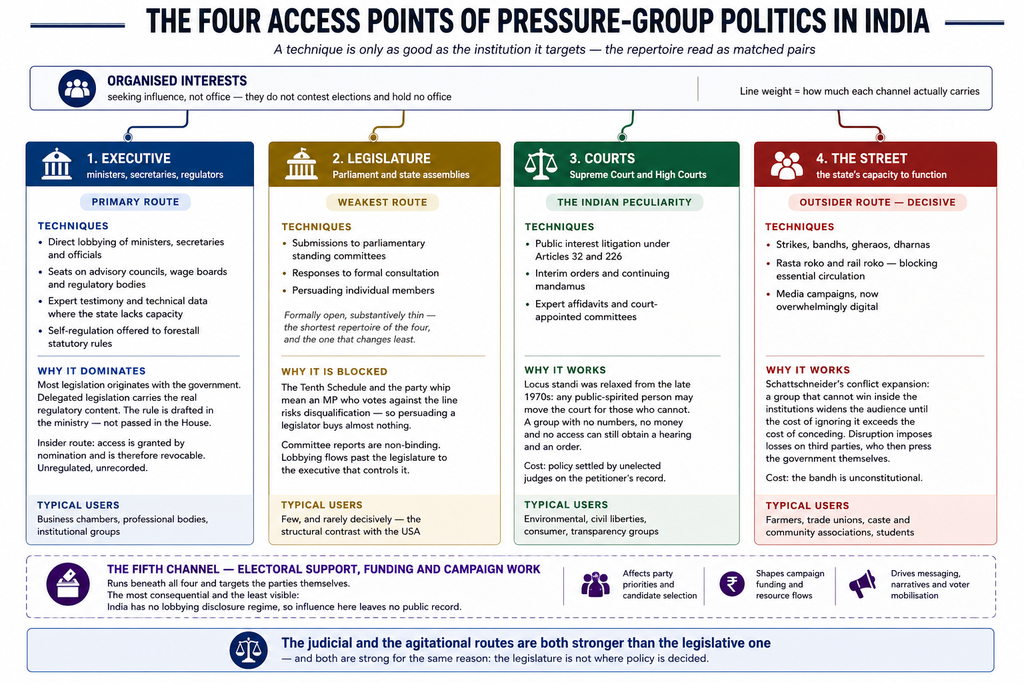
A technique is only as good as the institution it targets. The useful way to read the repertoire is therefore as a set of matched pairs — a method and the access point it is designed to work on.
| Technique | Target institution | Indian character |
|---|---|---|
| Direct lobbying of ministers, secretaries and MPs | Executive and bureaucracy | Dominant but entirely unregulated and unrecorded |
| Representation on official bodies — advisory councils, wage boards, regulators, standard-setting committees | Executive | The insider route; access granted by nomination, and therefore revocable |
| Submissions to consultation and to parliamentary standing committees | Legislature | Formally open, substantively thin; committee reports are non-binding |
| Expert testimony and supply of technical data | Bureaucracy, committees, regulators | Powerful where the state lacks in-house capacity — tax, trade, spectrum, pharmaceuticals, finance |
| Electoral support, funding and campaign work | Political parties | The most consequential and the least visible; no lobbying disclosure exists |
| Media campaigns and manufacture of public opinion | The public, and through it the government | Now overwhelmingly digital; hashtags, WhatsApp networks and paid amplification |
| Public interest litigation | Courts | Unusually strong in India; the preferred instrument of environmental, civil liberties and consumer groups |
| Strikes, bandhs, gheraos, dharnas, rail and road blockades | The state’s capacity to function | The outsider route; costly, disruptive and frequently decisive |
| Self-regulation and standard-setting | The regulatory agenda itself | Industry codes offered pre-emptively to forestall statutory regulation |
- The executive, not the legislature, is the primary Indian access point. Most legislation originates with the government, delegated legislation carries much of the real regulatory content, and the ministry is where a rule is drafted — not the House where it is passed.
- Individual MPs are poor targets, which is the structural difference from the United States. The Tenth Schedule and the party whip mean an MP voting against the line risks disqualification, so persuading a legislator buys almost nothing and lobbying flows past the legislature to the executive that controls it.
- Indian legislatures also have weak internal research capacity, few personal staff and thinly resourced committees. A group that supplies technical material is not competing with an in-house analytical apparatus; it is filling a vacuum.
- The judicial route is the great Indian peculiarity, and it exists because of a specific doctrinal choice.
- The relaxation of locus standi from the late 1970s let any public-spirited person move the court for those unable to approach it, converting Articles 32 and 226 into general-purpose instruments of policy contestation.
- A group with no numbers, no money and no access can therefore still obtain a hearing, an interim order and continuing supervision. Environmental, civil liberties, disability, consumer and transparency groups have built their record in court rather than in Parliament.
- The cost is real: policy questions are settled by unelected judges on a record assembled by the petitioner, and continuing mandamus substitutes for the political bargaining that would otherwise have to occur.
- The agitational route is the other great peculiarity, and it is less a sign of democratic failure than a rational response to blocked channels.
- Its logic is Schattschneider’s conflict expansion: a group that cannot win inside the institutions widens the audience until the cost of ignoring it exceeds the cost of conceding.
- Its currency is disruption of essential circulation — highways, rail lines, mandis, ports. The rasta roko and rail roko work by imposing losses on third parties who then press the government themselves.
- The dangers are obvious: the bandh has been held unconstitutional as a coercive imposition on unwilling citizens, and agitations shade readily into intimidation and property destruction.
In India the judicial and the agitational routes are both stronger than the legislative one — and both are strong for the same reason, that the legislature is not where policy is decided.
Business: The Privileged Interest
- The organised business lobby is the oldest, best-resourced and most continuously consulted interest in Indian politics: FICCI (1927), ASSOCHAM (1920), the CII, now the pre-eminent voice of modern industry, NASSCOM for software and services, and older chambers such as the Indian Merchants’ Chamber.
- The relationship changed fundamentally in 1991, and the change is the clearest single illustration of how a state’s economic role determines the shape of group politics.
| Before 1991 | After 1991 | |
|---|---|---|
| What the state controlled | Licences, quotas, permits, foreign exchange, capacity | Taxes, tariffs, regulation, land, credit, contracts |
| What business sought | Individual permissions for individual firms | General policy favourable to a sector |
| Mode of influence | Particularistic and covert — the firm, not the association | Associational and open — consultation, submissions, summits |
| Relationship | Dependence and rent-seeking | Consultation and partnership |
| Public standing | Suspect; the licence-permit raj made lobbying disreputable | Legitimate; business advice is solicited publicly |
- Access is now institutionalised, not merely available. The pre-budget consultations the Finance Minister holds with industry associations, economists, agriculturists, banks, startups and trade unions are an annual fixture, and ran again through the 2026-27 budget cycle.
- Business delegations accompanying state visits and the parallel business summit alongside a political one have become standing features of Indian diplomacy — a form of access no other interest enjoys.
- Foreign lobbies and advocacy groups are now a significant presence, and the disclosure asymmetry is telling: what foreign corporations spend seeking Indian market access becomes public through filings in their home jurisdictions, because India requires none.
- The electoral-bond period is the sharpest illustration of influence exercised without a public record: unlimited anonymous corporate donation, with the cap on corporate contributions and the duty to disclose them both removed. The Supreme Court struck the scheme down in 2024, and the party-system note carries that judgment.
- Lindblom’s structural argument is the necessary corrective to any account that stops at lobbying. Even with no association, no delegation and no donation, business would retain a privileged position, because governments are judged on growth and investment and cannot obtain either by command.
- This is why the scholarship on Indian state–business relations — the work collected by Jaffrelot, Kohli and Murali — treats the question as one of structural power and crony access, not of lobbying volume.
Labour: The Involuted Interest
- India’s trade union movement is old, legally privileged and politically visible — and weak in the two ways that matter: coverage and independence.
- The central weakness is that the union federations are frontal organisations of political parties. INTUC to the Congress, AITUC to the CPI, HMS to the socialists, CITU to the CPI(M), BMS to the Sangh Parivar, AICCTU to the CPI(ML), alongside AIUTUC, UTUC, TUCC and LPF — and the distinctive SEWA, which organises informal women workers and belongs to no party.
- A federation’s militancy therefore tracks which party is in office rather than what employers are doing. BMS declined to join the general strike of 12 February 2026, calling it politically motivated — a split that recurs at every national strike.
- Coverage is the deeper problem. Around nine-tenths of India’s workforce is informal, measured either by the enterprises people work in or by whether they receive contracts, paid leave and social security — and formal employment has grown only slowly while those leaving agriculture move into informal work.
- This is the Rudolphs’ involuted pluralism in its exact sense: a highly organised movement representing a small protected island, dividing and subdividing internally while the sea around it grows.
- Olson explains why the sea does not organise: dispersed, mobile, individually low-stake workers with no way to police contribution and no selective incentive to join.
- The Labour Codes are the current test. Parliament consolidated twenty-nine central laws into four codes — wages, industrial relations, social security, and occupational safety and health — and all four came into force on 21 November 2025, with central rules notified in May 2026 and state rules following very unevenly.
- Union objections centre on easier hire-and-fire through the raised retrenchment threshold, restrictions on the right to strike through notice requirements, longer permissible hours and wider fixed-term employment.
- Ten central federations called a nationwide general strike on 12 February 2026, claiming participation of some thirty crore workers and farmers across coal, banking, transport and plantations, with near-bandh conditions in Kerala, Odisha, Assam and Punjab. The codes remain in force.
- Globalisation compounded the difficulty by creating a footloose workforce — contract labour, fixed-term employment, gig and platform work — that is structurally hard to organise, since the worker’s employer may be an app and the workplace may be a scooter.
Farmers: The Strongest Demand Group
- Farmer mobilisation is the most consequential pressure-group politics India has produced — the clearest evidence available that the Indian state can be moved by organised pressure.
- The classical phase ran from the late 1970s to the early 1990s.
- Sharad Joshi‘s Shetkari Sanghatana in Maharashtra framed the conflict as Bharat versus India — an exploited countryside against a subsidised, protected urban-industrial sector, with the terms of trade rigged against agriculture by administered prices.
- Mahendra Singh Tikait‘s Bharatiya Kisan Union in western Uttar Pradesh fused agrarian demand with khap-based caste solidarity, and its sit-ins at Meerut and Delhi’s Boat Club set the template for later agitations.
- The Tamil Nadu Agriculturists’ Association under Narayanaswamy Naidu and the Karnataka Rajya Raitha Sangha under Nanjundaswamy carried the southern version, the latter adding an anti-globalisation edge against multinational seed and food companies.
- Rudolph and Rudolph’s “bullock capitalists” is the correct sociological description of who these movements represent. They speak for surplus-producing middle and rich peasants — cultivators with marketable output, irrigation and access to procurement.
- Their demands follow: remunerative prices, cheap power, fertiliser and credit subsidy, loan waivers and freedom from levies.
- Agricultural labourers, tenants and the landless are not represented in this agenda, and are often on the other side of it, since the cost of a higher wage falls on the same cultivator who demands a higher price. The movements’ claim to speak for “the farmer” is therefore a class claim presented as a sectoral one.
- The farm-laws agitation of 2020–21 is the fullest case study available.
- Three laws on trade in farm produce, contract farming and the Essential Commodities Act were passed in September 2020 with limited consultation and, in the Rajya Sabha, by a contested voice vote.
- The Samyukt Kisan Morcha — a platform of hundreds of unions, formed for the purpose and kept deliberately non-partisan — occupied the approaches to Delhi at Singhu, Tikri and Ghazipur for over a year, sustained by langar, village rotation and remittances.
- Its repertoire combined every technique in the catalogue: sustained occupation, tractor parades, mahapanchayats, a rail roko, targeted campaigning against the ruling party in state elections, and a full international media operation.
- The three laws were repealed in November 2021. Formal repeal of a completed central statute under pressure from an extra-parliamentary movement has no close precedent in independent India.
- The carry-forward matters as much as the victory, because it shows the limit.
- The legal guarantee of MSP — a statutory right to sell at the announced minimum support price — was the movement’s central unmet demand and remains unmet.
- A renewed ‘Delhi Chalo’ march in February 2024 was halted at the Punjab–Haryana borders. Jagjit Singh Dallewal began an indefinite fast in November 2024 and ended it on 6 April 2025 without a guarantee.
- Agitation has since broadened into opposition to the agriculture chapter of the proposed India–US trade agreement — sustained farmer pressure has made concessions on agriculture and dairy politically unaffordable — and into resistance to the replacement of MGNREGA by a rural employment law that received assent in December 2025.
- The trade-deal episode is the most revealing of these. Negotiations have repeatedly stalled over agriculture and dairy, which the government treats as a red line. A movement that could not obtain the legislation it wanted has made a whole category of concession politically unaffordable — which is what structural, rather than episodic, pressure looks like.
- Unit 8’s note on land reforms carries the agrarian crisis itself. Here the relevant fact is only that the crisis supplies the grievance while a specific class within it supplies the organisation.
The repeal of the farm laws proved that the Indian state can be moved. The unmet MSP demand proves how narrowly.
Caste and Community Associations
- Rudolph and Rudolph, in The Modernity of Tradition, made the argument that reversed the received view: caste associations are agents of modernisation, not obstacles to it.
- A caste association is not a caste. It is a voluntary body with a constitution, subscriptions, elected office-bearers, journals, hostels and a legislative agenda — an ascriptive category used to build a modern organisational form.
- It therefore teaches its members the skills of democratic politics — meetings, accounts, elections, memoranda, bargaining with the state — for many, their first experience of any of these.
- The Rudolphs’ three modes of mobilisation follow. Vertical — a dominant landed group delivering dependents’ votes, the earliest pattern. Horizontal — caste members organised across localities into a class-like bloc, which the associations created. Differential — parties assembling coalitions across several caste segments, the later pattern.
- Kothari made the complementary argument: caste-based groups have been agents of modernisation and reservoirs of leadership, drawing populations into politics that no other channel would have reached, and supplying the political class that the older elites could not.
- The formulation that follows from both is that caste did not politicise Indian politics; politics secularised caste, turning a ritual hierarchy into an instrument of competitive claim-making.
- The classic case is the Nadar Mahajana Sangam in Tamil Nadu, which combined temple-entry claims, education and electoral bargaining to move a stigmatised trading community into the mainstream.
- Contemporary instances are agitational rather than associational, and that shift is itself the finding. The Vanniyar Sangam‘s campaigns, the Jat agitations in Haryana, the Patidar agitation in Gujarat, and the Maratha agitation in Maharashtra all press for inclusion in reservation categories by demonstrations of numbers and disruption rather than by petition.
- The Maratha case shows the method’s efficiency. Manoj Jarange‘s five-day fast at Azad Maidan ended on 2 September 2025 with the Maharashtra government issuing a resolution on implementing the Hyderabad Gazette to grant eligible Marathas Kunbi certificates, opening OBC entitlements.
- The pattern is significant analytically: these are dominant landowning castes seeking protections designed for the disadvantaged — what happens when agrarian income collapses and public employment becomes the residual route to security.
- Unit 9’s note owns caste politics generally. The angle here is the associational one — caste as an organisational resource for pressing the state.
Religious and Communal Groups
- Myron Weiner, in Politics and Scarcity, made the finding that has shaped every account since: in India the communal pressure group, not the economic one, has been the dominant type.
- His explanation was structural. In a scarcity economy the state controls access to nearly everything worth having, and religious, caste and linguistic identity is the cheapest available basis on which to organise a claim — needing no subscription, office or prior organisation.
- Weiner’s point survives liberalisation, because the categories that identity groups mobilise around are still the categories in which the state distributes.
- The RSS and the Sangh Parivar are the paradigm case, and the most theoretically awkward one.
- Christophe Jaffrelot‘s study identifies the division of labour as the organisational innovation: a cultural organisation that disclaims politics, a political party that contests elections, and specialised fronts for students, workers, farmers, tribal areas, education and religion — ABVP, BMS, Bharatiya Kisan Sangh, Vanvasi Kalyan Ashram, Vidya Bharati, Seva Bharati.
- The design lets the organisation hold positions and court constituencies the party cannot afford to, while remaining formally separate from both.
- The shakha, the daily neighbourhood assembly, is the mechanism: face-to-face, local, non-electoral and continuous, producing cadre rather than voters. At its centenary in 2025 the organisation reported roughly 83,000 shakhas and about four million members. In July 2024 the Centre lifted the 1966 ban on government servants participating in RSS activities — contested, and directly relevant to the institutional-group question.
- The Vishva Hindu Parishad and Bajrang Dal supply the religious and street-mobilisation arms, and the Ram Janmabhoomi campaign remains the fullest demonstration of what a movement built on this architecture can achieve.
- Whether an organisation that controls a governing party is still a pressure group is a genuine analytical problem, not a rhetorical one.
- On the standard definition it is: it does not contest elections and holds no office, and its influence is exercised on those who do.
- Against that, it selects and disciplines personnel, sets ideological direction, and faces no electoral accountability for what follows — so it exercises the powers of a party while carrying none of a party’s obligations.
- The honest formulation is that the Sangh occupies a category the classification does not contain: an unelected organisation with party-like control and pressure-group-like immunity from answering for it.
- Other confessional bodies show the same type at smaller scale. The Jamiat Ulema-e-Hind and the All India Muslim Personal Law Board press on personal law, waqf and education; the Shiromani Gurdwara Parbandhak Committee is unusual in being a statutory body with an elected house and control of gurdwara resources, making it at once institutional and communal; Christian bodies organise around education, minority rights and anti-conversion legislation.
Professionals, Students and Youth
- Professional associations are disproportionately powerful for their numbers, and the reason is that they combine interest representation with statutory regulatory authority over entry to their own profession.
- The Indian Medical Association, the Bar Council of India and state bar associations, the Institute of Chartered Accountants of India, and engineers’, architects’ and teachers’ bodies each perform this double role.
- Compulsory enrolment is the perfect selective incentive in Olson’s sense — nobody may practise without joining — so these bodies never face the collective action problem that cripples larger interests.
- Student organisations are almost entirely party affiliates, which is their defining feature rather than an incidental one. ABVP, NSUI, SFI, AISA, AISF are the recruiting grounds and training academies of the national parties.
- The Lyngdoh Committee recommendations sought to depoliticise campus elections by capping expenditure, age and duration; compliance has been partial at best.
- The exceptional case is the JP movement of 1974, which began as a student agitation in Gujarat and Bihar and grew into the challenge that produced the Emergency and the first non-Congress government at the Centre — the demonstration that a student agitation can reshape a party system.
Civil Society, NGOs and Advocacy
- The rights-based advocacy of the 1990s and 2000s is the most successful non-agitational pressure-group politics India has seen.
- The Mazdoor Kisan Shakti Sangathan‘s wage-record jan sunwais in Rajasthan grew into the National Campaign for People’s Right to Information and then into the Right to Information Act 2005.
- The same networks produced MGNREGA (2005), the Forest Rights Act (2006) and the National Food Security Act (2013), several of them driven by sustained public interest litigation alongside the campaign.
- The National Advisory Council was an unusual institutionalisation of advocacy inside government — activists and academics with a direct line to the head of the ruling coalition and a hand in drafting.
- It was criticised from both directions: as an unelected parallel cabinet without constitutional standing, and as a device that co-opted movement leaders into the state.
- Comparable channels operate elsewhere: the National Security Advisory Board brings outside expertise into strategic policy, and NITI Aayog convenes experts, industry and states. The think tank is the newer form of the same access — influence through analysis rather than numbers.
- The state’s response has been a tightening regulatory regime — the sharpest current illustration of state dominance over group politics.
- The Foreign Contribution (Regulation) Act 2010 governs foreign funding of associations. The 2020 amendment prohibited sub-granting to other organisations, cut the ceiling on administrative expenditure from 50% to 20%, mandated Aadhaar for office-bearers, and required all foreign funds to pass through a single designated State Bank of India branch in New Delhi.
- The sub-granting ban is the most consequential provision, because the Indian model relied on large registered intermediaries funding small local bodies that could never obtain registration themselves.
- In Noel Harper v. Union of India, decided 8 April 2022, the Supreme Court upheld the amendments, holding that there is no fundamental right to receive foreign contribution. Critics read the judgment as accepting a national-security framing without requiring evidence for it.
- Registrations have lapsed and been cancelled on a very large scale — over twenty thousand cancellations since 2010, with many more expired and unrenewed.
- A Foreign Contribution (Regulation) Amendment Bill 2026, introduced in the Lok Sabha on 25 March 2026, would let a Designated Authority take over the assets of organisations whose registration is cancelled, surrendered or simply not renewed, by administrative action without prior judicial adjudication. It was referred to a Joint Parliamentary Committee on 12 August 2026 after wide opposition and remains pending.
- The backdrop includes a contested Intelligence Bureau report alleging that foreign-funded NGOs were conducting activity detrimental to development — disputed on methodology, never publicly examined, and influential on policy.
- The principled counter-position deserves stating at its strongest: the government should have accommodated these groups rather than banned them.
- Proscription under the UAPA removes an organisation but leaves the grievance, and drives its constituency out of institutional politics altogether.
- Accommodation would have addressed alienation and secessionist trends more effectively than proscription, because a group with a seat at the table has an interest in the table’s survival — the classic safety-valve case, applied to the groups the state finds least congenial.
The Weakest Interests
- Environmental groups have compensated for small numbers with legal skill. The Narmada Bachao Andolan under Medha Patkar, Chipko and Appiko, the Silent Valley campaign and the Koodankulam agitations established the repertoire, and the judicial route has been the main instrument — forest, air, coastal and mining jurisprudence rests almost entirely on petitions by such groups.
- Their weakness is Olson’s: the beneficiaries of clean air are everyone and therefore nobody, and no member’s livelihood turns on the outcome. They win cases and lose budgets.
- Women’s organisations present a striking anomaly: India has produced no single dominant women’s organisation on the scale of its business or farmer lobbies, despite an active field — AIDWA, the National Federation of Indian Women, the All India Women’s Conference, autonomous groups and SEWA.
- The reasons are structural: the field is split by party affiliation, by the autonomous-versus-affiliated divide, and by class and community differences.
- Yet the record is substantial — the anti-dowry amendments, the Vishaka guidelines and the 2013 sexual harassment legislation, the criminal law amendments after 2012, and the campaign behind the 106th Amendment — which suggests that influence and organisational scale are not the same thing.
- Consumer groups are the weakest of all — the textbook illustration of the collective action problem. Every citizen is a consumer, each stake in any given regulation is tiny, and the counterpart industry interest is concentrated and well funded.
- The Consumer Protection Act framework and the consumer commissions were created by the state rather than won by a movement, which is itself the evidence.
The Changing Nature of Pressure-Group Politics
- Kothari‘s account of the early decades is the baseline. Pressure groups then had little legitimacy in the public eye, were crowded out by a dominant Congress that absorbed interests internally through its factions, and were reduced to a supporting role in a system where opposition parties were themselves parties of pressure. Weiner‘s finding that communal groups dominated completes the picture.
- Robert Hardgrave and Stanley Kochanek identify the shift since the 1990s: from state-dominated pluralism toward a more powerful and more legitimate pressure-group politics. Four drivers.
- Liberalisation and globalisation removed the licensing state’s discretionary grip and made open advocacy respectable rather than disreputable.
- The retreat of the licence-permit regime changed what groups had to ask for — general policy rather than individual permissions.
- Coalition government multiplied access points, since a government of many parties has many doors.
- Interests were incorporated into policy-making bodies — the NAC, the NSAB, NITI Aayog, regulatory advisory committees.
| Gained since 1991 | Did not | |
|---|---|---|
| Which groups | Business and corporate, communal, rich-farmer, professional, transnational advocacy | Trade unions, student unions, environmental lobbies — still junior partners of parties |
| Why | Concentrated stakes, resources, state’s dependence on investment, identity as cheap organising base | Party affiliation, diffuse benefits, no selective incentive |
| Also | — | Women’s and consumer organisations remain weak; left-leaning groups most often proscribed |
- The state remains the dominant actor, and this is the correct conclusion for India. Unlike the United States, where pressure-group politics is at its most influential because parties are weak and access points many, the Indian state sets the terms on which groups operate — it registers, funds, recognises, licenses and bans them.
- It has periodically been intolerant of groups it regards as hostile, and the instruments are legal: the UAPA, the FCRA, income-tax registration, and the withdrawal of official recognition.
- Pressure-group politics is weaker where parties carry ideology. In Britain the Labour Party is presumed to represent labour, so a union’s route to influence runs through the party rather than around it; in the United States weak, undisciplined parties leave a vacuum that groups fill directly.
- India sits closer to Britain in form and to neither in substance: its parties claim to represent the relevant constituencies and its groups are largely their creatures, which suppresses independent interest articulation without producing programmatic representation in its place.
Assessment
Both columns below have to be stated at full strength before either can be weighed against the other.
| The case for | The case against |
|---|---|
| Supply specialised information the state does not otherwise have | Unequal access — organised business has continuous entry, the informal workforce almost none |
| Represent interests between elections, which a five-year mandate cannot | Methods are disruptive rather than deliberative |
| Provide expertise in drafting and implementation | No lobbying disclosure regime — influence leaves no record |
| Act as a check, raising the political cost of a bad decision | Internal oligarchy — groups are rarely democratic themselves |
| Widen participation and train political leadership | Capture of the public interest by narrow interests |
| Serve as a safety valve for grievance | Many are extensions of parties, not independent articulators |
- The case for is demonstrated rather than asserted. The repeal of the farm laws is the strongest evidence any democracy could offer that organised pressure can reverse settled legislation, and the stalling of a trade negotiation’s agriculture chapter in 2026 shows the same pressure operating structurally.
- The representation argument is the deepest: an election aggregates preferences once every five years across the whole of policy, and cannot register the intensity of a specific interest at the moment a decision is taken. Groups do exactly that.
- The case against turns on one point above all: unequal access, and Olson explains it. The asymmetry is not a failure of effort by the unorganised; it is a structural property of collective action that guarantees the interests most in need of representation will be the least represented.
- Internal oligarchy compounds it. Groups that demand democratic responsiveness from the state are frequently run by unelected permanent leaderships, and a group’s claim to represent its members is rarely tested.
- Party extension is the specifically Indian defect. Where a union or a student body is a party’s arm, its activity is party competition wearing the costume of interest articulation — which is why Indian strikes often predict the political calendar better than industrial conditions.
- The criminal and money-power element in some agitational politics — organised disruption for hire, extortion under cover of a bandh — is a real cost and not a marginal one.
- The honest verdict is neither celebration nor dismissal. Pressure groups have made Indian government better informed, more contestable and more responsive between elections. They have also made it more responsive to those who can afford to organise — and where nine-tenths of the workforce cannot, that is a serious charge, not a technical one.
The Regulation Question
- India has no lobbying disclosure law. No register of lobbyists; no duty to declare who was met, on whose behalf, on what subject or at what cost; no cooling-off period restraining officials from moving into the interests they regulated. Influence is exercised entirely without a public record.
- The comparative models are well established.
- United States — the Lobbying Disclosure Act 1995, strengthened by the Honest Leadership and Open Government Act 2007: registration of lobbyists, quarterly reporting of issues, clients and expenditure, and gift and revolving-door restrictions.
- European Union — a transparency register for the Commission, Parliament and Council, with registration a practical precondition of access.
- Canada — a lobbyists’ registry with a statutory Commissioner and monthly reporting of communications with designated officeholders.
- Indian attempts have been confined to private members’ bills. The Disclosure of Lobbying Activities Bill, introduced by Kalikesh Narayan Singh Deo in 2013 and reintroduced later, proposed a registration authority and disclosure of lobbying aimed at legislative and executive decisions. It lapsed without serious debate. The episodes that prompted it — the Radia tapes, and the disclosure through United States filings of sums spent seeking Indian market access — remain the standing illustration of what is not visible here.
- The arguments for a disclosure regime. Lobbying happens regardless, so the choice is between regulated and unregulated influence, not between influence and none. Registration would distinguish legitimate representation from corruption, which is currently impossible, and it would let the public see who was heard before a rule was made.
- The arguments against. A register may legitimise and entrench paid influence; it raises the cost of access in a way that favours the already-organised; disclosure regimes elsewhere are widely evaded through advisory and consultancy framings; and enforcement would fall on institutions already stretched.
- The connection to the electoral-bonds judgment is direct. The Court struck the scheme down because the voter’s right to information under Article 19(1)(a) outweighed the donor’s claim to anonymity. The identical logic applies to lobbying: if a citizen may know who funded a party, it is hard to explain why they may not know who drafted a regulation. That inference has not been drawn, legislatively or judicially.
Conclusion
Pressure groups are neither the guarantors of democracy that pluralist theory hoped for nor the distortion their critics allege. They are an accurate map of who in India can afford to organise. Where stakes are concentrated and members few — business, professions, surplus farmers — organisation is dense and influence real. Where stakes are diffuse and members many — informal labour, consumers, the environmentally harmed — the interest exists and the organisation does not.
- The state has not receded; it has re-selected. Liberalisation changed which groups the state listens to without loosening its control over the terms on which any of them exist — and the FCRA regime, UAPA proscription and the absence of a disclosure law are three faces of the same fact.
- The reform agenda that follows is narrow and unglamorous: a disclosure regime; stronger parliamentary committee capacity, so that the legislature becomes worth lobbying; and support for organising the interests that Olson’s logic predicts will otherwise never organise themselves.
Previous Year Questions
- Critically assess the role of pressure groups in the decision-making process of the government. (2024)
- Explain how pressure groups have been influencing public policy-making with suitable illustrations. (2014)
- Comment: Trade unions as pressure group in Indian politics. (2011)
- In what ways do pressure groups and movements exert influence in politics? In the Indian political context, discuss the implications of such influence being exerted. (2008)
- Identify the major pressure-groups in Indian Politics and examine their role in it. (2003)
- Differentiate a political party from a pressure group. Explain the role of R.S.S. and Bajrang Dal-units of Sangh-Parivar as pressure-groups in the Indian political system. (1999)
