

The National Commission for Minorities is the institutional answer to a question the Indian state has never fully settled: what does a constitutional democracy owe to communities that will always lose a headcount? It was created because the Constitution’s guarantees to minorities were being under-delivered, and it has spent three decades demonstrating that a body built to correct under-delivery can itself be under-delivered. Its statute is generous in language and thin in consequence, and the distance between the two is the whole subject.
Who counts as a minority, and why India has never said

- The most widely used working definition comes from the United Nations Sub-Commission on Prevention of Discrimination and Protection of Minorities, which described a minority as a non-dominant group in a population that wishes to preserve its ethnic, religious or linguistic traditions where these differ from those of the rest of the population.
- The definition has two limbs that must be read together. The objective limb is numerical and structural — fewer in number, and non-dominant in the sense of not holding decisive political or social power.
- The subjective limb is a wish to preserve a distinct identity. A group that has assimilated by choice is not a minority in this sense, however small it is. Minority status is a claim about identity, not merely a fact about arithmetic.
- The insertion of “non-dominance” is what prevents the concept from producing absurdities. A small but socially and economically dominant group is numerically fewer without being vulnerable, and protection is owed to vulnerability rather than to smallness.
- India has never enacted a statutory definition of “minority”. The Constitution uses the word repeatedly — in the marginal note to Article 29, in the text of Article 30, in Article 350B — and defines it nowhere.
- What exists instead is a notification power. Section 2(c) of the National Commission for Minorities Act, 1992 empowers the central government to notify, by publication in the Official Gazette, the communities that are minorities for the purposes of the Act.
- This is a substitution of administrative discretion for legislative definition. Parliament declined to say what a minority is and told the executive to name them instead, which converts a question of constitutional principle into a matter of government notification.
- The six notified communities are Muslims, Christians, Sikhs, Buddhists, Parsis (Zoroastrians) and, since a notification of January 2014, Jains.
- The first five were notified in 1993; Jains were added twenty-one years later, after the Supreme Court had declined to compel the notification.
- On the 2011 Census, these six communities together account for roughly 19.3 per cent of India’s population: Muslims 14.2 per cent, Christians 2.3 per cent, Sikhs 1.7 per cent, Buddhists 0.7 per cent, Jains 0.4 per cent, and Parsis a fraction of a percentage point at about 57,000 persons in absolute terms.
- Muslims alone constitute close to three-quarters of all notified minorities, which is the single most consequential fact about the Commission’s caseload and about the politics that surrounds it.
[Suggested image: bar chart of the six notified minority communities as a share of population, Census 2011]
What the notification leaves out
- The notification is exclusively religious. Linguistic minorities — who are expressly protected by Articles 29 and 30 and who have their own constitutional office — fall outside the Commission’s remit entirely.
- Article 350B provides for a Special Officer for Linguistic Minorities, appointed by the President, to investigate all matters relating to the safeguards provided for linguistic minorities and to report to the President. The office is a constitutional one; the Commission for religious minorities is merely statutory.
- The result is an odd inversion of status. The weaker institutional form protects the larger and more politically salient category.
- Denominational minorities within a notified minority — a sect that considers itself distinct from the larger community named in the notification — have no separate standing, although Article 26 protects religious denominations independently.
How minorities come into being
- Minority populations are not natural facts. They are produced by identifiable historical processes, and naming those processes explains why almost every state in the world has them.
- Migration, voluntary and involuntary, deposits communities inside populations to which they were previously external.
- Conquest and state formation convert a majority into a minority overnight by redrawing the boundary within which the headcount is taken.
- Imperialism moved populations across continents for labour and administration, and left communities stranded when it withdrew.
- Refugee flows created by war, famine, partition and persecution produce minorities in the receiving society.
- Globalisation has added a contemporary layer — labour mobility, professional migration and diasporic settlement — that is generating new minorities faster than the older processes ever did.
- Because minority status is produced by history rather than chosen, the vulnerability that attaches to it is not self-inflicted, and that is the moral foundation of every claim to special protection.
Why the question is not merely domestic
- Minorities have been the standing target of modern state violence, which is what makes their protection a matter for humanity rather than only for national governments.
- The persecution and extermination of Jews under Hitler remains the paradigm case of what a majoritarian state apparatus can do to a numerically small and politically undefended community.
- The Rohingya of Myanmar were rendered stateless by a citizenship law that simply omitted them, then driven across a border in numbers approaching a million — an illustration of how definitional exclusion precedes physical expulsion.
- The treatment of Uyghur Muslims in China shows the same logic executed through mass surveillance, internment and forced cultural assimilation rather than through expulsion.
- Each of these began not with violence but with classification — with the state deciding who belonged and who was merely present. That is precisely why the power to define and notify minorities, which India has vested in the executive, is not a technicality.
A state that reserves to itself the power to say who is a minority has reserved the power to say who is owed protection, and the two decisions are the same decision.
The two models of accommodation, and the one India chose
- Every plural society has to answer the same question — what should happen to difference? — and the answers cluster into two families.
| Assimilation / homogenisation | Multiculturalism | |
|---|---|---|
| Slogan | Unity in uniformity | Unity in diversity |
| Metaphor | The melting pot — ingredients dissolve into a common broth | The salad bowl — ingredients retain their form within a common dish |
| Citizenship | Undifferentiated; identity is private and legally invisible | Group-differentiated; identity can attract public recognition |
| Minority rights | None as such; equal individual rights suffice | Special rights recognised as a condition of equality |
| Risk | Coerced conformity; the majority’s culture becomes the neutral default | Ossified group boundaries; internal minorities left unprotected |
| Exemplar | Classical French republicanism | Canada, and the Indian constitutional scheme |
- Each model fails in a characteristic way. The melting pot is never neutral — what everything melts into is the culture of the numerically dominant group, so uniformity is majority culture rebranded as the universal. Multicultural recognition can freeze groups, strengthening the hand of a community’s internal authorities over its own dissenters and women.
The theoretical case for group-differentiated rights
- Will Kymlicka provides the most rigorous liberal defence of minority rights, and his argument matters because it is made from inside liberalism rather than against it.
- His central claim is that individual freedom is exercised within a societal culture that supplies the range of meaningful options a person chooses among. Losing that culture is not a sentimental loss but a loss of the raw material of choice.
- He therefore treats group-differentiated rights not as an exception to equality but as a requirement of it: majorities have their culture underwritten automatically by the state’s language, calendar, and public holidays, and minorities need explicit provision to obtain what the majority receives by default.
- He distinguishes external protections — claims by a group against the wider society, which liberalism can accommodate — from internal restrictions, claims by a group against its own members, which liberalism cannot. This distinction is the sharpest available tool for assessing any minority-rights regime.
- Bhikhu Parekh rejects the assimilationist model on the ground that it rests on a false view of culture as something a person can shed at will.
- He argues that human beings are culturally embedded, that no culture embodies the whole range of human possibility, and that a society therefore gains from a genuine dialogue between cultures rather than from the absorption of one into another.
- His model is neither the melting pot nor a mosaic of sealed communities but a community of communities, in which a shared political culture is itself negotiated rather than handed down by the majority.
- Rajeev Bhargava explains why the Indian arrangement cannot be assessed by the Western template at all.
- The Western model is a wall of separation between religion and state — mutual exclusion, in which the state neither helps nor hinders. India instead practises what Bhargava calls principled distance.
- Principled distance means the state may engage or disengage with religion depending on what equality and freedom require in the particular case, and may treat religions differently if the reasons for doing so are principled rather than partisan.
- This is why the Indian state can simultaneously fund minority educational institutions, reform Hindu temple entry, and refuse to establish any religion. Non-establishment does not require non-engagement, and a commission for minorities is intelligible only on this understanding.
- Gurpreet Mahajan brings the argument back to the Indian record and complicates it.
- She notes that Indian minority rights were framed overwhelmingly as rights of cultural preservation — language, script, educational institutions — rather than as rights against socio-economic exclusion, and that this framing has aged badly.
- The consequence is a mismatch: the constitutional protections are strongest exactly where minority disadvantage is least acute, and weakest where it is most acute. The Sachar findings are the empirical statement of that mismatch.
India’s actual choice
- The Constituent Assembly dropped political safeguards and retained cultural ones. Separate electorates were rejected outright as a colonial device that had produced Partition, and reservation of legislative seats for religious minorities was abandoned in 1949 on the recommendation of the Advisory Committee.
- What survived was cultural and educational autonomy under Articles 29 and 30, religious freedom under Articles 25 to 28, and the general equality code. Ambedkar’s position throughout was that minority protection must be real without perpetuating the separatism the Constitution was trying to end.
- Everything the state has built since sits on that foundation: a statutory commission in 1992, an evidence-gathering exercise in the Sachar Committee of 2006, and a delivery instrument in the Prime Minister’s New 15-Point Programme announced in 2006.
The constitutional architecture the Commission exists to operationalise
The Commission has no rights of its own to confer. Every safeguard it monitors was written into the Constitution before it existed, and its statutory mandate is essentially to make an existing set of guarantees operative. Reading the Commission without reading the guarantees produces a body that looks arbitrary; reading them together shows what it was supposed to be for.
The equality code
- Article 14 supplies the general standard of equality before the law against which any classification by religion must be justified.
- Article 15(1) prohibits discrimination by the state on grounds of religion, race, caste, sex or place of birth, and Article 15(2) extends the prohibition to access to shops, restaurants, wells, roads and public places.
- Article 15(4) and 15(5) permit special provision for socially and educationally backward classes and for Scheduled Castes and Scheduled Tribes — categories defined by caste and tribe, not by religion. This is the constitutional reason religion-based reservation has been so difficult to sustain.
- Article 16 guarantees equality of opportunity in public employment and forbids discrimination on the ground of religion in respect of any office under the state, with Article 16(4) permitting reservation for backward classes inadequately represented in the services.
- Article 25(2)(b) permits the state to throw open Hindu religious institutions of a public character to all classes and sections of Hindus — a reform power directed at the majority community, and the clearest textual proof that the Indian state was never neutral in the Western sense.
The religious freedom code
- Article 25 guarantees to all persons freedom of conscience and the right freely to profess, practise and propagate religion, subject to public order, morality, health and the other Part III rights.
- The inclusion of propagate was contested in the Assembly and is the textual basis of the missionary activity that anti-conversion legislation in several states now restricts.
- Article 26 guarantees to every religious denomination the right to establish and maintain institutions for religious and charitable purposes, to manage its own affairs in matters of religion, and to own, acquire and administer property.
- Article 26 protects denominational autonomy rather than individual conscience, which is why it is the provision invoked whenever the state legislates on the management of religious endowments.
- Article 27 bars compulsion to pay taxes for the promotion of any religion, and Article 28 prohibits religious instruction in wholly state-funded institutions while permitting it with consent in state-recognised or state-aided ones.
Articles 29 and 30: the core of minority rights
- Article 29(1) gives any section of citizens having a distinct language, script or culture the right to conserve it.
- The subject of Article 29(1) is “any section of citizens”, not “any minority”. On its face it protects the cultural interests of majority groups too, and the Supreme Court has read it that way.
- The right is one of conservation, which includes the right to agitate for the protection of a language and to establish institutions to preserve it.
- Article 29(2) provides that no citizen shall be denied admission to any state-maintained or state-aided educational institution on grounds only of religion, race, caste, language or any of them.
- This is an individual right against exclusion, and it sits in unresolved tension with Article 30: a minority institution’s right to admit its own community collides with a non-member’s right not to be excluded on the ground of religion.
- Article 30(1) gives all minorities, whether based on religion or language, the right to establish and administer educational institutions of their choice.
- Article 30(2) bars the state from discriminating against any educational institution in granting aid on the ground that it is under minority management. The right to aid is not conditional on surrendering the right to administer.
How Article 29 and Article 30 differ
| Article 29 | Article 30 | |
|---|---|---|
| Who holds the right | Any section of citizens with a distinct language, script or culture | Minorities only, religious or linguistic |
| Nature of the right | To conserve language, script and culture; and not to be denied admission | To establish and administer educational institutions |
| Basis | Culture and language | Minority status |
| Scope | Cultural, broader than education | Educational, and specific |
| Corresponding duty | State must not exclude on listed grounds | State must not discriminate in aid on the ground of minority management |
- The two articles are often bracketed as “cultural and educational rights”, but they do different work. Article 29 is a shield available to everyone; Article 30 is a power available only to minorities.
What “administer” means, and where it stops
- The word administer in Article 30(1) has generated more litigation than any other word in the minority-rights chapter, because everything turns on how much state regulation an institution must accept before administration becomes nominal.
- The settled position is that the right to administer includes the right to choose the governing body, appoint teaching and non-teaching staff, take disciplinary action, admit students of the community, and set a reasonable fee.
- It does not include a right to maladminister. The Supreme Court’s formulation is that “the right to administer cannot obviously include the right to maladminister”, and regulations aimed at academic standards, teacher qualifications, service conditions and the prevention of profiteering are permissible.
- The operative test is whether a regulation is directed at excellence or at control. A rule that raises the quality of education is compatible with Article 30; a rule that transfers real decision-making power away from the minority management is not.
The case law that built the framework
- In re Kerala Education Bill (1958) was an advisory opinion delivered under Article 143 on a reference by the President concerning Kerala’s Education Bill, and it laid the first foundations.
- The Court held that a minority must be determined by reference to the population of the state concerned rather than of India as a whole, and that a community numbering less than 50 per cent of a state’s population qualifies.
- It held that a minority institution does not lose its character by admitting non-members — the celebrated observation that a “sprinkling” of outsiders does not convert a minority institution into a general one.
- T. M. A. Pai Foundation v. State of Karnataka (2002) was decided by an eleven-judge bench, the largest ever assembled on the question, and remains the governing authority.
- It confirmed that for the purposes of Article 30, minority status is to be determined state-wise — the state is the unit, because the reorganisation of states on linguistic lines made the state the relevant political and cultural unit.
- It held that Article 30 confers no higher right than that enjoyed by the majority; it is a provision for equality, ensuring minorities are not disadvantaged, not a charter of privilege.
- It drew the central distinction between aided and unaided institutions: unaided institutions retain wide autonomy in admissions and fee-setting subject to merit and a bar on capitation fees and profiteering, while aided institutions accept greater regulation, including a reasonable share of seats for non-minority students.
- Islamic Academy of Education v. State of Karnataka (2003), a five-judge bench, was an attempt to work out what Pai meant in practice, and it directed the setting up of state-level committees to regulate admissions and to scrutinise fee structures.
- P. A. Inamdar v. State of Maharashtra (2005), a seven-judge bench, clarified Pai and Islamic Academy and held that the state cannot impose its reservation policy or quota on unaided private professional institutions, minority or non-minority.
- Parliament responded with the 93rd Constitutional Amendment (2005), inserting Article 15(5) to permit special provision for backward classes and SCs and STs in private educational institutions, aided or unaided — while expressly excepting minority educational institutions from its operation.
- Pramati Educational and Cultural Trust v. Union of India (2014) upheld Article 15(5) and held that the Right of Children to Free and Compulsory Education Act, 2009 does not apply to minority educational institutions, aided or unaided, because compelling them to admit twenty-five per cent from the neighbourhood would abrogate Article 30(1).
- The cumulative effect is a carve-out of considerable width: minority institutions stand outside both the reservation obligation under Article 15(5) and the admission obligation under the RTE Act.
- Bal Patil v. Union of India (2005) arose from the demand that Jains be notified as a minority under Section 2(c) of the 1992 Act.
- The Court held that notification under Section 2(c) is a matter of executive discretion and declined to issue a mandamus compelling the central government to notify Jains, treating the question as one of policy rather than of right.
- It reasoned that after T. M. A. Pai, minority status is a state-specific question, so a national notification is conceptually awkward, and that the correct unit of determination is the state.
- It expressed unease at the multiplication of minority claims, warning that a proliferating politics of minority identity risks working against the constitutional aspiration of a common national identity. That reasoning has been criticised as sitting uneasily with the Court’s own protective jurisprudence, but it remains the leading judicial statement of the sceptical view.
- The executive eventually did what the Court would not compel: Jains were notified as a minority in January 2014.
Aligarh Muslim University v. Naresh Agarwal (2024): the current turning point
- On 8 November 2024, a seven-judge Constitution Bench delivered the most important minority-rights judgment in decades, by a majority of four to three.
- The bench was headed by Chief Justice D. Y. Chandrachud, with Justices Sanjiv Khanna, J. B. Pardiwala and Manoj Misra joining the majority, and Justices Surya Kant, Dipankar Datta and Satish Chandra Sharma dissenting in three separate opinions.
- The majority overruled S. Azeez Basha v. Union of India (1967), which had held that an institution incorporated by a statute is established by that statute and therefore cannot be a minority institution.
- Azeez Basha had been the basis on which Aligarh Muslim University was denied minority status for more than half a century, on the reasoning that a body created by the Aligarh Muslim University Act, 1920 was a creature of the legislature rather than of the Muslim community.
- The majority held that reasoning to be wrong in principle. Incorporation by statute does not extinguish minority character, because a community seeking degree-granting status had no route to it in the colonial period except through legislation.
- The judgment replaced the old formalism with a substantive test of who established the institution, and the criteria are cumulative.
- The origin of the idea, purpose and implementation must be traceable to members of the minority community — the Court looked to who conceived the institution, who raised the funds and who drove its creation.
- The administrative structure must affirm the institution’s minority character and its benefit to the community, though the Court held that administration need not be in minority hands for the institution to remain a minority institution.
- Conferment of legal character by a pre-1950 statute does not by itself defeat minority status.
- The Court did not decide whether Aligarh Muslim University itself is a minority institution. It laid down the test and remitted the application of that test to a regular bench, which is where the question now sits — with the Union having argued that the University’s minority character was surrendered.
- The judgment matters far beyond one university. It resets the threshold question for every minority educational institution in India, and it does so in a direction that widens Article 30 at exactly the moment when the executive machinery for minority welfare has been contracting.
The Court expanded what a minority institution may be at the same time as the government narrowed what a minority claimant may receive, and the Commission sits between the two movements without the power to influence either.
From an executive resolution to a statute: how the Commission came to exist
- The premise of the whole enterprise is the maxim that democracy rests on “majority rule and minority rights” — that a government elected by a popular majority is nevertheless obliged to protect minority rights, and that the obligation is not discharged by having won an election.
- The maxim identifies the problem an institution like the Commission is meant to solve. Electoral majorities have no structural incentive to attend to those who cannot affect their re-election, so the attention has to be institutionalised rather than left to political goodwill.
The state precursors
- The idea was tested in the states long before it reached the Union, and the sequence is worth stating because it shows the demand originating from below.
- The first minorities commission in India was set up in Uttar Pradesh in 1960 under the chief ministership of Dr Sampurnanand — a state-level advisory body, the earliest institutional recognition that minority grievances needed a standing address.
- Bihar established a multi-member Minorities Commission in 1971, giving the model a collegiate rather than single-officer form.
- Gujarat set up a state minorities high-powered committee in 1977, in the aftermath of a decade of communal disturbance.
- Today eighteen states and union territories have statutory State Minorities Commissions, which is roughly two-thirds of the states — a coverage gap that remains one of the structural weaknesses of the whole architecture.
The 1978 Resolution
- The Ministry of Home Affairs Resolution of 1978 envisaged the setting up of a Minorities Commission at the Union level, and its language is the founding statement of the Indian minority-rights problem.
“Despite the safeguards provided in the Constitution and the laws in force, there persists among the Minorities a feeling of inequality and discrimination. In order to preserve secular traditions and to promote National Integration, the Government of India attaches the highest importance to the enforcement of the safeguards provided for the Minorities and is of the firm view that effective institutional arrangements are urgently required for the enforcement and implementation of all the safeguards provided for the Minorities.” — Ministry of Home Affairs Resolution, 1978
- Three things in that sentence set the terms for everything since.
- The problem is defined as a feeling of inequality and discrimination persisting despite existing safeguards. The diagnosis is one of implementation failure, not of inadequate law.
- The remedy is defined as an institutional arrangement for enforcement. The Commission was conceived as an enforcement instrument — and it has never been given the powers that word implies.
- The justification offered is secularism and national integration, not minority entitlement. Even at its origin, the state framed minority protection as an interest of the whole rather than a claim of a part.
- The Commission thus began life as a body created by executive resolution, without statutory backing, without security of tenure for its members, and abolishable at will by the government that made it.
From welfare to statute to ministry
- In 1984 the Minorities Commission was detached from the Ministry of Home Affairs and placed under the newly created Ministry of Welfare.
- The shift is more than administrative housekeeping. Under Home Affairs, minorities were a law-and-order and internal-security subject; under Welfare, they became a development subject. The relocation reframed the entire problem.
- The National Commission for Minorities Act, 1992 conferred statutory status on the body and renamed it the National Commission for Minorities, with the reconstituted Commission taking office in 1993.
- The Ministry of Minority Affairs was carved out of the Ministry of Social Justice and Empowerment in January 2006 to serve as the nodal ministry for minority welfare, and the Commission now functions under its administrative control.
- Jains were notified as the sixth minority community in January 2014, completing the present list.
| Year | Development | What changed |
|---|---|---|
| 1960 | Uttar Pradesh minorities commission under Dr Sampurnanand | First state-level body of its kind |
| 1971 | Bihar multi-member Minorities Commission | Collegiate form established |
| 1977 | Gujarat high-powered committee | Post-disturbance institutional response |
| 1978 | Ministry of Home Affairs Resolution | Union-level Commission created by executive order |
| 1984 | Transfer to the Ministry of Welfare | Reframed from security to development |
| 1992 | National Commission for Minorities Act | Statutory status, civil court powers, reporting duty |
| 2006 | Ministry of Minority Affairs created | Dedicated nodal ministry |
| 2014 | Jains notified | Six notified minority communities |
Composition, appointment and tenure
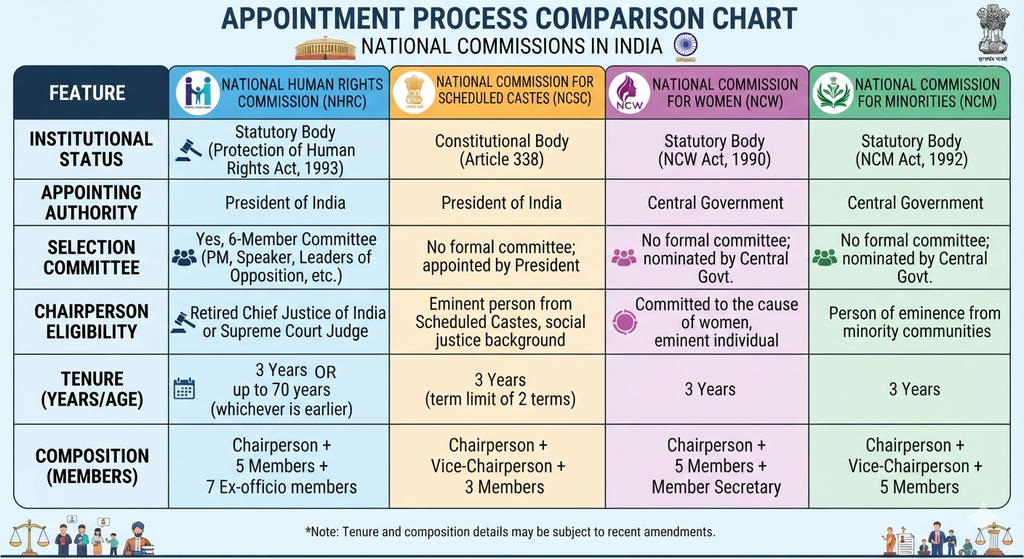
- The Commission consists of a Chairperson, a Vice-Chairperson and five Members — seven in all — nominated by the Central Government from among persons of eminence, ability and integrity.
- Five of the seven, including the Chairperson, must be from among the minority communities. The requirement guarantees minority presence without guaranteeing minority control of the appointment.
- Members hold office for a term of three years from the date of assumption of office, and are eligible for reappointment.
- The Commission has its own Secretary, an officer of the rank of Joint Secretary or above deputed by the government, and its staff is drawn largely from the general administrative pool rather than from an independent cadre.
What the appointment design does and does not secure
- Every member owes their appointment to the executive they are meant to hold to account, and there is no selection committee, no parliamentary involvement, no consultation with the Leader of the Opposition and no requirement of transparency in the choice.
- This is a weaker design than the National Human Rights Commission, whose members are chosen by a six-member committee including the Prime Minister, the Speaker, the Deputy Chairman of the Rajya Sabha, the leaders of the opposition in both Houses and the Home Minister.
- It is also weaker than the constitutional commissions for Scheduled Castes and Scheduled Tribes, whose members are appointed by the President under warrant and whose status derives from the Constitution rather than a statute.
- The consequence, stated plainly by critics, is that a commission composed entirely of nominees performs under the political identity of the government of the day. The composition changes with the government, and so, in perception if not always in fact, does the Commission’s willingness to criticise.
- The point is not that any particular appointee has been unworthy. It is that the design offers no answer to the charge of partisanship, and an institution whose only real asset is credibility cannot afford a design that makes the charge permanently plausible.
Functions and powers under the 1992 Act
The nine statutory functions
- The Act’s own enumeration is the best guide to what the Commission was meant to do, and reading it in order shows a body designed to move from evidence to monitoring to recommendation.
- Evaluate the progress of the development of minorities under the Union and the States.
- Monitor the working of the safeguards provided in the Constitution and in laws enacted by Parliament and the State Legislatures.
- Make recommendations for effective implementation of safeguards for the protection of the interests of minorities by the Central or State Governments.
- Look into specific complaints regarding deprivation of rights and safeguards of minorities and take up such matters with the appropriate authorities.
- Cause studies to be undertaken into problems arising out of any discrimination against minorities and recommend measures for their removal.
- Conduct studies, research and analysis on issues relating to the socio-economic and educational development of minorities.
- Suggest appropriate measures in respect of any minority to be undertaken by the Central or State Governments.
- Make periodical or special reports to the Central Government on any matter pertaining to minorities, and in particular on the difficulties they confront.
- Take up any other matter referred to it by the Central Government.
- Two verbs in that list carry the Commission’s principal weakness, and both were chosen deliberately. It may monitor safeguards, not investigate them; and it may look into complaints, not inquire into them.
- “Monitor” describes observation; “investigate” describes a process with findings. The constitutional commissions for Scheduled Castes and Scheduled Tribes are empowered to investigate and monitor; the Commission for Minorities is empowered only to monitor.
- “Look into” is weaker still than “inquire into”, which is the language used for the Scheduled Caste and Scheduled Tribe commissions and which carries the connotation of a formal proceeding culminating in a determination.
- The difference is not semantic. It determines whether a finding of the Commission has any status at all, and on the present language it has none.
The powers of a civil court
- While performing its functions, the Commission has all the powers of a civil court trying a suit in respect of five specified matters.
- Summoning and enforcing attendance of any person from any part of India and examining them on oath.
- Requiring the discovery and production of any document.
- Receiving evidence on affidavit.
- Requisitioning any public record or copy thereof from any court or office.
- Issuing commissions to have witnesses and documents examined elsewhere — which matters for a national body that cannot bring every witness to Delhi.
- These are procedural powers, not remedial ones. The Commission can compel a person to appear and answer; it cannot compel any authority to act on what it hears.
- Its findings are recommendatory. There is no power to award compensation, to direct prosecution, to quash an order, or to attach a consequence to non-compliance — and no offence of failing to implement a recommendation.
The reporting chain, and where it breaks
- Section 13 of the 1992 Act creates the accountability loop that is supposed to give recommendations their force.
- The Commission submits an annual report, and such special reports as it considers necessary, to the Central Government.
- The Central Government must lay the report before each House of Parliament, together with a memorandum of action taken on the recommendations relating to the Union, and the reasons for non-acceptance of any recommendation.
- Where a recommendation concerns a State Government, the report is to be laid before the State Legislature with a corresponding memorandum and reasons for non-acceptance.
- The design is intelligent. A recommendation cannot be enforced, but a refusal must be explained on the record and in public, and the obligation to give reasons is a real constraint on a government that wishes to appear reasonable.
- The obligation has simply not been discharged. The Commission’s annual reports have not been tabled in Parliament since around 2010, which means the one mechanism converting a recommendatory finding into a political cost has been dormant for well over a decade.
- The lapse has continued across governments of different political composition. It is a bureaucratic default rather than a partisan act, which makes it harder to correct and more revealing about how seriously the institution is taken.
A statutory duty to explain refusal is worth more than a power to compel, provided somebody is made to explain; when the tabling stops, the entire design stops with it.
The Sachar Committee and the evidence base for minority disadvantage
- The Commission’s mandate assumes a factual predicate — that minorities are in fact disadvantaged — and until 2006 the state had never systematically established it. The High Level Committee on the Social, Economic and Educational Status of the Muslim Community of India, constituted in March 2005 under Justice Rajindar Sachar and reporting in November 2006, supplied the evidence.
- Its central finding was that Muslims, the largest of India’s minorities at roughly three-quarters of the notified minority population, lag substantially behind on nearly every development indicator, in several respects below the Scheduled Castes and Scheduled Tribes.
The figures that changed the debate
| Indicator | Muslim | Comparator |
|---|---|---|
| Literacy rate (2001) | 59.1% | National average 64.8% |
| Children aged 6–14 never enrolled or dropped out | About one in four | — |
| Graduates or diploma holders, aged 20 and above | 4% | National 7% |
| Post-graduates among graduates | Roughly one in twenty | — |
| Share in the Indian Administrative Service | 3.0% | Population share 14.2% |
| Share in the Indian Police Service | 4.0% | — |
| Share in the Indian Foreign Service | 1.8% | — |
| Share in Indian Railways employment | About 4.5%, overwhelmingly in the lowest grades | — |
| Head-count poverty ratio | 31% | SC/ST 35%; second highest of all groups |
| Average bank credit | About half that extended to other minorities | About a third of that to “others” |
- The representation figures are the most quoted because they are the least deniable. A community that is one in seven Indians holds one in thirty-three IAS positions and one in fifty-five IFS positions, and no explanation confined to individual merit survives contact with a gap of that size sustained over decades.
The five explanations the Committee offered
- The report did not stop at measurement. It set out why the backwardness had proved so persistent, and each reason implies a different remedy.
- Compact settlement and the demand for local facilities. Muslim populations live in dense, concentrated localities and prefer to use schools and services within them, especially for girls, so the absence of a school inside the mohalla translates directly into non-enrolment rather than into travel.
- Discomfort with mainstream institutions and continued reliance on madrasas. Families uncertain of their reception in the general school system fall back on community institutions, whose certification is not recognised for most employment, closing off the routes the schooling was meant to open.
- Unhygienic settlements and low living conditions, with a consequent concentration in self-employment — petty trade, artisanal work, small manufacture — which limits exposure to formal-sector skills and to the credit system.
- Psychological fear and alienation from the rest of society, which inhibits integration and produces a compounding sequence: poor educational outcomes, restricted employment opportunity, and absorption into the unorganised sector, where there is neither security nor a path out.
- Non-use of banking and insurance. Low participation in formal finance — partly a matter of access, partly of religious objection to interest — keeps households outside the credit system. The Committee’s recommendation here was to connect these communities to information and communication technology so that awareness of banking and financial services becomes ordinary rather than exceptional.
- The fourth explanation is the one that matters most for the Commission. Fear and alienation are not remediable by any scheme; they are remediable only by demonstrated institutional responsiveness, which is exactly what a functioning minorities commission is supposed to provide.
The afterlife of Sachar: commissions, committees and schemes
- What happened to the Sachar findings is the clearest available test of whether the Indian state converts evidence about minorities into policy, and the answer is mixed at best.
The Ranganath Misra Commission
- The National Commission for Religious and Linguistic Minorities, constituted in October 2004 under Justice Ranganath Misra, a former Chief Justice of India, reported in May 2007 with the most far-reaching recommendations any official body has made on this subject.
- It recommended 15 per cent reservation for minorities in government employment and educational institutions, of which 10 per cent for Muslims and 5 per cent for the other notified minorities.
- As a fallback, where the primary recommendation could not be implemented, it proposed carving 8.4 per cent out of the existing 27 per cent Other Backward Classes quota for religious minorities.
- It recommended that Paragraph 3 of the Constitution (Scheduled Castes) Order, 1950 — which confines Scheduled Caste status to Hindus, Sikhs and Buddhists — be deleted, so that Dalits who convert to Islam or Christianity retain access to Scheduled Caste benefits.
- None of it was implemented. The report was tabled in Parliament in December 2009 and never acted upon, for reasons that are constitutional as much as political.
- Religion-based reservation runs into Articles 15(1) and 16(2), which prohibit discrimination on the ground of religion, and into the judicial insistence that backwardness be established by social and educational criteria rather than by religious identity.
- The 50 per cent ceiling on total reservation laid down in Indra Sawhney leaves little room for an additional block of this size.
- The Andhra Pradesh experience demonstrated the difficulty concretely: the state’s successive attempts to reserve seats and posts for backward sections among Muslims were repeatedly struck down by the High Court, and the litigation over the Andhra sub-quota is among the matters referred to a Constitution Bench of the Supreme Court, where it remains undecided.
- A parallel attempt by the Union in 2011 to carve a 4.5 per cent sub-quota for minorities within the OBC quota was struck down by the Andhra Pradesh High Court in 2012 for having been drawn on religious rather than backwardness criteria, and the Supreme Court declined to stay that judgment.
The Kundu Committee
- The Post-Sachar Evaluation Committee, appointed in 2013 under the economist Amitabh Kundu and reporting in October 2014, was asked to assess what had actually been done with the Sachar recommendations and with the 15-Point Programme.
- It found implementation partial and poorly targeted, with scheme benefits often failing to reach the districts and communities they were designed for.
- Its signature proposals were a Diversity Index to measure and incentivise plurality in educational institutions, workplaces and housing; an Equal Opportunity Commission to handle discrimination complaints across all disadvantaged groups; and the fixing of accountability on individual officers for delivery.
- Neither the Diversity Index nor the Equal Opportunity Commission was created. Both had been recommended by Sachar as well, so the state has now declined the same two institutional reforms twice.
The delivery machinery
- The Prime Minister’s New 15-Point Programme for the Welfare of Minorities, announced in 2006, is the umbrella instrument. Its four objectives are enhancing educational opportunities, ensuring an equitable share in economic activity and employment, improving living conditions through infrastructure, and preventing and controlling communal disharmony.
- Its operative mechanism is an earmarking rule: 15 per cent of the outlays and targets of participating ministries’ schemes are, to the extent possible, to be directed to notified minorities.
- The qualifier “to the extent possible” is doing most of the work. An earmarking with no enforcement and no audit is an aspiration, and successive evaluations have found the target unmet across most participating departments.
- The National Commission for Minority Educational Institutions, created by the 2004 Act of the same name, is the Commission’s institutional sibling and in one respect its superior.
- It is a quasi-judicial body with the powers of a civil court and, crucially, with adjudicatory power: it determines whether an institution is a minority educational institution, hears appeals against a state’s refusal of a No Objection Certificate or of minority status, and can cancel a minority status wrongly granted.
- Its decisions bind and prevail over inconsistent state law. The contrast is instructive: on the narrow question of institutional status Parliament was willing to create a body that decides, while on the broad question of minority rights it created a body that only observes.
- The scheme architecture has contracted sharply since 2022.
- The pre-matric scholarship was restricted to classes 9 and 10, ending support for classes 1 to 8 on the stated ground that the Right to Education Act already covers those years.
- The post-matric and merit-cum-means scholarships and the Maulana Azad National Fellowship for MPhil and PhD research have seen no fresh admissions since 2022-23.
- Between 2012-13 and 2021-22 the three scholarship schemes had delivered roughly 6.69 crore scholarships, about 67 lakh a year, and the fellowship had disbursed some Rs 739 crore.
- The consequence shows up in expenditure. Ministry of Minority Affairs utilisation fell to about 5 per cent of allocation in 2023-24 — roughly Rs 154 crore of Rs 3,098 crore — and about 22 per cent in 2024-25, against utilisation rates that had previously exceeded 90 per cent.
- The 2026-27 allocation of about Rs 3,400 crore restores headline numbers, but the revised estimates for the scholarship heads in the preceding year were close to nil, so the allocation measures intent rather than delivery.
The record: what the Commission has actually done
- The Commission’s routine work is complaint handling, and the volume is modest for a body serving nearly a fifth of the population.
- Complaints are received on discrimination, denial of safeguards, obstruction of religious practice, communal incidents and administrative harassment, and are taken up with the district or state authority concerned.
- Muslims file the overwhelming majority — some 4,543 complaints between 2018-19 and late 2021 alone — which reflects both the community’s size and the concentration of the problems the Commission exists for.
- On the narrower head of violence against minorities, the Commission recorded 568 complaints between 2014-15 and 2024-25, with Uttar Pradesh accounting for 251 and Delhi for 80.
- The Ministry has told Parliament that it maintains no central data of its own on violence against minorities and relies on what the Commission receives — which makes the Commission the state’s only systematic record, and a thin one.
- It has done substantial work on the misuse of political language about minorities. In 1998 the Commission wrote to the Election Commission asking that expressions such as “vote bank”, “appeasement” and “concessions” not be used with reference to minorities in the forthcoming elections.
- The intervention identified something real. Each of those words converts a constitutional entitlement into a favour, and repeated often enough the vocabulary makes the entitlement itself look illegitimate.
- Its most striking intervention was directed at the word that names it. A conference convened by the Commission with the Digital Empowerment Foundationdiscouraged the use of the term “minority” itself, on the argument that it is at odds with the constitutional philosophy under which everyone is a citizen of India without being majority or minority.
- This is a genuine dilemma rather than a rhetorical flourish. Protection requires classification, and classification entrenches the very difference that protection was meant to make harmless. No minorities commission anywhere has resolved it.
- On the technological side the Commission has pushed two connected ideas.
- With the Digital Empowerment Foundation it recommended a satellite support system for minority educational institutions, so that madrasas and community schools could be connected to the mainstream educational network rather than replaced by it.
- It has pressed for e-governance as the practical route to two kinds of connection — between the government and minorities, so that entitlements reach claimants without an intermediary, and between minorities and the majority, on the reasoning that isolation is what sustains the fear Sachar identified.
Who decides who is a minority, and at what level
- The largest unresolved question about the Commission is jurisdictional. Minority status is determined nationally, while the social reality it responds to is very often state-level.
- The Supreme Court held in T. M. A. Pai Foundation that for Article 30 purposes the state is the unit. The Commission’s notification under Section 2(c) is nevertheless all-India.
- The mismatch produces concrete anomalies. Hindus are a numerical minority in Lakshadweep, Mizoram, Nagaland, Meghalaya, Jammu and Kashmir, Manipur, Arunachal Pradesh, Punjab and Ladakh — in Lakshadweep and Mizoram at a few per cent — yet cannot claim the protection of Article 30 there, because the community is a national majority.
- Conversely, a nationally notified minority that is locally dominant carries protections it may not need in that state.
- The Ashwini Kumar Upadhyay litigation before the Supreme Court challenges precisely this. The petition attacks Section 2(c) of the National Commission for Minorities Act, 1992 and Section 2(f) of the National Commission for Minority Educational Institutions Act, 2004 as arbitrary and violative of Articles 14, 15, 21, 29 and 30, and asks that minority status be determined state-wise.
- The Union’s position has shifted more than once. An affidavit in March 2022 stated that state governments are competent to declare a community a minority within the state, appearing to concede the petitioner’s premise.
- A further affidavit weeks later withdrew that formulation, saying the earlier filing had been made without full consultation and that the question required consultation with states and stakeholders because of its far-reaching ramifications.
- The Court has repeatedly pressed the Union and the states for their views, granting what it described as a last opportunity to file, and has criticised the Union’s changes of position. The matter remains pending, and until it is decided the definitional foundation of the Commission’s own jurisdiction is unsettled.
A commission whose jurisdiction rests on a notification the executive may rewrite has borrowed its authority rather than been given it.
Structural weaknesses
- The recurring criticisms group into three families, and separating them matters because they call for different remedies.
| Family | The defect | What it produces |
|---|---|---|
| Capacity | Human resource deficiency — inconsistent staffing and delayed appointment of key officials; limited role of state minority commissions, with only about two-thirds of states having one and no integration with the national body; underutilisation of technology, since the complaint monitoring system does not amount to end-to-end complaint handling | Pendency, uneven reach, complainants who cannot track their own case |
| Budget | Research is a core mandate, yet only a small proportion of the allocation is spent on studies and analysis | The Commission cannot generate the evidence base its recommendations depend on |
| Legal and constitutional authority | No “teeth” — no legal capacity to give effect to its mandate; no constitutional power to conduct independent enquiries into transgressions of minority rights | Findings without consequences; an institution legally incapacitated to do its own job |
- Layered on these are the specific lacunae that have been pressed for years.
- It has only the power to monitor safeguards; the power to investigate their working has been recommended and never granted.
- It has only the power to look into complaints; the power to inquire into them, with the formality and finality that implies, has not been given.
- There is no mandatory duty on the Union or the states to consult it on matters affecting minority development, unlike the constitutional obligation under Articles 338 and 338A to consult the Scheduled Caste and Scheduled Tribe commissions on all major policy matters affecting those groups. This is the single sharpest asymmetry in the whole design.
- Government response to its recommendations has been lukewarm, and the Section 13 tabling lapse removes even the obligation to explain the indifference.
- Because every member is nominated, the Commission functions under the political identity of the day, the same criticism made of the National Commission for Women.
- Its political role has in practice been confined to the Muslim minority, which is defensible on caseload and indefensible as institutional design: Christian, Sikh, Buddhist, Parsi and Jain concerns have had markedly less of its attention.
- It lacks constitutional status on a par with the commissions for Scheduled Castes, Scheduled Tribes and Backward Classes, which is the umbrella demand under which most of the others sit.
The reform debate
- In 2004 the Parliamentary Standing Committee on Social Justice and Empowerment, chaired by Sumitra Mahajan, examined the Commission and made specific recommendations to strengthen it, singling out its insufficient investigative powers as the central defect. The recommendations were not implemented.
- The reform proposals that have accumulated since fall into a workable order.
- Evaluate members against specific performance criteria — decisions taken, disposal rate within stipulated time — so that accountability attaches to individuals rather than to the institution in the abstract.
- Set baseline pendency targets at the organisational level and report against them.
- Conduct a staffing needs assessment at regular intervals to address chronic vacancies in membership and in the secretariat.
- Build a feedback mechanism telling every complainant how their appeal was processed, irrespective of the outcome — the minimum standard of public service, and currently absent.
- Expand and strengthen state minorities commissions, and set them up where they do not exist, since a functioning state tier is the only realistic way to reduce pendency and make hearings effective across a country of this size.
- Confer constitutional status, with a mandatory consultation duty and the power to investigate and inquire — the reform that would make the others enforceable.
- The case against constitutional status is worth stating, because it is not frivolous. Status is not capacity: the National Commission for Scheduled Castes has Article 338 and still suffers vacancies, arrears and unimplemented recommendations, and elevating a body that cannot fill its own posts changes its letterhead rather than its output.
- The external assessment has been consistent. Asma Jahangir reported to the United Nations Human Rights Council after her mission to India as Special Rapporteur on freedom of religion or belief.
- She praised India’s legal framework, its constitutional protections and its commitment to secularism, and recorded that a comprehensive legal framework for freedom of religion exists on paper.
- She found that implementation varies from state to state, and described an atmosphere in which organised groups had generated a pervasive fear of mob violence, with attacks on Christian minorities among the episodes she documented.
“The level of action of the Government to protect its citizens in terms of freedom of religion or belief varies from state to state.” — Asma Jahangir
- She credited the Commission with prompt action and independent reporting, and recommended that its membership reflect the diversity of the country, particularly in terms of gender — a defect that persists.
- Hamid Ansari, the former Vice-President, has restated the 1978 diagnosis almost verbatim: that despite the safeguards in the Constitution and the laws in force, a feeling of inequality and discrimination persists among minorities. He has called for stronger safeguards and equal opportunity, and has blamed lack of will and tardy responses from the state agencies concerned.
- Wajahat Habibullah, a former chairperson of the Commission, has made the narrower and more practical point that leaving minority institutions without a chairperson reduces their effectiveness, and that these bodies matter because they allow the venting of grievances — that a functioning channel for complaint is itself a public good, independent of what the complaint achieves.
The Commission today
- The most telling recent fact about the Commission is that it stopped functioning. Iqbal Singh Lalpura’s term as chairperson ended on 12 April 2025, and no chairperson or members were appointed for roughly fifteen months, leaving a statutory body with a seven-member sanctioned strength operating with none.
- The post of Secretary also fell vacant in December 2025 when the incumbent was transferred and the officer named to replace her did not take charge, so the Commission was run by a Joint Secretary and deputy secretaries.
- A public interest petition was filed in the Delhi High Court seeking a mandamus to reconstitute the body. That a statutory commission had to be sued into existence is the sharpest available comment on its standing.
- The Ministry of Minority Affairs announced a new Commission on 16 July 2026, and Harjit Singh Grewal assumed charge as Chairperson on 21 July 2026, ending a vacancy of roughly fifteen months. Several of the seven sanctioned posts remained unfilled at that point.
- The vacancy fell in a period of unusual pressure. The Waqf (Amendment) Act, 2025 provoked the largest minority-rights litigation in years.
- In September 2025 the Supreme Court at the interim stage stayed the five-year practising-Muslim requirement for creating a waqf and the District Collector’s power to treat disputed property as government property, and capped non-Muslim representation on the Central Waqf Council and State Waqf Boards.
- The Commission, which exists precisely to be consulted on measures of this kind, had no chairperson and no members throughout.
Conclusion
- The National Commission for Minorities is a body whose design and practice fail in opposite directions, and the two failures have to be separated to be understood.
- The design was never adequate. A statute rather than a constitutional article; monitoring rather than investigation; looking into complaints rather than inquiring into them; no duty on any government to consult it; recommendations with no consequence attached.
- The practice has been worse than the design allowed. Even the weak instruments were left unused: the Section 13 reporting chain dormant since around 2010, the research budget unspent, the state tier unbuilt, and the Commission itself unconstituted for over a year in the middle of its most consequential decade.
- Its genuine contributions have been discursive rather than coercive — the intervention on election language, the fact-finding after communal incidents, the pressure that produced Sachar’s evidence base, the insistence that entitlement is not appeasement. These are the achievements available to a body that can speak but cannot act, and they are not nothing.
- The reform that matters is not simply constitutional status, which the record of the Scheduled Caste and Scheduled Tribe commissions shows is no guarantee. It is the combination of status with three specific powers: a mandatory duty of consultation, a power of independent investigation, and an enforced obligation on government to table reports and give reasons for refusal.
- Beneath the institutional question lies the argument the Commission was built on. India rejected the melting pot and chose the salad bowl, and a body of this kind is what that choice commits the state to maintaining.
- A minority right that no institution is able to vindicate is a statement of intent rather than a right, and the distance between the two is measured by how seriously the Commission is allowed to work.
Previous Year Questions
- Comment on National Commission for Minorities. (2023)
- Examine the role of the National Commission for Minorities in preserving, promoting and protecting the rights of minorities in India. (2017)
