

The Constitution of India is the supreme law of the Republic — the document from which every other law, office and power in the country draws its validity. It is also, unusually, a political argument written in legal form: a text that simultaneously builds a state, protects an individual, restrains a majority and commissions a social transformation. Understanding its salient features means understanding why a single document had to carry all four burdens at once.
What the Constitution Is

- The Constitution lays down the framework of government — the structure, procedures, powers and duties of institutions — and in the same breath sets out fundamental rights, directive principles and the duties of citizens.
- It was adopted on 26 November 1949 by the Constituent Assembly and came into force on 26 January 1950, the day the Dominion of India became the Republic of India.
- The two-month gap was functional: provisions on citizenship, elections and the provisional Parliament took effect immediately on adoption so that the machinery would be ready when the rest commenced.
- The Assembly took 2 years, 11 months and 18 days, sitting across eleven sessions and 165 days of debate, from its first meeting on 9 December 1946 to the signing on 24 January 1950.
- The Drafting Committee, appointed on 29 August 1947 and chaired by B. R. Ambedkar, produced the working text; B. N. Rau served as Constitutional Adviser and S. N. Mukherjee as chief draftsman.
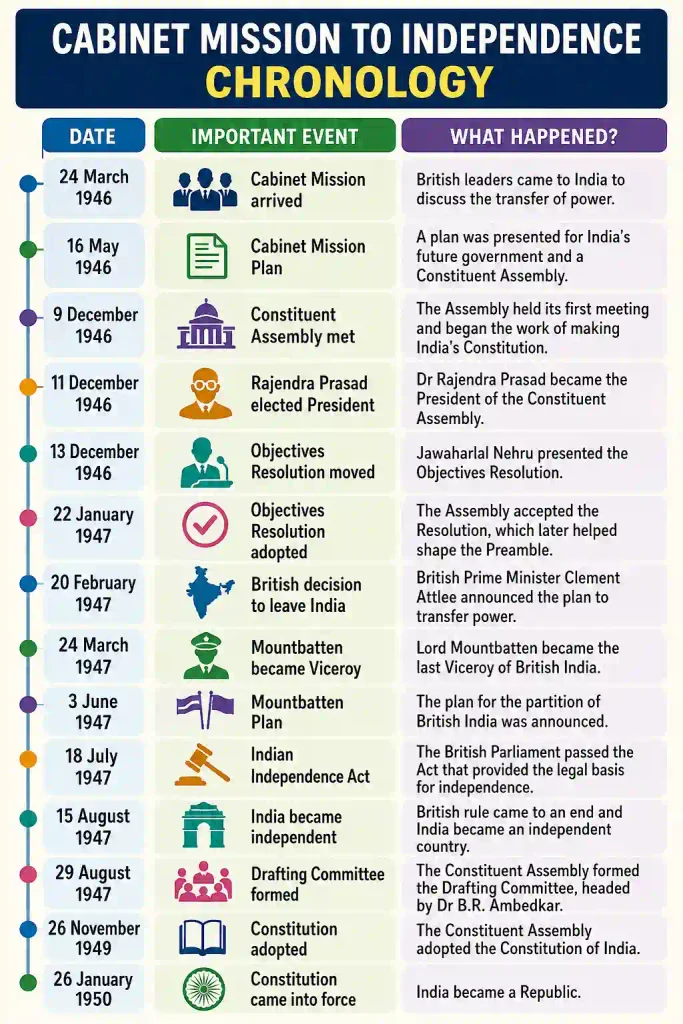
The replacement of the Government of India Act 1935
- The Constitution displaced the Government of India Act 1935 as the country’s fundamental governing instrument — the statute that until then defined provincial autonomy, the federal scheme, the Governor’s discretion and the emergency machinery.
- The 1935 Act was a grant from an imperial Parliament; the Constitution is a self-given document. That change of authorship, not merely of content, is the substantive break.
- The transition was legally seamless but politically total. The same administrative machinery now answered to a different source of authority — “We, the People of India” rather than the Crown-in-Parliament.
Constitutional autochthony and Article 395
- Autochthony means that a constitution is “of the soil” — that it derives validity from a domestic source and not from the legal system of any external power.
- India’s framers achieved this deliberately. Article 395 repealed the Indian Independence Act 1947 and the Government of India Act 1935, along with every enactment amending or supplementing the latter.
- Repealing the very statutes under which the Assembly had been convened was the legal severing of the umbilical cord: the Constitution now stands on its own authority.
- The contrast is instructive. Several Commonwealth constitutions of the period continued to rest on a United Kingdom statute for their validity and had to be re-enacted or patriated decades later.
- The Preamble performs the same function politically. Sovereignty is located in the people, and the Constitution is described as one the people “give to ourselves”.
Why Republic Day falls on 26 January
- The date was chosen, not administratively convenient. At its Lahore session in December 1929 the Congress adopted the resolution of Purna Swaraj — complete independence — and 26 January 1930 was observed across the country as the first Independence Day.
- Bringing the Constitution into force on 26 January 1950 folded the pledge of 1930 into the founding of the Republic, giving a nationalist date a constitutional meaning.
- 15 August therefore marks the transfer of power; 26 January marks the moment India became a sovereign democratic republic under a Constitution of its own making.
The Architecture of the Document
The Constitution is built in four layers — a Preamble stating purposes, Parts grouping subjects, Articles carrying the operative rules, and Schedules holding detail too bulky or too changeable for the main text. Appendices were added later to preserve material of continuing legal relevance. Each layer answers a different design problem, and the interplay between them explains most of what critics call the document’s untidiness.
The four layers
- Preamble — the statement of ideals: justice, liberty, equality and fraternity, and the description of India as a sovereign socialist secular democratic republic. It is the interpretive key to the rest.
- Parts — thematic divisions, each dealing with a distinct field: rights, directive principles, the Union, the States, local government, finance, services, elections, emergency and amendment.
- Articles — the numbered operative provisions, elaborating rights, duties, powers and procedures.
- Schedules — appendices to the main text holding lists, allocations, forms, oaths and salaries. Putting this material in Schedules allows updating without disturbing the architecture of the Parts.
- Appendices — five in the current official text, preserving instruments such as the Constitution (Application to Jammu and Kashmir) Order and extracts from the 44th, 86th and 88th Amendment Acts.
Original figures and the current position
| At commencement (1950) | Current position | |
|---|---|---|
| Articles | 395 | roughly 470 |
| Parts | 22 | 25 |
| Schedules | 8 | 12 |
| Appendices | none | 5 |
| Amendments | — | 106 enacted, latest in 2023 |
- The text runs to about 145,000 words, making it the longest written constitution of any sovereign state in the world.
- It is also the most frequently amended national constitution — a fact that sits oddly beside the charge that it is too rigid, and one examined below.
Why article numbers do not match the article count
- The framers chose not to renumber when adding provisions. New Articles are inserted with letters after the Article they follow, and repealed Articles leave gaps in the sequence.
- The consequence is arithmetical. The highest-numbered Article is still 395, but the actual count exceeds 470, because insertions add to the total without extending the numbering.
- Representative insertions:
- Article 21A — right to education, added by the 86th Amendment, 2002.
- Articles 31A to 31D — protections for agrarian reform and for laws giving effect to certain Directive Principles, added between the First and 42nd Amendments; 31D was later repealed.
- Article 300A — right to property, relocated out of Part III by the 44th Amendment, 1978, and made a constitutional but not fundamental right.
- Articles 371A to 371J — special provisions for Nagaland, Assam, Manipur, Andhra Pradesh, Sikkim, Mizoram, Arunachal Pradesh, Goa and Karnataka, the textual home of India’s asymmetrical federalism.
- Repeals cut the other way. Article 31 and the whole of Part VII were removed, and Articles 19(1)(f) and 31 disappeared together in 1978.
- The numbering is therefore a historical record rather than a table of contents — every letter suffix marks a political moment.
The Parts of the Constitution
| Part | Subject |
|---|---|
| I | The Union and its Territory |
| II | Citizenship |
| III | Fundamental Rights |
| IV | Directive Principles of State Policy |
| IVA | Fundamental Duties — 42nd Amendment, 1976 |
| V | The Union |
| VI | The States |
| VII | States in Part B of the First Schedule — repealed, 7th Amendment, 1956 |
| VIII | The Union Territories |
| IX | The Panchayats — 73rd Amendment, 1992 |
| IXA | The Municipalities — 74th Amendment, 1992 |
| IXB | The Co-operative Societies — 97th Amendment, 2011 |
| X | The Scheduled and Tribal Areas |
| XI | Relations between the Union and the States |
| XII | Finance, Property, Contracts and Suits |
| XIII | Trade, Commerce and Intercourse within India |
| XIV | Services under the Union and the States |
| XIVA | Tribunals — 42nd Amendment, 1976 |
| XV | Elections |
| XVI | Special Provisions Relating to Certain Classes |
| XVII | Official Language |
| XVIII | Emergency Provisions |
| XIX | Miscellaneous |
| XX | Amendment of the Constitution — Article 368 |
| XXI | Temporary, Transitional and Special Provisions |
| XXII | Short Title, Commencement, Authoritative Text in Hindi and Repeals |
- Read as a sequence, the Parts trace a descending order of constitutional priority: territory and citizenship first, then the individual against the state, then the state’s own obligations, and only then the machinery of government.
- The Parts added after 1950 — IVA, IXA, IXB and XIVA — record the three great post-founding preoccupations: duties, decentralisation, and the offloading of adjudication onto tribunals.
Part IXB and the limits of the amending route
- The 97th Amendment, 2011 inserted Part IXB on co-operative societies, added “co-operative societies” to the freedom of association in Article 19(1)(c), and inserted Article 43B among the Directive Principles.
- In Union of India v. Rajendra N. Shah (2021) a three-judge bench held Part IXB unconstitutional in its application to co-operative societies within the states.
- The reasoning was federal, not substantive. “Co-operative societies” is a State List entry, so an amendment regulating them altered the distribution of legislative power and required ratification by at least half the state legislatures under the proviso to Article 368(2). None had been obtained.
- Applying severability, Justices Rohinton Nariman and B. R. Gavai saved Part IXB so far as it governs multi-state co-operative societies, over which Parliament is competent.
- Justice K. M. Joseph dissented, holding that severance was impermissible and the amendment should have fallen entirely.
- The case is the clearest recent demonstration that the ratification requirement is a real constraint: an amendment can be struck down purely for taking the wrong procedural road.
The Schedules
| Schedule | Subject |
|---|---|
| First | States and Union Territories and their territorial extents |
| Second | Emoluments and privileges of the President, Governors, Speakers, judges, the CAG |
| Third | Forms of oaths and affirmations |
| Fourth | Allocation of seats in the Rajya Sabha |
| Fifth | Administration of Scheduled Areas and Scheduled Tribes |
| Sixth | Administration of tribal areas in Assam, Meghalaya, Tripura and Mizoram |
| Seventh | Union, State and Concurrent Lists — the division of legislative powers |
| Eighth | Official languages — 22 at present |
| Ninth | Laws immunised from judicial review — First Amendment, 1951 |
| Tenth | Anti-defection provisions — 52nd Amendment, 1985 |
| Eleventh | 29 subjects devolved to Panchayats — 73rd Amendment, 1992 |
| Twelfth | 18 subjects devolved to Municipalities — 74th Amendment, 1992 |
- The Ninth Schedule began as a shield for land reform and swelled into a general immunity device. I. R. Coelho (2007) held that laws placed in it after 24 April 1973 remain testable against the basic structure.
- The Seventh Schedule is the operative heart of Indian federalism — three lists, residuary power with the Union, and Union predominance on the Concurrent List.
- The Eleventh and Twelfth Schedules converted local government from a non-justiciable directive in Article 40 into a constitutional tier, though the devolution they list remains permissive rather than mandatory.
Sources of the Constitution and the Charge of Borrowing
- The framers worked with an open comparative method. B. N. Rau toured the United States, Canada, Ireland and Britain in 1947, and the Assembly had detailed studies of foreign constitutions before it.
- The result is a document assembled from many models but organised around Indian problems — partition, princely integration, mass illiteracy, caste hierarchy and linguistic plurality.
| Source | Features drawn |
|---|---|
| Government of India Act 1935 | Federal scheme and the three lists, office of Governor, judiciary, public service commissions, emergency provisions, administrative detail |
| United Kingdom | Parliamentary government, cabinet system and collective responsibility, rule of law, legislative procedure, Speaker, single citizenship, bicameralism, prerogative writs |
| United States | Fundamental Rights, judicial review, independence of the judiciary, impeachment of the President, removal of judges, office of Vice-President, the Preamble |
| Ireland | Directive Principles of State Policy, nomination to the Rajya Sabha, method of electing the President |
| Canada | Federation with a strong Centre, residuary powers with the Union, appointment of Governors by the Centre, advisory jurisdiction of the Supreme Court |
| Australia | Concurrent List, freedom of trade, commerce and intercourse, joint sitting of the two Houses |
| Weimar Germany | Suspension of Fundamental Rights during an Emergency |
| USSR | Fundamental Duties, the ideal of justice — social, economic and political in the Preamble, planning |
| France | Republic, and the ideals of liberty, equality and fraternity |
| South Africa | Procedure for amending the Constitution, election of members of the Rajya Sabha |
| Japan | The expression “procedure established by law” in Article 21 |
The 1935 Act as the structural spine
- The single largest debt is to the Government of India Act 1935, which supplied the federal architecture, the distribution of legislative powers, the machinery of the executive, and much of the administrative detail that gives the Constitution its bulk.
- Estimates of the derivation vary between roughly half and two-thirds of the text, depending on whether one counts articles or words. The charge inside the Assembly was framed as “about half”; later scholarship generally puts it higher.
- What matters more is what was changed. Against the 1935 Act, the Constitution introduced:
- an elected head of state in place of a Crown-appointed Governor-General;
- justiciable Fundamental Rights, where the 1935 Act had none;
- universal adult franchise, replacing a property-and-education franchise covering barely a quarter of adults;
- removal of the Governor’s discretionary override of a responsible ministry;
- an integrated judiciary armed with judicial review.
Ambedkar’s defence: selection is not copying
- Anticipating the charge, Ambedkar met it when introducing the Draft Constitution on 4 November 1948. After more than a century of written constitutions, he argued, the fundamental ideas had become common property, and similarity in the main provisions was therefore unavoidable.
- His second move was sharper. The Drafting Committee had made deliberate modifications to remedy defects observed elsewhere and to fit Indian conditions, and the charge of producing “a blind copy of the Constitutions of other countries”, he told the House, rested on “an inadequate study of the Constitution”.
- The analytical point behind the rhetoric is that borrowing is an act of selection, and selection expresses a theory. Three examples show the theory at work.
- India took the British parliamentary executive but rejected parliamentary sovereignty, subjecting legislation to a written constitution and judicial review.
- India took American judicial review but rejected due process, writing the Japanese formulation “procedure established by law” into Article 21 — only for the Supreme Court to read due process back in through Maneka Gandhi (1978).
- India took the Irish Directive Principles but placed them alongside justiciable rights rather than as a substitute, creating the Part III–Part IV tension that has driven half a century of litigation.
- Austin called the method an “art of selection and modification” producing a “beautiful patchwork” — a phrase that concedes the borrowing and denies the servility in the same breath.
A constitution is defined less by the materials it takes than by the ones it refuses; India’s refusals — of parliamentary sovereignty, of a restricted franchise, of an unaccountable executive — are where its originality lies.
The Lengthiest Written Constitution in the World
- At roughly 470 Articles in 25 Parts with 12 Schedules, and about 145,000 words, the Indian Constitution is several times longer than any comparable national text.
- The length is not accidental. Five structural causes account for it, and a sixth is usually left unstated.
Why it is so long
- Geographic and social diversity. A subcontinent of linguistic, religious, tribal and regional plurality could not be governed by a text of general principles. Articles 371A–371J, the Fifth and Sixth Schedules and the Eighth Schedule exist because uniform rules would not have held.
- The inheritance of the 1935 Act. The framers began from a statute of over 300 sections and ten schedules, and carried forward its habit of writing administrative arrangements into fundamental law.
- A single constitution for the Centre and the states. Unlike the United States, where each state writes its own constitution, India provided one document for both levels — with a partial exception for Jammu and Kashmir until 2019. Everything the states would otherwise have written for themselves sits inside the national text.
- Dominance of legal luminaries in the Assembly. Advocates formed the largest occupational group. Trained to distrust silence, they preferred to spell out what other constitutions leave to convention.
- The decision to constitutionalise detail and safeguards. Provisions on services, public service commissions, official language, finance, elections and tribunals, and the elaborate protections for minorities, Scheduled Castes and Scheduled Tribes, were written in because the framers would not trust ordinary legislation to preserve them.
- The sixth reason is decisive: conventions could not be assumed. Britain’s constitution is short because centuries of practice fill its gaps. India was starting a democracy in a society Ambedkar himself called essentially undemocratic in its habits, and what could not be assumed had to be written down.
| Constitution | Structure | Approximate length | Amendments |
|---|---|---|---|
| India, 1950 | ~470 Articles, 25 Parts, 12 Schedules | ~145,000 words | 106 in 76 years |
| United States, 1787 | 7 Articles | ~4,400 words; about 7,600 with amendments | 27 in 237 years |
| Australia, 1901 | 128 sections | short and skeletal | 8 carried out of 45 put to referendum |
| Canada, 1867 and 1982 | 147 sections in the 1867 Act, plus the Constitution Act 1982 | moderate | few; patriated only in 1982 |
| Japan, 1947 | 103 Articles | short | none |
- The comparison makes the design choice visible: constitutions that are short are also opaque, relying on convention, judicial gloss or separate state constitutions to do the work India put on the page.
- Frequency of amendment is not evidence of instability so much as of how much ordinary administrative material the document carries. Many Indian amendments concern reservation extensions, state reorganisation, tax entries and Ninth Schedule additions — matters other systems handle by statute.
Length was the price of writing down what other constitutions could leave to convention, and of governing a subcontinent from a single text.
Nature and Character of the Constitution
A blend of rigidity and flexibility
- The Constitution is neither rigid like the American nor flexible like the British. It uses three amendment tracks of graded difficulty.
- Simple majority, outside Article 368 — creation of new states and alteration of boundaries under Article 3, abolition or creation of legislative councils under Article 169, citizenship, official language.
- Special majority under Article 368 — a majority of the total membership of each House plus two-thirds of those present and voting.
- Special majority with ratification by half the states — for provisions touching the federal balance: the Seventh Schedule, representation of states in Parliament, election of the President, the powers of the higher judiciary, and Article 368 itself.
- Ambedkar’s answer to the rigidity charge was that the Assembly had provided the most facile amendment procedure any comparable constituent body had offered. If dissenters could not obtain two-thirds in a Parliament elected on adult franchise, their dissatisfaction was not shared by the public.
- The design principle is that the more a provision touches the federal contract or the structure of the state, the harder it is to change. The procedure itself is treated in depth elsewhere in this unit.
Federal in form, unitary in spirit
- India’s federation was not formed by contract among pre-existing states. The units were created by the Union, and Article 3 lets Parliament alter their boundaries, names and existence without their consent. Ambedkar’s formula was that India is an indestructible Union of destructible States.
- The unitary features are structural, not incidental: a single constitution, single citizenship, an integrated judiciary, all-India services, residuary powers with the Union, Union predominance on the Concurrent List, Article 249 allowing Parliament to legislate on a State List entry on a Rajya Sabha resolution, Article 253 on international agreements, Article 356 on President’s rule, and Articles 352 and 360.
- Against these stand genuinely federal features: a written and largely rigid constitution, the division of powers in the Seventh Schedule, a bicameral legislature with a chamber of states, and an independent judiciary to police the line.
The classificatory debate
| Scholar | Characterisation of the Indian Union |
|---|---|
| K. C. Wheare | “Quasi-federal” — a unitary state with subsidiary federal features, rather than a federal state with subsidiary unitary features |
| Ivor Jennings | A federation with a strong centralising tendency |
| Granville Austin | “Cooperative federalism” — the levels are interdependent, not watertight, and every federation is sui generis |
| W. H. Morris-Jones | “Bargaining federalism” — the real relationship is negotiated, not merely allocated |
| K. Santhanam | A “paramount federation”; in the Assembly he warned the fiscal provisions would leave the provinces “beggars at the door of the Centre” |
| Paul H. Appleby | “Extremely federal” — a minority reading, resting on the Union’s administrative dependence on the states |
| Alfred Stepan | “Holding together” and demos-enabling, against the American “coming together” and demos-constraining model |
| B. R. Ambedkar | Federal in normal times, unitary in emergency, by deliberate design |
- Wheare’s method has been criticised as legal-constitutional, static and ethnocentric — it reads statutes rather than practice, and takes the American model as the type from which everything else deviates. M. P. Singh argues that federalism is a dynamic concept, to be read in its socio-cultural and political context, and that even American federalism has shifted decisively toward the centre since the New Deal.
- Practice bears this out. India moved toward greater state bargaining power after 1989, under coalition governments and economic liberalisation — Balveer Arora described the drift as quasi-confederal — and back toward centralisation after 2014 with a single-party majority at the Union.
- Cooperative federalism is the constitutional design; bargaining federalism is what it becomes when the parties at the two levels differ. The Indian federation is therefore best described not as a fixed type but as an equilibrium that moves with the party system.
Parliamentary government, and a synthesis of two sovereignties
- The framers chose the parliamentary system over the presidential on two grounds Ambedkar stated on 4 November 1948: daily as well as periodic responsibility, and familiarity with a system India had partly practised since 1919.
- The deeper choice was to combine British parliamentary government with American judicial supremacy, and to accept neither in full.
- Parliamentary sovereignty is rejected: Parliament is a creature of the Constitution, and its laws are void if they violate Part III.
- Judicial supremacy is qualified: Article 21 was written as “procedure established by law”, and the Court’s power runs against a written text and an amending power Parliament controls, subject only to the basic structure.
- The result is constitutional supremacy rather than the supremacy of either organ — a synthesis worked out case by case from Shankari Prasad to Kesavananda Bharati, and treated separately in this unit.
Integrated and independent judiciary
- India has a single hierarchy of courts — Supreme Court, High Courts, subordinate courts — administering both Union and state law. There is no American-style dual system.
- Independence rests on security of tenure, removal only by an address of both Houses on proved misbehaviour or incapacity, salaries charged on the Consolidated Fund, and a bar on practice before the same court after retirement.
- The integrated structure is another unitary feature in federal clothing: state laws are interpreted finally by a national court, which keeps constitutional meaning uniform across a diverse federation.
Single citizenship and universal adult franchise
- Unlike the United States, Switzerland or Australia, India provides only one citizenship — of the Union. There is no citizenship of a state, and rights are not conditioned on domicile, subject to narrow exceptions such as Article 16(3).
- The purpose was integrationist: after Partition, single citizenship denied any constitutional foothold to claims of separate political personality.
- Universal adult franchise was granted at once and without phasing, when literacy stood at around twelve per cent. Under the 1935 Act, by Austin’s estimate, barely 28 per cent could vote in the provincial elections of 1946.
- The 61st Amendment, 1988 lowered the voting age from 21 to 18.
- This is the strongest single answer to the charge that the Assembly legislated for its own class: a body of the propertied and the educated gave the vote to everybody at the first opportunity.
Emergency provisions
- Three emergencies are provided — national under Article 352, President’s rule under Article 356, and financial under Article 360 — under which the federal structure converts, in Ambedkar’s description, into a unitary one.
- The provisions descend directly from the 1935 Act and were defended in the Assembly as a precaution; Ambedkar assured members that Article 356 would remain a “dead letter”.
- It did not. President’s rule has been used well over a hundred times, most flagrantly in 1977 and 1980, when incoming governments dissolved nine state assemblies each on the ground that the ruling party had lost the general election.
- S. R. Bommai (1994) ended the worst of it, holding that federalism is part of the basic structure, that a proclamation is justiciable on the material before the President, and that the floor of the House is the only test of a ministry’s majority.
A three-tier polity
- The original Constitution was two-tier — Union and states. Local government sat in Article 40, a non-justiciable directive to organise village panchayats.
- The 73rd and 74th Amendments, 1992 added Part IX, Part IXA and the Eleventh and Twelfth Schedules, creating a third constitutional tier with mandatory five-yearly elections, State Election Commissions, State Finance Commissions, and reservation for women and for Scheduled Castes and Scheduled Tribes.
- The tier is constitutionally guaranteed but functionally dependent: the listed subjects are devolved at the discretion of state legislatures, and fiscal autonomy remains thin.
A secular state
- Indian secularism is not a wall of separation but what Rajeev Bhargava calls principled distance — the state keeps a non-arbitrary distance from all religions, intervening or abstaining according to whether liberty, equality and dignity require it.
- The textual signature is Article 25(2)(b), which permits the state to throw open Hindu religious institutions to all classes — a power a strictly separationist state could not possess. Article 17, abolishing untouchability, does the same work.
- Religion is therefore a domain the state may reform in the name of equality, while freedom of conscience and the right of minorities to establish and administer educational institutions under Articles 29 and 30 are guaranteed.
Independent constitutional bodies
- The Constitution creates offices insulated from the executive and given constitutional rather than statutory status: the Election Commission, the Comptroller and Auditor General, the Union and State Public Service Commissions, the Attorney General, the Finance Commission, and later the National Commissions for Scheduled Castes and Scheduled Tribes.
- Their independence rests on the devices used for judges — fixed tenure, a difficult removal procedure, and salaries charged on the Consolidated Fund.
- These bodies answer a problem Ambedkar identified early: a democracy without a neutral referee for elections, audit and recruitment would be a democracy in form only.
Granville Austin’s Reading: A Social Document and a Seamless Web
Austin remains the most influential single interpreter of the Indian Constitution, and his contribution is analytical rather than descriptive. He read the document not as a machine for governing but as an instrument for remaking a society, and argued that its provisions cannot be understood in isolation from one another.
“The Indian Constitution is first and foremost a social document.” — Granville Austin
- The social document thesis holds that the majority of provisions are either directly aimed at furthering a social revolution or at establishing the conditions necessary for it.
- The evidence is textual: abolition of untouchability in Article 17, reservation, universal adult franchise at once, the socio-economic goals of Part IV, and the protective provisions for Scheduled Castes and Scheduled Tribes.
- The Constitution therefore expects the state to be an agent of transformation, not a neutral umpire — which is why a purely liberal-individualist reading of Part III never captures it.
- The seamless web is Austin’s claim that the Constitution pursues three strands which stand or fall together.
- National unity and integrity — a strong Centre, single citizenship, emergency powers, an integrated judiciary.
- Democratic institutions — universal franchise, parliamentary responsibility, justiciable rights, an independent judiciary and Election Commission.
- Social revolution — the Directive Principles, affirmative action, and the abolition of hierarchies of status.
- The metaphor’s force lies in interdependence: unity pursued at the cost of democracy destroys the basis of unity, and social revolution without democratic institutions has no lawful instrument.
- “Cornerstone of a nation” is Austin’s other governing image, and it is a claim rather than a compliment. In 1950 the nation was not yet made; the Constitution was to be the foundation on which one would be built.
- His account of the founding moment is that the national revolution — democracy and liberty denied by colonial rule — and the social revolution — emancipation and equality withheld by tradition and scripture from women and the lower castes — came together in the making of the Constitution.
- Testing the metaphor is more useful than repeating it. A cornerstone bears weight it does not itself create. The Constitution supplied instruments, not the social change: Article 17 did not end untouchability, and Part IV was made non-justiciable precisely so that the promise would not bind.
- Austin’s method also has a procedural component. He identified three working principles of the Assembly — decision-making by consensus, the principle of accommodation, and the art of selection and modification — and regarded the first two as India’s original contribution to the craft of constitution-making.
- Rajeev Bhargava situates Austin in a wider field, distinguishing three ways the Constitution has been studied: as a politico-legal document (Jennings, Alexandrowicz), as political history (Austin), and as an epiphenomenon of social relations (Chaube, Dutta Gupta). Bhargava’s own proposal is to read it as a moral document embodying an ethical vision — a bridge to constitutional morality below.
Criticisms of the Constitution
The sharpest criticisms were made inside the Constituent Assembly itself, which is a point in the document’s favour: the objections were heard, answered and recorded rather than suppressed. They fall into seven distinct lines of attack, and each has a serious answer.
“A carbon copy of the 1935 Act”
- K. Hanumanthaiya gave the complaint its most memorable form, that the freedom struggle’s cultural aspirations had produced an alien instrument.
“We wanted the music of Veena or Sitar, but here we have the music of an English band.” — K. Hanumanthaiya, Constituent Assembly
- Mahavir Tyagi put the same objection flatly: there was “nothing Gandhian” in the Constitution.
- The answer is that continuity of form concealed a reversal of authority. The 1935 Act had no rights, no elected head of state, a restricted franchise, and a Governor who could override a responsible ministry. Each was reversed.
- There is also a practical defence. With communal violence, refugee movement and the integration of over five hundred princely states proceeding at once, inventing an untried administrative order would have been reckless. Retaining machinery that worked was prudence, not servility.
“Un-Indian and un-Gandhian” — the missing village republic
- The Gandhian critique held that a constitution for India should have been built upward from the village panchayat, resting on direct participation rather than a representative parliamentary superstructure. T. K. Tope is the scholar most associated with the charge that the document is un-Indian and un-Gandhian in inspiration.
- Ambedkar’s reply was categorical, and reflected his reading of caste in rural India: the village, he asked the Assembly, was nothing but “a sink of localism, a den of ignorance, narrow-mindedness and communalism”.
- For Ambedkar the unit of the Constitution had to be the individual, protected by law and rights, because the village community was precisely the structure that enforced untouchability and graded inequality. Gandhi’s village republic looked like emancipation from above and subjection from within.
- The debate was deferred rather than settled. Article 40 placed panchayats among the non-justiciable directives, and the 73rd and 74th Amendments eventually gave them constitutional status — four decades late, and on Ambedkar’s terms rather than Gandhi’s, since the panchayat is now an elected unit of a representative system, not a self-sufficient republic.
“A lawyers’ paradise”
- Ivor Jennings is the source of the most quoted external criticism: that the Constitution is “too long, too rigid, too prolix”, and that its complexity, technicality and unnecessary detail make it a paradise for lawyers rather than a charter for citizens.
- The specific complaints are identifiable.
- Legalistic drafting — terms of art such as “procedure established by law”, “reasonable restrictions” and “public order”, whose meaning is discoverable only through litigation.
- Ambiguity built into rights — every freedom in Article 19 is qualified by grounds of restriction that require judicial construction.
- Sheer volume — more text means more room for inconsistency, and more inconsistency means more litigation.
- A recorded institutional cause — advocates were the largest occupational group in the Assembly, and the text reflects what critics called an overdose of legalism.
- The answers are three.
- Detail substituted for absent conventions. Britain can be brief because practice fills its silences. India could not assume habits that did not exist, and Ambedkar’s warning that constitutional morality “has to be cultivated” is the theoretical justification for writing things down.
- Litigation is how a rights-bearing democracy works. A constitution that generates cases is one whose guarantees are being invoked by citizens; the volume of Article 32 and Article 226 litigation is evidence of access, not of defect.
- The judiciary has simplified where the text was opaque — reading due process into Article 21 in Maneka Gandhi, and relaxing locus standi through public interest litigation precisely so that the poor need not hire counsel to reach the Court.
- The criticism retains force where it bites hardest. The cost and delay of Indian litigation mean that a rights document requiring interpretation is, in practice, more available to those who can afford lawyers.
“Borrowed”, “too long”, and the wider condemnation
- The borrowing objection is answered above: selection expresses a theory, and the departures matter more than the sources.
- The length objection is answered by the design reasons already set out — diversity, a single text for two levels, an inherited statute, and the refusal to rely on convention.
- Ambedkar’s own reply to the wider condemnation identified its sources precisely. Criticism came chiefly from the Communist Party, which wanted a constitution based on the dictatorship of the proletariat and condemned this one for resting on parliamentary democracy; and from the Socialists, who wanted freedom to nationalise property without compensation and Fundamental Rights without limitation.
- His response was not that these positions were wrong in principle but that the principles in the Constitution are the views of the present generation, and that the amending procedure left every future generation free to change them.
- He invoked Jefferson: each generation may bind itself, but none may bind its successors — “the earth belongs to the living and not to the dead”.
Not framed by a body elected on universal adult franchise
- The Assembly was indirectly elected. Its 389 seats — 296 elected from British provinces, 93 nominated by princely states — were filled by provincial legislators chosen on the restricted franchise of the 1935 Act. After Partition the strength fell to 299.
- The Cabinet Mission reasoned that an election on adult franchise would cause “a wholly unacceptable delay”, and called indirect election the “fairest and most practicable plan” in the circumstances.
- The objection is real: the body that wrote the Constitution was not elected by the people whose sovereignty its Preamble asserts.
- The answers:
- The alternative was postponing independence for an election the administrative machinery of 1946, amid communal breakdown, could not have delivered.
- The first general election of 1952, on universal adult franchise, returned a legislature of broadly similar composition — evidence that a directly elected Assembly would not have produced a very different document.
- The Assembly invited written submissions from the public, and drafting was preceded by extensive committee work.
- The Supreme Court in Kesavananda Bharati treated the phrase “We, the People” as settled and not open to factual audit.
One-party dominance and the social composition of the Assembly
- Congress held about 82 per cent of the seats — roughly 245 of 299 members — and the Congress Assembly Party was the private forum where most provisions were effectively decided before reaching the floor. Churchill’s jibe that it was an “assembly of Brahmins” captured the external perception; the internal charge was that this was a “Congress Constitution”.
- The social profile compounds it. Around 80 per cent of members came from the upper castes, and there were only fifteen women — about five per cent of the House.
- Rajeev Dhavan presses the strongest version: the Indian people had limited input into the process and no alternative but to accept the outcome.
- The answers turn on outputs rather than inputs.
- Austin’s formulation is the fair summary of the political fact: “The Assembly was the Congress and the Congress was India.” In 1946 the Congress was less a party than a coalition of ideological tendencies — liberal, socialist, Gandhian, conservative and Hindu-nationalist all sat within it.
- Congress co-opted members of other parties and independents — Ambedkar himself was brought back after losing his Bengal seat at Partition — precisely to make the document a consensus text.
- Most provisions were adopted by consensus rather than by majority vote, after extended debate. The contrast is with constitutions carried by a bare majority against an opposing bloc.
- The decisive rebuttal is substantive: an assembly of the propertied and the upper-caste gave the vote to everybody, abolished untouchability, and wrote reservation into the text. It did not legislate for its own class.
- The National Commission to Review the Working of the Constitution, appointed by a non-Congress government and reporting in 2002, recommended numerous amendments but no new constituent assembly — an implicit verdict on legitimacy.
Ambedkar’s own final answer
- His closing speech placed responsibility outside the text altogether, and remains the most honest thing said about the document by anyone who wrote it.
“However good a Constitution may be, it is sure to turn out bad because those who are called to work it, happen to be a bad lot.” — B. R. Ambedkar, Constituent Assembly, 25 November 1949
- He nevertheless defended the instrument on its own terms, saying he felt the Constitution was workable, flexible, and strong enough to hold the country together in peacetime and in war.
- The two statements are not in tension. Together they state the position the rest of this article develops: the Constitution supplies forms, and forms require a morality to animate them.
Reconciliation of Alternative Perspectives
The Constitution is often read as if it expressed a single political philosophy, and every such reading fails. It is better understood as a settlement among incompatible positions, held together not by ideological coherence but by a shared willingness to postpone, qualify and accommodate. That is a weakness in a treatise and a strength in a founding document.
The competing visions inside the Assembly
- Bhargava identifies at least five ideological positions contending in the Constituent Assembly:
- the non-modernist, quasi-communitarian vision of Gandhi, built on the self-sufficient village and direct participation;
- the liberal-democratic vision of Ambedkar, built on the individual, law and rights, with an interventionist state;
- the social-democratic vision of Nehru, adding socialism, planning, industrialisation, scientific temper and secularism;
- the radical egalitarian vision of K. T. Shah, pressing for explicit socialist commitments in the text;
- the Hindutva position, seeking a civilisational rather than a liberal foundation.
- None of these prevailed intact. The Gandhian model was consigned to the non-justiciable Part IV; Nehru’s socialism was moderated by propertied interests; K. T. Shah’s amendments were defeated; Hindutva was excluded from the constitutional definition of the nation.
- What emerged was the Ambedkar–Nehru synthesis — a rights-bearing individual, an interventionist developmental state, and a parliamentary federal structure — with the losing visions preserved as directives, exceptions and silences rather than erased.
The four reconciliations in the text
| Tension | How the Constitution holds both |
|---|---|
| Liberal rights vs socialist goals | Justiciable Part III alongside non-justiciable Part IV; the state may restrict rights to pursue directive goals, and Article 31C protects certain such laws |
| Universal citizenship vs group-differentiated rights | Articles 14 and 15(1) guarantee formal equality; Articles 15(4), 16(4), 330, 332, 335 and Articles 29–30 create group-specific protections for castes, tribes and minorities |
| Centralisation vs federal division | Seventh Schedule division and a Council of States, set against residuary power with the Union, Articles 249, 252, 253 and 356, and the emergency provisions |
| Tradition vs modernity | Freedom of religion under Articles 25–28 and preserved personal laws, set against Article 17, Article 25(2)(b) and the uniform civil code directive in Article 44 |
- Each row is a deliberate refusal to choose. The Constitution does not rank the competing values in advance; it creates institutions to arbitrate between them case by case.
- Bhargava’s account of contextual secularism generalises the method. There is no lexical order, no pre-existing hierarchy among constitutional values, so whether one value overrides another or is reconciled with it cannot be settled in advance; each conflict is resolved in its own context, and the outcome may satisfy neither side fully while remaining reasonably satisfactory to both.
Consensus by accommodation
- Austin’s three working principles describe the technique.
- Consensus — decisions by unanimity or near-unanimity, used on the most divisive questions such as the federal and language provisions.
- Accommodation — the capacity to reconcile seemingly incompatible concepts, visible in combining federal and unitary features, Commonwealth membership with republican status, and panchayati raj with a strong Centre.
- Selection and modification — the comparative method, adapting foreign provisions to Indian conditions.
- Austin regarded the first two as India’s original contribution to constitution-making, which is an argument that the Indian achievement is procedural as much as substantive.
- Accommodation came with an exit route. Since the principles embodied in the text were, in Ambedkar’s phrase, the views of the present generation, what could not be agreed was left amendable rather than forced.
- Pratap Bhanu Mehta captures what this makes the document: a cosmopolitan constitution standing at the crossing points of global constitutional law, syncretic and eclectic like the culture that produced it, and revolutionary in a peculiar way — in most countries a revolution produces a constitution, while in India the Constitution was expected to produce the revolution.
The Constitution’s coherence is not ideological but procedural: it does not tell Indians what to agree on, it tells them how to disagree without breaking the state.
Where accommodation failed
- Accommodation is not costless, and honesty requires naming its failures.
- Separate electorates were abolished over the objection of B. Pocker Bahadur, who argued minorities would be left without an adequate voice. Sardar Patel and Begum Aizaz Rasul carried the opposite view, the latter calling separate electorates a “self-destructive weapon”.
- Reserved seats for women were rejected at the insistence of women members. Hansa Mehta said Indian women had “never asked for privileges” but for social, economic and political justice, and Renuka Ray that the movement had been “fundamentally opposed to special privileges and reservations”. The 106th Amendment, 2023 reopened the question seventy-three years later.
- Preventive detention was written into Part III itself under Article 22, which one veteran freedom fighter called the darkest blot on the Constitution — a liberal guarantee and its own suspension inside the same Part.
- The fiscal centralisation Santhanam warned about was accommodated rather than resolved, and remains the live edge of Indian federalism.
Constitutional Morality
A constitution can prescribe institutions and procedures; it cannot prescribe the disposition with which they are worked. Constitutional morality names that disposition — and it entered Indian constitutional vocabulary from a nineteenth-century history of ancient Greece, by way of the chairman of the Drafting Committee.
Ambedkar, Grote, and the speech of 4 November 1948
- Introducing the Draft Constitution on 4 November 1948, Ambedkar defended the decision to write the form of administration into the Constitution rather than leave it to ordinary legislation, and did so by borrowing a phrase from George Grote’s History of Greece.
- Grote’s definition, which Ambedkar read into the record, holds three things in tension.
“A paramount reverence for the forms of the constitution, enforcing obedience to authority and acting under and within these forms, yet combined with the habit of open speech, of action subject only to definite legal control, and unrestrained censure of those very authorities as to all their public acts.” — George Grote, quoted by B. R. Ambedkar
- Grote’s further point, which Ambedkar endorsed, is that the diffusion of constitutional morality throughout the whole community — not merely among a majority — is the indispensable condition of a government at once free and peaceable, because even a powerful and obstinate minority can make free institutions unworkable without being strong enough to seize power.
The elements of constitutional morality
- Self-restraint by those who hold power. Constitutional forms bind the winners, and the test of the disposition is what a majority does when it could get away with more.
- Deference to constitutional process and form. Ambedkar’s insistence that India must hold fast to constitutional methods of achieving social and economic objectives, abandoning civil disobedience, non-cooperation and satyagraha now that constitutional routes were open, is the same argument applied to political practice.
- Criticism, but pacific criticism. Government is subject to the full force of censure; what constitutional morality rules out is the substitution of force for argument.
- This is the argument of Ambedkar’s closing address, remembered as the “Grammar of Anarchy” passage: methods that were legitimate against a colonial state — civil disobedience, non-cooperation, satyagraha — become the grammar of anarchy once constitutional means of redress exist, and the sooner they are abandoned the better.
- Recognition of plurality. The only way to resolve deep differences, on Ambedkar’s account, was to secure agreement on a constitutional process — a form of adjudication capable of mediating disagreement rather than suppressing it.
- Scepticism about any organ claiming to embody the popular will. Ambedkar was unwilling to let the legislature, the courts, or even the Constituent Assembly itself claim to speak authoritatively in the name of popular sovereignty; any such appeal must be tempered by the recognition that the future has claims as valid as the present.
- An open culture of criticism. On this reading the function of Parliament is not primarily to represent popular sovereignty but to interrogate government continuously — elections being a periodic assessment and Parliament a daily assessment.
“Not a natural sentiment”
- Ambedkar’s warning is the part of the doctrine most often omitted and the most important.
“Constitutional morality is not a natural sentiment. It has to be cultivated. We must realize that our people have yet to learn it. Democracy in India is only a top-dressing on an Indian soil, which is essentially undemocratic.” — B. R. Ambedkar, Constituent Assembly, 4 November 1948
- Two consequences follow, and both bear on the shape of the document.
- It justified the length. Because the conventions that sustain British practice could not be assumed, the administrative detail had to be written down — the argument that answers Jennings.
- It located the risk correctly. A society organised by graded inequality supplies undemocratic habits, so democratic forms would sit on an undemocratic substratum until the habits changed.
- Pratap Bhanu Mehta reads constitutional morality in this Ambedkarite register — as the ethic that makes constitutional government possible, resting on self-restraint, scepticism about final claims to represent the people, and an open culture of criticism, rather than as a menu of substantive values for courts to enforce.
Constitutional morality names the conduct a constitution can demand but cannot itself produce.
The judicial revival
- After decades of dormancy the phrase returned in the courts, and by the late 2010s had become a central interpretive device, usually deployed to set constitutional values against popular or social morality.
| Case | Year | What constitutional morality was made to do |
|---|---|---|
| Naz Foundation v. NCT of Delhi | 2009 | Delhi High Court read down Section 377 IPC; popular moral indignation is not a valid basis for overriding fundamental rights, and constitutional rather than public morality governs |
| K. S. Puttaswamy v. Union of India | 2017 | Privacy located in dignity and autonomy, with constitutional morality framing the recognition of an unenumerated right |
| Government of NCT of Delhi v. Union of India | 2018 | Held to be “not just the forms and procedures of the Constitution, but an enabling framework that allows a society the possibilities of self-renewal”; applied to the Lieutenant Governor’s relations with an elected government |
| Navtej Singh Johar v. Union of India | 2018 | Section 377 struck down so far as it criminalised consensual same-sex conduct: “constitutional morality cannot be martyred at the altar of social morality” |
| Joseph Shine v. Union of India | 2018 | Section 497 IPC on adultery struck down; a provision resting on the proprietary conception of a wife held incompatible with constitutional morality |
| Indian Young Lawyers Association v. State of Kerala, Sabarimala | 2018 | Exclusion of women of menstruating age held unconstitutional: “existing structures of social discrimination must be evaluated through the prism of constitutional morality” |
- Notice what changed between Ambedkar and the Court. For Ambedkar the idea was chiefly a discipline on political actors — a demand for restraint, process and criticism. In the judgments it becomes a source of substantive values enforced against legislative and social majorities.
- The doctrine has also been used to fill constitutional silences and to police discretionary power where the text is open — most visibly in the litigation over a Governor’s indefinite inaction on state bills under Article 200, where withholding assent without decision was argued to breach the disposition the office presupposes.
- Mahendra Pal Singh notes the narrowing this involves: judicial usage has often reduced constitutional morality to a vehicle for claiming fundamental rights, whereas Ambedkar intended a broader institutional and political safeguard against majoritarian and executive overreach.
The critique: whose morality?
- The core objection is that the doctrine lets judges substitute their own reading of constitutional values for democratic choice, and that the phrase is invoked far more often than it is defined.
- Justice Indu Malhotra’s dissent in Sabarimala is the sharpest judicial statement of the concern.
- She held that notions of rationality should not be imported into matters of religion, and that what constitutes an essential religious practice is for the religious community to decide, not the court.
- She warned that entertaining public interest petitions against religious practices could destabilise the secular fabric in a country of many faiths, and that Article 25 gives every individual an equal entitlement to practise faith freely.
- Her position is not that constitutional morality is meaningless but that it cannot be the sole touchstone for every religious practice, because equality is not the only value Part III protects.
- The Union Government has since attacked the doctrine frontally. Before the nine-judge bench hearing the Sabarimala reference in April 2026, the Solicitor General argued that constitutional morality is a “judicially evolved, vague and indeterminate concept” travelling beyond the written text; that it suits unwritten constitutions such as Britain’s rather than a codified one; and that it is not a ground of judicial review at all, since Articles 14, 15, 17, 19, 21 and 25 already supply the tools for testing discriminatory practices.
- The amicus offered a middle position — that it may assist interpretation but cannot independently invalidate a law — and Rajeev Dhavan argued it cannot operate as a free-standing ground to defeat religious freedom claims.
- Members of the bench pushed back, insisting that constitutional courts cannot surrender jurisdiction over practices that shock the conscience.
- One of the seven questions formally referred to that bench is whether the word “morality” in Articles 25 and 26 includes constitutional morality. The doctrine’s status is therefore, for the first time, squarely before the Court for authoritative determination; judgment was reserved on 14 May 2026 after sixteen days of argument.
A Living Document and Transformative Constitutionalism
The living-document doctrine
- In Dr. Balram Singh v. Union of India (November 2024), a bench of Chief Justice Sanjiv Khanna and Justice Sanjay Kumar dismissed petitions seeking deletion of the words “socialist” and “secular” inserted in the Preamble by the 42nd Amendment.
- Article 368 permits amendment of the Preamble as of any other part, and the retrospective date of adoption — 26 November 1949 — is no bar: the date of adoption “will not curtail or restrict the power under Article 368”.
- The Court described the Constitution as “a living document”, capable of evolving through parliamentary amendment and judicial interpretation.
- Substantively, it read “socialist” in the Indian sense as a commitment to welfare and equality of opportunity, consistent with a mixed economy and with private entrepreneurship, and “secular” as the state neither favouring nor penalising any faith.
- The judgment matters beyond the Preamble. It affirms that Indian constitutional meaning is not frozen at the founding, while leaving the basic structure as the outer limit on what amendment may do.
Transformative constitutionalism
- Transformative constitutionalism is the claim that the Constitution’s purpose is not merely to restrain the state but to change an unjust social order — a reading that converts Austin’s social-document thesis into a doctrine of interpretation.
- The Supreme Court has adopted the vocabulary explicitly in Navtej Singh Johar, Puttaswamy, Joseph Shine and the Sabarimala majority, treating Part III as a charter for changing society, not only for limiting government.
- The criticisms are substantial.
- It concentrates transformative authority in the least accountable branch, and can substitute judicial declaration for political mobilisation.
- The remedial record is uneven: judgments recognising rights have often not produced enforcement, as the aftermath of Sabarimala demonstrated.
- It sits uneasily with the Court’s deference in other domains — electoral finance, preventive detention, executive appointments — inviting the charge that transformation is pursued selectively.
- The honest formulation is that transformative constitutionalism is a real feature of the text — Articles 15, 16, 17 and Part IV are unintelligible otherwise — whose institutional custodian is contested. Whether the transformation is the Court’s to direct or Parliament’s to legislate is precisely what the current litigation over constitutional morality is about.
The constitutional present
- The 106th Amendment, 2023 — the Nari Shakti Vandan Adhiniyam, providing one-third reservation for women in the Lok Sabha and state assemblies — remains the most recent enacted amendment, and its operation awaits a census and delimitation.
- The 129th Constitution Amendment Bill, 2024 on simultaneous elections stands referred to a Joint Parliamentary Committee whose tenure has been extended into 2026; its grant of power to the Election Commission has drawn criticism from a former Chief Justice of India.
- The 131st Constitution Amendment Bill, 2026 on delimitation, which would have raised the Lok Sabha ceiling from 550 to 850 and allowed women’s reservation to proceed on the 2011 census, was introduced on 16 April 2026 and negatived the next day — a reminder that the special-majority requirement remains a real constraint.
- The Articles 200 and 201 litigation over gubernatorial assent has run through two rounds: a two-judge judgment of April 2025 prescribing timelines and deeming assent through Article 142, and a five-judge advisory opinion of November 2025 holding that courts may neither prescribe timelines nor create deemed assent, and may intervene only against prolonged, unexplained and indefinite inaction.
- Taken together these describe a constitution that is worked, contested and amended continuously — the practical meaning of calling it a living document.
Conclusion
The salient features of the Indian Constitution are best read as answers to problems the framers could not avoid: a subcontinent of unmatched diversity, a state inherited from a colonial statute, a society organised by graded inequality, and a political community that had just been partitioned. Length, borrowing, centralising federalism, an interventionist state and an elaborate rights structure are responses to that situation, not defects of drafting.
- Austin’s seamless web states the design and Ambedkar’s warning states its condition — and the record suggests both were right.
- The document has held for over seven decades because its forms were written with unusual care.
- It has frayed, wherever it has, exactly where the conduct those forms presuppose was withheld.
Previous Year Questions
- Write approximately 150 words on Constitutional morality in the Indian Constitution. (2024)
- Mention the founding principles that define India’s Constitution. (150 words) (2021)
- Comment in 150 words: Indian Constitution is a ‘Lawyers’ Paradise’. – Ivor Jennings. (2018)
- Discuss the extent to which the Indian Constitution reflects successful reconciliation of alternative perspectives. (2012)
