

“State the concept of plate tectonics. How does it help in explaining the formation of the Himalayas and Appalachian Mountains?” (2014)
- Plate tectonics, formalised in the 1960s through the work of Harry Hess (seafloor spreading), J. Tuzo Wilson, and W.J. Morgan, holds that the Earth’s rigid outer shell (the lithosphere) is broken into a mosaic of large and small plates that move relative to one another over the underlying, plastically deformable asthenosphere, driven ultimately by mantle convection and the pull of subducting oceanic slabs.
- The theory’s genuine explanatory power for mountain building lies in its classification of plate boundaries by relative motion — divergent (plates moving apart, as at mid-ocean ridges), convergent (plates moving together, producing subduction or continental collision), and transform (plates sliding past one another) — since a mountain range’s structural style and present-day tectonic activity level are directly determined by which boundary type produced it.
- The thesis argued here: the Himalayas and the Appalachians, though both unambiguously products of plate-tectonic mountain building, sit at opposite ends of a single unifying framework — the Wilson Cycle of ocean-basin opening and closing — with the Himalayas representing an actively ongoing continental collision and the Appalachians representing the eroded remnant of a completed collision cycle, and it is precisely plate tectonics that supplies the single theoretical vocabulary capable of explaining both cases within one coherent model.
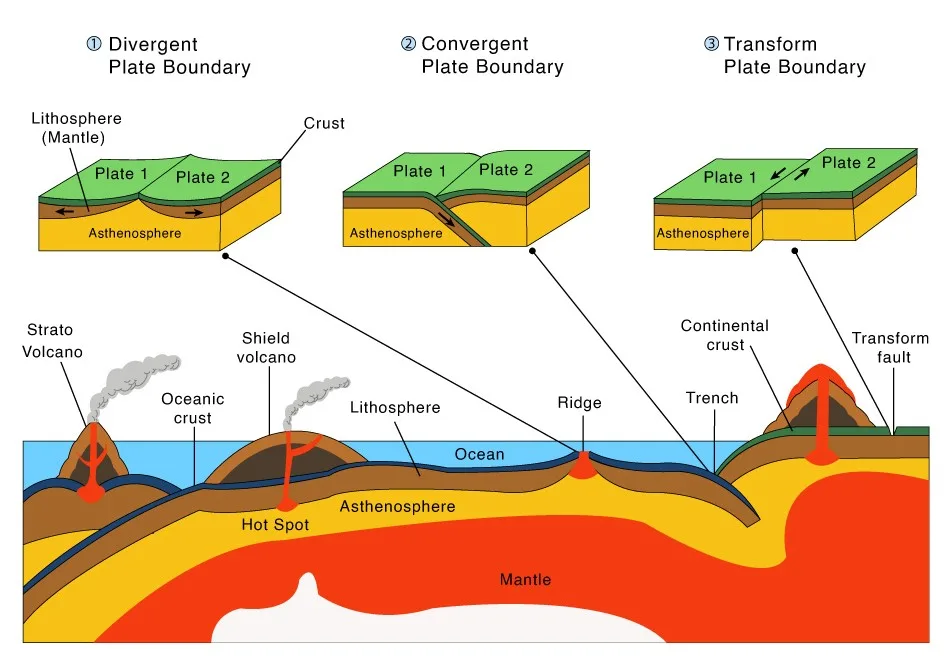
The Core Concept: Plates, Boundaries, and Convergent Mountain Building
- Convergent plate boundaries are the primary mountain-building setting in plate tectonics, producing two structurally distinct outcomes depending on the crust types involved: oceanic-continental convergence, where the denser oceanic plate subducts beneath the continental plate, producing volcanic arc mountains (e.g., the Andes), and continental-continental collision, where neither plate can subduct because continental crust is too buoyant, so the crust instead thickens dramatically through folding, faulting, and metamorphism, producing the world’s highest fold-mountain ranges.
- Mountain building via continental-continental collision requires an intervening ocean basin to have first existed and then been entirely consumed by subduction before the two continental margins can actually meet — meaning every major continental collision belt, whatever its current age, necessarily passed through an earlier phase of oceanic subduction before collision proper began.
- This entire sequence — rifting, ocean opening, subduction-driven ocean closing, and eventual continental collision — is termed the Wilson Cycle, and it is this single cyclical framework, rather than two separate unrelated explanations, that plate tectonics uses to account for mountain belts of very different ages and current activity levels.
The Himalayas: An Ongoing Continental Collision
- The Himalayas are the direct product of the ongoing collision between the Indian and Eurasian plates, which began approximately 50 million years ago once the Tethys Sea — the ocean basin that had previously separated the northward-drifting Indian subcontinent from Asia — was entirely consumed by subduction beneath the Eurasian margin.
- Because India continues to converge with Eurasia today at a measured rate of a few centimetres per year (confirmed directly by modern GPS geodesy), the Himalayas remain an actively rising mountain belt, with continuing crustal thickening, frequent seismicity, and measurable present-day uplift — a direct, continuing consequence of the collision having not yet reached tectonic equilibrium.
- The Tethyan sedimentary sequence — thick marine strata deposited in the Tethys Sea before its closure — supplies the folded sedimentary material now exposed across the Himalayan ranges, directly linking the mountains’ rock record to the vanished ocean basin whose closure plate tectonics identifies as the collision’s structural precondition.
- “Active tectonics is not a completed, historical event but a continuing process” — a description that captures precisely why the Himalayas remain seismically volatile and topographically extreme, in sharp contrast to the tectonically quiescent Appalachians discussed below.
The Appalachians: A Completed, Now-Passive-Margin Collision Belt
- The Appalachian Mountains record an earlier and now fully completed episode of the same Wilson Cycle process, built through a sequence of three successive collisional orogenies — the Taconic (roughly 470 million years ago), the Acadian (roughly 390-370 million years ago), and the Alleghanian (roughly 300-250 million years ago) — as the ancient Iapetus Ocean progressively closed and the continents bordering it (proto-North America, various island arcs, and ultimately Africa) collided in stages to help assemble the supercontinent Pangaea.
- Critically, mountain building did not end the story: once Pangaea subsequently rifted apart — the same rifting that eventually opened today’s Atlantic Ocean — the once-active Appalachian collision zone was left stranded on a now passive continental margin, with the plate boundary that had built the mountains effectively switching off as new spreading began elsewhere (along the mid-Atlantic ridge) rather than continuing along the old Appalachian suture.
- One of the classic pieces of evidence for continental drift itself draws directly on this Appalachian history: the mountain belt’s structural trend continues seamlessly from the eastern United States across the Atlantic into the old Hercynian mountains of southwest Ireland, Wales, and central Europe, a geological “fit” only explicable if the Appalachian-Caledonian-Hercynian belt was once a single, continuous mountain system later split apart by the Atlantic’s opening.
- Because no active plate boundary has operated along the Appalachian trend for roughly 200 million years since Pangaea’s breakup, the range today shows the classic signature of a passive-margin, deeply eroded orogen: comparatively low, gently rounded relief (having been worn down by prolonged subaerial denudation with no renewed uplift to counteract erosion) and negligible present-day seismicity, standing in complete structural contrast to the young, jagged, actively rising Himalayas.
Why Plate Tectonics Explains Both Within One Framework
- Plate tectonics succeeds precisely because it does not require two unrelated theories for these two mountain belts: both are continental-continental collision products, differing only in where each currently sits along the same Wilson Cycle — the Himalayas mid-collision and still actively converging, the Appalachians long past collision and now stranded on a passive margin following supercontinent breakup.
- This single framework directly explains observable present-day contrasts that older, purely descriptive theories of mountain building (such as Kober’s contraction-based geosynclinal theory) could not adequately account for: continuing Himalayan seismicity and uplift versus Appalachian tectonic quiescence, explained not by different mechanisms but by different stages of the identical underlying process.
- The theory’s predictive and explanatory reach extends further still — the same Wilson Cycle logic that explains the Appalachians’ present passive-margin quiescence predicts that a currently active belt like the Himalayas will, over a comparable multi-hundred-million-year timescale, eventually reach its own equivalent of tectonic quiescence once the India-Eurasia collision fully stabilises.
- Plate tectonics supplies mountain building’s single most powerful unifying concept: continental-continental collision following the closure of an intervening ocean basin, embedded within the broader cyclical logic of the Wilson Cycle’s rifting-spreading-subduction-collision sequence.
- Applying this framework to the Himalayas and Appalachians simultaneously demonstrates the theory’s genuine explanatory reach — it accounts not just for how each range formed, but for why one remains young, high, and seismically active while the other stands old, subdued, and tectonically quiet, purely as a function of each belt’s current position within the same underlying process.
- This capacity to explain both an ongoing and a long-completed orogeny within one coherent theoretical framework is precisely what distinguishes plate tectonics from the earlier, more geographically limited theories (contraction, geosynclinal) it decisively superseded during the twentieth century.