

“Write short note: Differences between Normal cycle and Arid cycle of Davis.” (2013)
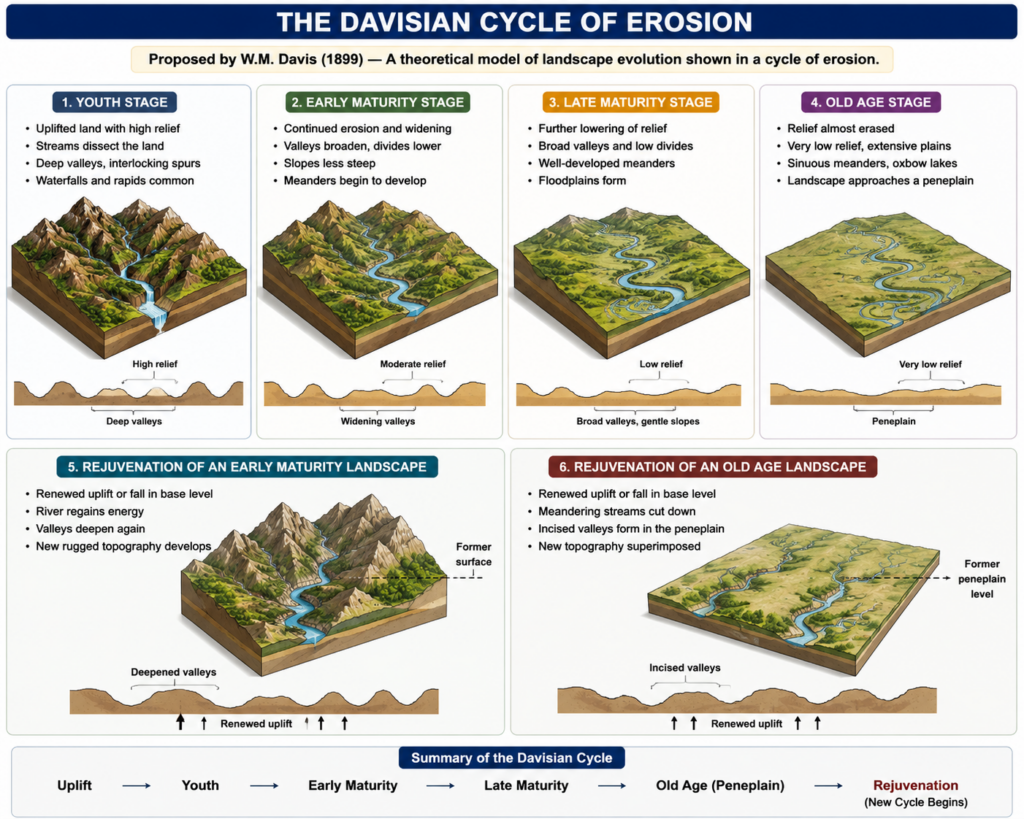
- W.M. Davis’s normal cycle of erosion (1899), developed around humid-temperate conditions, treats running water as the dominant, near-exclusive agent of landscape reduction, culminating in a low-relief peneplain graded to sea level through the familiar youth-maturity-old age sequence.
- Davis extended his own cyclical framework to arid regions in 1905, proposing an arid cycle of erosion operating under water scarcity, where fluvial action combined with wind action and mass wasting together reduce enclosed desert basins to a fundamentally different end-form.
- The thesis argued here: while both cycles share Davis’s underlying staged, directional architecture, they diverge sharply in their operative processes, drainage integration, and end-form, and this divergence is precisely what later drew L.C. King’s fundamental challenge to treating the humid cycle as geomorphology’s universal “normal” case.
Core Differences in Process and Setting
- Dominant agent: the normal cycle is driven almost exclusively by running water, whereas the arid cycle involves a combination of agents — infrequent but powerful sheet-flood and stream action, wind erosion and deflation, and significant mass wasting on steep, sparsely vegetated slopes.
- Drainage character: the normal cycle assumes an integrated, externally draining river network eventually reaching the sea, while the arid cycle is characterised by disintegrated, internally draining (endorheic) basins, since aridity and low relief prevent streams from maintaining a continuous course to an external base level.
- Base level: in the normal cycle, erosion is graded to sea level, the ultimate and singular base level; in the arid cycle, individual desert basins (bolsons) are instead graded to their own local, basin-floor base level — often a temporary playa lake — meaning the arid cycle operates on a fundamentally more localised base-level logic.
- Weathering regime: the normal cycle proceeds under humid-climate chemical weathering dominant conditions supporting continuous vegetation cover, whereas the arid cycle proceeds under mechanical weathering-dominant conditions (insolation weathering, salt weathering) on largely bare rock surfaces with sparse vegetation offering little protective cover.
Distinct Landform Suites Produced by Each Cycle
- The normal cycle’s landform sequence includes deep V-shaped youthful valleys, widened mature valleys with developed floodplains and meanders, and, in old age, a gently undulating peneplain studded with occasional resistant monadnocks.
- The arid cycle’s landform suite is entirely distinct: pediments (gently sloping, rock-cut erosional surfaces at the mountain base), bajadas (depositional aprons formed by coalescing alluvial fans between pediment and basin floor), playas (temporary basin-floor lakes, becoming salt-crusted salinas on evaporation), and inselbergs (isolated residual hills, the arid cycle’s equivalent of the normal cycle’s monadnocks).
- “A true pediment is a rockcut surface at the foot of mountains… pediment is an erosional landform while a fan is a constructional one” — a distinction with no real counterpart in the normal cycle’s vocabulary, since the normal cycle’s valley-widening process does not produce anything structurally equivalent to a pediment-bajada couplet.
- Scarp retreat versus slope decline: arid-cycle landscape reduction proceeds substantially through the parallel retreat of mountain-front scarps, extending pediments backward at a roughly constant angle — a mechanism structurally closer to what L.C. King would later generalise into his own pediplanation cycle, and notably different from the normal cycle’s assumption of progressive slope decline as hillslopes are worn down through time.
The Deeper Theoretical Divergence: Whose Cycle Is “Normal”?
- Davis himself treated the humid-temperate cycle as the default or “normal” case, with the arid cycle presented as a climatically special variant requiring its own separate treatment — a hierarchy that placed humid-fluvial landscapes at the conceptual centre of geomorphology.
- L.C. King directly challenged this hierarchy, arguing that arid, semi-arid, and savanna landscapes together cover roughly two-thirds of the world’s land area, and that scarp-retreat-driven pediplanation, not peneplanation, should instead be regarded as the truly dominant and widespread mode of landscape reduction globally.
- “Davis considered fluvial cycle as normal cycle which was severely criticized by King… thus arid cycle should be the normal cycle” — capturing precisely how King’s critique inverted Davis’s own climatic hierarchy rather than merely adding a parallel model alongside it.
- This disagreement is more than semantic: it reflects a genuine methodological divide between treating one climatic zone’s process suite as universally applicable (Davis’s original approach) versus recognising climatically zoned, region-specific process combinations as the geomorphologically accurate picture (the position climatic geomorphology, following Büdel and Peltier, subsequently formalised).
- The normal and arid cycles share Davis’s staged, directional cyclical architecture, but diverge fundamentally in operative process (fluvial-only versus combined fluvial-aeolian-mass-wasting), drainage integration (external versus endorheic), base level (sea level versus local basin floor), and end-form (peneplain-with-monadnocks versus pediplain-with-inselbergs).
- The distinction matters beyond pure classification because it exposed the limits of treating any single climatic cycle as universally “normal,” a critique King pressed home decisively and which subsequent climatic geomorphology (Peltier’s morphogenetic regions) generalised into the now-standard view that process dominance is everywhere climatically zoned.
- Both cycles nonetheless remain genuinely useful descriptive frameworks for their respective climatic settings, and their shared vocabulary — youth, maturity, old age, an erosional end-form graded to a controlling base level — continues to structure how geomorphologists describe landscape evolution across radically different climatic regimes.