

The Indian Councils Act, 1861

The Indian Councils Act, 1861 was an Act of the Parliament of the United Kingdom that transformed the Governor-General’s Council in India into a body functioning much like a cabinet, organised under the portfolio system. Passed in the direct aftermath of the Revolt of 1857, it addressed a set of administrative anxieties that the earlier Government of India Act, 1858, had left entirely untouched — that Act having reformed the Home Government in London while leaving India’s own governing machinery unchanged.
In restructuring both the executive and legislative functions of the Governor-General’s Council, expanding legislative authority to Bombay and Madras, and laying the groundwork for legislative councils elsewhere in India, the 1861 Act shaped much of the administrative architecture of British India for the following six decades — even as it stopped well short of establishing anything resembling genuine representative government.
Background
- The Act of 1858 had introduced changes exclusively in the Home Government, leaving the administrative set-up within India itself untouched.
- In the wake of the Revolt of 1857, there was a strong feeling that sweeping changes to India’s constitution were now called for — particularly in the direction of establishing closer contact with Indian public opinion.
- Sir Bartle Frere, Governor of Bombay, put the case memorably: “Unless you have some barometer or safety valve in the shape of a deliberative council, you will always be liable to very unlooked for and dangerous explosions (like the 1857 Revolt).”
- Syed Ahmed Khan similarly argued that one of the major causes of the 1857–58 crisis had been the want of contact between rulers and ruled.
- Even so, the question of actually associating Indians with the work of legislation was deferred until conditions had settled down.
- A further set of structural problems also necessitated reform:
- The Charter Act of 1833 had centralised legislation entirely in the central Legislative Council, which alone held the power to legislate for the whole country, dealing with matters great and small alike.
- This left it poorly equipped for the task, given its limited knowledge of conditions across such a vast and varied country, and it had neither the will nor the time to identify legislative standards genuinely common to all regions.
- The Legislative Council established under the Charter Act of 1853 had, in practice, developed a further set of shortcomings:
- It had effectively turned into a debating society, or a Parliament in miniature, arrogating to itself the functions and privileges of a representative body.
- It adopted the full formal apparatus of parliamentary procedure — three readings, referral to committees — all of which caused considerable delay.
- In attempting to act as an independent legislature, it at times even stopped supplies, and did not always work in accordance with the wishes of the Home Government.
- It further embarrassed the Government of India by repeatedly calling for information, including on secret matters.
- The authorities in England were determined to correct all of this.
- The Charter Act of 1833 had centralised legislation entirely in the central Legislative Council, which alone held the power to legislate for the whole country, dealing with matters great and small alike.
- Following an exchange of views between the Home Government and the Government of India, the first Indian Councils Act was duly passed in 1861.
Provisions of the Act
- The Act made notable changes to the composition of the Governor-General’s Council, which performed dual functions as both the executive and the legislature.
Changes to the Council’s Executive Functions
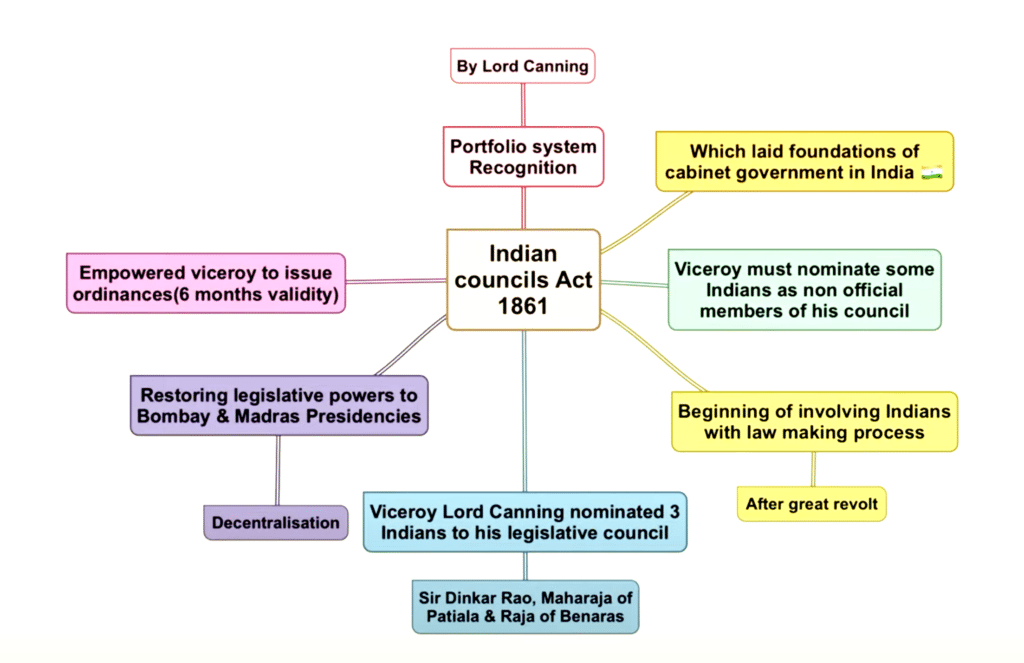
- The Executive Council of the Governor-General was expanded with the addition of a fifth member, responsible for Law — bringing the total to five members overseeing Home, Revenue, Military, Law, and Finance, with a sixth member for Public Works added after 1874.
- The Act empowered the Governor-General to frame rules for the more convenient transaction of Council business — a power Lord Canning used to introduce the portfolio system (a Cabinet-style structure) into the Government of India.
- Until then, the prevailing theory held that the Government of India was governed by the Executive Council as a single collective body, meaning all business and official papers had to be brought before every member — a system that had grown thoroughly cumbrous and inconvenient.
- Under the new arrangement, each member of the Council was allocated a portfolio covering a specific department, laying the foundations of Cabinet Government in India, with each branch of the administration now possessing its own official head.
- Routine administrative matters were disposed of directly by the member in charge, while more important matters were placed by that member before the Governor-General and decided in consultation with him; only questions of general policy now came before the Executive Council as a whole.
- This decentralisation of business made for considerably greater administrative efficiency.
Changes to the Council’s Legislative Functions
- For legislative purposes, the Governor-General’s Council was expanded through the addition of not less than six and not more than twelve “additional” members, nominated by the Governor-General to hold office for two years, of whom at least half were required to be non-official — whether English or Indian.
- This marked the beginning of a legislative system incorporating non-official members into the Governor-General’s Council. Under this provision, Lord Canning nominated three Indians to his legislative council: Sir Dinkar Rao, the Maharaja of Patiala, and the Raja of Benaras.
- The functions of these additional members, however, remained strictly confined to legislation — they had no control over administration or finance, nor any right of interpellation.
- No bill relating to public revenue or debt, religion, or military, naval, or foreign affairs could be passed without the Governor-General’s assent, and any Act so passed could still be disallowed by the Crown, acting through the Secretary of State for India.
- The resulting Imperial Legislative Council was, in effect, a purely advisory body — the Viceroy retained the power under the Act to overrule the Council whenever he deemed it necessary, as occurred in 1879, during Lord Lytton’s tenure.
Ordinance-Making Power of the Governor-General
- In cases of emergency, the Governor-General was empowered to issue ordinances without the Legislative Council’s concurrence — though these could remain in force for no more than six months.
Restoration of Legislative Powers to Madras and Bombay
- The Governments of Madras and Bombay had been stripped of their power of legislation under the Charter Act of 1833.
- The Indian Councils Act, 1861, restored this power to the Governors-in-Council of Madras and Bombay in their respective matters, though no law passed by either provincial council could take effect without the assent of the Governor-General — and on certain subjects, such as currency, posts and telegraphs, and naval and military matters, his prior approval was made obligatory.
- The legislative council at Calcutta was granted extensive authority to legislate for British India as a whole, while the councils at Bombay and Madras were empowered only to legislate for the “Peace and good Government” of their own presidencies.
Formation of Legislative Councils in Other Provinces
- The Act further provided for the Governor-General to establish legislative councils in other provinces as needed, granting him the power to create new provinces for legislative purposes and to appoint Lieutenant-Governors accordingly.
- Under this provision, Legislative Councils were subsequently established in Bengal (1862), the North-Western Provinces (present-day Uttar Pradesh, 1886), and the Punjab (1897).
Significance of the Act
- The Act contributed to the gradual construction and consolidation of the administrative framework of British India.
- The three separate Presidencies were brought into a common system, with the legislative and administrative authority of the Governor-General-in-Council asserted over all the provinces and extended to their entire population.
- The principle of recognising local needs and drawing on local knowledge was, for the first time, formally admitted — local councils were created or revived, with a number of non-official, and even Indian, members introduced in an advisory capacity.
- The Act also laid the foundation of legislative devolution: by vesting legislative powers in the Governments of Bombay and Madras, and by providing for similar legislative councils in other provinces, it set in motion a process of decentralisation that would culminate, decades later, in the grant of provincial autonomy under the Government of India Act, 1935.
- Sir Charles Wood, the Secretary of State for India at the time the Act was passed, considered it a measure of immense importance, remarking: “the act is a great experiment. That everything is changing in India is obvious enough, and that the old autocratic government cannot stand unmodified is indisputable.”
Criticism of the Act
- The Act made no attempt to clearly demarcate the jurisdiction of the Central and Local legislatures, as one might expect in a genuinely federal constitution.
- The Governor-General’s Council could legislate for the whole of India, and each provincial council for its own province, subject only to the requirement that the Governor-General’s sanction be obtained before legislating on certain specified matters.
- The Act did little, in practice, to enhance Indian influence within the legislative process — the councils’ role remained purely advisory, and no discussion of financial matters was permitted at all.
Not a True Legislature
- The legislative councils created under the Act could not reasonably be called true legislatures, either in their composition or in their functions.
- They functioned, in essence, as committees for the purpose of law-making — bodies through which the executive government obtained advice and assistance in framing legislation, rather than independent representative institutions.
- Ex-officio and official members consistently held a clear majority, virtually guaranteeing that official legislation would pass; this was made all the easier by the fact that nominated non-official members — always a minority — were often reluctant to attend Council sessions and quick to depart once they had.
- The functions of these new councils were, moreover, strictly confined to legislation: they had no power to inquire into grievances, call for information, or examine the conduct of the executive.
- The conduct of administration, including all matters connected with finance, remained under the exclusive purview and control of the wholly official Executive Councils.
- In no meaningful sense did the Act establish representative government in India.
- Sir Charles Wood himself made this explicit while introducing the Bill, stating clearly that Her Majesty’s Government had no intention of introducing a representative law-making body in the normal sense of the term.
- He compared the intended function of the new Legislative Councils instead to that of the durbar of an Indian ruler — a setting in which nobles might freely express their opinions, but where the ruler remained under no obligation to act on their advice.




