The Regulating Act of 1773 – UPSC History Optional

The Regulating Act of 1773 was the first attempt by the British Parliament to regulate the affairs of the East India Company in India and marks the beginning of parliamentary control over Company rule. It did not emerge in isolation — it was the direct outcome of the administrative failure of the Dual System of Government (1765–1772) established by Robert Clive in Bengal, and of the financial crisis that engulfed the Company by the early 1770s. Understanding the Regulating Act therefore requires tracing the collapse of the Dual System, the background that necessitated parliamentary intervention, the provisions of the Act itself, and its subsequent criticism and legacy — including the evolution of the judicial system it set in motion, from Warren Hastings to Lord Cornwallis. This article covers the topic comprehensively for UPSC History Optional aspirants.
Dual System (Diarchy) of Government (1765–1772)
Following the Treaty of Allahabad (1765), Robert Clive set up the infamous dual system of administration in Bengal.
- On 12 August 1765, Clive secured from Shah Alam II, the powerless Mughal Emperor, a farman granting the English Company the Diwani of Bengal, Bihar and Orissa, in return for an annual subsidy of 26 lakh rupees to the Emperor.
- The Nawab of Bengal was reduced to a mere pensioner: the Company was to pay him a fixed annual sum of 53 lakh rupees for the upkeep of the Nizamat.
- Clive thus established a Double Government in theory — the Company as Diwan, and the Nawab as Nizam. During this period, Nawab-ud-Daulla and Saif-ud-Daulla served as the Nawabs of Bengal.
- Under this system, the administration of Bengal was divided between the Diwani and the Nizamat.
Diwani
- The Diwani was concerned with revenue collection and civil justice.
- The right to collect revenue was given to the East India Company, which thereby acquired the Diwani (fiscal) functions in Bengal, Bihar and Orissa from the Mughal emperor.
Nizamat
- The Nizamat was concerned with police and criminal justice.
- This administrative responsibility was formally entrusted to the Nawab of Bengal.
Working of the Dual System
- Though the administration was theoretically divided between the Company and the Nawab, real power lay entirely with the Company.
- The fiction of Mughal sovereignty and the formal authority of the Nawab were carefully maintained even as actual control passed to the British.
- As Diwan, the Company collected the revenues of the province; and through its right to nominate the deputy Nizam (deputy subahdar), it also controlled the Nizamat — the police and judicial machinery. The deputy subahdar could not be removed without the Company’s consent.
- The English Resident at the Durbar decided every matter of importance, leaving the Nawab — stripped of independent military or financial support — a mere figurehead.
- Since the Company was, at this stage, neither willing nor able to collect revenue directly, it appointed two deputy diwans: Muhammad Reza Khan for Bengal and Raja Sitab Roy for Bihar. Muhammad Reza Khan also functioned as deputy Nizam.
- In this way, the entire administration of Bengal was carried out through Indian agency, while actual authority rested with the Company. This “masked system” reflected the Company’s reluctance to openly acknowledge that it had ceased to be a mere trading body and had become a ruling power.
- In England, what drew the greatest attention to this arrangement was the immense wealth the Company was expected to derive from Bengal’s revenues, estimated at £4,000,000 per annum.
- The system inaugurated by Clive continued under his successors, Verelst (1767–69) and Cartier (1769–72).

Merits and Reasons for the Dual Government
- The primary object of the arrangement was to strengthen the Company’s finances — burdened by the cost of maintaining armies — without formally assuming the responsibility of dominion.
- Clive displayed sagacity in adopting a policy of decentralisation in Bengal’s administration, thereby shielding the British from the wrath of Indian rulers who might otherwise have taken drastic steps to expel them.
- The dual system also saved the Company from the jealousy of rival European powers — the French, Dutch, and Portuguese — who would otherwise have withdrawn the tariffs they paid to Company servants had Clive taken full and open possession of Bengal.
- Clive was aware that Company servants lacked familiarity with the language, customs, traditions, and laws of Bengal, and were also too few in number to manage direct administration.
- Neither the Board of Directors nor the British Parliament favoured direct administration; Clive was unwilling to displease the home authorities. The dual system thus placated the Directors while sparing the Company Parliament’s wrath.
- Some, including Pitt, even then argued that the Crown should assume the governmental authority the Company had acquired, but this view found little support — Parliament’s first intervention in Company affairs, in 1767, took the modest form of a demand for a share of the plunder amounting to £400,000 per annum.
- The dual system allowed the Company to enjoy power and profit while remaining free of the real responsibility of administration — for every failure of governance, the Nawab of Bengal was to be held accountable.
- In essence, Clive established the Dual Government because the exigencies of the time demanded it — any alternative would have courted disaster. It was, in his own reckoning, a stop-gap, make-shift arrangement meant only to tide over the difficulties confronting the English in 1765.

Demerits of the Dual Government
The Dual Government of Clive has been criticised on several counts and ultimately led to disastrous results.
Power divorced from responsibility
- The administration of Bengal almost collapsed as power was divorced from responsibility. The absence of accountability on the Company’s part encouraged abuse of power and corruption.
- The British held both power and money, while the Nawab held neither — only the responsibility of running the administration and bearing the blame for its failures. With an annual grant of just 53 lakh rupees, the Nawab could not manage the administration smoothly, nor undertake any work of public utility.
Lawlessness
- Lacking power and funds to enforce law, the Nawab presided over widespread lawlessness — theft and robbery multiplied, and ordinary people suffered for want of justice.
- Justice itself was compromised: the Nawab’s judges, whose appointments depended heavily on British influence, could not deliver impartial verdicts, to the detriment of the public.
Oppression of the peasantry
- The dual system caused severe oppression of the peasantry, and the condition of agriculture in Bengal steadily deteriorated.
- Since the power to collect revenue rested entirely with the Company, the Nawab could neither invest in irrigation nor extend loans to needy farmers for want of funds.
- The great famine of 1770 was an indirect outcome of these difficulties.
- Private trade by Company servants reduced the Company’s own revenue, prompting it to demand higher revenue from the zamindars — which in turn intensified the oppression of the peasantry.
- The oppression grew so acute that Governor Verelst (1767–69) appointed English supervisors for Diwani lands to check the harshness and venality of revenue collectors and zamindars. His successor, John Cartier (1769–72), however, found that these supervisors only deepened the confusion and corruption.
Downfall in revenue collection
- The decline of agriculture eventually caused a corresponding decline in the Company’s income.
- During the seven years the dual system operated, the Company teetered on the brink of bankruptcy and had to seek exemption from the £400,000 per annum owed to Parliament — even as its own servants prospered exceedingly.
- This sorry state of affairs finally roused the British Government to bring some order into the Company’s Indian affairs.
Abuse of private trade
- Poor administration fuelled a rapid rise in private trade, which British servants conducted duty-free.
- Company servants traded privately without paying tax and reaped large profits, while Bengal’s own merchants — overburdened with taxes — suffered greatly. The Dual Government thus dealt a severe blow to local trade and commerce.
Downfall of local industries
- The Dual Government also hastened the decline of local industries, as Company agents forced weavers and other artisans to work exclusively for the Company.
Oppression by the Nawab’s servants
- Once it became clear that the Nawab was little more than a puppet of the English Company, his own servants grew wayward and oppressive, adding further to the suffering of Bengal’s people.
Partial justice
- As noted above, people failed to receive proper justice under the dual system, since the Nawab’s judges — dependent on British favour for their appointments — could not render impartial verdicts.
- Taken together, the Dual Government proved a failure for Bengal, giving rise to grave administrative complications and unchecked corruption. It was finally abolished in 1772 by Lord Warren Hastings, on the orders of the Directors of the Company. At the time of its abolition, Mubarak-ud-Daulla was the Nawab of Bengal.
The Regulating Act of 1773
The Regulating Act was passed by Lord North’s Government in 1773 to remove several evils inherent in the Company’s affairs and the prevailing state of governance in India. It marked the first step towards parliamentary control over the Company and towards centralised administration in India. The Act, however, did not prove a lasting solution to the concerns surrounding the Company’s affairs, and Pitt’s India Act of 1784 was subsequently enacted as a more radical reform.
Background: Why the Regulating Act Was Needed
A discreditable legacy — the Dual Government and the Bengal Famine
- The Dual Government (1765–1772) was widely regarded as a discreditable and shameful chapter of British rule in India.
- It was followed by the Bengal famine of 1770, one of the most appalling disasters in Indian history, for which the Company’s agents were blamed.
Lack of coordination between the Presidencies
- The Company’s Indian territories were divided into three Presidencies — Bengal, Madras, and Bombay — each headed by a Governor-in-Council responsible to the Directors in England.
- There was little coordination between them; each Presidency waged wars and concluded treaties on its own initiative, creating fresh problems and inviting disgrace and disaster. The British Government could no longer tolerate such chaotic and hazardous conduct, making state intervention necessary.
Administrative confusion
- The Dual Government devised by Clive had made confusion worse confounded — corruption was at its peak, and cases of plunder and oppression were routine. This divorce of power from responsibility left the system riddled with defects, and Parliament could no longer remain a passive spectator.
The wealth of Company servants and the rise of the “Nabobs”
- Bengal’s rich resources had enriched the Company, whose proprietors raised dividends to 10% in 1767 and proposed raising them further to 12.5% in 1771.
- Company servants exploited their position to amass fortunes through illegal, unequal trade and the forcible extraction of bribes and gifts from Indian chiefs and zamindars — Clive himself returned to England at the age of 34 with property yielding £40,000 a year.
- The Company’s high dividends and its officials’ fabulous wealth provoked envy, jealousy, and contempt among other sections of British society. Merchants excluded from Indian trade by the Company’s monopoly, along with Britain’s rising manufacturing and free-enterprise interests, worked to break that monopoly by attacking the Company’s administration of Bengal and targeting returning officials such as Clive and Warren Hastings.
- These officials were derisively called “nabobs”, ridiculed in the press and on stage, and shunned by the aristocracy as exploiters and oppressors of the Indian people.
- In March 1772, the Directors declared yet another dividend of 12.5%, only to ask the Government in August for a loan of £1 million — prompting the pointed question of why a Company should go bankrupt when its own servants returned home with pockets full of gold. These factors made the Company deeply unpopular.
Non-payment of tribute by the Company
- In 1766, the Company agreed to pay £400,000 annually as tribute to the British Government. It paid this for some years, but subsequently pleaded inability, citing financial losses from the collapse of tea sales to America since 1768 (as the Dutch had captured the American market).
- The Company owed money to both the Bank of England and the Government, and held 15 million pounds of tea rotting unsold in British warehouses.
Bankruptcy of the Company
- The Dual Government had ruined Bengal’s administration and, with it, the Company’s finances, forcing it to seek a loan from the British Government.
- It came as a shock to the Government that a Company whose servants returned laden with gold could itself be running at a loss — an especially inopportune moment to go bankrupt, given how few friends the Company had left.
- In applying for the loan, the Directors effectively signed the “death warrant” of the Company’s independence. A secret committee appointed to investigate reported the Company’s financial condition as genuinely deplorable.
- The British Government sanctioned a loan of £1.4 million at 4% annual interest, on condition that the Company submit its accounts to the British Treasury. Alongside this loan, Parliament passed the Regulating Act to regulate the Company’s administration.
- The East India Company was essentially a trading firm operating over a vast area of India while also maintaining an army to protect its interests. Prime Minister Lord North decided to introduce governmental control, since the Company lacked experience in governing the territories it had conquered.
- The British Parliament appointed two committees — a Secret Committee and a Select Committee — to examine the matter, after which Lord North moved to overhaul the Company’s management and provide a legal framework of government for its Indian possessions through the Regulating Act, 1773.
- This was the first step on the road to governmental control of India. The Act set up a system that supervised (regulated) the Company’s work without formally taking power away from it — hence the name “Regulating Act.” The Company retained a powerful lobby in Parliament, and its shareholders, together with this lobby, opposed the Act despite the Company’s financial crisis.
Summary of reasons for the Regulating Act, 1773
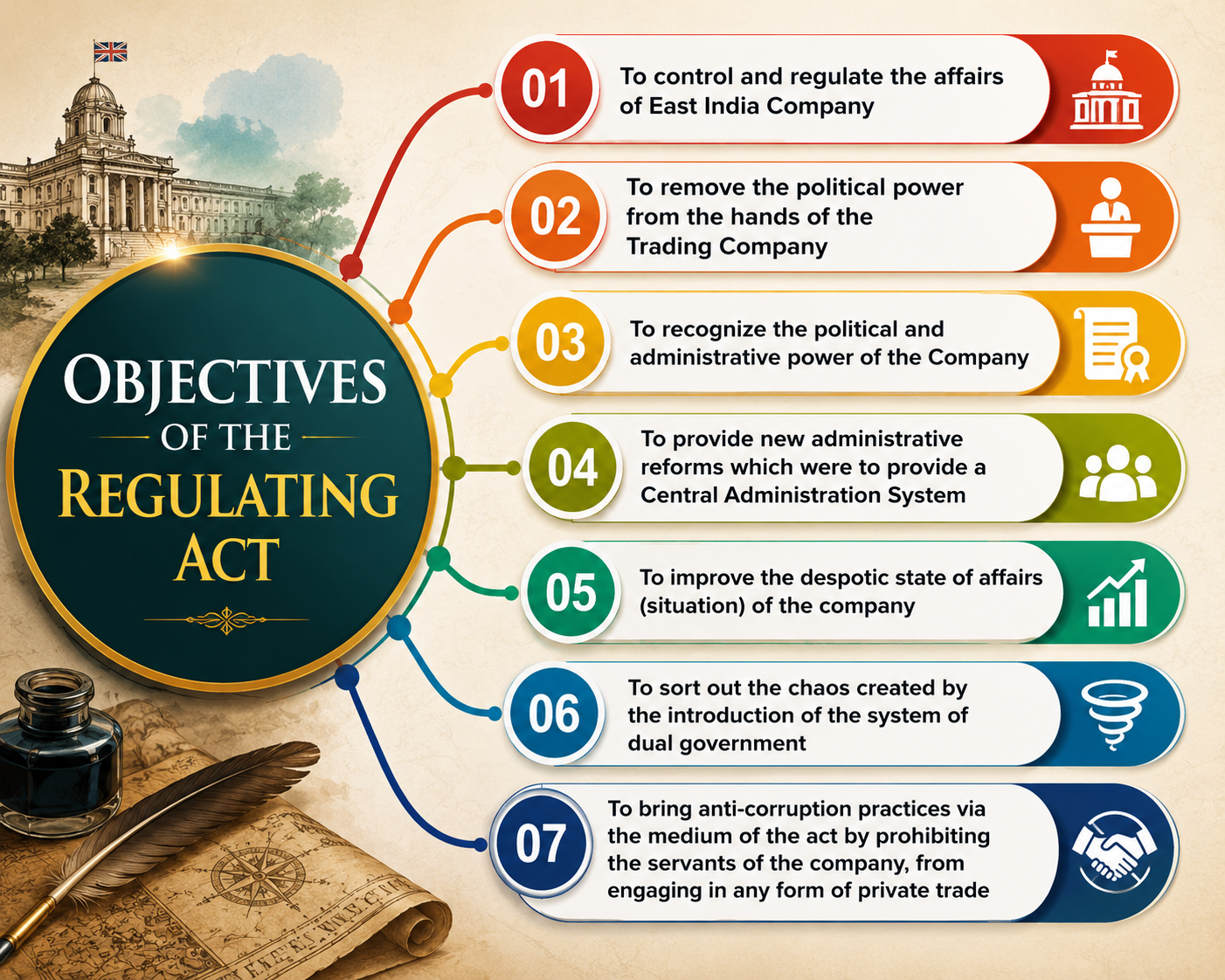
- Being a trading company, the EIC faced serious difficulties of governance.
- The need to address the problem of managing the Company’s affairs in India.
- The need to check rampant corruption among Company servants.
- The terrible famine in Bengal (1770).
- The need to address the failures of the dual system of governance instituted by Clive.
- The need to bring under control a body that had evolved from a trading concern into a semi-sovereign political entity in India.
- The lack of a proper judicial administration.
- The Company’s defeat in 1769 at the hands of Hyder Ali.
Provisions of the Regulating Act
The Act remodelled the constitution of the Company both in England and in India, permitting it to retain its possessions and powers in India while bringing its management under British Government control.
Reform of the Court of Directors
- Directors were henceforth elected for four years (earlier, elections were held annually), with the total number fixed at 24, one-fourth retiring each year; retiring Directors could not be re-elected immediately.
- In England, the qualifying vote in the Court of Proprietors was raised from £500 to £1,000 in stock.
Asserting the British Cabinet’s control over the Company
- Directors were required to place all correspondence with Indian authorities on civil and military affairs before the Secretary of State in England, and all correspondence relating to revenue before the Treasury.
- Company dividends were capped at 6% until the £1.5 million loan was repaid, and the Court of Directors was restricted to four-year terms.
- The Act laid down the principle of honest administration by prohibiting any person holding civil or military office under the Crown from directly or indirectly accepting any present, gift, donation, gratuity, or reward, and by barring Company servants from engaging in private trade.
The Governor-General and Council
- The Governor of Bengal was elevated to the status of Governor-General, assisted by a Council of four members. Decisions were carried by majority vote, with the Governor-General holding a casting vote in case of a tie; three members of the Council formed a quorum.
- The Act itself named the first Governor-General, Warren Hastings, and his four Councillors — Philip Francis, Clavering, Monson, and Barwell — who were to hold office for five years and could be removed early only by the King, on the recommendation of the Court of Directors. Future appointments were to be made by the Company.
- The Governor-General-in-Council was vested with the civil and military government of the Presidency of Fort William in Bengal, was empowered to administer the revenues of Bengal, Bihar, and Orissa, and was to superintend and control the subordinate Presidencies of Madras and Bombay in matters of war and peace with Indian states, except in emergencies.
- The Governor-General-in-Council was required to keep the Court of Directors fully informed of all activities affecting the Company’s interests and to act in obedience to the Directors’ orders and instructions.
India’s First Supreme Court
- The Act empowered the Crown to establish, by charter, a Supreme Court of Judicature consisting of a Chief Justice and three puisne judges.
- The Supreme Court was constituted in 1774 at Fort William, Calcutta, with Sir Elijah Impey as the first Chief Justice, and Chambers, Lemaistre, and Hyde as puisne judges.
- It functioned as the supreme judiciary over all British subjects, including within the provinces of Bengal, Bihar, and Orissa. However, the Act said nothing precise about the relationship between the Supreme Court and the Government of Bengal — it merely subjected the Company to the control of the British Government.
Jurisdiction of the Supreme Court
- The Court was given a very wide, but vague, jurisdiction covering all British subjects, their servants, and persons employed by the Company, as well as cases against the Company and the Corporation of Calcutta.
- Its civil jurisdiction extended to His Majesty’s subjects, persons employed directly or indirectly by the Company, and persons who had voluntarily agreed in writing to submit their disputes to it — though terms such as “British subjects,” “subjects of His Majesty,” and “persons employed directly or indirectly in the service of the Company” were never clearly defined.
- All public servants of the Company were made amenable to its jurisdiction, and all British subjects in Bengal — European and Indian — could seek redress against oppression through it.
- The Court could entertain suits, actions, and complaints against Company servants or any of His Majesty’s subjects, and could grant redress through the full range of methods available under English judicial procedure. It possessed both original and appellate jurisdiction, and followed English custom by hearing cases with the help of a jury of British subjects.
- It could also accept cases against the Governor-General and members of his Council, though it had no power to arrest or imprison them in any such action. It was further required to give due consideration and respect to Indian religious and social customs.
- Appeals from the provincial courts lay to the Governor-General-in-Council, which served as the final court of appeal; the rules and regulations framed by the Governor-General-in-Council were not required to be registered with the Supreme Court.
- A later amendment — the Amending Act of 1781 — exempted the official actions of Company public servants from the Supreme Court’s jurisdiction.
Salaries
- The Act provided liberal salaries: £25,000 for the Governor-General, £10,000 for each Council member, £8,000 for the Chief Justice of the Supreme Court, and £6,000 for each puisne judge, annually.

Criticism of the Regulating Act, 1773
The Act was by no means satisfactory — it failed to streamline Indian administration, while British supervision remained ineffective owing to the sheer difficulty of communication across such distance. It offered nothing directly for the people of India, who continued to pay revenue to the Company even as many died of starvation in Bengal, Bihar, and Orissa. Built on a theory of checks and balances, the Act broke down in practice under the pressures of Indian circumstances and its own inherent flaws.
Governor-General at the mercy of the Council
- The appointment of a Governor-General with a Council of only four members was meant to improve upon the earlier, unwieldy Council of 12–16 members at Fort William. Yet the Governor-General was given no veto power.
- Since decisions were taken by majority vote, the Governor-General was merely “first among equals” — and during his first two years in office, Warren Hastings was repeatedly outvoted by the majority in Council. Administration suffered from disunity within the Council and disharmony between the Council and the Governor-General, and the Act’s ambiguity gave rise to serious conflict between them.
Vague jurisdiction of the Supreme Court
- The ambiguity surrounding the Supreme Court’s jurisdiction, and its unclear relationship with the Governor-General-in-Council, produced serious conflict between the two authorities, which came to be ranged in hostile camps over disputed jurisdiction. The Governor-General-in-Council found itself unable to frame laws the judges would recognise.
- The Act never clearly defined who qualified as a “British subject” for purposes of the Supreme Court’s charter — in one reading, the whole population of Bengal, Bihar, and Orissa; in another, only those of English birth; and in a third, only the inhabitants of Calcutta.
- Nor was it clarified whether the Court should apply British law or native codes to Indian litigants. Since British judges knew only British law, they applied it as they understood it to be legally correct — an ambiguity that led directly to the hanging of Nand Kumar (discussed below). It also created an anomalous relationship between the new Supreme Court, administering English law, and the existing country courts of Bengal.
Inadequate control over the Presidencies, and the Company’s growing vulnerability
- The Presidencies of Madras and Bombay exploited the vague wording of the Act to act on their own discretion, pleading emergency to wage wars and conclude alliances without reference to the Governor-General-in-Council.
- The Act failed to build goodwill between the Company and the British Government, and left the Company vulnerable to charges that its administration was corrupt, oppressive, and economically ruinous — charges the Act’s anti-corruption provisions had failed to prevent.
- The first Governor-General, Warren Hastings, was himself impeached on charges of corruption; the Council split into rival factions — the Hastings group and the Francis group — who fought bitterly over these charges.
- The Act was, throughout, a compromise, deliberately vague in many of its provisions. It neither openly asserted the sovereignty of the British Crown nor invaded the titular authority of the Nawab of Bengal. As historians have observed, it gave “neither the state a definite control over the Company nor the Directors a definite control over their servants, nor the Governor-General a definite control over his Council nor the Calcutta Presidency a definite control over Madras and Bombay.” These obscurities stemmed largely from Parliament’s inability to properly settle the question of sovereignty in India.
- Many of the Act’s defects were subsequently addressed by the Declaratory Act of 1781 (which more precisely defined the Supreme Court’s jurisdiction), Pitt’s India Act of 1784, and the Amendment Act of 1786.
Why the Regulating Act Still Mattered
Despite its flaws, the Regulating Act of 1773 was important as the first attempt by the British Government to regulate Company administration in India for better governance.
- It formally recognised Parliament’s right to control Indian affairs, and subjected Indian territories to a degree of centralised control for the first time.
- From 1773 onward, executive and judicial administration in the country was placed on a regular — if imperfect — footing by parliamentary act.
- It can, in this sense, be said to mark the beginning of a constitution for British India, asserting Parliament’s right to legislate for the country.
The Nand Kumar Case
The Nand Kumar case is a striking example of corruption, nepotism, and injustice under early British rule, and illustrates the practical dangers of the Regulating Act’s vague jurisdictional provisions.
- Raja Nand Kumar of Bengal was a prominent zamindar. In March 1775, he laid before the Council a letter charging Warren Hastings with having accepted a bribe of ₹3,45,105 from Munni Begum, widow of the former Nawab, in exchange for granting her the zamindari.
- The charge was taken up by Council member Sir Philip Francis — who had encouraged Nand Kumar to expose Hastings — along with the other members of the Supreme Council of Bengal. The Council majority found Hastings guilty and directed him to refund the sum to the Company’s treasury, but Hastings was able to override the Council’s charges.
- While the charges against Hastings remained pending (they were subsequently dropped), Nand Kumar was suddenly arrested — at the instance of a Calcutta merchant, Mohan Das, and allegedly at the instigation of Hastings — on a charge of forgery.
- Tried before Sir Elijah Impey, India’s first Chief Justice, Nand Kumar was found guilty and hanged in Calcutta on 5 August 1775, under a British parliamentary statute.
Peculiar Features of the Trial
- The forgery charge was brought against Nand Kumar shortly after he had levelled his own charges against Hastings.
- Chief Justice Impey was a close personal friend of Hastings.
- Every judge of the Supreme Court cross-examined the defence witnesses, causing Nand Kumar’s defence to collapse entirely.
- After conviction, Nand Kumar’s application for leave to appeal to the King-in-Council was rejected by the Court.
- The alleged forgery had occurred nearly five years earlier — well before the Supreme Court was even established.
- Forgery was not regarded as a capital crime under either Hindu law or Mohammedan law.
- Hastings was later impeached before the House of Commons on his return to England for crimes and misdemeanours during his time in India, including the alleged judicial killing of Nand Kumar. The House of Lords finally acquitted him of all charges in April 1795, and the Company subsequently granted him an annual compensation of £4,000.
From Diarchy to Direct Control: Warren Hastings
In 1773, Warren Hastings became the first Governor-General of Bengal, with administrative authority over British India as a whole.
Practices of Warren Hastings
- Hastings’s arrival in Bengal as Governor of the Presidency of Fort William in 1772 proved a turning point.
- That same year, the Court of Directors ordered the Company to “stand forth as Diwan” — formally ending the dual system and placing an administrative burden directly on the Company’s commercial officials, thereby laying the foundation of the civil service.
- Englishmen were appointed as Collectors in the districts, under the overall control of a Board of Revenue at Calcutta — a weak arrangement that Hastings himself described as producing “petty tyrants and heavy rulers of the people.”
- Nonetheless, the foundations of the modern civil service were laid during his tenure, and much administrative precedent was set that profoundly shaped later British attitudes to governing India.
- Fluent in Bengali, Urdu, and Persian, Hastings understood the value of an acculturated civil servant and worked to build an “oriental elite” of civil servants competent in Indian languages and responsive to Indian tradition, while also striving to raise the moral and intellectual standards of Company servants.
- Dastaks (duty-free trade passes) were abolished in 1773, and those engaging in private trade were made to pay a 2.5% duty to the Board of Customs; Hastings also separated the revenue and commercial branches of administration.
- The Regulating Act itself barred all Company officials — from the Governor-General and Councillors down to the Chief Justice and other Supreme Court judges — from accepting gifts, donations, gratuities, or rewards, with legal conviction by the Supreme Court or the Mayor’s Court as the penalty for violation.
- In 1780–81, revenue and judicial administration in the districts was entrusted to English officers, marking the “nucleus” of a civil service with growing systematisation and specialisation of functions. By Pitt’s India Act of 1784, these officers were given definite scales of pay and emoluments.
More About Warren Hastings
- In 1758, at Clive’s instance, Hastings was made British Resident at Murshidabad, the Bengali capital — a major step in his career.
- In 1771, he was appointed Governor of Calcutta, the most important Presidency, at a time when moves were underway in Britain to unify the divided system of government across British India under a single rule centred at Calcutta. Hastings was the natural choice as first Governor-General.
- As Governor, he launched a largely successful crackdown on bandits operating in Bengal.
- Hastings held deep respect for the ancient scriptures of Hinduism and sought to base British governance on the earliest available precedents, allowing Brahmin advisors to shape the interpretation of law — since no Englishman thoroughly understood Sanskrit before Sir William Jones, this task fell to religious commentators well versed in the tradition.
- In 1781, Hastings founded the Madrasa Aliya; in 1784, he supported Sir William Jones’s founding of the Bengal Asiatic Society (now the Asiatic Society of Bengal), which became a storehouse of knowledge on the subcontinent.
- Hastings’s legacy as an Indian administrator has been described as dualistic: he instituted reforms that shaped India’s administrative path for years to come, yet he remains, in a sense, “the architect of British India and the one ruler of British India to whom the creation of such an entity was anathema” — a man who respected Indian customs while remaining loyal to the British mission.
- Hastings resigned in 1784, after ten years of service in which he helped extend and regularise the nascent Raj founded by Clive.
Judicial System
Background
- The grant of Diwani in 1765 gave the East India Company the right to collect revenue in Bengal, Bihar, and Orissa, but the Nawabi administration and the Mughal system of justice remained largely in place.
- Between 1765 and 1772, judicial administration in the subah stayed in the hands of Indian officers, following Mughal practice in both civil and criminal matters. Clive appointed Muhammad Reza Khan to represent the Company’s civil jurisdiction; as Naib Nazim, Reza Khan also administered the Nawab’s criminal jurisdiction.
- The Mughal judicial system was never centrally organised and relied heavily on local faujdars and their executive discretion. Although sharia (Islamic law) was invoked for legitimacy, its application varied widely depending on the seriousness of the case and the interpretation of the muftis and kazis.
- The system focused more on mutual resolution of conflict than on punitive justice (except in cases of rebellion), and punishment, when meted out, often depended on the social status of the accused.
British Criticism of the System
- Many Company officials attributed the state of the system to an eighteenth-century “degeneration,” in which zamindars and revenue farmers had allegedly usurped judicial authority, driven more by pecuniary interest than by justice — giving rise to complaints about the “venality” of the justice system.
- By 1769, it was being argued that direct European supervision was needed to achieve a “centralisation of the judicial prerogative,” reclaiming it from zamindars and revenue farmers and thereby asserting the Company’s sovereignty.
Reform Under Warren Hastings
- When Hastings took charge as Governor in 1772, he moved to take full control of the justice system. Reza Khan was arrested, and Hastings urged the Company’s Directors not to restore him to his former position.
- Under the new system of 1772, each district was to have two courts — a civil court (Diwani Adalat) and a criminal court (Faujdari Adalat) — retaining the Mughal nomenclature. Criminal justice applied Muslim law, while personal matters such as inheritance and marriage followed Muslim or Hindu law, depending on the parties involved — a division broadly modelled on the English system, where such matters fell under ecclesiastical law administered by the Bishops’ courts.
- The civil courts were presided over by European District Collectors, assisted by maulvis and Brahman pundits who interpreted indigenous law for them, with an appeal court in Calcutta presided over by the President and two Council members.
- The criminal courts were headed by a kazi (judge) and a mufti (jurist), under the supervision of the European Collectors. The appeal court, the Sadar Nizamat Adalat, was shifted from Murshidabad to Calcutta.
- In practice, Hastings personally supervised the criminal justice system until 1774, when he finally acknowledged his failure to improve the law-and-order situation, and reluctantly accepted the Court of Directors’ decision to reinstate Reza Khan at the head of the Nizamat Adalat — which was moved back to Murshidabad.
Further Changes (1773–1781)
- Between 1773 and 1781, the civil justice system underwent further change, partly to meet the demands of revenue collection and partly in deference to the Whig principle of separating executive functions from the administration of justice.
- Under plans devised by Hastings and Sir Elijah Impey, Chief Justice of the Calcutta Supreme Court, district collectors were divested of their judicial duties. In civil justice, the earlier district courts gave way first to six provincial courts, and later to eighteen mofussil courts, all presided over solely by covenanted European officers of the Company.
- For a time, the new Supreme Court created by the Regulating Act functioned as an appeal court.
- The Code of 1781 laid down specific rules and regulations for all civil courts down to the lowest level, and required all judicial orders thereafter to be recorded in writing.
The Problem of Conflicting Legal Interpretations
- The major obstacle to certainty and uniformity in the system was the conflicting interpretation of indigenous law. Brahman pundits, for instance, often gave divergent readings of the various schools of dharmashastra, with opinions sometimes varying widely even on the same point of law from case to case.
- To reduce this uncertainty, a committee of eleven pundits compiled, at Hastings’s instance, a digest of Hindu law in 1775, which N. B. Halhed translated into English in 1776 to lessen European judges’ dependence on their indigenous interpreters. A code of Muslim law followed by 1778.
- With this standardisation, the practice of law increasingly required specialised training — giving rise to a distinct professional class of “lawyers.” In effect, the reforms of the Hastings era tended to centralise judicial authority and reduce administration to a system.
Changes Under Lord Cornwallis
Civil justice
- It was Lord Cornwallis, through his Code of 1793, who finally separated revenue collection from the administration of civil justice, safeguarding property rights against abuse by revenue officials and their agents.
- The new system created a hierarchy of courts, from zillah (district) and city courts, through four provincial courts, up to the Sadar Diwani Adalat with appellate jurisdiction — all headed by European judges, with provision for the appointment of “native commissioners.”
Criminal justice
- The criminal justice system was similarly overhauled, following complaints from district magistrates about the anomalies of Islamic law and corruption within the criminal courts; it was also felt that so vital a branch of administration could no longer remain in Indian hands.
- The Faujdari Adalats, which had functioned under Naib Nazim Reza Khan, were abolished and replaced by courts of circuit headed by European judges. The office of the Naib Nazim itself was abolished, and the Sadar Nizamat Adalat was brought back to Calcutta, placed directly under the Governor-General-in-Council.
- Cornwallis’s judicial reforms thus resulted in the total exclusion of Indians from the system, giving it an increasingly authoritarian and racially exclusive character.
Extension of the Judicial System
- The Cornwallis regulations were extended to Banaras in 1795, and to the Ceded and Conquered Provinces in 1803 and 1805 respectively.
- But the Bengal system — built on the assumption of a Permanent Settlement with the zamindars — faltered badly when introduced in Madras under Lord Wellesley. By 1806, it was clear that in a Ryotwari area, where the Collector also functioned as Settlement Officer and revenue assessor, and where no powerful zamindar class existed as in Bengal, separating revenue collection from magisterial and judicial power created serious problems.
- On Thomas Munro’s insistence, the Court of Directors proposed, in 1814, a different system for Madras that allowed greater Indianisation at the lower levels (village panchayats, district and city courts) and combined magisterial, revenue, and some judicial powers in the office of the Collector.
- This system was fully introduced in Madras by 1816, and later extended to Bombay by Elphinstone in 1819.
Unresolved Issues and the Charter Act of 1833
- Certain issues remained unresolved — beyond the question of Indianisation, there was the matter of codifying laws to establish a uniform judicial administration across British India. These issues were not addressed until the governor-generalship of Lord Bentinck and the Charter Act of 1833.
- The Charter Act of 1833 opened judicial positions to Indians and provided for a Law Commission to codify laws. The commission, appointed under Lord Macaulay, completed its task by 1837, though full implementation had to wait until after the Revolt of 1857.
- The Code of Civil Procedure was introduced in 1859, the Indian Penal Code in 1860, and the Criminal Procedure Code in 1862.
Limitations of the System
- This institutionalised justice system applied only within British India. In the vast princely states, judicial administration remained a motley mix of British Indian law and the personal decrees of the princes, who also served as the highest judicial appellate authority.
- Within British India itself, the judicial administration looked markedly different from what it had been under Mughal rule, and ordinary Indians found the new system, and its interpretations of law, difficult to comprehend.
- Justice became distant — physically, owing to the geographical remoteness of district courts, and psychologically, as people struggled to understand complex procedures dominated by a new class of lawyers. As a consequence, justice also became expensive, and as court cases piled up, delays of fifty years or more were not unheard of.
- In many cases, the interpretation of Hindu personal law by Brahman pundits chiefly benefited the conservative and feudal elements of Indian society. The principle of equality before law often did not extend to Europeans, and important domains — such as the police and the army — remained largely untouched by this colonial conception of the “Rule of Law.”
Conclusion
The journey from the Dual System of 1765 to the Regulating Act of 1773, and onward through the judicial reforms of Hastings and Cornwallis, traces the East India Company’s gradual transformation from a purely commercial enterprise into a territorial and administrative power answerable — however imperfectly — to the British Parliament. While the Regulating Act was riddled with ambiguities that produced real institutional conflict, most visibly in the Nand Kumar case, it nonetheless laid the constitutional foundation on which later reforms — the Pitt’s India Act of 1784, the Charter Act of 1833, and beyond — would build. For UPSC History Optional aspirants, the Regulating Act of 1773 is best understood not as an isolated statute but as the hinge between the chaos of Dual Government and the more structured, though still deeply flawed, colonial administration that followed.