

Manipur National Parks
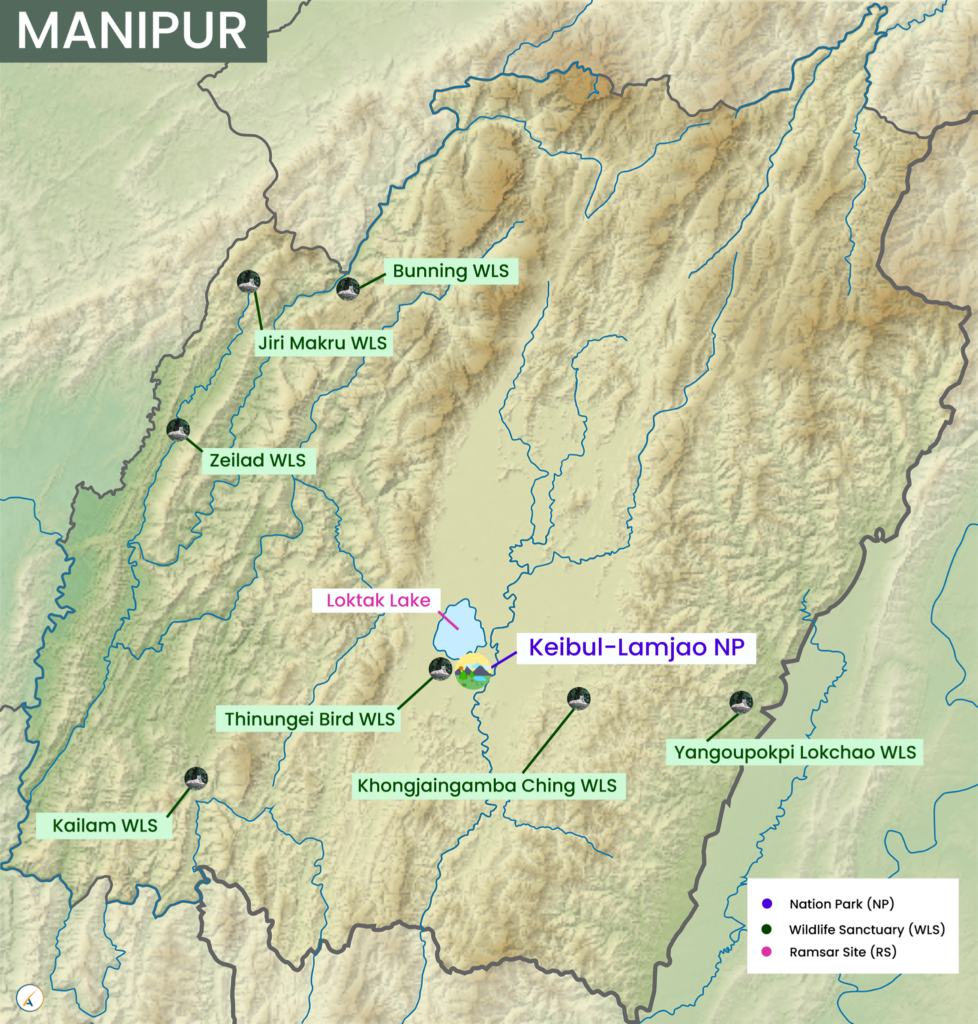
Keibul-Lamjao National Park
- It is located in the Bishnupur district in Manipur.
- It is the only floating park in the world. It is an integral part of Loktak Lake (a Ramsar site).
- The National Park is characterised by floating decomposed plant materials locally called phumdis.
- It was declared a National Park to preserve the natural refuge of brow-antlered deer (also called sangai, dancing deer & Manipurs’s Eld’s deer; EN).
- This is the last natural habitat of the endangered brow-antlered deer(Sangai deer), the dancing deer of Manipur.
- Vegetation: semi-evergreen forests, aquatic, and wetland.
- Major Fauna: brow-antlered deer, hog deer, large Indian civet, Asian golden cat.
Wildlife Sanctuaries of Manipur
Jiri Makru Wildlife Sanctuaries
- The Jiri Makru Wildlife Sanctuary is located near Imphal in the state of Manipur.
- The sanctuary spans the West Manipur Hills and is partially located in Imphal East (Jiribam Sub-division) district and partly in Tamenglong district.
- It is located between the tributaries of the Barak river near the Assam-Manipur border.
- Major Fauna: Capped langur and hoolock gibbon.
Kailam Wildlife Sanctuaries
- Situated within the Kailam-Tipaimukh Hill Range in the district of Churachandpur, Manipur.
- Most of the streams flow from this hill range into the Tuivai river.
- It is home to a variety of hornbills, including the Great Indian Hornbill.
- Major Fauna: Hoolock gibbon, barking deer, clouded leopard.
Others
- Bunning Wildlife Sanctuary: Barail Range.
- Khongjaingamba Ching
- Thinungei Bird Sanctuary: It is a floodplain. It is the first Bird Sanctuary of Manipur.
- Yangoupokpi Lokchao: Southeast of Loktak Lake (Keibul Lamjao National Park) along the Indo-Myanmar border.
- Zeilad: It is a group of lakes. Wildlife similar to Kailam Wildlife Sanctuary.
Ramsar Sites of Manipur
Loktak Lake
- It is the largest freshwater lake in the north-eastern region. Keibul Lamjao, the only floating national park in the world, floats over it. Thick, floating mats of weeds covered with soil (phumids) are a characteristic feature.
- It is included on the Montreux Record in 1993 as a result of ecological problems such as deforestation in the catchment area, infestation of water hyacinth, and pollution.