

- Seismic waves are elastic waves set off when strain energy stored in rocks is suddenly released, most often by an earthquake, but also by volcanic blasts, landslides and underground nuclear or chemical explosions.
- They are recorded by a seismograph; the trace is a seismogram, and their study is seismology.
- Seismology is the most reliable source of information on the deep Earth, though an indirect one.
- The deepest borehole (Kola, Russia) reached only about 12 km, and volcanic material, density and temperature give only partial clues about the interior of the Earth.
- What seismic waves reveal depends on how fast they travel, which media they cross, and where they are reflected, refracted or stopped.
Origin of Seismic Waves
Why the Earth Shakes
- Tectonic stress pushes the rocks on either side of a fault in opposite directions while friction locks it; strain builds until the rock’s strength is exceeded, the fault slips abruptly, and the stored energy radiates outward as seismic waves (the elastic rebound idea).
Focus and Epicentre
- The focus (hypocentre) is the point inside the Earth where rupture begins and energy is released; foci are shallow (0–70 km), intermediate (70–300 km) or deep (300–700 km), the deepest lying at about 700 km in the mantle.
- The epicentre is the point on the surface vertically above the focus; being nearest to it, it receives the waves first and is usually shaken hardest.
Types of Seismic Waves
- Body waves are generated at the focus and travel through the body of the Earth; they are of two kinds, P and S.
- Surface waves form when body waves reach the surface and interact with near-surface layers; they travel along the surface.
- Wave velocity depends on the elastic properties (incompressibility and rigidity) and density of the medium.
- Velocity rises with stiffness and falls with density, so waves change speed and are reflected and refracted wherever the medium changes.
Primary Waves (P Waves)
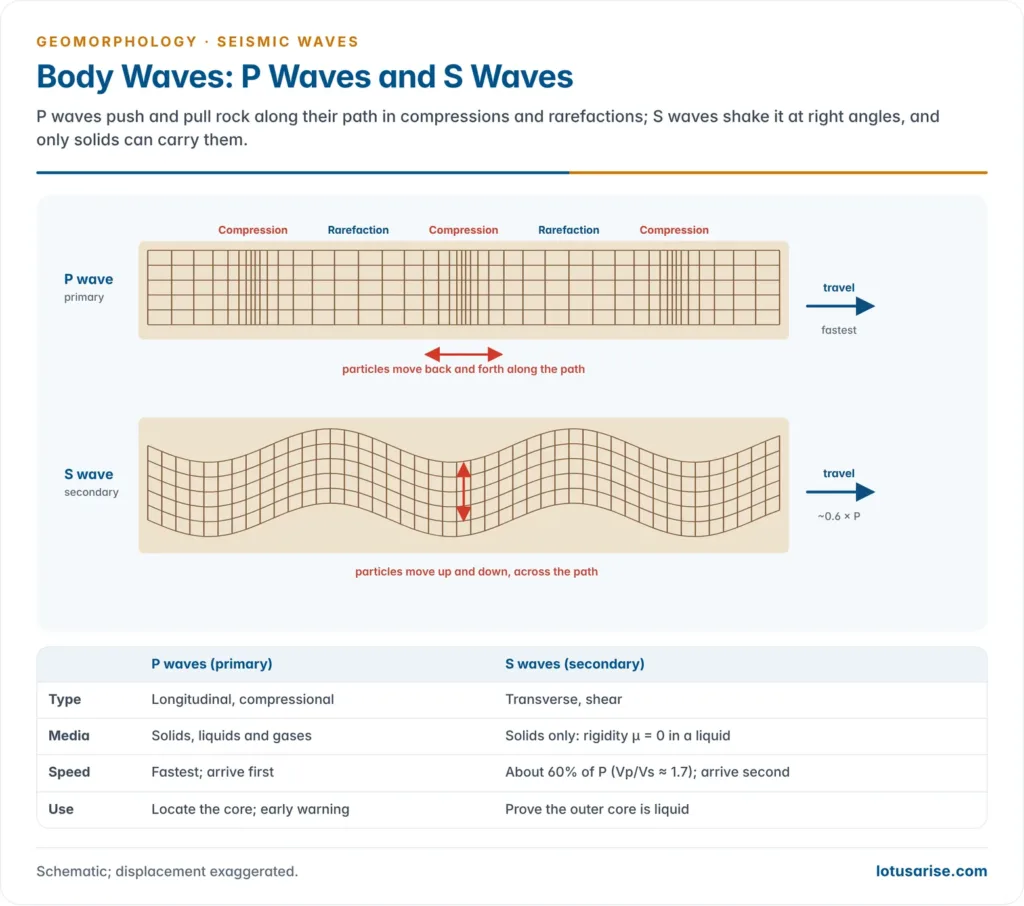
- Also called longitudinal or compressional waves; like sound waves, they move particles back and forth along the direction of travel in alternate compressions and rarefactions.
- They are the fastest seismic waves and the first to arrive at a station, hence “primary”.
- They pass through solids, liquids and gases, fastest in solids and slowed in liquids.
- Velocity is Vp = √[(K + 4μ/3)/ρ], where K is incompressibility (bulk modulus), μ rigidity (shear modulus) and ρ density.
Secondary Waves (S Waves)
- Also called transverse, shear or distortional waves; particles vibrate at right angles to the direction of travel, like a shaken rope, making crests and troughs.
- The vibration may be vertical (SV) or horizontal (SH).
- They travel at roughly 60% of P-wave speed (Vp/Vs ≈ 1.7), so they arrive second, after a time lag.
- They move only through solids: velocity is Vs = √(μ/ρ), and a liquid has zero rigidity (μ = 0).
- An S wave travels only if the medium resists shearing and springs back, dragging the next particle sideways; a liquid cannot (water poured from a glass does not keep the glass’s shape), so Vs falls to zero and S waves die out at any liquid layer.
- The S–P time lag grows with distance; roughly, distance (km) ≈ 8 × S–P time (seconds) for nearby earthquakes, and lags from three stations fix the epicentre by triangulation.
Surface Waves (L Waves)
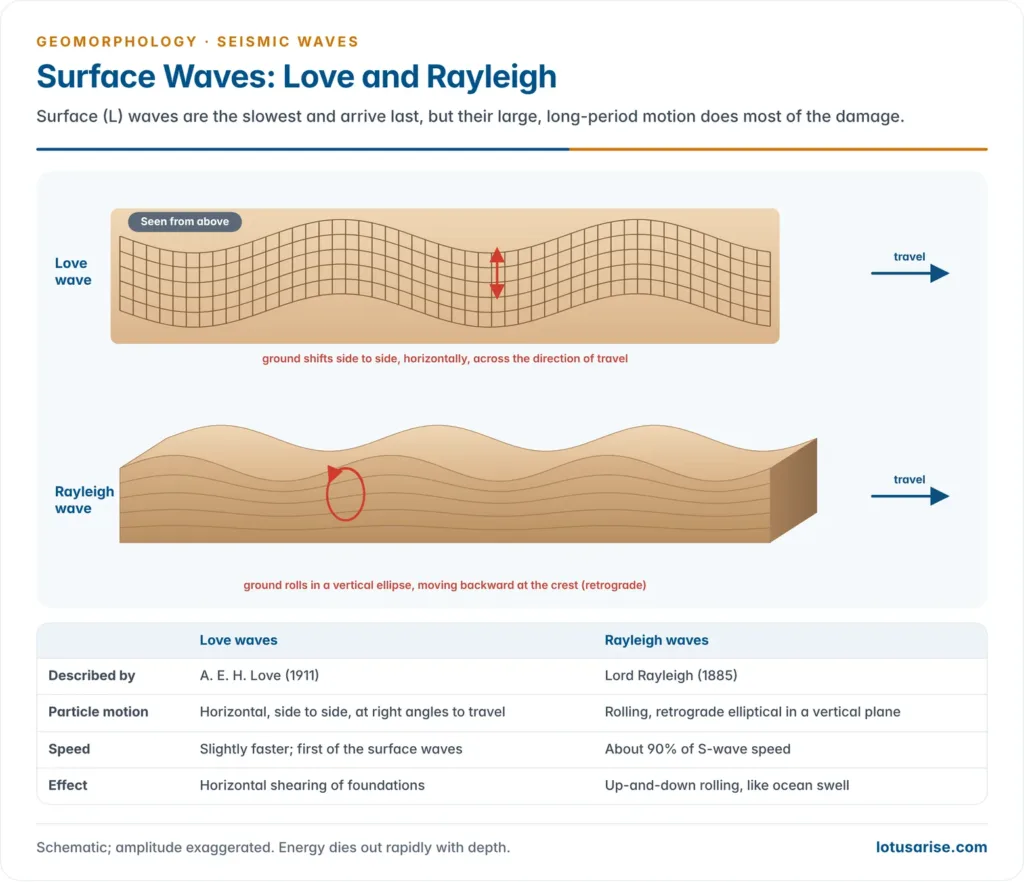
- Also called long-period (L) waves: low frequency, long wavelength and large amplitude.
- Confined to the outer crust, their energy dies out rapidly with depth; spreading over a surface rather than a volume, they lose energy slowly with distance and travel the longest distances of all seismic waves.
- Slowest of the three, they are recorded last, but they cause the largest ground displacement and most of the destruction.
- They are of two kinds, named after the scientists who described them mathematically.
| Feature | Love waves | Rayleigh waves |
|---|---|---|
| Described by | Augustus Edward Hough Love (1911) | John William Strutt, Lord Rayleigh (1885) |
| Particle motion | Horizontal, side to side, at right angles to travel | Rolling, retrograde elliptical in a vertical plane |
| Speed | Slightly faster; arrive first of the surface waves | About 90% of S-wave speed |
| Effect | Horizontal shearing of foundations | Up-and-down and to-and-fro rolling, like ocean swell |
- Long-period shaking is amplified in thick, soft sediment basins.
- The 2001 Bhuj earthquake brought down multi-storey buildings in Ahmedabad, over 200 km away.
- The Mandalay (Myanmar) earthquake of March 2025 (Mw 7.7) collapsed a high-rise under construction in Bangkok, about 1,000 km away, on the soft clay of its basin.
P, S and L Waves Compared
| Property | P waves | S waves | L (surface) waves |
|---|---|---|---|
| Type | Body, longitudinal | Body, transverse | Surface (Love, Rayleigh) |
| Particle motion | Along the path | Across the path | Horizontal or rolling |
| Media | Solid, liquid, gas | Solids only | Near-surface solids |
| Relative speed | Fastest | About 0.6 of P | Slowest |
| Arrival on seismogram | First | Second | Last |
| Frequency and amplitude | High, small | High, larger | Low, largest |
| Damage | Least | Moderate | Most |
| Use | Locate core, early warning | Prove liquid outer core | Magnitude, crustal structure |
Reading a Seismogram
- At a distant station, a seismogram shows three phases in order.
- Preliminary tremors are small, weak swings from P waves.
- Second preliminary tremors follow a short gap, from S waves.
- Main tremors are the large, long swings of surface waves.
- Earthquake early warning exploits the head start of P waves: sensors detect them and issue alerts seconds before the damaging S and surface waves arrive.
- Indian example: Uttarakhand Bhookamp Alert (IIT Roorkee, 2021) is India’s first earthquake early-warning mobile app.
How Seismic Waves Reveal the Earth’s Interior
Curved Paths, Reflection and Refraction
- In a homogeneous Earth, waves would travel in straight lines at constant speed; instead, ray paths are curved, concave towards the surface.
- Velocity increases with depth, because rigidity and incompressibility rise faster than density, so rays refract gradually and bend back up.
- Abrupt jumps or drops in velocity mark boundaries, the discontinuities inside the Earth, where waves are sharply reflected (rebound) or refracted (change direction).
- Between about 100 and 250 km, S waves slow down in a low-velocity zone: rock there is near its melting point and partly molten, marking the weak asthenosphere beneath the rigid lithosphere.
- Velocity changes show changes in material and state; changes of direction, including the shadow zones, show where the layers lie.
The Emergence of Shadow Zones
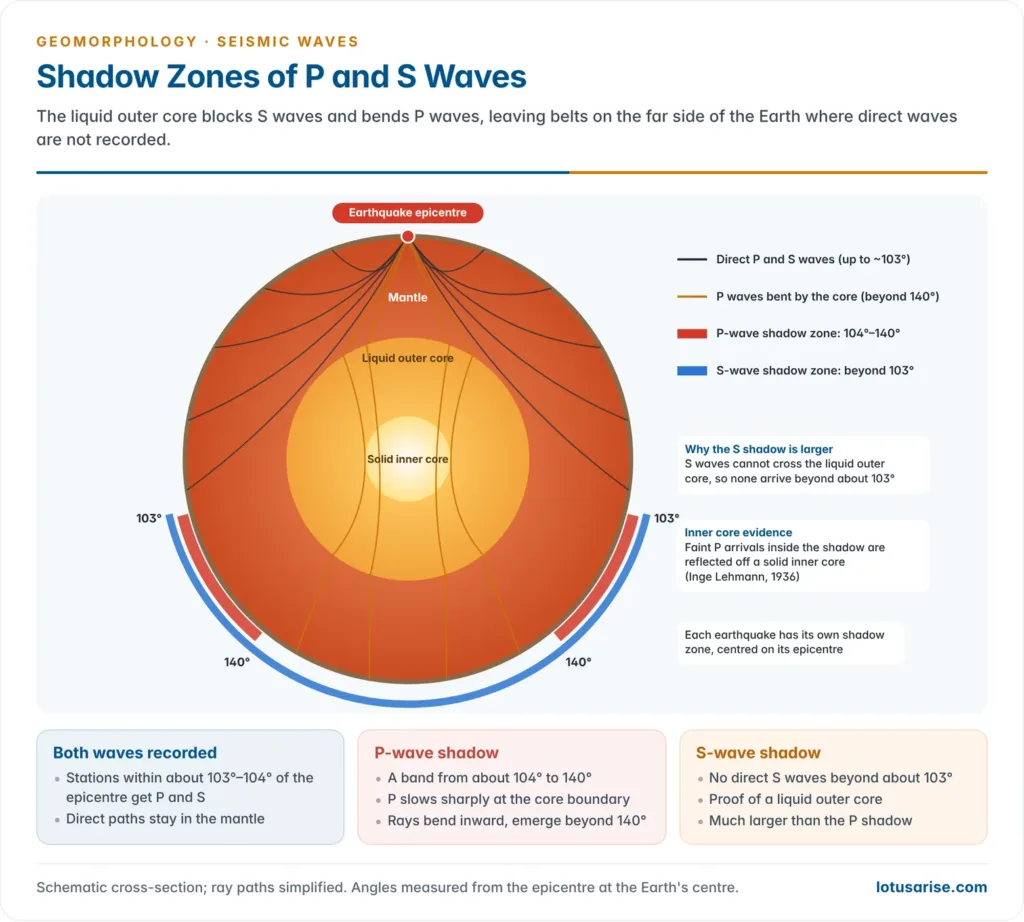
- A shadow zone is a belt of the Earth’s surface where a given earthquake’s direct waves are not recorded; each earthquake has its own shadow zone, centred on its epicentre.
- Stations within about 103°–104° of the epicentre record both P and S waves.
- S-wave shadow zone: no direct S waves beyond about 103°.
- This covers everything beyond that angle, nearly 40% of the Earth’s surface, so the S-wave shadow is much larger than the P-wave shadow.
- Cause: S waves cannot cross the liquid outer core.
- P-wave shadow zone: a band from about 104° to 140°.
- Cause: at the core–mantle boundary (about 2,900 km), P-wave speed drops sharply, so rays bend inward and emerge beyond 140°.
- Faint P arrivals inside the P shadow are waves reflected and refracted at a faster, solid inner core.
Milestones in Reading the Interior
| Year | Seismologist | Finding from seismic waves |
|---|---|---|
| 1906 | Richard Dixon Oldham | Delayed and missing waves at great distances reveal a distinct core |
| 1909 | Andrija Mohorovičić | Velocity jump at the base of the crust (Moho) |
| 1913 | Beno Gutenberg | Core–mantle boundary fixed at about 2,900 km |
| 1926 | Harold Jeffreys | Core has very low rigidity, so the outer core is liquid |
| 1936 | Inge Lehmann | Faint P waves in the shadow zone reveal an inner core (about 5,150 km) |
| 1971 | Adam Dziewonski and Freeman Gilbert | Earth’s free oscillations confirm the inner core is solid |
| 1981 | Adam Dziewonski and Don Anderson | Standard one-dimensional velocity–depth model (PREM) |
- Average wave speeds through the layers:
| Layer | P-wave speed (km/s) | S-wave speed (km/s) |
|---|---|---|
| Crust | 5–7 | 3.5–4 |
| Upper mantle | 7.5–8.5 | 4.5–5 |
| Lower mantle | 10–13.7 | 5.5–7.3 |
| Outer core (liquid) | 8–10 | Nil |
| Inner core (solid) | About 11 | About 3.5 |
Evaluation and Current Understanding
- Strengths: seismic waves give the layered model (crust, mantle, outer and inner core), the depths of the discontinuities and the physical state of each layer.
- Together with the Earth’s mean density (about 5.5 g/cm³), which demands a dense centre, and with geomagnetism, they point to an iron–nickel core.
- Seismic tomography, like a CT scan built from millions of travel times, now maps 3-D velocity variations: cold subducted slabs, rising plumes and two huge low-shear-velocity provinces beneath Africa and the Pacific.
- The inner core is dynamic: repeating earthquakes from the South Sandwich Islands show it spun slightly faster than the mantle from 2003 to 2008 and then more slowly than the mantle, drifting backwards relative to it (Wei Wang, John Vidale and colleagues, 2024); a 2025 follow-up found its near surface changing shape.
- Limitations: stations are unevenly spread, with few on the ocean floor; velocity alone cannot fix composition, which needs rock physics, meteorite analogues and magnetic data; and some readings of deep structure remain non-unique.
Previous Year Questions
2010Bring out the relevance of seismic study in determining the structure of the interior of the earth.2005Write short note: Role of seismic waves in the study of earth’s interior.





Nice one. Thank you so much
THANK You
Maja aa gya thanks 🙏
I felt difficult to understand because diagram is not present for each wave at the same place to easily understand