

- A mineral is a naturally occurring substance, usually solid and inorganic, that can be written as a chemical formula and has a crystal structure.
- The International Mineralogical Association recognises about 6,200 mineral species (2025).
- Most are inorganic, formed by various combinations of elements.
- A few occur as single (native) elements: gold, silver, diamond (carbon) and sulphur.
- A small proportion of the earth’s crust is organic material, such as coal and petroleum.
- India’s mineral wealth rests on old crystalline rocks of the Peninsula, and its output is concentrated in a handful of States. Iron ore alone made up about 70% of the value of metallic minerals in 2018-19 and about 78% in 2023-24.
Mineral Resources
Mining and India’s Mineral Base
- Mining and quarrying span pits, shafts, quarries and wells, with the on-site dressing and beneficiation (crushing, screening, washing, grading) that makes ore saleable.
- Methods:
- Opencast mining suits minerals lying close to the surface.
- Underground mining reaches deeper deposits.
- Drilling and pumping bring up oil and natural gas.
- Why India is rich: its large area and varied geology give it a wide range of minerals.
- A classical appraisal counted nearly 100 minerals worked, about 30 of them important.
- It rated coal, iron and mica as fairly abundant; manganese, titanium, aluminium, refractory materials and limestone as adequate; and copper, lead and zinc as deficient. Tin and nickel were called workable.
- Trade has shifted since that appraisal:
- In 2019-20 India was self-sufficient in bauxite, iron ore and sillimanite, and imported magnesite, rock phosphate, manganese and copper concentrate.
- In 2023-24 it imported 5.59 million tonnes of manganese ore against 271 tonnes exported, and 4.49 million tonnes of bauxite. It is now self-sufficient in zinc, while nickel is wholly imported.
- World rank in 2023 (British Geological Survey, with Indian output for 2023-24):
| Mineral or metal | India’s rank | Share of world output |
|---|---|---|
| Iron ore | 3rd | 11.05% |
| Chromite | 3rd | 8.39% |
| Manganese ore | 5th | 6.38% |
| Bauxite | 6th | 5.75% |
| Aluminium (primary) | 2nd | 5.95% |
| Zinc (slab) | 3rd | 5.75% |
| Copper (refined), lead (refined) | 10th | 1.84%, 1.44% |
Types of Minerals
- Mineral resources fall into two major categories: metallic and non-metallic.
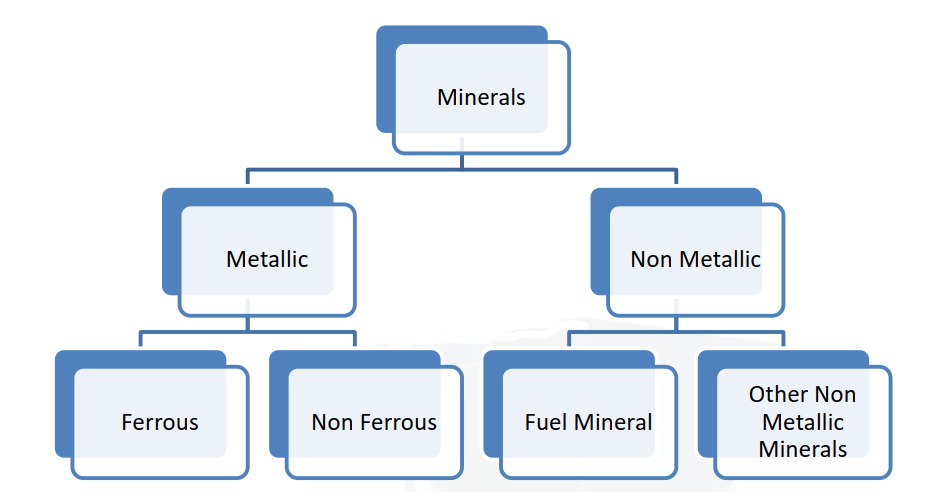
Metallic Minerals
- Metallic minerals contain metal elements in their raw form. Smelting them yields a new product, the metal.
- They rank as the second most important group after fossil fuels, and they are lodged mainly in Archaean and Dharwar rocks, with some in the Cuddapah system.
- Examples: iron ore, copper, gold, zinc, silver, manganese and chromite.
- Share in mineral value: leaving out fuel, atomic and minor minerals, they are dominant: ₹1,28,632 crore of ₹1,41,803 crore in 2023-24, against ₹13,171 crore for non-metallic minerals.
- They give a strong base to metallurgical industry, and so drive industrialisation and urbanisation.
- Ferrous and non-ferrous:
- Ferrous minerals contain iron: chromite, iron ore and manganese. Pyrites, tungsten, nickel and cobalt are often listed here too, for their part in steel making.
- Non-ferrous minerals have none: lead, silver, gold, copper and bauxite, with tin and magnesium. The Indian Bureau of Mines places nickel in this group.
- Significance: iron consumption per person is a yardstick of a country’s living standard, since iron underpins basic industry.
Non-metallic Minerals
- Non-metallic minerals yield no metal. Melting them gives no new metallic product.
- By origin they are organic or inorganic:
- Organic: the fossil fuels or mineral fuels, formed from buried plants and animals, such as coal and petroleum. Coal is mined from India’s coalfields in Gondwana and Tertiary rocks.
- Inorganic: mica and limestone, graphite, dolomite, gypsum, nitrate and potash.
| Feature | Metallic | Non-metallic |
|---|---|---|
| Content | Metal elements in raw form | No metal to extract |
| On melting | A new product forms | No new product |
| Rock setting | Usually igneous and metamorphic | Often young fold mountains and sedimentary rocks |
| Conduction | Good conductors of heat and electricity | Mostly insulators |
| Working | Malleable and ductile | Not malleable or ductile; break easily |
| Look | Generally lustrous | No shine or lustre |
Mineral Belts of India
- The defining feature of Indian minerals is their uneven distribution, and relief, rock and rainfall explain it:
- High-rainfall tracts lack soluble minerals such as limestone, gypsum and salts.
- The northern plains are poor because thick alluvium buries the bedrock.
- The Himalaya has varied rocks but a complex structure. Small deposits, hard terrain, poor transport, sparse population and a harsh climate make most mining uneconomic.
- The old crystalline plateaus and low hills of the Peninsula hold the rich, sizeable deposits. The belts are grouped there.
- Five major belts are usually recognised, under varying names.
| Belt | Also called | Extent | Geological base | Main minerals |
|---|---|---|---|---|
| North-Eastern Peninsular | Northern, Chota Nagpur | Chota Nagpur and Odisha plateaus: Jharkhand, West Bengal, Odisha | Archaean, Dharwar, Gondwana troughs | Coal, iron, manganese, mica, bauxite, copper, kyanite, chromite, beryl, apatite |
| Central | Midland | Chhattisgarh, Madhya Pradesh, Telangana, Andhra Pradesh, Maharashtra | Dharwar, Gondwana, Vindhyan | Manganese, bauxite, limestone, marble, coal, gems, mica, iron, graphite |
| Southern | South-Eastern | Karnataka plateau, Tamil Nadu upland, parts of Andhra Pradesh | Dharwar, Cuddapah, Tertiary lignite | Iron, manganese, chromite, bauxite, gold, lignite |
| South-Western | None | Western Karnataka, Goa, Ratnagiri | Dharwar | Iron, garnet, clay |
| North-Western | Western | Aravalli in Rajasthan, adjoining Gujarat | Aravalli and Delhi rocks, Tertiary basins | Copper, lead, zinc, uranium, mica, steatite, beryllium, gems, petroleum, salt |
North-Eastern Peninsular (Northern) Belt
- The richest belt and the mineral heartland of India. Almost every major mineral occurs here.
- Chota Nagpur’s classical national shares, and where these minerals lie now:
| Mineral | Older list | Classical appraisal | Now |
|---|---|---|---|
| Kyanite | 100% | 100% | Jharkhand 7.83% of resources; Telangana 45.75%, Andhra Pradesh 30.28% (2020) |
| Iron ore | 90% | 93% | Odisha, Jharkhand and Chhattisgarh hold 78% of haematite (2020) |
| Chromium | 90% | 70% | Odisha alone about 96% of chromite (2020) |
| Mica | 75% | 70% | Shifted to other States |
| Coal | 70% | 84% | Spread across Gondwana fields in several States |
- Assam petroleum tract: older schemes attach Assam to this belt for petroleum, lignite and Tertiary coal. Most schemes now treat it as lying outside the main belts.
Central Belt
- The second largest belt, a westward extension of the same ore province from Chota Nagpur into Chhattisgarh, Madhya Pradesh and eastern Maharashtra.
- Huge iron ore and limestone reserves lie in Chhattisgarh.
- The Godavari-Wardha valley holds large coal reserves.
- The belt still needs fuller geological survey.
Southern (South-Eastern) Belt
- Eastern Karnataka: Bellary and Hospet for iron ore.
- Andhra Pradesh: the Cuddapah and Kurnool region for mining, and Nellore for mica.
- Telangana leads in kyanite and produces limestone and manganese ore. The belt’s bauxite lies in Andhra Pradesh (12% of resources, 2020), not in Telangana as older lists say.
- Tamil Nadu: the largest lignite reserves in India, at 79% of the national total (1 April 2024), mainly around Neyveli.
- In ferrous minerals and bauxite it resembles the north-eastern belt. It lacks coal other than lignite, so its range is narrower.
South-Western Belt
- Karnataka: the Dharwad region is rich in minerals, with Shimoga, Chitradurga, Tumkur and Chikmagalur as other areas.
- Goa is known for iron ore, and Ratnagiri in Maharashtra also has iron reserves.
- Garnet and clay are the other deposits.
North-Western Belt
- It runs along the Aravalli Range through Rajasthan and Gujarat. It developed late and promises non-ferrous metals: copper, lead and zinc, with uranium, mica, steatite, beryllium, and aquamarine and emerald.
- Gujarat: known for petroleum, with gypsum, manganese and bauxite.
- Salt: both States are rich in it, from the Kachchh coast and the playa lakes of Rajasthan.
- Rajasthan: building stones (sandstone, granite, marble), with extensive gypsum and Fuller’s earth. Dolomite and limestone feed the cement industry.
Outside the Main Belts
- Himalaya: generally poor in metals, with pockets of coal, bauxite, copper, lead, zinc, slate, gypsum and limestone.
- Offshore: Mumbai High and the Godavari basin hold oil and gas.
- Sea bed: ocean resources include oil, gas and polymetallic nodules carrying manganese, copper and nickel.
- India has held a nodule exploration contract with the International Seabed Authority since 25 March 2002, covering 75,000 sq km of the Central Indian Ocean Basin.
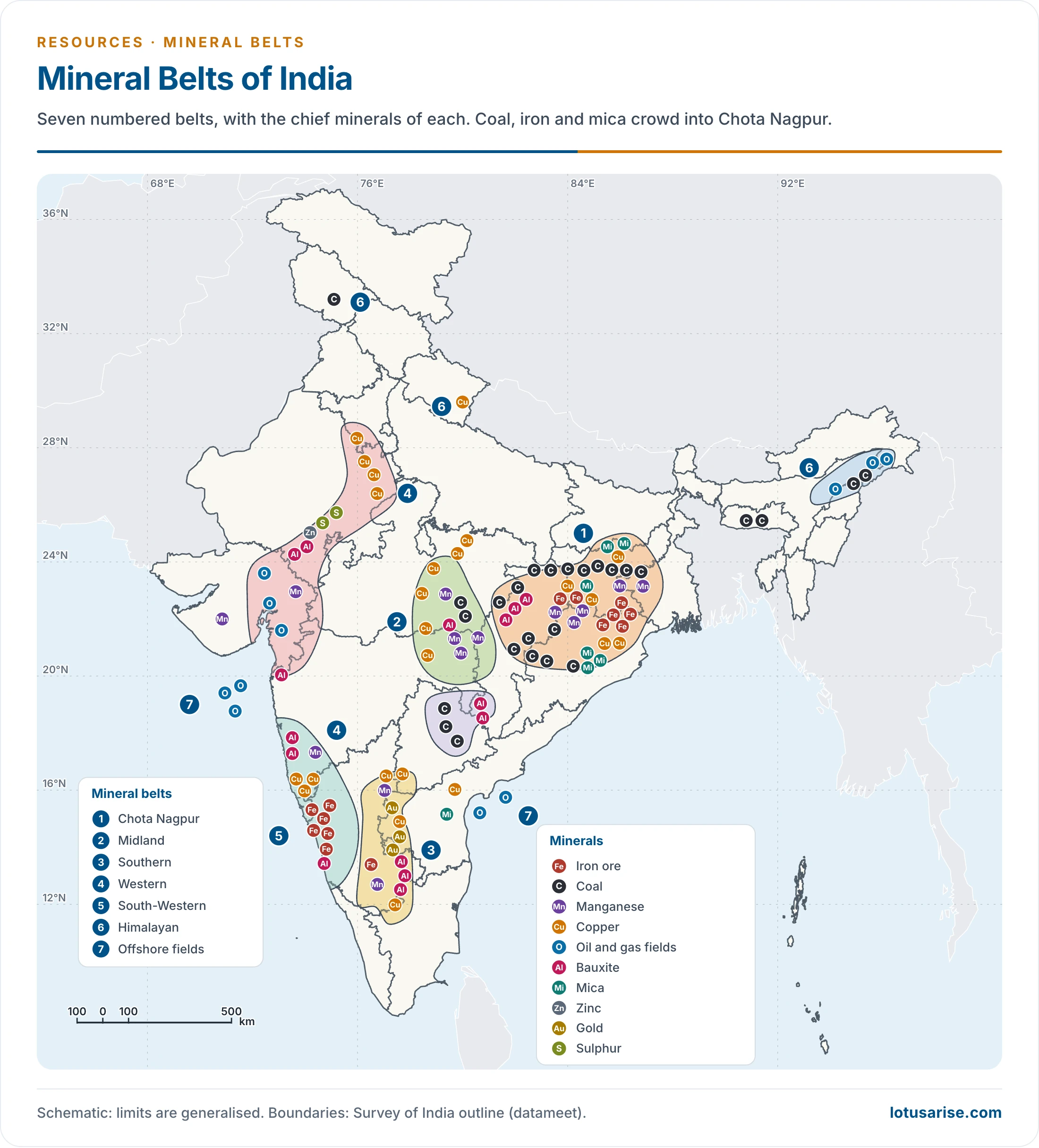
- This map numbers seven belts: 1 Chota Nagpur, 2 Midland, 3 Southern, 4 Western, 5 South-Western, 6 Himalayan, and 7 the offshore fields.
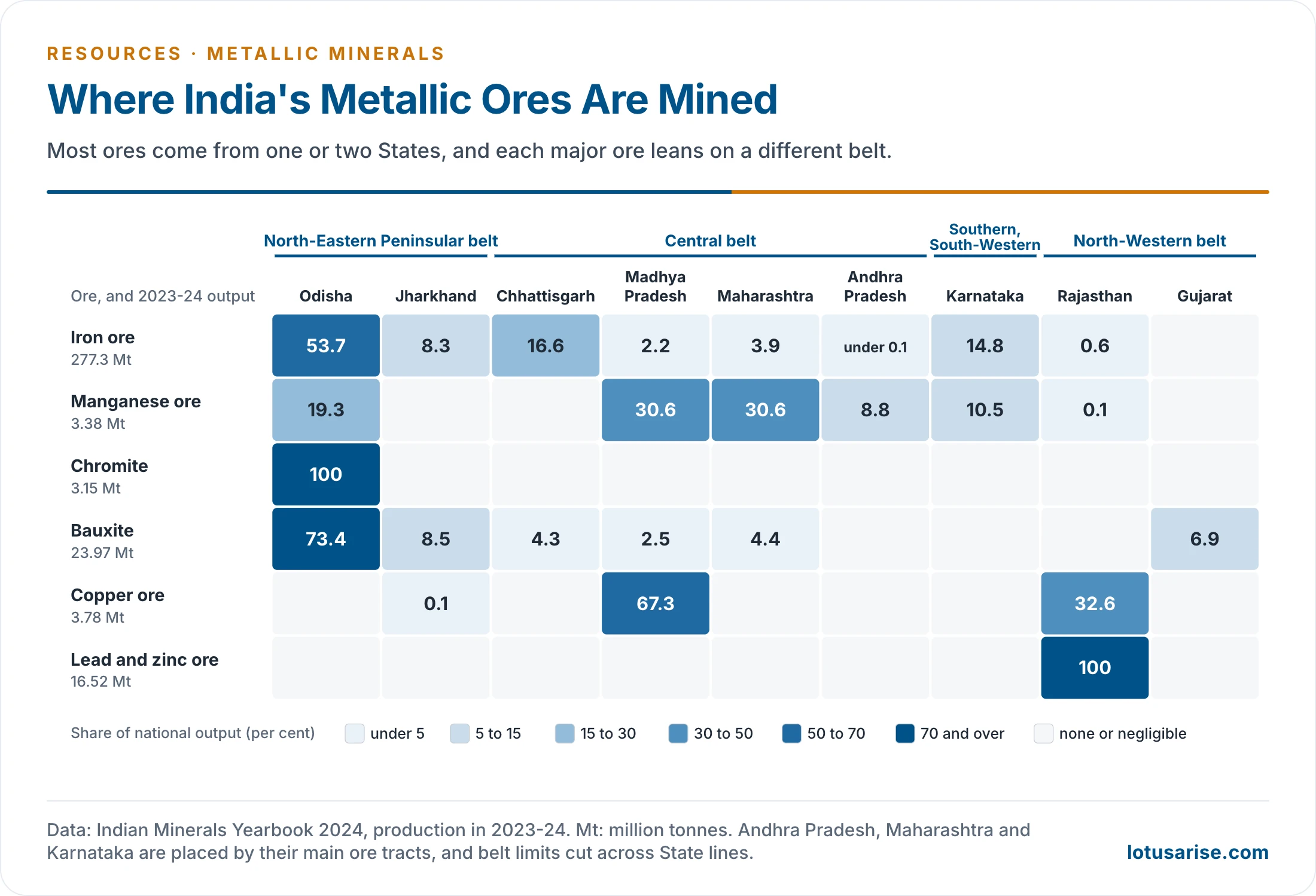
Geological Structure and the Belts
- Each belt follows a rock system:
- Dharwar rocks carry the high-grade iron and manganese of Singhbhum, Bastar, Bellary and Goa, along with gold and copper.
- Cuddapah rocks add iron, manganese, copper and cement limestone.
- Gondwana troughs along the Damodar, Mahanadi and Godavari hold nearly all the coal.
- Vindhyan rocks supply limestone, building stone and diamonds.
- Laterite cappings on old plateau surfaces hold bauxite, from the Eastern Ghats to the Maikala Range.
- Tertiary rocks hold petroleum and lignite.
- So the belts trace the older part of the Indian rock system, exposed across the Peninsular Plateau, while alluvium hides it in the plains.
Conservation and Critical Minerals
- Minerals are exhaustible, which earns mining the label of a robber industry: ore once removed never comes back.
- Ways to conserve:
- Efficient mining and beneficiation, so that less ore is lost.
- Recycling of cyclic metals such as iron, aluminium, copper, brass and tin.
- Substitution of scarce metals by plentiful ones, such as aluminium for copper in electrical work.
- Exporting manufactured goods instead of raw ore.
- Policy: the National Mineral Policy, 2019 aims at transparency, better regulation and sustainable mining.
- Critical minerals:
- In June 2023 the Ministry of Mines listed 30 critical minerals, including copper, nickel, cobalt, lithium, tungsten, graphite and the rare earths. They carry high economic value and high supply risk.
- The MMDR Amendment Act, 2023 placed 24 critical and strategic minerals in a separate part of its First Schedule and empowered the Centre to auction their blocks.
- The National Critical Mineral Mission, approved on 29 January 2025, runs from 2024-25 to 2030-31 with ₹16,300 crore of government spending and an expected ₹18,000 crore from public sector firms.
- Why they matter: they feed electric vehicles, batteries, electronics, defence and clean energy, while India depends on imports for many of them.
- Supply is concentrated: China refines most of the world’s rare earths, graphite and lithium, so a supply shock or export curb hits industry and national security together.
- Challenges: long import chains, thin domestic resources, and the tailings, dust and forest loss that come with extraction.
- Processing is the weaker link: India has few refining and separation plants, the technology is capital-heavy, rare-earth separation leaves acidic and radioactive waste, and lithium processing uses much water and energy.
Iron Ore Distribution in India
Iron Ore
- Iron ores are rocks and minerals from which metallic iron can be extracted.
- India’s reserves are large. They occur in several formations, but the main economic deposits lie in the Precambrian volcano-sedimentary Banded Iron Formation (BIF).
- Magnetite has the highest iron content, up to 72%, and its magnetic quality is valuable in the electrical industry.
- Haematite is the main industrial ore by quantity used, though its theoretical iron content is a little lower.
- Four producing belts:
- Odisha-Jharkhand
- Durg-Bastar-Chandrapur
- Bellary-Chitradurga-Chikmagalur-Tumkur
- Maharashtra-Goa
Four Types of Iron Ore
| Ore | Iron content | Colour and form | Setting | Areas or remarks |
|---|---|---|---|---|
| Magnetite (Fe₃O₄, “black ore”) | Up to 72%; 60–70% as mined | Black, magnetic | Dharwar and Cuddapah; igneous or metamorphosed banded rock | Karnataka, Andhra Pradesh, Rajasthan, Tamil Nadu, Goa, Keralam (Kerala) |
| Haematite (Fe₂O₃) | 60–70% | Red and brown; massive, hard | Dharwar and Cuddapah; banded iron formations | Odisha, Jharkhand, Chhattisgarh, Andhra Pradesh; Karnataka, Maharashtra, Goa in the west |
| Limonite | 30–40% in low-grade ore; up to 60% in classical tables | Yellow | Damuda series of Raniganj, Garhwal, Mirzapur, Kangra valley | Low grade, but easy and cheap to mine |
| Siderite (iron carbonate) | About 48% in pure form; under 40% in Indian ore | Brown; many impurities | Sedimentary beds | Low grade, but self-fluxing because it holds lime |
- Which is “best”: magnetite is richest in iron, so it is often called the best. Haematite is still treated as superior in India, because its ores are of higher grade as actually worked and far more of them are proven.
- Only 202 million tonnes of magnetite rank as reserves, against 6,209 million tonnes of haematite.
Iron Ore Distribution and Reserves
- Total resources: 35.29 billion tonnes (National Mineral Inventory, 1 April 2020).
| Ore | Total resources (million tonnes) | Of which reserves | Older figure (2010) | Leading States (2020) |
|---|---|---|---|---|
| Haematite | 24,057 | 6,209 | 17,882 | Odisha 39%, Jharkhand 20%, Chhattisgarh 19%, Karnataka 12%, Goa 5% |
| Magnetite | 11,227 | 202 | 10,644 | Karnataka 69.5%, Andhra Pradesh 13.1%, Rajasthan 7.1%, Tamil Nadu 4.7%, Goa 2.3% |
- About 95% of total resources lie in Odisha, Jharkhand, Chhattisgarh, Karnataka, Goa, Telangana, Andhra Pradesh and Tamil Nadu.
- About 79% of haematite lies in the Eastern Sector, and about 93% of magnetite in the Southern Sector.
- World position: by iron content India holds about 3,400 million tonnes of the world’s 87,000 million tonnes of reserves (USGS, 2024).
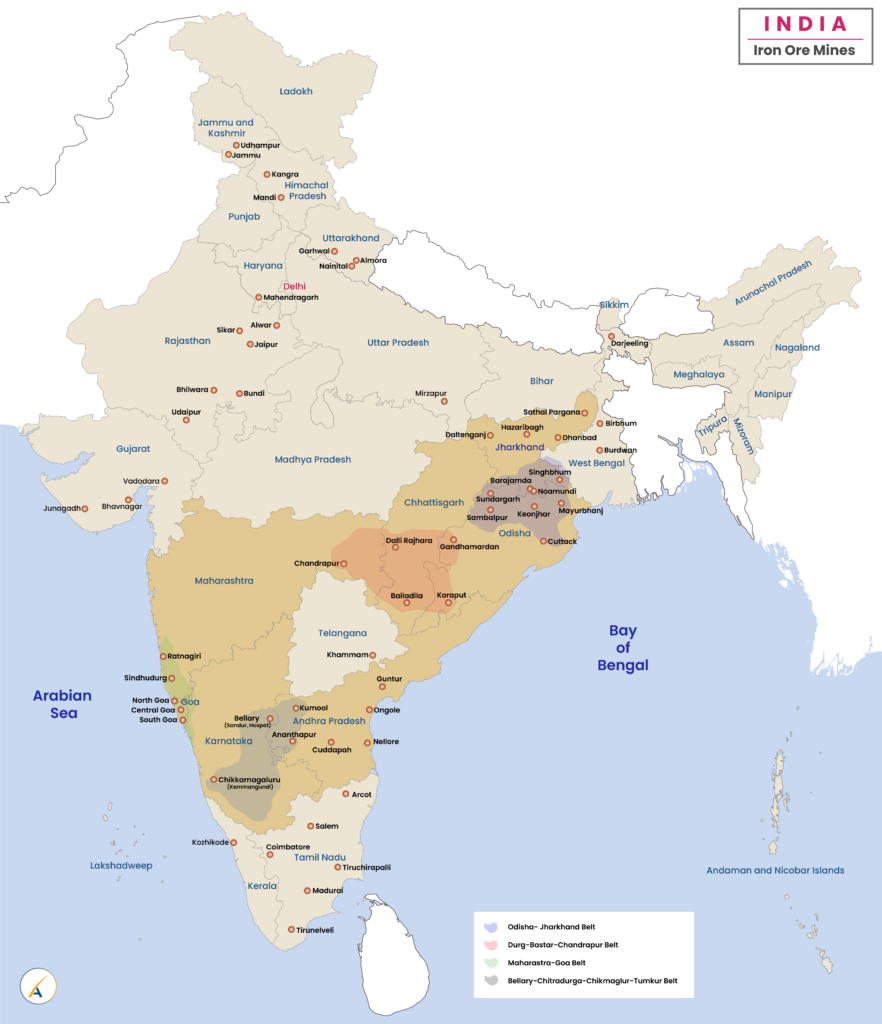
- On this map, “Sathal Pargana” should read Santhal Parganas and “Kumool” Kurnool.
Production
| Year | 1950-51 | 1960-61 | 1970-71 | 1980-81 | 1990-91 | 2000-01 | 2009-10 | 2011-12 | 2022-23 | 2023-24 | 2024-25 |
|---|---|---|---|---|---|---|---|---|---|---|---|
| Million tonnes | 3.9 | 10.9 | 32.5 | 42.2 | 53.7 | 80.6 | 218.6 | 167.3 | 258.3 | 277.3 | 289.4 |
- Output climbed steadily to 2009-10, then fell sharply when the courts halted mining in Karnataka and Goa. It has since passed the old peak.
- World production (2023): Australia 952 million tonnes (38%), Brazil 436 (17%), India 277 (11%), China 250 (10%).
| State | 2023-24 (million tonnes) | Share | Share in 2011-12 |
|---|---|---|---|
| Odisha | 148.96 | 53.71% | 40.06% |
| Chhattisgarh | 46.04 | 16.60% | 18.21% |
| Karnataka | 41.00 | 14.78% | 7.88% |
| Jharkhand | 22.90 | 8.26% | 11.32% |
| Maharashtra | 10.73 | 3.87% | 0.88% |
| Madhya Pradesh | 6.05 | 2.18% | 0.66% |
| Rajasthan | 1.53 | 0.55% | 0.02% |
| Goa | 0.01 | under 0.01% | 19.95% |
- About 90% of output comes from mechanised mines. All iron ore mining is opencast, and 72.95% of output in 2023-24 was fines.
Iron Ore in Karnataka
- Third in output in 2023-24. The ore is mainly high-grade haematite and magnetite, and output has grown about threefold since 1980.
- Chikmagalur district:
- Kemmangundi in the Baba Budan Hills has high-grade ore that fed the Bhadravati steel plant.
- The Kudremukh Hills hold very large deposits of low-grade magnetite, mined on a large scale for export through New Mangalore port.
- Mining stopped at the end of 2005 after a Supreme Court judgment, because the area had become a national park. KIOCL now runs a pellet plant at Mangaluru on ore from elsewhere.
- Bellary-Hospet area and Sandur Ranges: high-grade ore that serves the Vijayanagar steel plant of JSW at Toranagallu.
- Illegal mining in Bellary grew into a national scandal.
- The Supreme Court banned mining in Bellary on 29 July 2011, and in Tumkur and Chitradurga in August 2011.
- On 18 April 2013 it let Category A and most Category B mines reopen and cancelled 49 Category C leases.
- Other mining areas: Chitradurga, Uttara Kannada, Shimoga, Dharwad, Tumkur, Kumaraswamy and Ramandurg.
- Donimalai Iron Ore Mine: commissioned in 1977 in the Bellary region and worked by the National Mineral Development Corporation (NMDC).
- It produced 4 million tonnes a year of run-of-mine ore (ore as mined, unprocessed) at about 65% iron, exported through Chennai and Marmagao.
- When Karnataka set an 80% premium on ore sales for lease renewal, NMDC stopped work in November 2018. Mining resumed after a 22.5% premium was approved in December 2020, on a lease running to 3 November 2038.
Iron Ore in Odisha
- Largest producer: 148.96 million tonnes, 53.71% of India (2023-24), and largest holder of haematite.
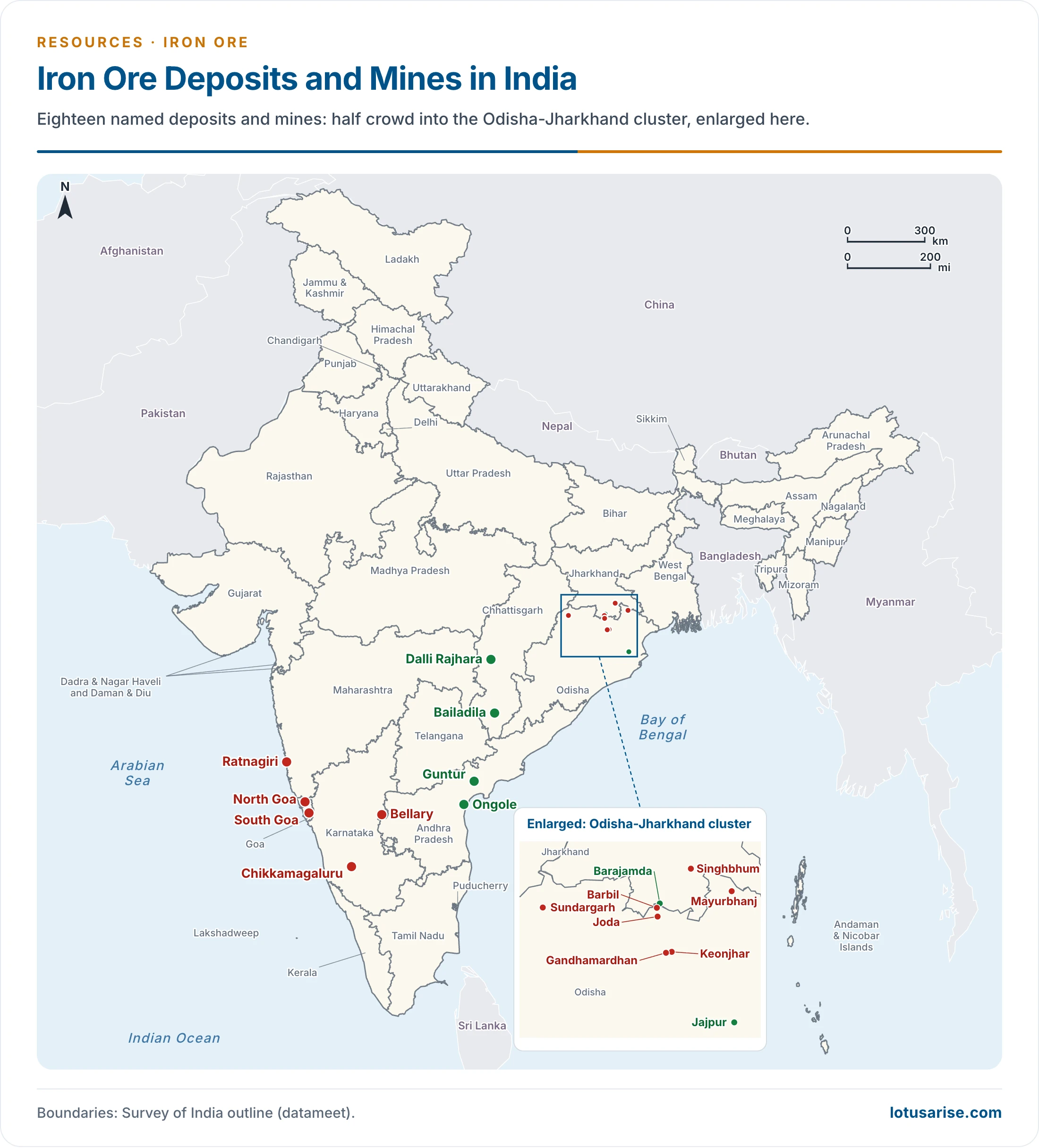
- India’s richest haematite deposits lie in the Barabil-Koira valley, in Keonjhar and adjoining Sundargarh. About 100 deposits crowd into 53 sq km, with ore of about 60% iron or more.
- The most important deposits, by district:
- Keonjhar: Banspani, Thakurani, Toda, Kiriburu. Sundargarh: Barsua, Koira, Malangtoli.
- Mayurbhanj: Gorumahisani, Sulaipat, Badampahar. Cuttack: the Tomka range and Daitari hill.
- Koraput: Hirapur hills. Sambalpur: Nalibassa hill.
Iron Ore in Chhattisgarh
- Second in output in 2023-24 (16.60%), and in earlier years third. It holds 19% of haematite resources (2020).
- The ores are widely spread. The leading deposits are in Bastar and Durg: Bailadila in the south and Dalli-Rajhara in Durg. Raigarh, Bilaspur and Surguja also produce.
- Bailadila:
- 14 deposits lie along a north-south range about 48 km long, with high-grade ore above 65% iron.
- It has long been described as the largest mechanised mine in Asia. Mining and beneficiation are done here, and smelting elsewhere, as at the Visakhapatnam steel plant.
- Slurry pipeline: a line of about 267 km, commissioned in the mid-2000s, carries ore slurry (a semi-liquid mixture) from Bailadila to the pellet plant at Visakhapatnam now run by AM/NS India. NMDC is building its own 15 million tonne a year line through Jagdalpur.
- Nagarnar: NMDC’s steel plant in Bastar started production in 2023-24.
- Trade: high-grade ore has long gone out through Visakhapatnam, much of it to Japan, which has almost no iron ore of its own.
- Environment: the forest here is dense, and mining and waste dumping call for steady afforestation.
- Dalli-Rajhara: a 32 km range with about 120 million tonnes of ore at 68–69% iron, worked for the Bhilai steel plant.
Iron Ore in Goa
- Production began late, and Goa rose quickly from nothing to a leading position.
- It was second with 19.95% in 2011-12 (33.4 million tonnes).
- Now: only about 0.01 million tonnes in 2023-24, after court orders stopped mining.
- The Supreme Court suspended mining in 2012, allowed it back in 2014 under a cap of 20 million tonnes a year, and in February 2018 quashed 88 leases.
- Output has been returning through auctioned blocks: 0.36 million tonnes in April-November 2024.
- The ore is mostly low-grade limonite and siderite, worked in opencast mechanised mines, of which there were nearly 315 across North, Central and South Goa.
- The richest deposits are in North Goa, at Pirna-Adolpale-Asnora, Sirigao-Bicholim and Sanquelim-Onda.
- Transport: river barges on the Mandovi and Zuari, joined by the Cumbarjua canal, or ropeways, carry ore to Marmagao port.
- Trade: most of Goa’s ore went to Japan; recent shipments have gone to China.
- Environment: wash-off from dumps silts fields, streams and creeks in the rains, harming crops and fish.
Iron Ore in Jharkhand
- Fourth in output in 2023-24 (8.26%), down from 11% in 2011-12, and holder of 20% of haematite resources (2020).
- Mining began in Singhbhum district in 1904, when it was part of Bihar. The ore is of very high quality, and the deposits are long-lived.
- The main belt is a range about 50 km long, from near Gua to Pantha in Bonai, Odisha.
- Gua is a mechanised public sector mine of the Steel Authority of India.
- Other Singhbhum deposits are Budhu Buru, Kotamati Buru and Rajori Buru. The Noamundi mines lie at Kotamati Buru.
- Magnetite occurs near Daltonganj in Palamu. Smaller deposits occur in Santhal Parganas, Hazaribagh, Dhanbad and Ranchi.
Iron Ore in Other States
- Other producers and occurrences:
- Maharashtra: Chandrapur, Ratnagiri, Sindhudurg, and now Gadchiroli.
- Andhra Pradesh (0.13 million tonnes in 2023-24): Kurnool, Guntur, Cuddapah, Anantapur, Nellore, and Khammam (now in Telangana).
- Tamil Nadu: Salem, Tiruchirappalli, Madurai. Rajasthan: Jaipur, Udaipur, Bhilwara.
- Northern hills and plains: Mirzapur (Uttar Pradesh), Garhwal and Almora (Uttarakhand), Kangra and Mandi (Himachal Pradesh), Mahendragarh (Haryana), Udhampur (Jammu and Kashmir).
- Others: Burdwan and Birbhum (West Bengal), Bhavnagar and Junagadh (Gujarat), Kozhikode (Keralam).
Export of Iron Ore from India
- Volume swings widely:
| Year | 1960-61 | 1980-81 | 2000-01 | 2010-11 | 2011-12 | 2013-14 | 2022-23 | 2023-24 |
|---|---|---|---|---|---|---|---|---|
| Exports (million tonnes) | 3.2 | 22.4 | 20.2 | 46.9 | 47.2 | 16.5 | 21.17 | 46.37 |
- Older accounts made India the fifth largest exporter, sending 50–60% of output abroad, with Japan taking about three-fourths.
- Now:
- Exports were about 17% of output in 2023-24.
- China took 94% and Indonesia 3%, so Japan is no longer the main buyer.
- Fines made up 68% of exports, pellets 26% and lumps 5%.
- India also imported 4.96 million tonnes.
- Major ports: Visakhapatnam, Paradip, Marmagao and Mangalore.
- Trade policy: export duty is 30% on ore of 58% iron and above, and nil below that grade.
- Future demand: the National Steel Policy, 2017 targets 300 million tonnes of steel capacity by 2030-31, so a growing steel industry will absorb more ore at home and leave less for export.
Problems Faced by the Iron Ore Mining Industry
- Lack of adequate mechanisation: small private mines remain manual or semi-mechanised, though about 90% of output is mechanised.
- Infrastructure: rail, port and pipeline capacity limit movement from mine to market.
- Money and skills: exploration and beneficiation are capital-hungry, and the sector needs trained mining and processing staff.
- Environmental concerns: tailings disposal, dust in Bellary, silting in Goa and forest loss at Bailadila.
- Export orientation and trade policy: raw ore is sold abroad while domestic steel needs grow, and changing export duties alter the economics of mining.
- Global economic slowdown: demand and prices follow world steel, and China above all.
- Concentration: the mineral map is lopsided, with most ore in only a few States.
Previous Year Questions
2025What are the key environmental and economic challenges linked to the extraction and processing of critical minerals?2024Map item: Gua2023Why are critical minerals essential for economic development and national security in India?2022India is bestowed with rich mineral resources due to its geological structure. Correlate the above statement with the large mineral belts of India.2016Map item: Kudremukh2012Delineate the mineral belts of India and mention their distinctive features.1996Critically examine the metalliferous mineral resources of India with particular reference to their present and future demands.1992Explain the distribution of the major mineral resources of the Deccan plateau together with the extent of their exploitation.1989Attempt a spatial analysis of the development of minerals-based industries in relation to mineral resources potentialities and their exploitation in different states of India.


I don’t know who are you and how you are able to make a profit from this but I should thank you from the bottom of my heart sir.
such detailed notes and well-written
thankyou sir thank you soo much
I have gone through all of the resources and I find it really soo helpful sir thankyou
I don’t make any profit from this website instead I have invested all my affiliate + ebook income + my savings to this website to help UPSC aspirants who can’t afford coaching or don’t want to join any coaching. I thought UPSC aspirants will support this website but, very few people are supporting it and unfortunately, It is becoming unsustainable for me to run this website. Let’s see how long I can run this website.
you should charge atleast a token fee of 500 rs atleast … just to ensure value of labour as well as value for resource.
True
Sir, kindly add a token amount who are willing to contribute now! Once selected will definitely contribute in some kind!
tell us how can we contribute sir
great initiative shouldn’t stop in the way sir
we are ready to contribute
Thanks 😊 sir for providing wonderful content…. please provide your UPI I’d…so that anyone who wants to send you money can send..thanks again you are just amazing no one provide content like yours
yes sir …keep the good work … pls tell how we can contribute..thanks
sir please tell us how we can support by financially sir please provide any link
Support by downloading any Notes on LotusArise Store.
https://store.lotusarise.com
You have to run this website Sir.It is helping us alot.Thank you
Guys, Even 1% people of total visitors are not contributing when everything is available for free!
Sir, you are truly saying Good but here is a fact, We are students, some of us are from poor background and some of us belongs to Average financially well living family background
It’s our pleasure to have your benevolent support ♥️
We are truly helpful to you..
And we will surely purchase your other notes as well if we need..
Now lastly, I want to say, We are really thankful to you for your work
It is free, Just because of you, Your free content proves that In our country not salable, Knowledge is not for sale…
Thanks You & Love from Uttar Pradesh 🍫♥️
Thank you so much 🙏
Sir if you have such a great knowledge you should start a YouTube channel for geography optional as we all need a great teacher for geography and I truly believe it turn into income source.
sir thank you so much.
There are only some people who helps the other selflessly. You are one of them sir. This site is really very helpful. Whenever i have any questions to answer or doubt, the first site that comes in my mind is lotusarise. I jump on this site without wasting my time because I know the things that I get here, will not get anywhere else. Thank you from the bottom of my heart and love u sir.
Thanks for your kind words. Keep reading & Happy Learning.
Sir plz tell us about urself
Thank you sir for providing a precious guideline to us
Thank you so much sir
Its really a great full work till now i also did not contribute but definetly contribute in future from my saving because now i am not earning thank you sir from bottom of my heart
Excellent job
I am preparing for the examination by self-study and have wasted a lot of time in finding the good resource for Geography and now found this site. All the topics are at one place and that too with very informative, well-presented content.
Thanks a lot for providing us such an excellent content!
Internet Surfing is the best hobby of every UPSC aspirant. Keep Reading.
Sir thank you so much for providing such information to us with out any charges .🙏🙏🙏🙏🙏🙏🙏🙏🙏🥰 I can see your hard work and dedication in these notes . again thank you so much sir ❤️
Sir Thank you so much for this website .
It helps not only understand the syllabus very easily but also a top quality notes are also available ..Really appreciating sir ❤️
V nyc
THANK YOU WORD IS EVEN SMALL FOR YOUR EXCELLENT CONTRIBUTION TO UPSC ASPIRANT , THIS SHOWS YOUR WILLINGNESS TO HELP NEEDY PEOPLE AT NO COSTS .
THANK YOU FOR HELPING STUDENTS LIKE ME WHO WANT CONSOLIDATE MATERIAL FOR Preparations.
Thank you sir for your kind gesture to help us for our preparation…it’s really very helpful…please go ahead…whole heartedly wishing for your great success and make more aspirants get benefitted like us🙏🙏
i do self study at home and this site helps at a very great extent in my preparation. thankyou so much sir this is really really helpfull . the best , detailed, simplify and excellent content.
i have no such word which can show how thankfull i am. thank you for your efforts sir. ☺
Keep Reading
Heartly TQ so much and Love you sir ❤️ 😍
Sir great explanation
thank you so much for the information, it’s really helpful for us, thank you thank you thank you very much.
Great content i must say… I don’t known who you are Sir, but this is an excellent initiative of yours… Perhaps you might have been one of the brightest aspirats… I have been using the contents of your site for the last 6-7 months.. Perhaps the best blogging on upsc geography I have ever read..thankful to u & your all hardworks… You should charge a minimum token fee
Thankq so much sir
Best quality iron ore is Hematite not Magnetite. Please rectify it.
Thanku so much sir …inti help ke liye.✨
Thankful to u sir, but sir I have need of medical history notes pls help me
Thanks you so much sir❤️
Thank you so much for your service sir wherever you are godbless u . You are my last resort surely i will never forget you sir. Now i cant offord but surely will in future and i will share to friends.please never stop your service.Im totally dependent on your notes. Thank u for your selfless service we will surely support you sir.
this content is too old please update accrodingle
Hello! I just wanted to ask if the notes are up to date?
Yes in pdf, I have updated.