

- Rural and urban settlements are the two basic components of the human settlement system. They are told apart by population size, density, occupational structure, function and way of life.
- Rural settlements depend mainly on primary activities: agriculture, animal rearing, forestry and fishing. Urban settlements depend on secondary, tertiary and quaternary activities: industry, trade, transport, administration and services.
- The core of the distinction is functional specialisation and complexity. Modern geography treats the two as ends of a rural–urban continuum rather than a strict dichotomy, especially in India, where large villages, census towns and peri-urban belts blur the line.
Rural and Urban Settlements Compared

Meaning
- A rural settlement is the village with the land from which its people draw their livelihood: houses, cattle sheds, threshing floors, fields, pastures and common land.
- It is a cluster of dwellings set in an agricultural landscape, with strong kin and community bonds.
- In India the basic rural unit is the revenue village (mauza): a parcel of land with fixed boundaries, drawn for land revenue rather than around a community.
- An urban settlement is a non-agricultural place: a concentration of people, buildings and networks whose economy rests on manufacturing, exchange and services.
- It acts as a node for the surrounding countryside, supplying markets, jobs, administration and services.
Criteria of Distinction
- Morphology (physical structure):
- Towns have tall and dense buildings, wide roads, a central business district (CBD), administrative and recreational centres, and separate functional zones.
- Villages are agrarian landscapes: low houses of local materials, narrow lanes, and fields beginning at the edge of the built-up area.
- Function (occupation):
- Most rural workers are in primary activities.
- Urban workers are mainly in secondary (manufacturing) and tertiary (services) work. The share of non-farm work is the most widely used functional test, as in India’s census.
- Demography:
- Towns have high population density and a large population on a small area.
- Rural density is lower, and settlements are smaller and more spread out.
- Towns also have a more selective population: more working-age adults, often a male surplus from migration, and lower fertility.
- Cultural traits:
- Urban society is stratified mainly by class: income, occupation and education.
- Rural society is stratified more by caste, kinship, religion and land ownership.
- Rural life has face-to-face, personal ties; urban life has many impersonal, formal contacts and greater anonymity.
- Infrastructure:
- Economic infrastructure (transport, communication, power, banking) is denser in towns.
- Social infrastructure (hospitals, colleges, recreation) is concentrated in towns, though rural coverage has improved through national schemes.
- Administration:
- Towns are governed by urban local bodies: municipal corporations, municipal councils, nagar panchayats and cantonment boards.
- Villages are governed by gram panchayats under the 73rd Amendment; towns fall under the 74th Amendment.
- Pitirim Sorokin and Carle Zimmerman (1929) set out eight contrasts that remain the classic sociological list: occupation, environment, size, density, homogeneity, social differentiation and stratification, mobility, and systems of interaction.
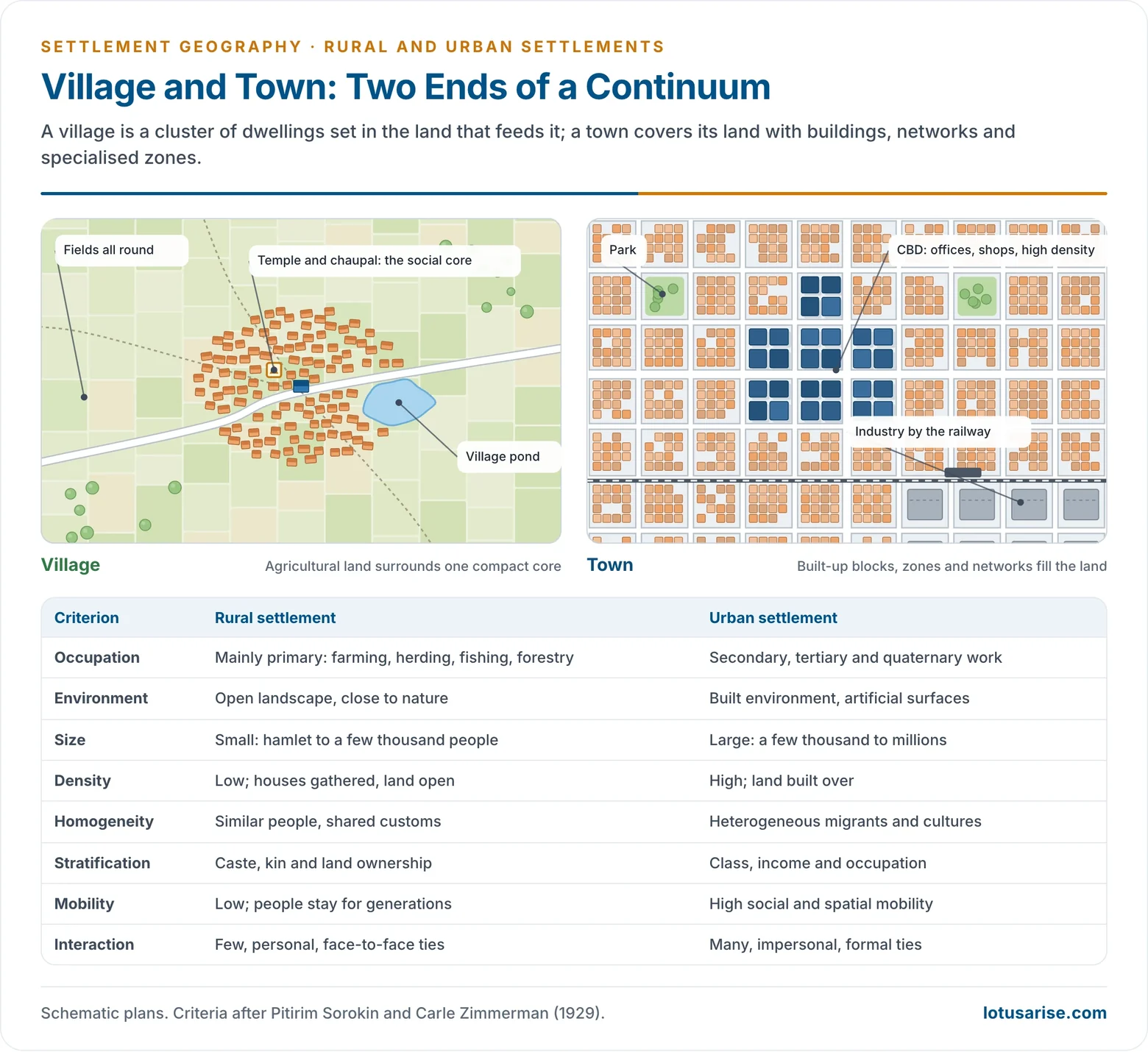
| Basis | Rural settlement | Urban settlement |
|---|---|---|
| Occupation | Primary activities | Secondary, tertiary, quaternary |
| Density | Low | High |
| Social order | Caste, kin, land | Class, income, occupation |
| Governance (India) | Gram panchayat | Urban local body |
| Relation to region | Served by towns | Serves a hinterland |
The Rural–Urban Continuum
- No single criterion separates rural from urban everywhere. Settlements form a graded series, from homestead and hamlet through village and market centre to town, city and metropolis.
- Robert Redfield (1947) described a folk–urban continuum from small, homogeneous, sacred communities to large, heterogeneous, secular cities.
- Ray Pahl (1966) argued that urban and rural ways of life coexist in the same places. Commuter villages and urban villages show that place type does not fix way of life.
- In India the continuum is visible in:
- Large villages with many non-farm workers, especially in Kerala, the Ganga plain and around metropolitan cities.
- Census towns: places that are urban by census tests but still governed by gram panchayats.
- Peri-urban belts and the rural–urban fringe, where farmland, factories and housing mix.
The Rural–Urban Line in India
Census Definition
- The Census of India classes as urban:
- Statutory towns: all places with a municipal corporation, municipality, cantonment board, notified town area committee or nagar panchayat.
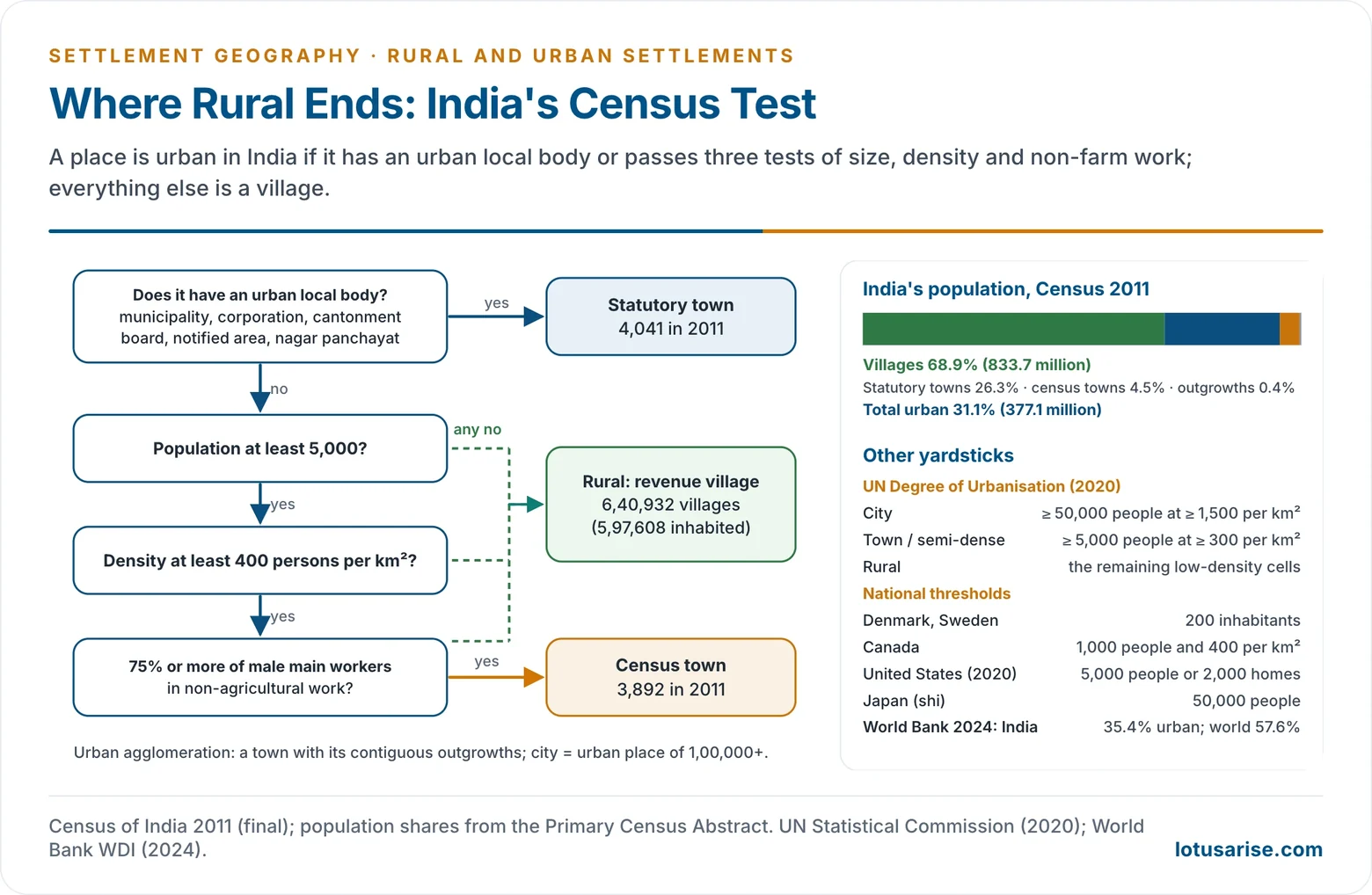
- Census towns: places that meet all three tests at the same time:
- a population of at least 5,000;
- a density of at least 400 persons per km² (about 1,000 per square mile);
- at least 75% of male main workers engaged in non-agricultural work.
- An outgrowth is a built-up area such as a railway colony or university campus next to a town; a town with its outgrowths forms an urban agglomeration (UA).
- A town of 1,00,000 or more people is a city.
- Everything that is not urban is rural. The basic rural unit is the revenue village.
- A rural place is one that fails any one of the three tests and has no urban local body. It need not have 75% of its workers in farming.
- Census 2011 counted:
- 7,933 towns: 4,041 statutory towns and 3,892 census towns.
- 6,40,932 villages, of which 5,97,608 were inhabited.
- 833.7 million rural people (68.8%) and 377.1 million urban people (31.1%).
- The number of census towns nearly trebled, from 1,362 in 2001 to 3,892 in 2011. This shows how many large villages have turned to non-farm work while keeping rural government.
- Limits of the census line:
- The male-worker test ignores women’s work, and the 5,000 threshold is high by world standards.
- Places are classified from the previous census’s data, and states decide whether to create urban local bodies.
- Grid-based methods therefore put India’s “real” urban share well above the official figure. The World Bank series, built from national definitions, puts India at 35.4% urban in 2024 against a world average of 57.6%.
- The next census, delayed from 2021, has a population reference date of 1 March 2027. Its houselisting phase ran in 2026, and no results are yet available.
Other Yardsticks
- Countries draw the line at very different sizes, so national urban shares are not strictly comparable.
- The UN Statistical Commission (2020) endorsed the Degree of Urbanisation, which classifies 1 km² grid cells:
- cities: at least 50,000 people at a density of at least 1,500 per km²;
- towns and semi-dense areas: at least 5,000 people at 300 per km² or more;
- rural areas: the remaining, mostly low-density cells.
| Country or body | Urban threshold |
|---|---|
| Denmark, Sweden | 200 inhabitants |
| Canada | 1,000 people and 400 per km² |
| United States (2020) | 5,000 people or 2,000 housing units |
| India | Urban local body, or 5,000 people + 400 per km² + 75% male non-farm workers |
| Japan (shi) | 50,000 people |
| UN Degree of Urbanisation | 5,000 people at 300 per km² (town); 50,000 at 1,500 per km² (city) |
From Hamlet to Megalopolis
Rural Orders
- Homestead or farmstead: one house or a few houses standing on the farm. Examples are the dhanis of Rajasthan and the farmsteads of the Prairies and Pampas.
- Hamlet: a small cluster of houses smaller than a village.
- In British usage a hamlet has no church and no commercial premises, though it may have a chapel or hall.
- In India hamlets are called purva, majra, tola, para, dhani or faliya. They usually lie within the boundary of a revenue village and depend on its main site.
- Village: a clustered rural community, larger than a hamlet, with a population of a few hundred to a few thousand.
- Villages were the usual home of societies practising subsistence agriculture, and of many fishing and pastoral communities.
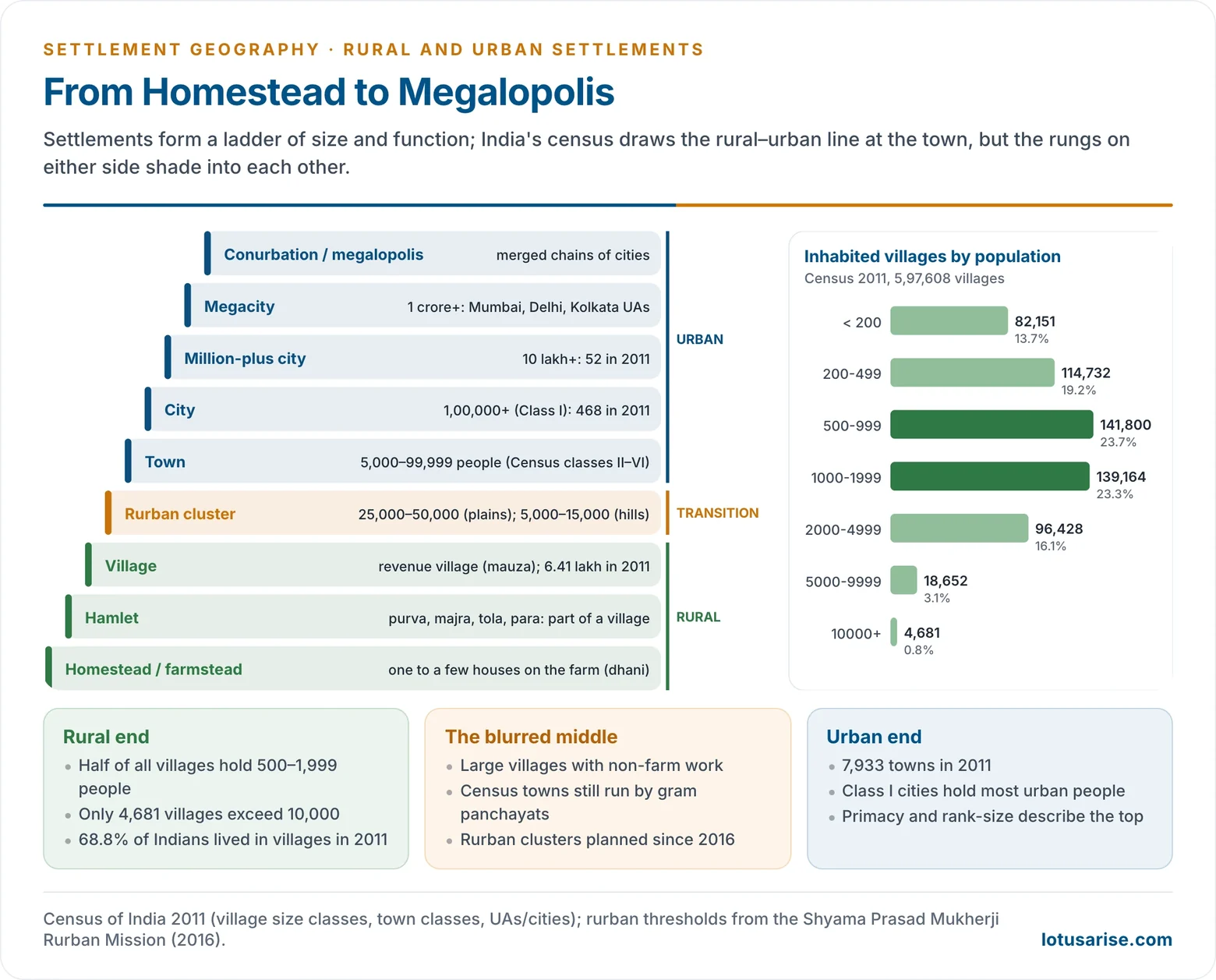
- Census 2011 recorded 5,97,608 inhabited villages. Almost half of them (47%) had 500–1,999 people, and only 4,681 had more than 10,000.
- Rurban: a transitional settlement, rural in governance but urban in function.
- The Shyama Prasad Mukherji Rurban Mission (launched February 2016) defines a rurban cluster as geographically contiguous villages with about 25,000–50,000 people in plain and coastal areas and 5,000–15,000 in desert, hilly or tribal areas.
- It set out to develop 300 such clusters with urban amenities.
Urban Orders
- Urban places form a hierarchy in which fewer, larger centres offer more and higher-order functions.
- Town: a medium-sized settlement, larger than a village but smaller than a city.
- In the census, towns are graded into six classes by population. Class I is 1,00,000 and above; Class VI is below 5,000.
- City: a large urban place with extensive systems of housing, transport, sanitation, utilities and communication. Its density favours interaction among people, firms and government.
- India had 468 Class I UAs and cities in 2011.
- Metropolis: from the Greek for “mother city“, the parent city that sent out colonists.
- Today it means a large city or conurbation that dominates the economic, political and cultural life of a region and links it to national and global networks.
- India had 52 million-plus UAs and cities in 2011 (final tables; 53 in the provisional count).
- Megacity: a city of 10 million or more. In 2011 these were Greater Mumbai UA (18.4 million), Delhi UA (16.3 million) and Kolkata UA (14.1 million).
- Conurbation: a continuous urban area formed when towns grow together, as along the Hooghly around Kolkata. The term was coined by Patrick Geddes in Cities in Evolution (1915).
- Megalopolis: from the Greek mégas (great) and pólis (city), a chain of adjoining metropolitan areas, separated in places but merging into one urbanised region.
- Lewis Mumford (1938) used the word for a stage of urban growth.
- Jean Gottmann (1961) gave it its modern meaning for the Boston–Washington seaboard of the United States.
- It is also called a mega-region.
- Primate city: the leading city of a country, disproportionately larger than any other.
- Mark Jefferson (1939) defined it as at least twice as large as the next city and more than twice as significant. London, Paris, Bangkok, Lima and Dhaka are examples.
| Census class | Population |
|---|---|
| Class I (city) | 1,00,000 and above |
| Class II | 50,000–99,999 |
| Class III | 20,000–49,999 |
| Class IV | 10,000–19,999 |
| Class V | 5,000–9,999 |
| Class VI | Below 5,000 |
Previous Year Questions
1997Examine the census concept of Urban areas in India.2003Discuss the census definition of urban areas in India.





Awesome
Thank you so much
sir thank you so much … i was following you on youtube but came to know about this lotusarise recently … you are doing a great job for us.
Most welcome Subham, Guys please join the telegram channel for notification of new articles.
Geography Optional Channel: https://t.me/lotusarisegeography
Sir please upload remaining topic as early as possible 🙏
Thanks sir
Valuable material sir…tnq
What is nature of settlement geography?
very helpful. thank you
Thank you for this help.😊
Thank you Sir