Q. Recently there was a proposal to translocate some of the lions from their natural habitat in Gujarat to which one of the following sites?
- Corbett National Park
- Kuno Palpur Wildlife Sanctuary
- Mudumalai Wildlife Sanctuary
- Sariska National Park
Answer: (b) Kuno Palpur Wildlife Sanctuary
Notes:
- An environment ministry’s expert committee has approved Kuno Palpur Wildlife Sanctuary in Madhya Pradesh as a second home for Asiatic lion.
- The last wild population of the Asiatic lion is found in the region of Gir Forest National Park, in the state of Gujarat.
- The single population faces the threats of epidemics, natural disasters and other anthropogenic factors.
- In 2013 the supreme court ruled in favour of translocation of the Asiatic lion to Kuno Palpur wildlife sanctuary in the interest of genetic stability of these species.
- However, the Gujrat government will not share lions unless 33 studies as mandated by Internation wildlife watchdog IUCN is completed.
Jim Corbett National Park
- Jim Corbett National Park is a national park in India located in the Nainital district of Uttarakhand state. The first national park in India, it was established in 1936 during the British Raj and named Hailey National Park.
- It has numerous ravines, ridges, minor streams and small plateaus with varying aspects and degrees of slope. The park encompasses the Patli Dun valley formed by the Ramganga river.
- Ramganga, Sonanadi, Mandal, Palain and Kosi are the major rivers flowing through the Reserve.
- It protects parts of the Upper Gangetic Plains moist deciduous forests and Himalayan subtropical pine forests ecoregions.
- It has a humid subtropical and highland climate.
Mudumalai Wildlife Sanctuary
- Mudumalai Tiger Reserve is located in the Nilgiris District of Tamil Nadu state at the tri-junction of three states, viz, Karnataka, Kerala and Tamil Nadu.
- It is a part of Nilgiri Biosphere Reserve (1st Biosphere Reserve in India) along with Wayanad Wildlife Sanctuary (Kerala) in the West, Bandipur National Park (Karnataka) in the North, Mukurthi National Park and Silent Valley in the South.
- Flora:
- The Reserve has tall grasses, commonly referred to as ‘Elephant Grass‘.
- Bamboo of the giant variety, valuable timber species like Teak, Rosewood, etc.
- There are several species of endemic flora.
- Fauna:
- Flagship Species: Tiger and Asian Elephant.
- Other species: Indian Gaur, Spotted Deer, Common Langur, Malabar Giant Squirrel, Wild Dog, Jungle Cat among others.
- Birds:
- Reserve has got a wide variety of more than 260 species of birds.
- 8% of bird species found in India are recorded in Mudumalai.
- This includes rare birds like Malabar grey hornbill, Malabar pied hornbill, Malabar laughing thrush among others.
Sariska National Park
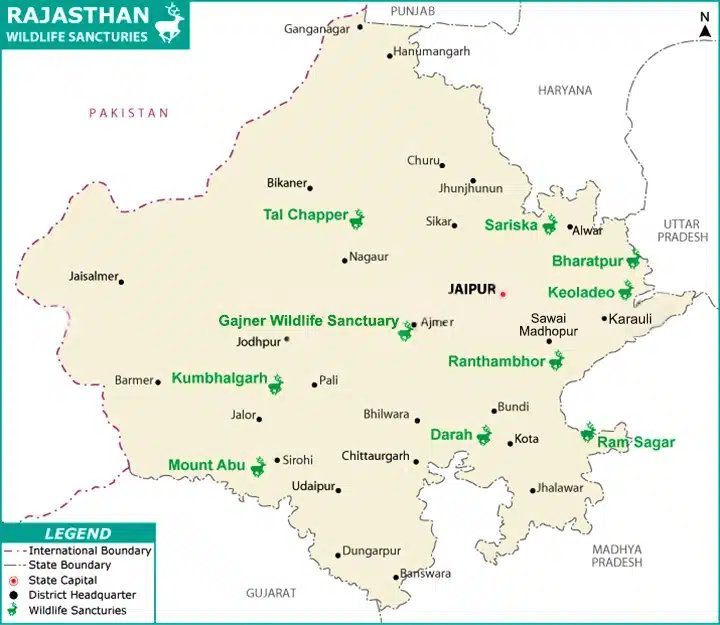
- Sariska Tiger Reserve is located in Aravali hills and forms a part of the Alwar District of Rajasthan.
- Sariska was declared a wildlife sanctuary in 1955 and was declared the tiger reserve later in 1978, making it a part of India’s Project Tiger.
- The Reserve houses ruined temples, forts, pavilions and a palace.
- Kankarwadi fort is located in the centre of the Reserve and it is said that Mughal emperor Aurangzeb had imprisoned his brother Dara Shikoh at this fort in struggle for succession to the throne.
- The Reserve also houses a famous temple of lord Hanuman at Pandupole related to Pandavas.
- Flora and Fauna:
- The Reserve is immensely rich in flora and fauna, and is famous for Royal Bengal Tiger.
- The park has populations of leopards, Nilgai, Sambar, chital etc.