

“Should I read Shubhra Ranjan’s 2,000-page dictations, or save time with OnlyIAS’s typed bullet points?”
The classic dilemma in Old Rajinder Nagar photocopy stalls
When evaluating Shubhra Ranjan vs OnlyIAS PSIR in Delhi’s Old Rajinder Nagar or Mukherjee Nagar photocopy stalls, you will encounter the two legacy titans of the UPSC PSIR market: the yellow-bound spiral volumes of Shubhra Ranjan and the printed booklets of OnlyIAS.
For thousands of aspirants embarking on Political Science and International Relations, the initial dilemma is almost always framed as a contest between these two legacy sources: “Should I read Shubhra Ranjan’s detailed classroom dictations, or should I save time with OnlyIAS’s concise typed bullet points?”
While coaching forums endlessly debate which of these two legacy compilations is better, they overlook a critical reality that senior UPSC evaluators see every single year: both resources suffer from a systemic crisis called “Template Fatigue,” and both leave aspirants stranded at the dreaded 240–255 marks ceiling.
Below is an unfiltered, comparative review of Shubhra Ranjan vs OnlyIAS PSIR typed notes, an expose of why their shared templates depress your Mains score, and why modern high-scorers are pivoting to LotusArise PSIR Notes as the definitive 2026/2027 alternative.
1. Shubhra Ranjan vs OnlyIAS PSIR: Side-by-Side Comparison Matrix
As stipulated in the official UPSC Civil Services Examination notification, optional evaluators seek advanced academic mastery. Before diagnosing their shared vulnerabilities, examine how both legacy typed notes contrast, volume, and pedagogical origin:
| Evaluation Metric | Shubhra Ranjan PSIR Typed Notes | OnlyIAS PSIR Typed Notes | LotusArise PSIR Notes (Modern Standard) |
|---|---|---|---|
| Pedagogical Source | Verbatim classroom lecture dictations transcribed by students | Secondary coaching compilation formatted into study booklets | Curated academic prose synthesized from university standard texts |
| Total Volume | ~1,980 pages across 6 bulky printed volumes | ~800 pages across concise summary booklets | ~1,400 pages Reference Notes + ~643 pages across 5 Revision Booklets |
| Writing Register | Spoken, conversational classroom English with spoken redundancies | Fragmented, telegraphic bullet points (General Studies style) | Rigorous, high-register academic prose ready for Mains reproduction |
| Political Theory (1A) | Strong foundational narratives; limited secondary scholars | Superficial bullet outlines; weak philosophical derivation | Exhaustive philosophical dialectics with explicit scholar matrices |
| Indian Politics (1B) | Standard constitutional commentary; static case studies | Factual article lists resembling Laxmikanth | Contemporary institutional debates (Kohli, Jaffrelot, Palshikar, Mehta) |
| International Relations (2B) | Static 2021–2022 baseline; requires heavy external compilation | Outdated 2022 baseline; missing modern minilaterals | Mains 2026/2027 baseline (Global South, minilaterals, tech diplomacy, de-risking) |
| Pre-Mains Revision System | None provided (requires 200+ hours to condense manually) | Linear reading; lacks dedicated exam answer cards | 5 Dedicated Revision Booklets designed for 72-hour consolidation |
2. The Shared Crisis: “Template Fatigue” in UPSC Mains Evaluation
While Shubhra Ranjan and OnlyIAS look different on the surface—one being voluminous narrative dictation and the other concise bullet points—they share a fatal flaw that depresses your score: Template Fatigue.
Every year, roughly 7,000 to 8,000 candidates write PSIR in Mains. Between 70% and 80% of these candidates rely on either Shubhra Ranjan notes or OnlyIAS summaries. Put yourself in the shoes of the university professor evaluating PSIR copies in the UPSC evaluation hall:
- Identical Openings: When the question asks about Machiavelli in Western Political Thought, 40 consecutive copies start with: “Machiavelli was a child of his times.” When asked about Locke, all 40 state: “Locke was the father of philosophical liberalism who gave the night-watchman state.” When asked about Mill: “Mill was a reluctant democrat and a prophet of empty liberty.”
- Identical Scholar Pairs: Every answer on Rawls pairs him with Nozick’s Wilt Chamberlain example. Every answer on Gramsci mentions civil society and organic intellectuals in the exact same sequence. Every answer on Indian secularism cites Donald Eugene Smith.
- The Evaluator’s Reflex: When an examiner reads the 30th copy featuring the exact same phrasing, quotes, and structural flow, their grading reflex shifts from critical appreciation to indifferent standardization. They award 4.5 or 5 out of 10. The candidate is not failed, but they are condemned to a total of 240 to 250 marks across both papers.
To cross into the 290–310+ zone, your answer must feel fresh, intellectually distinctive, and rooted in high-register academic scholarship that stands out from the coaching pile.
3. The Catch-22: Pick Your Weakness?
When you choose between Shubhra Ranjan and OnlyIAS, you are essentially forced to pick between two severe structural liabilities:
Option A: Choose Shubhra Ranjan and Drown in Volume
You gain narrative storytelling and solid foundational clarity, but you are burdened with nearly 2,000 pages of conversational dictation. In the 100 days between Prelims and Mains—when you must also revise four GS papers, write essay mocks, and practice ethics—re-reading 2,000 pages takes 20 full days per cycle. Most aspirants fail to complete even two comprehensive revisions, leading to severe recall failure in the exam hall.
Option B: Choose OnlyIAS and Starve on 20-Markers
You save reading time with ~800 pages of bullet points, but you sacrifice academic depth. When confronted with a 20-marker requiring dialectical arguments and secondary scholars, your answers read like General Studies Paper 2. The university examiner penalizes choppy, disconnected bullet points, giving you mediocre marks on the questions that carry 70% of the paper’s weight.
4. The Modern Alternative: Why Top Scorers Are Pivoting to LotusArise
LotusArise PSIR Notes were engineered specifically to break aspirants out of this legacy Catch-22. Instead of choosing between unmanageable bulk and shallow bullet points, LotusArise provides a complete, modern academic architecture:
A. Breaking Template Fatigue with Fresh Academic Scholars
LotusArise upgrades your intellectual vocabulary. Instead of relying on the same tired, over-used quotes, every topic integrates fresh, authoritative political scientists and contemporary scholars whose citations immediately signal high-caliber scholarship to the evaluator:
- In Political Theory: C.B. Macpherson, G.A. Cohen, Quentin Skinner, Bhikhu Parekh, Michael Walzer, Iris Marion Young.
- In Indian Government & Politics: Pratap Bhanu Mehta, Christophe Jaffrelot, Suhas Palshikar, Upendra Baxi, Madhav Khosla, Devesh Kapur.
- In International Relations: Ashley Tellis, Kanti Bajpai, C. Raja Mohan, Harsh V. Pant, Shivshankar Menon, Henry Farrell, Evelyn Goh.
B. The Dual-Layer System: Depth Without the Volume Penalty
LotusArise separates foundational reference from pre-exam execution:
- Comprehensive Reference Guides (~1,400 pages): Complete conceptual coverage synthesized from Oxford Handbooks and classic university texts, written in fluent, academic prose.
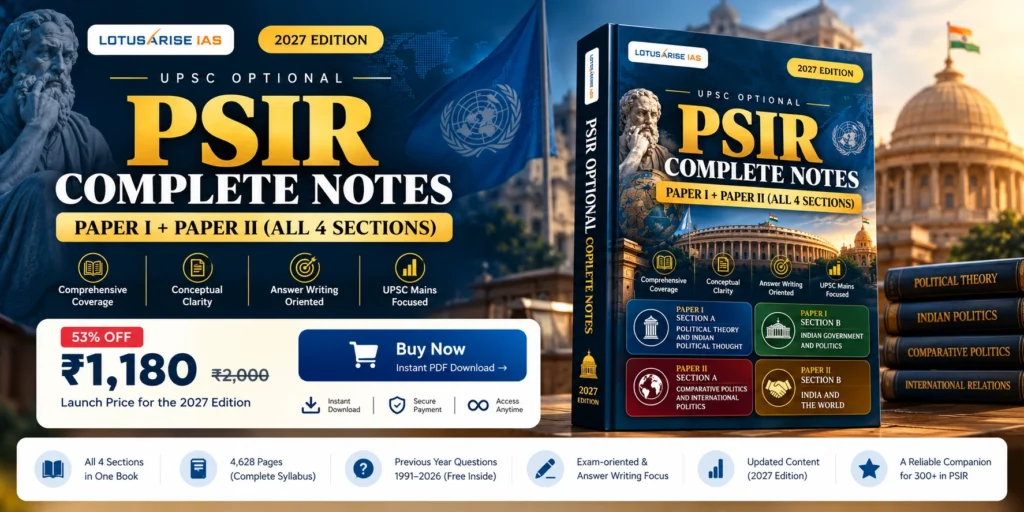
- 5 Modular Revision Booklets (~643 pages total): Modular, exam-ready review cards with dedicated “Thinkers to Name” tables and ready answer skeletons available in the PSIR Optional Mains Master Kit that allow you to revise an entire paper in 24 hours before Mains.
C. Contemporary 2026/2027 Geopolitics Baseline
While both Shubhra Ranjan and OnlyIAS are anchored to 2021–2022 notes, LotusArise is fully updated to the 2026/2027 geopolitical baseline—integrating the restructuring of supply chains, weaponized interdependence, minilateral plurilateralism, Global South leadership, and India’s evolving multi-alignment doctrine.
5. Strategic Roadmap: How to Upgrade Your PSIR Preparation
If you are currently holding Shubhra Ranjan or OnlyIAS notes, here is how to pivot toward a 300+ score:
- Step 1: Stop Re-Reading 2,000 Pages of Spoken Dictation. Reading conversational transcripts for the third time will not improve your answer writing. You need structured, high-register prose and targeted answer writing techniques.
- Step 2: Upgrade Your Revision Mechanism. Switch your primary review engine to the LotusArise 5 Revision Booklets (~643 pages). Use the “Thinkers to Name” matrices to memorize 4 to 6 distinctive scholars for every syllabus topic, and test your retention on topic-wise PYQ model answers.
- Step 3: Refresh Your Paper 2 Geopolitics. Replace outdated 2022 foreign policy examples with LotusArise’s contemporary 2026/2027 frameworks, grounding every bilateral relationship in formal IR theory.
Final Verdict
Between Shubhra Ranjan and OnlyIAS, Shubhra Ranjan offers better foundational narrative, while OnlyIAS offers a faster read. However, neither solves the ultimate challenge of UPSC Mains: delivering distinct, high-register academic answers that escape template fatigue and score 290–310+.
For serious aspirants preparing for Mains 2026/2027, LotusArise PSIR Notes represents the complete, modern standard—delivering uncompromised academic depth, pre-built revision architecture, and the intellectual edge required to break through the coaching ceiling.
Break Free from Legacy Coaching Templates
To move beyond the limitations of Shubhra Ranjan vs OnlyIAS PSIR, stand out in the evaluation hall with high-register academic prose, distinctive scholar citations, 5 modular Revision Booklets (~643 pages), and cutting-edge 2026/2027 International Relations analysis.