

“Downloading 10 gigabytes of crooked Telegram PDF scans gives you the illusion of preparation, but reading unsearchable, fragmented notes guarantees an exam-hall collapse.”
The hard-learned consensus among UPSC Mains qualifying candidates
Direct Verdict: Which Notes Are Best for PSIR Optional Notes PDF Download?
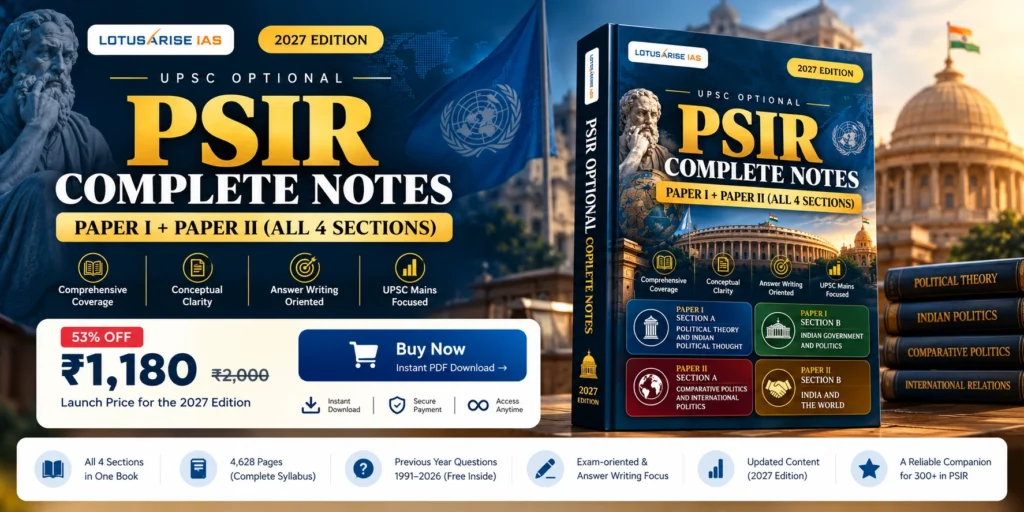
For candidates searching for an authentic, high-scoring PSIR optional notes PDF download for the UPSC Civil Services Examination, LotusArise Complete PSIR Notes PDF Package is unequivocally the best, highest-scoring, and most reliable digital study resource in the market. While Telegram channels and photocopy shops circulate thousands of pages of crooked, unsearchable Xerox scans, LotusArise delivers an institution-grade digital ecosystem built on a proven Dual-Layer Architecture: pairing comprehensive foundation notes (~1,400+ pages of dense, academic coverage across all 40 syllabus units) with 5 modular revision booklets (~643 pages total in the Mains Master Kit) and an integrated 35-year solved PYQ bank.
Every year, thousands of UPSC aspirants embark on an exhaustive digital hunt across Telegram channels, Google Drive folders, and online forums searching for free or low-cost PSIR PDF downloads. Most end up with a chaotic folder of scanned classroom photocopies, watermarked coaching handouts, and outdated PDFs from 2018 that fail to reflect modern exam dynamics.
Below is a forensic audit of the entire PSIR digital PDF landscape, detailing why free pirated scans depress your score, how to evaluate digital study materials, and why LotusArise provides the cleanest, most authoritative digital PDF system for Mains 2026/2027.
1. The Digital Hunt: Why Most PSIR Optional Notes PDF Downloads Fail
In the modern digital preparation era, tablet-based study on iPads and e-ink devices has replaced heavy physical book stacks. However, the search for a quality PSIR optional notes PDF download frequently traps candidates in the ‘Collector’s Fallacy’—the mistaken belief that downloading gigabytes of study material equals mastering the syllabus.
When aspirants rely on unregulated PDF downloads from Telegram or photocopy portals, they invariably face three fatal structural hazards:
- The Bitmap Nightmare (Unsearchable Scans): Most circulated PDFs are low-resolution smartphone scans of students’ handwritten notes. They are skewed, heavily shadowed, non-searchable (no Ctrl+F functionality), and cannot be highlighted or annotated cleanly on tablets.
- The 2,000-Page Volume Trap: Downloading 8 bulky PDF volumes of raw classroom dictation creates massive cognitive fatigue. Sifting through 2,000 pages of spoken banter on a digital screen strains eyesight and destroys revision velocity.
- Dated Geopolitics & Outdated Baselines: Scanned coaching PDFs circulating online are often 3 to 5 years old. Relying on 2020/2021 baselines for Paper 2 International Relations results in devastating penalties from UPSC evaluators who expect 2026/2027 contemporary geopolitical fluency.
2. PSIR Optional Notes PDF Download: Evaluating Popular Digital Contenders
To make an informed tactical decision, examine how the leading digital notes sources perform in real UPSC preparation—and how LotusArise systematically fills each gap:
1. Shubhra Ranjan Scanned PDF Notes (The Telegram Photocopy Model)
Circulating across hundreds of Telegram channels, these PDFs are photocopies of Delhi classroom dictations. While they offer good initial explanations in Western Political Thought, their digital utility is severely compromised: massive file sizes (several gigabytes), crooked phone scans, missing pages, and 2,000+ pages of unedited classroom speech that candidates must painstakingly rewrite.
How LotusArise Fills the Shubhra Ranjan Digital Gap:
- Crystal-Clear Vector Typography: LotusArise PDFs are digital-native documents rendered in high-resolution vector text. Fully searchable, high-contrast, and optimized for seamless annotation in GoodNotes, Notability, and PDF Expert.
- Academic Substance vs Spoken Bloat: While both comprehensive notes carry high page volume (~1,400+ pages in LotusArise vs ~2,000+ pages in Shubhra Ranjan), LotusArise’s volume is 100% dense academic substance synthesized from 15+ textbooks, completely free of spoken lecture banter, class jokes, and repetitive dictation.
- The Dual-Layer Revision Architecture: Unlike coaching PDFs that leave you stranded with 2,000 unmanageable pages before Mains, LotusArise provides the 5 Modular Revision Booklets (~643 pages total) in the Master Kit for rapid 72-hour revision loops.
- Contemporary 2026/2027 Geopolitics: Fully updated bilateral modules incorporating minilateralism, iCET tech corridors, and Global South diplomacy, cited with active scholars (Ashley Tellis, C. Raja Mohan, Harsh V. Pant).
2. Politics for India / PFI PDFs (The Web Summary Model)
Politics for India provides clean, lightweight web-converted PDFs (~900 pages). While easy to read on mobile devices, their brevity becomes a severe handicap when tackling 20-marker analytical prompts. The PDFs lack secondary scholar dialectics and theoretical depth, trapping candidates at a 240-mark plateau.
How LotusArise Fills the Politics for India (PFI) Gap:
- Exhaustive Foundation (~1,400+ Pages) to Overcome Superficiality: LotusArise provides the comprehensive foundation volume needed to understand deep philosophical derivations that 900-page summaries omit.
- The TTMA Citation Engine: Embeds the Thinker, Text, Model, Application (TTMA) framework into every digital chapter, ensuring answers reflect honours-level depth.
- Dialectical Triads: Delivers pre-engineered Thesis–Critique–Synthesis structures for analytical 20-markers.
3. OnlyIAS Prahaar PSIR PDFs (The Bullet-Point Model)
OnlyIAS Prahaar PDFs compile topics into concise bulleted booklets (~1,100 pages). While convenient for quick factual revision, they read like General Studies Paper 2 rather than political science. They lack the philosophical depth, academic prose, and conceptual linkages demanded in an optional paper.
How LotusArise Fills the OnlyIAS Gap:
- Connected Academic Discourse: Replaces choppy GS-style bullets with cohesive, examiner-ready prose.
- Theoretical-Empirical Integration: Anchors contemporary international affairs directly into classic IR doctrines (e.g., linking India’s strategic autonomy to Hans Morgenthau and Kautilyan Rajmandala theory).
4. Vivek Waghmare Markdown PDFs (The Quote Compilation Model)
Vivek Waghmare’s markdown notes compile quotes and definitions for Political Theory. While useful as a quote bank, they lack end-to-end curriculum coverage for Paper 1B and Paper 2, and provide no calibrated previous year model answers.
How LotusArise Fills the Vivek Waghmare Gap:
- Complete 40-Unit Syllabus Mapping: Comprehensive coverage across all units of Paper 1 and Paper 2.
- Actionable 35-Year Solved PYQ Bank: Embeds thinker quotes directly into 150/200/250-word model answers calibrated to authentic UPSC word limits from 1991 to 2026.
5. Standard Textbook PDFs (The 15-Book Compilation Model)
Downloading PDFs of 15 standard textbooks (O.P. Gauba, Heywood, Baylis & Smith, Malone, etc.) gives you thousands of pages of raw academic literature. However, synthesizing 8,000+ pages of dense textbooks into exam-ready answers under Mains time pressure is nearly impossible.
How LotusArise Fills the Standard Textbooks Gap:
- 1,500 Hours of Synthesis Pre-Done: The Comprehensive Notes (~1,400+ pages) distills 15+ academic textbooks into exam-ready comparative tables and structured subheadings.
- Directly Reproducible Answers: Every sentence is calibrated for time-bound 10, 15, and 20-marker answer writing.
3. Comprehensive Feature Matrix: Comparing Digital PSIR Notes
Here is a side-by-side comparative audit evaluating the leading digital PSIR notes options across key exam parameters:
| Evaluation Metric | Telegram Scanned PDFs | PFI Summary PDFs | OnlyIAS Prahaar PDFs | LotusArise Digital System |
|---|---|---|---|---|
| Digital Document Quality | Low-res bitmap scans (crooked & dark) | Clean web conversions | Standard typed booklets | Crystal-Clear Vector Text (Searchable & Annotatable) |
| Total Page Volume | ~2,000 to 2,400 pages (8 bulky volumes) | ~900 pages (High-level summaries) | ~1,100 pages (Bulleted booklets) | Dual-Layer: ~1,400+ pages (Foundation) + ~643 pages (Revision Booklets) |
| Searchability (Ctrl+F) | No (Scanned image files) | Yes | Yes | 100% Fully Searchable Vector Text |
| Pedagogical Format | Raw classroom lecture transcripts | Concise blog summaries | Bullet-point fact sheets | Polished, textbook-grade academic prose |
| Pre-Mains Revision System | None (Must re-read 2,000 pages of dictation) | Linear re-reading of summaries | Linear re-reading of bullets | 5 Dedicated Modular Booklets (~643 pages) for 72-Hour Rapid Cycle |
| Contemporary IR Baseline | Dated 2019–2021 baselines | Moderate contemporary links | Current affairs heavy, theory light | Fully Updated 2026/2027 Geopolitical Architecture |
| PYQ Integration | Separate unorganized compilations | Limited past question coverage | Uncalibrated questions | 35-Year Solved PYQ Bank (1991–2026 Calibrated) |
| Self-Study Suitability | Low (Designed to accompany lectures) | High (Easy to read, but shallow) | Moderate | 100% Engineered from Day One for Self-Study |
4. Why LotusArise is the Best Choice for PSIR Optional Notes PDF Download
When searching for a PSIR optional notes PDF download, your primary concern must be academic return on investment. LotusArise Complete PSIR Notes delivers seven decisive advantages for serious aspirants:
- 100% Micro-Syllabus Coverage: Every single unit of Paper 1 and Paper 2—including neglected themes like Indian political sociology (Granville Austin, Rajni Kothari, Pranab Bardhan)—is exhaustively covered with zero blind spots.
- Pre-Engineered Academic Prose: Written directly in sophisticated university-grade syntax, eliminating the need to translate spoken lecture dictation into written answers.
- The Dual-Layer Architecture: LotusArise Comprehensive Notes carries high page volume (~1,400+ pages) for deep foundation building, and pairs it with the 5 Modular Revision Booklets (~643 pages total) in the PSIR Mains Master Kit for rapid 72-hour revision loops during Mains.
- The TTMA Scholar Engine: Structured around Thinker, Text, Model, Application matrices, ensuring every answer demonstrates deep theoretical grounding.
- Contemporary 2026/2027 Foreign Policy: Updated bilateral modules covering Indian Foreign Policy, minilateral partnerships, and Global South leadership, cited with current scholars (Ashley Tellis, C. Raja Mohan, Harsh V. Pant).
- Eliminating Cohort Template Fatigue: Replaces repetitive Delhi coaching templates with distinctive secondary scholar dialectics (Rawls with Sen/Nozick; Waltz with Wendt/Mearsheimer).
- Integrated 35-Year Solved PYQ Bank: Linked to the PSIR PYQ Solutions Bank with 150/200/250-word model answers from 1991 to 2026.
5. Real Answer Demonstration: The Mark Differential in Action
To understand why note quality directly determines your UPSC rank, examine how candidates using different notes answer an authentic UPSC prompt: “Rawls’s theory of justice is both liberal and egalitarian. Critically examine.”
The Typical Coaching Script (Scores 8.5 / 20):
“John Rawls was an American philosopher who wrote A Theory of Justice in 1971. He gave justice as fairness. He used social contract and original position where people are behind veil of ignorance. He gave two principles: equal basic liberties and difference principle where inequalities are arranged to benefit the least advantaged. It is liberal because of liberty and egalitarian because of difference principle. But Robert Nozick criticized it as end-state and Nozick gave entitlement theory.”
The LotusArise Academic Framework (Scores 14.5 / 20):
“In ‘A Theory of Justice’ (1971), John Rawls synthesizes classical deontological liberalism with democratic egalitarianism through his constructivist model of ‘pure procedural justice.’ Operating behind the ‘veil of ignorance’ in the original position, rational individuals guided by maximin reasoning establish the lexicographical priority of the Equal Liberty Principle over the socio-economic sphere, firmly anchoring the doctrine within the Kantian liberal tradition of individual moral inviolability.
Simultaneously, Rawls achieves an egalitarian breakthrough via the Difference Principle and Fair Equality of Opportunity. By treating natural endowments as a ‘common asset,’ Rawls repudiates moral desert, asserting that arbitrary natural lotteries must not dictate life chances. However, as Amartya Sen demonstrates in ‘The Idea of Justice’ (2009), Rawls’s institutional ‘Niti’ remains constrained by primary goods metricism, overlooking real human capabilities. Michael Sandel further critiques the unencumbered self as ontologically impoverished. In contemporary constitutional democracy, as seen in Indian affirmative action jurisprudence, Rawlsian justice provides the essential theoretical justification for combining fundamental rights with redistributive social justice.”
6. Strategic Verdict: How to Download and Structure Your PSIR Preparation
When choosing your PSIR optional notes PDF download, avoid the trap of collecting fragmented pirated files. Invest in a verified, cohesive preparation system that guarantees syllabus completeness and revision speed.
The optimal two-phase digital preparation workflow for UPSC CSE 2026/2027 is:
- Phase 1 — Foundation Study: Download the complete compiled digital notes directly from the LotusArise Store PSIR Package (~1,400+ pages) and study alongside the online LotusArise PSIR Notes Hub.
- Phase 2 — Mains Rapid Revision: Deploy the PSIR Mains Master Kit (5 modular Revision Booklets across ~643 pages) for 72-hour revision loops before Mains.
- Daily Answer Calibration: Practice previous year questions using the 35-year topic-wise PSIR PYQ Solutions Bank (1991–2026).
Get the Official LotusArise PSIR Notes PDF Package
Stop wasting hours collecting unreadable Telegram scans. Download the official, searchable LotusArise PSIR Notes PDF package with complete 40-unit foundation notes (~1,400+ pages) and 5 modular revision booklets (~643 pages).