

“Next IAS provides neat printed yellow booklets and engaging lectures, but 1,800 pages without topic-wise 35-year PYQ model answers leaves aspirants stranded 10 days before Mains.”
The consensus from UPSC Mains PSIR study circles in Delhi
Direct Verdict: Next IAS PSIR Notes Review—Is It Worth It for UPSC CSE?
For candidates preparing for the UPSC Civil Services Examination, Next IAS PSIR notes (curated under faculty Piyush Choubey sir) offer clean, readable yellow booklets, but they do not serve as a self-sufficient, high-scoring revision weapon for Mains. While Next IAS provides structured classroom handouts that avoid the messy handwriting of legacy Xerox notes, the material suffers from three critical pedagogical limitations: (1) content is heavily indexed to classroom lecture commentary rather than dense, standalone honours prose, (2) there is no 35-year topic-wise solved PYQ bank with pre-engineered 250-word answer templates, and (3) the bulky 1,800+ page volume lacks rapid revision summaries for the 100-day window between Prelims and Mains.
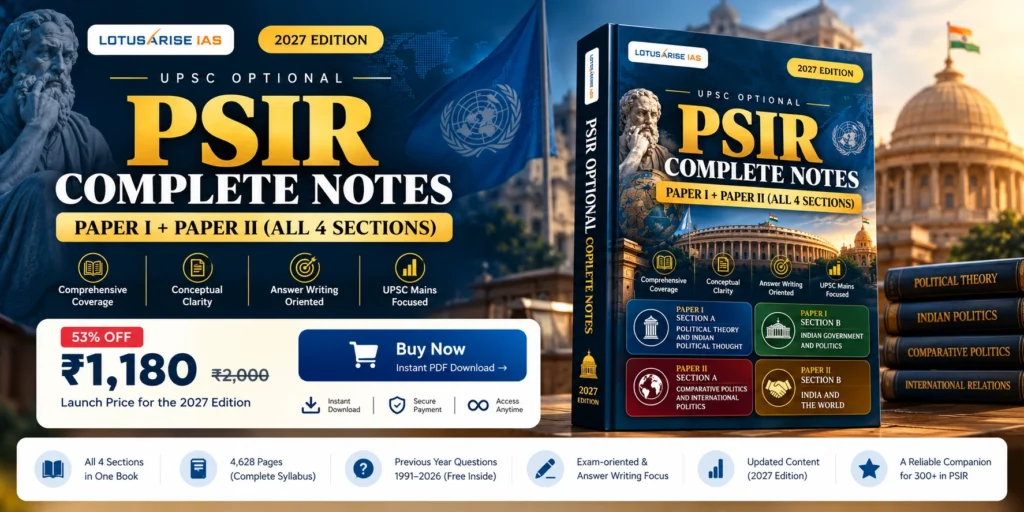
Serious aspirants who want guaranteed 300+ precision choose LotusArise Complete PSIR Notes (~1,400+ dense academic pages across all 40 syllabus units), paired with the 1,300+ Solved PSIR PYQs Bank (1991–2026) and the PSIR Mains Master Kit.
Below is an objective, forensic Next IAS PSIR notes review, analyzing syllabus coverage, scholar depth, page counts, and real comparative scripts against Shubhra Ranjan and LotusArise.
1. The Next IAS Offering: Strengths and Classroom Architecture
Next IAS has emerged as one of the premier coaching institutes in Old Rajinder Nagar, Delhi. Under Piyush Choubey sir, their PSIR optional course attracts hundreds of foundation students each year.
Their printed yellow study booklets offer several genuine advantages over unorganized market materials:
- Clean Typography: Unlike Shubhra Ranjan handwritten Xerox scans, Next IAS materials are professionally typed, neatly formatted, and easy to read.
- Solid General Structure: The syllabus units follow the official UPSC notification sequentially, covering basic definitions and historical timelines.
- Good Conceptual Pedagogy in Lectures: In class, Piyush Choubey sir explains complex philosophical ideas with accessible contemporary analogies.
- Current Affairs Integration: Next IAS provides regular monthly updates for Paper 2B International Relations.
2. The 3 Hidden Gaps in Next IAS PSIR Booklets for Self-Study
Despite its visual polish, an objective Next IAS PSIR notes review reveals why self-study students and Mains repeaters struggle to convert these booklets into 15+ marks in UPSC:
- Gap 1: The ‘Lecture-Dependency’ Curse: Next IAS booklets are designed as lecture companions. Key conceptual links, philosophical transitions, and critical scholar debates discussed verbally in class are omitted from the printed text, leaving distance learners and self-study aspirants with disjointed bullet points.
- Gap 2: Lack of Exhaustive 35-Year Solved PYQ Models: While the booklets list past questions at the end of some chapters, they provide zero line-by-line model answers. Without pre-engineered 150-word and 250-word answer skeletons, candidates struggle to structure answers under 11-minute exam conditions.
- Gap 3: Bulky Volume Without a Dual-Layer Architecture: Spanning over 1,800+ printed pages across multiple thick volumes, Next IAS notes create severe revision bottlenecks. Without modular 72-hour revision summaries, candidates cannot revise the material before Mains.
3. Direct Comparison: Next IAS vs Shubhra Ranjan vs LotusArise
Evaluate the three leading PSIR study sources side-by-side across key operational parameters:
| Evaluation Parameter | Next IAS PSIR (Piyush Choubey) | Shubhra Ranjan Notes | LotusArise Framework |
|---|---|---|---|
| Format & Readability | Typed yellow booklets; neat font | Handwritten Xerox scans; inconsistent handwriting | Searchable, typed academic text; clean typography |
| Standalone Self-Study | Moderate; assumes lecture attendance | Low; requires classroom audio dictation | 100% standalone; complete theoretical depth |
| Page Count Volume | ~1,800+ printed pages | ~2,500+ scanned pages | ~1,400+ Foundation Notes + 643-page Revision Booklets |
| Scholar Integration (TTMA) | Basic to moderate; mostly primary thinkers | Extensive, but dated Delhi coaching formulations | Structured TTMA matrices pairing primary thinkers with secondary critics |
| 35-Year Solved PYQ Bank | Unsolved question lists only | Selective mock answers via test series | 1,300+ topic-wise solved model answers (1991–2026) |
| Pre-Mains Revision System | None; candidate must make own notes | Crash course booklets (additional fee) | 5 modular revision booklets (~643 pages total) in Master Kit |
| Pricing & Accessibility | ₹55,000+ course / Expensive postal notes | ₹60,000+ course / Xerox market cost | Affordable digital download via LotusArise Store |
4. The Evaluator Perception: Coaching Template vs Honours Prose
When a senior academic evaluator from Delhi University or JNU grades 300 PSIR copies, scripts written from Next IAS or Shubhra Ranjan booklets suffer from ‘template fatigue’:
Why Coaching Clones Plateau at 235–250 Marks:
- Identical Opening Sentences: When 200 candidates open a question on Machiavelli with the exact phrase taught in class, evaluators award a flat, median 7 or 8 marks out of 20.
- Superficial Current Affairs Sprinkles: Inserting isolated news headlines without grounding them in foundational theoretical doctrines (e.g., Kenneth Waltz, Alexander Wendt) reads like GS Paper 2.
- The LotusArise Solution: LotusArise equips candidates with diverse, academic honours prose anchored in the TTMA engine (Thinker, Text, Model, Application), ensuring your script stands out as high-caliber scholarship.
5. How LotusArise Fills the Next IAS Gaps
For aspirants who already possess Next IAS booklets or are considering self-study, LotusArise Complete PSIR Notes and the PSIR Mains Master Kit provide the missing scoring layer:
- 1,300+ Ready-to-Memorize Model Answers: Every question asked in UPSC Mains from 1991 to 2026 is solved in exact 150-word and 250-word formats in the LotusArise Solved PYQs Bank.
- The Dual-Layer Architecture: Build comprehensive depth from ~1,400+ pages of dense Foundation Notes, then deploy the 5 modular revision booklets (~643 pages) for 72-hour revision loops.
- Exhaustive Academic Scholar Matrices: Gain instant access to secondary scholars across Western Political Thought, Political Theory, and Indian Foreign Policy (e.g., Quentin Skinner, Bhikhu Parekh, Hamza Alavi, Amitav Acharya).
- Instant Digital Access: Download printable PDFs directly from the LotusArise Store PSIR Package.
6. Final Verdict & Recommendation for 2026/2027 Aspirants
If you are enrolled in Next IAS classroom lectures, use Piyush Choubey sir’s lectures for general conceptual orientation. However, do not rely exclusively on coaching booklets for Mains answer writing or last-minute revision.
- For Self-Study Aspirants: Skip the expensive ₹55,000 coaching fee. LotusArise Complete Notes provide more comprehensive academic depth at a fraction of the cost.
- For Mains Answer Writing: Benchmark your drafts against the 1,300+ topic-wise solved PYQ models to eliminate coaching evaluator subjectivity.
- Explore Our In-Depth Reviews: Read our related reviews on LotusArise vs Shubhra Ranjan and Which Notes Are Best for PSIR Optional.
Related Master Guides in this PSIR Planning & Review Series:
- 120-Day Time-Bound Roadmap: How to Complete PSIR Optional in 4 Months
- Self-Study Preparation Strategy: Can I Prepare PSIR Optional Without Coaching?
- Online Video Courses Analysis: Sleepy Classes PSIR Review vs LotusArise
Upgrade Beyond Bulky Coaching Booklets
Don’t get stuck in 1,800+ pages of lecture companions. Get instant access to 40-unit complete notes (~1,400+ pages), 1,300+ topic-wise solved PYQs (1991–2026), and 5 modular revision booklets (~643 pages) in the LotusArise PSIR Mains Master Kit.