

“A quote bank gives you memorable soundbites, but a complete optional engine builds the dialectics needed for 20-markers.”
The distinction between topper quote repositories and structured curriculums
When evaluating LotusArise vs Vivek Waghmare PSIR notes in recent UPSC Mains preparation cycles, a new generation of digital study resources has emerged across Notion workspaces and Obsidian markdown vaults.
Among the most widely shared of these digital compilations are the markdown notes authored by Vivek Waghmare. Filled with neatly cataloged thinker quotations, concise conceptual definitions, and summary comparison tables, Vivek Waghmare’s notes have gained strong traction among aspirants looking for a modern digital quote bank.
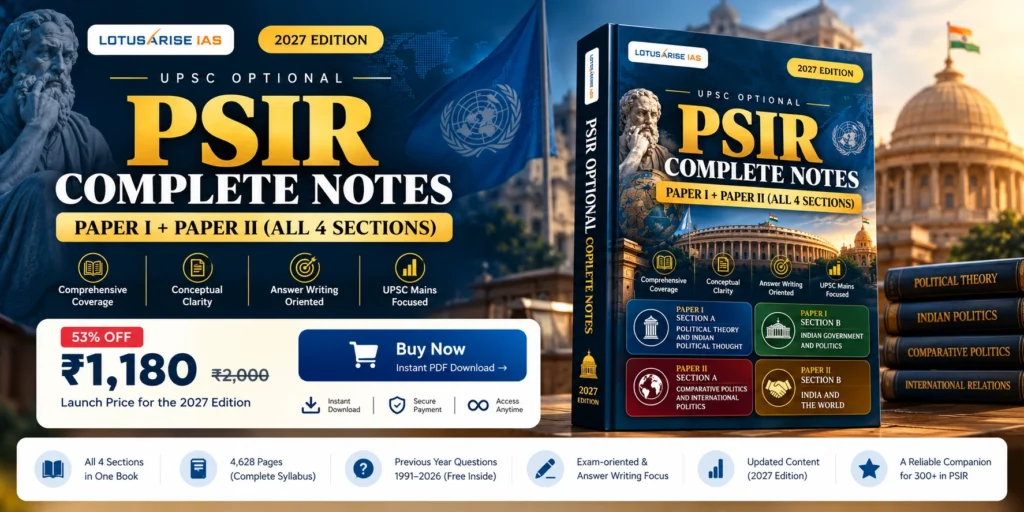
At the same time, LotusArise PSIR Notes has established itself as the premier institution-grade optional ecosystem for Mains 2026/2027—combining comprehensive reference guides (~1,400 pages) with 5 modular Revision Booklets (~643 pages), topic-wise PYQ frameworks (1991–2026), and contemporary International Relations modules on the PSIR Optional Notes.
This raises a crucial strategic question for UPSC aspirants: Can a digital quote bank serve as your primary PSIR preparation engine, or do you need a complete, multi-layered reference and revision ecosystem?
Below is an objective review and comparative breakdown of LotusArise vs Vivek Waghmare PSIR notes, examining where markdown quote banks succeed, where they hit severe analytical limits, and how to structure your preparation for a 300+ score.
1. LotusArise vs Vivek Waghmare PSIR: Side-by-Side Comparison Matrix
To evaluate LotusArise vs Vivek Waghmare PSIR across architecture, depth, and exam utility, examine the matrix below:
| Evaluation Parameter | Vivek Waghmare PSIR Notes (Markdown Series) | LotusArise PSIR Notes (Complete Ecosystem) |
|---|---|---|
| Format & Medium | Raw Markdown web clippings, bulleted quotes, and summary tables | Dual-layer system: Comprehensive Reference Guides + 5 Modular Revision Booklets |
| Pedagogical Intent | High-yield thinker quote repository and introductory concept outlines | Complete end-to-end self-study engine from foundational concepts to 300+ Mains answers |
| Syllabus Completeness | Selective topic compilations; uneven coverage across dynamic Paper 1B & Paper 2 | 100% micro-syllabus coverage mapped strictly to 1991–2026 UPSC PYQs |
| Analytical Prose Flow | Fragmented, numbered bullet points with bolded quotations | Cohesive, academic prose with formal vocabulary ready for direct exam reproduction |
| Paper 1A (Political Theory) | Valuable collection of thinker quotes (Wolin, Sabine, Catlin); lighter on secondary dialectics | Exhaustive philosophical derivations, counter-critiques, and dedicated “Thinkers to Name” tables |
| Paper 1B (Indian Politics) | Basic thematic notes with standard political science commentary | Institutional debates citing Atul Kohli, Christophe Jaffrelot, Suhas Palshikar, Upendra Baxi, Madhav Khosla |
| Paper 2 (IR & Foreign Policy) | Sparse, outline-level foreign policy notes; limited contemporary theoretical integration | Cutting-edge 2026/2027 baseline: Global South diplomacy, minilaterals, tech statecraft, de-risking |
| Mains Revision Architecture | Linear markdown reading; relies on candidate to structure their own review cards | 5 Dedicated Revision Booklets (~643 pages) designed for 72-hour pre-exam consolidation |
2. The Strength of Vivek Waghmare’s Notes: A Valuable Quote Bank
As reflected in the official UPSC Civil Services Examination notification, optional evaluators reward analytical rigor, and Vivek Waghmare’s quote compilations offer genuine utility for specific tasks:
- Curated Thinker Quotations: For candidates who struggle to remember direct quotes from classic commentators in Western Political Thought—such as Sheldon Wolin on the visionary nature of political theory, George Catlin on political philosophy vs science, or C.B. Macpherson on possessive individualism—Vivek Waghmare’s compilations provide crisp, memorable soundbites.
- Clean Digital Taxonomy: Because the notes are authored in markdown, they are cleanly segmented with clear headings and bulleted takeaways, making them easy to import into personal note-taking apps like Notion or Obsidian.
- Quick Tabular Distinctions: His notes feature useful side-by-side comparison tables clarifying classic distinctions (such as Political Theory vs Political Science vs Political Philosophy, or Classical vs Modern Realism).
In analyzing LotusArise vs Vivek Waghmare PSIR, an essential distinction must be drawn between a quote repository and a complete preparation ecosystem.
3. The Pitfall of Quote Banks: The “Name-Dropping” Trap
When assessing LotusArise vs Vivek Waghmare PSIR for Mains, relying exclusively on a quote bank creates serious vulnerabilities in 20-markers in UPSC Mains evaluation:
A. The “Ornamental Quote” Syndrome
When an aspirant studies from isolated bullet points and quote banks without understanding the foundational philosophical architecture, their answer writing betrays a telltale flaw: ornamental name-dropping.
They drop a quote by Sheldon Wolin or Hannah Arendt at the top of the answer, but the rest of the text fails to integrate the quote’s philosophical derivation. Senior academic evaluators from Delhi University or JNU spot this instantly. They recognize that the candidate has merely memorized a quote bank rather than internalized the thinker’s underlying ontological argument. The result is mediocre grading (5 to 6 marks out of 10).
B. The Absence of 20-Marker Dialectical Skeletons
In a 20-marker (250 words / 3 pages), quotes alone cannot carry the argument. As stressed in PSIR answer writing techniques, you need a dialectical progression:
- Establishing the thesis and internal epistemological mechanics.
- Engaging competing schools of thought (Marxist, Communitarian, Feminist, Post-colonial).
- Synthesizing the debate into contemporary governance or geopolitical resonance.
Because Vivek Waghmare’s notes are structured as concise bullet summaries, they lack the extended dialectical transitions required to fill three pages of rigorous academic prose.
C. The Paper 2 Contemporary Deficit
While markdown quote banks can catalog static thinkers in Paper 1A effectively, they struggle to keep pace with Paper 2 (Comparative Politics and International Relations). Paper 2 requires dynamic, ongoing synthesis of contemporary foreign policy doctrines, minilateral groupings, global economic security, and evolving regional security architectures that simple outline notes cannot adequately cover.
4. The Complete LotusArise Ecosystem Advantage
LotusArise PSIR Notes is not merely a collection of quotes; it is a meticulously engineered, multi-layered preparation ecosystem designed to take you from foundational understanding to a 300+ score:
Layer 1: Comprehensive Reference Guides (~1,400 Pages)
Exhaustive, academic coverage across all four syllabus sections (Papers 1A, 1B, 2A, 2B). Synthesized directly from premier university authorities (Andrew Heywood, George Sabine, Subrata Mukherjee & Sushila Ramaswamy, Oxford Handbooks), it provides the deep intellectual context needed to master complex, non-linear UPSC questions.
Layer 2: The 5 Dedicated Revision Booklets (~643 Pages Total)
Engineered specifically for the intense 100-day window between Prelims and Mains, these modular booklets in the PSIR Optional Mains Master Kit condense every theme into high-yield review cards:
- Structured “Thinkers to Name” Matrices: 4 to 6 categorized scholars per theme (Core Theorists, Critical Commentators, Indian/Contemporary Scholars).
- Pre-Engineered Answer Frames: Ready introduction hooks and concluding bridges that link abstract theory directly to modern Indian constitutionalism and global diplomacy.
- 72-Hour Review Capability: Allows you to revise an entire optional paper in a single day during the final sprint.
Layer 3: Topic-Wise PYQs Compilations (1991–2026)
Over 35 years of UPSC Previous Year Questions meticulously classified by micro-topic, accompanied by structural answer skeletons in our Topic-Wise PYQs Compilations (1991–2026) so you understand precisely how the Commission has tested each concept over three decades.
Layer 4: Mains 2026/2027 Geopolitics Integration
Every bilateral and multilateral topic is updated with contemporary theoretical frameworks (Weaponized Interdependence, Minilateralism, Leading Power doctrine, Strategic Autonomy 2.0) and insights from premier strategic minds (S. Jaishankar, C. Raja Mohan, Harsh V. Pant, Ashley Tellis, Shivshankar Menon).
5. How to Strategically Combine Both Resources
If you have already downloaded Vivek Waghmare’s markdown notes, you do not need to discard them. Instead, adopt this high-efficiency hybrid strategy:
- Make LotusArise Your Primary Learning & Revision Spine: Use LotusArise Comprehensive Notes to understand the deep philosophical logic, and rely on the LotusArise 5 Revision Booklets (~643 pages) for your daily pre-Mains answer revision and structural framing.
- Use Vivek Waghmare as a Secondary Quote Checklist: Glance through his markdown notes as a quick flashcard tool to check whether you can recall alternative quotes by Sheldon Wolin, Sabine, or Catlin.
- Embed Quotes into LotusArise Dialectics: When writing practice answers, embed any interesting quotes from Vivek Waghmare directly into the structured answer frames provided by LotusArise, ensuring your answers possess both rhetorical sparkle and academic depth.
Final Verdict
Vivek Waghmare’s markdown compilations are a praiseworthy example of a student quote repository—useful for quick digital referencing and memorable soundbites. However, a quote bank is not a substitute for a comprehensive optional curriculum.
To secure a competitive rank in UPSC CSE Mains, you need an integrated ecosystem that provides conceptual authority, complete syllabus coverage, 2026/2027 contemporary foreign policy analysis, and rapid-revision exam cards. LotusArise PSIR Notes delivers that complete institutional engine, empowering you to approach the exam hall with total confidence and reach the 300+ score threshold.
Discover the Complete LotusArise PSIR Ecosystem
Move beyond fragmented quote banks. Explore the complete PSIR optional ecosystem—including comprehensive reference guides, 5 modular Revision Booklets (~643 pages), topic-wise PYQs (1991–2026), and ready answer skeletons.