

“Just buy Shubhra Ranjan ma’am’s photocopied notes and start reading.”
The default advice handed to virtually every UPSC PSIR fresher in Old Rajinder Nagar
For nearly a decade, this single sentence has served as the unwritten starting point for candidates opting for Political Science and International Relations (PSIR) in the UPSC Civil Services Examination. In the photocopy stalls of Old Rajinder Nagar and Mukherjee Nagar, the spiral-bound yellow and white bundles of Shubhra Ranjan notes have achieved near-mythical status.
However, as the UPSC Mains examination has evolved over recent seasons—becoming decidedly more analytical, interdisciplinary, and demanding of high-register academic prose—a growing number of serious aspirants are confronting a sobering reality: the traditional coaching notes that carried toppers in 2017 are creating a scoring plateau at 240–255 marks today.
Into this vacuum, LotusArise PSIR Notes has emerged as the modern, high-yield benchmark for aspirants seeking 285–305+ scores. When analyzing LotusArise vs Shubhra Ranjan PSIR notes, how do the two actually compare when stripped of marketing claims and coaching hype? Which source offers superior conceptual depth in Western Political Thought? Whose International Relations notes reflect post-2024 global shifts? And crucially, which material can you realistically revise in the grueling 100-day window between Prelims and Mains?
Here is an exhaustive, unfiltered, side-by-side review and strategic breakdown of LotusArise vs Shubhra Ranjan PSIR notes.
1. LotusArise vs Shubhra Ranjan PSIR: Side-by-Side Comparison Matrix
To evaluate LotusArise vs Shubhra Ranjan PSIR notes objectively across the eight vital parameters that dictate your final Mains rank, examine the comparison matrix below:
| Evaluation Metric | Shubhra Ranjan PSIR Notes | LotusArise PSIR Notes (2026/2027 Edition) |
|---|---|---|
| Pedagogy & Source | Verbatim transcription of classroom lectures and verbal dictations | Curated academic prose synthesized directly from university standard treatises |
| Total Volume | ~1,980 pages across 6 bulky printed booklets | ~1,400 pages Reference Notes + ~643 pages across 5 Modular Revision Booklets |
| Tone & Register | Spoken, conversational classroom English with extensive conversational repetition | Formal, rigorous academic prose ready for direct answer copy-pasting |
| Paper 1A (Political Theory) | Excellent foundational stories; limited secondary scholarly debates | Deep theoretical dialectics, sub-theories, and explicit scholar matrices |
| Paper 1B (Indian Government) | Standard constitutional commentary; outdated dynamic political citations | Contemporary institutional debates (Atul Kohli, Christophe Jaffrelot, Suhas Palshikar, Pratap Bhanu Mehta) |
| Paper 2A (Comparative Politics) | Basic structural-functionalism and dependency; sparse contemporary paradigms | Comprehensive coverage of democratic transitions, political economy, and post-colonial state theories |
| Paper 2B (IR & Foreign Policy) | Static 2021–2022 baseline; requires massive external compilation | Mains 2026/2027 contemporary baseline; integrated Global South, minilateralism, supply chain resilience, and modern foreign policy doctrines |
| Pre-Mains Revision System | None provided (student must make their own short notes from scratch) | 5 Dedicated Revision Booklets with “Thinkers to Name” tables and ready intro-conclusion frames |
2. Where Shubhra Ranjan Notes Excel (Honest Appraisal)
When evaluating LotusArise vs Shubhra Ranjan PSIR notes from a beginner’s perspective, it would be disingenuous to dismiss Shubhra Ranjan notes. As outlined in the official UPSC Civil Services Examination notification, optional papers test advanced academic understanding, and there is a legitimate reason why Shubhra Ranjan notes originally became popular:
- Exceptional Storytelling for Beginners: If you come from an engineering, commerce, or medical background and have never read a word of political philosophy, Shubhra Ranjan’s classroom lectures make Western Political Thinkers intuitive. She humanizes Plato’s disappointment with Athenian democracy, Hobbes’s terror during the English Civil War, and Karl Marx’s fury at capitalist exploitation.
- Comforting Class Structure: Because the notes are direct student transcriptions of classroom dictations, they replicate the pacing of an offline coaching batch. For aspirants who want to feel like they are sitting in a classroom, the notes provide psychological comfort.
- Predictable Foundation: Her coverage of classic thinkers (Plato, Aristotle, Machiavelli, Hobbes, Locke, Rousseau, Mill, Marx, Gramsci, Arendt) establishes a dependable baseline that will prevent you from failing completely.
However, what makes her notes an accessible beginner’s primer is precisely what makes them dangerous as a final Mains scoring engine.
3. The 3 Hidden Flaws of Shubhra Ranjan Notes for Mains 2026/2027
Flaw #1: The Volume Trap and Spoken Dictation Inefficiency (~1,980 Pages)
The six printed volumes of Shubhra Ranjan notes span almost 2,000 pages. Why are they so voluminous? Not because of academic depth, but because of conversational repetition.
In a classroom setting, a teacher repeats the same concept three or four times using conversational phrasing: “What Plato wants to say is…”, “Now try to understand this point…”, “In other words, you can say that…”. When scribes transcribe these sessions into printed notes, that conversational fluff remains on the page. In the final 100 days between Prelims and Mains, reading 2,000 pages of spoken dictation takes 18 to 22 days per revision cycle. Most candidates manage only one or two shallow readings, entering the exam hall without muscle memory for core scholar citations.
Flaw #2: The “Evaluation Fatigue” and the 240-Mark Ceiling
In any given Mains year, between 6,000 and 8,000 aspirants write PSIR. An estimated 65% to 75% of them prepare from Shubhra Ranjan notes. Consider the psychology of the UPSC examiner—a seasoned professor from Delhi University or JNU who evaluates hundreds of scripts per week.
When the examiner reads 40 consecutive copies starting an answer on Machiavelli with the exact same quote (“Machiavelli was a child of his times”) or defining John Locke as the “father of philosophical liberalism who gave the concept of night-watchman state,” evaluation fatigue sets in. The answers feel commoditized, generic, and coaching-templated. The examiner awards a safe 4.5 or 5 out of 10. You will easily score 240, but you will never breach the 290–305 barrier required for a top-50 rank.
Flaw #3: The Static International Relations Baseline (Locked in 2021–2022)
While Political Theory (Paper 1A) changes slowly, Paper 2 (Comparative Politics and International Relations) is dynamic. The market printed notes of Shubhra Ranjan are fundamentally anchored to a 2021–2022 baseline.
They lack substantive, theoretically grounded frameworks for:
- The transformation of the Indo-Pacific architecture (Quad evolution, AUKUS, minilateral plurilateralism).
- India’s institutional leadership in the Global South post-G20 presidency and Voice of Global South Summits.
- The breakdown of the post-Cold War European security order and Russia-China strategic entente.
- De-risking, weaponized interdependence (Henry Farrell & Abraham Newman), and critical tech diplomacy (iCET).
Relying solely on legacy notes for Paper 2 forces you into writing superficial GS-2 style current affairs answers that fail to score in an optional paper.
4. How LotusArise Re-Engineered PSIR Notes for 300+ Aspirants
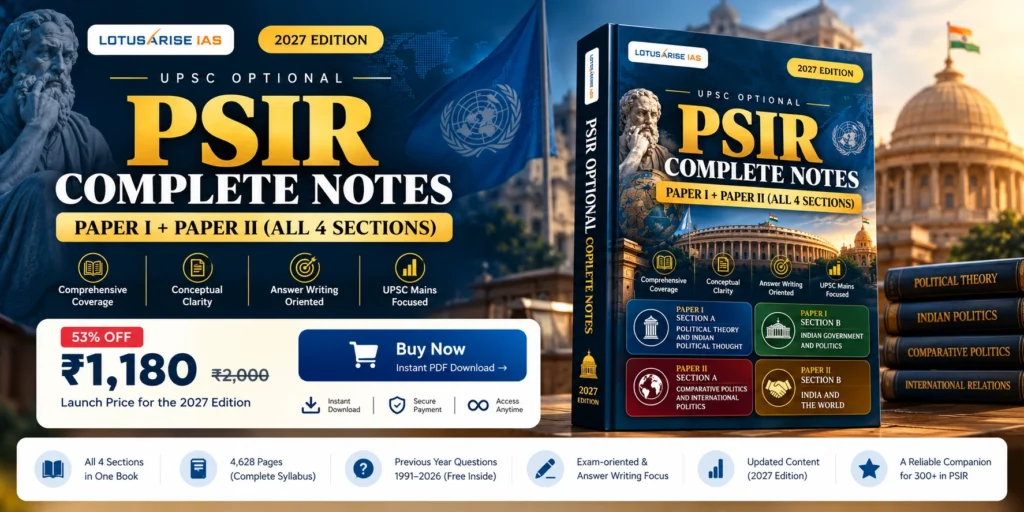
LotusArise PSIR Notes were created specifically to dismantle the volume-to-retention crisis that plagues PSIR candidates. Instead of selling raw classroom transcripts, LotusArise developed a structured, dual-layer learning ecosystem:
A. Academic Prose Over Spoken Dictation
Every page of LotusArise is written in formal, academic prose synthesized directly from authoritative treatises—including George Sabine, Andrew Heywood, David Boucher & Paul Kelly, Subrata Mukherjee & Sushila Ramaswamy, and Oxford Handbooks. When you read LotusArise, you are reading the exact high-register vocabulary that UPSC evaluators reward.
B. The 5 Modular Revision Booklets (~643 Pages Total)
LotusArise does not leave your pre-Mains condensation to chance. Alongside the comprehensive reference guide, you receive the LotusArise 5 Revision Booklets (~643 pages) designed for rapid review:
- Paper 1 Section A (Political Theory): ~138 pages of high-density conceptual cards.
- Paper 1 Section B (Indian Government & Politics): ~134 pages covering institutional dialectics.
- Paper 2 Section A (Comparative Politics & IR Theory): ~142 pages on comparative structures and IR schools.
- Paper 2 Section B (India & the World): ~125 pages of contemporary bilateral, regional, and multilateral doctrines.
- Practice Question Set & Answer Frames: ~104 pages of high-yield Mains skeletons mapped to previous year questions (PYQs).
With LotusArise Revision Booklets, completing a full, high-retention revision cycle takes just 3 to 4 days rather than 3 weeks.
C. Dedicated “Thinkers to Name” Matrices on Every Theme
Instead of burying scholar names in long paragraphs of lecture notes, every LotusArise topic features an explicit scholar matrix categorizing thinkers into Core Theorists, Contemporary Commentators, and Critical Counter-Perspectives. You can instantly retrieve 4 to 5 distinctive names for any 10-marker or 20-marker.
5. Real Answer Breakdown: Standard Dictation vs LotusArise Frame
To understand why LotusArise delivers superior marks, consider how an aspirant answers this recurring 20-marker question from the UPSC PSIR PYQs:
“Critically examine John Rawls’s Difference Principle and evaluate the Libertarian critique.” (20 Marks / 250 Words)
The Standard Coaching Template Answer (Shubhra Ranjan Style):
- Introduction: Quotes Rawls as reviving political philosophy in 1971 with A Theory of Justice. Mentions the Original Position and Veil of Ignorance.
- Body: Explains the Lexical Priority and the Difference Principle (inequalities are justified only if they benefit the least advantaged). Brings in Robert Nozick’s Anarchy, State, and Utopia and his Wilt Chamberlain example. Mentions that Nozick considers taxation as forced labor.
- Conclusion: Concludes that Rawls provides a golden mean between liberty and equality, while Nozick supports pure capitalism.
Evaluator’s impression: Predictable, accurate, but identical to 500 other copies. Mark: 9 / 20.
The LotusArise High-Register Answer Frame:
- Philosophical Framing: Opens by framing Rawls’s Difference Principle as an epistemological break from teleological utilitarianism (Bentham) to deontological liberalism, redefining moral desert by treating natural talents as a “common asset” (Rawls’s critique of the genetic lottery).
- Dialectical Engagement: Details the Difference Principle through the maximin rule and lexical difference principle (leximin), contrasting it with pure Pareto optimality.
- Advanced Scholar Critique: Cites Robert Nozick’s historical entitlement theory and self-ownership principle, but deepens the critique with G.A. Cohen’s Marxist critique (Rescuing Justice and Equality, arguing that the talented incentives violate the ethos of justice) and Amartya Sen’s realization-focused Niti vs Nyaya critique (The Idea of Justice).
- Institutional Anchor: Concludes by grounding the debate in Article 39(b) and 39(c) of the Indian Constitution, illustrating how the Indian state balances Nozickian property rights with Rawlsian distributive justice.
Evaluator’s impression: Nuanced, multi-dimensional academic scholarship with institutional synthesis. Mark: 14.5 / 20.
That 5.5-mark difference across twenty questions in Papers 1 and 2 translates directly into a 50 to 60-mark swing—the exact margin between an interview call and a top-50 rank in the final PDF.
6. Final Verdict: Which One Should You Choose?
Your choice depends on where you currently stand in your UPSC preparation cycle:
- Choose Shubhra Ranjan Notes If: You have never read political science, you struggle with conceptual foundations, and you have 18 months before your first attempt. In that case, reading her lectures can serve as a friendly, narrative starting point.
- Choose LotusArise PSIR Notes If: You are targeting Mains 2026/2027, value your study hours, refuse to waste 200 hours making handwritten summaries from dictations, and want high-register academic prose with 5 pre-built revision booklets and modern IR frameworks.
- The Hybrid Strategy (Smartest Move): If you are deciding between LotusArise vs Shubhra Ranjan PSIR after already finishing foundation notes, do not re-read old dictations. Upgrade your revision engine immediately to the LotusArise Revision Booklets (~643 pages). Use the LotusArise scholar matrices and contemporary IR modules to replace your generic answers with high-scoring frameworks.
Experience the LotusArise Academic Edge
Inspect the academic prose, structured scholar matrices, and exam-ready revision architecture before committing. Download our comprehensive free sample containing foundational theory, contemporary IR frameworks, and sample revision cards.