

“Everyone in Delhi is choosing PSIR. Has the optional become too saturated? Are examiners penalizing candidates because too many people write the same answers?”
The recurring anxiety of UPSC beginners choosing their optional subject
In the tea stalls and study circles of Old Rajinder Nagar and Mukherjee Nagar, a persistent rumor circulates every year around optional selection: that Political Science and International Relations (PSIR) has become “dangerously saturated,” that UPSC evaluators are “scaling down” marks, and that candidates should abandon it for smaller, niche optionals.
This creates an acute strategic dilemma for serious aspirants: Is PSIR Still a High Scoring Optional in the UPSC Civil Services Examination, or has the overwhelming volume of candidates destroyed its scoring predictability?
The unfiltered, data-backed truth is: PSIR remains one of the highest-scoring and most reliable optionals in UPSC history, producing multiple All India Rank 1 toppers and regular 300+ scores every single year. What is saturated is not the optional itself—it is the monotonous reproduction of generic coaching templates. When thousands of candidates write identical answers, examiners penalize the template, not the discipline.
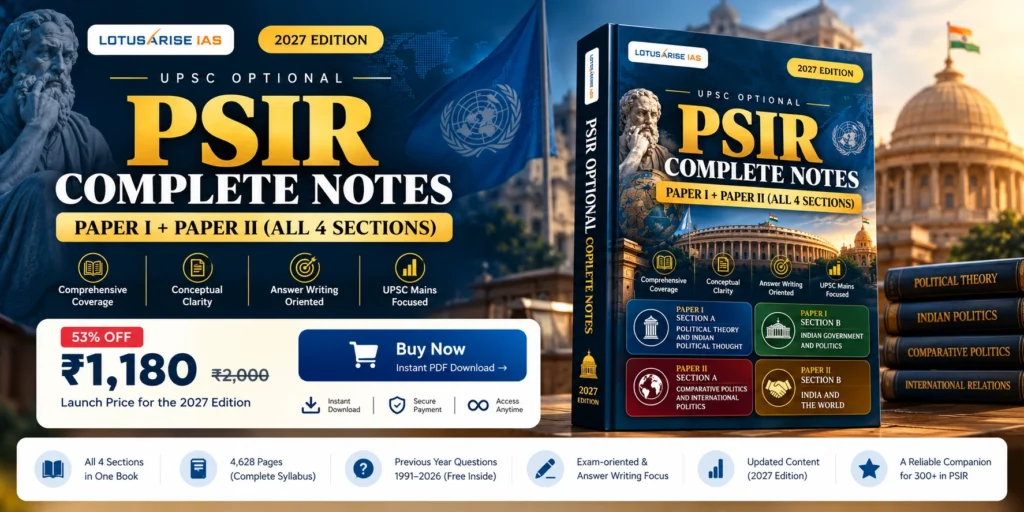
Below is a forensic analysis debunking the saturation myth, detailing PSIR’s unmatched General Studies overlap ROI, and demonstrating how LotusArise PSIR Notes provides the differentiated academic prose needed to dominate Mains 2026/2027.
1. Is PSIR Still a High Scoring Optional: Reality vs Myth Matrix
Before examining the scoring mechanics, contrast the common coaching myths with the actual empirical reality of UPSC PSIR evaluation:
| Evaluation Parameter | The Coaching Myth | The Empirical Reality in UPSC Mains |
|---|---|---|
| Scoring Ceiling | “PSIR has a hard ceiling at 250 marks due to scaling.” | False. Multiple candidates cross 290 to 315 marks every year, securing top-10 ranks. |
| “Saturation” Factor | “Evaluators are tired of reading PSIR answers.” | Evaluators are tired of identical photocopied dictations. Distinctive answers receive 70%+ marks. |
| General Studies Synergy | “Overlap is exaggerated; GS demands different answers.” | Massive 70–80% overlap with GS-2 (Polity & IR), plus substantial overlap with GS-4 Ethics and Essay. |
| Syllabus Predictability | “Questions are becoming too abstract and unpredictable.” | Highly predictable core. 70% of Paper 1 maps directly to recurring themes from 35 years of PSIR PYQs. |
| Overall Preparation ROI | “Niche optionals take less time.” | Highest net ROI in UPSC CSE when factoring in GS savings, essay preparation, and interview readiness. |
2. Debunking the Saturation Myth: What UPSC Data Actually Proves
As documented in the official UPSC Civil Services Examination notification and annual Union Public Service Commission reports, PSIR consistently ranks among the top optionals for success rate and topper concentration.
When candidates ask Is PSIR Still a High Scoring Optional, they only need to examine recent topper histories: from Tina Dabi (AIR 1) to Ishita Kishore (AIR 1) and dozens of rankers in the top 50, PSIR has consistently delivered rank-clinching scores. Unlike technical optionals (such as Mathematics or Engineering) where a single calculation error can sink your score to 180, or literature optionals with unpredictable scaling, PSIR offers unmatched scoring stability.
A well-prepared PSIR candidate with solid conceptual grounding rarely drops below 260 marks. And when paired with high-register academic vocabulary and secondary thinker matrices, the score routinely ascends to 295–310 marks.
3. What Actually Suffers: The “Coaching Template” Penalty
If PSIR is not saturated, why do thousands of aspirants find themselves stranded at 240 marks? The culprit is coaching template fatigue:
- Over 70% of PSIR candidates in Delhi rely on the exact same photocopied lecture dictations.
- They use the exact same introductory stories on Plato and Aristotle in Western Political Thought.
- They cite the exact same standard examples on John Rawls without exploring secondary debates (G.A. Cohen, Michael Sandel, Amartya Sen).
- Their Paper 2 answers reflect outdated 2021 geopolitics rather than modern 2026/2027 foreign policy frameworks.
When a university evaluator reads 40 consecutive answer scripts repeating the exact same classroom dictation verbatim, they award median marks (4.5 or 5 out of 10). It is not the optional that is being penalized—it is the absence of intellectual originality.
4. The Unmatched ROI of PSIR: 180+ Marks Overlap in General Studies
No other optional subject in the UPSC Civil Services Examination provides the staggering return on investment (ROI) that PSIR delivers across the rest of the syllabus:
1. General Studies Paper 2 (Polity, Governance & IR): ~75% Overlap
Almost the entire syllabus of GS-2 is subsumed within PSIR Paper 1B (Indian Government and Politics) and Paper 2B (Indian Foreign Policy). While other aspirants spend 200 hours reading separate books for GS-2, a PSIR student automatically masters constitutional doctrines, statutory bodies, judicial review, federalism, and international relations.
2. General Studies Paper 4 (Ethics, Integrity & Aptitude): ~40% Overlap
In Section A of GS-4, questions on moral thinkers, virtue ethics (Aristotle), duty ethics (Kant), utilitarianism (Bentham, Mill), and justice (Rawls) are native territories for a PSIR student. You can quote political philosophers with effortless authority.
3. The Essay Paper (250 Marks)
In recent UPSC seasons, the Essay paper has pivoted heavily toward philosophical and socio-political themes. The dialectical training gained in Political Theory enables PSIR students to write multi-dimensional, structured essays that easily score 130–145+ marks.
4. The Personality Test (Interview): 275 Marks
Over 50% of questions in the UPSC interview panel revolve around national governance, constitutional controversies, and international geopolitics. PSIR candidates possess natural poise and analytical depth on these topics.
5. How to Stand Out: Moving from Coaching Scripts to Academic Prose
To overcome template fatigue and unlock a 300+ score in PSIR, you must upgrade your study material from spoken lecture dictations to structured academic prose:
This is where LotusArise PSIR Notes provides an insurmountable competitive edge:
- High-Register Academic Prose: Written directly in scholarly English ready for direct examination reproduction.
- Contemporary 2026/2027 Geopolitics: Exhaustive Paper 2 coverage incorporating Global South diplomacy, minilateral security architectures, and supply chain statecraft.
- The 5 Modular Revision Booklets (~643 Pages): Pre-built revision cards and scholar matrices from the PSIR Mains Master Kit that enable you to complete 4–5 full revision cycles in the 100 days before Mains.
6. Final Verdict: Should You Choose PSIR for 2026/2027?
If you are choosing your optional subject for UPSC 2026/2027, the verdict on Is PSIR Still a High Scoring Optional is an unequivocal YES:
- Do not be misled by coaching center rumors claiming PSIR is saturated. What is saturated is the reproduction of generic photocopied classroom scripts.
- Choose PSIR if you want the highest synergy with General Studies Paper 2, GS-4 Ethics, Essay, and the Interview panel—saving 200+ hours in your overall preparation.
- Arm yourself with LotusArise PSIR Notes and the 5 Modular Revision Booklets to guarantee that your answers stand out with scholarly depth, contemporary relevance, and rank-securing 300+ marks.
Unlock the True 300+ Potential of PSIR
Step beyond generic coaching dictations. Equip yourself with the modern benchmark in UPSC PSIR optional: comprehensive academic reference guides, 5 modular revision booklets (~643 pages), and fully updated 2026/2027 International Relations analysis.