

The Uncomfortable Truth About Geography Optional
Every year, thousands of aspirants pick Geography Optional because coaching institutes market it as a “safe,” “popular,” and “scoring” subject with easy overlaps with General Studies, Prelims, Essay, and Interview. The pitch is compelling. The reality, experienced quietly by the majority, is quite different.
Most aspirants who struggle in Geography Optional are not lazy. They are misdirected. They read voluminously but cannot write analytically. They memorise theories but cannot apply them. They collect PDFs obsessively but have no coherent revision structure. They complete Paper I but feel perpetually overwhelmed by Paper II. After enormous effort, they score between 230 and 270 — enough to demoralise but not enough to eliminate.
“Geography Optional does not punish ignorance. It punishes the absence of geographical thinking — the capacity to see patterns, causes, and spatial relationships where others see only facts.”
The problem is architectural. Geography is not a collection of topics to be memorised — it is an academic discipline with its own epistemology, vocabulary, and analytical tradition. UPSC Geography Optional is, above all, a test of geographical reasoning. Those who recognise this distinction early gain a decisive advantage.

Common Myths That Sink Aspirants
- Geography Optional has maximum overlap with GS — so preparation is “free.” (Overlap exists, but the depth and nature of treatment is entirely different.)
- Memorising physical geography features is sufficient for Paper I.
- Paper II is just “reading the newspaper about India.”
- Diagrams are optional extras, not marks-earners.
- Models and theories are only for 15-mark questions.
What UPSC Actually Tests — Not What You Think
Before opening a single textbook, you must internalise what the UPSC examiner is actually looking for. The fundamental error most beginners make is treating Geography Optional as a factual subject where comprehensiveness of content determines marks. This is profoundly mistaken.
Three Layers of Examination Demand
Layer 1 — Conceptual Understanding
UPSC does not ask “what is monsoon.” It asks you to evaluate the dynamic concepts of monsoon, explain the role of jet streams in monsoon mechanics, or critically assess the changing nature of monsoon under climate change. The question is always a conceptual probe dressed in topical clothing.
“Discuss the concept of deep ecology and its relevance to contemporary environmental policy.”
Actual PYQ — Conceptual Probe
This question rewards not the aspirant who knows what deep ecology is, but the one who can trace its philosophical lineage through Naess and Devall, contrast it with shallow ecology and PAVE theory, and anchor it in India’s constitutional and policy framework — all within 200 words.
Layer 2 — Geographical Thinking
A geographer does not describe. A geographer explains patterns, identifies spatial variation, studies the human-environment dialectic, and examines why regions differ. The difference between a History student’s answer about Punjab agriculture and a Geography Optional student’s answer is that the geography student asks: Why Punjab? Why not Rajasthan? What were the hydrological preconditions? What environmental consequences followed the Green Revolution? How do satellite data now reveal groundwater depletion?
Layer 3 — Contemporary Relevance
Post-2015 UPSC questions increasingly demand analytical anchoring in recent developments. Climate change, SDGs, Kunming-Montreal Global Biodiversity Framework, IPCC AR6 findings, carbon neutrality discourse, urban heat islands, river basin conflicts — these are not optional additions to answers. In 10-mark and 20-mark questions, they are the difference between 6 marks and 14 marks.
The Examiner’s Implicit Rubric
- Does the candidate understand the process, not just the outcome?
- Does the answer demonstrate spatial thinking — where, why there, why not elsewhere?
- Are thinkers and theorists cited with appropriate critical evaluation?
- Is there a diagram that adds analytical value (not decoration)?
- Does the conclusion point toward contemporary implications or policy relevance?
Reading the Syllabus Like a Research Scholar
The UPSC Geography Optional syllabus is the single most important document in your entire preparation. Most aspirants read it once, mistake it for a table of contents, and move on. This is a catastrophic error that leads to months of misdirected effort.
Spend a full week on the syllabus. Print it. Annotate it. Map it against PYQs. What the syllabus specifies is not merely what topics exist — it defines the scope, depth, and angle from which each topic should be approached.
Paper I — Structural Architecture
| Section | Core Themes | PYQ Frequency | Priority |
|---|---|---|---|
| Geomorphology | Landform processes, Davis-Penck-King theories, slope evolution | High (1-2 per year) | High |
| Climatology | Jet streams, monsoon dynamics, climate change, ENSO | Very High | High |
| Oceanography | Currents, coral reefs, UNCLOS, marine resources | Moderate-High | High |
| Biogeography | Biomes, island biogeography, biodiversity, ecosystem | High (trending up) | High |
| Environmental Geography | PAVE, deep ecology, carbon neutrality, EIA, LDN | Very High (post-2015) | High |
| Population Geography | DTM, migration systems, demographic dividend | High | High |
| Settlement Geography | Urban morphology, rank-size rule, primate city, sphere of influence | Very High (1-2 per year) | High |
| Economic Geography | Location theories, Von Thünen, Weber, Christaller | High | High |
| Regional Planning | Growth poles, core-periphery, Friedmann, Myrdal | Moderate | Medium |
Strategic Insight — The Syllabus Is the Answer
Every word in the UPSC syllabus is deliberate. “Discuss the concept of ecosystem” means UPSC wants conceptual treatment, not a list of examples. “Evaluate theories of” means UPSC wants critical assessment, not description. Train yourself to read the syllabus as a set of examination instructions, not topic headers.
NCERTs — The Foundation Most Aspirants Dismiss
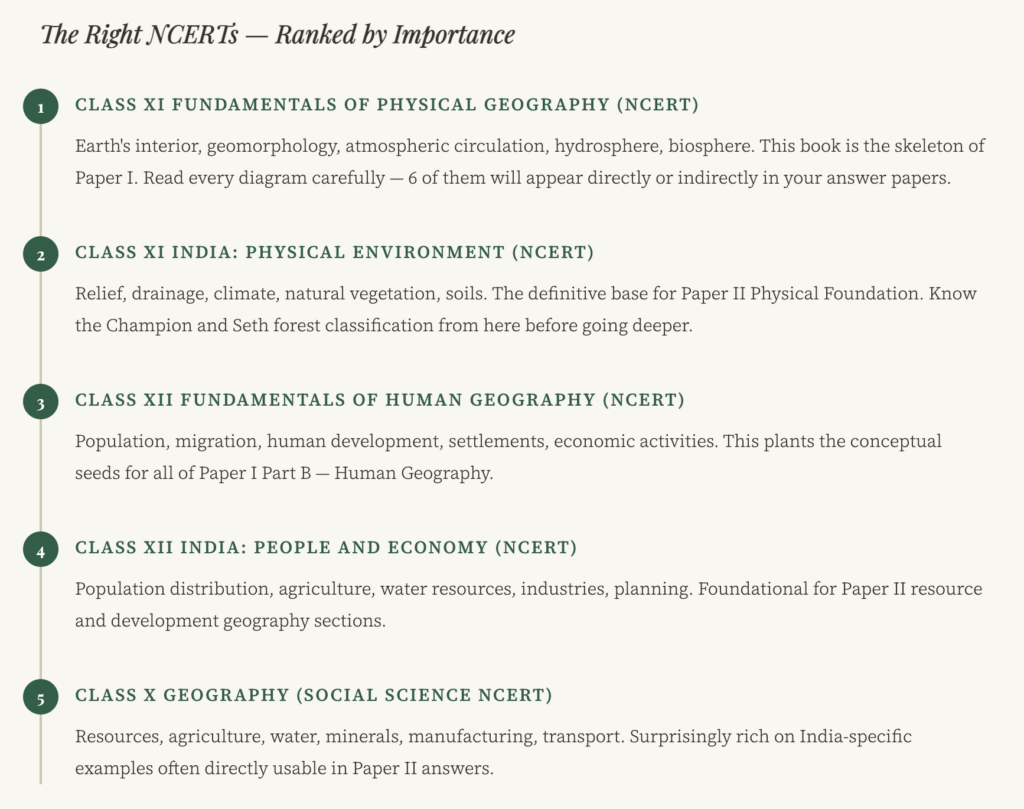
The single most common mistake made by mid-level aspirants — those who have attempted Mains once or twice and are repeating — is bypassing NCERTs as “too basic.” This reflects a fundamental misunderstanding of what NCERTs do.
NCERTs do not teach you content. They install the conceptual vocabulary and visual mental models of geography — the framework upon which all advanced understanding is built. Aspirants who have this foundation find Savindra Singh, Majid Husain, and Strahler intuitive. Those who skip it find the same books laborious and retention poor.
Mastering Physical Geography — The Right Way
Physical Geography intimidates aspirants because it is scientific and process-oriented. Most people approaching Geography from a humanities background find the terminology impenetrable initially. But Physical Geography, once understood through the right framework, becomes one of the most logical and rewarding sections.
The framework is simple: for every phenomenon, ask Process → Landform/Outcome → Spatial Pattern → Theory → Criticism → Contemporary Relevance.
Geomorphology — The Art of Reading Landscapes
The most common complaint: “There are too many theories and they all look similar.” The resolution is to organise theories by the fundamental philosophical question each is answering, not by author.
How to Organise Geomorphological Theories
- Davis (Geographical Cycle) — Structure, Process, Stage. A closed deterministic system. Good for diagrams.
- Penck (Morphological Analysis) — Denudation vs. uplift rate. Convex/concave slopes encode tectonic history.
- King (Pediplanation) — Parallel retreat of slopes in semi-arid environments. Explains African landscapes.
- Hack (Dynamic Equilibrium) — Landscapes in steady state, not evolutionary stages. Criticism of Davis.
Each theory should be prepared with a labelled diagram, a statement of the core argument, its applicability in India (the Deccan Plateau for peneplains, the Rajasthan pediments for pediplanation), and the standard criticism. A well-prepared geomorphology answer integrates all four in 200 words — that is what earns 13–15 marks on a 15-mark question.
Climatology — From Description to Process
The most commonly failed section. Aspirants who score below 10 on monsoon questions invariably describe — those who score 14+ explain the process chain: differential heating of land and sea → pressure gradient → Somali Jet formation → Arabian Sea branch vs. Bay of Bengal branch → orographic intensification → break monsoon conditions → withdrawal. Each link in that chain is a mark’s opportunity.
“Evaluate the dynamic concepts of monsoon and their implications under a changing climate regime.”
PYQ Trend — Climatology
Notice: UPSC never simply asks “describe monsoon.” The word “evaluate” signals that your answer must include the dynamic mechanisms, competing theories (Flohn, Halley, Ramage), and a contemporary climate change dimension. Answers without this three-part architecture cannot score above 10 on a 15-mark question.
Oceanography — The Neglected Goldmine
Oceanography is consistently underrepared and consistently asked. UPSC favours it precisely because it differentiates. Questions on El Niño-Southern Oscillation linkages, thermohaline circulation and climate regulation, coral bleaching and biodiversity loss, and the Blue Economy have appeared with increasing frequency post-2015.
Prepare with the Indian Ocean specifically in mind — IOTC fisheries governance, Agulhas Current dynamics, monsoon-ocean coupling — as these provide India-specific anchoring that examiners reward.
Human Geography — Think Like a Social Scientist
Human Geography is the highest-scoring section of Paper I for candidates who approach it analytically. The reason is structural: Human Geography demands integration of thinkers, theories, quantitative patterns, qualitative examples, and policy implications — and UPSC rewards exactly this kind of synthesis.
Population Geography — Beyond the Numbers
The most common error: treating population geography as a GS-style factual section. Population geography is fundamentally about spatial patterns, process explanations, and temporal change. The DTM is not just a model to describe — it is a lens through which you interpret fertility transition in Kerala vs. Bihar, mortality decline in sub-Saharan Africa, and ageing demographics in Japan and Germany simultaneously.
Population Geography — High-Yield Analytical Frameworks
- Demographic Transition Model — with regional variation and India-state-level differentiation
- Zelinsky’s Migration Transition — linking mobility patterns to development stages
- Ravenstein’s Laws of Migration — critically evaluated with Indian push-pull context
- Lee’s Push-Pull Theory — intervening opportunities, rural-urban migration corridors
- Demographic Dividend — India’s window, demographic trap, gender dimension
Settlement Geography — The Perennial Favourite
Settlement Geography has been asked in almost every UPSC Geography Optional paper since 1986. It is one of the most diagram-rich topics in the syllabus, and it is one where preparation quality is immediately visible to the examiner.
The conceptual architecture to build: rural settlement morphology (nucleated, dispersed, linear, circular) → factors determining rural form → urban morphology → CBD and land-use models (Burgess, Hoyt, Harris-Ullman) → rank-size rule and primate city → sphere of influence and central place theory → rural-urban fringe and urban sprawl dynamics.
“Analyse the concept of sphere of influence of urban centres and its geographical implications for regional development.”
PYQ — Settlement Geography
Economic Geography — Location as Logic
Most aspirants fear Economic Geography because of its quantitative flavour. In practice, UPSC tests the logic of location theory, not computational ability. You need to understand why Weber’s least-cost theory places an industry where transport costs and labour costs are minimised—not to solve the algebraic formula. The conceptual argument, diagrammatically supported, is what earns marks.
Models, Theories & Laws — The True Rank Separator
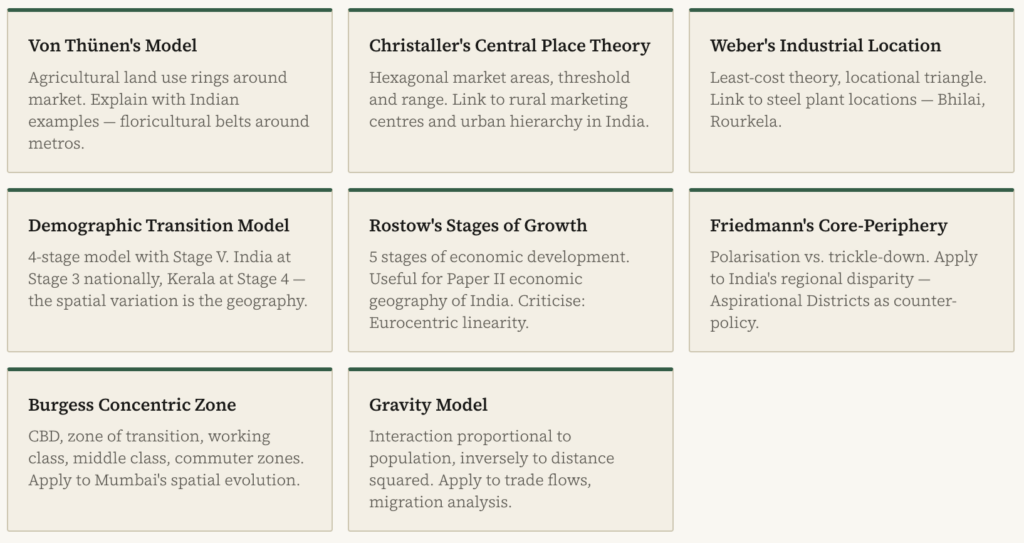
Analysis of 39 years of UPSC Geography Optional PYQs reveals one consistent pattern: candidates who score 310+ have superior command of models and theories. Not because UPSC directly asks “explain Von Thünen’s model” — though it sometimes does — but because models provide the analytical scaffolding that transforms mediocre answers into exceptional ones.
When answering a question on urbanisation in India, the candidate who structures their answer around Friedmann’s Core-Periphery Model, cites Myrdal’s Circular Causation, and concludes with Smart Cities as a contemporary policy intervention is operating at a fundamentally different intellectual level than one who simply lists Mumbai, Delhi, and Bangalore.
The Five-Point Model Framework
For every model, prepare: (1) Origin and proponent with historical context, (2) Core assumptions, (3) Labelled diagram, (4) Application with India-specific example, (5) Critical limitations and contemporary relevance. This framework should take 200–250 words per model in your notes — compact enough for revision, rich enough for any question type.
India Geography Through a Dynamic Lens
Paper II is the section where candidates most commonly underperform relative to their preparation effort. The reason is almost always the same: they prepare it statically. Paper II Indian Geography is increasingly dynamic — UPSC wants you to interpret India’s geographical realities through the lens of contemporary processes, policy, and challenges.
Agriculture — Far Beyond Crops and Seasons
Every aspirant knows Punjab grows wheat. UPSC wants to know why, at what environmental cost, under what policy architecture, and with what implications for water security, farmer income, and the agricultural transition India needs by 2030. The static content is the starting point, not the answer.
High-priority integration points: climate-resilient agriculture and millet promotion (Millets Year 2023), PM-KUSUM solar agriculture, Pradhan Mantri Fasal Bima Yojana as a risk transfer mechanism, the groundwater depletion crisis in the Indo-Gangetic Plain revealed by GRACE satellite data, and the organic farming transition in Sikkim as a model case study.
Urbanisation — A Crisis and an Opportunity
India will have 600 million urban residents by 2031. UPSC Geography Optional questions on urbanisation increasingly demand analysis of urban heat islands, peri-urban transitions, water and sanitation infrastructure deficits, and the equity dimensions of Smart Cities. Aspirants who treat urbanisation as a static demographic fact miss the entire marks opportunity.
Regional Development — The Big-Picture Question
North-South disparity, coastal-interior divide, tribal belt underdevelopment, and the aspiration of India’s north-eastern states — these spatial inequalities are among the most analytically rich topics in Paper II. Prepare with Myrdal’s cumulative causation as your theoretical anchor and the Aspirational Districts Programme as your contemporary policy example.
Paper II Contemporary Integration Checklist
- National Water Policy, river interlinking debates, Ken-Betwa controversy
- PM GatiShakti National Master Plan and multimodal logistics
- Industrial corridors (DMIC, CBIC, BIMSTEC connectivity)
- North East: Act East Policy, BOLD-QIT biodiversity conservation
- Urban: AMRUT 2.0, Smart Cities, climate-resilient city planning
- Environment: NGT jurisprudence, Compensatory Afforestation Fund (CAMPA)
Maps — The Most Underutilised Weapon in Geography Optional
Every serious Geography Optional aspirant knows maps matter. Almost none practise them consistently enough. This is one of the most reliable differentiators between the 250-score candidate and the 310-score candidate, and it is almost entirely a matter of disciplined daily practice rather than talent.
“A good map in a Geography Optional answer does three things simultaneously: it demonstrates spatial knowledge, it structures the answer visually for the examiner, and it communicates what would take 80 words to describe in 15 seconds.”
What to Map — Priority Framework
Not all mapping practice is equally valuable. Prioritise by frequency of examination relevance:
| Category | Specific Items | Paper |
|---|---|---|
| India Physical | Drainage basins, watersheds, passes, mountain ranges, plateaus | Paper II |
| India Agricultural | Crop distribution, irrigation systems, agro-climatic zones | Paper II |
| India Mineral/Energy | Coalfields (Gondwana), petroleum basins, renewable energy corridors | Paper II |
| World Biomes | Tropical rainforests, savannas, Mediterranean, tundra — location + characteristics | Paper I |
| World Ocean Currents | Named currents, gyres, upwelling zones, impact on climate | Paper I |
| Global Tectonic | Plate boundaries, seismic zones, Himalayan orogeny sequence | Paper I |
| Biodiversity Hotspots | All 36 global hotspots, India’s 4 + 1 marine proposed | Papers I & II |
Answer Writing — Where Preparation Finally Meets Performance
Answer writing is the stage where the most preparation effort is wasted — and where the most marks are recoverable with the right structural approach. The single most common failure mode: candidates who have genuinely excellent knowledge but score 7/15 because they write continuous descriptive prose with no structure, no diagram, and no analytical differentiation.
The Three-Layer Answer Architecture
Every Geography Optional answer — regardless of word limit — should operate on three layers simultaneously:
Theory Base (LotusArise Notes / Savindra Singh / Standard Sources)
The conceptual foundation. Definition with thinker citation. The established academic understanding. This is what most candidates have — it is necessary but not sufficient.
India-Specific Data and Examples (Minimum 3–5)
Named places, specific data points, Indian case studies. This is what differentiates UPSC Geography Optional from a world geography exercise. The examiner expects India to be foregrounded in even theoretical questions.
Contemporary Policy or Current Affairs Peg
The analytical superstructure. A recent development, a policy instrument, a global framework — something that demonstrates the aspirant is not studying geography from a museum but engaging with it as a living discipline.
The Answer Framework — Applied
For every answer: Introduction (definition + thinker citation) → Sub-headings reflecting types/components/causes/impacts → Diagram cue with label → India-specific context → Contemporary policy/current affairs peg → Forward-looking conclusion. This is not a rigid formula — it is an analytical architecture that can flex for 10-mark and 20-mark questions alike.
Four Answer-Writing Mistakes That Cost You 30+ Marks
- Continuous prose without sub-headings — examiner cannot identify your arguments. Structure is marks.
- Diagrams without labels — a diagram without labels earns nothing. Every line, every arrow, every feature must be named.
- Introduction that is just a definition — the introduction should set up your analytical argument, not merely define terms.
- Conclusion that summarises instead of synthesises — conclusions should point forward (policy implication, research gap, future trajectory), not backwards.
Notes Architecture for Intelligent Revision
The revision crisis strikes most aspirants 6–8 weeks before Mains: their accumulated notes are 1,500+ pages across multiple books, PDFs, and notebooks — completely unrevision-able in the time available. This crisis is predictable and entirely preventable with the right notes architecture from Day 1.
Three-Tier Notes System
Primary Notes — The Knowledge Repository
Comprehensive conceptual notes. Detailed. All thinkers cited. Full model explanations with diagrams. India examples. This is what you build during main preparation — roughly 800–1000 pages for both papers. You read this once or twice thoroughly.
Secondary Notes — The Condensed Revision Base
Distilled from primary notes. Key frameworks, major arguments, critical examples, PYQ year tags. 300–400 pages. This is your 3rd-4th revision resource — used in the last 3–4 months.
Final Notes — The Last-Week Rescue
20–30 pages per paper. Pure anchors: model names, key thinkers, India data points, current affairs hooks. Written in a form only you can decode. Read the night before every section.
PYQ Analysis — Decoding 39 Years of the Examiner’s Mind
Previous Year Questions are not merely practice material. They are the most precise intelligence available about UPSC’s examination philosophy, topic preferences, question framing conventions, and conceptual depth expectations. Most aspirants use PYQs for practice. The correct approach is to use them for intelligence gathering first, practice second.
Key Patterns From 1986–2025 Analysis
- Ecosystem dynamics, energy flow, and nutrient cycling have been asked in various forms at least 15 times — it is the single most repeated concept in Geography Optional
- Environmental Geography questions have increased sharply post-2015, averaging 3–4 questions per year vs. 1–2 pre-2015
- Carbon Neutrality appeared in 2021 and 2024 — expect continued presence as India’s NDC commitments evolve
- PAVE theory was asked in 2017 and 2024 — suggesting it is now a permanent fixture of the UPSC conceptual canon
- Deep Ecology (2023) represents UPSC’s growing interest in philosophical dimensions of environmental geography
- Settlement Geography has never gone more than two consecutive years without a question — and often features in both papers
- Regional planning models (Friedmann, growth poles) appear cyclically every 3–4 years — predictably overdue if absent recently
LotusArise PYQ Analysis — Available in “Geography Optional 300+ Score Pack“
A comprehensive analysis of 39 years of UPSC Geography Optional PYQ patterns (1986–2025), covering topic-wise frequency, decade-wise trend shifts, and actionable preparation implications, has been published on the LotusArise IAS website. This is the most detailed PYQ analysis available for Geography Optional anywhere online.
Current Affairs Integration — Enrichment, Not Substitution
A critical nuance that most coaching institutes get wrong: current affairs should enrich Geography Optional answers, not dominate them. Aspirants who convert Geography Optional preparation into extended current affairs reading inevitably find their conceptual depth eroding while their answer length increases — a net negative outcome.
The correct model: Geography Optional concepts are the skeleton. Current affairs are the muscle. Every concept you study should have a current affairs hook — a recent policy, data point, event, or international framework that gives the concept contemporary relevance without displacing the conceptual treatment.
High-Yield Current Affairs Anchors — 2024–2025
| Theme | Current Affairs Hook | Linked GS Topics |
|---|---|---|
| Carbon Neutrality | India’s NDC update, Net Zero 2070, Carbon Credit Trading Scheme (CCTS) | GS III Environment, Economy |
| Biodiversity | Kunming-Montreal GBF targets (30×30), IPBES reports, Project Snow Leopard | GS III Environment |
| Ocean Geography | High Seas Treaty (BBNJ Agreement), India’s Deep Ocean Mission | GS II International Relations |
| Urban Geography | AMRUT 2.0, Smart Cities completion, urban heat island data from IMD | GS I Society |
| Agriculture Geography | PM-PRANAM, Millets as Shree Anna, National Agroforestry Policy | GS III Agriculture |
| Disaster Geography | Sendai Framework progress, India’s NDMA reforms, CDRI and LiFE | GS III Disaster Management |
| Regional Development | PM GatiShakti, Aspirational Districts 2.0, North-East connectivity push | GS II Governance |
The 12-Month Preparation Timeline
Geography Optional rewards those who build understanding progressively — it cannot be rushed or crammed. The following timeline is designed for a first-time aspirant with no prior geography background who begins 12 months before Mains. Experienced aspirants can compress Phase 1–2.
Months 1–2: Foundation (NCERTs + Syllabus Mapping)
Read all relevant NCERTs cover to cover. Map every NCERT chapter to the UPSC syllabus. Mark diagrams for future recall. Simultaneously, read PYQs (not for answers — just to understand what questions look like).
Months 3–5: Core Concept Building (Standard Sources)
Savindra Singh for Physical and Environmental Geography. Majid Husain for Human Geography. Khullar for India Geography. Build primary notes alongside reading — do not read then note separately. Start short daily answer writing from Month 4.
Months 6–7: Models, Theories, and PYQ Integration
Deep preparation of all models in the grid above. Begin PYQ analysis — topic by topic. Map which subtopics are most frequently asked. Begin integrating current affairs into notes systematically. Daily maps practice starts here.
Months 8–9: Paper II India Geography Intensive
Full Paper II preparation with dynamic lens. Every section anchored in recent developments. Atlas work — district-level India maps for resources, industries, agriculture. Begin full-length answer writing sessions.
Months 10–11: Test Series + Revision Architecture
Join test series (LotusArise Test Series recommended). Build secondary notes from primary. Weekly full-paper simulations. Diagnose weak areas and return to primary notes selectively. Current affairs update boxes refreshed.
Month 12: Final Revision + Consolidation
Three revisions of secondary notes. Build final notes (20–30 pages per paper). Maps daily. PYQ papers under timed conditions. Diagram practice without reference. Read LotusArise current affairs update boxes.
The Final Reality Check
Geography Optional is not a shortcut. No optional is. It is a discipline that requires conceptual depth, spatial imagination, diagrammatic fluency, and the intellectual stamina to integrate theory, India-specific data, and contemporary relevance under timed examination conditions.
But for aspirants who invest in this discipline with the right strategy — not merely effort, but directed, structured, PYQ-anchored effort — Geography Optional is one of the most intellectually satisfying and strategically rewarding optional subjects in the Civil Services examination.
“The aspirant who scores 320 in Geography Optional is not more intelligent than the one who scores 260. They have made better architectural decisions about how to study, what to study, and how to write.”
The ideal journey is clear: Syllabus analysis → NCERTs → Concept building with standard sources → Model and theory mastery → Mapping practice → Current affairs integration → PYQ-led preparation → Three-layer answer writing → Intelligent notes architecture → Test series → Mains.
Those who follow this sequence with consistency and intellectual honesty — reviewing their test series answers without defensiveness, revisiting gaps without embarrassment, building the habit of geographical thinking into how they read the newspaper, watch the news, and observe the world — emerge as the candidates Geography Optional was always designed to reward.
Begin Your Geography Optional Journey with LotusArise IAS
LotusArise IAS (lotusarise.com) provides PYQ-driven Geography Optional notes, a comprehensive test series, and structured courses — all built around the exact preparation architecture this guide describes. Notes are written on the three-layer model with PYQ year tags, India-specific data, and quarterly-updated current affairs boxes. For aspirants who want the industry’s most analytically rigorous Geography Optional support, LotusArise is the starting point.