

The Anatomy of a 300+ Score — What Actually Changes
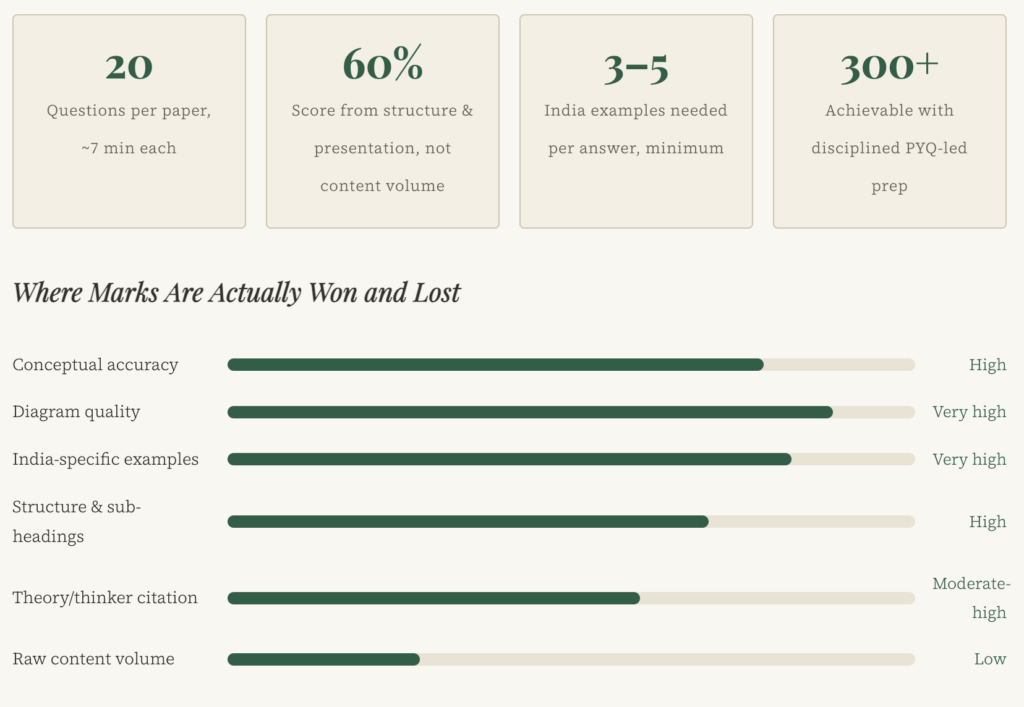
Every year, a handful of Geography Optional candidates cross 300 out of 500 — a threshold most aspirants treat as aspirational rather than achievable. Having studied the answer patterns, notes architecture, and preparation habits of candidates who have crossed this mark, one finding stands out: the gap between 260 and 310 is rarely a knowledge gap. It is a structural and strategic gap.
A candidate scoring 260 and a candidate scoring 310 frequently know the same theories, have read the same Savindra Singh chapters, and recall similar facts about Indian agriculture. What separates them is not what they know — it is how they deploy what they know inside a 7-minute answer window under examination pressure.
“300 is not a content score. It is a presentation score built on a content foundation. Most aspirants over-invest in the foundation and under-invest in the presentation.”
Why More Books Never Get You Past 270
There is a specific failure pattern visible across aspirants stuck between 230 and 270: an ever-expanding reading list. Savindra Singh, then Majid Husain, then Khullar, then five YouTube channels, then a coaching institute’s printed material, then another institute’s test series booklet. Each addition feels like progress. None of it moves the score.
The reason is simple — at 260, the limiting factor is rarely missing content. It is the inability to organise existing content into an examiner-friendly answer within the time available. Adding more sources adds more raw material to an already poorly organised system. It does not fix the organisation problem; it makes it worse.
The Diminishing Returns Curve of Extra Books
- Book 1 (a solid core text): builds 70% of your conceptual base
- Book 2 (a second standard reference): adds 15% — mostly useful cross-validation
- Book 3 onward: adds 2–3% each, but consumes disproportionate revision time
- Net effect beyond two core sources: time lost to consolidation exceeds marginal content gained
One pattern that consistently appears among candidates who eventually cross 300: they consolidate early. A senior Geography Optional ranker once described it plainly — the year they stopped buying new material and instead rewrote their existing notes three times was the year their score jumped by 40 marks. Several aspirants following that same consolidation principle have leaned on the LotusArise IAS Geography Optional Course precisely because it compresses the multi-source problem into one coherent, PYQ-mapped syllabus walkthrough, freeing up months that would otherwise go into chasing more material.
Concept Over Content — The First Discipline of a 300+ Score
UPSC Geography Optional, at the 300+ tier, is overwhelmingly a test of conceptual command, not factual recall. The questions that separate 12/15 answers from 7/15 answers are almost always conceptual probes — “evaluate,” “critically discuss,” “examine the validity of” — disguised as topic-based questions.
The Process-Pattern-Theory-Criticism Loop
For every topic in Physical Geography and a large part of Human Geography, train yourself to run a fixed mental loop before writing: What is the process? What spatial pattern does it produce? Which theory explains it? What is the standard criticism of that theory? What is the contemporary application? This loop, applied consistently, converts a descriptive answer into an analytical one — and analytical answers are what cross the 60% mark threshold per question.
Illustration — Same Topic, Two Treatments
Descriptive treatment: “Pediplanation is the process by which slopes retreat in semi-arid areas, producing pediments and inselbergs.” (Scores ~6/15)
Analytical treatment: Process (parallel slope retreat under King’s model) → pattern (pediment-inselberg landscape) → theoretical lineage (critique of Davis’s slope decline) → Indian application (Rajasthan pediments, Aravalli inselbergs) → contemporary relevance (desertification monitoring via remote sensing). (Scores 13+/15)
“ I stopped trying to write everything I knew and started writing only what answered the actual verb in the question — evaluate, discuss, critically examine. That single shift, more than any book, is what took my Paper I from 145 to 178.
— A recurring observation among Geography Optional aspirants who later cleared the exam
Diagram Density — The Silent Marks Multiplier
If there is one single habit that most reliably separates 300+ scorers from the rest, it is diagram density — the number of well-labelled, relevant diagrams per answer booklet, not per answer. A candidate who places 25–30 diagrams across a 20-question paper is operating at a different visual and analytical register than one who places 5.
What Makes a Diagram Marks-Worthy (Not Just Decorative)
- Every line, arrow, and feature is labelled — an unlabelled diagram is functionally a doodle to the examiner
- The diagram is placed where it replaces text, not alongside redundant text describing the same thing
- It is drawn before you finish describing the concept in words — diagram-first thinking, not diagram-as-afterthought
- Complex process diagrams (monsoon mechanism, demographic transition curve, Burgess concentric zones) are rehearsed dozens of times before the exam — not attempted for the first time in the exam hall
The discipline required here is almost athletic — diagrams must be practised to the point of muscle memory, the same way a classical musician rehearses scales. Aspirants preparing through the LotusArise IAS Geography Optional Course often mention that the dedicated diagram bank — pre-drawn, labelled, and organised by topic — became their single most revisited resource in the final 90 days, precisely because it removed the guesswork of “is this diagram good enough” at a stage when there was no time left to find out the hard way.
The India Anchor — Why Every Answer Needs It
UPSC Geography Optional is, structurally, a paper about the world taught through an Indian lens. Even Paper I questions on global phenomena — biomes, ocean currents, urban models — earn disproportionately higher marks when the answer is anchored with Indian examples, data, or case studies, because the examiner is implicitly checking whether the candidate can localise universal theory.
| Universal Concept | India Anchor That Earns Marks |
|---|---|
| Von Thünen’s land use rings | Floriculture and dairy belts around Bengaluru, Pune, NCR |
| Köppen climate classification | India’s own climatic diversity — Cherrapunji to Jodhpur in one country |
| Demographic Transition Model | Kerala (Stage 4) vs. Bihar (Stage 2-3) — intra-country variation |
| Central Place Theory | Rural periodic markets (haats) in tribal belts of Chhattisgarh, Odisha |
| Biodiversity hotspots | Western Ghats, Himalaya, Indo-Burma, Sundaland (India’s four) |
The rule of thumb followed by most high scorers: no answer leaves the page without at least three named Indian places, policies, or data points — even on a purely theoretical question. This single habit, applied across 40 answers in the two papers, can plausibly account for 20–30 additional marks in aggregate.
Theory Fluency — Deploying Models Under Pressure
Knowing a model and being able to deploy it inside a 200-word answer under timed pressure are two entirely different skills. Most aspirants can recite Weber’s least-cost theory if asked directly. Far fewer can recognise, mid-exam, that a seemingly unrelated question on India’s steel industry location is actually a Weber question in disguise — and respond accordingly within seconds of reading the question.
- Von Thünen – Agricultural zonation by transport cost — deploy for any “explain the pattern of X crop/dairy belt” question
- Weber’s Least Cost – Industrial location — deploy whenever a question asks “why is X industry located where it is”
- Christaller’s CPT – Market hierarchy and service areas — deploy for settlement hierarchy and rural marketing questions
- Friedmann’s Core-Periphery – Regional disparity — deploy for any “regional imbalance” or “uneven development” framing
This pattern-recognition skill — seeing the underlying model inside a disguised question — is precisely what separates a candidate who has merely read about models from one who has internalised them as analytical tools. It is also the skill most directly trainable through structured mock answer evaluation, which is why many aspirants treat their test series performance, not their notes, as the real diagnostic of where their model fluency actually stands.
PYQ-Led Preparation — Studying What Is Actually Asked
A 39-year analysis of UPSC Geography Optional PYQs (1986–2025) reveals a discipline-defining truth: a relatively small set of core themes account for a disproportionate share of total questions asked. Ecosystem dynamics and energy flow, settlement morphology, monsoon mechanisms, location theories, and — increasingly post-2015 — Environmental Geography concepts like carbon neutrality, PAVE theory, and deep ecology recur with striking regularity.
What PYQ-Led Preparation Actually Means in Practice
- Every topic in your notes carries a PYQ year tag — so you instantly know its examination weightage
- High-frequency topics (asked 8+ times since 1986) get disproportionately more diagram and model rehearsal
- Topics asked once or never get covered for safety, but not over-invested in
- You can predict, with reasonable confidence, which 60–70% of the paper will draw from a known core, leaving genuine surprise to only 30–40%
Several Geography Optional toppers credit this exact discipline — treating PYQs as the primary syllabus, not supplementary practice — as the single highest-leverage activity in their preparation. It is also the foundation on which the LotusArise IAS Geography Optional 300+ Score Pack is built: every topic inside it is sequenced and weighted according to its actual 1986–2025 PYQ frequency, so the time spent studying is proportionate to the time UPSC actually rewards.
Current Affairs as Marks Multiplier, Not Burden
At the 300+ tier, current affairs integration is not optional polish — it is often the deciding factor between a 12 and a 15 on a 15-mark question. The examiner is explicitly looking for evidence that the candidate engages with geography as a living, evolving discipline rather than a closed textbook subject.
| Static Concept | Marks-Earning Contemporary Peg |
|---|---|
| Carbon cycle / climate geography | India’s Net Zero 2070 target, Carbon Credit Trading Scheme |
| Biodiversity conservation | Kunming-Montreal Global Biodiversity Framework’s 30×30 target |
| Ocean governance | High Seas Treaty (BBNJ), India’s Deep Ocean Mission |
| Urban geography | Urban heat island data, AMRUT 2.0 implementation gaps |
| Disaster geography | Sendai Framework mid-term review, NDMA reforms |
The discipline here is to maintain a small, quarterly-updated “current affairs box” attached to each chapter of your notes — not a separate, unwieldy current affairs file that competes for revision time. This is precisely the format used inside LotusArise IAS notes.
Answer Writing — The 200-Word Discipline
A 15-mark question gives you roughly 200–250 words and 9–10 minutes. Within that constraint, a 300+ scorer fits a definition with a thinker’s name, a clearly labelled diagram, a sub-headed analytical structure, at least three India-specific examples, one contemporary peg, and a forward-looking conclusion. This sounds impossible until it is rehearsed into a repeatable template.
Introduction (20–25 words)
Definition with a thinker citation. Sets the conceptual frame immediately — the examiner forms a first impression here.
Body with sub-headings (120–140 words)
Two to three sub-headed sections covering causes/types/components as the question demands — never continuous prose.
Diagram (placed inline, not appended)
One labelled diagram that replaces a paragraph of description — drawn at the point in the answer where it is most relevant.
Contemporary peg (15–20 words)
One specific policy, data point, or recent development that grounds the answer in 2024–2026 reality.
Conclusion (15–20 words)
Forward-looking — implication, trajectory, or policy direction. Never a flat summary of what was just written.
This template should be rehearsed until it becomes near-automatic — the same way a classical musician’s fingers find the right keys without conscious thought. The only way to build that automaticity is repeated, evaluated practice, which is exactly why most candidates who eventually cross 300 describe their test series phase, not their reading phase, as where the real score jump happened.
Why Test Series Is Non-Negotiable Past 270
There is a hard ceiling that self-study alone rarely breaks through, and it sits almost exactly around 260–270. The reason is structural: a candidate cannot accurately evaluate their own diagram quality, structural discipline, or word-economy under exam conditions. Self-assessment is blind to one’s own blind spots by definition.
What a Good Evaluation Should Tell You
- Whether your diagram earned marks or was treated as decorative by the evaluator
- Whether your introduction set up an argument or merely repeated the question
- Whether your India examples were specific enough or generically named without elaboration
- Whether your time allocation across 20 questions left weaker answers under-attempted
This is the exact gap a structured, examiner-style evaluated test series is designed to close — and it is why aspirants who plateau around 260 for two attempts in a row most often break through only after committing to a properly evaluated test series rather than another round of solo reading. The test series component built into the LotusArise IAS Geography Optional 300+ Score Pack is structured precisely on this principle — full-length, PYQ-pattern papers evaluated against the same three-layer architecture (theory, India anchor, contemporary peg) this guide has walked through.
The Last 60 Days — Where 300 Is Actually Won
A counter-intuitive finding from studying high-scoring candidates’ preparation timelines: the final 60 days contribute disproportionately to the difference between a 270 and a 310 score, far more than the preceding ten months. This is not because new content is learned in this window — almost none is. It is because this is when fluency is built.
Days 60–40: Full-syllabus diagram drilling
Every major diagram from both papers, drawn from memory, timed. No new content — pure rehearsal.
Days 40–20: Full-length timed mocks, twice weekly
Complete 500-mark papers under exact exam conditions, evaluated, with errors logged in a single running document.
Days 20–7: Final notes consolidation
Reducing to the 20–30 page final notes per paper — pure anchors, no new reading.
Days 7–1: Pure recall, zero new input
Reading only final notes and current affairs update boxes. No new books, no new sources — discipline matters more than diligence here.
The single most common mistake in this window is treating it as more reading time rather than rehearsal time. The candidates who cross 300 almost universally describe their last two months as repetitive, almost boring — the same diagrams, the same models, the same answer template, over and over — precisely because that repetition is what converts knowledge into reflex.
The Complete 300+ Checklist
Before you sit for Mains, run through this checklist honestly. Each unchecked item is a quantifiable number of marks left on the table.
- Every chapter’s notes carry a PYQ year tag indicating examination weightage
- At least 25 diagrams across both papers are rehearsed to the point of automatic recall
- Every answer template includes a minimum of three named India-specific examples
- All eight core location/settlement/demographic models can be deployed within 30 seconds of recognising a disguised question
- Each chapter has a quarterly-refreshed current affairs update box, not a separate sprawling current affairs file
- At least 8–10 full-length papers have been attempted under timed conditions and formally evaluated
- Final notes are compressed to 20–30 pages per paper, readable in under two hours each
- The last two weeks before Mains involve zero new content — pure recall and rehearsal only
“300+ is not the reward for reading more. It is the reward for converting what you already know into something an examiner can recognise as excellence in under ten minutes, twenty times in a row.”
The strategy in this guide is not exotic. It is, in fact, remarkably ordinary — concept before content, diagram before decoration, India before the world, PYQ before guesswork, rehearsal before reading. What is rare is the discipline to actually follow it consistently for ten to twelve months. Aspirants who have walked this path and built their preparation around exactly this sequence — often using the LotusArise IAS Geography Optional 300+ Score Pack as the backbone that keeps notes, diagrams, current affairs, and testing all pulling in the same direction — are disproportionately represented among those who eventually do cross 300.