

“Buying 14 standard reference books feels satisfying, but reading 7,000 pages while preparing GS and Prelims is a recipe for burnout. What toppers actually do is streamline.”
LotusArise Self-Study Advisory
1. The Textbook Hoarding Fallacy in UPSC PSIR Preparation
Every beginner searching for the Best PSIR Optional Booklist for UPSC is greeted with an overwhelming laundry list: O.P. Gauba, Andrew Heywood, George Sabine, Brian Nelson, B.L. Fadia, Oxford Companions, Baylis & Smith, David Malone, and Sumit Ganguly.
Buying this 14-volume library costs over ₹15,000 and totals more than 7,500 pages of dense, uncurated academic prose. Aspirants spend four months wading through the introductory chapters of Heywood and Gauba, only to realize they have covered less than 15% of the syllabus while Mains answer writing remains untouched. To score 300+ in PSIR, you must distinguish between reference books and an actionable study syllabus.
2. The Critical Audit: Standard Books vs Syllabus Reality
Here is an honest appraisal of the standard textbooks commonly recommended by coaching institutes:
| Syllabus Section | Commonly Recommended Standard Book | Pedagogical Strength | The Critical UPSC Mains Limitation |
|---|---|---|---|
| Political Theory (1A) | O.P. Gauba / Andrew Heywood (Politics) | Accessible introductions to concepts like liberty and rights. | Lacks comparative scholar dialectics and 150/250-word answer calibration. |
| Western Thinkers (1A) | Brian Nelson / Subrata Mukherjee & Sushila Ramaswamy | Comprehensive biographical narratives. | Extremely bulky (600+ pages); lacks the 5-point exam-oriented anatomy. |
| Indian Govt & Politics (1B) | B.L. Fadia & Kuldeep Fadia / Oxford Companion | Exhaustive institutional coverage. | Reads like an encyclopedia; impossible to revise during Mains crunch. |
| Comparative Politics (2A) | J.C. Johari | Covers classical systems and approaches. | Dated prose; lacks contemporary post-colonial and globalization updates. |
| Global Politics (2A) | Baylis, Smith & Owens (Globalization of World Politics) | Global gold standard for IR theories. | Over 700 pages of Western-centric examples with zero Indian foreign policy integration. |
| Indian Foreign Policy (2B) | David Malone (Does the Elephant Dance?) | Superb historical narrative of diplomacy. | Published in 2011; completely outdated for 2026/2027 geopolitical dynamics. |
3. The Streamlined Self-Study Core Booklist for 2026/2027
If you choose to read standard reference books, limit yourself strictly to this high-yield, curated core list:
- Paper 1 Part A (Theory & Thinkers): O.P. Gauba (An Introduction to Political Theory) for baseline definitions, supplemented by Western Thinkers summaries.
- Paper 1 Part B (Indian Government & Politics): Bidyut Chakrabarty & R.K. Pandey (Indian Government and Politics) or select chapters from the Oxford Companion to Politics in India (Niraja Gopal Jayal & Pratap Bhanu Mehta).
- Paper 2 Part A (Comparative & International Politics): Andrew Heywood (Global Politics)—far more readable and exam-relevant than Baylis & Smith.
- Paper 2 Part B (India and the World): S. Jaishankar (The India Way & Why Bharat Matters) alongside Ministry of External Affairs annual reports.
4. The Modern Solution: Replacing 7,000 Pages with Modular Notes
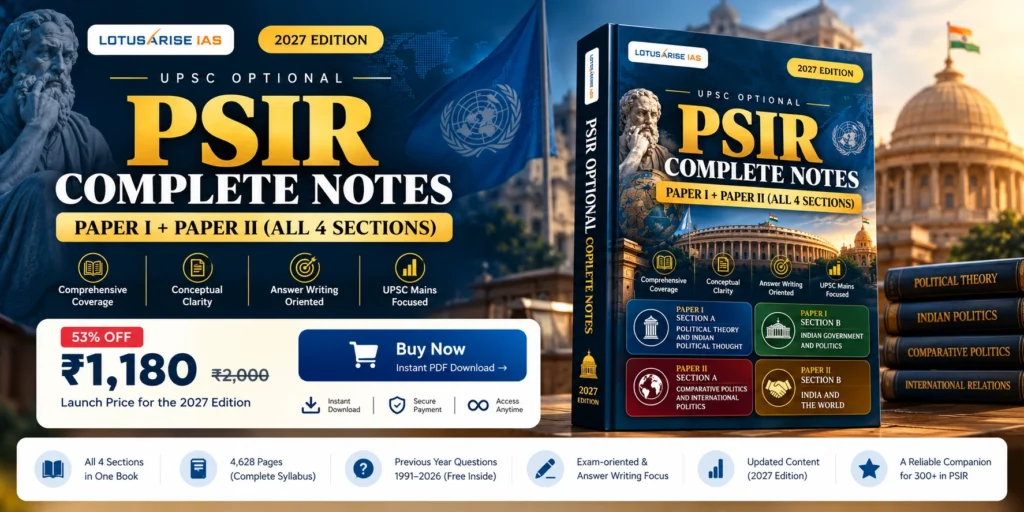
The modern topper approach skips reading 14 separate physical textbooks from cover to cover. Instead, successful self-study candidates use LotusArise Complete PSIR Notes as their primary single source.
LotusArise notes synthesize the best insights from Gauba, Heywood, Nelson, Austin, Kothari, and Baylis & Smith into a structured, exam-calibrated curriculum. Every topic includes:
- Crisp definitions and theoretical genealogies.
- Comparative thinker tables (Thesis vs Critique).
- Contemporary institutional and geopolitical case studies.
- Direct integration with Modular Revision Booklets for rapid 72-hour consolidation.
5. Calculating the ROI of Standard Books vs Curated Systems
Consider the preparation arithmetic between two candidate pathways:
The Traditional Textbook Pathway:
14 physical books • 7,500 total pages • 6 to 8 months of passive reading • 0 standardized answer templates • High risk of revision failure in the final 100 days.
The Modern Modular Notes Pathway:
Single integrated syllabus curriculum • 100% syllabus alignment across all 40 units • 2.5 months of active conceptual mastery • 643-page high-yield revision cards • Direct access to 35 years of solved PYQs.
6. Strategic Conclusion: Final Advice for Optional Book Selection
To build an efficient, stress-free optional preparation:
- Do not buy all books at once: If you buy reference books, read only specific syllabus-mapped chapters rather than entire volumes.
- Anchor in syllabus units: Check each topic against the comprehensive PSIR Optional Notes Directory.
- Test against real questions: Before buying any supplementary book, check whether past 10-year prompts are already covered in the PSIR PYQ Solutions Bank.
- Adopt the Master Kit: Review the complete self-study curriculum in the PSIR Mains Master Kit.
Replace 7,000 Pages of Bulky Textbooks with One System
Streamline your PSIR preparation. Get the complete syllabus-calibrated notes, 643-page revision booklets, and 35-year PYQ solutions in the LotusArise Master Kit.