

“I have 6 thick spiral booklets totaling nearly 2,000 pages. Prelims is cleared, Mains is in 90 days, and I haven’t even revised Paper 1 once. How will I ever revise this before exam day?”
The recurring post-Prelims panic of UPSC PSIR candidates
Every year, within forty-eight hours of the UPSC Prelims results, a quiet panic sweeps through the study rooms of Political Science and International Relations (PSIR) candidates. Aspirants who spent months feeling secure because they had read through their coaching notes suddenly confront the unforgiving mathematics of the Mains timetable.
Looking at the six bulky, yellow-and-white spiral bundles stacked on their desk, candidates are forced to ask: Are Shubhra Ranjan Notes Too Voluminous to Revise in the grueling 100-day window between Prelims and Mains?
The unfiltered operational reality is: yes, 2,000 pages of conversational classroom dictation are structurally impossible to revise multiple times during the Mains crunch. Because UPSC Mains evaluates rapid recall and structured articulation under extreme time pressure, an un-revisable 2,000-page note pile transforms from an asset into an active liability.
Below is a forensic breakdown of the 100-day revision crunch, why DIY short-note-making fails, and how the LotusArise 5 Modular Revision Booklets (~643 pages total) solve the volume crisis and deliver stress-free 72-hour pre-exam revision.
1. Are Shubhra Ranjan Notes Too Voluminous to Revise: The 100-Day Math
Before analyzing why candidates hit a revision wall, examine the mathematical reality of revising coaching dictations versus a modular revision system:
| Revision Parameter | Shubhra Ranjan Classroom Dictation | LotusArise Modular Revision System |
|---|---|---|
| Total Page Count | ~1,980 pages across 6 bulky spiral volumes | ~643 pages across 5 targeted revision booklets |
| Reading Speed Required | ~10 pages/hour (conversational prose requires continuous filtering) | ~25 pages/hour (structured bullet frames, tables, and bolded keywords) |
| Time for 1 Revision Cycle | ~198 study hours (~25 full 8-hour study days) | ~26 study hours (~3 full study days) |
| Possible Cycles in 100 Days | At most 1 full cycle (leads to severe recall decay) | 4 to 5 complete revision cycles (guarantees photographic recall) |
| Final 72-Hour Feasibility | Impossible; candidate can only glance through 1 booklet | 100% complete revision of all 4 papers in 72 hours |
| Exam Hall Execution | Hesitant recall; disorganized answers; 240-mark plateau | Immediate recall of exact scholar matrices and contemporary IR frameworks |
2. The 100-Day Mains Crunch: Breaking Down the Preparation Time
As outlined in the official UPSC Civil Services Examination notification, the Mains examination comprises nine intensive subjective papers conducted over two consecutive weekends. When evaluating whether Are Shubhra Ranjan Notes Too Voluminous to Revise, aspirants must honestly audit their available study hours.
Between Prelims in late May and Mains in September, you have roughly 100 calendar days. Assuming an aggressive 10 hours of daily study, you have a fixed budget of 1,000 total study hours. Here is how that budget is inevitably distributed:
- General Studies 1, 2, 3 & 4: Minimum 450 hours (History, Geography, Polity, Economy, Environment, Security, Ethics).
- Essay Preparation & Mock Writing: 80 hours (brainstorming, quote collection, 8 full-length essays).
- Compulsory Indian Language & English: 40 hours.
- Full-Length Test Series Writing & Mentorship Analysis: 130 hours (writing 8 optional tests + 8 GS tests takes 48 hours of writing alone, plus reviews).
This leaves you with at most 300 net hours for your entire PSIR optional revision. If a single pass through 1,980 pages of Shubhra Ranjan notes takes nearly 200 hours, you can barely finish one complete revision cycle before exam day begins.
3. The 2,000-Page Trap: Why Reading Once Is Worse Than Not Reading
In cognitive science, the Ebbinghaus Forgetting Curve proves that without active revision, human memory retains less than 20% of detailed textual information after 30 days. In an exam like UPSC PSIR, where an answer in Western Political Thought demands quoting specific scholars (Plato, Aristotle, Machiavelli, Hobbes, Locke, Rousseau, Mill, Marx, Gramsci, Arendt), a single passive reading is lethal.
When an aspirant enters the examination hall having revised their notes only once three months prior, their answers suffer from three fatal symptoms:
- The “Vague Memory” Hesitation: The candidate spends 2 precious minutes per question trying to remember whether Quentin Skinner was a Cambridge School theorist or a Marxist critic, destroying their 7-minute time budget.
- The Imbalanced Syllabus Syndrome: Because students always start revising from Paper 1A, they revise Western Political Thought three times, but enter the exam hall having barely skimmed Paper 2B (Indian Foreign Policy). Consequently, their Paper 2 score collapses to 110 marks.
- General Studies Dilution: When optional concepts are not razor-sharp, the candidate instinctively writes General Studies-style bullet points, losing the academic optional edge.
4. The DIY Summary Trap: 200 Lost Study Hours
Recognizing the volume crisis of 2,000 pages, the default advice given to aspirants is: “Make your own short notes.”
While making short notes sounds virtuous, for an optional as vast as PSIR, manual condensation is a catastrophic time trap. To condense 2,000 pages of conversational dictation into 300 pages of crisp revision sheets requires reading the material, deciding what to omit, writing it by hand or typing, and cross-referencing with PSIR PYQs. This process takes at least 200 to 250 focused hours.
Spending 250 hours summarizing notes between June and August means sacrificing answer-writing practice, ignoring GS-3 and GS-4 Ethics case studies, and burning out before the exam even begins.
5. The LotusArise Solution: 5 Modular Booklets (~643 Pages)
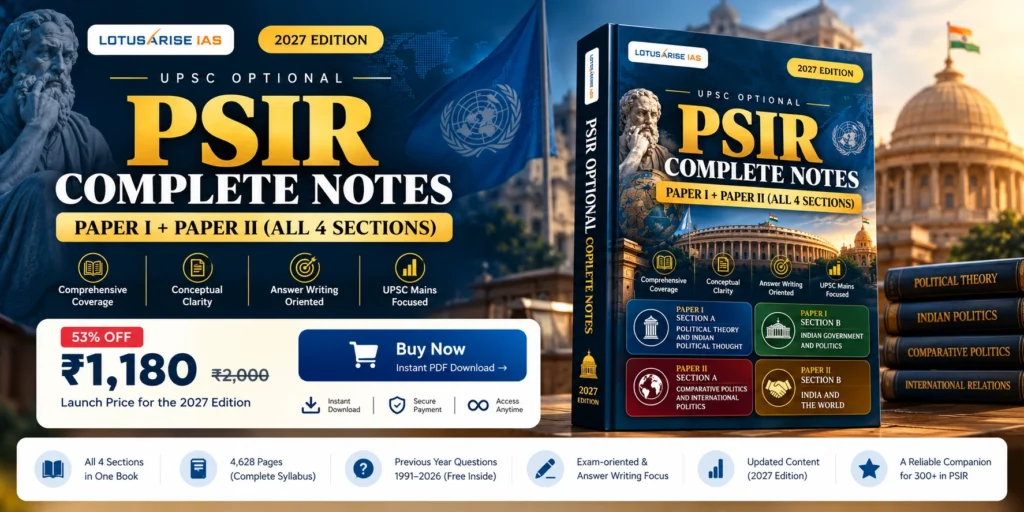
To eliminate the revision crisis forever, LotusArise engineered the 5 Modular Revision Booklets (~643 pages total) as the hero revision engine for UPSC Mains 2026/2027:
Instead of forcing candidates to make their own summary cards, LotusArise synthesized the entire UPSC PSIR optional curriculum into five lean, high-density booklets calibrated strictly for rapid pre-exam recall:
- Booklet 1: Political Theory & Thinkers (142 pages) — Complete thinker matrices, core ontological concepts, and ready-to-write 20-marker frames from Plato to contemporary political theory.
- Booklet 2: Indian Government & Politics (138 pages) — High-yield institutional debates citing Atul Kohli, Christophe Jaffrelot, Suhas Palshikar, Upendra Baxi, and landmark Supreme Court jurisprudence.
- Booklet 3: Comparative Politics & IR Theory (126 pages) — Realism, Liberalism, Constructivism, Marxist IR, post-colonial state theories, and global political economy dialectics.
- Booklet 4: India and the World (135 pages) — Cutting-edge 2026/2027 foreign policy frameworks: Global South leadership, minilateral security networks (Quad, I2U2, IMEC), and tech diplomacy.
- Booklet 5: Master PYQ Skeletons (102 pages) — Topic-wise answer structures for every recurring question from 1991–2026 UPSC Mains.
At an average of ~130 pages per booklet, a candidate can comfortably revise one entire booklet in 5 hours. That means the entire optional can be completely revised in just 26 study hours, enabling you to execute four complete revision cycles before Mains.
6. Final Verdict: The Winning 72-Hour Pre-Mains Blueprint
If you are deciding your revision architecture for UPSC Mains 2026/2027, here is your definitive, battle-tested blueprint:
- Do not attempt to revise 2,000 pages of raw dictations in the final 100 days. You will run out of time, suffer severe anxiety, and experience memory collapse in Paper 2.
- Do not waste 200 hours making handwritten summary notes from scratch. That time belongs to answer writing, GS test series, and Essay practice.
- Adopt the Modular Revision Engine: Rely on the LotusArise 5 Modular Revision Booklets (~643 pages) as your dedicated Mains weapon. Use them for active recall, complete 4 to 5 rapid revision passes, and enter the examination hall with photographic clarity on every thinker, debate, and IR doctrine.
Solve the PSIR Volume Crisis Forever
Never let 2,000 pages of bulky dictations destroy your pre-exam confidence. Equip yourself with the 5 modular LotusArise Revision Booklets (~643 pages total) engineered specifically for 72-hour pre-Mains consolidation and 300+ scores.