

“Ma’am’s notes are 2,000 pages, but toppers say read Gauba, Heywood, and Baylis & Smith. If I read the books, when will I revise?”
The perpetual dilemma of every serious UPSC PSIR aspirant
If you have chosen Political Science and International Relations (PSIR) for the UPSC Civil Services Examination, you have almost certainly confronted this dilemma: Are Shubhra Ranjan notes enough for PSIR, or do you need to spend hundreds of hours plowing through standard academic treatises?
Walk through the photocopy stalls of Old Rajinder Nagar, and seniors will give you two diametrically opposed pieces of advice. The coaching loyalist will tell you: “Just memorize ma’am’s notes line by line; toppers didn’t touch a single book.” Meanwhile, academic rankers and interview toppers will counter: “Coaching notes are too generic; without O.P. Gauba, Andrew Heywood, and academic journal citations, your answers will lack depth and stagnate at 240 marks.”
Both viewpoints contain a grain of truth, yet following either dogmatically leads to disaster. In reality, evaluating whether Are Shubhra Ranjan notes enough for PSIR exposes a classic structural dilemma: coaching notes create an evaluation plateau at 240–255 marks, while attempting to read a 3,500-page standard booklist triggers fatal book fatigue and revision paralysis.
Below is a frank, forensic breakdown of why neither extreme works for Mains 2026/2027, and how LotusArise PSIR Notes serves as the definitive, single-source middle ground engineered for 300+ scores.
1. Are Shubhra Ranjan Notes Enough for PSIR: Comparison Matrix
Before examining why candidates get trapped between notes and books, examine how the three preparation pathways compare across volume, depth, and Mains scoring efficacy:
| Evaluation Metric | Shubhra Ranjan Notes Alone | Standard Booklist (Gauba, Heywood, Sikri) | LotusArise PSIR Notes (Complete Engine) |
|---|---|---|---|
| Total Reading Volume | ~1,980 pages of classroom dictations | ~3,600+ pages across 8–10 academic textbooks | ~1,400 pages Reference Guides + ~643 pages Revision Booklets |
| Academic Vocabulary | Conversational spoken English transcribed from lectures | Rich academic prose, but highly dense and unstructured for exam questions | Curated high-register academic vocabulary directly calibrated for Mains answers |
| Syllabus Mapping | Teacher-centric pacing; some micro-topics condensed into casual dictation | Poor exam mapping; requires candidate to manually hunt topics across chapters | 100% micro-syllabus mapped strictly against 1991–2026 UPSC PYQs |
| Paper 2 Currency (IR) | Static 2021–2022 baseline requiring heavy magazine compilation | Textbooks reflect past decades; virtually no contemporary minilateralism | Mains 2026/2027 contemporary baseline: Global South, supply chain resilience, and modern foreign policy |
| Pre-Mains Revision | Extremely difficult (requires manual summary note-making) | Impossible during 100-day window; leads to severe anxiety | 5 Modular Revision Booklets designed for 72-hour pre-exam consolidation |
| Expected Score Range | 235–255 marks (evaluation template fatigue) | 250–270 marks (if revised; failure to revise drops to <230) | 285–305+ marks (academic rigor + structured recall) |
2. The 240-Mark Plateau: Why Notes Alone Fall Short
As mandated by the official UPSC Civil Services Examination notification, optional papers test candidates at an honours degree level. When asking Are Shubhra Ranjan notes enough for PSIR, one must understand why thousands of candidates hit an unyielding scoring ceiling at 240–255 marks.
The primary reason is evaluator template fatigue. Roughly 6,000 to 8,000 candidates appear for Mains every year with PSIR. A substantial percentage of them write answers derived from the exact same photocopied classroom dictations:
- Every candidate begins Plato’s question on philosopher king with the exact same classroom metaphor about the ship of state.
- Every candidate defines John Rawls’s Theory of Justice using the identical four-step lecture formula, citing no secondary debates beyond basic Nozick and Amartya Sen.
- Every candidate analyzes Indian foreign policy through broad, dated tropes from 2021 without incorporating the strategic nuances of the Indo-Pacific Economic Framework (IPEF), multi-alignment, or minilaterals (I2U2, Quad, IMEC).
When an academic evaluator from Delhi University or JNU reads 50 consecutive answer scripts repeating the exact same lecture phrases, none of them receive 8 out of 10 marks. They receive 4.5 or 5. Over two papers (20 questions each), that 1.5-mark deficit per question accumulates into a massive 50 to 60 mark handicap—the exact difference between Rank 35 and missing the final interview list.
3. The Standard Book Trap: 3,500 Pages of Revision Paralysis
Confronted with the 240-mark plateau of classroom dictations, many diligent aspirants make an emotional pivot: they buy the standard academic booklist recommended by toppers:
- Paper 1A: A History of Political Thought by Subrata Mukherjee & Sushila Ramaswamy (600 pages), An Introduction to Political Theory by O.P. Gauba (550 pages), and Political Ideologies by Andrew Heywood (400 pages).
- Paper 1B: Indian Government and Politics by B.L. Fadia (850 pages) and The Oxford Companion to Politics in India by Niraja Gopal Jayal & Pratap Bhanu Mehta (600 pages).
- Paper 2A & 2B: Global Politics by Andrew Heywood (550 pages), The Globalization of World Politics by Baylis, Smith & Owens (650 pages), and Does the Elephant Dance? by David Malone (450 pages).
Total reading volume: Over 4,600 pages of dense, university-level academic prose.
While these books are intellectually stimulating, reading them for UPSC Mains triggers fatal operational bottlenecks. Academic treatises are not structured around the 15-mark and 20-mark constraints of UPSC. A chapter on Gramsci in an academic text may span 45 pages exploring Italian historical context, but in the examination hall, you must deliver his core concept of hegemony, organic intellectuals, and civil society in exactly 250 words.
More critically, in the intense 100-day window between Prelims and Mains—when you must balance General Studies 1 through 4, Essay, and optional tests—revising 4,600 pages of textbooks is mathematically impossible. Aspirants who attempt this enter the examination hall mentally exhausted, suffering from severe retention failure.
4. Paper-by-Paper Audit: Notes vs Books vs Exam Demand
To provide a clear, unambiguous answer to whether Are Shubhra Ranjan notes enough for PSIR across the syllabus, consider the paper-by-paper reality:
Paper 1A: Political Theory and Western Political Thought
In Western Political Thought, Shubhra Ranjan notes provide clean introductory narratives on thinkers from Plato to Marx. However, they are weak on secondary academic debates and modern critiques (such as feminist critiques of Locke, post-colonial critiques of Mill, and communitarian challenges to Rawls). Books like Gauba provide these critiques but lack exam-ready answer structures.
Paper 1B: Indian Government and Politics
In Indian Politics, coaching notes rely heavily on standard constitutional commentary that resembles General Studies Paper 2. To secure top marks, you must cite contemporary institutional scholars like Atul Kohli on state capacity, Christophe Jaffrelot on caste mobilization, and Suhas Palshikar on electoral regimes. Reading full academic volumes for these insights is inefficient.
Paper 2A: Comparative Politics and International Relations Theory
In Comparative Politics, lecture notes provide elementary overviews of structural-functionalism and modernization theory. But modern questions demand rigorous engagement with post-colonial state theories, democratic backsliding, and comparative political economy. Academic textbooks are too diffuse; lecture notes are too thin.
Paper 2B: India and the World (Indian Foreign Policy)
In Indian Foreign Policy, coaching notes are notoriously outdated, reflecting an IR baseline frozen in 2021–2022. Textbooks are even older. To excel in 2026/2027, you must seamlessly integrate modern doctrines: India’s leadership in the Global South, tech diplomacy, de-risking supply chains, and complex balancing between the US and Eurasia.
5. The LotusArise Solution: The Complete Single-Source Engine
Recognizing that aspirants are trapped between voluminous spoken dictations and unmanageable textbook stacks, LotusArise engineered a single-source optional ecosystem that delivers the depth of standard books with the speed and structure of exam-ready notes:
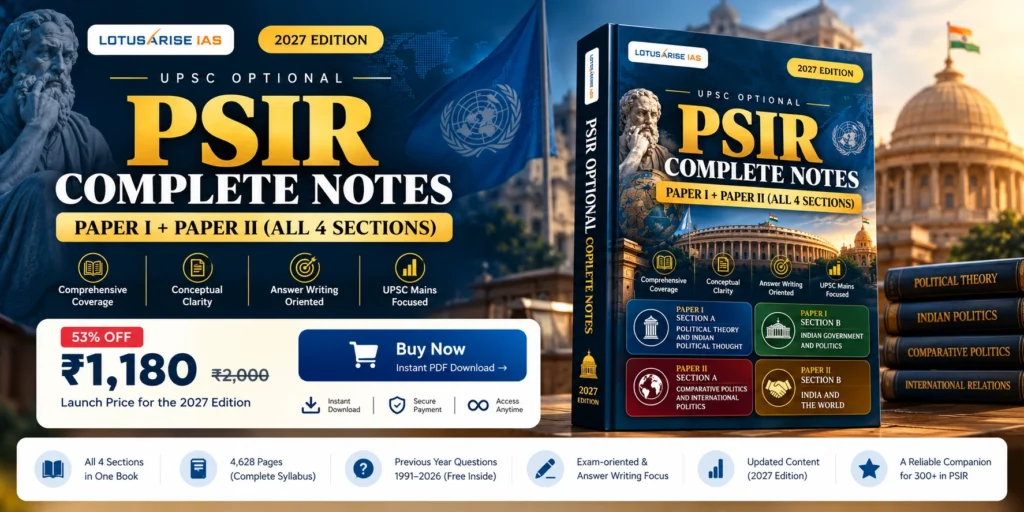
Instead of forcing candidates to synthesize Gauba, Heywood, and Malone manually, LotusArise Reference Notes (~1,400 pages) synthesize every standard academic treatise into formal, high-register prose. Every micro-topic contains ready-to-write conceptual definitions, counter-critiques, and dedicated “Thinkers to Name” matrices.
Crucially, to eliminate book fatigue and pre-exam panic, LotusArise pairs these reference guides with the 5 Modular Revision Booklets (~643 pages total):
- Booklet 1: Political Theory & Thinkers (142 pages) — complete scholar tables and 20-marker frames.
- Booklet 2: Indian Government & Politics (138 pages) — contemporary institutional debates and judicial case laws.
- Booklet 3: Comparative Politics & IR Theory (126 pages) — core dialectics and theoretical paradigms.
- Booklet 4: India and the World (135 pages) — cutting-edge 2026/2027 geopolitical doctrines and bilateral matrices.
- Booklet 5: Master PYQ Frameworks (102 pages) — high-yield answer skeletons for all recurring themes from 1991–2026 PSIR PYQs.
With this architecture, the dilemma of Are Shubhra Ranjan notes enough for PSIR disappears entirely. You get the academic authority of standard textbooks without reading 3,500 pages, and the revision agility of concise booklets without sacrificing marks.
6. Final Verdict: The Winning 300+ Study Blueprint
If you are deciding your study strategy for UPSC Mains 2026/2027, here is the definitive, actionable roadmap:
- If you rely ONLY on Shubhra Ranjan notes: Expect a score ceiling around 240–255 marks due to evaluation template fatigue and generic classroom phrasing.
- If you attempt to read the entire standard booklist: You risk severe book fatigue, revision breakdown, and entering the exam hall without solid retention.
- The Smart 300+ Strategy: Choose a single integrated source. Use LotusArise PSIR Notes as your primary reference engine for conceptual depth, and rely on the 5 Modular Revision Booklets for rapid 72-hour pre-exam revision.
End the Dilemma Between Notes and Books
Stop wasting hundreds of study hours compiling notes from 10 different textbooks. Experience the complete single-source ecosystem with curated academic prose, contemporary IR frameworks, and ready-to-write scholar matrices.