Q. With reference to Ocean Mean Temperature (OMT), which of the following statements is/are correct?
- OMT is measured up to a depth of 26°C isotherm which is 129 meters in the southwestern Indian Ocean during January — March.
- OMT collected during January – March can be used in assessing whether the amount of rainfall in monsoon will be less or more than a certain long-term mean.
Select the correct answer using the code given below:
- 1 only
- 2 only
- Both 1 and 2
- Neither 1 nor 2
Answer: (b) 2 only
Notes:
- Ocean heat content (OHC) and Ocean Mean Temperature (OMT) are important climatic parameters required for atmospheric and oceanic studies like cyclone and monsoon predictions and ocean heat transport estimations.
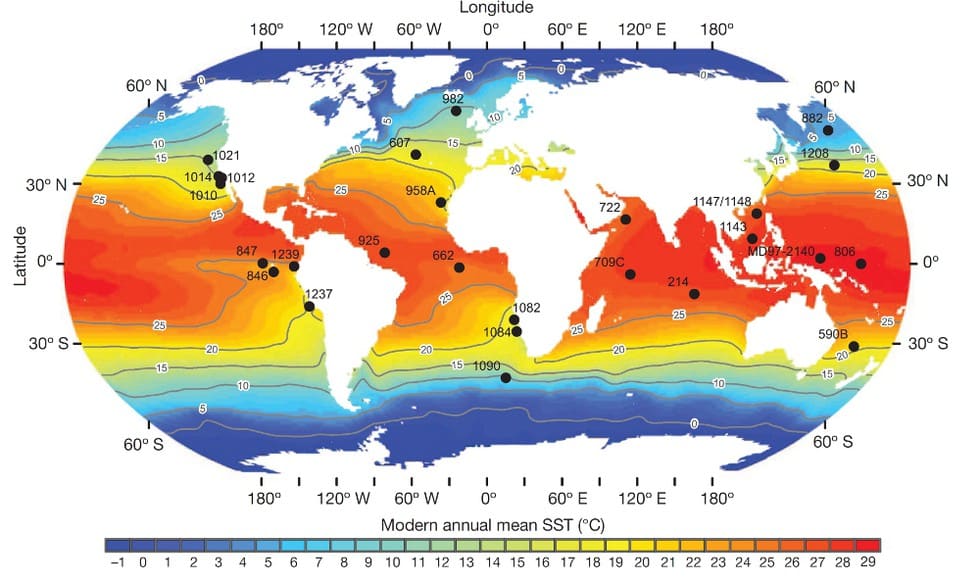
- Sea surface temperature (SST) is routinely used for predicting whether the total amount of rainfall that India receives during the monsoon season will be less or more than the long-term mean of 887.5 mm.
- Now, scientists from Pune’s Indian Institute of Tropical Meteorology (IITM) find that ocean means temperature (OMT) that has a better ability to predict this than the sea surface temperature.
- Compared with SST which has a 60% success rate of predicting the Indian summer monsoon, OMT has an 80% success rate.
- The SST is restricted to a few millimeters of the top ocean layer and is largely influenced by strong winds, evaporation, or thick clouds.
- In contrast, OMT, which is measured up to a depth of 26 degrees isotherm, is more stable and consistent, and the spatial spread is also less.
- The 26 degrees isotherm is seen at depths varying from 50–100 meters.
- During January–March, the mean 26 degrees C isotherm depth in the Southwestern Indian Ocean is 59 meters.